Analysing the Dark Side of Charismatic Leadership in Organisations
VerifiedAdded on 2023/06/04
|8
|2145
|79
Essay
AI Summary
This essay critically examines the dark side of charismatic leadership, exploring how traits like unethical behaviour and abuse of power can negatively impact followers and organizations. It references various scholars who define charismatic leaders and the potential pitfalls when their 'dark side' emerges, leading to manipulation and self-interest. The essay contrasts this with transformational leadership, which focuses on inspiring and empowering followers. It concludes that while there's no single ideal leadership style, leaders should prioritize the well-being of their followers and adapt their approach based on their expertise, rather than seeking personal gain. Desklib provides access to similar essays and resources for students.
Running head: ORGANISATIONAL BEHAVIOUR
ORGANISATIONAL BEHAVIOUR
Name of the student
Name of the University
Author Note
ORGANISATIONAL BEHAVIOUR
Name of the student
Name of the University
Author Note

Paraphrase This Document
Need a fresh take? Get an instant paraphrase of this document with our AI Paraphraser
1
ORGANISATIONAL BEHAVIOUR
Leadership is the act through which an individual leads a group of people or an
organisation. A leader is a person who has ethical and moral values and the ability to lead a
group of people towards a set goal and shows them the way to achieve the goal. There are
several leadership styles which are based on the characteristics and the values that one has.
Every leader has different styles of leading and this where the leadership styles come from
(Silva, 2016). The different kinds of leadership styles are transformational leadership, servant
leadership, transactional leadership, laissez-faire leadership, autocratic leadership,
bureaucratic leadership, democratic leadership and charismatic leadership. Just like the good
qualities that every leader possesses, there are dark sides to them as well. This essay will
critically discuss the dark side of charismatic leaders and derive if there is any leadership
style which is ideal for every individual.
Shamir, Arthur and House (2018) states charismatic leaders as individuals who hold
charisma in their personality and are able to influence the people and lead them with his
power of attraction and the effect that they have on the people with their style of speech and
convincing power. Graham, Ziegert and Capitano (2015) observe that the charismatic
elements of this kind of leadership style to give a clear sense of direction and purpose and a
proper vision to the followers so that they are able to go on a fixed path towards the
achievement of their goals. The charismatic nature that the leader incorporates in this
leadership style motivates the followers to work harder for the fulfilment of their goals and to
provide better results. Bell (2013) further states that the followers are influenced by the
charismatic leader due to the knowledge that he possesses, his expertise in the field that he is
leading in and the control that he holds over the situation. Moreover, communication is a
major attribute of any leadership style. This is why a charismatic leader should be able to
effectively communicate with his followers and not just give out information. The leader
should be able to understand the characters and habits of his followers so that it becomes
ORGANISATIONAL BEHAVIOUR
Leadership is the act through which an individual leads a group of people or an
organisation. A leader is a person who has ethical and moral values and the ability to lead a
group of people towards a set goal and shows them the way to achieve the goal. There are
several leadership styles which are based on the characteristics and the values that one has.
Every leader has different styles of leading and this where the leadership styles come from
(Silva, 2016). The different kinds of leadership styles are transformational leadership, servant
leadership, transactional leadership, laissez-faire leadership, autocratic leadership,
bureaucratic leadership, democratic leadership and charismatic leadership. Just like the good
qualities that every leader possesses, there are dark sides to them as well. This essay will
critically discuss the dark side of charismatic leaders and derive if there is any leadership
style which is ideal for every individual.
Shamir, Arthur and House (2018) states charismatic leaders as individuals who hold
charisma in their personality and are able to influence the people and lead them with his
power of attraction and the effect that they have on the people with their style of speech and
convincing power. Graham, Ziegert and Capitano (2015) observe that the charismatic
elements of this kind of leadership style to give a clear sense of direction and purpose and a
proper vision to the followers so that they are able to go on a fixed path towards the
achievement of their goals. The charismatic nature that the leader incorporates in this
leadership style motivates the followers to work harder for the fulfilment of their goals and to
provide better results. Bell (2013) further states that the followers are influenced by the
charismatic leader due to the knowledge that he possesses, his expertise in the field that he is
leading in and the control that he holds over the situation. Moreover, communication is a
major attribute of any leadership style. This is why a charismatic leader should be able to
effectively communicate with his followers and not just give out information. The leader
should be able to understand the characters and habits of his followers so that it becomes
2
ORGANISATIONAL BEHAVIOUR
easier for him to lead the group. Charismatic leaders are the best in giving public speeches
and connecting with the crowd and motivating them in any situation. They are able to deliver
any message in the best way and excite the crowd with the importance of the message. They
are able the understand every situation in a much deeper way which helps these leaders to
better lead the group and also help them solve any issues that might be faced by the group.
Antonakis and Day (2017) further proposed that charismatic leaders can help to make
changes in the society and they are the ones who have the capability to emotionally appeal to
the crowd and have them follow him to fulfil the mission of the leader.
However, charismatic leaders also have a dark side which comes into being when they
are most vulnerable. Even though these leaders are able to attract a large group of the crowd
to themselves, there are several instances where the leader fail to do so. To understand this it
is first important to understand the concept of the dark side. Kaiser, LeBreton and Hogan
(2015) define the characteristics of the dark side as being dysfunctional, counterproductive
and subclinical. These characteristics can prove to be a major defect for the personality of an
individual. The dark side is defined in this research as the personality that is portrayed by an
individual when they are tired, stresses or not worried about the way that they are being
perceived by other people. According to Karakitapoğlu-Aygün and Gumusluoglu (2013), the
dark side of charismatic leadership style will give rise to traits such as unethical behaviours,
injustice, abuse of power and others. These traits do not allow the followers from realising
their goal and hence prevents them from finding ways to achieve them. This research further
divulges into the concept that the dark side of leadership can lead to the downfall of the
organisation and the followers since the leader would not be able to lead the followers in the
right direction and supervise them in their actions. The behaviour that is portrayed by the
leaders during this time will not be in the interest of the followers or the organisation but their
ORGANISATIONAL BEHAVIOUR
easier for him to lead the group. Charismatic leaders are the best in giving public speeches
and connecting with the crowd and motivating them in any situation. They are able to deliver
any message in the best way and excite the crowd with the importance of the message. They
are able the understand every situation in a much deeper way which helps these leaders to
better lead the group and also help them solve any issues that might be faced by the group.
Antonakis and Day (2017) further proposed that charismatic leaders can help to make
changes in the society and they are the ones who have the capability to emotionally appeal to
the crowd and have them follow him to fulfil the mission of the leader.
However, charismatic leaders also have a dark side which comes into being when they
are most vulnerable. Even though these leaders are able to attract a large group of the crowd
to themselves, there are several instances where the leader fail to do so. To understand this it
is first important to understand the concept of the dark side. Kaiser, LeBreton and Hogan
(2015) define the characteristics of the dark side as being dysfunctional, counterproductive
and subclinical. These characteristics can prove to be a major defect for the personality of an
individual. The dark side is defined in this research as the personality that is portrayed by an
individual when they are tired, stresses or not worried about the way that they are being
perceived by other people. According to Karakitapoğlu-Aygün and Gumusluoglu (2013), the
dark side of charismatic leadership style will give rise to traits such as unethical behaviours,
injustice, abuse of power and others. These traits do not allow the followers from realising
their goal and hence prevents them from finding ways to achieve them. This research further
divulges into the concept that the dark side of leadership can lead to the downfall of the
organisation and the followers since the leader would not be able to lead the followers in the
right direction and supervise them in their actions. The behaviour that is portrayed by the
leaders during this time will not be in the interest of the followers or the organisation but their
⊘ This is a preview!⊘
Do you want full access?
Subscribe today to unlock all pages.

Trusted by 1+ million students worldwide
3
ORGANISATIONAL BEHAVIOUR
own which is not the real trait of a charismatic leader since their first priority should always
be the well-being of the followers and the organisation.
Westerlaken and Woods (2013) further state that charismatic leaders while being
dominated by their dark side show signs of aggression, threat, exploitation and punishment so
that they can manipulate the followers into working for his personal gain. They do not portray
the usual characteristics of helpfulness and loyalty towards the followers and no longer hold
the charisma that they usually have. The dark side prevents them from understanding the
issues and wants of the followers and he longer is able to provide them with a proper
direction through which they can fulfil their goals. As stated by Fioravante (2013) the dark
side of charismatic leader are more attracted to abusing and controlling the situation that
exhibits moral reasoning. The leader does not lead the followers by communicating with
them, he rather rules autocratically. He fails to see the positiveness of the future that helps the
followers and him to become successful and things only about the benefits that he is going to
derive from the situation. Due to the poor channels of communication that is present between
the followers and the leader, the leader is not able to establish an organisation which is
successful and supported by the followers. This is not the usual kind of scenario that is
expected from a charismatic leader whose main attribute is to ensure that proper
communication is established between the leader and the followers or the organisation so that
they are able to create an environment which is in support of the followers and the
organisation. Schyns and Schilling (2013) acknowledge that the dark side of a charismatic
leader is developed voluntarily and that this is done to cause harm to the followers in both
physical and verbal way. This kind of action is done only in self-interest and the goodness of
the followers are not considered by the leader. This kind of action is mostly focused on the
followers than the organisation itself and even though they might cause harm to the
ORGANISATIONAL BEHAVIOUR
own which is not the real trait of a charismatic leader since their first priority should always
be the well-being of the followers and the organisation.
Westerlaken and Woods (2013) further state that charismatic leaders while being
dominated by their dark side show signs of aggression, threat, exploitation and punishment so
that they can manipulate the followers into working for his personal gain. They do not portray
the usual characteristics of helpfulness and loyalty towards the followers and no longer hold
the charisma that they usually have. The dark side prevents them from understanding the
issues and wants of the followers and he longer is able to provide them with a proper
direction through which they can fulfil their goals. As stated by Fioravante (2013) the dark
side of charismatic leader are more attracted to abusing and controlling the situation that
exhibits moral reasoning. The leader does not lead the followers by communicating with
them, he rather rules autocratically. He fails to see the positiveness of the future that helps the
followers and him to become successful and things only about the benefits that he is going to
derive from the situation. Due to the poor channels of communication that is present between
the followers and the leader, the leader is not able to establish an organisation which is
successful and supported by the followers. This is not the usual kind of scenario that is
expected from a charismatic leader whose main attribute is to ensure that proper
communication is established between the leader and the followers or the organisation so that
they are able to create an environment which is in support of the followers and the
organisation. Schyns and Schilling (2013) acknowledge that the dark side of a charismatic
leader is developed voluntarily and that this is done to cause harm to the followers in both
physical and verbal way. This kind of action is done only in self-interest and the goodness of
the followers are not considered by the leader. This kind of action is mostly focused on the
followers than the organisation itself and even though they might cause harm to the
Paraphrase This Document
Need a fresh take? Get an instant paraphrase of this document with our AI Paraphraser
4
ORGANISATIONAL BEHAVIOUR
followers, these leaders might work for the betterment of the organisation as a whole in some
contexts.
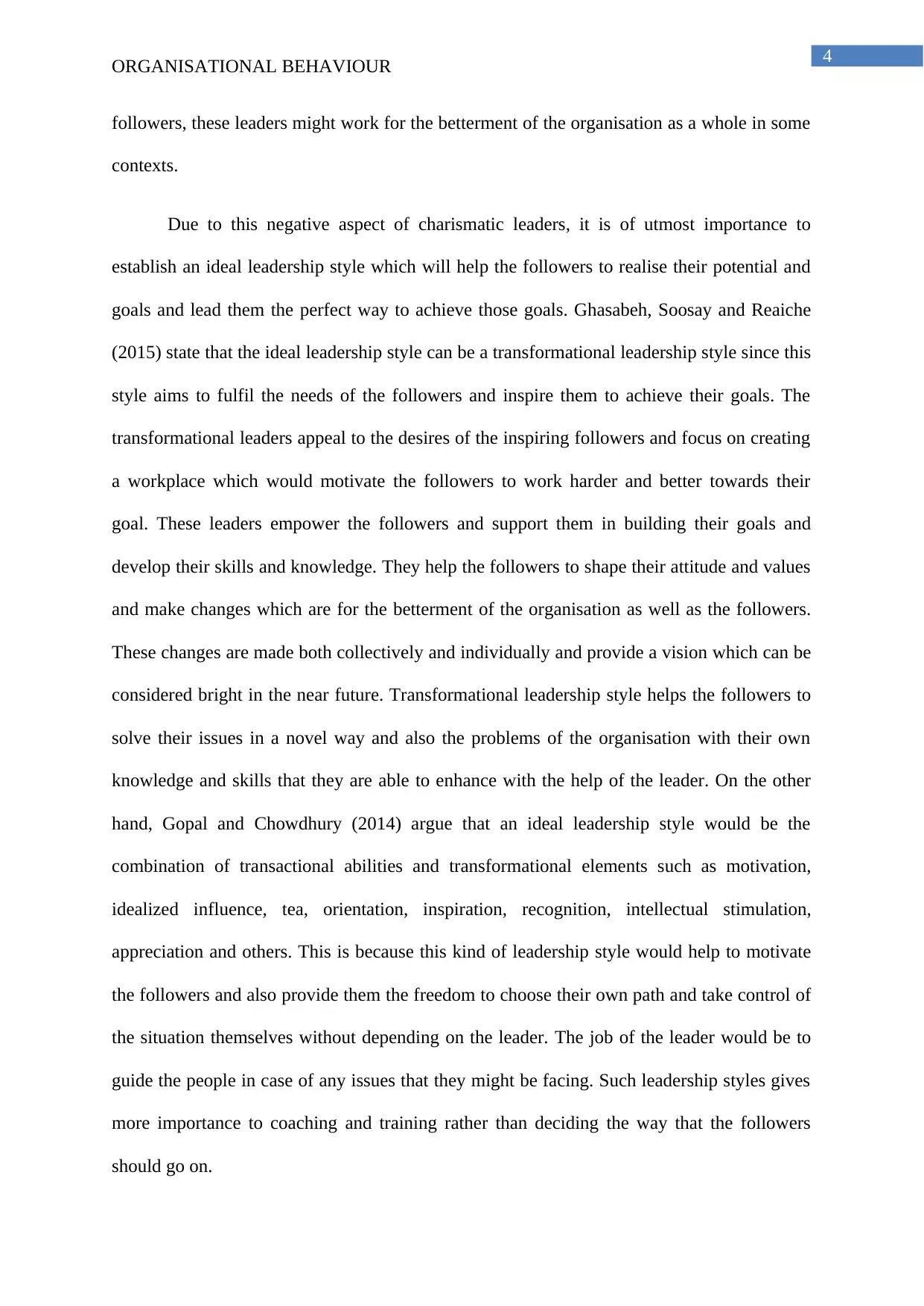
Due to this negative aspect of charismatic leaders, it is of utmost importance to
establish an ideal leadership style which will help the followers to realise their potential and
goals and lead them the perfect way to achieve those goals. Ghasabeh, Soosay and Reaiche
(2015) state that the ideal leadership style can be a transformational leadership style since this
style aims to fulfil the needs of the followers and inspire them to achieve their goals. The
transformational leaders appeal to the desires of the inspiring followers and focus on creating
a workplace which would motivate the followers to work harder and better towards their
goal. These leaders empower the followers and support them in building their goals and
develop their skills and knowledge. They help the followers to shape their attitude and values
and make changes which are for the betterment of the organisation as well as the followers.
These changes are made both collectively and individually and provide a vision which can be
considered bright in the near future. Transformational leadership style helps the followers to
solve their issues in a novel way and also the problems of the organisation with their own
knowledge and skills that they are able to enhance with the help of the leader. On the other
hand, Gopal and Chowdhury (2014) argue that an ideal leadership style would be the
combination of transactional abilities and transformational elements such as motivation,
idealized influence, tea, orientation, inspiration, recognition, intellectual stimulation,
appreciation and others. This is because this kind of leadership style would help to motivate
the followers and also provide them the freedom to choose their own path and take control of
the situation themselves without depending on the leader. The job of the leader would be to
guide the people in case of any issues that they might be facing. Such leadership styles gives
more importance to coaching and training rather than deciding the way that the followers
should go on.
ORGANISATIONAL BEHAVIOUR
followers, these leaders might work for the betterment of the organisation as a whole in some
contexts.
Due to this negative aspect of charismatic leaders, it is of utmost importance to
establish an ideal leadership style which will help the followers to realise their potential and
goals and lead them the perfect way to achieve those goals. Ghasabeh, Soosay and Reaiche
(2015) state that the ideal leadership style can be a transformational leadership style since this
style aims to fulfil the needs of the followers and inspire them to achieve their goals. The
transformational leaders appeal to the desires of the inspiring followers and focus on creating
a workplace which would motivate the followers to work harder and better towards their
goal. These leaders empower the followers and support them in building their goals and
develop their skills and knowledge. They help the followers to shape their attitude and values
and make changes which are for the betterment of the organisation as well as the followers.
These changes are made both collectively and individually and provide a vision which can be
considered bright in the near future. Transformational leadership style helps the followers to
solve their issues in a novel way and also the problems of the organisation with their own
knowledge and skills that they are able to enhance with the help of the leader. On the other
hand, Gopal and Chowdhury (2014) argue that an ideal leadership style would be the
combination of transactional abilities and transformational elements such as motivation,
idealized influence, tea, orientation, inspiration, recognition, intellectual stimulation,
appreciation and others. This is because this kind of leadership style would help to motivate
the followers and also provide them the freedom to choose their own path and take control of
the situation themselves without depending on the leader. The job of the leader would be to
guide the people in case of any issues that they might be facing. Such leadership styles gives
more importance to coaching and training rather than deciding the way that the followers
should go on.

5
ORGANISATIONAL BEHAVIOUR
Hence, it can be derived from the above analysis that even charismatic leaders have a
dark side which creates a negative impact on the future and the achievement of the followers.
However, in searching for an ideal style of leadership which will be helpful for the followers,
it is not possible to decide on any one style since each style has their own pros and cons.
Therefore, it is most important for a leader to follow their own style based on their expertise
and work towards helping their followers rather than thinking about their personal gain.
ORGANISATIONAL BEHAVIOUR
Hence, it can be derived from the above analysis that even charismatic leaders have a
dark side which creates a negative impact on the future and the achievement of the followers.
However, in searching for an ideal style of leadership which will be helpful for the followers,
it is not possible to decide on any one style since each style has their own pros and cons.
Therefore, it is most important for a leader to follow their own style based on their expertise
and work towards helping their followers rather than thinking about their personal gain.
⊘ This is a preview!⊘
Do you want full access?
Subscribe today to unlock all pages.
Trusted by 1+ million students worldwide
6
ORGANISATIONAL BEHAVIOUR
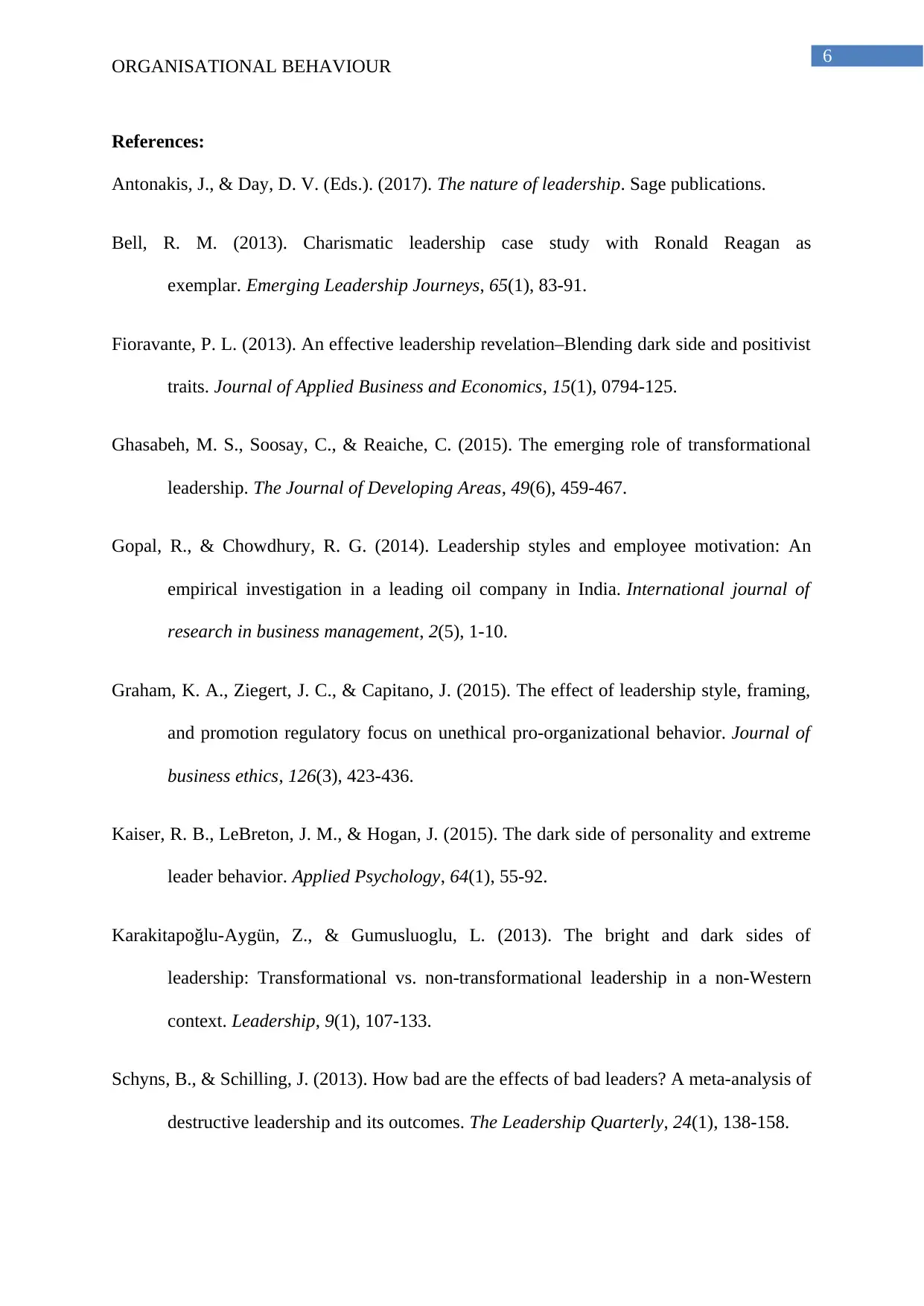
References:
Antonakis, J., & Day, D. V. (Eds.). (2017). The nature of leadership. Sage publications.
Bell, R. M. (2013). Charismatic leadership case study with Ronald Reagan as
exemplar. Emerging Leadership Journeys, 65(1), 83-91.
Fioravante, P. L. (2013). An effective leadership revelation–Blending dark side and positivist
traits. Journal of Applied Business and Economics, 15(1), 0794-125.
Ghasabeh, M. S., Soosay, C., & Reaiche, C. (2015). The emerging role of transformational
leadership. The Journal of Developing Areas, 49(6), 459-467.
Gopal, R., & Chowdhury, R. G. (2014). Leadership styles and employee motivation: An
empirical investigation in a leading oil company in India. International journal of
research in business management, 2(5), 1-10.
Graham, K. A., Ziegert, J. C., & Capitano, J. (2015). The effect of leadership style, framing,
and promotion regulatory focus on unethical pro-organizational behavior. Journal of
business ethics, 126(3), 423-436.
Kaiser, R. B., LeBreton, J. M., & Hogan, J. (2015). The dark side of personality and extreme
leader behavior. Applied Psychology, 64(1), 55-92.
Karakitapoğlu-Aygün, Z., & Gumusluoglu, L. (2013). The bright and dark sides of
leadership: Transformational vs. non-transformational leadership in a non-Western
context. Leadership, 9(1), 107-133.
Schyns, B., & Schilling, J. (2013). How bad are the effects of bad leaders? A meta-analysis of
destructive leadership and its outcomes. The Leadership Quarterly, 24(1), 138-158.
ORGANISATIONAL BEHAVIOUR
References:
Antonakis, J., & Day, D. V. (Eds.). (2017). The nature of leadership. Sage publications.
Bell, R. M. (2013). Charismatic leadership case study with Ronald Reagan as
exemplar. Emerging Leadership Journeys, 65(1), 83-91.
Fioravante, P. L. (2013). An effective leadership revelation–Blending dark side and positivist
traits. Journal of Applied Business and Economics, 15(1), 0794-125.
Ghasabeh, M. S., Soosay, C., & Reaiche, C. (2015). The emerging role of transformational
leadership. The Journal of Developing Areas, 49(6), 459-467.
Gopal, R., & Chowdhury, R. G. (2014). Leadership styles and employee motivation: An
empirical investigation in a leading oil company in India. International journal of
research in business management, 2(5), 1-10.
Graham, K. A., Ziegert, J. C., & Capitano, J. (2015). The effect of leadership style, framing,
and promotion regulatory focus on unethical pro-organizational behavior. Journal of
business ethics, 126(3), 423-436.
Kaiser, R. B., LeBreton, J. M., & Hogan, J. (2015). The dark side of personality and extreme
leader behavior. Applied Psychology, 64(1), 55-92.
Karakitapoğlu-Aygün, Z., & Gumusluoglu, L. (2013). The bright and dark sides of
leadership: Transformational vs. non-transformational leadership in a non-Western
context. Leadership, 9(1), 107-133.
Schyns, B., & Schilling, J. (2013). How bad are the effects of bad leaders? A meta-analysis of
destructive leadership and its outcomes. The Leadership Quarterly, 24(1), 138-158.
Paraphrase This Document
Need a fresh take? Get an instant paraphrase of this document with our AI Paraphraser
7
ORGANISATIONAL BEHAVIOUR
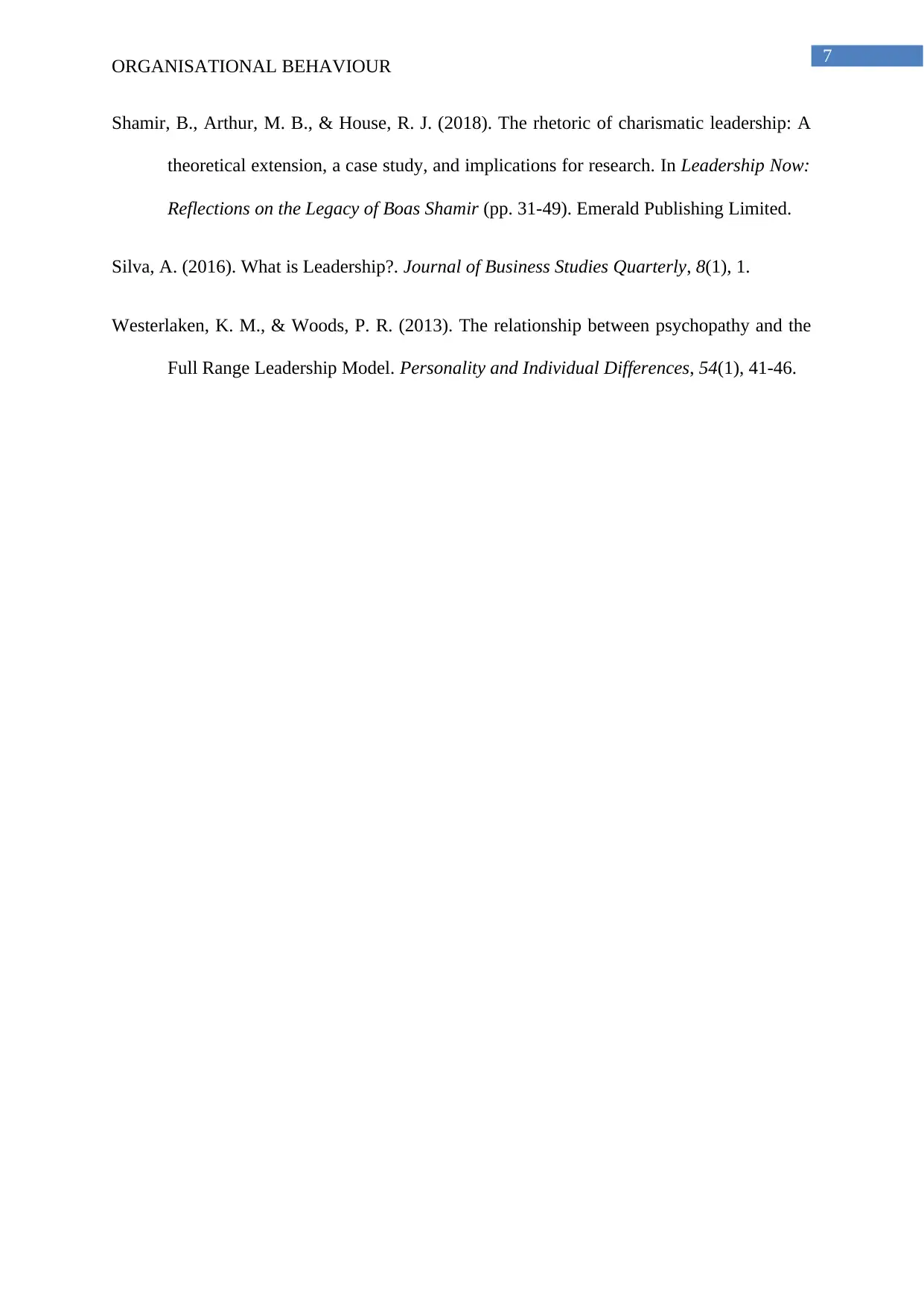
Shamir, B., Arthur, M. B., & House, R. J. (2018). The rhetoric of charismatic leadership: A
theoretical extension, a case study, and implications for research. In Leadership Now:
Reflections on the Legacy of Boas Shamir (pp. 31-49). Emerald Publishing Limited.
Silva, A. (2016). What is Leadership?. Journal of Business Studies Quarterly, 8(1), 1.
Westerlaken, K. M., & Woods, P. R. (2013). The relationship between psychopathy and the
Full Range Leadership Model. Personality and Individual Differences, 54(1), 41-46.
ORGANISATIONAL BEHAVIOUR
Shamir, B., Arthur, M. B., & House, R. J. (2018). The rhetoric of charismatic leadership: A
theoretical extension, a case study, and implications for research. In Leadership Now:
Reflections on the Legacy of Boas Shamir (pp. 31-49). Emerald Publishing Limited.
Silva, A. (2016). What is Leadership?. Journal of Business Studies Quarterly, 8(1), 1.
Westerlaken, K. M., & Woods, P. R. (2013). The relationship between psychopathy and the
Full Range Leadership Model. Personality and Individual Differences, 54(1), 41-46.

1 out of 8


Related Documents


Your All-in-One AI-Powered Toolkit for Academic Success.
+13062052269
info@desklib.com
Available 24*7 on WhatsApp / Email
![[object Object]](/_next/static/media/star-bottom.7253800d.svg)
Unlock your academic potential
Copyright © 2020–2026 A2Z Services. All Rights Reserved. Developed and managed by ZUCOL.