Report: Current Status and Future of Chemical Industry Economics

Verified

Added on  2022/11/13

|9
|1634
|292
Report
AI Summary
This report offers a comprehensive analysis of the chemical industry's economics, examining its significant contribution to the global economy, including its impact on GDP and employment. It delves into the industry's current status, geographical distribution, technological advancements, and the substantial investments in research and development. The report also explores the future prospects of the chemical industry, considering both internal and external factors that may influence its growth, such as economic shifts in key regions and the potential for innovation. It concludes by summarizing the industry's vital role and the challenges it faces, emphasizing its importance to the world economy and its ability to innovate. The report also provides information on the industry's major players and their contributions to the global economy. The report also discusses the impact of the industry on employment and wages worldwide. Finally, the report highlights the investments in research and development, and the innovative products that have significantly contributed to the economy.
Document Page
Running head: ECONOMICS OF CHEMICAL INDUSTRIES
Economics of Chemical Industries
Name of the Student
Name of the University
Student ID
tabler-icon-diamond-filled.svg

Paraphrase This Document

Need a fresh take? Get an instant paraphrase of this document with our AI Paraphraser
Document Page
1ECONOMICS OF CHEMICAL INDUSTRIES
Executive Summary
In this report, a discussion is made on the status and future of the chemical industry.
Chemical industry is one of the most important industries in the world and it has a huge
contribution in the development of the world economy. The industry thus holds a significant
position in the world and upon the status of industry depends the flow of global economy.
The current status of the industry thus discussed in the report thoroughly along with its future
prospects and existing issues.
Document Page
2ECONOMICS OF CHEMICAL INDUSTRIES
Table of Contents
Introduction................................................................................................................................3
Discussion..................................................................................................................................3
Status of the chemical industry..............................................................................................3
Future of the chemical industry..............................................................................................5
Conclusion..................................................................................................................................6
References..................................................................................................................................7
Document Page
3ECONOMICS OF CHEMICAL INDUSTRIES
Introduction
Industries play a vital role in running an economy smoothly because all of the income
that is generated in the world comes from different kinds of service and manufacturing
industry like hotel industry, agricultural industry, automobile industry, chemical industry and
many more. In this report, only one of the industry is considered for discussion and that is
chemical industry. Chemical is one of the largest industry in the world with contribution of
$1.1 trillion to the global GDP. In the below paragraphs focus is given on the status of the
chemical industry based on the factors like technology, geographical distribution,
employment and it contribution to the economy. In the report, the discussion on future of the
industry has also been made.
Discussion
Status of the chemical industry
Chemical industry contributed about 7 percent of the world’s GDP in the year 2017
and helped to generate 120 million jobs including indirect, direct and induced employment
(Link & Scott, 2013). The concept of direct and indirect employment is general that is
workers working in the chemical companies directly are direct employees and the workers
employed in the allied sector or in the wider part of the supply chain are indirectly employed,
however, the employment generate by the demand created by the employees of the industry
are called induced employees (Botte, 2014). The estimated worth of the total impact created
by the chemical industry, its allied sector and influenced sectors is $ 5.7 trillion. Total
number of direct employees in the industry as of 2017 was 15 million. Apart from that,
around 60 million of people are involved or employed in the industry indirectly. This industry
has huge impact on the economy because every 1 unit of money generated by the industry
contributes in generation of 4.2 unit of money in the economy. The industry paid around
tabler-icon-diamond-filled.svg

Paraphrase This Document

Need a fresh take? Get an instant paraphrase of this document with our AI Paraphraser
Document Page
4ECONOMICS OF CHEMICAL INDUSTRIES
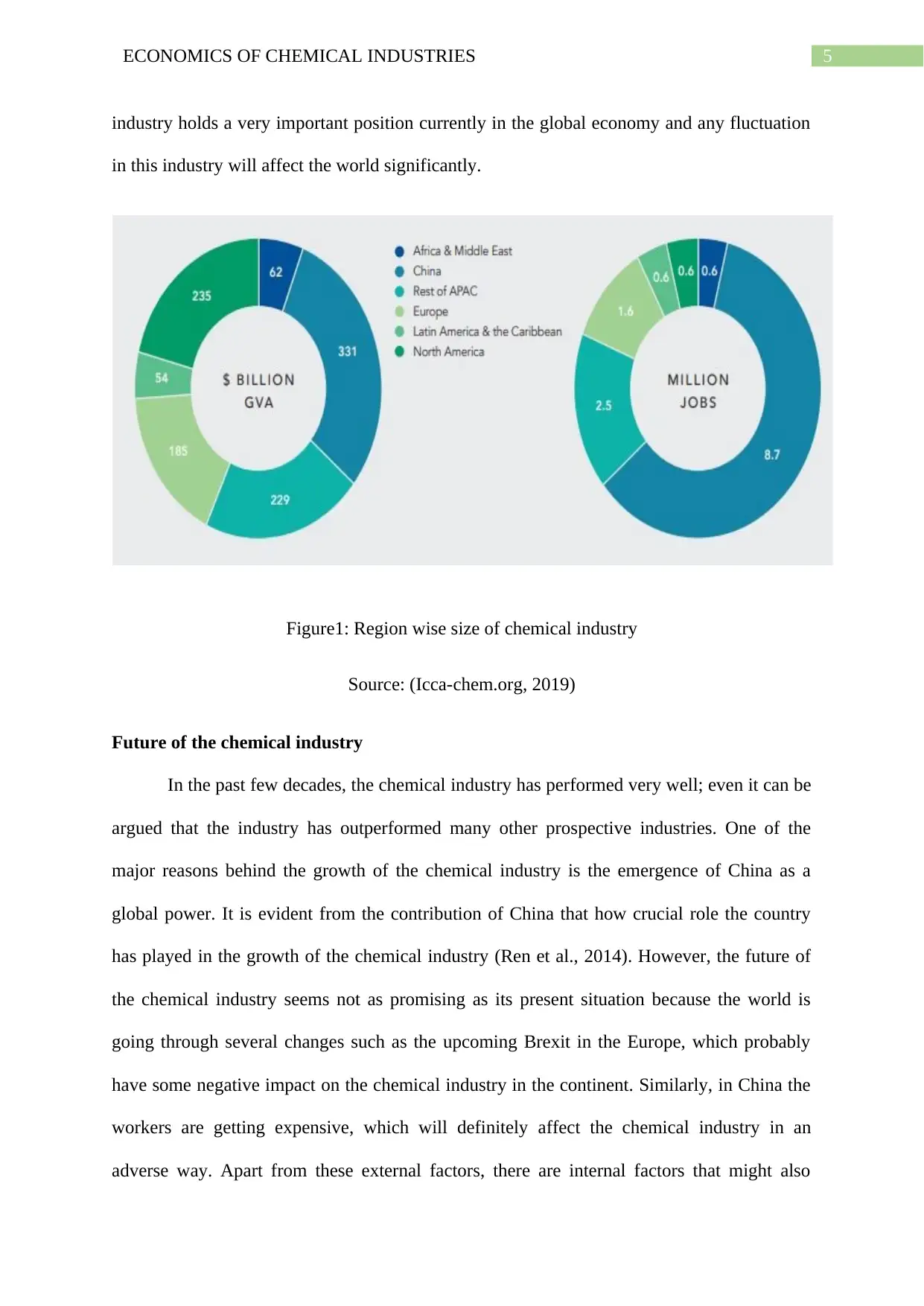
$313 billion in wages worldwide in 2017. Geographically the chemical industry can be
divided into five regions namely Europe, Asia-Pacific, North America, Latin America and the
Caribbean and Africa and Middle East. Among all the five regions, chemical industry’s
contribution in the GDP of Asia-Pacific is the highest with $2.6 trillion. Asia-Pacific holds
the record of jobs created by the chemical industry at 83 million. On the other hand, among
the five regions, the lowest contribution to GDP is in Latin America and the Caribbean at
$374 million and the lowest number of jobs generated is 5 million in Africa and Middle East
(Icca-chem.org, 2019). The contribution of chemical industry to the global economy is so
large that it equals the sum of the contribution of India, Brazil and Mexico. Of $313 billion
paid as wages to the workers of the chemical industry in 2017, $196 billion is spent under
consumer spending indicates the vastness of the market run by the contribution of the
chemical industry. The contribution of chemical industry is not limited to the money terms
only, it has contributed in terms of technology too. The industry invests a huge amount of
money in its research and development wing to innovate new chemical products that can be
applied in various useful purposes. In 2017, the chemical industry has invested $51 billion in
research and development. Of this $51 billion investment, the contribution of the US and
China was the highest with $15 billion and $12 billion respectively The investment has also
generated 1.7 million jobs and contributed $92 billion in the global GDP. However,
contribution to GDP and employment is not the ultimate benefit the world has gained from
the investment in the research and development of the chemical industry. The innovation of
synthetic nitrogen and organic LED has contributed to the economy significantly. Synthetic
nitrogen is widely used in agriculture industry and estimates state that around 50 percent of
the global population depends on it. On the other, hand OLED is used as display component
in television and mobile devices (Takahasi et al., 2014). The top five spenders in R&D are
China, the United States, Japan, Germany and Korea (Lager et al., 2014). Therefore, chemical
Document Page
5ECONOMICS OF CHEMICAL INDUSTRIES
industry holds a very important position currently in the global economy and any fluctuation
in this industry will affect the world significantly.
Figure1: Region wise size of chemical industry
Source: (Icca-chem.org, 2019)
Future of the chemical industry
In the past few decades, the chemical industry has performed very well; even it can be
argued that the industry has outperformed many other prospective industries. One of the
major reasons behind the growth of the chemical industry is the emergence of China as a
global power. It is evident from the contribution of China that how crucial role the country
has played in the growth of the chemical industry (Ren et al., 2014). However, the future of
the chemical industry seems not as promising as its present situation because the world is
going through several changes such as the upcoming Brexit in the Europe, which probably
have some negative impact on the chemical industry in the continent. Similarly, in China the
workers are getting expensive, which will definitely affect the chemical industry in an
adverse way. Apart from these external factors, there are internal factors that might also
Document Page
6ECONOMICS OF CHEMICAL INDUSTRIES
affect the industry such as inability to innovate new chemical products (Tidd & Bessant,
2018). In the last few years, the industry has not come up with innovative product that has
contributed to the global economy significantly. Hence, the future of the chemical industry
seems sceptical, as the growth rate is around 2 percent, which lower than expected growth of
3.6 percent (McKinsey & Company, 2017). However, the chemical industry in Indian is
growing and seems it will perform well in the future.
Conclusion
The above discussion regarding global chemical industry leads to the conclusion that
the industry is one of the largest industry in world that generates huge income and provides
jobs to millions of people. The world depends on the industry for around 7 percent of its
GDP. It is one of the industry where a huge amount of fund is invested in research and
development and ground-breaking innovation is done that changes the face of the world.
However, the future of this industry seems cloudy due to some external and internal factors
such as Brexit and recent inability to innovate new products respectively.
tabler-icon-diamond-filled.svg

Paraphrase This Document

Need a fresh take? Get an instant paraphrase of this document with our AI Paraphraser
Document Page
7ECONOMICS OF CHEMICAL INDUSTRIES
References
Botte, G. G. (2014). Electrochemical manufacturing in the chemical industry. The
Electrochemical Society Interface, 23(3), 49-55.
Icca-chem.org. (2019). Retrieved 21 July 2019, from https://www.icca-chem.org/wp-
content/uploads/2019/03/ICCA_EconomicAnalysis_Report_030819.pdf
Lager, T., Rennard, J. P., Kinkel, S., Kleine, O., & Diekmann, J. (2014). Interlinkages and
paths of German factories' manufacturing and R&D strategies in China. Journal of
Manufacturing Technology Management.
Link, A. N., & Scott, J. T. (2013). Public R&D subsidies, outside private support, and
employment growth. Economics of Innovation and New Technology, 22(6), 537-550.
McKinsey & Company. (2017). Chemicals 2025: Will the industry be dancing to a very
different tune?. Retrieved 21 July 2019, from
https://www.mckinsey.com/industries/chemicals/our-insights/chemicals-2025-will-
the-industry-be-dancing-to-a-very-different-tune
Ren, W., Xue, B., Geng, Y., Sun, L., Ma, Z., Zhang, Y., ... & Zhang, L. (2014). Inventorying
heavy metal pollution in redeveloped brownfield and its policy contribution: Case
study from Tiexi District, Shenyang, China. Land Use Policy, 38, 138-146.
Takahashi, T., Shizu, K., Yasuda, T., Togashi, K., & Adachi, C. (2014). Donor–acceptor-
structured 1, 4-diazatriphenylene derivatives exhibiting thermally activated delayed
fluorescence: design and synthesis, photophysical properties and OLED
characteristics. Science and technology of advanced materials, 15(3), 034202.
Tidd, J., & Bessant, J. R. (2018). Managing innovation: integrating technological, market
and organizational change. John Wiley & Sons.
Document Page
8ECONOMICS OF CHEMICAL INDUSTRIES
chevron_up_icon
1 out of 9
circle_padding
hide_on_mobile
zoom_out_icon
[object Object]