ACCT6006: Auditing and Financial Analysis of Dick Smith's Collapse
VerifiedAdded on 2021/11/10
|11
|3213
|30
Report
AI Summary
This report provides a comprehensive analysis of the Dick Smith collapse, examining the various factors that contributed to its failure. It begins with a brief history of the company and identifies the primary reasons for its downfall, including excessive inventory buildup and accounting irregularities. The report then delves into the accusations against the directors for breaching Australian Accounting Standards, particularly focusing on the use of fraudulent accounting methods like 'Real Activities Management.' It further explores the signs that auditors should have considered when identifying the going concern problem and analyzes the 2014/15 annual report to provide evidence that the company might not be a going concern. The report also discusses the reasons behind Deloitte's unmodified audit opinion and the auditor's legal liability in this context. The analysis covers key issues like inventory valuation, cash flow problems, and the role of management in the company's failure. The report concludes by highlighting the importance of ethical accounting practices and the responsibilities of auditors in ensuring the accuracy and reliability of financial statements.
1
ACCT6006 Auditing
ACCT6006 Auditing

Paraphrase This Document
Need a fresh take? Get an instant paraphrase of this document with our AI Paraphraser
2
Contents
Introduction......................................................................................................................................3
Part 1: Brief History of Dick Smith and reasons that causes its failure..........................................3
Part 2: Accusation against the Directors of Dick Smith for Breach of Australian Accounting
Standards..........................................................................................................................................4
Part 3: Signs to be taken into account by Auditors for Identifying Going Concern Problem.........5
Part 4: Analyse of Dick Smith annual report 2014/15 to provide the evidence that company
might not be going concern.............................................................................................................7
Part 5: Reason behind giving the unmodified audit opinion by Deloitte for the financial year
ended 30June, 2015.........................................................................................................................8
Part 6: Auditor’s Legal Liability in the case of Dick Smith Electronics Ltd for providing answer
to an unmodified audit opinion for the financial year 30 June 2015...............................................9
Conclusion.......................................................................................................................................9
References......................................................................................................................................11
Contents
Introduction......................................................................................................................................3
Part 1: Brief History of Dick Smith and reasons that causes its failure..........................................3
Part 2: Accusation against the Directors of Dick Smith for Breach of Australian Accounting
Standards..........................................................................................................................................4
Part 3: Signs to be taken into account by Auditors for Identifying Going Concern Problem.........5
Part 4: Analyse of Dick Smith annual report 2014/15 to provide the evidence that company
might not be going concern.............................................................................................................7
Part 5: Reason behind giving the unmodified audit opinion by Deloitte for the financial year
ended 30June, 2015.........................................................................................................................8
Part 6: Auditor’s Legal Liability in the case of Dick Smith Electronics Ltd for providing answer
to an unmodified audit opinion for the financial year 30 June 2015...............................................9
Conclusion.......................................................................................................................................9
References......................................................................................................................................11
3
Introduction
Dick Smith was the renowned entity of Australia that collapsed in year 2016 due to
unethical accounting practices. There are many issues that have been found in financial report of
the company and same has been reported by liquidator in his report. Some of the values of
financial elements of the company have been wrongly reported in annual report that causes
undue increase in profits but it was not actually earned. Similarly there are many accounting
issues that will discussed in this essay and all these issues were the reason behind the failure of
Dick Smith.
The purpose of this essay is to examine the financial reports and relevant news articles
for identifying the probable causes and reasons for the collapse of the Dick Smith in very short
span of time. The essay will specifically highlight the accounting standards that have been
breached by the director of the company. Identification of signs that indicate that auditors
provided in the annual report that there was going concern problem of Dick Smith. This essay
also reports the evidences from the annual report for depicting the fraudulent accounting
practices followed by Dick Smith. Further there will be discussion on reasons that has caused
auditors to give unmodified audit opinion on the financial statements ended 30 June, 2015.
Lastly, there will be discussion on auditor’s legal liability for not providing the modified opinion
on the financial statements of Dick Smith for year ended 30June, 2015.
Part 1: Brief History of Dick Smith and reasons that causes its failure
Dick Smith Holdings was the subsidiary of Woolworth and it is known as Dick Smith
Electronics or DSE. Dick Smith had large number of electronic retails stores that sold wide
variety of electronic goods for domestic as well as industrial purpose. Dick Smith was formerly
listed on Australian Stock Exchange and it has successfully expanded its business in New
Zealand as well as many parts of Australia. Dick Smith Electronics has been founded by Dick
Smith in year 1968 and since then company has grown rapidly and Woolworth has purchased its
100% shares that makes the Dick Smith, subsidiary of Woolworth.
There are many reasons that have caused the failure of Dick Smith in year 2016 but the
exact reason was not clearly known as it was management act which was not easy to identify.
Introduction
Dick Smith was the renowned entity of Australia that collapsed in year 2016 due to
unethical accounting practices. There are many issues that have been found in financial report of
the company and same has been reported by liquidator in his report. Some of the values of
financial elements of the company have been wrongly reported in annual report that causes
undue increase in profits but it was not actually earned. Similarly there are many accounting
issues that will discussed in this essay and all these issues were the reason behind the failure of
Dick Smith.
The purpose of this essay is to examine the financial reports and relevant news articles
for identifying the probable causes and reasons for the collapse of the Dick Smith in very short
span of time. The essay will specifically highlight the accounting standards that have been
breached by the director of the company. Identification of signs that indicate that auditors
provided in the annual report that there was going concern problem of Dick Smith. This essay
also reports the evidences from the annual report for depicting the fraudulent accounting
practices followed by Dick Smith. Further there will be discussion on reasons that has caused
auditors to give unmodified audit opinion on the financial statements ended 30 June, 2015.
Lastly, there will be discussion on auditor’s legal liability for not providing the modified opinion
on the financial statements of Dick Smith for year ended 30June, 2015.
Part 1: Brief History of Dick Smith and reasons that causes its failure
Dick Smith Holdings was the subsidiary of Woolworth and it is known as Dick Smith
Electronics or DSE. Dick Smith had large number of electronic retails stores that sold wide
variety of electronic goods for domestic as well as industrial purpose. Dick Smith was formerly
listed on Australian Stock Exchange and it has successfully expanded its business in New
Zealand as well as many parts of Australia. Dick Smith Electronics has been founded by Dick
Smith in year 1968 and since then company has grown rapidly and Woolworth has purchased its
100% shares that makes the Dick Smith, subsidiary of Woolworth.
There are many reasons that have caused the failure of Dick Smith in year 2016 but the
exact reason was not clearly known as it was management act which was not easy to identify.
⊘ This is a preview!⊘
Do you want full access?
Subscribe today to unlock all pages.

Trusted by 1+ million students worldwide
4
The Administrator appointed in case of Dick Smith has successfully found the possible causes of
collapse of Dick Smith and has provided in its report. The main reason behind the collapse of
Dick Smith is excessive buying to build up the stock of inventory for the purpose of expansion.
In addition to inventory buildup, there were many accounting issues that were reported by the
administrator in his report. In last few months of collapse of the Dick Smith it has been found
that company was undergoing in losses and the main reason behind this was decrease in sales
and excessive inventory (The Conversation, 2016). The decision of directors to built up the
inventory and get rebates on the bulk purchases has forced to maintain inventory at very low cost
in their accounts and also the non availability cash surplus also affected liquidity position of the
company. During the last few month of collapse of Dick Smith it was found that company has
failed to pay its liabilities and also struggling with the working capital.
Another big mistake that has been committed was fraud performed by Anchorage
Capital. Anchorage Capital was involved accounting fraud through creating the hype in the stock
market and making millions of dollars through sales of shares at very high price. A year back of
Dick Smith collapse it was found that books of accounts has been manipulated and high profits
are being reported that helps in increasing the market value of shares. The increasing trend in
share price had attracted millions of potential shareholders to invest in company that raised the
value of company to $500 million. But company fails to meet the commitment made to
shareholders as revenue growth was not as expected and profits are declined and lead to losses.
This has left company with significant level of stocks and outdated products that has very low
value in the market. So the reasons like shortage of cash, accounting frauds, increase in debt and
continue losses are the main reasons behind the collapse of Dick Smith in starting of year 2016
(News.com.au, 2016).
Part 2: Accusation against the Directors of Dick Smith for Breach of Australian
Accounting Standards
Dick Smith directors are accused of adopting the use of fraudulent accounting methods
that are known within the industry as ‘Real Activities Management’. This accounting practice
involves the use of manipulation of sales figures and inventories of stock in which it purchases
excessive amount of inventory for rapid expansion of its stores and obtaining bank rebates from
The Administrator appointed in case of Dick Smith has successfully found the possible causes of
collapse of Dick Smith and has provided in its report. The main reason behind the collapse of
Dick Smith is excessive buying to build up the stock of inventory for the purpose of expansion.
In addition to inventory buildup, there were many accounting issues that were reported by the
administrator in his report. In last few months of collapse of the Dick Smith it has been found
that company was undergoing in losses and the main reason behind this was decrease in sales
and excessive inventory (The Conversation, 2016). The decision of directors to built up the
inventory and get rebates on the bulk purchases has forced to maintain inventory at very low cost
in their accounts and also the non availability cash surplus also affected liquidity position of the
company. During the last few month of collapse of Dick Smith it was found that company has
failed to pay its liabilities and also struggling with the working capital.
Another big mistake that has been committed was fraud performed by Anchorage
Capital. Anchorage Capital was involved accounting fraud through creating the hype in the stock
market and making millions of dollars through sales of shares at very high price. A year back of
Dick Smith collapse it was found that books of accounts has been manipulated and high profits
are being reported that helps in increasing the market value of shares. The increasing trend in
share price had attracted millions of potential shareholders to invest in company that raised the
value of company to $500 million. But company fails to meet the commitment made to
shareholders as revenue growth was not as expected and profits are declined and lead to losses.
This has left company with significant level of stocks and outdated products that has very low
value in the market. So the reasons like shortage of cash, accounting frauds, increase in debt and
continue losses are the main reasons behind the collapse of Dick Smith in starting of year 2016
(News.com.au, 2016).
Part 2: Accusation against the Directors of Dick Smith for Breach of Australian
Accounting Standards
Dick Smith directors are accused of adopting the use of fraudulent accounting methods
that are known within the industry as ‘Real Activities Management’. This accounting practice
involves the use of manipulation of sales figures and inventories of stock in which it purchases
excessive amount of inventory for rapid expansion of its stores and obtaining bank rebates from
Paraphrase This Document
Need a fresh take? Get an instant paraphrase of this document with our AI Paraphraser
5
its suppliers for inflation of its earnings. The strategy intends to raise the share prices of the
company and the director’s receives incentives for pursuing of excessive growth for increase in
the stock (The ugly story of Dick Smith, from float to failure, 2016). The directors are accused
for not complying effective with the Corporations Law by the use of faulty accounting practices
such as RAM (Real Activities Management). It involves structuring the financial transactions in
a manner that ultimately results in manipulating the financial information for misleading the end-
users. The activities involves mainly achieving a reduction in the expenses involved in research
and development activities, price discounts for meeting short-term earnings targets, stimulating
overproduction for generating excess inventory for reducing the cost of goods sold (Some
answers, more questions over Dick Smith failure, 2016).
The directors of the company are mainly accused for violating the various provisions of
the Corporations Act that also includes continuous disclosure obligations. It has been stated in
the context of the company that the directors decision to buy stock is mainly based on the rebate
obtained from the suppliers and not taking into account the needs and requirements of the
customers (Clarke, 2003). This has resulted in increasing the bad stock of the company and
ultimately raising its debt obligations. It has been claimed by the shareholders of the company
that its directors were aware of the potential problems but them also violated the continuous
disclosure obligations by not presenting the realistic and fair financial information to them. The
directors had adopted the use of false accounting practices to deceive the investors and reflecting
the inflated share prices that have negatively impacted the interest of the stakeholders. The
avoidance of continuous disclosure obligation by its directors is held largely responsible for
making it bankrupt by not selling profitably the excessive inventory purchases and thus resulting
in shortage of cash flow. The directors and executives of the Dick Smith were legally claimed by
its shareholders on account of their failure to implement adequate system related to rebates and
management of inventory (The Conversation, 2016).
Part 3: Signs to be taken into account by Auditors for Identifying Going Concern Problem
A business entity need to prepare the financial statements in accordance with the going
concern basis that directs an entity to view its business to be carried out on a continuing basis in
the future context. Thus, in this context it is essential that management by expecting that the
its suppliers for inflation of its earnings. The strategy intends to raise the share prices of the
company and the director’s receives incentives for pursuing of excessive growth for increase in
the stock (The ugly story of Dick Smith, from float to failure, 2016). The directors are accused
for not complying effective with the Corporations Law by the use of faulty accounting practices
such as RAM (Real Activities Management). It involves structuring the financial transactions in
a manner that ultimately results in manipulating the financial information for misleading the end-
users. The activities involves mainly achieving a reduction in the expenses involved in research
and development activities, price discounts for meeting short-term earnings targets, stimulating
overproduction for generating excess inventory for reducing the cost of goods sold (Some
answers, more questions over Dick Smith failure, 2016).
The directors of the company are mainly accused for violating the various provisions of
the Corporations Act that also includes continuous disclosure obligations. It has been stated in
the context of the company that the directors decision to buy stock is mainly based on the rebate
obtained from the suppliers and not taking into account the needs and requirements of the
customers (Clarke, 2003). This has resulted in increasing the bad stock of the company and
ultimately raising its debt obligations. It has been claimed by the shareholders of the company
that its directors were aware of the potential problems but them also violated the continuous
disclosure obligations by not presenting the realistic and fair financial information to them. The
directors had adopted the use of false accounting practices to deceive the investors and reflecting
the inflated share prices that have negatively impacted the interest of the stakeholders. The
avoidance of continuous disclosure obligation by its directors is held largely responsible for
making it bankrupt by not selling profitably the excessive inventory purchases and thus resulting
in shortage of cash flow. The directors and executives of the Dick Smith were legally claimed by
its shareholders on account of their failure to implement adequate system related to rebates and
management of inventory (The Conversation, 2016).
Part 3: Signs to be taken into account by Auditors for Identifying Going Concern Problem
A business entity need to prepare the financial statements in accordance with the going
concern basis that directs an entity to view its business to be carried out on a continuing basis in
the future context. Thus, in this context it is essential that management by expecting that the
6
entity can become insolvent in the future should not prepare the financial statement under the
going concern basis but with the use of a different basis such as break-up basis. The
responsibility of an auditor is highly important in this regard for determining whether the
financial statements can be prepared by the use of going concern assumption. The auditing
standards of ISA 570 has been developed in this regard for obtaining appropriate audit evidence
about the adequacy of the management use of going concern assumption. It is therefore the
responsibility of the auditor in determining whether there is presence of any material uncertainty
in the financial statements of an entity. As such, the auditors holds an important obligation to
protect the interests of the stakeholders by ensuring that an entity would continue to run its
operations in the foreseeable future and this forms the basis of their decision-making process
(Putra, 2017).
It has been argued in the case of Dick Smiths that Deloitte, the auditing firm of the
company, has questioned its rebates and over-valuation of its inventory. The auditing firm has
also provided advise to the directors for controlling the weaknesses in their management control
systems but the question arises how did they value the company as a going concern despite of
identification such accounting issues. Therefore, the auditor of Dick Smith should have also
considered the following points for identifying the going concern problem:
Analytical Procedures: The procedures are used as a substantive test for determining nay
negative trend within the financial statement of a firm. This can involve identifying any
liquidity or solvency issues by assessing the adverse conditions indicated in the balance
sheet.
Internal matters: The presence of an inadequate control system characterized by weak
accounting system can also be used the auditor for identifying the issue of going concern
Financial issues: The financial difficulties faced by the firm such as increasing debt
liabilities as in the case of Dick Smith also serves as a potential sign to indicate the
problem relating to the continuing operations of the company in the future context (Going
concern- who is responsible, 2017).
entity can become insolvent in the future should not prepare the financial statement under the
going concern basis but with the use of a different basis such as break-up basis. The
responsibility of an auditor is highly important in this regard for determining whether the
financial statements can be prepared by the use of going concern assumption. The auditing
standards of ISA 570 has been developed in this regard for obtaining appropriate audit evidence
about the adequacy of the management use of going concern assumption. It is therefore the
responsibility of the auditor in determining whether there is presence of any material uncertainty
in the financial statements of an entity. As such, the auditors holds an important obligation to
protect the interests of the stakeholders by ensuring that an entity would continue to run its
operations in the foreseeable future and this forms the basis of their decision-making process
(Putra, 2017).
It has been argued in the case of Dick Smiths that Deloitte, the auditing firm of the
company, has questioned its rebates and over-valuation of its inventory. The auditing firm has
also provided advise to the directors for controlling the weaknesses in their management control
systems but the question arises how did they value the company as a going concern despite of
identification such accounting issues. Therefore, the auditor of Dick Smith should have also
considered the following points for identifying the going concern problem:
Analytical Procedures: The procedures are used as a substantive test for determining nay
negative trend within the financial statement of a firm. This can involve identifying any
liquidity or solvency issues by assessing the adverse conditions indicated in the balance
sheet.
Internal matters: The presence of an inadequate control system characterized by weak
accounting system can also be used the auditor for identifying the issue of going concern
Financial issues: The financial difficulties faced by the firm such as increasing debt
liabilities as in the case of Dick Smith also serves as a potential sign to indicate the
problem relating to the continuing operations of the company in the future context (Going
concern- who is responsible, 2017).
⊘ This is a preview!⊘
Do you want full access?
Subscribe today to unlock all pages.
Trusted by 1+ million students worldwide
7
Part 4: Analyse of Dick Smith annual report 2014/15 to provide the evidence that company
might not be going concern
It is highly important for the companies to be going concern to sustain in the market for
the long term. Going concern refers to the most important fundamental accounting principle that
very company must follow. This accounting principle is based on the assumption that company
will carry out its business for foreseeable future with no perception to close it down in future. It
is highly important to report about the going concern in the annual report. It is management duty
to verify and report in annual report that company has no intention to close the down the
business or any of business units in future. It is highly important there must be enough evidences
in the annual report that proves that company is going concern and will survive for long run
(Seyam & Brickman, 2016).
On evaluation of annual report of Dick Smith for year 2014-15 it has been found that
there are few evidences that show that company will not be going concern in future. The annual
report clearly shows that huge amount of cash has been provided to the suppliers in order to have
surplus stock but this strategy of directors has not worked as there was cash shortage for longer
period of time. The shortage of cash was due to decrease in demand of the electronics products
and company has failed to collect the account receivable on time. The annual report of year
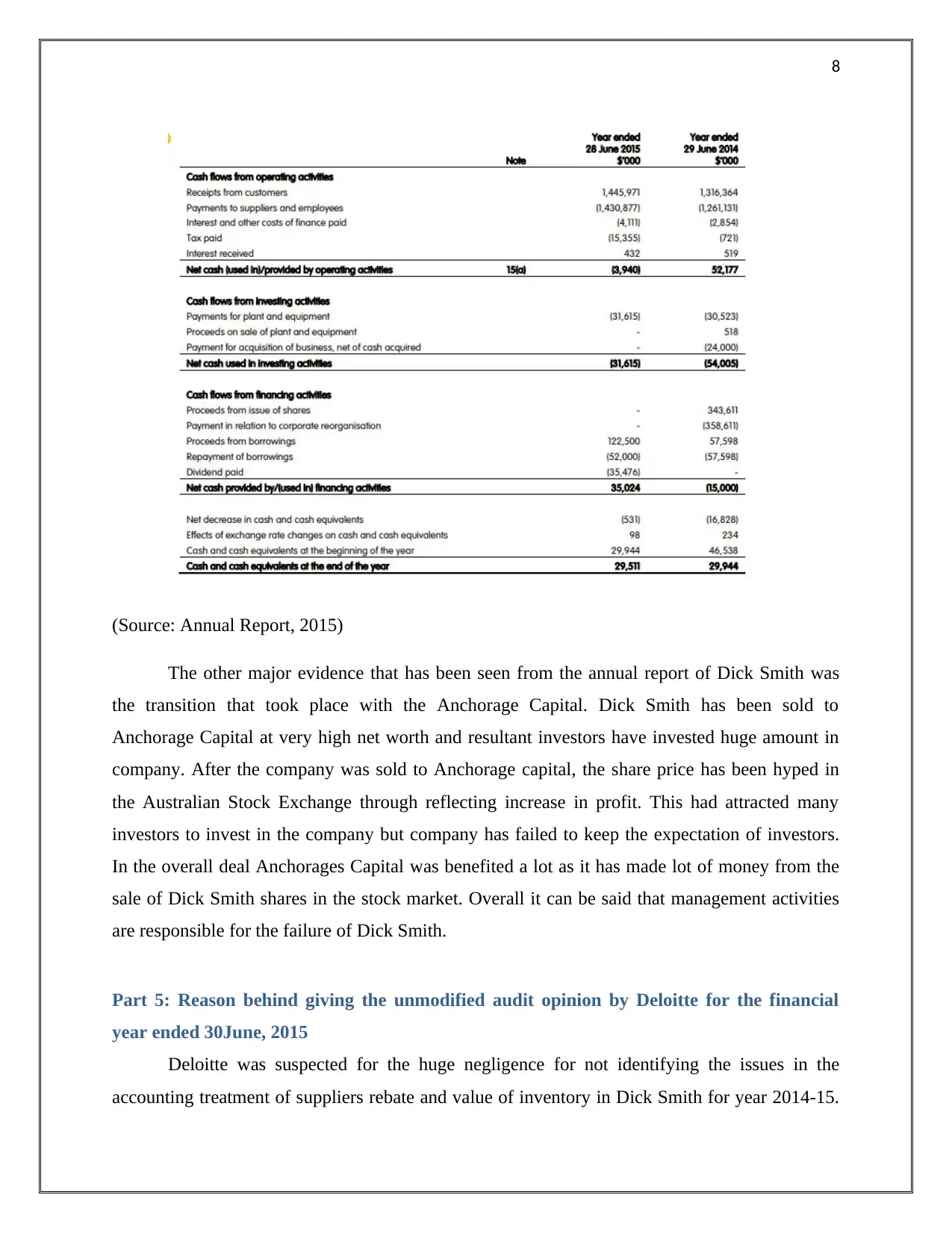
2014-15 shows the increase in sales revenue but fails to generate the free cash flows which have
increased the debt liabilities (Annual Report, 2015). The director’s intention of stock piling does
not work in favor of company but it was main reason behind the shortage of working capital.
Through analyzing the liquidator report it was found that directors and management had
purchased the large volume of inventory in order to satisfy the needs of new stores. In doing so,
management has taken a huge bank loan and also received the rebates from the suppliers. The
impact of this was increased debt at one side of balance sheet and lower cost inventory on other
hand that has lost its value due to change in technology. Below is extracts of cash flow statement
from the annual report 2014-15 that clearly shows there was no cash surplus from the operating
activity in year 2015 (Annual Report, 2015).
Part 4: Analyse of Dick Smith annual report 2014/15 to provide the evidence that company
might not be going concern
It is highly important for the companies to be going concern to sustain in the market for
the long term. Going concern refers to the most important fundamental accounting principle that
very company must follow. This accounting principle is based on the assumption that company
will carry out its business for foreseeable future with no perception to close it down in future. It
is highly important to report about the going concern in the annual report. It is management duty
to verify and report in annual report that company has no intention to close the down the
business or any of business units in future. It is highly important there must be enough evidences
in the annual report that proves that company is going concern and will survive for long run
(Seyam & Brickman, 2016).
On evaluation of annual report of Dick Smith for year 2014-15 it has been found that
there are few evidences that show that company will not be going concern in future. The annual
report clearly shows that huge amount of cash has been provided to the suppliers in order to have
surplus stock but this strategy of directors has not worked as there was cash shortage for longer
period of time. The shortage of cash was due to decrease in demand of the electronics products
and company has failed to collect the account receivable on time. The annual report of year
2014-15 shows the increase in sales revenue but fails to generate the free cash flows which have
increased the debt liabilities (Annual Report, 2015). The director’s intention of stock piling does
not work in favor of company but it was main reason behind the shortage of working capital.
Through analyzing the liquidator report it was found that directors and management had
purchased the large volume of inventory in order to satisfy the needs of new stores. In doing so,
management has taken a huge bank loan and also received the rebates from the suppliers. The
impact of this was increased debt at one side of balance sheet and lower cost inventory on other
hand that has lost its value due to change in technology. Below is extracts of cash flow statement
from the annual report 2014-15 that clearly shows there was no cash surplus from the operating
activity in year 2015 (Annual Report, 2015).
Paraphrase This Document
Need a fresh take? Get an instant paraphrase of this document with our AI Paraphraser
8
(Source: Annual Report, 2015)
The other major evidence that has been seen from the annual report of Dick Smith was
the transition that took place with the Anchorage Capital. Dick Smith has been sold to
Anchorage Capital at very high net worth and resultant investors have invested huge amount in
company. After the company was sold to Anchorage capital, the share price has been hyped in
the Australian Stock Exchange through reflecting increase in profit. This had attracted many
investors to invest in the company but company has failed to keep the expectation of investors.
In the overall deal Anchorages Capital was benefited a lot as it has made lot of money from the
sale of Dick Smith shares in the stock market. Overall it can be said that management activities
are responsible for the failure of Dick Smith.
Part 5: Reason behind giving the unmodified audit opinion by Deloitte for the financial
year ended 30June, 2015
Deloitte was suspected for the huge negligence for not identifying the issues in the
accounting treatment of suppliers rebate and value of inventory in Dick Smith for year 2014-15.
(Source: Annual Report, 2015)
The other major evidence that has been seen from the annual report of Dick Smith was
the transition that took place with the Anchorage Capital. Dick Smith has been sold to
Anchorage Capital at very high net worth and resultant investors have invested huge amount in
company. After the company was sold to Anchorage capital, the share price has been hyped in
the Australian Stock Exchange through reflecting increase in profit. This had attracted many
investors to invest in the company but company has failed to keep the expectation of investors.
In the overall deal Anchorages Capital was benefited a lot as it has made lot of money from the
sale of Dick Smith shares in the stock market. Overall it can be said that management activities
are responsible for the failure of Dick Smith.
Part 5: Reason behind giving the unmodified audit opinion by Deloitte for the financial
year ended 30June, 2015
Deloitte was suspected for the huge negligence for not identifying the issues in the
accounting treatment of suppliers rebate and value of inventory in Dick Smith for year 2014-15.
9
The fact that was represented by Deloitte was that it has conducted the complete audit procedure
for accounting of rebates but has failed to locate and report the material issues in the accounting
system and processes of Dick Smith (Legal Liability of Auditors, 2017). To be on safer side and
to remain as an external auditor of Dick Smith for longer run, Deloitte has not taken considerable
steps to check the manipulation in the accounting standards and use test controls to check the
material misstatement by the management. This has caused Deloitte to make the unmodified
audit opinion for the financial year ended 30 June, 2015 (Annual Report, 2015).
Part 6: Auditor’s Legal Liability in the case of Dick Smith Electronics Ltd for providing
answer to an unmodified audit opinion for the financial year 30 June 2015
Deloitte, the auditor of Dick Smith Electronics, has been alleged due to providing
unmodified audit opinion for the financial year 2015 despite of identifying various accounting
issues present within its financial reports. Deloitte ahs raised questions on the management of the
firm regarding the over-valuation of its inventory and manipulation of the sales figure for
meeting the expected budget. Thus, despite of knowing the financial issues present within the
company its auditors can be regarded as legally responsible for providing a justification to give
unmodified audit opinions (Spencer, 2017). This is because as per the IAS 570 the auditors
before classifying an entity as a going concern need to accurately assess the information
provided by the management for protecting the interest of the stakeholders. However, Deloitte
has been legally claimed by Dick Smith shareholders of intentionally providing unmodified audit
opinions and therefore they have a case to answer. This is because it has not reported any
material deficiency in the controls and systems within the company in respect of identifying,
calculating and recognition of debates. Therefore, the legal claim can be filed against the
auditing firm of the company in addition to its former directors and executives (Clarke, 2003).
Conclusion
The overall assessment of collapse of Dick Smith has helped to learn the lesson on
accounting fraud that management and auditors carried out to earn the huge profits. From the
case of Dick Smith it was clearly held the real activities of management are hard to identify and
such material misstatement can cause severe damage to the going concern accounting principle.
It is the duty of auditor to test the misstatement of management and report them in annual report.
The fact that was represented by Deloitte was that it has conducted the complete audit procedure
for accounting of rebates but has failed to locate and report the material issues in the accounting
system and processes of Dick Smith (Legal Liability of Auditors, 2017). To be on safer side and
to remain as an external auditor of Dick Smith for longer run, Deloitte has not taken considerable
steps to check the manipulation in the accounting standards and use test controls to check the
material misstatement by the management. This has caused Deloitte to make the unmodified
audit opinion for the financial year ended 30 June, 2015 (Annual Report, 2015).
Part 6: Auditor’s Legal Liability in the case of Dick Smith Electronics Ltd for providing
answer to an unmodified audit opinion for the financial year 30 June 2015
Deloitte, the auditor of Dick Smith Electronics, has been alleged due to providing
unmodified audit opinion for the financial year 2015 despite of identifying various accounting
issues present within its financial reports. Deloitte ahs raised questions on the management of the
firm regarding the over-valuation of its inventory and manipulation of the sales figure for
meeting the expected budget. Thus, despite of knowing the financial issues present within the
company its auditors can be regarded as legally responsible for providing a justification to give
unmodified audit opinions (Spencer, 2017). This is because as per the IAS 570 the auditors
before classifying an entity as a going concern need to accurately assess the information
provided by the management for protecting the interest of the stakeholders. However, Deloitte
has been legally claimed by Dick Smith shareholders of intentionally providing unmodified audit
opinions and therefore they have a case to answer. This is because it has not reported any
material deficiency in the controls and systems within the company in respect of identifying,
calculating and recognition of debates. Therefore, the legal claim can be filed against the
auditing firm of the company in addition to its former directors and executives (Clarke, 2003).
Conclusion
The overall assessment of collapse of Dick Smith has helped to learn the lesson on
accounting fraud that management and auditors carried out to earn the huge profits. From the
case of Dick Smith it was clearly held the real activities of management are hard to identify and
such material misstatement can cause severe damage to the going concern accounting principle.
It is the duty of auditor to test the misstatement of management and report them in annual report.
⊘ This is a preview!⊘
Do you want full access?
Subscribe today to unlock all pages.
Trusted by 1+ million students worldwide

10
Paraphrase This Document
Need a fresh take? Get an instant paraphrase of this document with our AI Paraphraser
11
References
Annual Report. (2015). Dick Smith. Retrieved on November 22, 2018, from
Clarke, F. (2003). Corporate Collapse: Accounting, Regulatory and Ethical Failure. Cambridge
University Press.
Going concern- who is responsible. (2017). Retrieved 22 November, 2018, from
Legal Liability of Auditors. (2017). Retrieved on November 22, 2018, from
News.com.au. (2016). McGrathNicol releases Dick Smith report. Retrieved on November 22,
2018, from
Putra, L. (2017). How Auditors Evaluate Entity Going Concern. Retrieved 22 November, 2018,
from
Seyam, A. & Brickman, S. (2016). The Going Concern Assumptions and Presentation on
Financial Statements. Retrieved on November 22, 2018, from
Some answers, more questions over Dick Smith failure. (2016). Retrieved 22 November, 2018,
from
Spencer, L. (2017). Deloitte dragged into Dick Smith directors’ legal battle. Retrieved 22
November, 2018, from
The Conversation. (2016). The ugly story of Dick Smith, from float to failure. Retrieved on
November 22, 2018, from
References
Annual Report. (2015). Dick Smith. Retrieved on November 22, 2018, from
Clarke, F. (2003). Corporate Collapse: Accounting, Regulatory and Ethical Failure. Cambridge
University Press.
Going concern- who is responsible. (2017). Retrieved 22 November, 2018, from
Legal Liability of Auditors. (2017). Retrieved on November 22, 2018, from
News.com.au. (2016). McGrathNicol releases Dick Smith report. Retrieved on November 22,
2018, from
Putra, L. (2017). How Auditors Evaluate Entity Going Concern. Retrieved 22 November, 2018,
from
Seyam, A. & Brickman, S. (2016). The Going Concern Assumptions and Presentation on
Financial Statements. Retrieved on November 22, 2018, from
Some answers, more questions over Dick Smith failure. (2016). Retrieved 22 November, 2018,
from
Spencer, L. (2017). Deloitte dragged into Dick Smith directors’ legal battle. Retrieved 22
November, 2018, from
The Conversation. (2016). The ugly story of Dick Smith, from float to failure. Retrieved on
November 22, 2018, from

1 out of 11


Related Documents


Your All-in-One AI-Powered Toolkit for Academic Success.
+13062052269
info@desklib.com
Available 24*7 on WhatsApp / Email
![[object Object]](/_next/static/media/star-bottom.7253800d.svg)
Unlock your academic potential
Copyright © 2020–2026 A2Z Services. All Rights Reserved. Developed and managed by ZUCOL.