English Language Errors of L1 and L2 Learners: Analysis and Correction
VerifiedAdded on 2023/06/04
|17
|2287
|471
Homework Assignment
AI Summary
This assignment presents a detailed analysis of common English language errors made by both L1 (native) and L2 (second language) learners. The student has compiled a table of 20 language errors, encompassing both spoken and written forms. Each error is categorized based on the agent, mode (spoken or written), and the specific linguistic criteria involved, such as syntactic, phonetic, or morphological errors. The assignment provides an analysis of each error, explaining the nature of the mistake and offering a correction. The errors range from incorrect verb conjugations and double negatives to mispronunciations and incorrect usage of compound words, prepositions, and sentence structures. The analysis draws upon various linguistic concepts and developmental stages of language acquisition, offering a comprehensive overview of the challenges faced by language learners and providing valuable insights into effective language correction strategies. The assignment demonstrates a strong understanding of grammatical principles and a keen ability to identify and analyze language errors.
Running head: COMMON LANGUAGE ERRORS OF L1 AND L2 LEARNERS
Name of the Student:
Name of the University:
Author Note:
Name of the Student:
Name of the University:
Author Note:
Paraphrase This Document
Need a fresh take? Get an instant paraphrase of this document with our AI Paraphraser

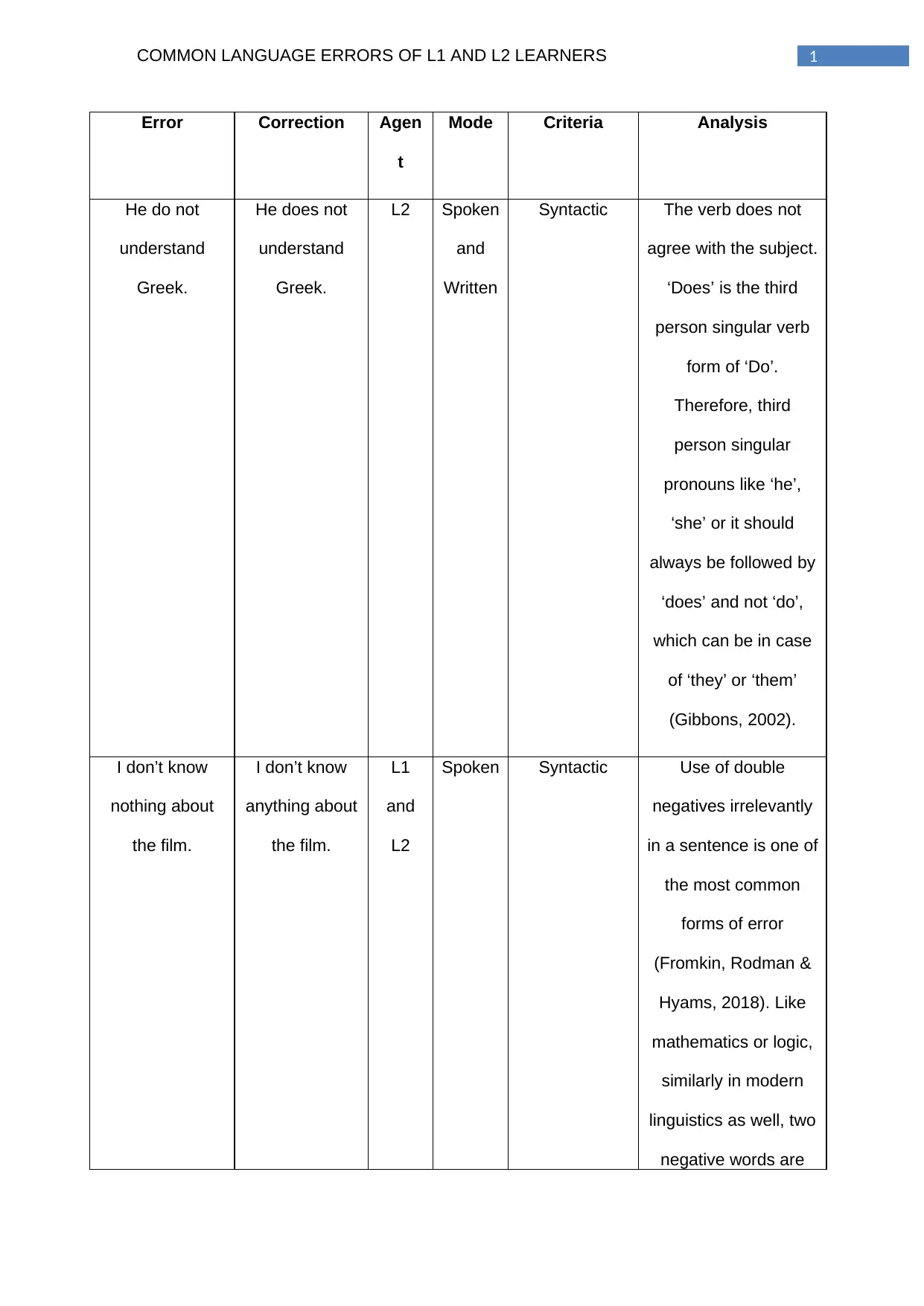
1COMMON LANGUAGE ERRORS OF L1 AND L2 LEARNERS
Error Correction Agen
t
Mode Criteria Analysis
He do not
understand
Greek.
He does not
understand
Greek.
L2 Spoken
and
Written
Syntactic The verb does not
agree with the subject.
‘Does’ is the third
person singular verb
form of ‘Do’.
Therefore, third
person singular
pronouns like ‘he’,
‘she’ or it should
always be followed by
‘does’ and not ‘do’,
which can be in case
of ‘they’ or ‘them’
(Gibbons, 2002).
I don’t know
nothing about
the film.
I don’t know
anything about
the film.
L1
and
L2
Spoken Syntactic Use of double
negatives irrelevantly
in a sentence is one of
the most common
forms of error
(Fromkin, Rodman &
Hyams, 2018). Like
mathematics or logic,
similarly in modern
linguistics as well, two
negative words are
Error Correction Agen
t
Mode Criteria Analysis
He do not
understand
Greek.
He does not
understand
Greek.
L2 Spoken
and
Written
Syntactic The verb does not
agree with the subject.
‘Does’ is the third
person singular verb
form of ‘Do’.
Therefore, third
person singular
pronouns like ‘he’,
‘she’ or it should
always be followed by
‘does’ and not ‘do’,
which can be in case
of ‘they’ or ‘them’
(Gibbons, 2002).
I don’t know
nothing about
the film.
I don’t know
anything about
the film.
L1
and
L2
Spoken Syntactic Use of double
negatives irrelevantly
in a sentence is one of
the most common
forms of error
(Fromkin, Rodman &
Hyams, 2018). Like
mathematics or logic,
similarly in modern
linguistics as well, two
negative words are

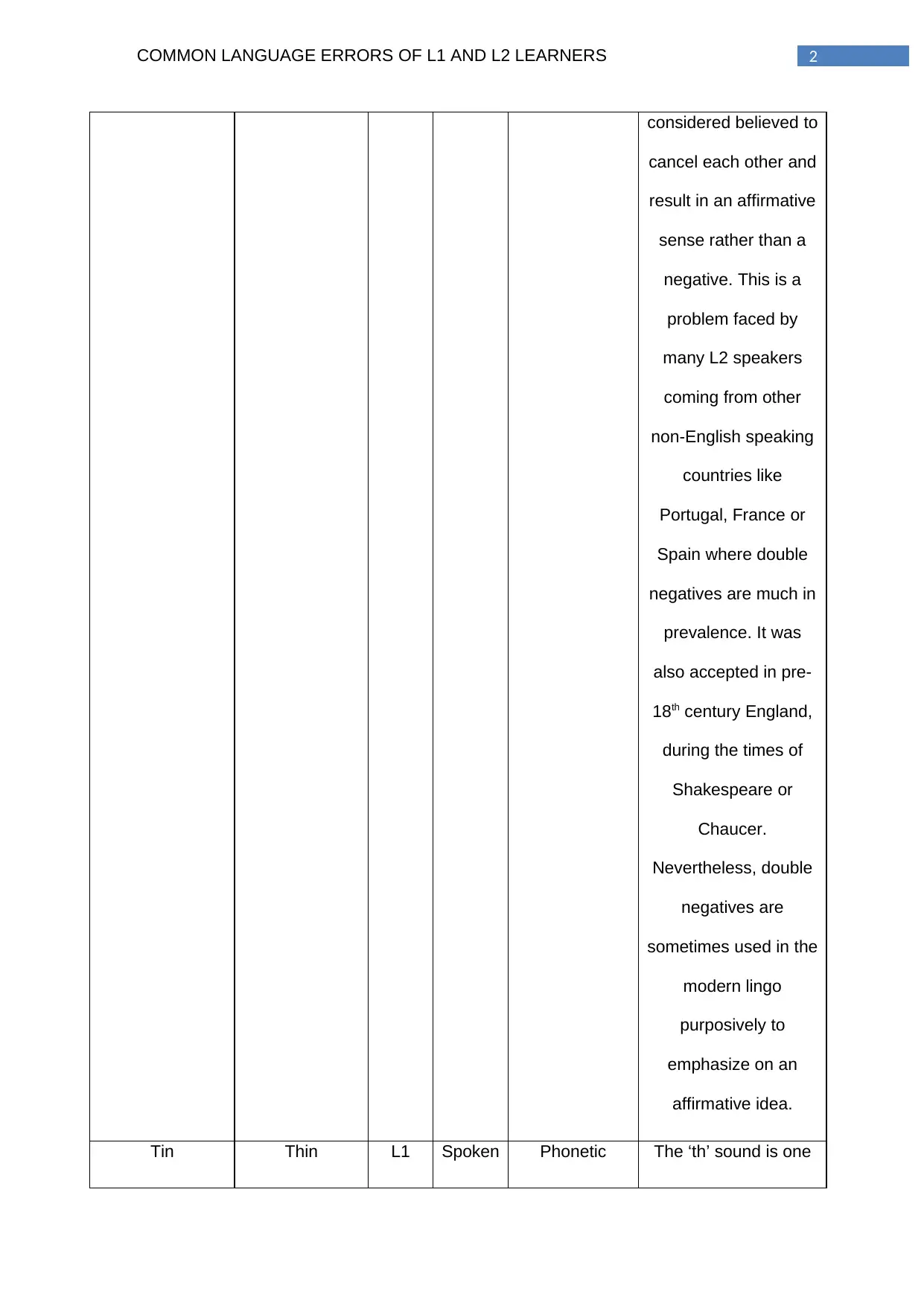
2COMMON LANGUAGE ERRORS OF L1 AND L2 LEARNERS
considered believed to
cancel each other and
result in an affirmative
sense rather than a
negative. This is a
problem faced by
many L2 speakers
coming from other
non-English speaking
countries like
Portugal, France or
Spain where double
negatives are much in
prevalence. It was
also accepted in pre-
18th century England,
during the times of
Shakespeare or
Chaucer.
Nevertheless, double
negatives are
sometimes used in the
modern lingo
purposively to
emphasize on an
affirmative idea.
Tin Thin L1 Spoken Phonetic The ‘th’ sound is one
considered believed to
cancel each other and
result in an affirmative
sense rather than a
negative. This is a
problem faced by
many L2 speakers
coming from other
non-English speaking
countries like
Portugal, France or
Spain where double
negatives are much in
prevalence. It was
also accepted in pre-
18th century England,
during the times of
Shakespeare or
Chaucer.
Nevertheless, double
negatives are
sometimes used in the
modern lingo
purposively to
emphasize on an
affirmative idea.
Tin Thin L1 Spoken Phonetic The ‘th’ sound is one
⊘ This is a preview!⊘
Do you want full access?
Subscribe today to unlock all pages.

Trusted by 1+ million students worldwide

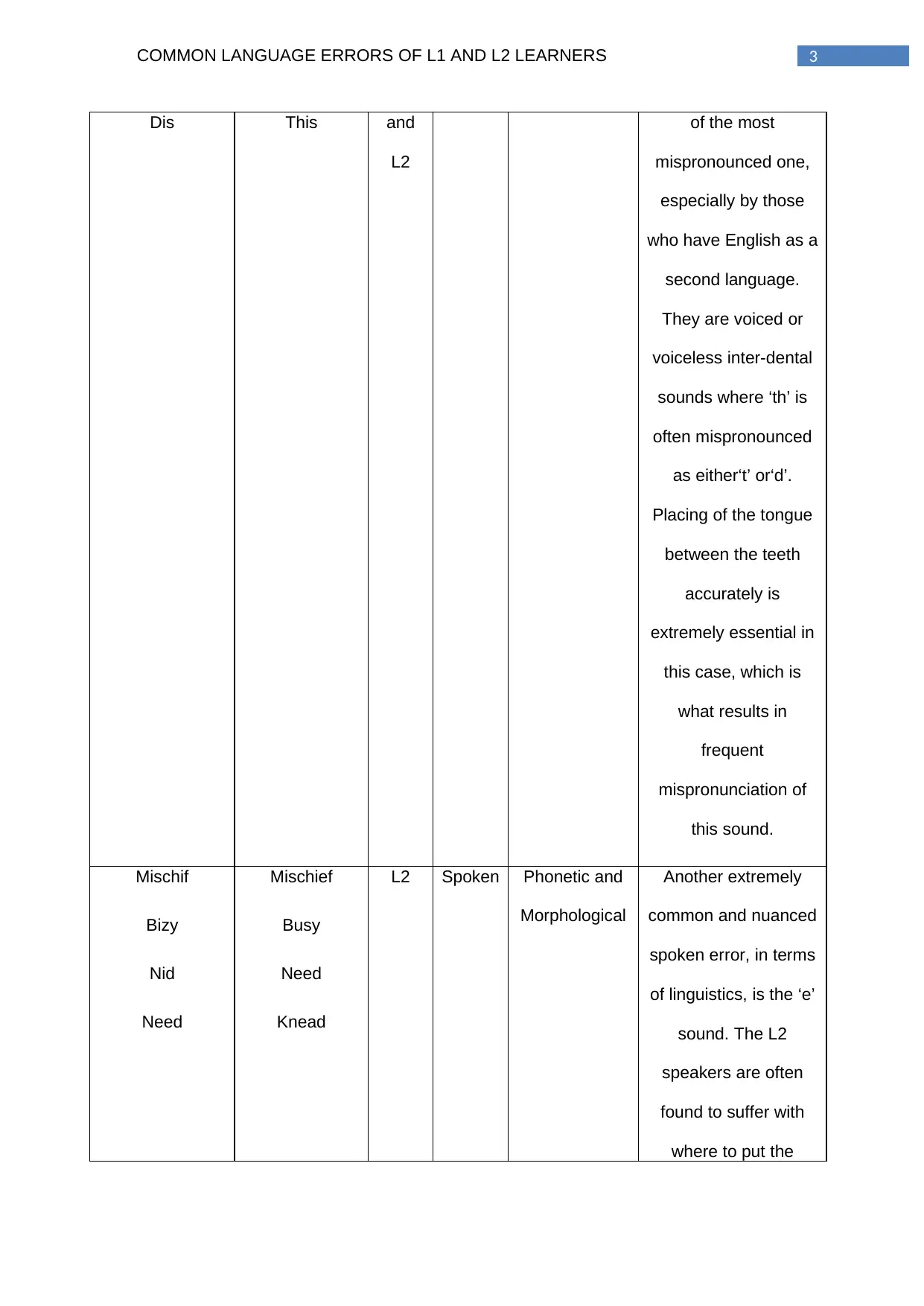
3COMMON LANGUAGE ERRORS OF L1 AND L2 LEARNERS
Dis This and
L2
of the most
mispronounced one,
especially by those
who have English as a
second language.
They are voiced or
voiceless inter-dental
sounds where ‘th’ is
often mispronounced
as either‘t’ or‘d’.
Placing of the tongue
between the teeth
accurately is
extremely essential in
this case, which is
what results in
frequent
mispronunciation of
this sound.
Mischif
Bizy
Nid
Need
Mischief
Busy
Need
Knead
L2 Spoken Phonetic and
Morphological
Another extremely
common and nuanced
spoken error, in terms
of linguistics, is the ‘e’
sound. The L2
speakers are often
found to suffer with
where to put the
Dis This and
L2
of the most
mispronounced one,
especially by those
who have English as a
second language.
They are voiced or
voiceless inter-dental
sounds where ‘th’ is
often mispronounced
as either‘t’ or‘d’.
Placing of the tongue
between the teeth
accurately is
extremely essential in
this case, which is
what results in
frequent
mispronunciation of
this sound.
Mischif
Bizy
Nid
Need
Mischief
Busy
Need
Knead
L2 Spoken Phonetic and
Morphological
Another extremely
common and nuanced
spoken error, in terms
of linguistics, is the ‘e’
sound. The L2
speakers are often
found to suffer with
where to put the
Paraphrase This Document
Need a fresh take? Get an instant paraphrase of this document with our AI Paraphraser

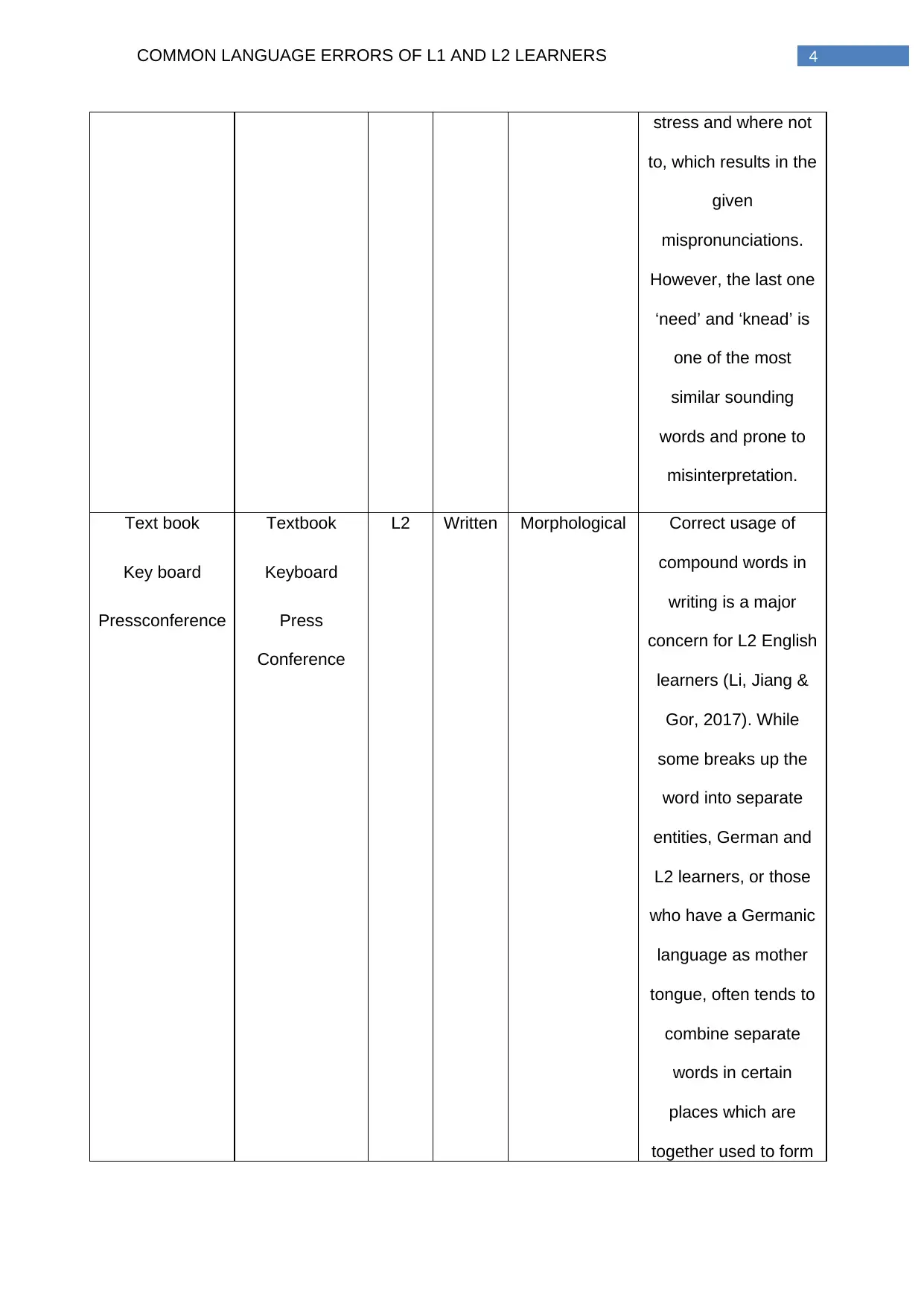
4COMMON LANGUAGE ERRORS OF L1 AND L2 LEARNERS
stress and where not
to, which results in the
given
mispronunciations.
However, the last one
‘need’ and ‘knead’ is
one of the most
similar sounding
words and prone to
misinterpretation.
Text book
Key board
Pressconference
Textbook
Keyboard
Press
Conference
L2 Written Morphological Correct usage of
compound words in
writing is a major
concern for L2 English
learners (Li, Jiang &
Gor, 2017). While
some breaks up the
word into separate
entities, German and
L2 learners, or those
who have a Germanic
language as mother
tongue, often tends to
combine separate
words in certain
places which are
together used to form
stress and where not
to, which results in the
given
mispronunciations.
However, the last one
‘need’ and ‘knead’ is
one of the most
similar sounding
words and prone to
misinterpretation.
Text book
Key board
Pressconference
Textbook
Keyboard
Press
Conference
L2 Written Morphological Correct usage of
compound words in
writing is a major
concern for L2 English
learners (Li, Jiang &
Gor, 2017). While
some breaks up the
word into separate
entities, German and
L2 learners, or those
who have a Germanic
language as mother
tongue, often tends to
combine separate
words in certain
places which are
together used to form

5COMMON LANGUAGE ERRORS OF L1 AND L2 LEARNERS
a meaning, as
compound words,
since it is often done
in their native
language.
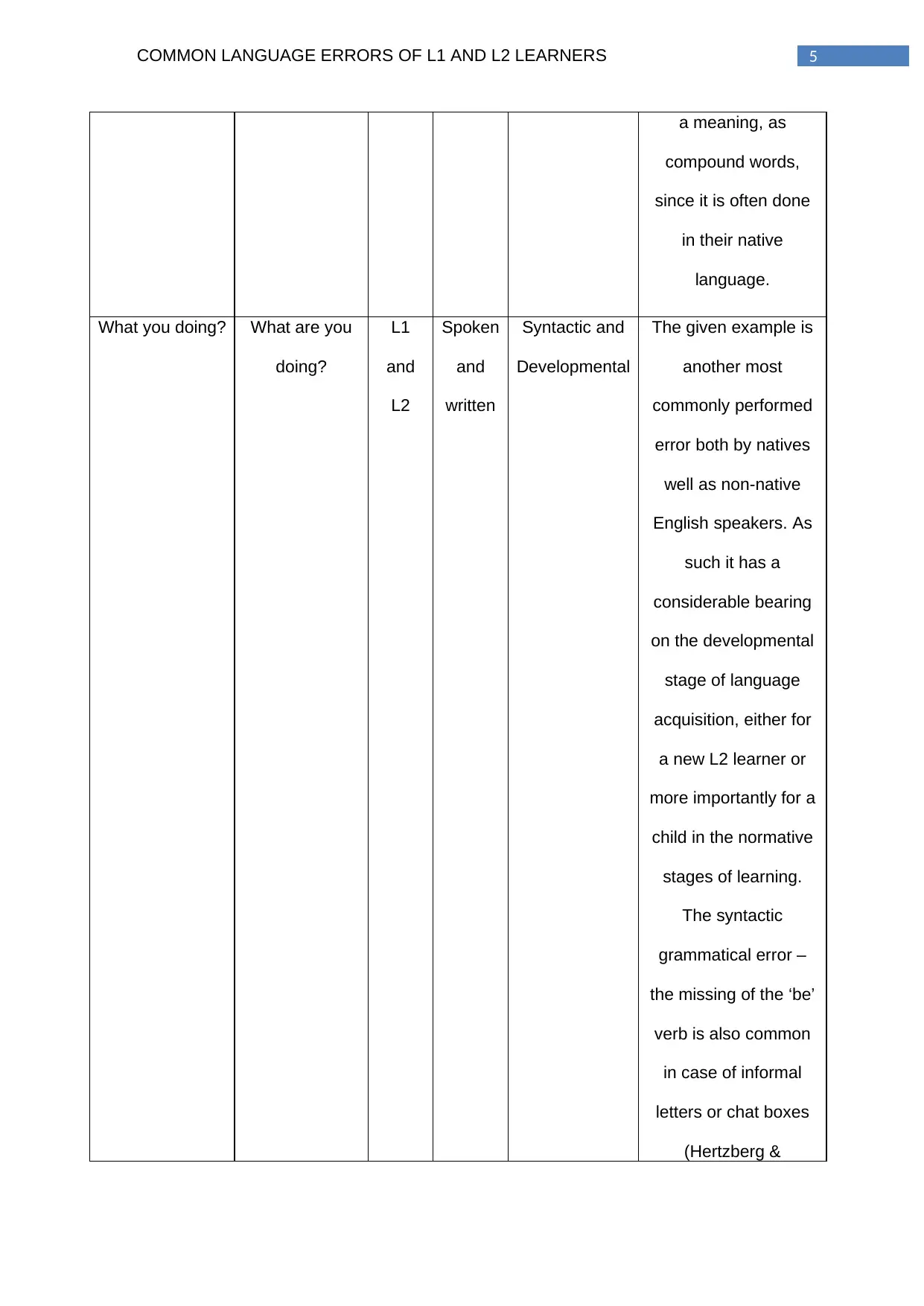
What you doing? What are you
doing?
L1
and
L2
Spoken
and
written
Syntactic and
Developmental
The given example is
another most
commonly performed
error both by natives
well as non-native
English speakers. As
such it has a
considerable bearing
on the developmental
stage of language
acquisition, either for
a new L2 learner or
more importantly for a
child in the normative
stages of learning.
The syntactic
grammatical error –
the missing of the ‘be’
verb is also common
in case of informal
letters or chat boxes
(Hertzberg &
a meaning, as
compound words,
since it is often done
in their native
language.
What you doing? What are you
doing?
L1
and
L2
Spoken
and
written
Syntactic and
Developmental
The given example is
another most
commonly performed
error both by natives
well as non-native
English speakers. As
such it has a
considerable bearing
on the developmental
stage of language
acquisition, either for
a new L2 learner or
more importantly for a
child in the normative
stages of learning.
The syntactic
grammatical error –
the missing of the ‘be’
verb is also common
in case of informal
letters or chat boxes
(Hertzberg &
⊘ This is a preview!⊘
Do you want full access?
Subscribe today to unlock all pages.

Trusted by 1+ million students worldwide

6COMMON LANGUAGE ERRORS OF L1 AND L2 LEARNERS
Freeman, 2012).
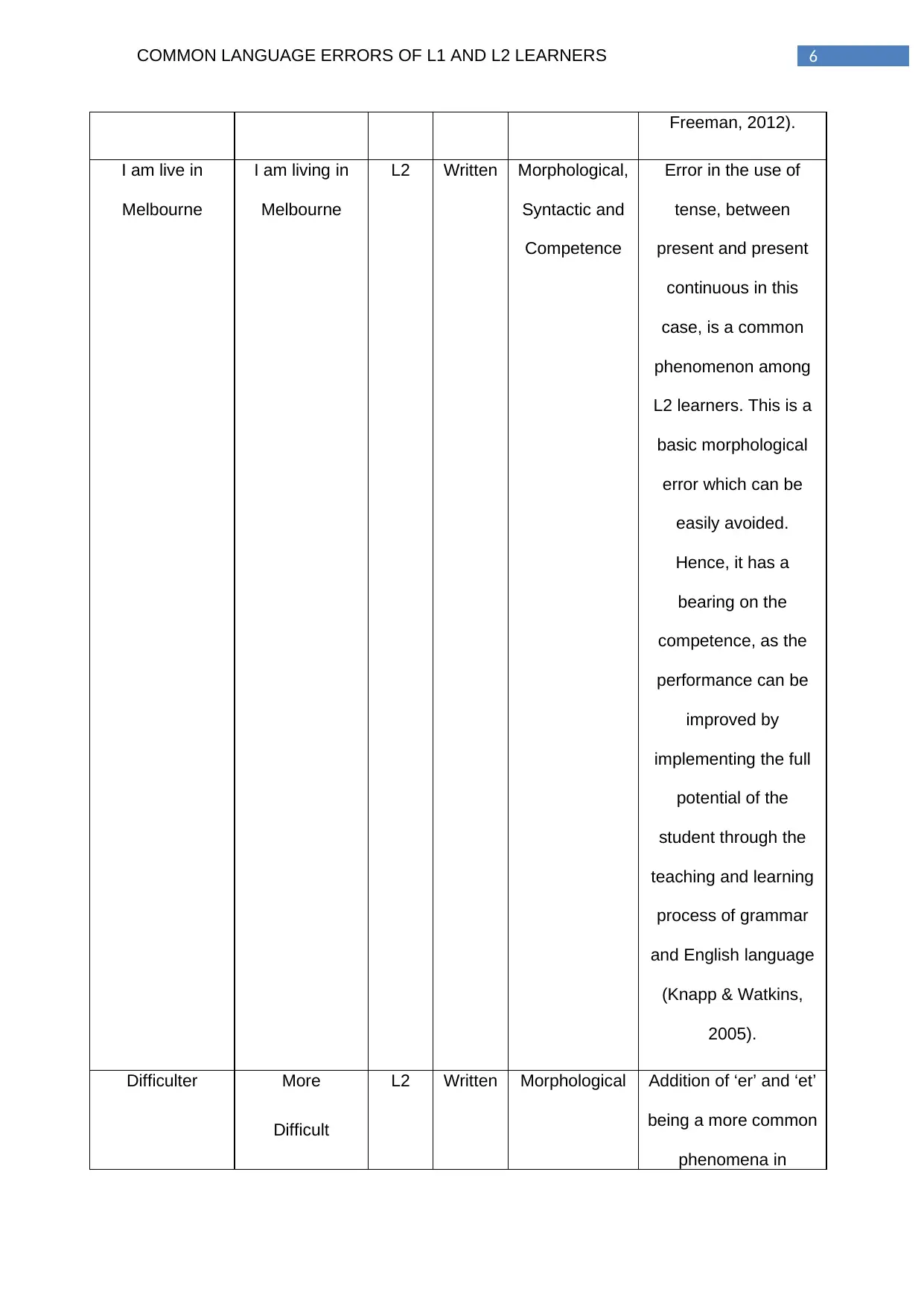
I am live in
Melbourne
I am living in
Melbourne
L2 Written Morphological,
Syntactic and
Competence
Error in the use of
tense, between
present and present
continuous in this
case, is a common
phenomenon among
L2 learners. This is a
basic morphological
error which can be
easily avoided.
Hence, it has a
bearing on the
competence, as the
performance can be
improved by
implementing the full
potential of the
student through the
teaching and learning
process of grammar
and English language
(Knapp & Watkins,
2005).
Difficulter More
Difficult
L2 Written Morphological Addition of ‘er’ and ‘et’
being a more common
phenomena in
Freeman, 2012).
I am live in
Melbourne
I am living in
Melbourne
L2 Written Morphological,
Syntactic and
Competence
Error in the use of
tense, between
present and present
continuous in this
case, is a common
phenomenon among
L2 learners. This is a
basic morphological
error which can be
easily avoided.
Hence, it has a
bearing on the
competence, as the
performance can be
improved by
implementing the full
potential of the
student through the
teaching and learning
process of grammar
and English language
(Knapp & Watkins,
2005).
Difficulter More
Difficult
L2 Written Morphological Addition of ‘er’ and ‘et’
being a more common
phenomena in
Paraphrase This Document
Need a fresh take? Get an instant paraphrase of this document with our AI Paraphraser

7COMMON LANGUAGE ERRORS OF L1 AND L2 LEARNERS
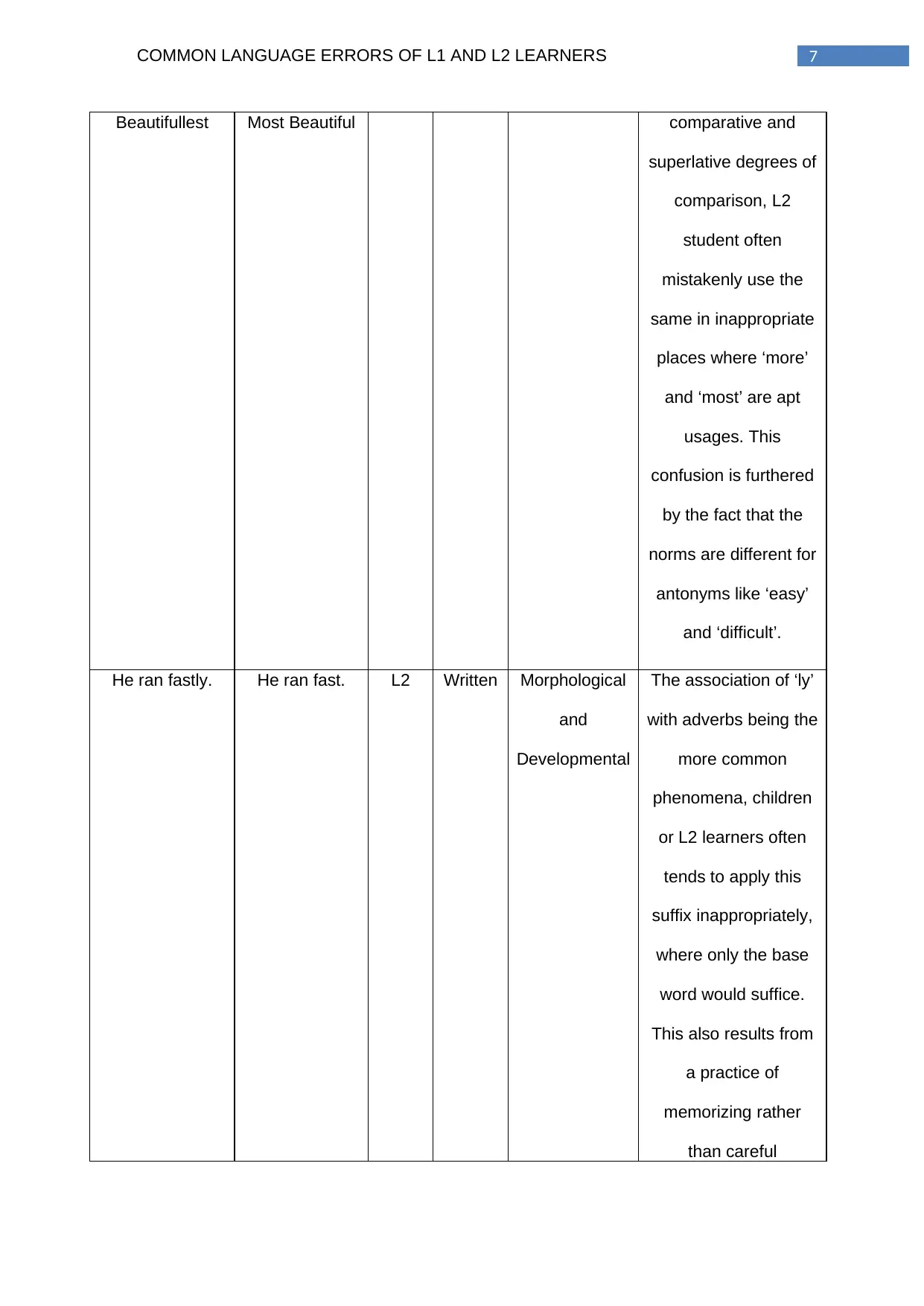
Beautifullest Most Beautiful comparative and
superlative degrees of
comparison, L2
student often
mistakenly use the
same in inappropriate
places where ‘more’
and ‘most’ are apt
usages. This
confusion is furthered
by the fact that the
norms are different for
antonyms like ‘easy’
and ‘difficult’.
He ran fastly. He ran fast. L2 Written Morphological
and
Developmental
The association of ‘ly’
with adverbs being the
more common
phenomena, children
or L2 learners often
tends to apply this
suffix inappropriately,
where only the base
word would suffice.
This also results from
a practice of
memorizing rather
than careful
Beautifullest Most Beautiful comparative and
superlative degrees of
comparison, L2
student often
mistakenly use the
same in inappropriate
places where ‘more’
and ‘most’ are apt
usages. This
confusion is furthered
by the fact that the
norms are different for
antonyms like ‘easy’
and ‘difficult’.
He ran fastly. He ran fast. L2 Written Morphological
and
Developmental
The association of ‘ly’
with adverbs being the
more common
phenomena, children
or L2 learners often
tends to apply this
suffix inappropriately,
where only the base
word would suffice.
This also results from
a practice of
memorizing rather
than careful

8COMMON LANGUAGE ERRORS OF L1 AND L2 LEARNERS
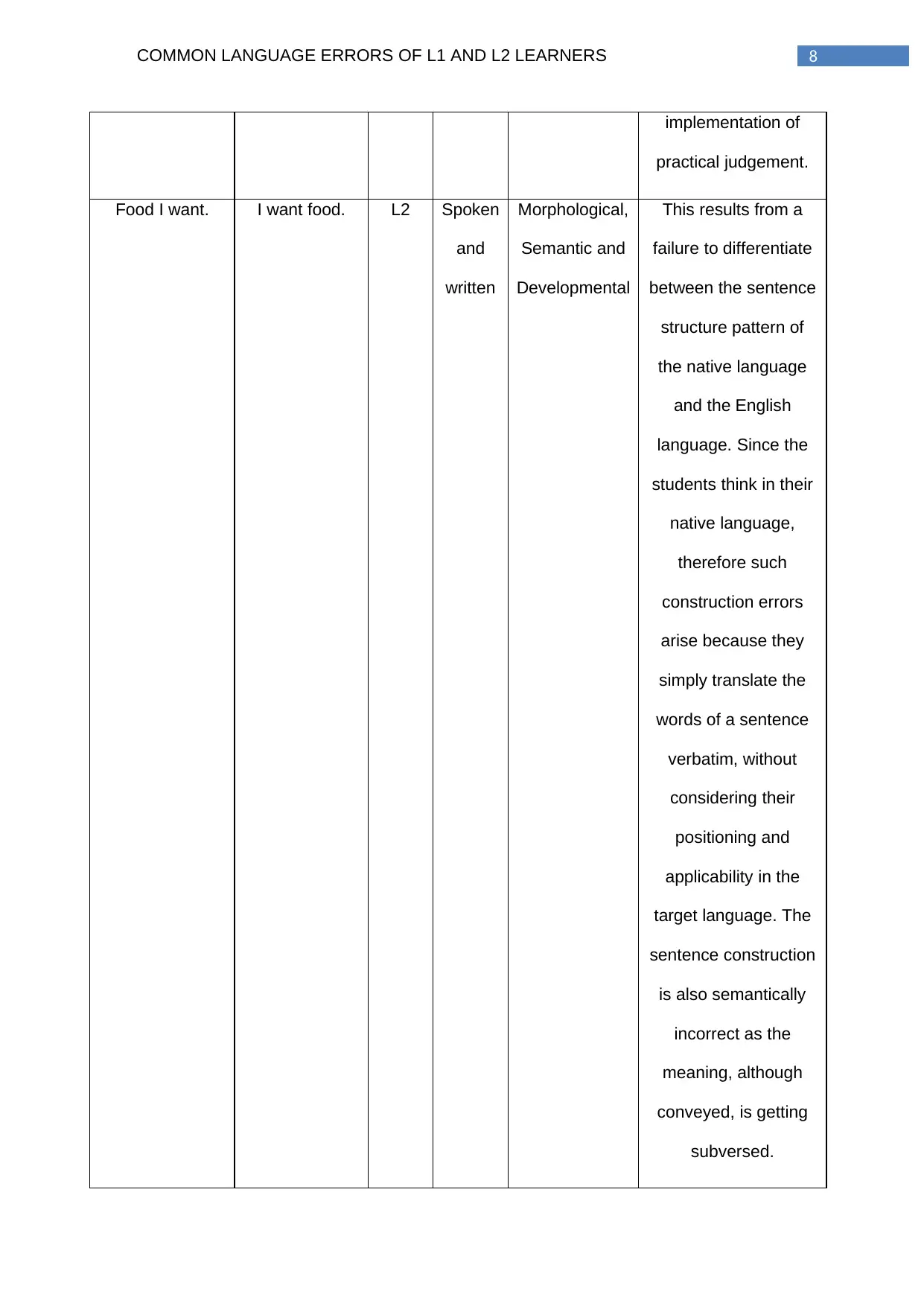
implementation of
practical judgement.
Food I want. I want food. L2 Spoken
and
written
Morphological,
Semantic and
Developmental
This results from a
failure to differentiate
between the sentence
structure pattern of
the native language
and the English
language. Since the
students think in their
native language,
therefore such
construction errors
arise because they
simply translate the
words of a sentence
verbatim, without
considering their
positioning and
applicability in the
target language. The
sentence construction
is also semantically
incorrect as the
meaning, although
conveyed, is getting
subversed.
implementation of
practical judgement.
Food I want. I want food. L2 Spoken
and
written
Morphological,
Semantic and
Developmental
This results from a
failure to differentiate
between the sentence
structure pattern of
the native language
and the English
language. Since the
students think in their
native language,
therefore such
construction errors
arise because they
simply translate the
words of a sentence
verbatim, without
considering their
positioning and
applicability in the
target language. The
sentence construction
is also semantically
incorrect as the
meaning, although
conveyed, is getting
subversed.
⊘ This is a preview!⊘
Do you want full access?
Subscribe today to unlock all pages.

Trusted by 1+ million students worldwide

9COMMON LANGUAGE ERRORS OF L1 AND L2 LEARNERS
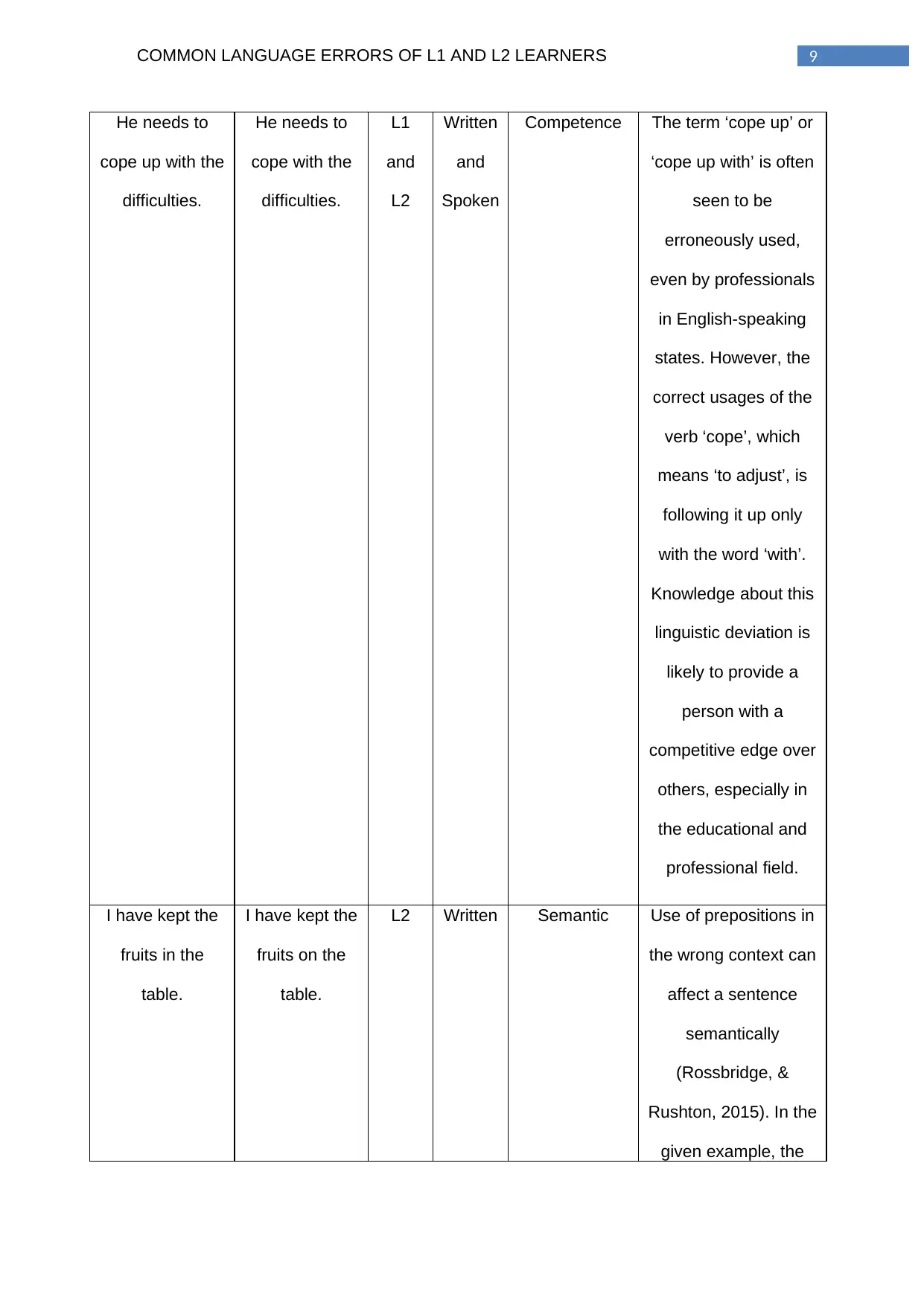
He needs to
cope up with the
difficulties.
He needs to
cope with the
difficulties.
L1
and
L2
Written
and
Spoken
Competence The term ‘cope up’ or
‘cope up with’ is often
seen to be
erroneously used,
even by professionals
in English-speaking
states. However, the
correct usages of the
verb ‘cope’, which
means ‘to adjust’, is
following it up only
with the word ‘with’.
Knowledge about this
linguistic deviation is
likely to provide a
person with a
competitive edge over
others, especially in
the educational and
professional field.
I have kept the
fruits in the
table.
I have kept the
fruits on the
table.
L2 Written Semantic Use of prepositions in
the wrong context can
affect a sentence
semantically
(Rossbridge, &
Rushton, 2015). In the
given example, the
He needs to
cope up with the
difficulties.
He needs to
cope with the
difficulties.
L1
and
L2
Written
and
Spoken
Competence The term ‘cope up’ or
‘cope up with’ is often
seen to be
erroneously used,
even by professionals
in English-speaking
states. However, the
correct usages of the
verb ‘cope’, which
means ‘to adjust’, is
following it up only
with the word ‘with’.
Knowledge about this
linguistic deviation is
likely to provide a
person with a
competitive edge over
others, especially in
the educational and
professional field.
I have kept the
fruits in the
table.
I have kept the
fruits on the
table.
L2 Written Semantic Use of prepositions in
the wrong context can
affect a sentence
semantically
(Rossbridge, &
Rushton, 2015). In the
given example, the
Paraphrase This Document
Need a fresh take? Get an instant paraphrase of this document with our AI Paraphraser

10COMMON LANGUAGE ERRORS OF L1 AND L2 LEARNERS
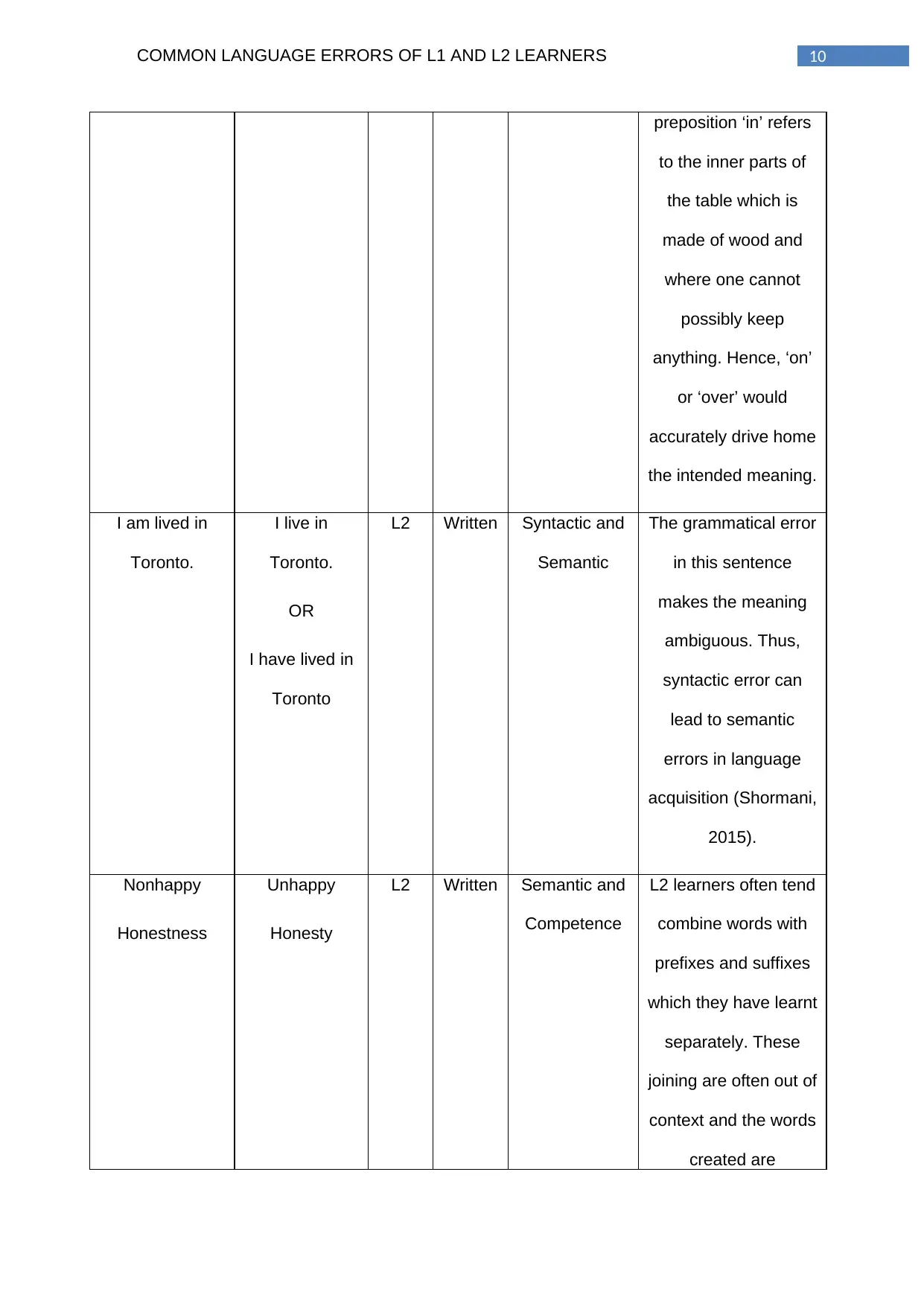
preposition ‘in’ refers
to the inner parts of
the table which is
made of wood and
where one cannot
possibly keep
anything. Hence, ‘on’
or ‘over’ would
accurately drive home
the intended meaning.
I am lived in
Toronto.
I live in
Toronto.
OR
I have lived in
Toronto
L2 Written Syntactic and
Semantic
The grammatical error
in this sentence
makes the meaning
ambiguous. Thus,
syntactic error can
lead to semantic
errors in language
acquisition (Shormani,
2015).
Nonhappy
Honestness
Unhappy
Honesty
L2 Written Semantic and
Competence
L2 learners often tend
combine words with
prefixes and suffixes
which they have learnt
separately. These
joining are often out of
context and the words
created are
preposition ‘in’ refers
to the inner parts of
the table which is
made of wood and
where one cannot
possibly keep
anything. Hence, ‘on’
or ‘over’ would
accurately drive home
the intended meaning.
I am lived in
Toronto.
I live in
Toronto.
OR
I have lived in
Toronto
L2 Written Syntactic and
Semantic
The grammatical error
in this sentence
makes the meaning
ambiguous. Thus,
syntactic error can
lead to semantic
errors in language
acquisition (Shormani,
2015).
Nonhappy
Honestness
Unhappy
Honesty
L2 Written Semantic and
Competence
L2 learners often tend
combine words with
prefixes and suffixes
which they have learnt
separately. These
joining are often out of
context and the words
created are

11COMMON LANGUAGE ERRORS OF L1 AND L2 LEARNERS
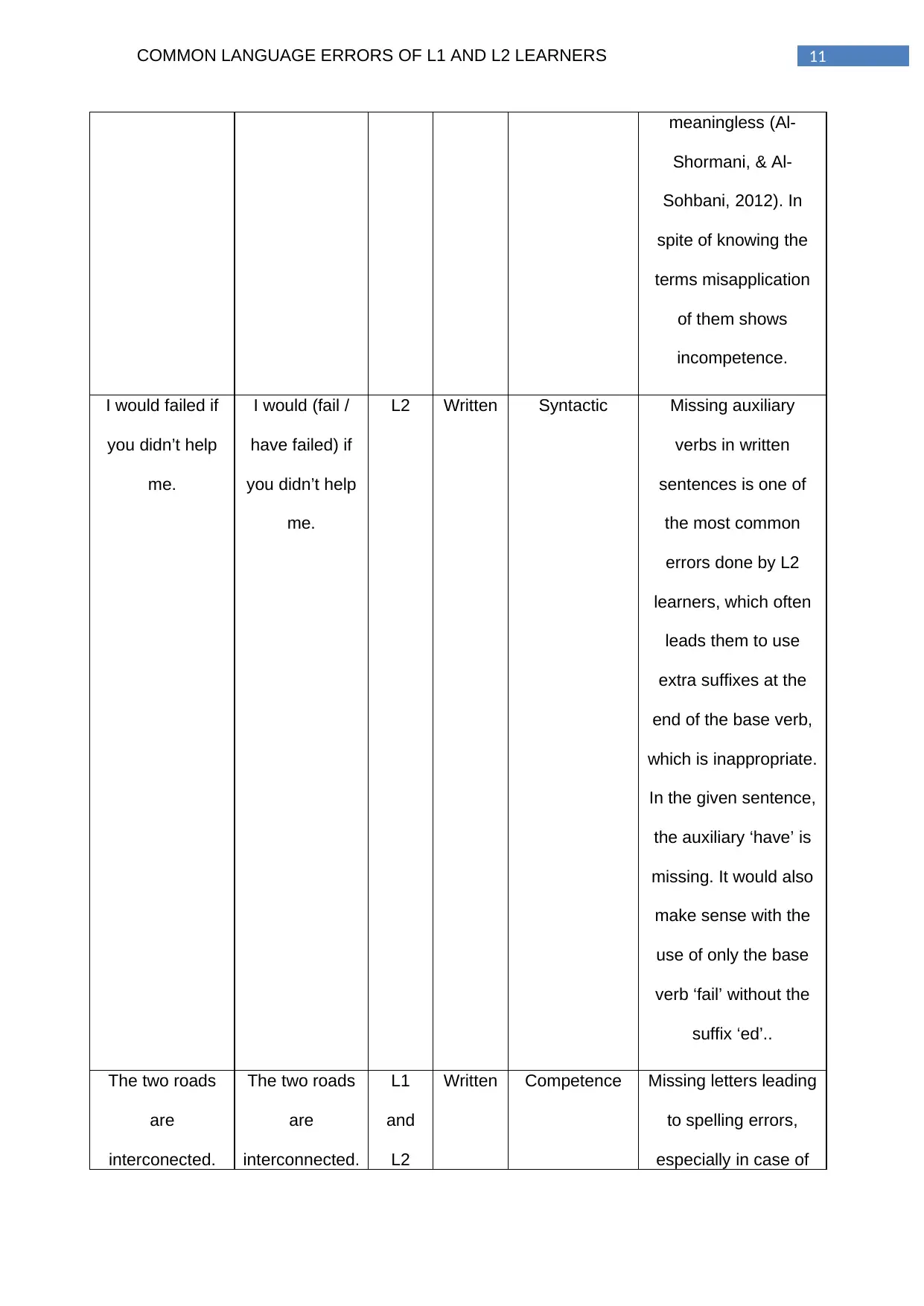
meaningless (Al-
Shormani, & Al-
Sohbani, 2012). In
spite of knowing the
terms misapplication
of them shows
incompetence.
I would failed if
you didn’t help
me.
I would (fail /
have failed) if
you didn’t help
me.
L2 Written Syntactic Missing auxiliary
verbs in written
sentences is one of
the most common
errors done by L2
learners, which often
leads them to use
extra suffixes at the
end of the base verb,
which is inappropriate.
In the given sentence,
the auxiliary ‘have’ is
missing. It would also
make sense with the
use of only the base
verb ‘fail’ without the
suffix ‘ed’..
The two roads
are
interconected.
The two roads
are
interconnected.
L1
and
L2
Written Competence Missing letters leading
to spelling errors,
especially in case of
meaningless (Al-
Shormani, & Al-
Sohbani, 2012). In
spite of knowing the
terms misapplication
of them shows
incompetence.
I would failed if
you didn’t help
me.
I would (fail /
have failed) if
you didn’t help
me.
L2 Written Syntactic Missing auxiliary
verbs in written
sentences is one of
the most common
errors done by L2
learners, which often
leads them to use
extra suffixes at the
end of the base verb,
which is inappropriate.
In the given sentence,
the auxiliary ‘have’ is
missing. It would also
make sense with the
use of only the base
verb ‘fail’ without the
suffix ‘ed’..
The two roads
are
interconected.
The two roads
are
interconnected.
L1
and
L2
Written Competence Missing letters leading
to spelling errors,
especially in case of
⊘ This is a preview!⊘
Do you want full access?
Subscribe today to unlock all pages.

Trusted by 1+ million students worldwide
1 out of 17
Your All-in-One AI-Powered Toolkit for Academic Success.
+13062052269
info@desklib.com
Available 24*7 on WhatsApp / Email
Unlock your academic potential
Copyright © 2020–2025 A2Z Services. All Rights Reserved. Developed and managed by ZUCOL.