University Engineering Systems Analysis and Modeling - Task 2

Verified

Added on  2023/01/19

|14
|1712
|58
Homework Assignment
AI Summary
This document provides a comprehensive set of solutions for Task 2 of an engineering systems analysis assignment. It begins by calculating the determinant of a 3x3 matrix and then delves into solving three closed loops of a DC circuit using Kirchhoff's laws, employing both substitution and Gaussian elimination methods. The solution further explores matrix solutions using inverse matrices. The document then moves on to analyze voltage calculations in a circuit with a resistor and capacitor over time and calculates the atmospheric pressure at various altitudes using exponential equations. Furthermore, the document utilizes the bisection and Newton's methods to find the root of a non-linear equation. The assignment also includes the integration of a current function using the trapezoidal rule and the creation of a mathematical model to solve a first-order linear differential equation. Finally, the document provides solutions for differential equations in LCR circuits using Laplace Transforms and other methods.
Document Page
Analyse and Model Engineering
System
tabler-icon-diamond-filled.svg

Paraphrase This Document

Need a fresh take? Get an instant paraphrase of this document with our AI Paraphraser
Document Page
Document Page
TASK 2.0
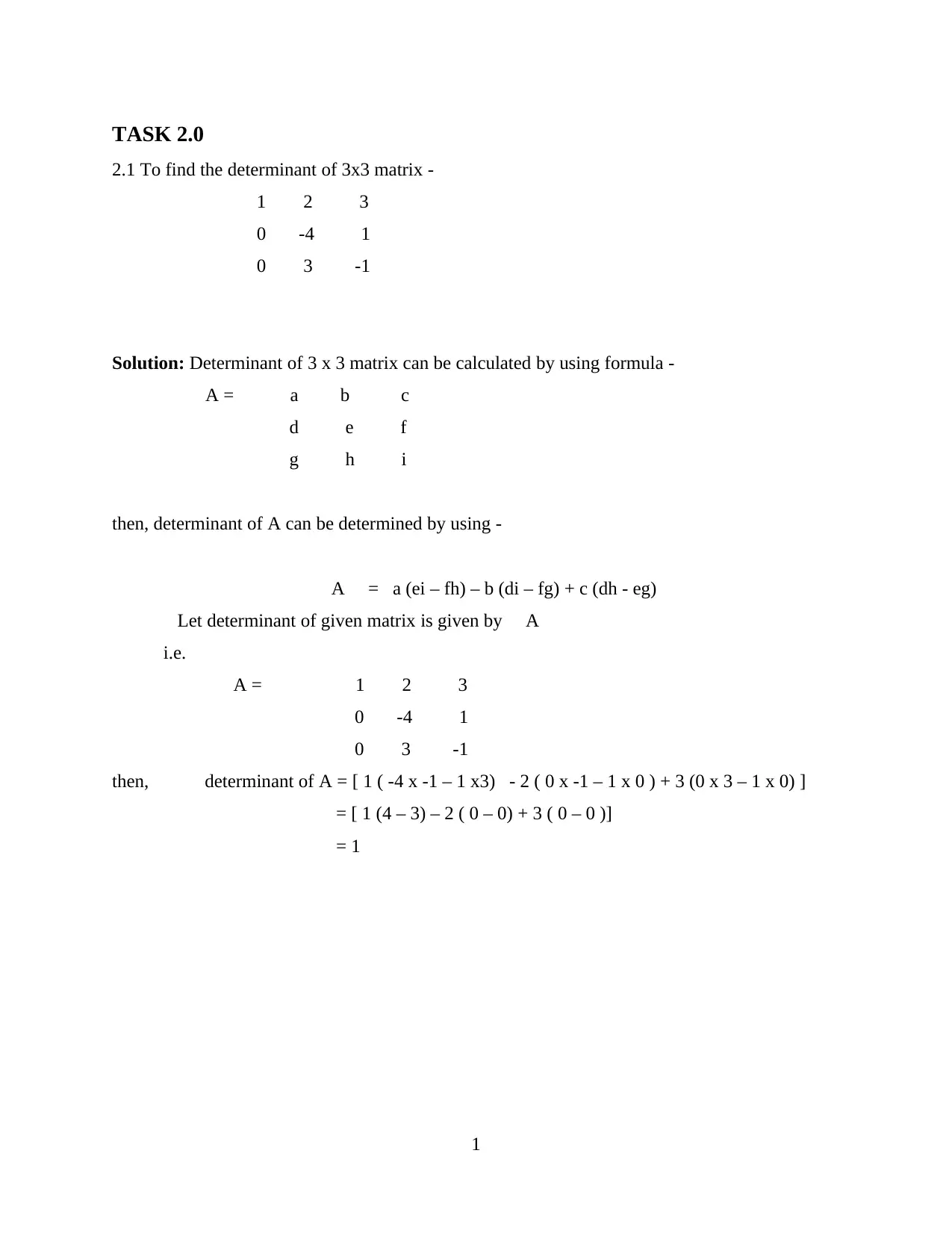
2.1 To find the determinant of 3x3 matrix -
1 2 3
0 -4 1
0 3 -1
Solution: Determinant of 3 x 3 matrix can be calculated by using formula -
A = a b c
d e f
g h i
then, determinant of A can be determined by using -
A = a (ei – fh) – b (di – fg) + c (dh - eg)
Let determinant of given matrix is given by A
i.e.
A = 1 2 3
0 -4 1
0 3 -1
then, determinant of A = [ 1 ( -4 x -1 – 1 x3) - 2 ( 0 x -1 – 1 x 0 ) + 3 (0 x 3 – 1 x 0) ]
= [ 1 (4 – 3) – 2 ( 0 – 0) + 3 ( 0 – 0 )]
= 1
1
Document Page
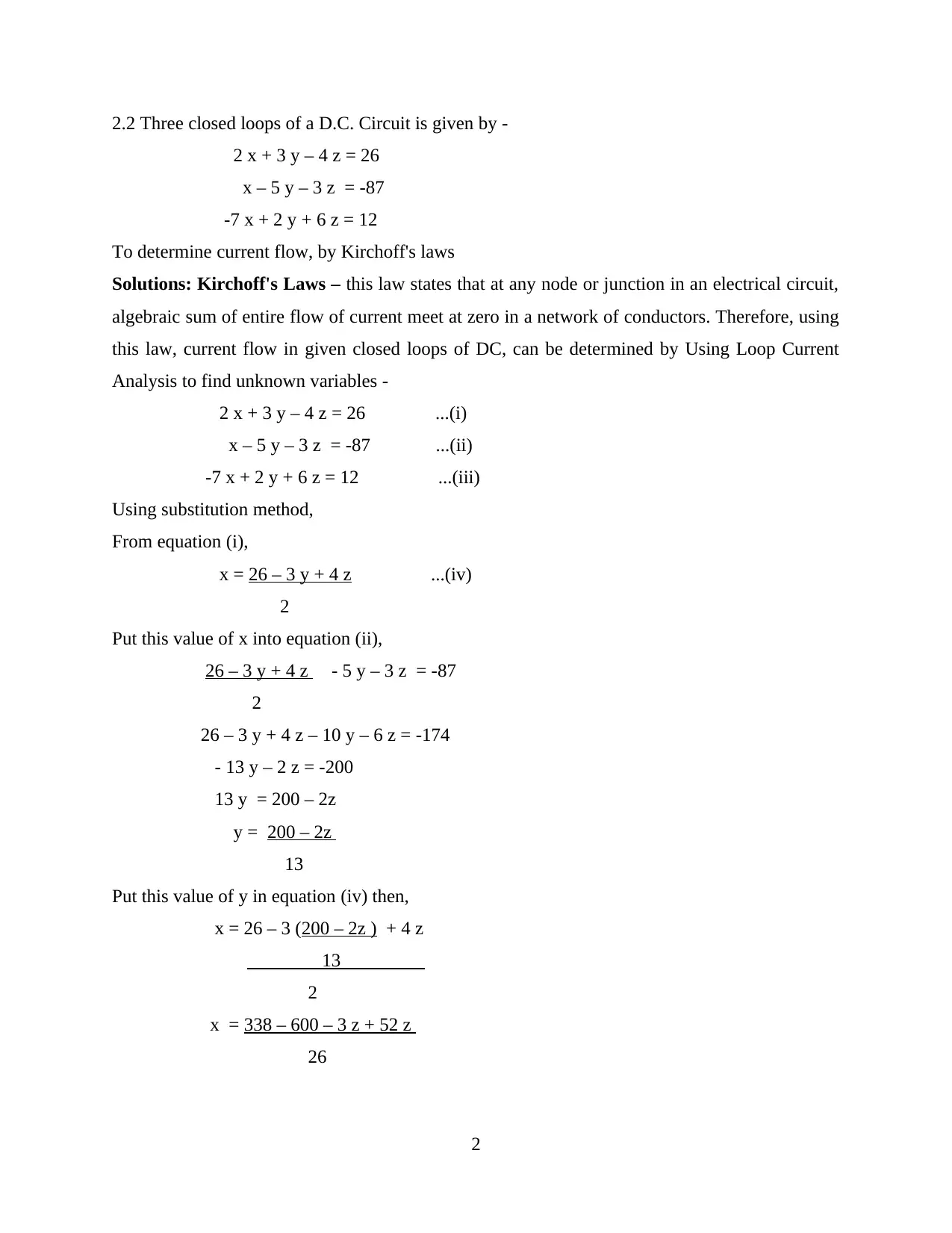
2.2 Three closed loops of a D.C. Circuit is given by -
2 x + 3 y – 4 z = 26
x – 5 y – 3 z = -87
-7 x + 2 y + 6 z = 12
To determine current flow, by Kirchoff's laws
Solutions: Kirchoff's Laws – this law states that at any node or junction in an electrical circuit,
algebraic sum of entire flow of current meet at zero in a network of conductors. Therefore, using
this law, current flow in given closed loops of DC, can be determined by Using Loop Current
Analysis to find unknown variables -
2 x + 3 y – 4 z = 26 ...(i)
x – 5 y – 3 z = -87 ...(ii)
-7 x + 2 y + 6 z = 12 ...(iii)
Using substitution method,
From equation (i),
x = 26 – 3 y + 4 z ...(iv)
2
Put this value of x into equation (ii),
26 – 3 y + 4 z - 5 y – 3 z = -87
2
26 – 3 y + 4 z – 10 y – 6 z = -174
- 13 y – 2 z = -200
13 y = 200 – 2z
y = 200 – 2z
13
Put this value of y in equation (iv) then,
x = 26 – 3 (200 – 2z ) + 4 z
13
2
x = 338 – 600 – 3 z + 52 z
26
2
tabler-icon-diamond-filled.svg

Paraphrase This Document

Need a fresh take? Get an instant paraphrase of this document with our AI Paraphraser
Document Page
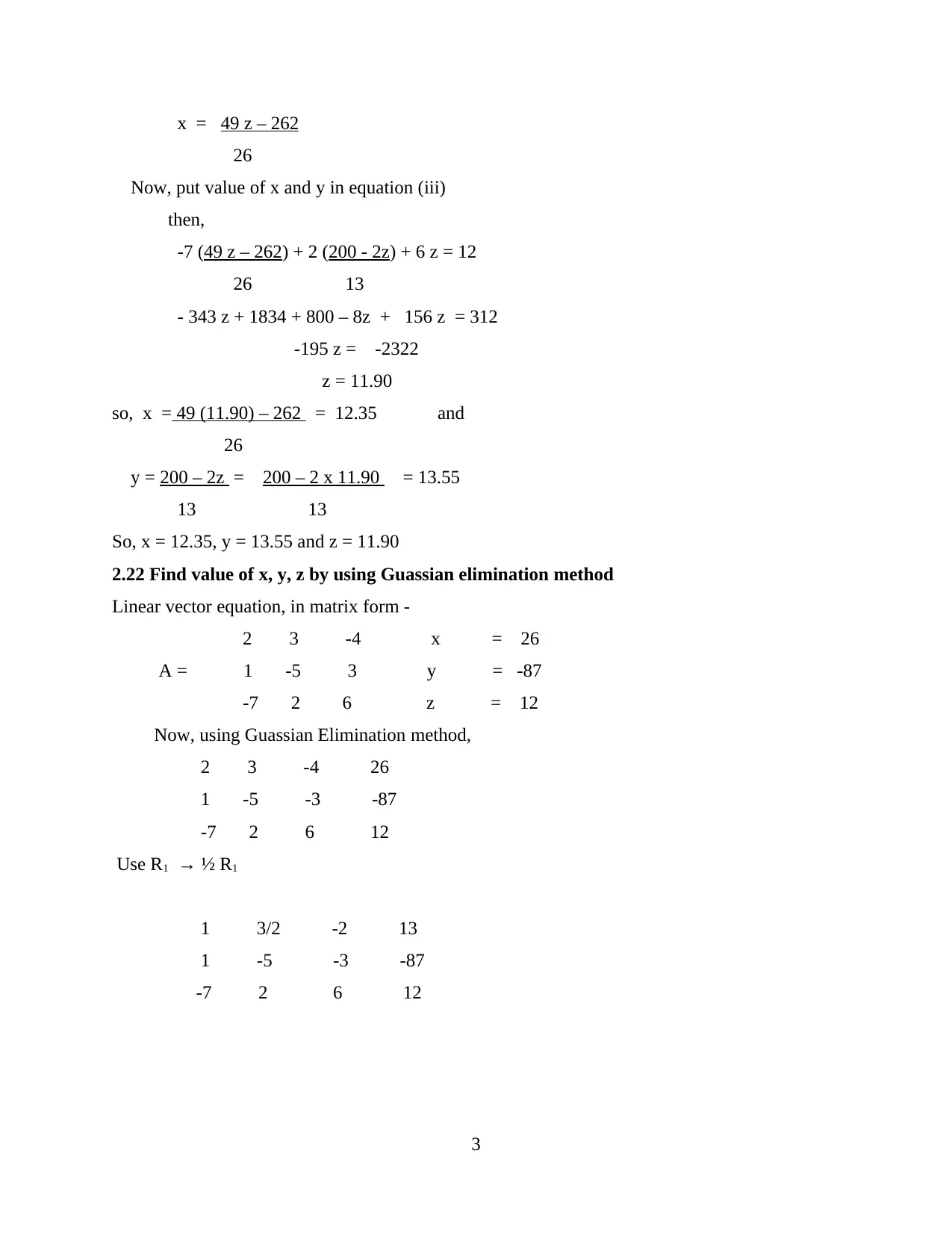
x = 49 z – 262
26
Now, put value of x and y in equation (iii)
then,
-7 (49 z – 262) + 2 (200 - 2z) + 6 z = 12
26 13
- 343 z + 1834 + 800 – 8z + 156 z = 312
-195 z = -2322
z = 11.90
so, x = 49 (11.90) – 262 = 12.35 and
26
y = 200 – 2z = 200 – 2 x 11.90 = 13.55
13 13
So, x = 12.35, y = 13.55 and z = 11.90
2.22 Find value of x, y, z by using Guassian elimination method
Linear vector equation, in matrix form -
2 3 -4 x = 26
A = 1 -5 3 y = -87
-7 2 6 z = 12
Now, using Guassian Elimination method,
2 3 -4 26
1 -5 -3 -87
-7 2 6 12
Use R1 → ½ R1
1 3/2 -2 13
1 -5 -3 -87
-7 2 6 12
3
Document Page
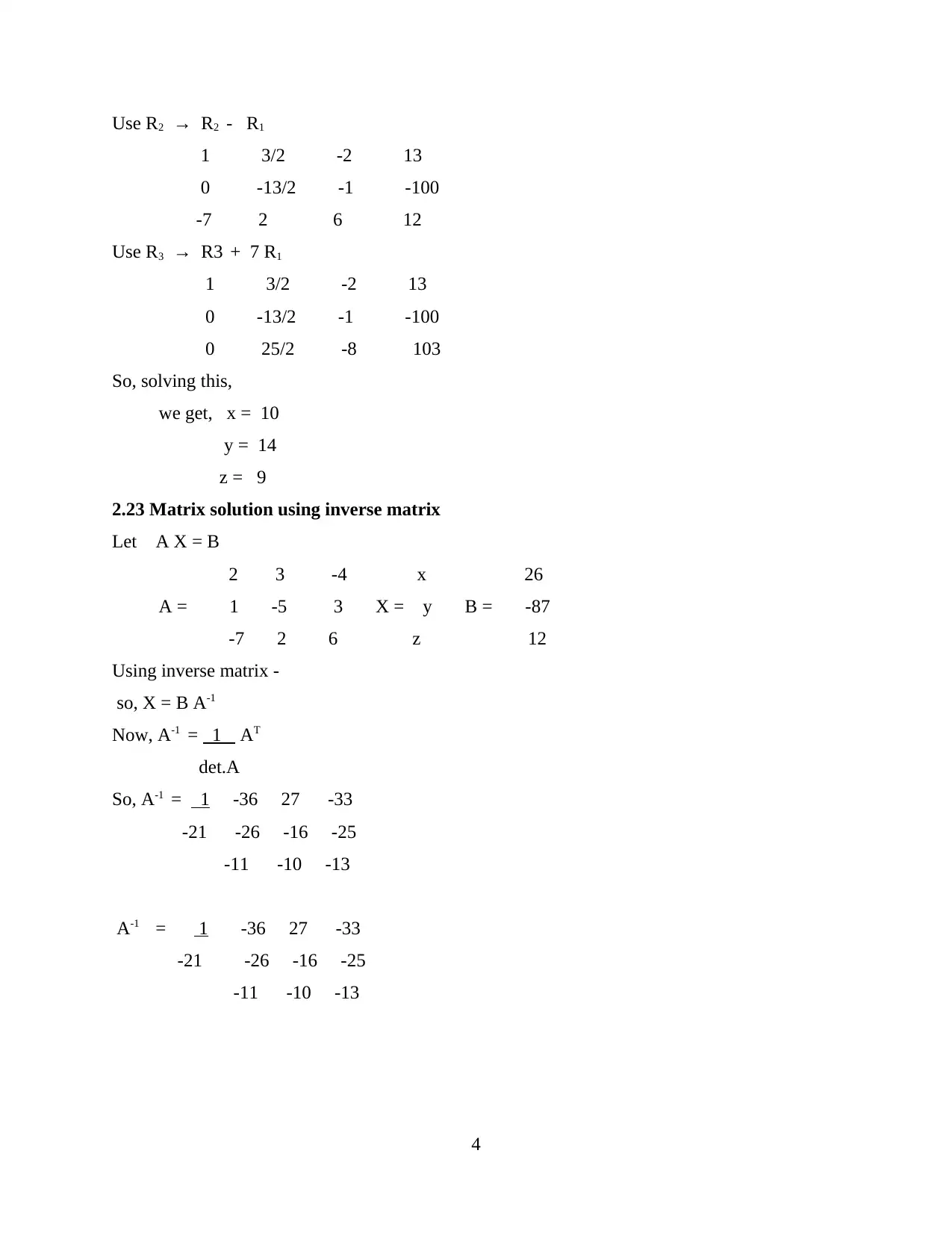
Use R2 → R2 - R1
1 3/2 -2 13
0 -13/2 -1 -100
-7 2 6 12
Use R3 → R3 + 7 R1
1 3/2 -2 13
0 -13/2 -1 -100
0 25/2 -8 103
So, solving this,
we get, x = 10
y = 14
z = 9
2.23 Matrix solution using inverse matrix
Let A X = B
2 3 -4 x 26
A = 1 -5 3 X = y B = -87
-7 2 6 z 12
Using inverse matrix -
so, X = B A-1
Now, A-1 = 1 AT
det.A
So, A-1 = 1 -36 27 -33
-21 -26 -16 -25
-11 -10 -13
A-1 = 1 -36 27 -33
-21 -26 -16 -25
-11 -10 -13
4
Document Page
So,
x 1 -36 27 -33 26
y = -21 -26 -16 -25 -87
z -11 -10 -13 12
x = 10
y = 14
z = 9
5
tabler-icon-diamond-filled.svg

Paraphrase This Document

Need a fresh take? Get an instant paraphrase of this document with our AI Paraphraser
Document Page
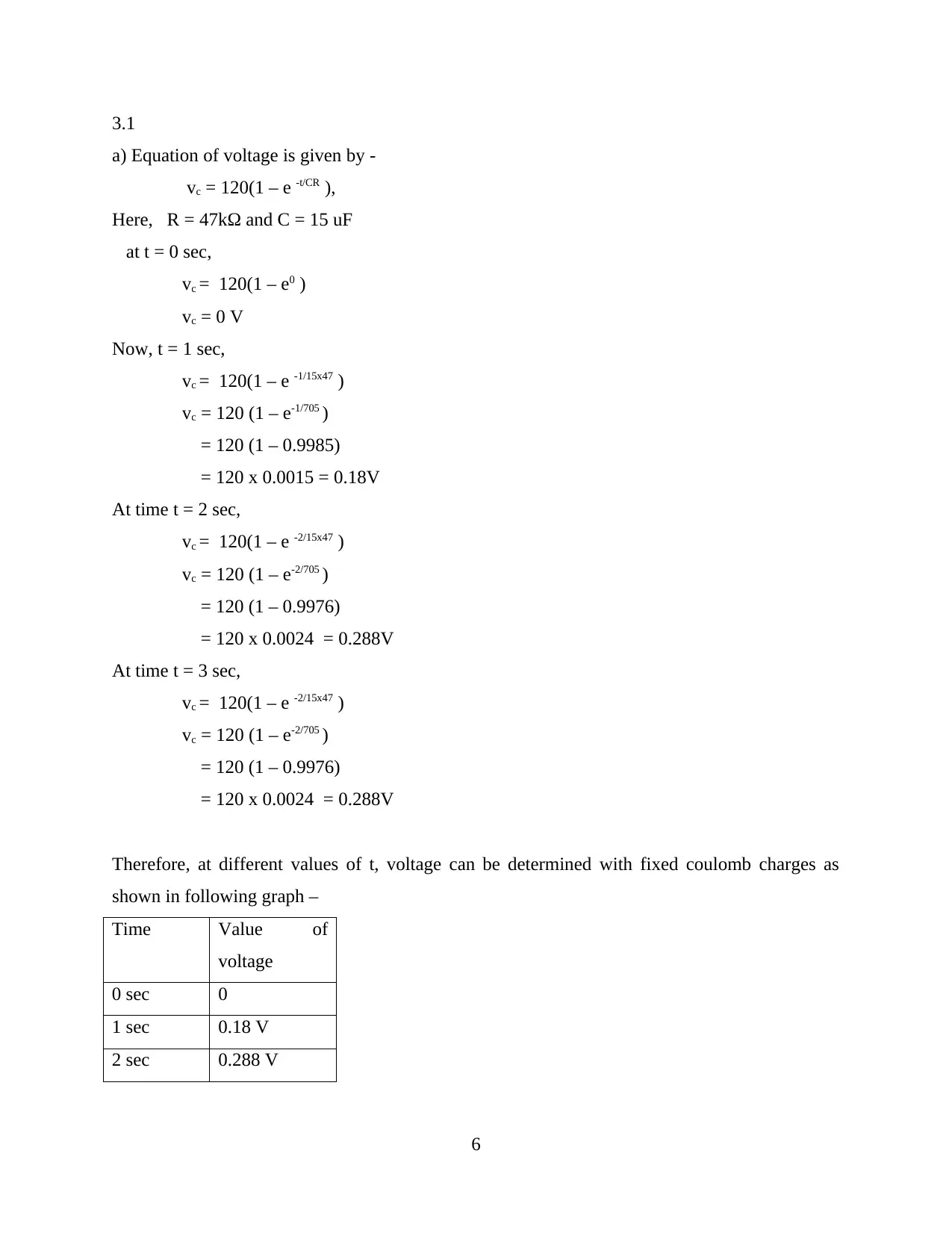
3.1
a) Equation of voltage is given by -
vc = 120(1 – e -t/CR ),
Here, R = 47kΩ and C = 15 uF
at t = 0 sec,
vc = 120(1 – e0 )
vc = 0 V
Now, t = 1 sec,
vc = 120(1 – e -1/15x47 )
vc = 120 (1 – e-1/705 )
= 120 (1 – 0.9985)
= 120 x 0.0015 = 0.18V
At time t = 2 sec,
vc = 120(1 – e -2/15x47 )
vc = 120 (1 – e-2/705 )
= 120 (1 – 0.9976)
= 120 x 0.0024 = 0.288V
At time t = 3 sec,
vc = 120(1 – e -2/15x47 )
vc = 120 (1 – e-2/705 )
= 120 (1 – 0.9976)
= 120 x 0.0024 = 0.288V
Therefore, at different values of t, voltage can be determined with fixed coulomb charges as
shown in following graph –
Time Value of
voltage
0 sec 0
1 sec 0.18 V
2 sec 0.288 V
6
Document Page
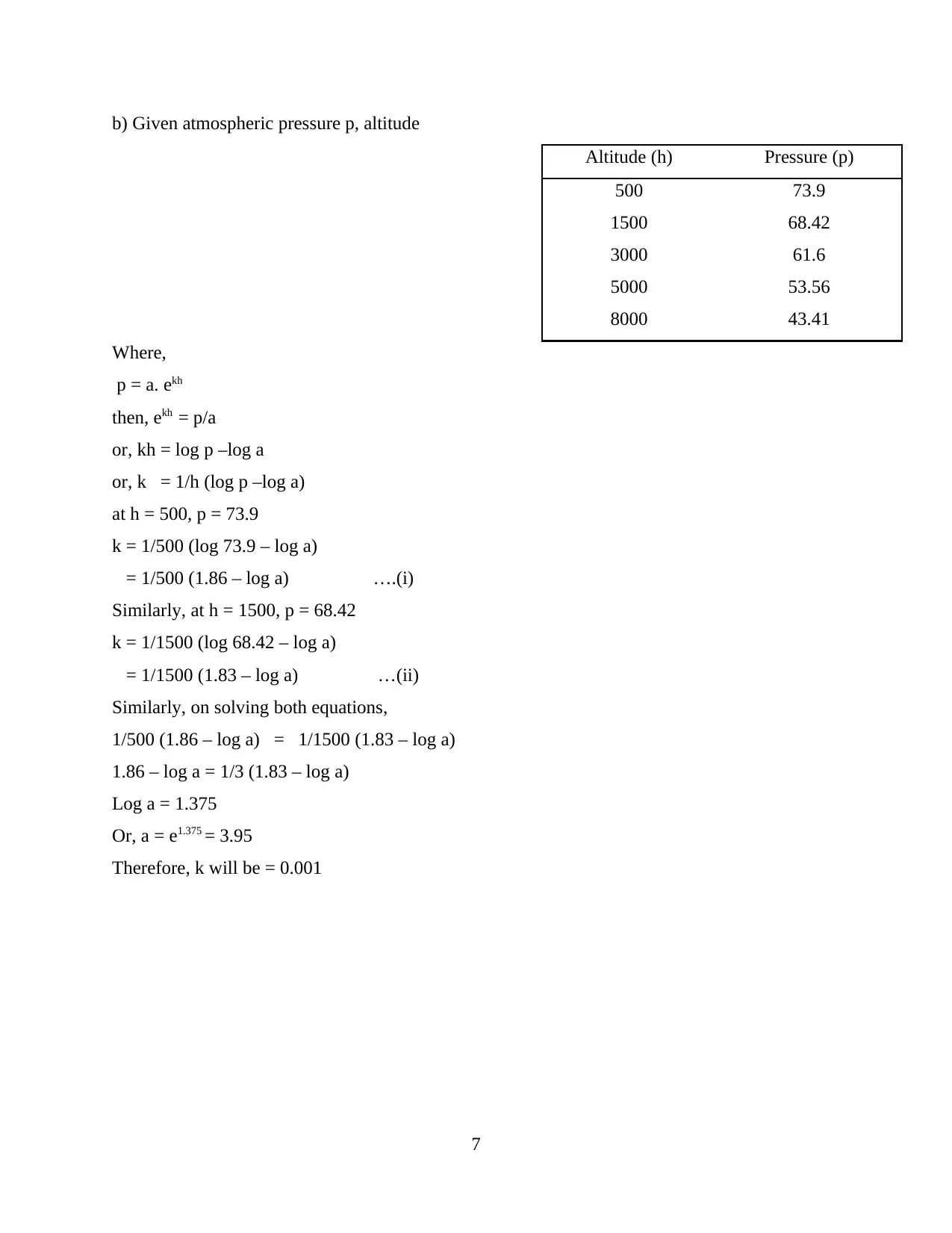
b) Given atmospheric pressure p, altitude
Altitude (h) Pressure (p)
500 73.9
1500 68.42
3000 61.6
5000 53.56
8000 43.41
Where,
p = a. ekh
then, ekh = p/a
or, kh = log p –log a
or, k = 1/h (log p –log a)
at h = 500, p = 73.9
k = 1/500 (log 73.9 – log a)
= 1/500 (1.86 – log a) ….(i)
Similarly, at h = 1500, p = 68.42
k = 1/1500 (log 68.42 – log a)
= 1/1500 (1.83 – log a) …(ii)
Similarly, on solving both equations,
1/500 (1.86 – log a) = 1/1500 (1.83 – log a)
1.86 – log a = 1/3 (1.83 – log a)
Log a = 1.375
Or, a = e1.375 = 3.95
Therefore, k will be = 0.001
7
Document Page
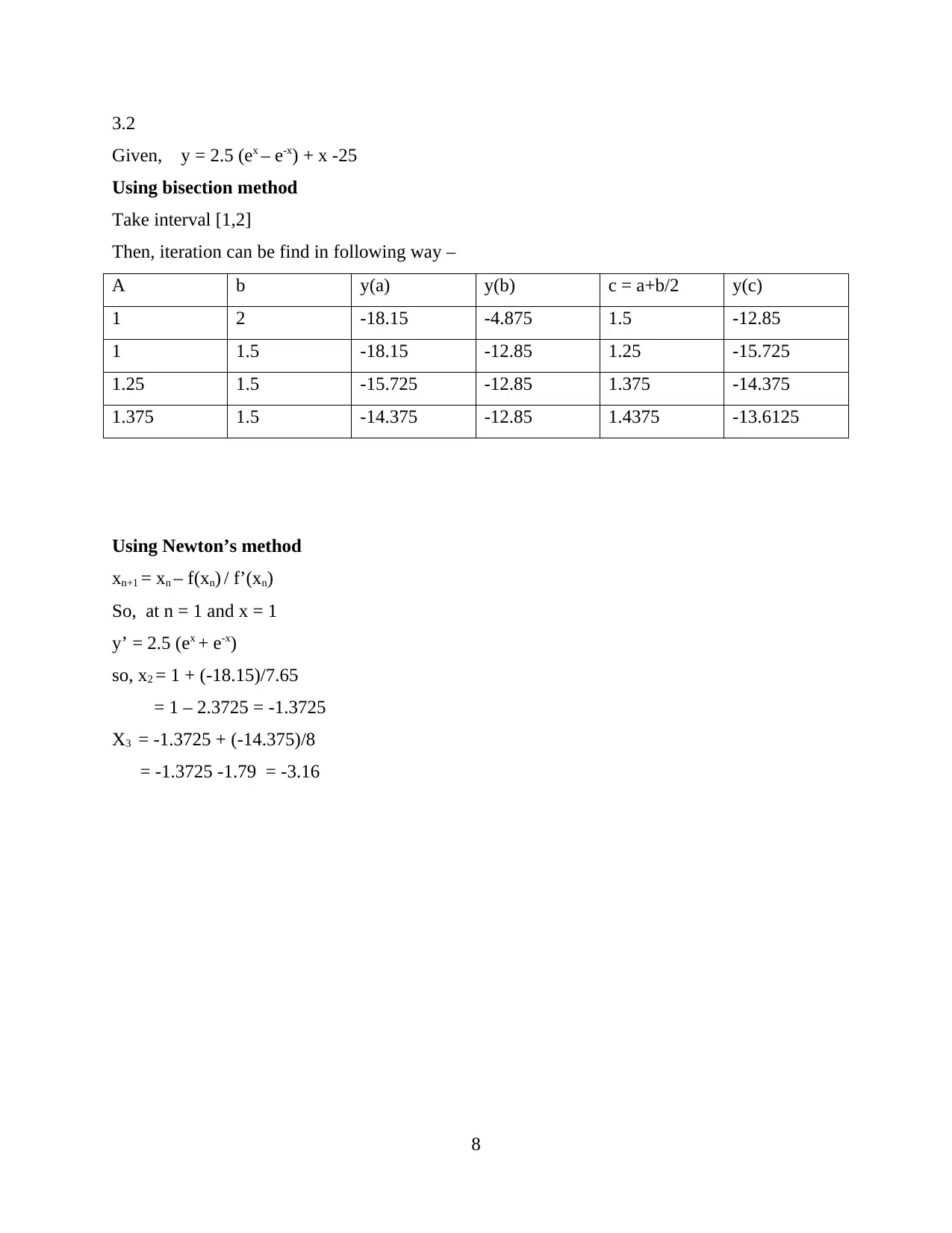
3.2
Given, y = 2.5 (ex – e-x) + x -25
Using bisection method
Take interval [1,2]
Then, iteration can be find in following way –
A b y(a) y(b) c = a+b/2 y(c)
1 2 -18.15 -4.875 1.5 -12.85
1 1.5 -18.15 -12.85 1.25 -15.725
1.25 1.5 -15.725 -12.85 1.375 -14.375
1.375 1.5 -14.375 -12.85 1.4375 -13.6125
Using Newton’s method
xn+1 = xn – f(xn) / f’(xn)
So, at n = 1 and x = 1
y’ = 2.5 (ex + e-x)
so, x2 = 1 + (-18.15)/7.65
= 1 – 2.3725 = -1.3725
X3 = -1.3725 + (-14.375)/8
= -1.3725 -1.79 = -3.16
8
tabler-icon-diamond-filled.svg

Paraphrase This Document

Need a fresh take? Get an instant paraphrase of this document with our AI Paraphraser
Document Page
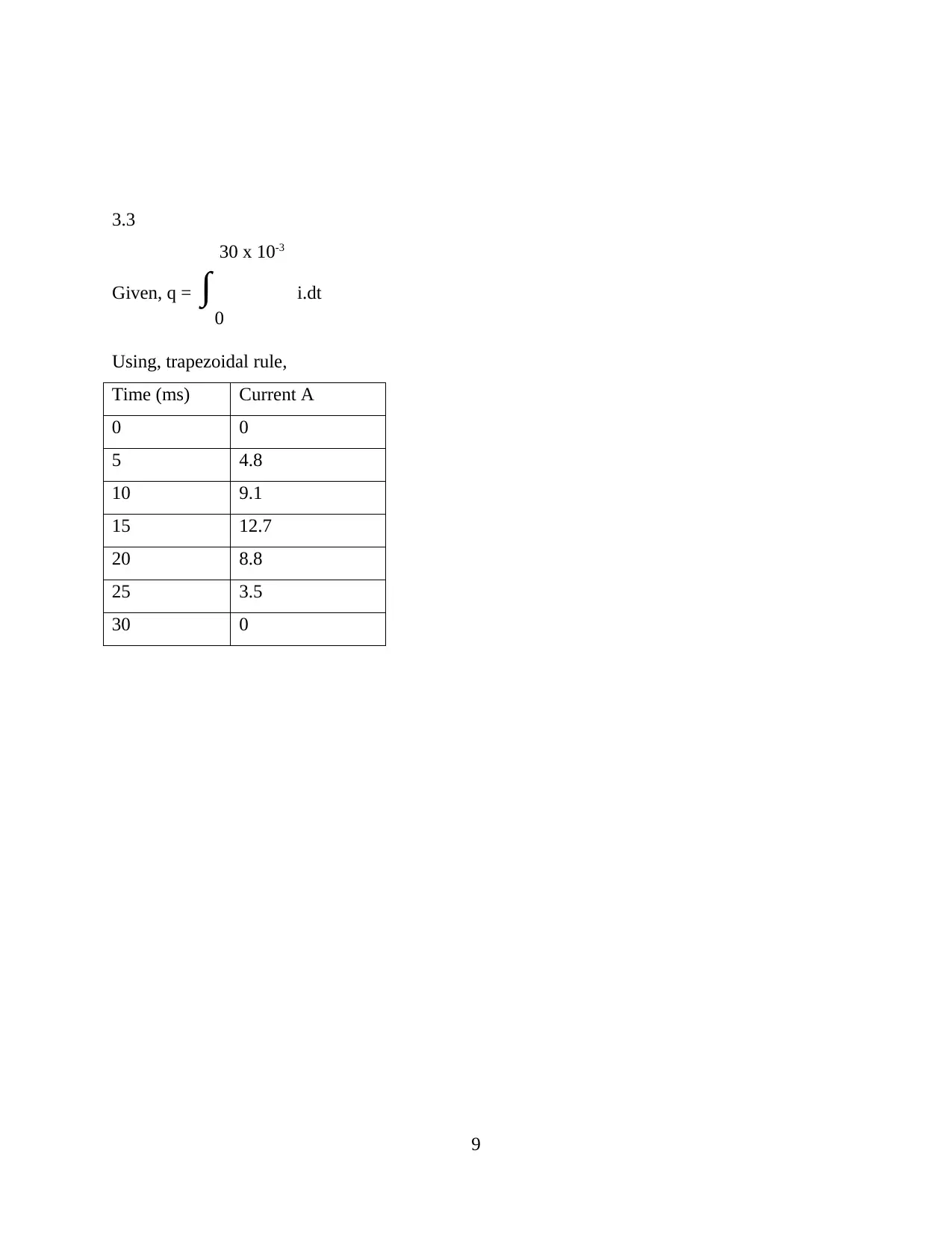
3.3
30 x 10-3
Given, q = i.dt
0
Using, trapezoidal rule,
Time (ms) Current A
0 0
5 4.8
10 9.1
15 12.7
20 8.8
25 3.5
30 0
9
Document Page
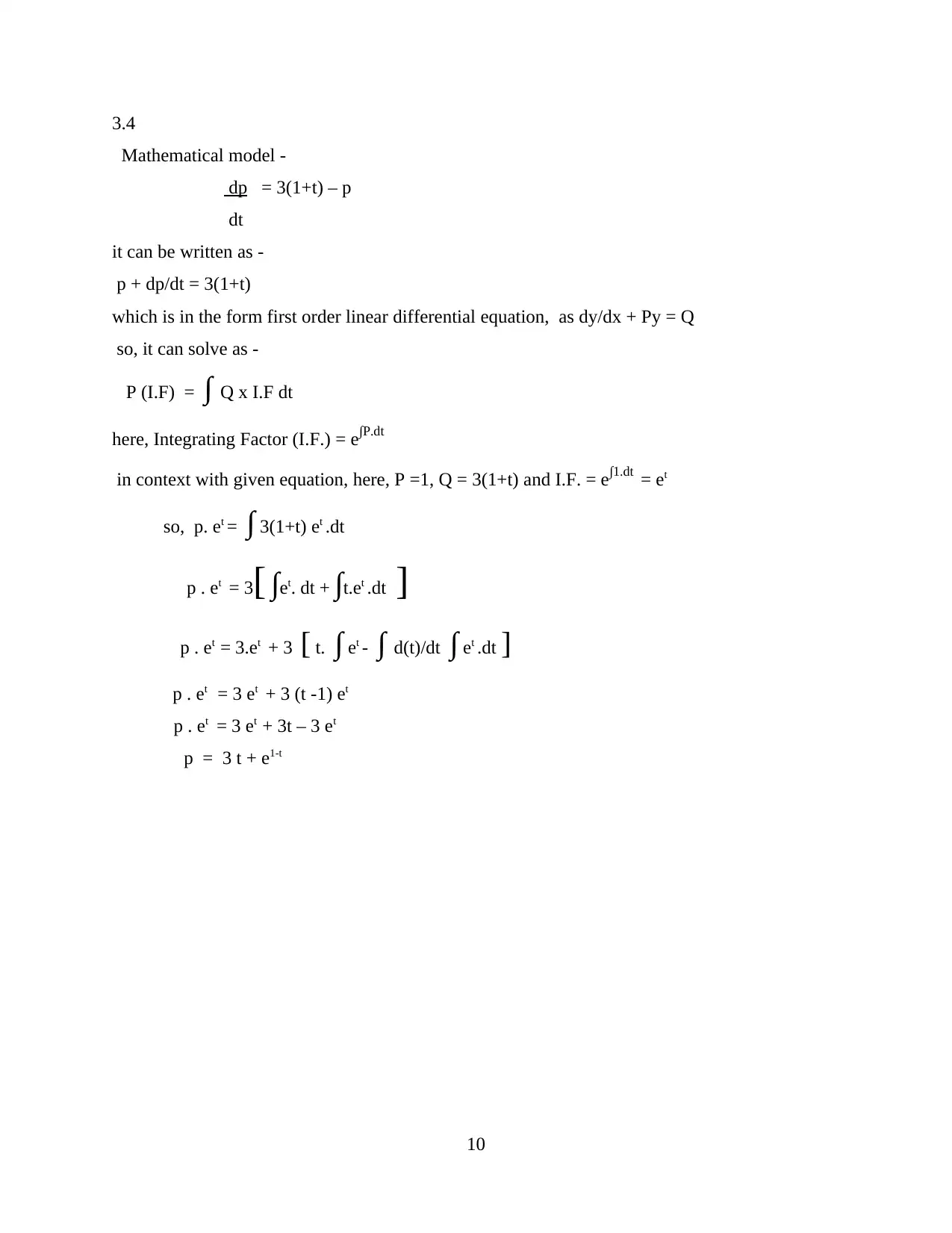
3.4
Mathematical model -
dp = 3(1+t) – p
dt
it can be written as -
p + dp/dt = 3(1+t)
which is in the form first order linear differential equation, as dy/dx + Py = Q
so, it can solve as -
P (I.F) = Q x I.F dt
here, Integrating Factor (I.F.) = e∫P.dt
in context with given equation, here, P =1, Q = 3(1+t) and I.F. = e∫1.dt = et
so, p. et = 3(1+t) et .dt
p . et = 3[ et. dt + t.et .dt ]
p . et = 3.et + 3 [ t. et - d(t)/dt et .dt ]
p . et = 3 et + 3 (t -1) et
p . et = 3 et + 3t – 3 et
p = 3 t + e1-t
10
chevron_up_icon
1 out of 14
circle_padding
hide_on_mobile
zoom_out_icon
[object Object]