Report: Analyzing Job Cuts and Stakeholder Impact at NAB
VerifiedAdded on 2020/06/06
|9
|1945
|52
Report
AI Summary
This report provides an in-depth analysis of the job cuts implemented by the National Australia Bank (NAB). The study examines the financial rationale behind the decision, including the role of technology and the bank's pursuit of increased profitability. It highlights the impact on various stakeholders, including employees, investors, and the broader community, exploring their concerns and the ethical implications of the job cuts. The report delves into the application of accounting theory, stakeholder theory, and agency theory to understand the complexities of the situation. It concludes by assessing the potential adverse effects of the strategy on business performance and suggests alternative approaches for the management team to consider, emphasizing the importance of employee welfare and ethical considerations.

The Analysis of NAB

Paraphrase This Document
Need a fresh take? Get an instant paraphrase of this document with our AI Paraphraser
ABSTRACT
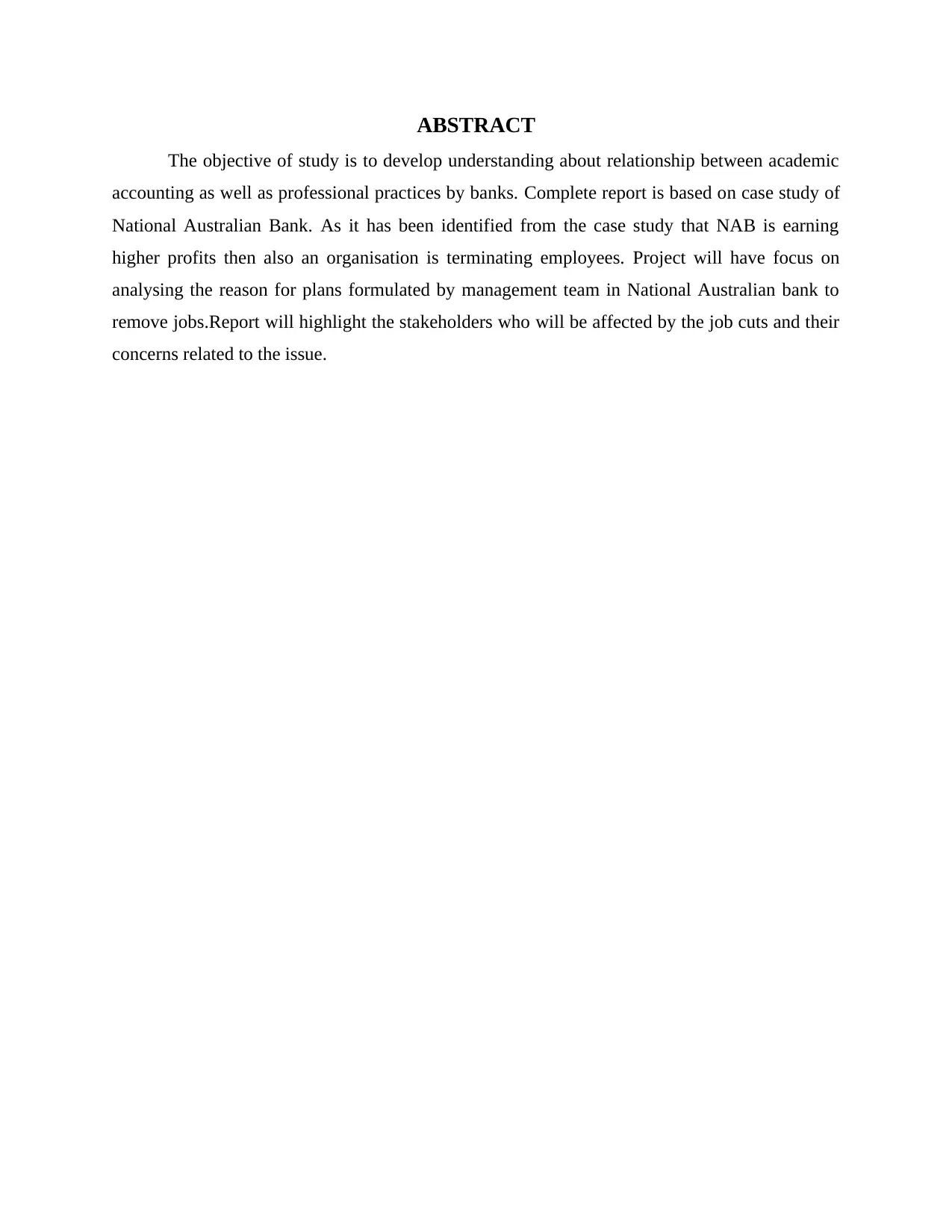
The objective of study is to develop understanding about relationship between academic
accounting as well as professional practices by banks. Complete report is based on case study of
National Australian Bank. As it has been identified from the case study that NAB is earning
higher profits then also an organisation is terminating employees. Project will have focus on
analysing the reason for plans formulated by management team in National Australian bank to
remove jobs.Report will highlight the stakeholders who will be affected by the job cuts and their
concerns related to the issue.
The objective of study is to develop understanding about relationship between academic
accounting as well as professional practices by banks. Complete report is based on case study of
National Australian Bank. As it has been identified from the case study that NAB is earning
higher profits then also an organisation is terminating employees. Project will have focus on
analysing the reason for plans formulated by management team in National Australian bank to
remove jobs.Report will highlight the stakeholders who will be affected by the job cuts and their
concerns related to the issue.

TABLE OF CONTENTS
INTRODUCTION...........................................................................................................................4
MAIN BODY ..................................................................................................................................4
CONCLUSION ...............................................................................................................................6
REFERENCES................................................................................................................................7
INTRODUCTION...........................................................................................................................4
MAIN BODY ..................................................................................................................................4
CONCLUSION ...............................................................................................................................6
REFERENCES................................................................................................................................7
⊘ This is a preview!⊘
Do you want full access?
Subscribe today to unlock all pages.

Trusted by 1+ million students worldwide
INTRODUCTION
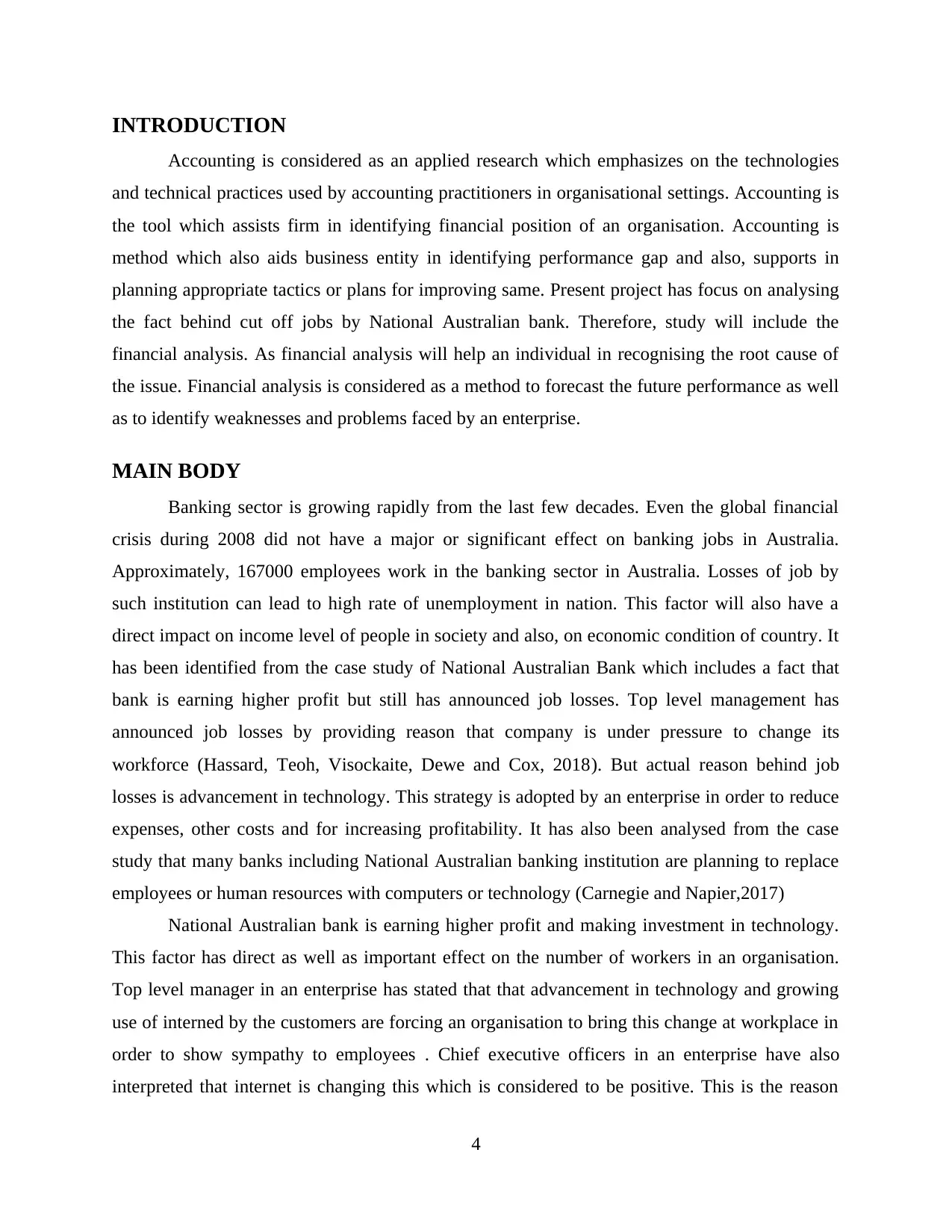
Accounting is considered as an applied research which emphasizes on the technologies
and technical practices used by accounting practitioners in organisational settings. Accounting is
the tool which assists firm in identifying financial position of an organisation. Accounting is
method which also aids business entity in identifying performance gap and also, supports in
planning appropriate tactics or plans for improving same. Present project has focus on analysing
the fact behind cut off jobs by National Australian bank. Therefore, study will include the
financial analysis. As financial analysis will help an individual in recognising the root cause of
the issue. Financial analysis is considered as a method to forecast the future performance as well
as to identify weaknesses and problems faced by an enterprise.
MAIN BODY
Banking sector is growing rapidly from the last few decades. Even the global financial
crisis during 2008 did not have a major or significant effect on banking jobs in Australia.
Approximately, 167000 employees work in the banking sector in Australia. Losses of job by
such institution can lead to high rate of unemployment in nation. This factor will also have a
direct impact on income level of people in society and also, on economic condition of country. It
has been identified from the case study of National Australian Bank which includes a fact that
bank is earning higher profit but still has announced job losses. Top level management has
announced job losses by providing reason that company is under pressure to change its
workforce (Hassard, Teoh, Visockaite, Dewe and Cox, 2018). But actual reason behind job
losses is advancement in technology. This strategy is adopted by an enterprise in order to reduce
expenses, other costs and for increasing profitability. It has also been analysed from the case
study that many banks including National Australian banking institution are planning to replace
employees or human resources with computers or technology (Carnegie and Napier,2017)
National Australian bank is earning higher profit and making investment in technology.
This factor has direct as well as important effect on the number of workers in an organisation.
Top level manager in an enterprise has stated that that advancement in technology and growing
use of interned by the customers are forcing an organisation to bring this change at workplace in
order to show sympathy to employees . Chief executive officers in an enterprise have also
interpreted that internet is changing this which is considered to be positive. This is the reason
4
Accounting is considered as an applied research which emphasizes on the technologies
and technical practices used by accounting practitioners in organisational settings. Accounting is
the tool which assists firm in identifying financial position of an organisation. Accounting is
method which also aids business entity in identifying performance gap and also, supports in
planning appropriate tactics or plans for improving same. Present project has focus on analysing
the fact behind cut off jobs by National Australian bank. Therefore, study will include the
financial analysis. As financial analysis will help an individual in recognising the root cause of
the issue. Financial analysis is considered as a method to forecast the future performance as well
as to identify weaknesses and problems faced by an enterprise.
MAIN BODY
Banking sector is growing rapidly from the last few decades. Even the global financial
crisis during 2008 did not have a major or significant effect on banking jobs in Australia.
Approximately, 167000 employees work in the banking sector in Australia. Losses of job by
such institution can lead to high rate of unemployment in nation. This factor will also have a
direct impact on income level of people in society and also, on economic condition of country. It
has been identified from the case study of National Australian Bank which includes a fact that
bank is earning higher profit but still has announced job losses. Top level management has
announced job losses by providing reason that company is under pressure to change its
workforce (Hassard, Teoh, Visockaite, Dewe and Cox, 2018). But actual reason behind job
losses is advancement in technology. This strategy is adopted by an enterprise in order to reduce
expenses, other costs and for increasing profitability. It has also been analysed from the case
study that many banks including National Australian banking institution are planning to replace
employees or human resources with computers or technology (Carnegie and Napier,2017)
National Australian bank is earning higher profit and making investment in technology.
This factor has direct as well as important effect on the number of workers in an organisation.
Top level manager in an enterprise has stated that that advancement in technology and growing
use of interned by the customers are forcing an organisation to bring this change at workplace in
order to show sympathy to employees . Chief executive officers in an enterprise have also
interpreted that internet is changing this which is considered to be positive. This is the reason
4
Paraphrase This Document
Need a fresh take? Get an instant paraphrase of this document with our AI Paraphraser
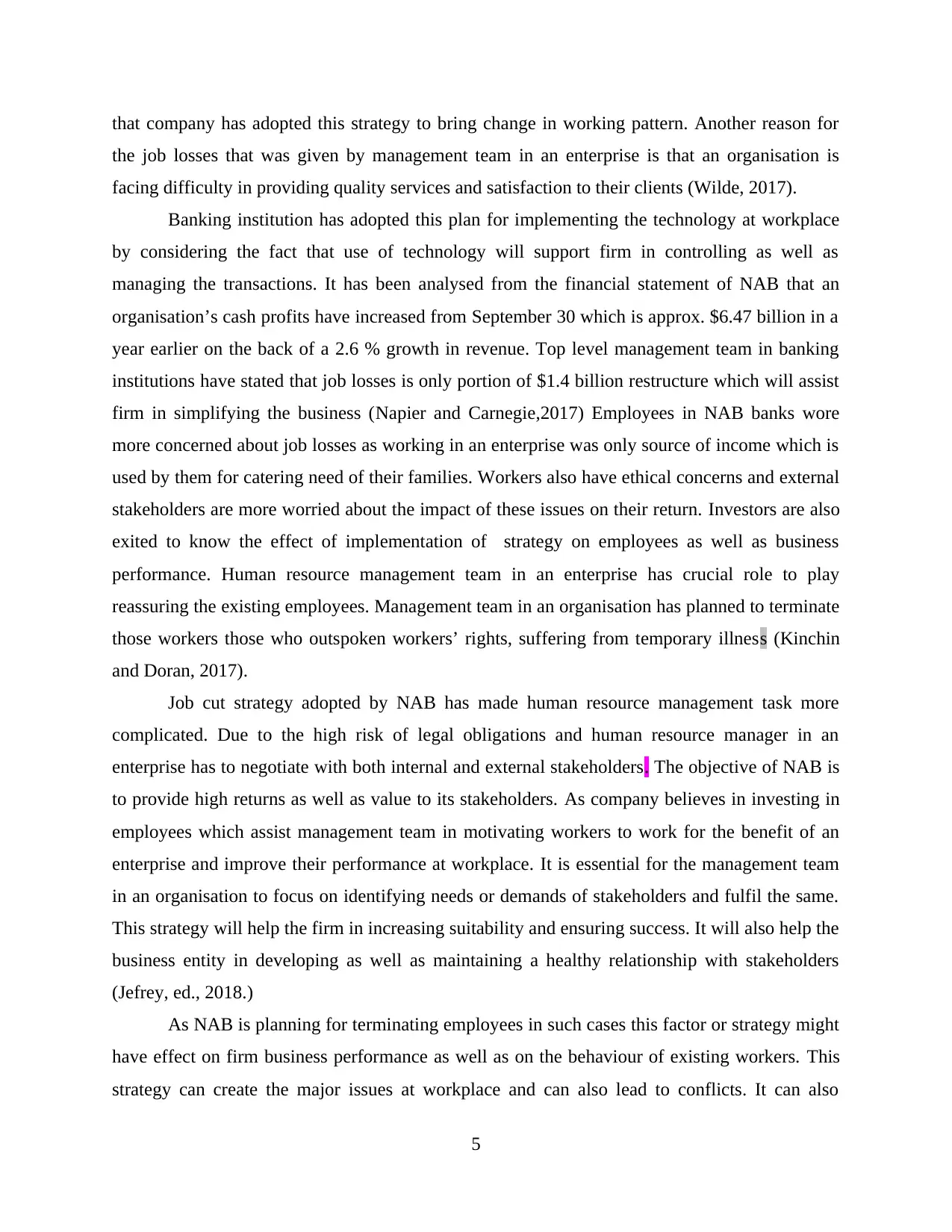
that company has adopted this strategy to bring change in working pattern. Another reason for
the job losses that was given by management team in an enterprise is that an organisation is
facing difficulty in providing quality services and satisfaction to their clients (Wilde, 2017).
Banking institution has adopted this plan for implementing the technology at workplace
by considering the fact that use of technology will support firm in controlling as well as
managing the transactions. It has been analysed from the financial statement of NAB that an
organisation’s cash profits have increased from September 30 which is approx. $6.47 billion in a
year earlier on the back of a 2.6 % growth in revenue. Top level management team in banking
institutions have stated that job losses is only portion of $1.4 billion restructure which will assist
firm in simplifying the business (Napier and Carnegie,2017) Employees in NAB banks wore
more concerned about job losses as working in an enterprise was only source of income which is
used by them for catering need of their families. Workers also have ethical concerns and external
stakeholders are more worried about the impact of these issues on their return. Investors are also
exited to know the effect of implementation of strategy on employees as well as business
performance. Human resource management team in an enterprise has crucial role to play
reassuring the existing employees. Management team in an organisation has planned to terminate
those workers those who outspoken workers’ rights, suffering from temporary illness (Kinchin
and Doran, 2017).
Job cut strategy adopted by NAB has made human resource management task more
complicated. Due to the high risk of legal obligations and human resource manager in an
enterprise has to negotiate with both internal and external stakeholders. The objective of NAB is
to provide high returns as well as value to its stakeholders. As company believes in investing in
employees which assist management team in motivating workers to work for the benefit of an
enterprise and improve their performance at workplace. It is essential for the management team
in an organisation to focus on identifying needs or demands of stakeholders and fulfil the same.
This strategy will help the firm in increasing suitability and ensuring success. It will also help the
business entity in developing as well as maintaining a healthy relationship with stakeholders
(Jefrey, ed., 2018.)
As NAB is planning for terminating employees in such cases this factor or strategy might
have effect on firm business performance as well as on the behaviour of existing workers. This
strategy can create the major issues at workplace and can also lead to conflicts. It can also
5
the job losses that was given by management team in an enterprise is that an organisation is
facing difficulty in providing quality services and satisfaction to their clients (Wilde, 2017).
Banking institution has adopted this plan for implementing the technology at workplace
by considering the fact that use of technology will support firm in controlling as well as
managing the transactions. It has been analysed from the financial statement of NAB that an
organisation’s cash profits have increased from September 30 which is approx. $6.47 billion in a
year earlier on the back of a 2.6 % growth in revenue. Top level management team in banking
institutions have stated that job losses is only portion of $1.4 billion restructure which will assist
firm in simplifying the business (Napier and Carnegie,2017) Employees in NAB banks wore
more concerned about job losses as working in an enterprise was only source of income which is
used by them for catering need of their families. Workers also have ethical concerns and external
stakeholders are more worried about the impact of these issues on their return. Investors are also
exited to know the effect of implementation of strategy on employees as well as business
performance. Human resource management team in an enterprise has crucial role to play
reassuring the existing employees. Management team in an organisation has planned to terminate
those workers those who outspoken workers’ rights, suffering from temporary illness (Kinchin
and Doran, 2017).
Job cut strategy adopted by NAB has made human resource management task more
complicated. Due to the high risk of legal obligations and human resource manager in an
enterprise has to negotiate with both internal and external stakeholders. The objective of NAB is
to provide high returns as well as value to its stakeholders. As company believes in investing in
employees which assist management team in motivating workers to work for the benefit of an
enterprise and improve their performance at workplace. It is essential for the management team
in an organisation to focus on identifying needs or demands of stakeholders and fulfil the same.
This strategy will help the firm in increasing suitability and ensuring success. It will also help the
business entity in developing as well as maintaining a healthy relationship with stakeholders
(Jefrey, ed., 2018.)
As NAB is planning for terminating employees in such cases this factor or strategy might
have effect on firm business performance as well as on the behaviour of existing workers. This
strategy can create the major issues at workplace and can also lead to conflicts. It can also
5
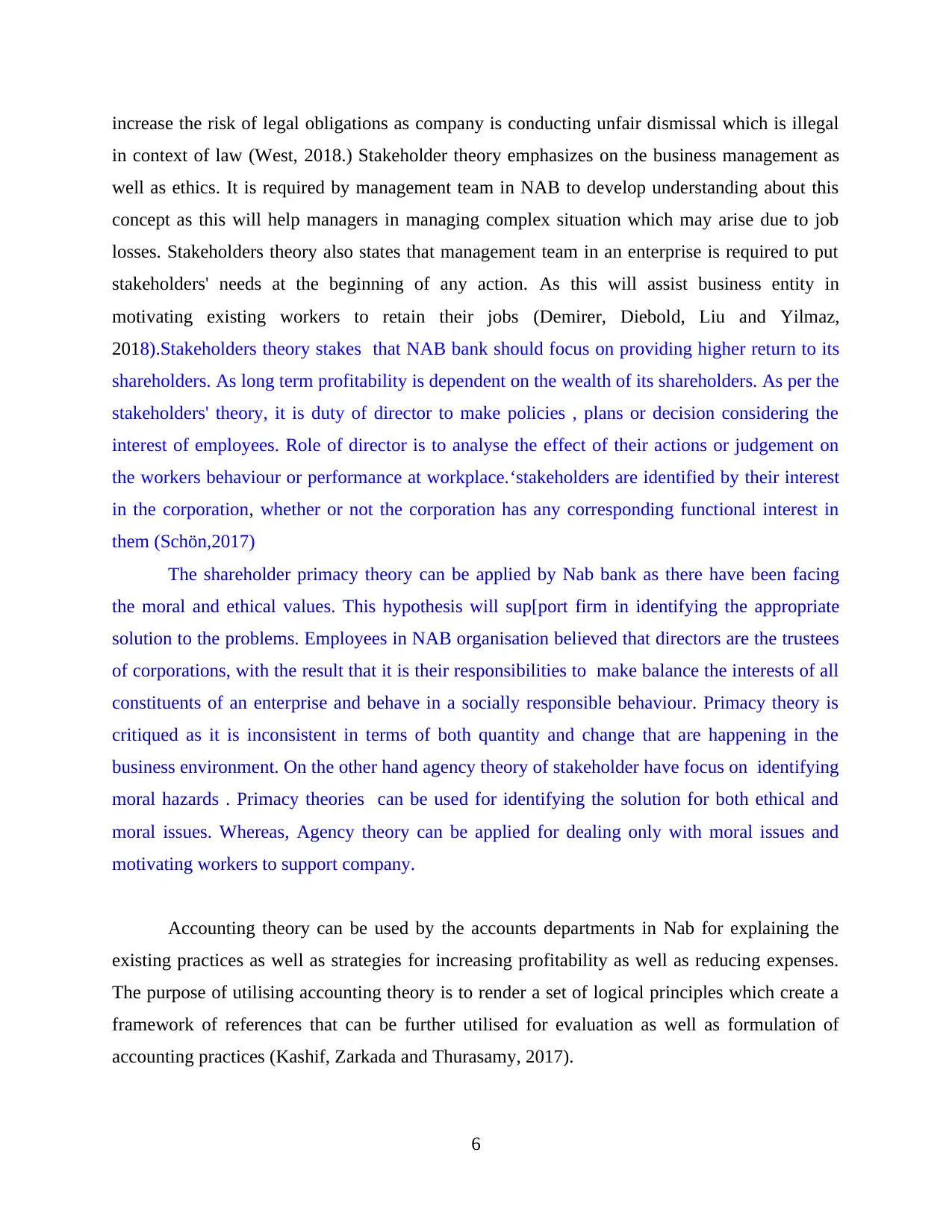
increase the risk of legal obligations as company is conducting unfair dismissal which is illegal
in context of law (West, 2018.) Stakeholder theory emphasizes on the business management as
well as ethics. It is required by management team in NAB to develop understanding about this
concept as this will help managers in managing complex situation which may arise due to job
losses. Stakeholders theory also states that management team in an enterprise is required to put
stakeholders' needs at the beginning of any action. As this will assist business entity in
motivating existing workers to retain their jobs (Demirer, Diebold, Liu and Yilmaz,
2018).Stakeholders theory stakes that NAB bank should focus on providing higher return to its
shareholders. As long term profitability is dependent on the wealth of its shareholders. As per the
stakeholders' theory, it is duty of director to make policies , plans or decision considering the
interest of employees. Role of director is to analyse the effect of their actions or judgement on
the workers behaviour or performance at workplace.‘stakeholders are identified by their interest
in the corporation, whether or not the corporation has any corresponding functional interest in
them (Schön,2017)
The shareholder primacy theory can be applied by Nab bank as there have been facing
the moral and ethical values. This hypothesis will sup[port firm in identifying the appropriate
solution to the problems. Employees in NAB organisation believed that directors are the trustees
of corporations, with the result that it is their responsibilities to make balance the interests of all
constituents of an enterprise and behave in a socially responsible behaviour. Primacy theory is
critiqued as it is inconsistent in terms of both quantity and change that are happening in the
business environment. On the other hand agency theory of stakeholder have focus on identifying
moral hazards . Primacy theories can be used for identifying the solution for both ethical and
moral issues. Whereas, Agency theory can be applied for dealing only with moral issues and
motivating workers to support company.
Accounting theory can be used by the accounts departments in Nab for explaining the
existing practices as well as strategies for increasing profitability as well as reducing expenses.
The purpose of utilising accounting theory is to render a set of logical principles which create a
framework of references that can be further utilised for evaluation as well as formulation of
accounting practices (Kashif, Zarkada and Thurasamy, 2017).
6
in context of law (West, 2018.) Stakeholder theory emphasizes on the business management as
well as ethics. It is required by management team in NAB to develop understanding about this
concept as this will help managers in managing complex situation which may arise due to job
losses. Stakeholders theory also states that management team in an enterprise is required to put
stakeholders' needs at the beginning of any action. As this will assist business entity in
motivating existing workers to retain their jobs (Demirer, Diebold, Liu and Yilmaz,
2018).Stakeholders theory stakes that NAB bank should focus on providing higher return to its
shareholders. As long term profitability is dependent on the wealth of its shareholders. As per the
stakeholders' theory, it is duty of director to make policies , plans or decision considering the
interest of employees. Role of director is to analyse the effect of their actions or judgement on
the workers behaviour or performance at workplace.‘stakeholders are identified by their interest
in the corporation, whether or not the corporation has any corresponding functional interest in
them (Schön,2017)
The shareholder primacy theory can be applied by Nab bank as there have been facing
the moral and ethical values. This hypothesis will sup[port firm in identifying the appropriate
solution to the problems. Employees in NAB organisation believed that directors are the trustees
of corporations, with the result that it is their responsibilities to make balance the interests of all
constituents of an enterprise and behave in a socially responsible behaviour. Primacy theory is
critiqued as it is inconsistent in terms of both quantity and change that are happening in the
business environment. On the other hand agency theory of stakeholder have focus on identifying
moral hazards . Primacy theories can be used for identifying the solution for both ethical and
moral issues. Whereas, Agency theory can be applied for dealing only with moral issues and
motivating workers to support company.
Accounting theory can be used by the accounts departments in Nab for explaining the
existing practices as well as strategies for increasing profitability as well as reducing expenses.
The purpose of utilising accounting theory is to render a set of logical principles which create a
framework of references that can be further utilised for evaluation as well as formulation of
accounting practices (Kashif, Zarkada and Thurasamy, 2017).
6
⊘ This is a preview!⊘
Do you want full access?
Subscribe today to unlock all pages.
Trusted by 1+ million students worldwide
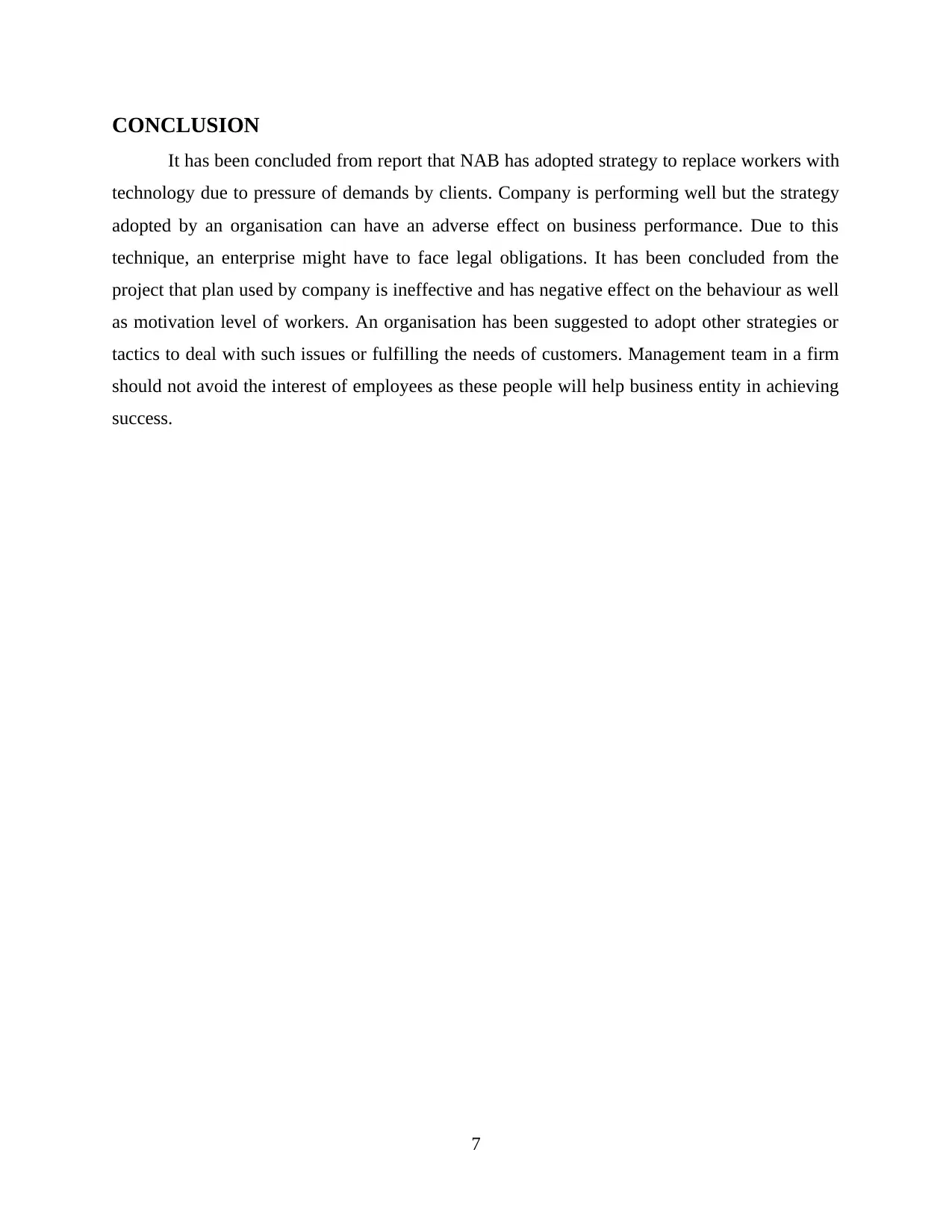
CONCLUSION
It has been concluded from report that NAB has adopted strategy to replace workers with
technology due to pressure of demands by clients. Company is performing well but the strategy
adopted by an organisation can have an adverse effect on business performance. Due to this
technique, an enterprise might have to face legal obligations. It has been concluded from the
project that plan used by company is ineffective and has negative effect on the behaviour as well
as motivation level of workers. An organisation has been suggested to adopt other strategies or
tactics to deal with such issues or fulfilling the needs of customers. Management team in a firm
should not avoid the interest of employees as these people will help business entity in achieving
success.
7
It has been concluded from report that NAB has adopted strategy to replace workers with
technology due to pressure of demands by clients. Company is performing well but the strategy
adopted by an organisation can have an adverse effect on business performance. Due to this
technique, an enterprise might have to face legal obligations. It has been concluded from the
project that plan used by company is ineffective and has negative effect on the behaviour as well
as motivation level of workers. An organisation has been suggested to adopt other strategies or
tactics to deal with such issues or fulfilling the needs of customers. Management team in a firm
should not avoid the interest of employees as these people will help business entity in achieving
success.
7
Paraphrase This Document
Need a fresh take? Get an instant paraphrase of this document with our AI Paraphraser
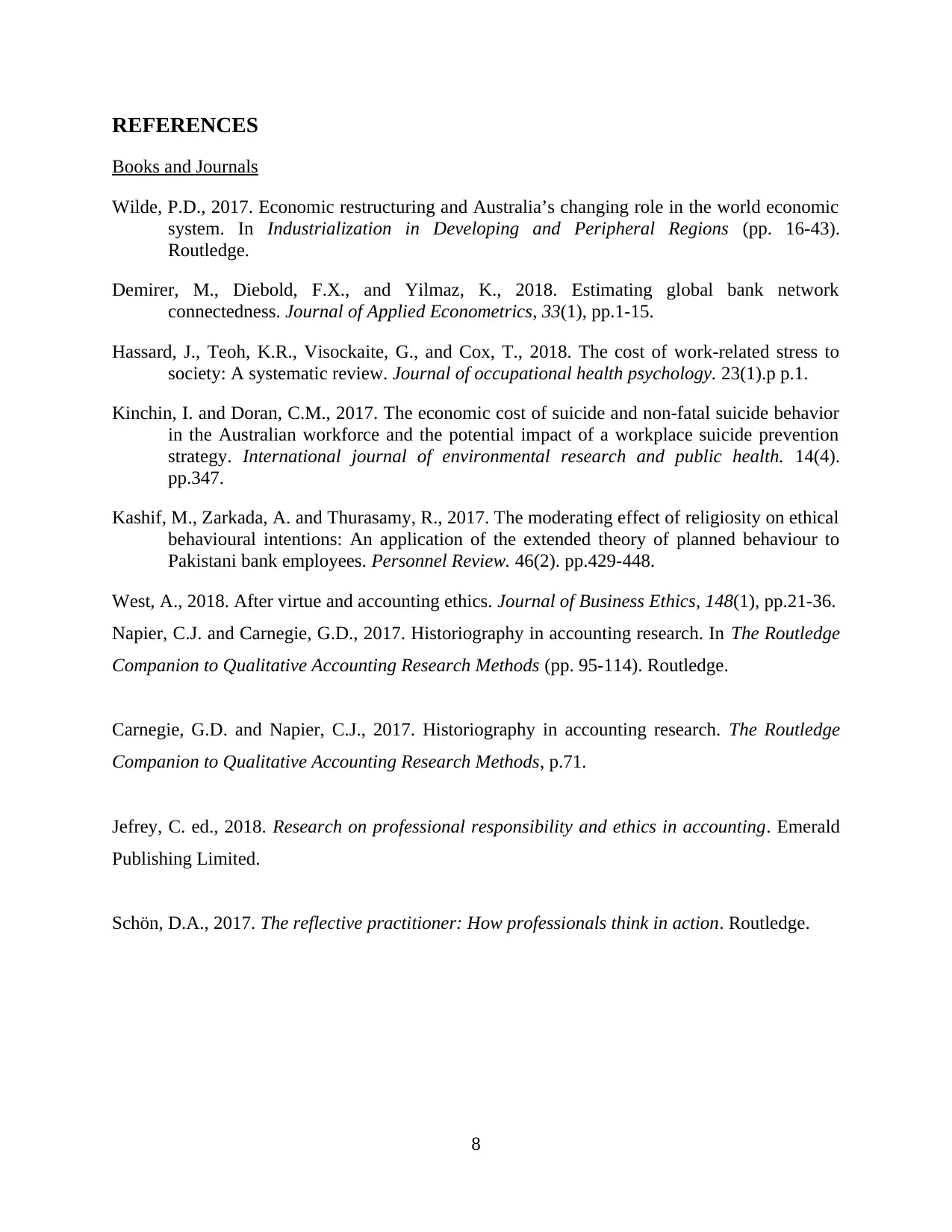
REFERENCES
Books and Journals
Wilde, P.D., 2017. Economic restructuring and Australia’s changing role in the world economic
system. In Industrialization in Developing and Peripheral Regions (pp. 16-43).
Routledge.
Demirer, M., Diebold, F.X., and Yilmaz, K., 2018. Estimating global bank network
connectedness. Journal of Applied Econometrics, 33(1), pp.1-15.
Hassard, J., Teoh, K.R., Visockaite, G., and Cox, T., 2018. The cost of work-related stress to
society: A systematic review. Journal of occupational health psychology. 23(1).p p.1.
Kinchin, I. and Doran, C.M., 2017. The economic cost of suicide and non-fatal suicide behavior
in the Australian workforce and the potential impact of a workplace suicide prevention
strategy. International journal of environmental research and public health. 14(4).
pp.347.
Kashif, M., Zarkada, A. and Thurasamy, R., 2017. The moderating effect of religiosity on ethical
behavioural intentions: An application of the extended theory of planned behaviour to
Pakistani bank employees. Personnel Review. 46(2). pp.429-448.
West, A., 2018. After virtue and accounting ethics. Journal of Business Ethics, 148(1), pp.21-36.
Napier, C.J. and Carnegie, G.D., 2017. Historiography in accounting research. In The Routledge
Companion to Qualitative Accounting Research Methods (pp. 95-114). Routledge.
Carnegie, G.D. and Napier, C.J., 2017. Historiography in accounting research. The Routledge
Companion to Qualitative Accounting Research Methods, p.71.
Jefrey, C. ed., 2018. Research on professional responsibility and ethics in accounting. Emerald
Publishing Limited.
Schön, D.A., 2017. The reflective practitioner: How professionals think in action. Routledge.
8
Books and Journals
Wilde, P.D., 2017. Economic restructuring and Australia’s changing role in the world economic
system. In Industrialization in Developing and Peripheral Regions (pp. 16-43).
Routledge.
Demirer, M., Diebold, F.X., and Yilmaz, K., 2018. Estimating global bank network
connectedness. Journal of Applied Econometrics, 33(1), pp.1-15.
Hassard, J., Teoh, K.R., Visockaite, G., and Cox, T., 2018. The cost of work-related stress to
society: A systematic review. Journal of occupational health psychology. 23(1).p p.1.
Kinchin, I. and Doran, C.M., 2017. The economic cost of suicide and non-fatal suicide behavior
in the Australian workforce and the potential impact of a workplace suicide prevention
strategy. International journal of environmental research and public health. 14(4).
pp.347.
Kashif, M., Zarkada, A. and Thurasamy, R., 2017. The moderating effect of religiosity on ethical
behavioural intentions: An application of the extended theory of planned behaviour to
Pakistani bank employees. Personnel Review. 46(2). pp.429-448.
West, A., 2018. After virtue and accounting ethics. Journal of Business Ethics, 148(1), pp.21-36.
Napier, C.J. and Carnegie, G.D., 2017. Historiography in accounting research. In The Routledge
Companion to Qualitative Accounting Research Methods (pp. 95-114). Routledge.
Carnegie, G.D. and Napier, C.J., 2017. Historiography in accounting research. The Routledge
Companion to Qualitative Accounting Research Methods, p.71.
Jefrey, C. ed., 2018. Research on professional responsibility and ethics in accounting. Emerald
Publishing Limited.
Schön, D.A., 2017. The reflective practitioner: How professionals think in action. Routledge.
8

9
⊘ This is a preview!⊘
Do you want full access?
Subscribe today to unlock all pages.
Trusted by 1+ million students worldwide

1 out of 9


Related Documents


Your All-in-One AI-Powered Toolkit for Academic Success.
+13062052269
info@desklib.com
Available 24*7 on WhatsApp / Email
![[object Object]](/_next/static/media/star-bottom.7253800d.svg)
Unlock your academic potential
Copyright © 2020–2026 A2Z Services. All Rights Reserved. Developed and managed by ZUCOL.