Nazi Propaganda: Analysis of Techniques and Impact on German Society

Verified

Added on  2022/09/12

|4
|639
|61
Essay
AI Summary
This essay provides an analysis of Nazi propaganda, highlighting its significance in shaping the beliefs and behaviors of German citizens. It focuses on the Reich Ministry for Public Enlightenment and Propaganda's role in transmitting Nazi ideology through easily accessible portrayals of good versus evil. The propaganda strategically targeted groups deemed undesirable, such as Jews, Gypsies, and political dissidents, capitalizing on existing stereotypes and the economic and political climate. Key themes included the deification of Hitler, demonization of opponents, and rallying the public for war and eugenics. The essay examines specific propaganda posters, illustrating how they employed techniques like the halo effect and authority bias to enhance Hitler's image and promote Nazi ideals, ultimately portraying him as a strong leader capable of restoring Germany's power.
Document Page
The Nazi Propaganda
NAME OF STUDENT:
COURSE NAME:
tabler-icon-diamond-filled.svg

Paraphrase This Document

Need a fresh take? Get an instant paraphrase of this document with our AI Paraphraser
Document Page
Analysis
Propaganda was significant technique that was used by Nazis to shape faith and
behaviour of German citizens and by posters they inundated Germans with
ideas developed to gain back up and build endurance to their conceptualisation
for future of Germany. While there are many events that present relevance that
Nazis placed on propoganda, none is more relevant than the beginning of Reich
Ministry for Public Enlightenment and Propaganda (RMVP). Under these, Nazi
party discovered their effecaciousness to transmit principle thinking into
portrayals that presented Good vs. Evil notion valued over Us vs. Them
scenario, simply approachable and contemplated by public. By taking advantage
of prevailing typecast and attitudes of Germans, Nazi propaganda tend to victim
those whom they deemed as their rivals or undeserving of being inhabitant such
as Jews, Gypsies, homosexuals, communists and other political protestors and
those Germans who were observed as substandard and harmful to establishing
powerful Germany like mentally or physical disabled individuals. Considering
political and economic during that period, merged with indignity and biasness
of Treaty of Versailles, the German public was suitable for such propaganda.
Hence Nazi propaganda attempted to realise established objective of Nazi party
and concentrated on amplification of certain matters such as indignity of
Germany and unjustness of Versailles Treaty, flaw of Weinmar parliamentary
republic and bad of Jewry, Bolshevism, and Capitalism compared to loyalist Nazi
German (George, 2019). Whereas these were presiding themes, the propaganda itself had
three focal points i.e. Deification of Hitler (example as messiah character to be pursued),
Defining the opponent and validating their treatment (example Jews and Bolsheviks),
Rallying the public ( example for war and eugenics.
1
Document Page
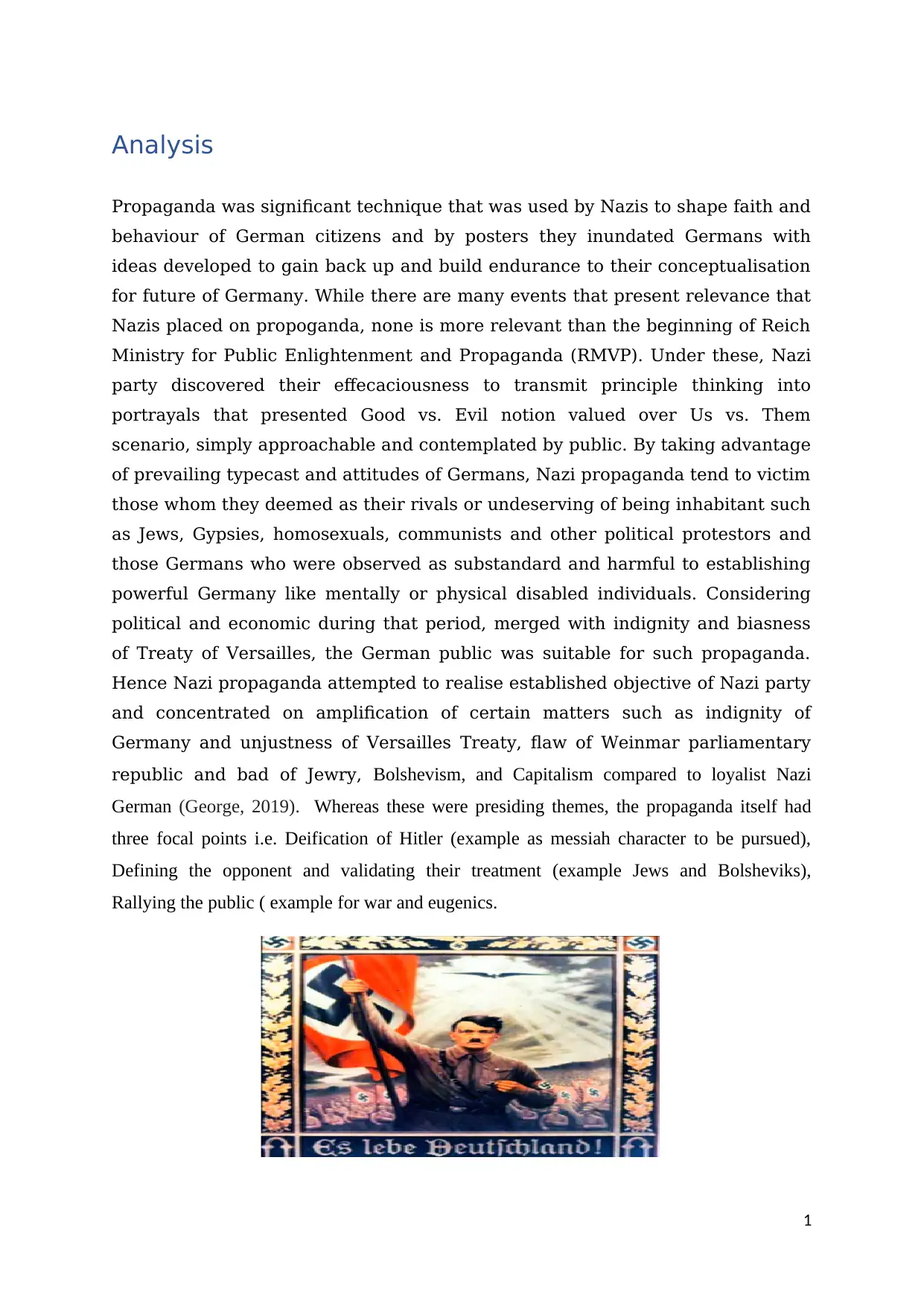
[Poster 1]
Source: (Narayanaswami, 2011)
One of the finest representation of Nazi propaganda is a poster as shown above which created
the craze of personality around Adolf Hitler where it can be clearly noticed that a light
appears around Hitler which portrays his messiah image, almost giving him a halo. Moreover
the appearance of winged bird offers angelic feature to this poster and this is only intensified
by appearance of wreath like flowers surrounding the poster (Narayanaswami, 2011) These
were designed to activate primary reaction amongst the viewers, prinicpally the Halo effect, a
social prejudice where deemed qualities of depicted personality surged on different extent of
persona.
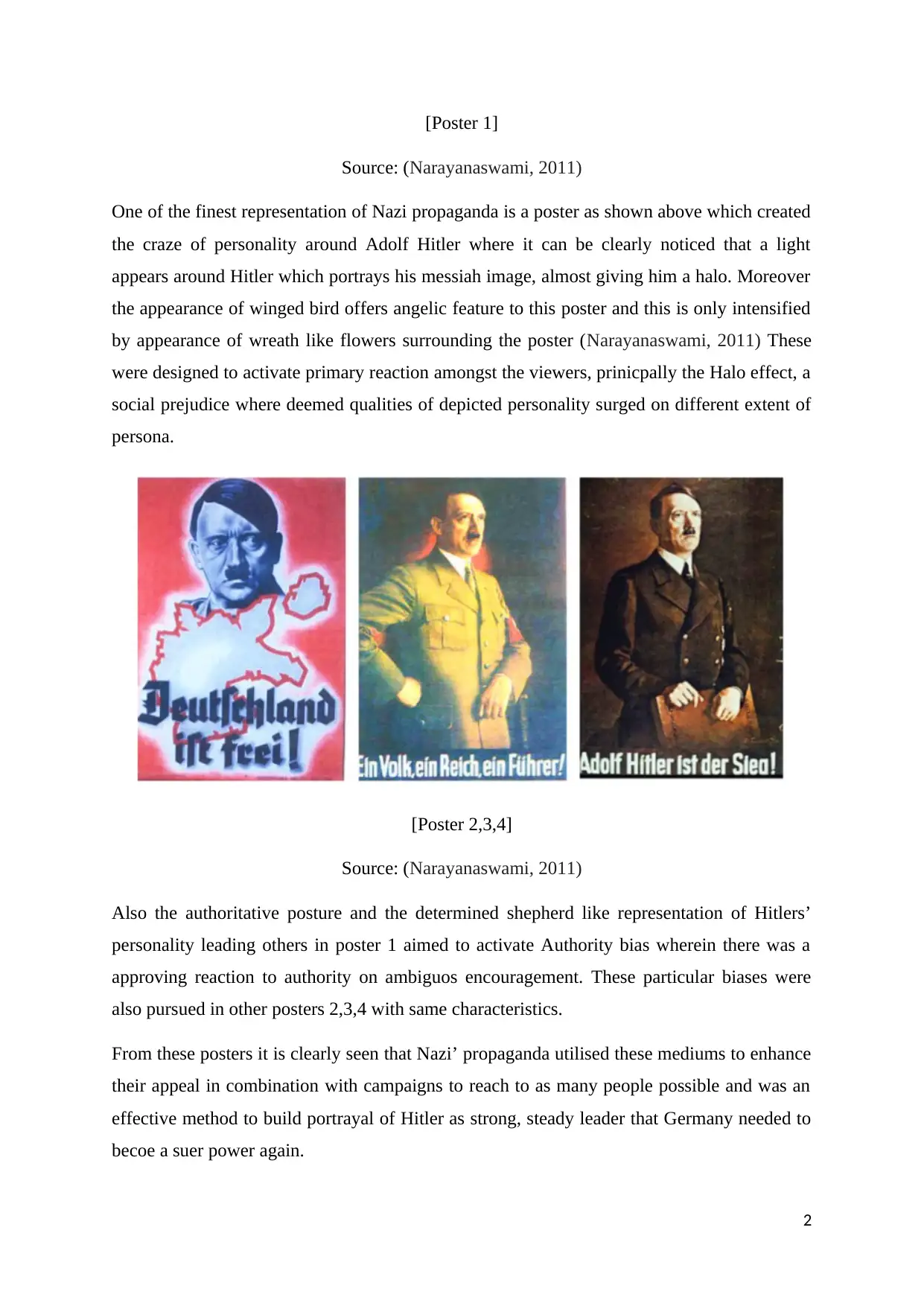
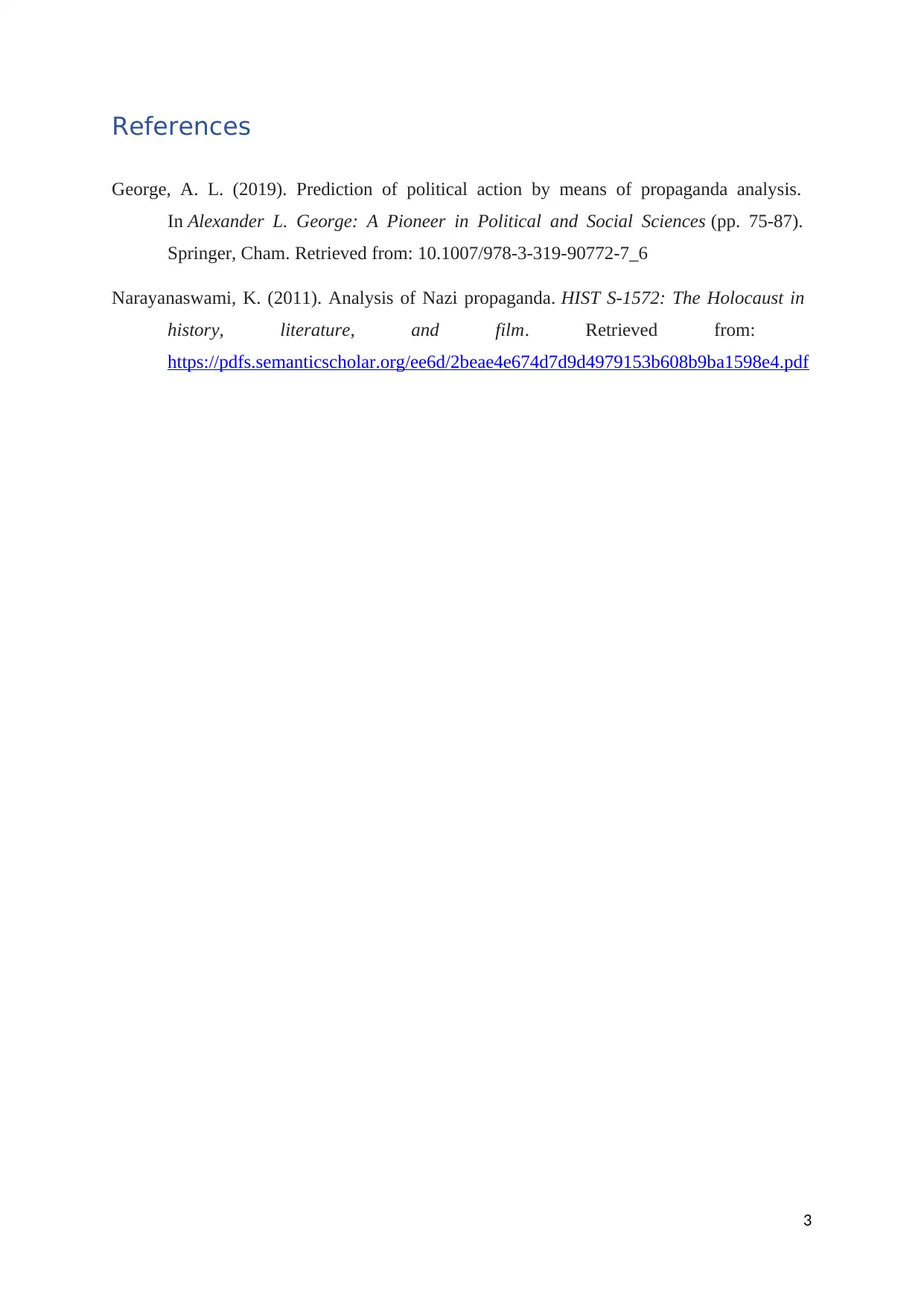
[Poster 2,3,4]
Source: (Narayanaswami, 2011)
Also the authoritative posture and the determined shepherd like representation of Hitlers’
personality leading others in poster 1 aimed to activate Authority bias wherein there was a
approving reaction to authority on ambiguos encouragement. These particular biases were
also pursued in other posters 2,3,4 with same characteristics.
From these posters it is clearly seen that Nazi’ propaganda utilised these mediums to enhance
their appeal in combination with campaigns to reach to as many people possible and was an
effective method to build portrayal of Hitler as strong, steady leader that Germany needed to
becoe a suer power again.
2
Document Page
References
George, A. L. (2019). Prediction of political action by means of propaganda analysis.
In Alexander L. George: A Pioneer in Political and Social Sciences (pp. 75-87).
Springer, Cham. Retrieved from: 10.1007/978-3-319-90772-7_6
Narayanaswami, K. (2011). Analysis of Nazi propaganda. HIST S-1572: The Holocaust in
history, literature, and film. Retrieved from:
https://pdfs.semanticscholar.org/ee6d/2beae4e674d7d9d4979153b608b9ba1598e4.pdf
3
chevron_up_icon
1 out of 4
circle_padding
hide_on_mobile
zoom_out_icon
[object Object]