Legal Analysis: Neindorf v Junkovic and Commercial Law Principles
VerifiedAdded on 2021/02/19
|9
|2395
|31
Report
AI Summary
This law report provides a detailed analysis of the Neindorf v Junkovic case, focusing on commercial law principles. The report examines the issue of negligence, duty of care, and the application of relevant legislation, including the Competition and Consumer Act 2010. It explores the different types of negligence, such as contributory, comparative, and gross negligence, and how these concepts relate to the case. The report applies the IRAC (Issue, Rule, Application, Conclusion) method to dissect the case scenario and legal arguments. It further discusses the breach of duty, causation, and harm, along with the legal outcomes and judgments. The conclusion highlights the application of comparative negligence in the case and offers insights into the responsibilities of both parties involved. The report also provides a conclusion of the case and includes references to relevant legal sources.
Law Assessment
(Task 2)
(Task 2)

Paraphrase This Document
Need a fresh take? Get an instant paraphrase of this document with our AI Paraphraser
Table of Contents
INTRODUCTION...........................................................................................................................1
MAIN BODY...................................................................................................................................1
Issue.............................................................................................................................................1
Rules............................................................................................................................................1
Application..................................................................................................................................3
Conclusion...................................................................................................................................4
CONCLUSION................................................................................................................................5
REFERENCES................................................................................................................................6
INTRODUCTION...........................................................................................................................1
MAIN BODY...................................................................................................................................1
Issue.............................................................................................................................................1
Rules............................................................................................................................................1
Application..................................................................................................................................3
Conclusion...................................................................................................................................4
CONCLUSION................................................................................................................................5
REFERENCES................................................................................................................................6
INTRODUCTION
Commercial Law is the law which determines about the legal rights and duties of any
parties which are engaged in commerce and trade activities. It is the most important law for
conducting any of the business activity as it guides about business decision which can help to
accomplish the organisational goals. There are number of branches which comes under
commercial law such as contract law, intellectual property law, law of negligence and many
more. In this project, the discussion will be conducted on the case: Neindorf v Junkovic. To
understand every thing in detail about the case: IRAC formate will be used were each and every
information are mentioned in a detail form.
MAIN BODY
Case Scenario- This was the case which occurred between Neindorf v Junkovic where
different decisions where given by different level of court by considering different situations.
Here, Neindorf was the plaintiff whereas Junkovic was defendant in this particular case. The
incident took place when Neindorf was going to see the garage which was on sale, announced by
Junkovic (Residential Premises – Standard of Care to be ascribed”: Neindorf -v- Junkovic [2005]
HCA 75, 2005).
Issue
It was one of the simple case where different issues arises because plaintiff is trying to
prove that standard of care is owned by the occupier of particular place (NEINDORF v
JUNKOVIC, High Court of Australia, 2005). Plaintiff is raising the point that pathway which
connect to house should not be cracked and if it cracked then it is the default of defendant where
as Junkovic is not ready to accept any of the default as it comes under government property.
Rules
As per the given case scenario and issues which are presented above shows that there are
number of laws and regulations which will be applied in this particular case.
Negligence: It is explained as the breach of code of conduct due to which people have to
suffer from unnecessary problem. The problem can be either in monitory form or even in any
other form. If in any of the circumstance, people becomes able to prove about negligence which
causes harm to them just because of other, then they can easily avail for losses which they have
suffered due to someone else negligence. In simple words, it is professional negligence that
1
Commercial Law is the law which determines about the legal rights and duties of any
parties which are engaged in commerce and trade activities. It is the most important law for
conducting any of the business activity as it guides about business decision which can help to
accomplish the organisational goals. There are number of branches which comes under
commercial law such as contract law, intellectual property law, law of negligence and many
more. In this project, the discussion will be conducted on the case: Neindorf v Junkovic. To
understand every thing in detail about the case: IRAC formate will be used were each and every
information are mentioned in a detail form.
MAIN BODY
Case Scenario- This was the case which occurred between Neindorf v Junkovic where
different decisions where given by different level of court by considering different situations.
Here, Neindorf was the plaintiff whereas Junkovic was defendant in this particular case. The
incident took place when Neindorf was going to see the garage which was on sale, announced by
Junkovic (Residential Premises – Standard of Care to be ascribed”: Neindorf -v- Junkovic [2005]
HCA 75, 2005).
Issue
It was one of the simple case where different issues arises because plaintiff is trying to
prove that standard of care is owned by the occupier of particular place (NEINDORF v
JUNKOVIC, High Court of Australia, 2005). Plaintiff is raising the point that pathway which
connect to house should not be cracked and if it cracked then it is the default of defendant where
as Junkovic is not ready to accept any of the default as it comes under government property.
Rules
As per the given case scenario and issues which are presented above shows that there are
number of laws and regulations which will be applied in this particular case.
Negligence: It is explained as the breach of code of conduct due to which people have to
suffer from unnecessary problem. The problem can be either in monitory form or even in any
other form. If in any of the circumstance, people becomes able to prove about negligence which
causes harm to them just because of other, then they can easily avail for losses which they have
suffered due to someone else negligence. In simple words, it is professional negligence that
1
⊘ This is a preview!⊘
Do you want full access?
Subscribe today to unlock all pages.

Trusted by 1+ million students worldwide
occur just because of irresponsibleness . Here, given duty is breached by the authorised person.
But, before taking any of the result, it is necessary that different elements should be checked
which can prove that whether person falls under the category of negligence or not.
Duty: It is the most important part of any of the work where practitioner are given the
responsibilities to perform their work in appropriate manner (Foster, 2019). Whenever any of the
practitioner are given the work, they must ensure that they are performing it in suitable way
without involving in any of the mistakes. Default in performing delegated duty many create lots
of problem for practitioner and even for organisation too. For example: Whenever any of the
perso sells their property, they are needed to make sure that they mention each and every single
information about the property and if in any of the case they fails to do then legal action can be
taken against them.
Breach: Whenever any of the involved party fails to perform their part of work which
has been delegated to them then they falls under the category of breach. This types of situation
arises whenever person is unable to perform their duty on time else they have neglected the given
work. For example: When any of the person wants to sell his/her property and in that situation it
is necessary that they must provide every single information. If person fails to do so then they
falls under the category of breach of duty.
Cause: It is the situation due to which expected result changes and produces something
which is unexpected for the person or even organisation. Whenever this types of situation arises,
it become important for plaintiff to prove that due to their negligence they have to suffer from
losses.
Harm: This process says that due to negligence person has to suffer. Here, suffer
includes problem either in monetary term or something else or both (Porter, 2017). This element
is crucial because it helps to support innocent person by clearing out any of the problem which
they faces. The most crucial point over here is that harm needs to be appropriate on ground of
physical, mental or even social damage so that case can be filed against the one who has
performed default.
Types of Negligence
Whenever it is proved that there is a negligence, it is being checked that whether the
mistake was completely of single person or even other persons where also involved in it. If
default is of both the parties then it is being decided that what covers the major part of mistake
2
But, before taking any of the result, it is necessary that different elements should be checked
which can prove that whether person falls under the category of negligence or not.
Duty: It is the most important part of any of the work where practitioner are given the
responsibilities to perform their work in appropriate manner (Foster, 2019). Whenever any of the
practitioner are given the work, they must ensure that they are performing it in suitable way
without involving in any of the mistakes. Default in performing delegated duty many create lots
of problem for practitioner and even for organisation too. For example: Whenever any of the
perso sells their property, they are needed to make sure that they mention each and every single
information about the property and if in any of the case they fails to do then legal action can be
taken against them.
Breach: Whenever any of the involved party fails to perform their part of work which
has been delegated to them then they falls under the category of breach. This types of situation
arises whenever person is unable to perform their duty on time else they have neglected the given
work. For example: When any of the person wants to sell his/her property and in that situation it
is necessary that they must provide every single information. If person fails to do so then they
falls under the category of breach of duty.
Cause: It is the situation due to which expected result changes and produces something
which is unexpected for the person or even organisation. Whenever this types of situation arises,
it become important for plaintiff to prove that due to their negligence they have to suffer from
losses.
Harm: This process says that due to negligence person has to suffer. Here, suffer
includes problem either in monetary term or something else or both (Porter, 2017). This element
is crucial because it helps to support innocent person by clearing out any of the problem which
they faces. The most crucial point over here is that harm needs to be appropriate on ground of
physical, mental or even social damage so that case can be filed against the one who has
performed default.
Types of Negligence
Whenever it is proved that there is a negligence, it is being checked that whether the
mistake was completely of single person or even other persons where also involved in it. If
default is of both the parties then it is being decided that what covers the major part of mistake
2
Paraphrase This Document
Need a fresh take? Get an instant paraphrase of this document with our AI Paraphraser
and who falls in the side of minority. By looking at all this points, negligence have been divided
into three different parts and they are:
Contributory Negligence: It is the situation where plaintiff had suffered from different
problem just because of their own default too. They even lack evidences for proving that whose
mistake have created problem for them (Mendelson and Mendelson, 2016). In short, it is
expected that the main reason behind the default is of both the parties due to which there is less
chance of getting any compensation.
Comparative Negligence: It is the case where both defaulter and innocent party have to
suffer equally. In this situation, it is necessary that both most share the losses.
Gross Negligence: When any of the default performed by practitioner just because not
following the appropriate manner to complete the task. In this situation, practitioners are
personally liable and they have to bear all of the losses.
Case Related to Negligence
Case: Oyston v St Patrick’s College 2011
Issue: Oyston was studying in St Patrick's college where other students used to bullying with her
and that is one of civil wrong. Due to lack of proper formation of policies and law, department of
college were unable to take any of the positive decision for providing justice to girl.
Judgement: The judges in this particular case decided that it was the default of college because
they are the one who is needed to form anti-bullying laws and regulations so that any of the
student will have to not suffer from any sort of bullying. It was decided that this is a case related
to tort of negligence (Student Wins Negligence Case Against School for Bullying, 2011).
Competition& Consumer Act 2010: It is the act which has been passed by legalisation.
It was previously known as Trade Practices Act 1974. The main motive this act was to enhance
the fair trade practices within the market place (Slot and Farley, 2017). It is necessary for each
and every person that they must follow each and every guidelines while purchasing and selling
any of the product. This law is helpful because it sets the standard of market due to which any
types of monopoly doesn't arises in any of the situation.
As per competition & consumer act 2010, it is necessary for any of the person that they
must explain each and every point in being while entering into any of the contract related to
sales of goods. Here, buyer and seller both need to be aware but it is the responsibilities of seller
3
into three different parts and they are:
Contributory Negligence: It is the situation where plaintiff had suffered from different
problem just because of their own default too. They even lack evidences for proving that whose
mistake have created problem for them (Mendelson and Mendelson, 2016). In short, it is
expected that the main reason behind the default is of both the parties due to which there is less
chance of getting any compensation.
Comparative Negligence: It is the case where both defaulter and innocent party have to
suffer equally. In this situation, it is necessary that both most share the losses.
Gross Negligence: When any of the default performed by practitioner just because not
following the appropriate manner to complete the task. In this situation, practitioners are
personally liable and they have to bear all of the losses.
Case Related to Negligence
Case: Oyston v St Patrick’s College 2011
Issue: Oyston was studying in St Patrick's college where other students used to bullying with her
and that is one of civil wrong. Due to lack of proper formation of policies and law, department of
college were unable to take any of the positive decision for providing justice to girl.
Judgement: The judges in this particular case decided that it was the default of college because
they are the one who is needed to form anti-bullying laws and regulations so that any of the
student will have to not suffer from any sort of bullying. It was decided that this is a case related
to tort of negligence (Student Wins Negligence Case Against School for Bullying, 2011).
Competition& Consumer Act 2010: It is the act which has been passed by legalisation.
It was previously known as Trade Practices Act 1974. The main motive this act was to enhance
the fair trade practices within the market place (Slot and Farley, 2017). It is necessary for each
and every person that they must follow each and every guidelines while purchasing and selling
any of the product. This law is helpful because it sets the standard of market due to which any
types of monopoly doesn't arises in any of the situation.
As per competition & consumer act 2010, it is necessary for any of the person that they
must explain each and every point in being while entering into any of the contract related to
sales of goods. Here, buyer and seller both need to be aware but it is the responsibilities of seller
3
that should provide prior information if in any of the situation problem is there in any of the
goods else legal actions can be taken at any period of time. According to schedule 2 of
Australian Consumer law, it is is necessary to inform about the product which are needed to be
sold to any of the other person (Haucap and Stühmeier, 2016).
Application
In this case, it was found that Neindorf has to suffer from the accident because pathway
was cracked from where she could have reached to Junkovic's house. Due to this injury she has
to suffer from ankle injury which creates lots of problem for her (Vines, 2017). This was one of
the case which was entertained at different level of court. Here, different laws and acts where
applicable among which it starts from competition & consumers act 2010. By looking at this law,
it was the responsibility of Junkovic to inform about the location of the place which he was
going to sell. Although, he have sold number of similar properties in different area but similar
incident never took place before so it was important that he must have provided the detail
information while posting the add about the add.
When it comes to second situation, it is understandable that their was a negligence in
informing every single information to each client. Neindorf should have think that while driving
to new way she should be careful because she is not aware about any of the situation which may
occur during the journey (Handford and McGivern, 2015). From the above given situation of
negligence, it can be found that there is a breach of duty and due to which different result has
been obtained as compared to expected. In this case, Neindorf could have shown proper care
towards her way to saleable property then pathway would have also not created any of problem
and even ankle could have been also saved.
In third situation, it can be understood there are three types of negligence and according
to above case there is a negligence. But, it is understand that if both party could have tried to
known about the situation in detail then result might have been different. For example: if
Neindorf would have asked about all of the information that how she can reach up to destination
in best possible manner (Plunkett, 2018). And, even Junkovic have informed about the pathway
which reaches near the house.
Conclusion
From the above mentioned facts and laws, it can be understood that there is a tort of
negligence by both the parties it falls under the category of Comparative Negligence. In this,
4
goods else legal actions can be taken at any period of time. According to schedule 2 of
Australian Consumer law, it is is necessary to inform about the product which are needed to be
sold to any of the other person (Haucap and Stühmeier, 2016).
Application
In this case, it was found that Neindorf has to suffer from the accident because pathway
was cracked from where she could have reached to Junkovic's house. Due to this injury she has
to suffer from ankle injury which creates lots of problem for her (Vines, 2017). This was one of
the case which was entertained at different level of court. Here, different laws and acts where
applicable among which it starts from competition & consumers act 2010. By looking at this law,
it was the responsibility of Junkovic to inform about the location of the place which he was
going to sell. Although, he have sold number of similar properties in different area but similar
incident never took place before so it was important that he must have provided the detail
information while posting the add about the add.
When it comes to second situation, it is understandable that their was a negligence in
informing every single information to each client. Neindorf should have think that while driving
to new way she should be careful because she is not aware about any of the situation which may
occur during the journey (Handford and McGivern, 2015). From the above given situation of
negligence, it can be found that there is a breach of duty and due to which different result has
been obtained as compared to expected. In this case, Neindorf could have shown proper care
towards her way to saleable property then pathway would have also not created any of problem
and even ankle could have been also saved.
In third situation, it can be understood there are three types of negligence and according
to above case there is a negligence. But, it is understand that if both party could have tried to
known about the situation in detail then result might have been different. For example: if
Neindorf would have asked about all of the information that how she can reach up to destination
in best possible manner (Plunkett, 2018). And, even Junkovic have informed about the pathway
which reaches near the house.
Conclusion
From the above mentioned facts and laws, it can be understood that there is a tort of
negligence by both the parties it falls under the category of Comparative Negligence. In this,
4
⊘ This is a preview!⊘
Do you want full access?
Subscribe today to unlock all pages.
Trusted by 1+ million students worldwide
being as a plaintiff, she should have understood that due to her own default as well she has been
suffering from the problem of ankle injury. By looking at the situation, it will be important for
court to declare their decision as comparative negligence and both should share equal percentage
of losses. Secondly, it is important that both the parties can even solve their case without
involving any of the court proceeding at any of the stage.
5
suffering from the problem of ankle injury. By looking at the situation, it will be important for
court to declare their decision as comparative negligence and both should share equal percentage
of losses. Secondly, it is important that both the parties can even solve their case without
involving any of the court proceeding at any of the stage.
5
Paraphrase This Document
Need a fresh take? Get an instant paraphrase of this document with our AI Paraphraser
CONCLUSION
It is concluded from the project that commercial law is one of the most important law
which plays crucial role for any of the person who is involved in commerce and trade sector.
Secondly, different elements of negligence must be satisfied to proved that party has neglected
the given work. It is said that buyer and seller both should be aware while selling or buying any
of the products. Competition& Consumer Act 2010 doesn't allow any of the person perform any
sort of monopoly in the market for the shake of personal benefits.
6
It is concluded from the project that commercial law is one of the most important law
which plays crucial role for any of the person who is involved in commerce and trade sector.
Secondly, different elements of negligence must be satisfied to proved that party has neglected
the given work. It is said that buyer and seller both should be aware while selling or buying any
of the products. Competition& Consumer Act 2010 doesn't allow any of the person perform any
sort of monopoly in the market for the shake of personal benefits.
6
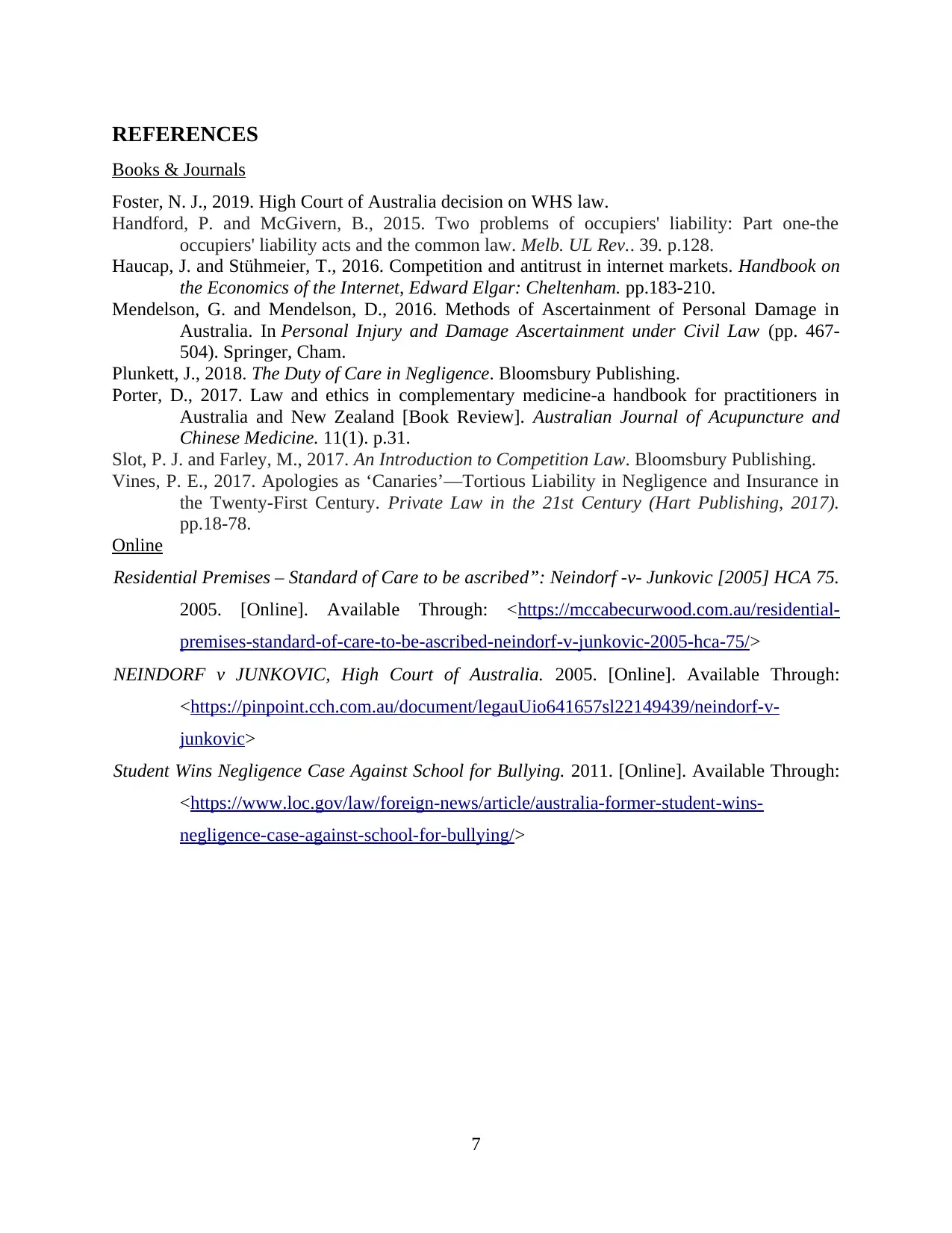
REFERENCES
Books & Journals
Foster, N. J., 2019. High Court of Australia decision on WHS law.
Handford, P. and McGivern, B., 2015. Two problems of occupiers' liability: Part one-the
occupiers' liability acts and the common law. Melb. UL Rev.. 39. p.128.
Haucap, J. and Stühmeier, T., 2016. Competition and antitrust in internet markets. Handbook on
the Economics of the Internet, Edward Elgar: Cheltenham. pp.183-210.
Mendelson, G. and Mendelson, D., 2016. Methods of Ascertainment of Personal Damage in
Australia. In Personal Injury and Damage Ascertainment under Civil Law (pp. 467-
504). Springer, Cham.
Plunkett, J., 2018. The Duty of Care in Negligence. Bloomsbury Publishing.
Porter, D., 2017. Law and ethics in complementary medicine-a handbook for practitioners in
Australia and New Zealand [Book Review]. Australian Journal of Acupuncture and
Chinese Medicine. 11(1). p.31.
Slot, P. J. and Farley, M., 2017. An Introduction to Competition Law. Bloomsbury Publishing.
Vines, P. E., 2017. Apologies as ‘Canaries’—Tortious Liability in Negligence and Insurance in
the Twenty-First Century. Private Law in the 21st Century (Hart Publishing, 2017).
pp.18-78.
Online
Residential Premises – Standard of Care to be ascribed”: Neindorf -v- Junkovic [2005] HCA 75.
2005. [Online]. Available Through: <https://mccabecurwood.com.au/residential-
premises-standard-of-care-to-be-ascribed-neindorf-v-junkovic-2005-hca-75/>
NEINDORF v JUNKOVIC, High Court of Australia. 2005. [Online]. Available Through:
<https://pinpoint.cch.com.au/document/legauUio641657sl22149439/neindorf-v-
junkovic>
Student Wins Negligence Case Against School for Bullying. 2011. [Online]. Available Through:
<https://www.loc.gov/law/foreign-news/article/australia-former-student-wins-
negligence-case-against-school-for-bullying/>
7
Books & Journals
Foster, N. J., 2019. High Court of Australia decision on WHS law.
Handford, P. and McGivern, B., 2015. Two problems of occupiers' liability: Part one-the
occupiers' liability acts and the common law. Melb. UL Rev.. 39. p.128.
Haucap, J. and Stühmeier, T., 2016. Competition and antitrust in internet markets. Handbook on
the Economics of the Internet, Edward Elgar: Cheltenham. pp.183-210.
Mendelson, G. and Mendelson, D., 2016. Methods of Ascertainment of Personal Damage in
Australia. In Personal Injury and Damage Ascertainment under Civil Law (pp. 467-
504). Springer, Cham.
Plunkett, J., 2018. The Duty of Care in Negligence. Bloomsbury Publishing.
Porter, D., 2017. Law and ethics in complementary medicine-a handbook for practitioners in
Australia and New Zealand [Book Review]. Australian Journal of Acupuncture and
Chinese Medicine. 11(1). p.31.
Slot, P. J. and Farley, M., 2017. An Introduction to Competition Law. Bloomsbury Publishing.
Vines, P. E., 2017. Apologies as ‘Canaries’—Tortious Liability in Negligence and Insurance in
the Twenty-First Century. Private Law in the 21st Century (Hart Publishing, 2017).
pp.18-78.
Online
Residential Premises – Standard of Care to be ascribed”: Neindorf -v- Junkovic [2005] HCA 75.
2005. [Online]. Available Through: <https://mccabecurwood.com.au/residential-
premises-standard-of-care-to-be-ascribed-neindorf-v-junkovic-2005-hca-75/>
NEINDORF v JUNKOVIC, High Court of Australia. 2005. [Online]. Available Through:
<https://pinpoint.cch.com.au/document/legauUio641657sl22149439/neindorf-v-
junkovic>
Student Wins Negligence Case Against School for Bullying. 2011. [Online]. Available Through:
<https://www.loc.gov/law/foreign-news/article/australia-former-student-wins-
negligence-case-against-school-for-bullying/>
7
⊘ This is a preview!⊘
Do you want full access?
Subscribe today to unlock all pages.
Trusted by 1+ million students worldwide

1 out of 9


Related Documents


Your All-in-One AI-Powered Toolkit for Academic Success.
+13062052269
info@desklib.com
Available 24*7 on WhatsApp / Email
![[object Object]](/_next/static/media/star-bottom.7253800d.svg)
Unlock your academic potential
Copyright © 2020–2026 A2Z Services. All Rights Reserved. Developed and managed by ZUCOL.