Detailed Analysis of the NSW Refugee Health Plan (2011-2016)
VerifiedAdded on 2023/06/10
|13
|3990
|190
Report
AI Summary
This report provides an analysis of the NSW Refugee Health Plan (2011-2016) implemented by the New South Wales (NSW) state government. The plan aimed to address the health needs of refugees and asylum-seekers, who often face significant health challenges due to various factors including cultural differences, psychological trauma, and social determinants. The report examines the plan's goals, which included providing immunization, mental health, reproductive health, oral health, nutritional health, and preventive health services. It highlights the multi-disciplinary approach adopted by the government, involving various stakeholders such as the Primary Health and Community Partnerships Branch, NSW Refugee Health Service, and others. The analysis discusses the strategic priorities, implementation strategies, and the role of the Department of Health in monitoring and supervising the plan's execution. The report also emphasizes the importance of evidence-based practice and the commitment to social justice, gender equity, and human rights in ensuring equitable healthcare access for refugees. The plan's eight strategic priorities, including policy development, collaboration between GPs and healthcare providers, promotion of well-being, specialized healthcare services, development of action plans, accessible mainstream care, evaluation, and research, are thoroughly examined. The report concludes that the plan's implementation was comprehensive, involving collaboration among numerous stakeholders to improve the health outcomes of refugees and asylum seekers in NSW.
Running head: POLICY ANALYSIS 1
Analysis of the NSW Refugee Health Plan
Name
Institution
Analysis of the NSW Refugee Health Plan
Name
Institution

Paraphrase This Document
Need a fresh take? Get an instant paraphrase of this document with our AI Paraphraser
POLICY ANALYSIS 2
Analysis of the NSW Refugee Health Plan
Introduction
The NSW Refugee Health Plan is a policy-framework that the state government of New
South Wales (NSW) came up with to help in addressing the health issues of the refugees as well
as other people who have undergone refugee-like experiences at one point in their life. The plan
was to be implemented between the year 20011 and 2016. According to the state government of
NSW, the state has been receiving a large number of refugees. As a country, Australia has been
receiving so many refugees who leave their mother land and relocate into the country because of
war, political, or religious conflicts that cause instability and compel them to seek for refuge.
There are also other people who come into the country as asylums-seekers because it provides a
safe place that can accommodate them. However, when such refugees come into the country, a
large number of them are deployed to NSW state (Mahimbo, Seale & Heywood, 2017). That is
why the state government of NSW decided to come up with this plan. The purpose why this
paper is to analyze this policy because it was a brilliant idea that the government had come up
because it would help in providing a long-term solution to healthcare challenges faced by the
refugees who come to the state whenever the circumstances force them to flee from their
respective countries of origin (Ross, Harding, Seal & Duncan, 2016). The idea of providing safe
and quality care to be commendable because it not only addresses the needs of the refugees and
asylum-seekers, but also strives towards the realization of health equality and equity in the state
and Australia at large.
The government decided to implement this policy because it was aimed at addressing the
health needs of the refugees that immigrate into the country. According to official records, the
refugees that come into the state often have poor state of health. When it comes to the matters of
Analysis of the NSW Refugee Health Plan
Introduction
The NSW Refugee Health Plan is a policy-framework that the state government of New
South Wales (NSW) came up with to help in addressing the health issues of the refugees as well
as other people who have undergone refugee-like experiences at one point in their life. The plan
was to be implemented between the year 20011 and 2016. According to the state government of
NSW, the state has been receiving a large number of refugees. As a country, Australia has been
receiving so many refugees who leave their mother land and relocate into the country because of
war, political, or religious conflicts that cause instability and compel them to seek for refuge.
There are also other people who come into the country as asylums-seekers because it provides a
safe place that can accommodate them. However, when such refugees come into the country, a
large number of them are deployed to NSW state (Mahimbo, Seale & Heywood, 2017). That is
why the state government of NSW decided to come up with this plan. The purpose why this
paper is to analyze this policy because it was a brilliant idea that the government had come up
because it would help in providing a long-term solution to healthcare challenges faced by the
refugees who come to the state whenever the circumstances force them to flee from their
respective countries of origin (Ross, Harding, Seal & Duncan, 2016). The idea of providing safe
and quality care to be commendable because it not only addresses the needs of the refugees and
asylum-seekers, but also strives towards the realization of health equality and equity in the state
and Australia at large.
The government decided to implement this policy because it was aimed at addressing the
health needs of the refugees that immigrate into the country. According to official records, the
refugees that come into the state often have poor state of health. When it comes to the matters of
POLICY ANALYSIS 3
health, the refugees are worse-off as compared to the rest of the Australian citizens and residents.
There are many reasons why the refugees are lagging behind when it comes to matters of health.
Their social, economic, behavioral, and environment al determinants expose them to a wide
range of health issues. Among the most significant factors that influence the health of the NSW-
based refugees include cultural diversity (Botfield, Newman & Zwi, 2016). These people face
cultural difficulties because they come from a cultural background that is quite different from
that in Australia. Meaning, for them to receive quality care that satisfies their needs, they must
have a special attention be given an opportunity to benefit from a culturally-competent care.
Besides, these people have been exposed to lots of psychological trauma. Therefore, to meet
their needs, they must have a well-organized team of practitioners who can attend to their unique
situation and address it as expected (Chaves, Paxton, Biggs, Thambiran, Gardiner, Williams &
Davis, 2017). Last, but not least, the refugees must be given a social consideration because their
status makes it challenging for them to access healthcare services in the country. Meaning, it can
be much better is there is a special program designed for them.
After classifying the refugees as a group that requires special attention, the state
government of NSW came up with this plan because it would play a significant role in
addressing the health needs of the newly-arrived refugees as well as their counterparts who have
been in the country for up to five years. The government acknowledged that these refugees must
be helped because if not empowered, there would be wide health disparities between them and
the rest of the Australian population. Therefore, to achieve, this objective, the government set
some goals that it was looking forward to accomplishing (Murray & Skull, 2005). These
included the goals to do with the provision of immunization services, delivery of mental health
services, reproductive health services, oral health services, nutritional health services, and
health, the refugees are worse-off as compared to the rest of the Australian citizens and residents.
There are many reasons why the refugees are lagging behind when it comes to matters of health.
Their social, economic, behavioral, and environment al determinants expose them to a wide
range of health issues. Among the most significant factors that influence the health of the NSW-
based refugees include cultural diversity (Botfield, Newman & Zwi, 2016). These people face
cultural difficulties because they come from a cultural background that is quite different from
that in Australia. Meaning, for them to receive quality care that satisfies their needs, they must
have a special attention be given an opportunity to benefit from a culturally-competent care.
Besides, these people have been exposed to lots of psychological trauma. Therefore, to meet
their needs, they must have a well-organized team of practitioners who can attend to their unique
situation and address it as expected (Chaves, Paxton, Biggs, Thambiran, Gardiner, Williams &
Davis, 2017). Last, but not least, the refugees must be given a social consideration because their
status makes it challenging for them to access healthcare services in the country. Meaning, it can
be much better is there is a special program designed for them.
After classifying the refugees as a group that requires special attention, the state
government of NSW came up with this plan because it would play a significant role in
addressing the health needs of the newly-arrived refugees as well as their counterparts who have
been in the country for up to five years. The government acknowledged that these refugees must
be helped because if not empowered, there would be wide health disparities between them and
the rest of the Australian population. Therefore, to achieve, this objective, the government set
some goals that it was looking forward to accomplishing (Murray & Skull, 2005). These
included the goals to do with the provision of immunization services, delivery of mental health
services, reproductive health services, oral health services, nutritional health services, and
⊘ This is a preview!⊘
Do you want full access?
Subscribe today to unlock all pages.

Trusted by 1+ million students worldwide
POLICY ANALYSIS 4
preventive health services. These are the services that had been identified because they had to be
regarded as priority areas that had to be addressed if the government was really concerned about
the improvement of the health status of the refugees (Guajardo, Slewa-Younan, Kitchener,
Mannan, Mohammad & Jorm, 2018). Nevertheless, to achieve all these, the government chose to
apply a few models that were deemed appropriate for the addressing the needs of the refugees.
The models included the commitments to the principles of social justice, gender equity, and
human rights. Each of these principles was of great contribution towards the implementation of
the plan. The government had demonstrated its commitments towards the elimination of any
disparities in the health of the refugees because, despite their poor state, they had to be granted
full rights to quality and safe medical care just like the rest of the Australian population.
Policy Analysis
The NSW Refugee Health Plan is a policy framework that the state government of SSW
had come up with because it would help in addressing the health needs of the refugees and
asylum-seekers in the state. For a very long time, the NSW state has been receiving a large
portion of the refugees and asylum-seekers from different parts of the world. However, whenever
they come into the country, these already disadvantaged immigrants find it quite challenging to
fit into the country because they have a myriad of physical, mental, and psychological health
problems that need an immediate redress (Riggs, Gibbs, Kilpatrick, Gussy, van Gemert, Ali &
Waters, 2015). However, this might not happen because the poor status of these people in the
Australian society deprives them of an opportunity to get access to healthcare services just like
the rest of the people. In this regard, the state government felt that it was the right time to come
up with this policy because it would help in providing an ultimate solution to this crisis. This
preventive health services. These are the services that had been identified because they had to be
regarded as priority areas that had to be addressed if the government was really concerned about
the improvement of the health status of the refugees (Guajardo, Slewa-Younan, Kitchener,
Mannan, Mohammad & Jorm, 2018). Nevertheless, to achieve all these, the government chose to
apply a few models that were deemed appropriate for the addressing the needs of the refugees.
The models included the commitments to the principles of social justice, gender equity, and
human rights. Each of these principles was of great contribution towards the implementation of
the plan. The government had demonstrated its commitments towards the elimination of any
disparities in the health of the refugees because, despite their poor state, they had to be granted
full rights to quality and safe medical care just like the rest of the Australian population.
Policy Analysis
The NSW Refugee Health Plan is a policy framework that the state government of SSW
had come up with because it would help in addressing the health needs of the refugees and
asylum-seekers in the state. For a very long time, the NSW state has been receiving a large
portion of the refugees and asylum-seekers from different parts of the world. However, whenever
they come into the country, these already disadvantaged immigrants find it quite challenging to
fit into the country because they have a myriad of physical, mental, and psychological health
problems that need an immediate redress (Riggs, Gibbs, Kilpatrick, Gussy, van Gemert, Ali &
Waters, 2015). However, this might not happen because the poor status of these people in the
Australian society deprives them of an opportunity to get access to healthcare services just like
the rest of the people. In this regard, the state government felt that it was the right time to come
up with this policy because it would help in providing an ultimate solution to this crisis. This
Paraphrase This Document
Need a fresh take? Get an instant paraphrase of this document with our AI Paraphraser
POLICY ANALYSIS 5
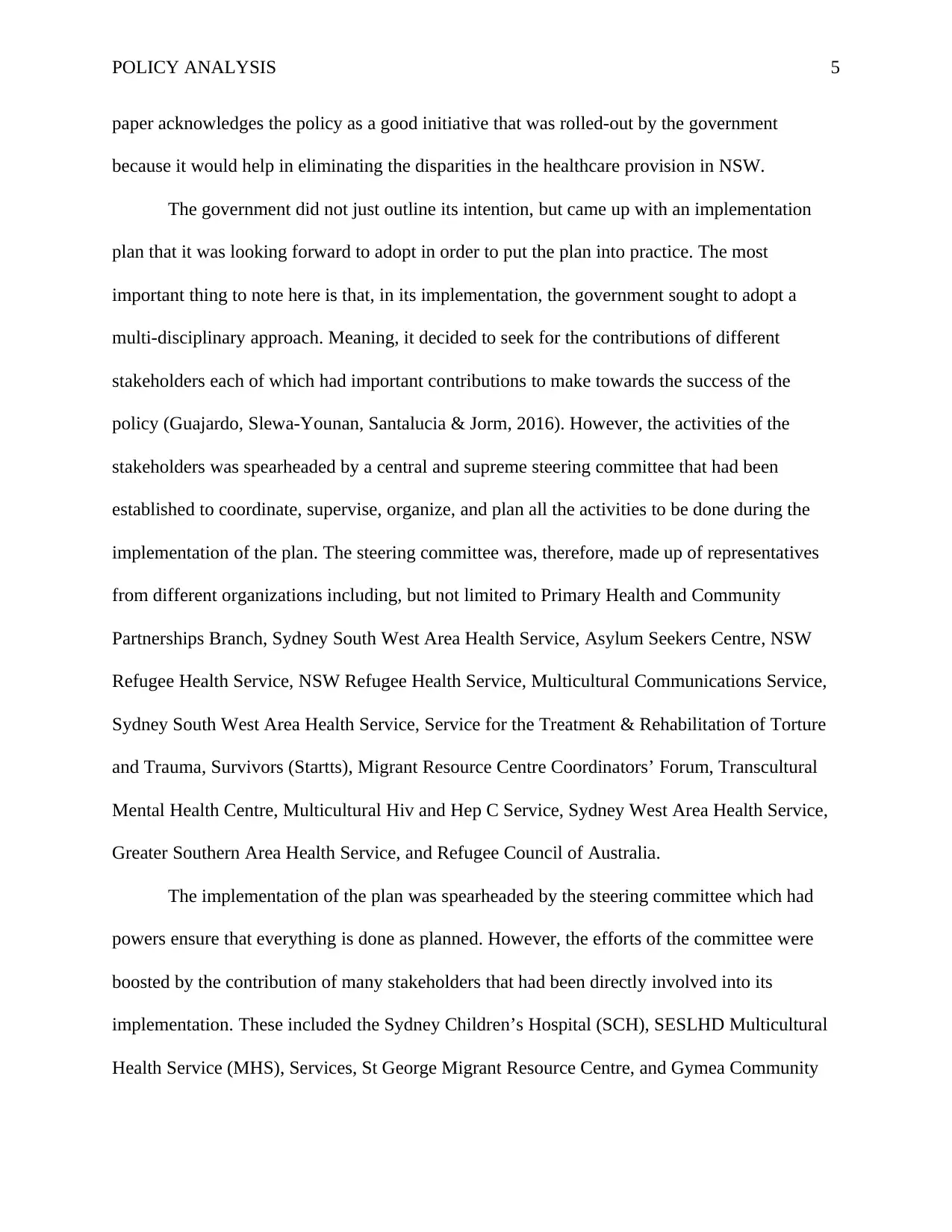
paper acknowledges the policy as a good initiative that was rolled-out by the government
because it would help in eliminating the disparities in the healthcare provision in NSW.
The government did not just outline its intention, but came up with an implementation
plan that it was looking forward to adopt in order to put the plan into practice. The most
important thing to note here is that, in its implementation, the government sought to adopt a
multi-disciplinary approach. Meaning, it decided to seek for the contributions of different
stakeholders each of which had important contributions to make towards the success of the
policy (Guajardo, Slewa-Younan, Santalucia & Jorm, 2016). However, the activities of the
stakeholders was spearheaded by a central and supreme steering committee that had been
established to coordinate, supervise, organize, and plan all the activities to be done during the
implementation of the plan. The steering committee was, therefore, made up of representatives
from different organizations including, but not limited to Primary Health and Community
Partnerships Branch, Sydney South West Area Health Service, Asylum Seekers Centre, NSW
Refugee Health Service, NSW Refugee Health Service, Multicultural Communications Service,
Sydney South West Area Health Service, Service for the Treatment & Rehabilitation of Torture
and Trauma, Survivors (Startts), Migrant Resource Centre Coordinators’ Forum, Transcultural
Mental Health Centre, Multicultural Hiv and Hep C Service, Sydney West Area Health Service,
Greater Southern Area Health Service, and Refugee Council of Australia.
The implementation of the plan was spearheaded by the steering committee which had
powers ensure that everything is done as planned. However, the efforts of the committee were
boosted by the contribution of many stakeholders that had been directly involved into its
implementation. These included the Sydney Children’s Hospital (SCH), SESLHD Multicultural
Health Service (MHS), Services, St George Migrant Resource Centre, and Gymea Community
paper acknowledges the policy as a good initiative that was rolled-out by the government
because it would help in eliminating the disparities in the healthcare provision in NSW.
The government did not just outline its intention, but came up with an implementation
plan that it was looking forward to adopt in order to put the plan into practice. The most
important thing to note here is that, in its implementation, the government sought to adopt a
multi-disciplinary approach. Meaning, it decided to seek for the contributions of different
stakeholders each of which had important contributions to make towards the success of the
policy (Guajardo, Slewa-Younan, Santalucia & Jorm, 2016). However, the activities of the
stakeholders was spearheaded by a central and supreme steering committee that had been
established to coordinate, supervise, organize, and plan all the activities to be done during the
implementation of the plan. The steering committee was, therefore, made up of representatives
from different organizations including, but not limited to Primary Health and Community
Partnerships Branch, Sydney South West Area Health Service, Asylum Seekers Centre, NSW
Refugee Health Service, NSW Refugee Health Service, Multicultural Communications Service,
Sydney South West Area Health Service, Service for the Treatment & Rehabilitation of Torture
and Trauma, Survivors (Startts), Migrant Resource Centre Coordinators’ Forum, Transcultural
Mental Health Centre, Multicultural Hiv and Hep C Service, Sydney West Area Health Service,
Greater Southern Area Health Service, and Refugee Council of Australia.
The implementation of the plan was spearheaded by the steering committee which had
powers ensure that everything is done as planned. However, the efforts of the committee were
boosted by the contribution of many stakeholders that had been directly involved into its
implementation. These included the Sydney Children’s Hospital (SCH), SESLHD Multicultural
Health Service (MHS), Services, St George Migrant Resource Centre, and Gymea Community
POLICY ANALYSIS 6
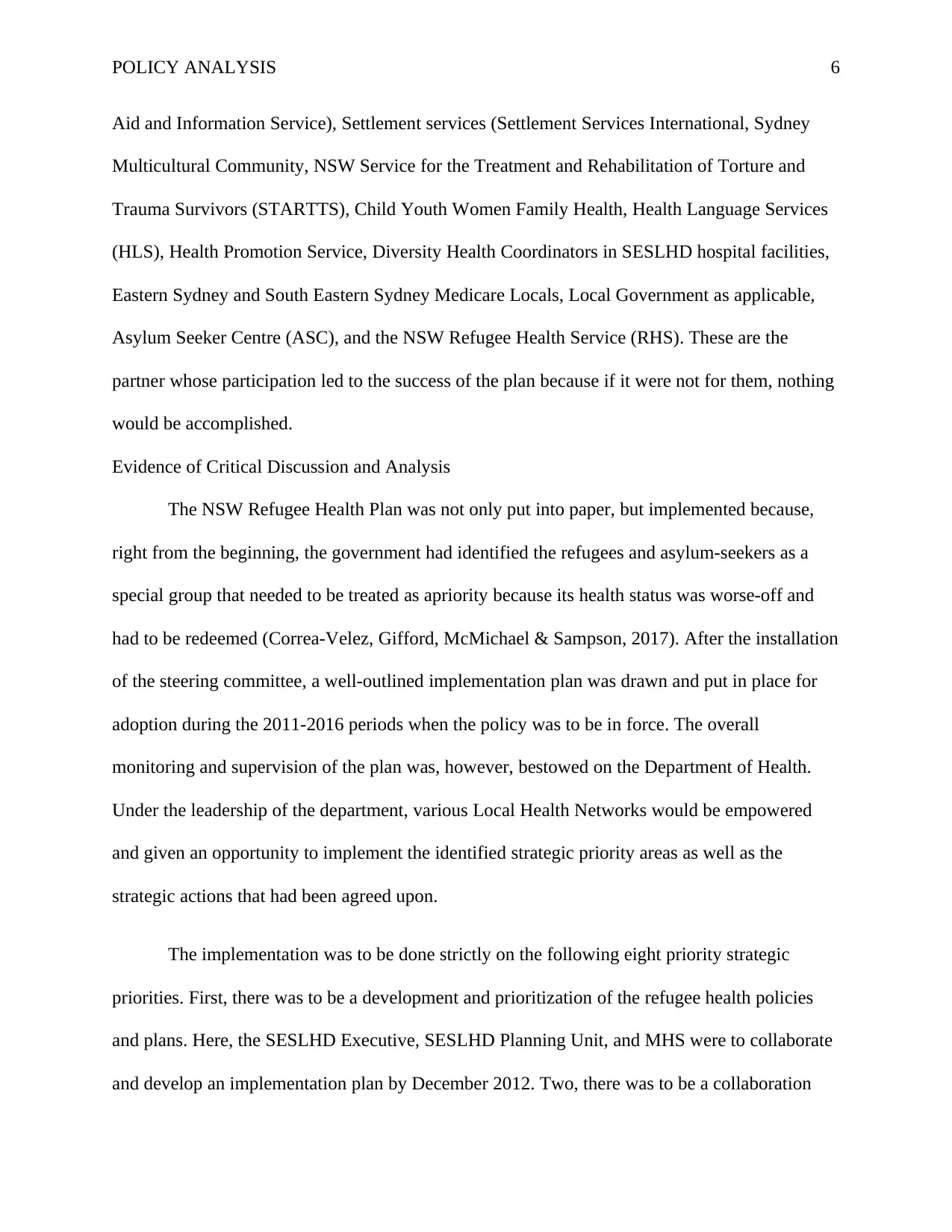
Aid and Information Service), Settlement services (Settlement Services International, Sydney
Multicultural Community, NSW Service for the Treatment and Rehabilitation of Torture and
Trauma Survivors (STARTTS), Child Youth Women Family Health, Health Language Services
(HLS), Health Promotion Service, Diversity Health Coordinators in SESLHD hospital facilities,
Eastern Sydney and South Eastern Sydney Medicare Locals, Local Government as applicable,
Asylum Seeker Centre (ASC), and the NSW Refugee Health Service (RHS). These are the
partner whose participation led to the success of the plan because if it were not for them, nothing
would be accomplished.
Evidence of Critical Discussion and Analysis
The NSW Refugee Health Plan was not only put into paper, but implemented because,
right from the beginning, the government had identified the refugees and asylum-seekers as a
special group that needed to be treated as apriority because its health status was worse-off and
had to be redeemed (Correa-Velez, Gifford, McMichael & Sampson, 2017). After the installation
of the steering committee, a well-outlined implementation plan was drawn and put in place for
adoption during the 2011-2016 periods when the policy was to be in force. The overall
monitoring and supervision of the plan was, however, bestowed on the Department of Health.
Under the leadership of the department, various Local Health Networks would be empowered
and given an opportunity to implement the identified strategic priority areas as well as the
strategic actions that had been agreed upon.
The implementation was to be done strictly on the following eight priority strategic
priorities. First, there was to be a development and prioritization of the refugee health policies
and plans. Here, the SESLHD Executive, SESLHD Planning Unit, and MHS were to collaborate
and develop an implementation plan by December 2012. Two, there was to be a collaboration
Aid and Information Service), Settlement services (Settlement Services International, Sydney
Multicultural Community, NSW Service for the Treatment and Rehabilitation of Torture and
Trauma Survivors (STARTTS), Child Youth Women Family Health, Health Language Services
(HLS), Health Promotion Service, Diversity Health Coordinators in SESLHD hospital facilities,
Eastern Sydney and South Eastern Sydney Medicare Locals, Local Government as applicable,
Asylum Seeker Centre (ASC), and the NSW Refugee Health Service (RHS). These are the
partner whose participation led to the success of the plan because if it were not for them, nothing
would be accomplished.
Evidence of Critical Discussion and Analysis
The NSW Refugee Health Plan was not only put into paper, but implemented because,
right from the beginning, the government had identified the refugees and asylum-seekers as a
special group that needed to be treated as apriority because its health status was worse-off and
had to be redeemed (Correa-Velez, Gifford, McMichael & Sampson, 2017). After the installation
of the steering committee, a well-outlined implementation plan was drawn and put in place for
adoption during the 2011-2016 periods when the policy was to be in force. The overall
monitoring and supervision of the plan was, however, bestowed on the Department of Health.
Under the leadership of the department, various Local Health Networks would be empowered
and given an opportunity to implement the identified strategic priority areas as well as the
strategic actions that had been agreed upon.
The implementation was to be done strictly on the following eight priority strategic
priorities. First, there was to be a development and prioritization of the refugee health policies
and plans. Here, the SESLHD Executive, SESLHD Planning Unit, and MHS were to collaborate
and develop an implementation plan by December 2012. Two, there was to be a collaboration
⊘ This is a preview!⊘
Do you want full access?
Subscribe today to unlock all pages.
Trusted by 1+ million students worldwide
POLICY ANALYSIS 7
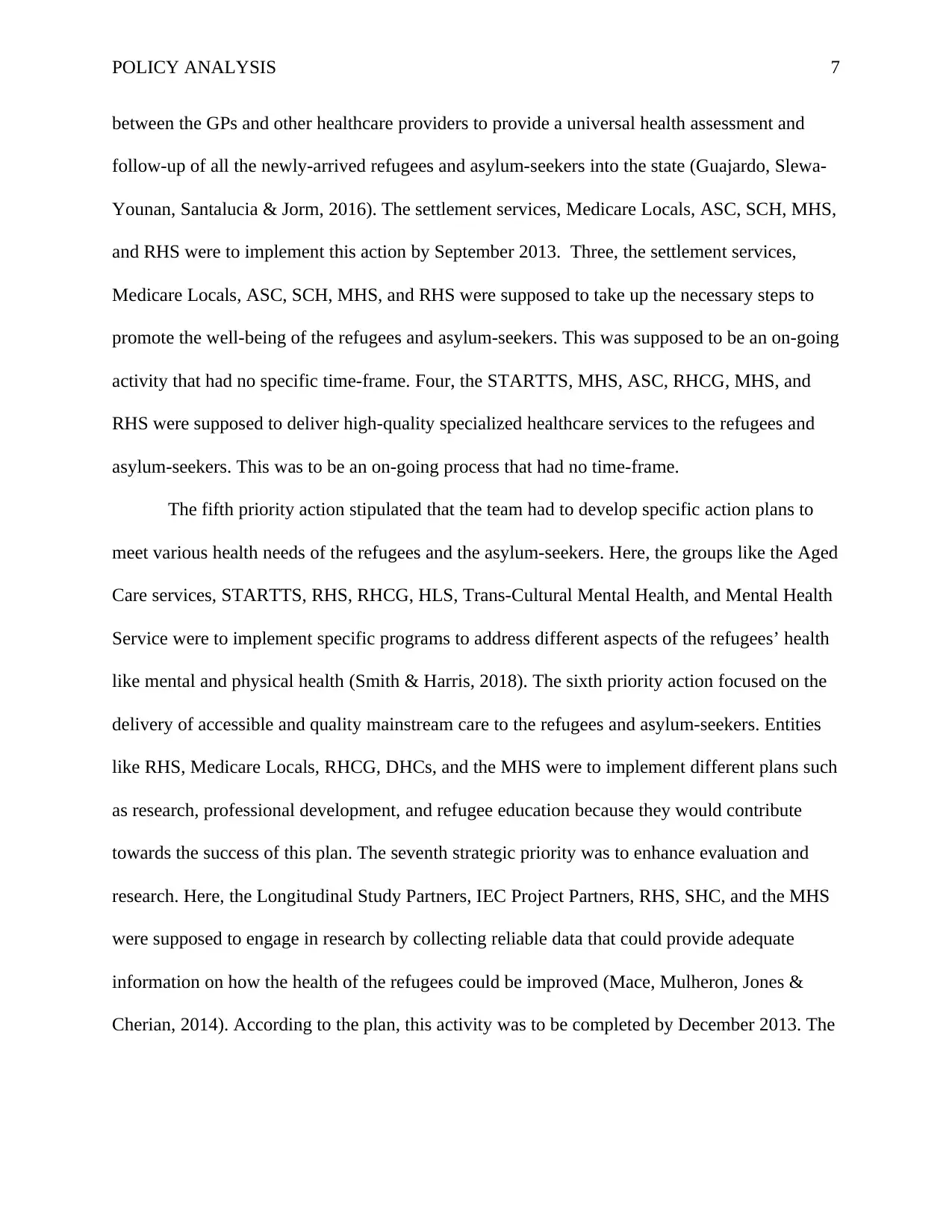
between the GPs and other healthcare providers to provide a universal health assessment and
follow-up of all the newly-arrived refugees and asylum-seekers into the state (Guajardo, Slewa-
Younan, Santalucia & Jorm, 2016). The settlement services, Medicare Locals, ASC, SCH, MHS,
and RHS were to implement this action by September 2013. Three, the settlement services,
Medicare Locals, ASC, SCH, MHS, and RHS were supposed to take up the necessary steps to
promote the well-being of the refugees and asylum-seekers. This was supposed to be an on-going
activity that had no specific time-frame. Four, the STARTTS, MHS, ASC, RHCG, MHS, and
RHS were supposed to deliver high-quality specialized healthcare services to the refugees and
asylum-seekers. This was to be an on-going process that had no time-frame.
The fifth priority action stipulated that the team had to develop specific action plans to
meet various health needs of the refugees and the asylum-seekers. Here, the groups like the Aged
Care services, STARTTS, RHS, RHCG, HLS, Trans-Cultural Mental Health, and Mental Health
Service were to implement specific programs to address different aspects of the refugees’ health
like mental and physical health (Smith & Harris, 2018). The sixth priority action focused on the
delivery of accessible and quality mainstream care to the refugees and asylum-seekers. Entities
like RHS, Medicare Locals, RHCG, DHCs, and the MHS were to implement different plans such
as research, professional development, and refugee education because they would contribute
towards the success of this plan. The seventh strategic priority was to enhance evaluation and
research. Here, the Longitudinal Study Partners, IEC Project Partners, RHS, SHC, and the MHS
were supposed to engage in research by collecting reliable data that could provide adequate
information on how the health of the refugees could be improved (Mace, Mulheron, Jones &
Cherian, 2014). According to the plan, this activity was to be completed by December 2013. The
between the GPs and other healthcare providers to provide a universal health assessment and
follow-up of all the newly-arrived refugees and asylum-seekers into the state (Guajardo, Slewa-
Younan, Santalucia & Jorm, 2016). The settlement services, Medicare Locals, ASC, SCH, MHS,
and RHS were to implement this action by September 2013. Three, the settlement services,
Medicare Locals, ASC, SCH, MHS, and RHS were supposed to take up the necessary steps to
promote the well-being of the refugees and asylum-seekers. This was supposed to be an on-going
activity that had no specific time-frame. Four, the STARTTS, MHS, ASC, RHCG, MHS, and
RHS were supposed to deliver high-quality specialized healthcare services to the refugees and
asylum-seekers. This was to be an on-going process that had no time-frame.
The fifth priority action stipulated that the team had to develop specific action plans to
meet various health needs of the refugees and the asylum-seekers. Here, the groups like the Aged
Care services, STARTTS, RHS, RHCG, HLS, Trans-Cultural Mental Health, and Mental Health
Service were to implement specific programs to address different aspects of the refugees’ health
like mental and physical health (Smith & Harris, 2018). The sixth priority action focused on the
delivery of accessible and quality mainstream care to the refugees and asylum-seekers. Entities
like RHS, Medicare Locals, RHCG, DHCs, and the MHS were to implement different plans such
as research, professional development, and refugee education because they would contribute
towards the success of this plan. The seventh strategic priority was to enhance evaluation and
research. Here, the Longitudinal Study Partners, IEC Project Partners, RHS, SHC, and the MHS
were supposed to engage in research by collecting reliable data that could provide adequate
information on how the health of the refugees could be improved (Mace, Mulheron, Jones &
Cherian, 2014). According to the plan, this activity was to be completed by December 2013. The
Paraphrase This Document
Need a fresh take? Get an instant paraphrase of this document with our AI Paraphraser
POLICY ANALYSIS 8
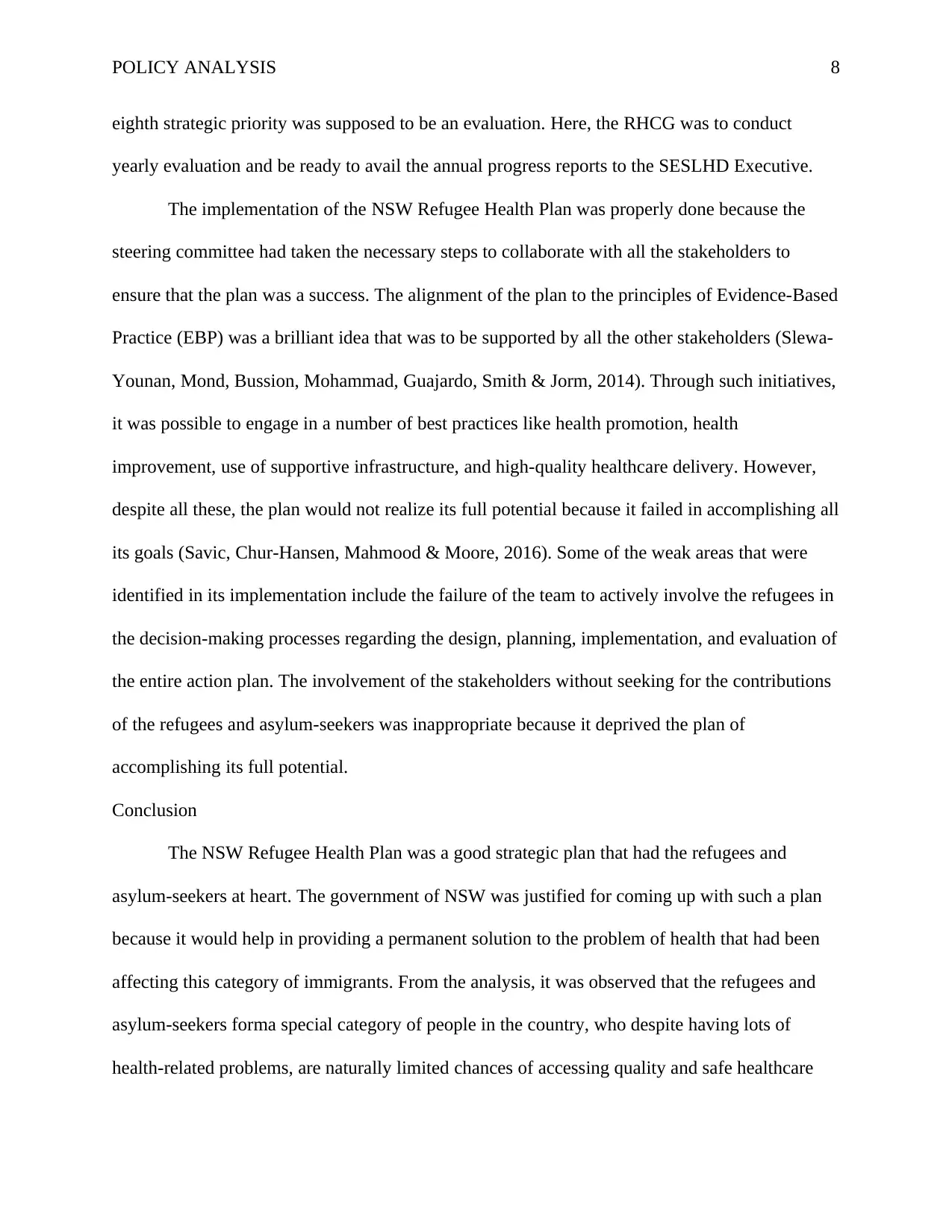
eighth strategic priority was supposed to be an evaluation. Here, the RHCG was to conduct
yearly evaluation and be ready to avail the annual progress reports to the SESLHD Executive.
The implementation of the NSW Refugee Health Plan was properly done because the
steering committee had taken the necessary steps to collaborate with all the stakeholders to
ensure that the plan was a success. The alignment of the plan to the principles of Evidence-Based
Practice (EBP) was a brilliant idea that was to be supported by all the other stakeholders (Slewa-
Younan, Mond, Bussion, Mohammad, Guajardo, Smith & Jorm, 2014). Through such initiatives,
it was possible to engage in a number of best practices like health promotion, health
improvement, use of supportive infrastructure, and high-quality healthcare delivery. However,
despite all these, the plan would not realize its full potential because it failed in accomplishing all
its goals (Savic, Chur-Hansen, Mahmood & Moore, 2016). Some of the weak areas that were
identified in its implementation include the failure of the team to actively involve the refugees in
the decision-making processes regarding the design, planning, implementation, and evaluation of
the entire action plan. The involvement of the stakeholders without seeking for the contributions
of the refugees and asylum-seekers was inappropriate because it deprived the plan of
accomplishing its full potential.
Conclusion
The NSW Refugee Health Plan was a good strategic plan that had the refugees and
asylum-seekers at heart. The government of NSW was justified for coming up with such a plan
because it would help in providing a permanent solution to the problem of health that had been
affecting this category of immigrants. From the analysis, it was observed that the refugees and
asylum-seekers forma special category of people in the country, who despite having lots of
health-related problems, are naturally limited chances of accessing quality and safe healthcare
eighth strategic priority was supposed to be an evaluation. Here, the RHCG was to conduct
yearly evaluation and be ready to avail the annual progress reports to the SESLHD Executive.
The implementation of the NSW Refugee Health Plan was properly done because the
steering committee had taken the necessary steps to collaborate with all the stakeholders to
ensure that the plan was a success. The alignment of the plan to the principles of Evidence-Based
Practice (EBP) was a brilliant idea that was to be supported by all the other stakeholders (Slewa-
Younan, Mond, Bussion, Mohammad, Guajardo, Smith & Jorm, 2014). Through such initiatives,
it was possible to engage in a number of best practices like health promotion, health
improvement, use of supportive infrastructure, and high-quality healthcare delivery. However,
despite all these, the plan would not realize its full potential because it failed in accomplishing all
its goals (Savic, Chur-Hansen, Mahmood & Moore, 2016). Some of the weak areas that were
identified in its implementation include the failure of the team to actively involve the refugees in
the decision-making processes regarding the design, planning, implementation, and evaluation of
the entire action plan. The involvement of the stakeholders without seeking for the contributions
of the refugees and asylum-seekers was inappropriate because it deprived the plan of
accomplishing its full potential.
Conclusion
The NSW Refugee Health Plan was a good strategic plan that had the refugees and
asylum-seekers at heart. The government of NSW was justified for coming up with such a plan
because it would help in providing a permanent solution to the problem of health that had been
affecting this category of immigrants. From the analysis, it was observed that the refugees and
asylum-seekers forma special category of people in the country, who despite having lots of
health-related problems, are naturally limited chances of accessing quality and safe healthcare
POLICY ANALYSIS 9
services that they direly need. As a one of the states which accommodate the highest number of
refugees, NSW felt that it was a time it organized for a steering committee and bring together all
the relevant stakeholders to outline and implement the plan as expected (Masters, Lanfranco,
Sneath, Wade, Huffam, Pollard & Friedman, 2018). Everything to do with the organization and
the formulation of the strategic priorities and action plans was done to the perfection. However,
the implementation process was not all that successful because of the few were areas or
loopholes that were identified. These touch on the areas to do with the participation of the
refugees, active involvement of the local community organizations, and the choice of priority
areas to address during the implementation. Because of this, this paper suggests the following:
First, the implementation of the plan would have addressed the issue of the participation
of the refugee communities in the state. Since the whole plan was about the refugees, it would
not be justifiable to come up with such a plan and execute everything without seeking for the
contribution of the new and old refugees. This was supposed to be done because each of the
refugees have specific and unique problem that had to be addressed (Botfield, Newman & Zwi,
2018). However, such problems would be best addressed if the refugees themselves were
involved in identifying and coming up with the most appropriate intervention strategies for them.
Secondly, the paper suggests that the implementation of the plan would have encompassed a
strong collaborative approach between the government agencies and local community
organizations within NSW. Such collaboration was appropriate because if there were strong
partnerships, everything would be implemented as planned. Each of these stakeholders is
important because they could have brought some ideas that would be relied upon to address the
health needs of the refugees as required (Mahimbo, Seale, Smith & Heywood, 2017). Last, but
by no means the least, this paper suggests that in its implementation plan, the team would have
services that they direly need. As a one of the states which accommodate the highest number of
refugees, NSW felt that it was a time it organized for a steering committee and bring together all
the relevant stakeholders to outline and implement the plan as expected (Masters, Lanfranco,
Sneath, Wade, Huffam, Pollard & Friedman, 2018). Everything to do with the organization and
the formulation of the strategic priorities and action plans was done to the perfection. However,
the implementation process was not all that successful because of the few were areas or
loopholes that were identified. These touch on the areas to do with the participation of the
refugees, active involvement of the local community organizations, and the choice of priority
areas to address during the implementation. Because of this, this paper suggests the following:
First, the implementation of the plan would have addressed the issue of the participation
of the refugee communities in the state. Since the whole plan was about the refugees, it would
not be justifiable to come up with such a plan and execute everything without seeking for the
contribution of the new and old refugees. This was supposed to be done because each of the
refugees have specific and unique problem that had to be addressed (Botfield, Newman & Zwi,
2018). However, such problems would be best addressed if the refugees themselves were
involved in identifying and coming up with the most appropriate intervention strategies for them.
Secondly, the paper suggests that the implementation of the plan would have encompassed a
strong collaborative approach between the government agencies and local community
organizations within NSW. Such collaboration was appropriate because if there were strong
partnerships, everything would be implemented as planned. Each of these stakeholders is
important because they could have brought some ideas that would be relied upon to address the
health needs of the refugees as required (Mahimbo, Seale, Smith & Heywood, 2017). Last, but
by no means the least, this paper suggests that in its implementation plan, the team would have
⊘ This is a preview!⊘
Do you want full access?
Subscribe today to unlock all pages.
Trusted by 1+ million students worldwide
POLICY ANALYSIS 10
focused on the availability of health practitioners who have special training on the delivery of
refugee care. As a matter of fact, refugees are not Australians, but immigrants who come from
different backgrounds. This might make it a bit challenging for the Australian medics to attend to
their needs to the perfection. Therefore, to ensure that this problem is resolved, emphasis could
have been put on the availability of staff that has a special training particularly on the refugees
(Masters, Lanfranco, Sneath, Wade, Huffam, Pollard & Friedman, 2018). During their training,
these personnel should be adequately prepared and given the skills to prepare them to operate in
such a multicultural setting.
focused on the availability of health practitioners who have special training on the delivery of
refugee care. As a matter of fact, refugees are not Australians, but immigrants who come from
different backgrounds. This might make it a bit challenging for the Australian medics to attend to
their needs to the perfection. Therefore, to ensure that this problem is resolved, emphasis could
have been put on the availability of staff that has a special training particularly on the refugees
(Masters, Lanfranco, Sneath, Wade, Huffam, Pollard & Friedman, 2018). During their training,
these personnel should be adequately prepared and given the skills to prepare them to operate in
such a multicultural setting.
Paraphrase This Document
Need a fresh take? Get an instant paraphrase of this document with our AI Paraphraser
POLICY ANALYSIS 11
References
Botfield, J. R., Newman, C. E., & Zwi, A. B. (2016). Young people from culturally diverse
backgrounds and their use of services for sexual and reproductive health needs: A
structured scoping review. Sexual health, 13(1), 1-9.
Botfield, J. R., Newman, C. E., & Zwi, A. B. (2018). Engaging Migrant and Refugee Young
People with Sexual Health Care: Does Generation Matter More Than Culture?. Sexuality
Research and Social Policy, 1-11.
Chaves, N. J., Paxton, G. A., Biggs, B. A., Thambiran, A., Gardiner, J., Williams, J., ... & Davis,
J. S. (2017). The Australasian Society for Infectious Diseases and Refugee Health
Network of Australia recommendations for health assessment for people from refugee-
like backgrounds: an abridged outline. The Medical Journal of Australia, 206(7), 310-
315.
Correa-Velez, I., Gifford, S. M., McMichael, C., & Sampson, R. (2017). Predictors of secondary
school completion among refugee youth 8 to 9 years after resettlement in Melbourne,
Australia. Journal of International Migration and Integration, 18(3), 791-805.
Guajardo, M. G. U., Slewa-Younan, S., Kitchener, B. A., Mannan, H., Mohammad, Y., & Jorm,
A. F. (2018). Improving the capacity of community-based workers in Australia to provide
initial assistance to Iraqi refugees with mental health problems: an uncontrolled
evaluation of a Mental Health Literacy Course. International Journal of Mental Health
Systems, 12(1), 2.
Guajardo, M. G. U., Slewa-Younan, S., Santalucia, Y., & Jorm, A. F. (2016). Important
considerations when providing mental health first aid to Iraqi refugees in Australia: a
Delphi study. International journal of mental health systems, 10(1), 54.
References
Botfield, J. R., Newman, C. E., & Zwi, A. B. (2016). Young people from culturally diverse
backgrounds and their use of services for sexual and reproductive health needs: A
structured scoping review. Sexual health, 13(1), 1-9.
Botfield, J. R., Newman, C. E., & Zwi, A. B. (2018). Engaging Migrant and Refugee Young
People with Sexual Health Care: Does Generation Matter More Than Culture?. Sexuality
Research and Social Policy, 1-11.
Chaves, N. J., Paxton, G. A., Biggs, B. A., Thambiran, A., Gardiner, J., Williams, J., ... & Davis,
J. S. (2017). The Australasian Society for Infectious Diseases and Refugee Health
Network of Australia recommendations for health assessment for people from refugee-
like backgrounds: an abridged outline. The Medical Journal of Australia, 206(7), 310-
315.
Correa-Velez, I., Gifford, S. M., McMichael, C., & Sampson, R. (2017). Predictors of secondary
school completion among refugee youth 8 to 9 years after resettlement in Melbourne,
Australia. Journal of International Migration and Integration, 18(3), 791-805.
Guajardo, M. G. U., Slewa-Younan, S., Kitchener, B. A., Mannan, H., Mohammad, Y., & Jorm,
A. F. (2018). Improving the capacity of community-based workers in Australia to provide
initial assistance to Iraqi refugees with mental health problems: an uncontrolled
evaluation of a Mental Health Literacy Course. International Journal of Mental Health
Systems, 12(1), 2.
Guajardo, M. G. U., Slewa-Younan, S., Santalucia, Y., & Jorm, A. F. (2016). Important
considerations when providing mental health first aid to Iraqi refugees in Australia: a
Delphi study. International journal of mental health systems, 10(1), 54.
POLICY ANALYSIS 12
Mace, A. O., Mulheron, S., Jones, C., & Cherian, S. (2014). Educational, developmental and
psychological outcomes of resettled refugee children in Western Australia: a review of
School of Special Educational Needs: Medical and Mental Health input. Journal of
paediatrics and child health, 50(12), 985-992.
Mahimbo, A., Seale, H., & Heywood, A. E. (2017). Immunisation for refugees in Australia: a
policy review and analysis across all States and Territories. Australian and New Zealand
journal of public health, 41(6), 635-640.
Mahimbo, A., Seale, H., Smith, M., & Heywood, A. (2017). Challenges in immunisation service
delivery for refugees in Australia: A health system perspective. Vaccine, 35(38), 5148-
5155.
Masters, P. J., Lanfranco, P. J., Sneath, E., Wade, A. J., Huffam, S., Pollard, J., ... & Friedman,
N. (2018). Health issues of refugees attending an infectious disease refugee health clinic
in a regional Australian hospital. Australian journal of general practice, 47(5), 305.
Murray, S. B., & Skull, S. A. (2005). Hurdles to health: immigrant and refugee health care in
Australia. Australian Health Review, 29(1), 25-29.
Riggs, E., Gibbs, L., Kilpatrick, N., Gussy, M., van Gemert, C., Ali, S., & Waters, E. (2015).
Breaking down the barriers: a qualitative study to understand child oral health in refugee
and migrant communities in Australia. Ethnicity & health, 20(3), 241-257.
Ross, L., Harding, C., Seal, A., & Duncan, G. (2016). Improving the management and care of
refugees in Australian hospitals: a descriptive study. Australian Health Review, 40(6),
679-685.
Savic, M., Chur-Hansen, A., Mahmood, M. A., & Moore, V. M. (2016). ‘We don’t have to go
Mace, A. O., Mulheron, S., Jones, C., & Cherian, S. (2014). Educational, developmental and
psychological outcomes of resettled refugee children in Western Australia: a review of
School of Special Educational Needs: Medical and Mental Health input. Journal of
paediatrics and child health, 50(12), 985-992.
Mahimbo, A., Seale, H., & Heywood, A. E. (2017). Immunisation for refugees in Australia: a
policy review and analysis across all States and Territories. Australian and New Zealand
journal of public health, 41(6), 635-640.
Mahimbo, A., Seale, H., Smith, M., & Heywood, A. (2017). Challenges in immunisation service
delivery for refugees in Australia: A health system perspective. Vaccine, 35(38), 5148-
5155.
Masters, P. J., Lanfranco, P. J., Sneath, E., Wade, A. J., Huffam, S., Pollard, J., ... & Friedman,
N. (2018). Health issues of refugees attending an infectious disease refugee health clinic
in a regional Australian hospital. Australian journal of general practice, 47(5), 305.
Murray, S. B., & Skull, S. A. (2005). Hurdles to health: immigrant and refugee health care in
Australia. Australian Health Review, 29(1), 25-29.
Riggs, E., Gibbs, L., Kilpatrick, N., Gussy, M., van Gemert, C., Ali, S., & Waters, E. (2015).
Breaking down the barriers: a qualitative study to understand child oral health in refugee
and migrant communities in Australia. Ethnicity & health, 20(3), 241-257.
Ross, L., Harding, C., Seal, A., & Duncan, G. (2016). Improving the management and care of
refugees in Australian hospitals: a descriptive study. Australian Health Review, 40(6),
679-685.
Savic, M., Chur-Hansen, A., Mahmood, M. A., & Moore, V. M. (2016). ‘We don’t have to go
⊘ This is a preview!⊘
Do you want full access?
Subscribe today to unlock all pages.
Trusted by 1+ million students worldwide

1 out of 13


Related Documents


Your All-in-One AI-Powered Toolkit for Academic Success.
+13062052269
info@desklib.com
Available 24*7 on WhatsApp / Email
![[object Object]](/_next/static/media/star-bottom.7253800d.svg)
Unlock your academic potential
Copyright © 2020–2026 A2Z Services. All Rights Reserved. Developed and managed by ZUCOL.