Service Level Agreement (SLA) Analysis for IT Services

Verified

Added on  2023/06/07

|5
|783
|197
Homework Assignment
AI Summary
This assignment analyzes a Service Level Agreement (SLA) focusing on IT services. The student examines the types of services defined, such as terrestrial fiber Ethernet, wireless access, and Ethernet over copper. The analysis identifies missing services like quick fault restoration. Key performance areas are assessed, including installation updates, service availability (99%), and fault resolution times. Defined metrics like connectivity, delay, packet loss, and jitter are discussed, along with the use of application performance monitoring tools. Gaps in the SLA, such as responsibility for system performance and outages due to natural disasters, are identified. The consequences of not using an SLA are outlined, highlighting the lack of guidelines and accountability. Finally, the assignment proposes incident management as a suitable process for developing SLAs, ensuring both client and service provider accountability for fault restoration.
Document Page
Running head: SERVICE LEVEL AGREEMENT
SERVICE LEVEL AGREEMENT
Name of student:
Name of university:
Author’s note:
tabler-icon-diamond-filled.svg

Paraphrase This Document

Need a fresh take? Get an instant paraphrase of this document with our AI Paraphraser
Document Page
1SERVICE LEVEL AGREEMENT
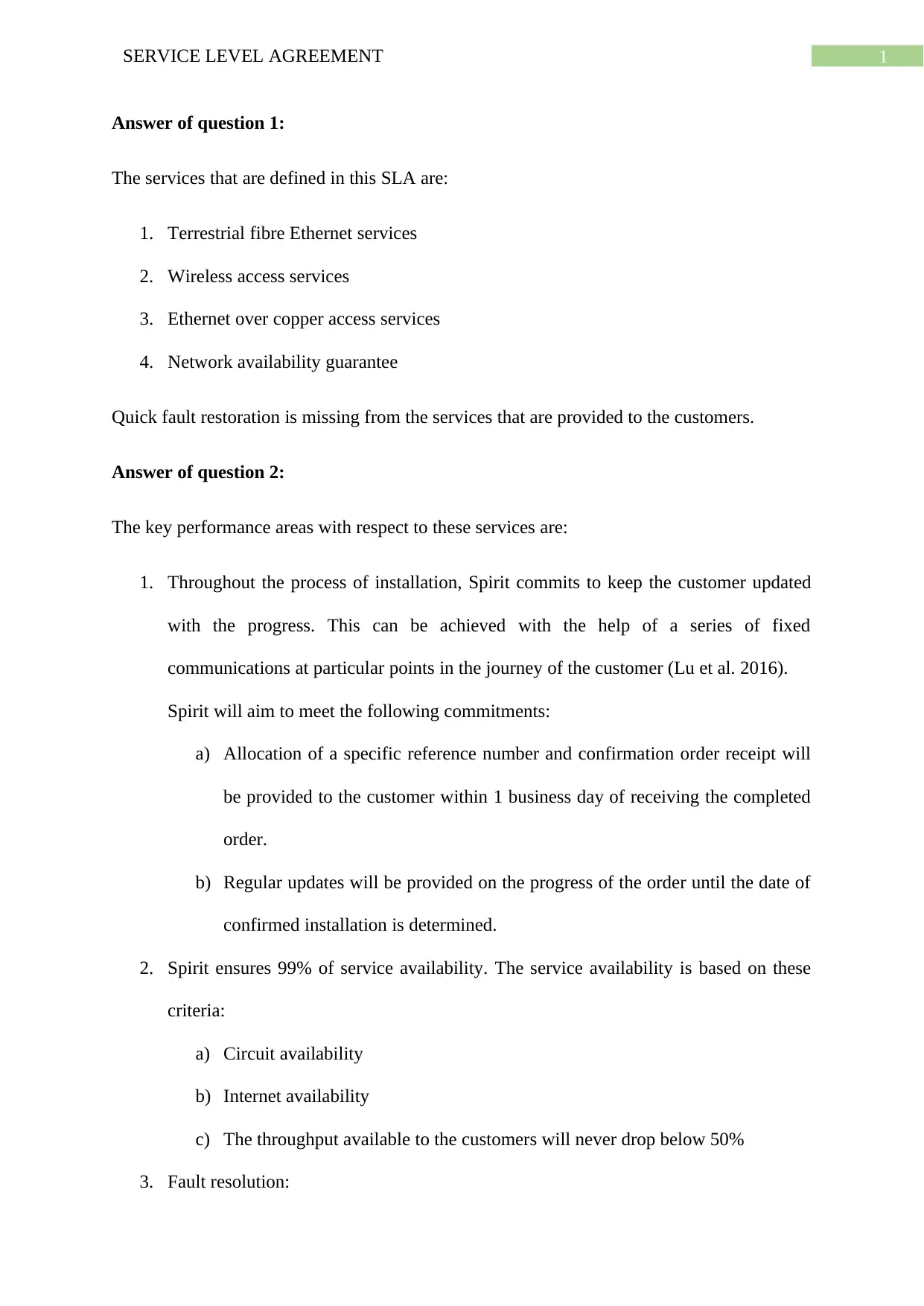
Answer of question 1:
The services that are defined in this SLA are:
1. Terrestrial fibre Ethernet services
2. Wireless access services
3. Ethernet over copper access services
4. Network availability guarantee
Quick fault restoration is missing from the services that are provided to the customers.
Answer of question 2:
The key performance areas with respect to these services are:
1. Throughout the process of installation, Spirit commits to keep the customer updated
with the progress. This can be achieved with the help of a series of fixed
communications at particular points in the journey of the customer (Lu et al. 2016).
Spirit will aim to meet the following commitments:
a) Allocation of a specific reference number and confirmation order receipt will
be provided to the customer within 1 business day of receiving the completed
order.
b) Regular updates will be provided on the progress of the order until the date of
confirmed installation is determined.
2. Spirit ensures 99% of service availability. The service availability is based on these
criteria:
a) Circuit availability
b) Internet availability
c) The throughput available to the customers will never drop below 50%
3. Fault resolution:
Document Page
2SERVICE LEVEL AGREEMENT
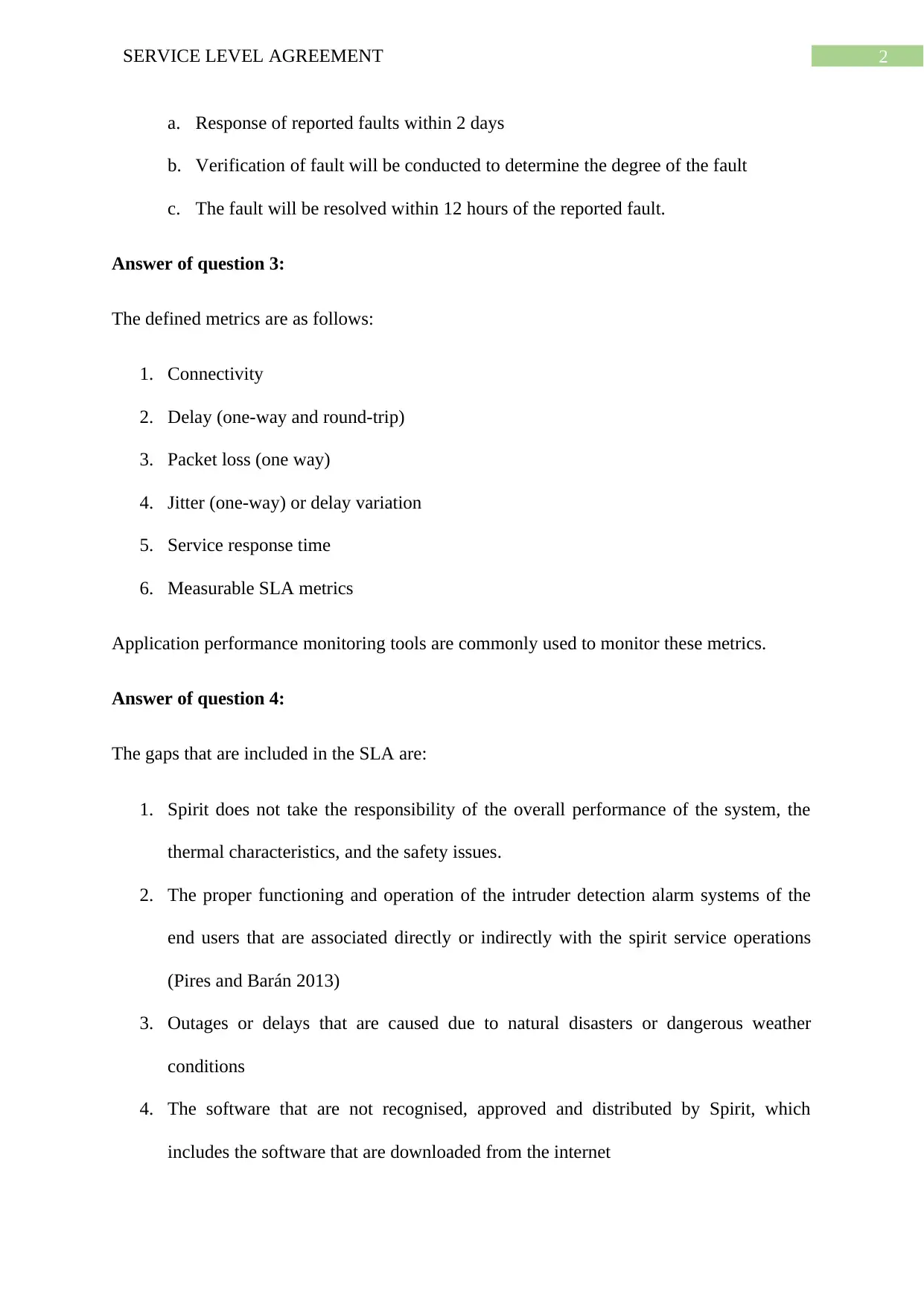
a. Response of reported faults within 2 days
b. Verification of fault will be conducted to determine the degree of the fault
c. The fault will be resolved within 12 hours of the reported fault.
Answer of question 3:
The defined metrics are as follows:
1. Connectivity
2. Delay (one-way and round-trip)
3. Packet loss (one way)
4. Jitter (one-way) or delay variation
5. Service response time
6. Measurable SLA metrics
Application performance monitoring tools are commonly used to monitor these metrics.
Answer of question 4:
The gaps that are included in the SLA are:
1. Spirit does not take the responsibility of the overall performance of the system, the
thermal characteristics, and the safety issues.
2. The proper functioning and operation of the intruder detection alarm systems of the
end users that are associated directly or indirectly with the spirit service operations
(Pires and Barán 2013)
3. Outages or delays that are caused due to natural disasters or dangerous weather
conditions
4. The software that are not recognised, approved and distributed by Spirit, which
includes the software that are downloaded from the internet
Document Page
3SERVICE LEVEL AGREEMENT
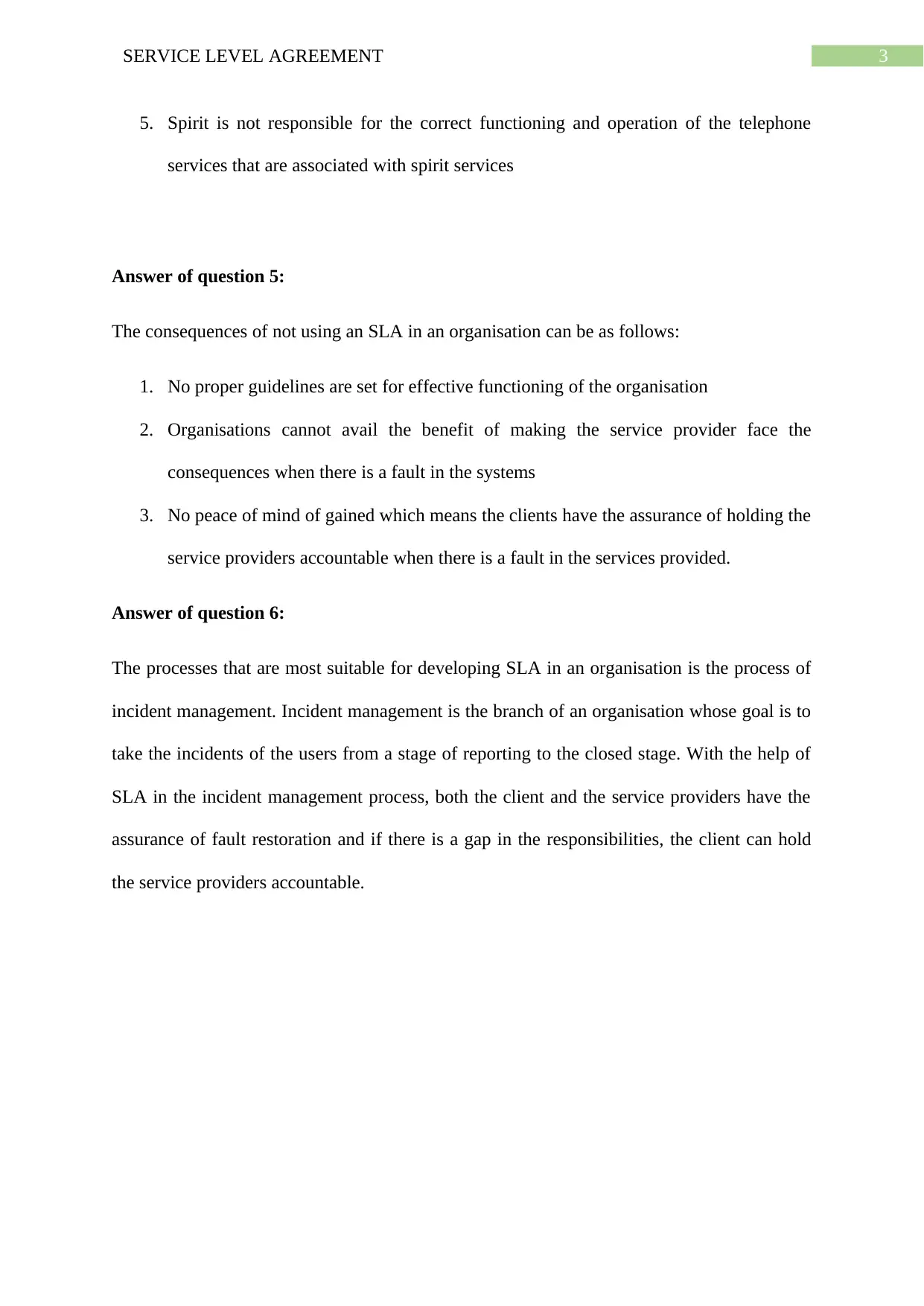
5. Spirit is not responsible for the correct functioning and operation of the telephone
services that are associated with spirit services
Answer of question 5:
The consequences of not using an SLA in an organisation can be as follows:
1. No proper guidelines are set for effective functioning of the organisation
2. Organisations cannot avail the benefit of making the service provider face the
consequences when there is a fault in the systems
3. No peace of mind of gained which means the clients have the assurance of holding the
service providers accountable when there is a fault in the services provided.
Answer of question 6:
The processes that are most suitable for developing SLA in an organisation is the process of
incident management. Incident management is the branch of an organisation whose goal is to
take the incidents of the users from a stage of reporting to the closed stage. With the help of
SLA in the incident management process, both the client and the service providers have the
assurance of fault restoration and if there is a gap in the responsibilities, the client can hold
the service providers accountable.
tabler-icon-diamond-filled.svg

Paraphrase This Document

Need a fresh take? Get an instant paraphrase of this document with our AI Paraphraser
Document Page
4SERVICE LEVEL AGREEMENT
Reference
Lu, K., Yahyapour, R., Wieder, P., Yaqub, E., Abdullah, M., Schloer, B. and Kotsokalis, C.,
2016. Fault-tolerant service level agreement lifecycle management in clouds using
actor system. Future Generation Computer Systems, 54, pp.247-259.
Pires, F.L. and Barán, B., 2013, December. Multi-objective virtual machine placement with
service level agreement: A memetic algorithm approach. In Proceedings of the 2013
IEEE/ACM 6th International Conference on Utility and Cloud Computing (pp. 203-
210). IEEE Computer Society.
chevron_up_icon
1 out of 5
circle_padding
hide_on_mobile
zoom_out_icon
[object Object]