English 2370: Analysis of Tecumseh's Speeches on American Leadership

Verified

Added on  2022/08/15

|4
|1574
|14
Homework Assignment
AI Summary
This homework assignment is an analysis of Tecumseh's speeches, focusing on his arguments and rhetorical strategies within the context of American leadership and Native American rights. The student's work includes a thesis statement, identification of main claims, and detailed analysis of three key sentences from Tecumseh's speeches. The analysis examines Tecumseh's call to action, his critique of white colonization, and his advocacy for the rights and independence of his people. The assignment also explores the use of rhetorical devices and the historical context of the speeches. The student cites the provided texts and uses MLA citation format. The assignment requires the student to analyze speeches by Tecumseh, focusing on his calls for resistance against colonial forces and the importance of preserving Native American rights and autonomy. The student examines the use of rhetorical devices, the articulation of key claims, and the historical context of the speeches. The assignment follows the guidelines of the English 2370 course, including the requirement to cite the assigned readings and adhere to specific formatting guidelines.
Document Page
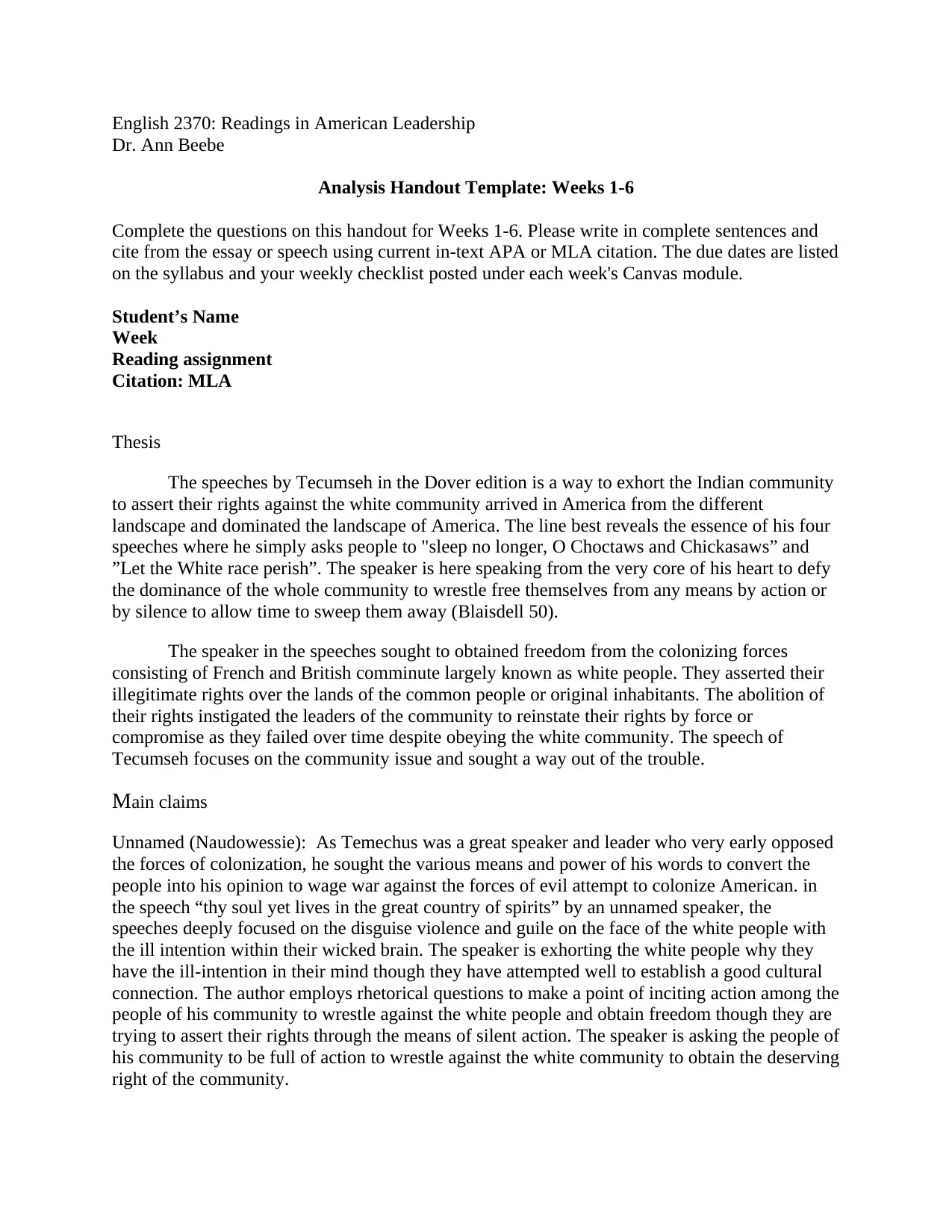
English 2370: Readings in American Leadership
Dr. Ann Beebe
Analysis Handout Template: Weeks 1-6
Complete the questions on this handout for Weeks 1-6. Please write in complete sentences and
cite from the essay or speech using current in-text APA or MLA citation. The due dates are listed
on the syllabus and your weekly checklist posted under each week's Canvas module.
Student’s Name
Week
Reading assignment
Citation: MLA
Thesis
The speeches by Tecumseh in the Dover edition is a way to exhort the Indian community
to assert their rights against the white community arrived in America from the different
landscape and dominated the landscape of America. The line best reveals the essence of his four
speeches where he simply asks people to "sleep no longer, O Choctaws and Chickasaws” and
”Let the White race perish”. The speaker is here speaking from the very core of his heart to defy
the dominance of the whole community to wrestle free themselves from any means by action or
by silence to allow time to sweep them away (Blaisdell 50).
The speaker in the speeches sought to obtained freedom from the colonizing forces
consisting of French and British comminute largely known as white people. They asserted their
illegitimate rights over the lands of the common people or original inhabitants. The abolition of
their rights instigated the leaders of the community to reinstate their rights by force or
compromise as they failed over time despite obeying the white community. The speech of
Tecumseh focuses on the community issue and sought a way out of the trouble.
Main claims
Unnamed (Naudowessie): As Temechus was a great speaker and leader who very early opposed
the forces of colonization, he sought the various means and power of his words to convert the
people into his opinion to wage war against the forces of evil attempt to colonize American. in
the speech “thy soul yet lives in the great country of spirits” by an unnamed speaker, the
speeches deeply focused on the disguise violence and guile on the face of the white people with
the ill intention within their wicked brain. The speaker is exhorting the white people why they
have the ill-intention in their mind though they have attempted well to establish a good cultural
connection. The author employs rhetorical questions to make a point of inciting action among the
people of his community to wrestle against the white people and obtain freedom though they are
trying to assert their rights through the means of silent action. The speaker is asking the people of
his community to be full of action to wrestle against the white community to obtain the deserving
right of the community.
tabler-icon-diamond-filled.svg

Paraphrase This Document

Need a fresh take? Get an instant paraphrase of this document with our AI Paraphraser
Document Page
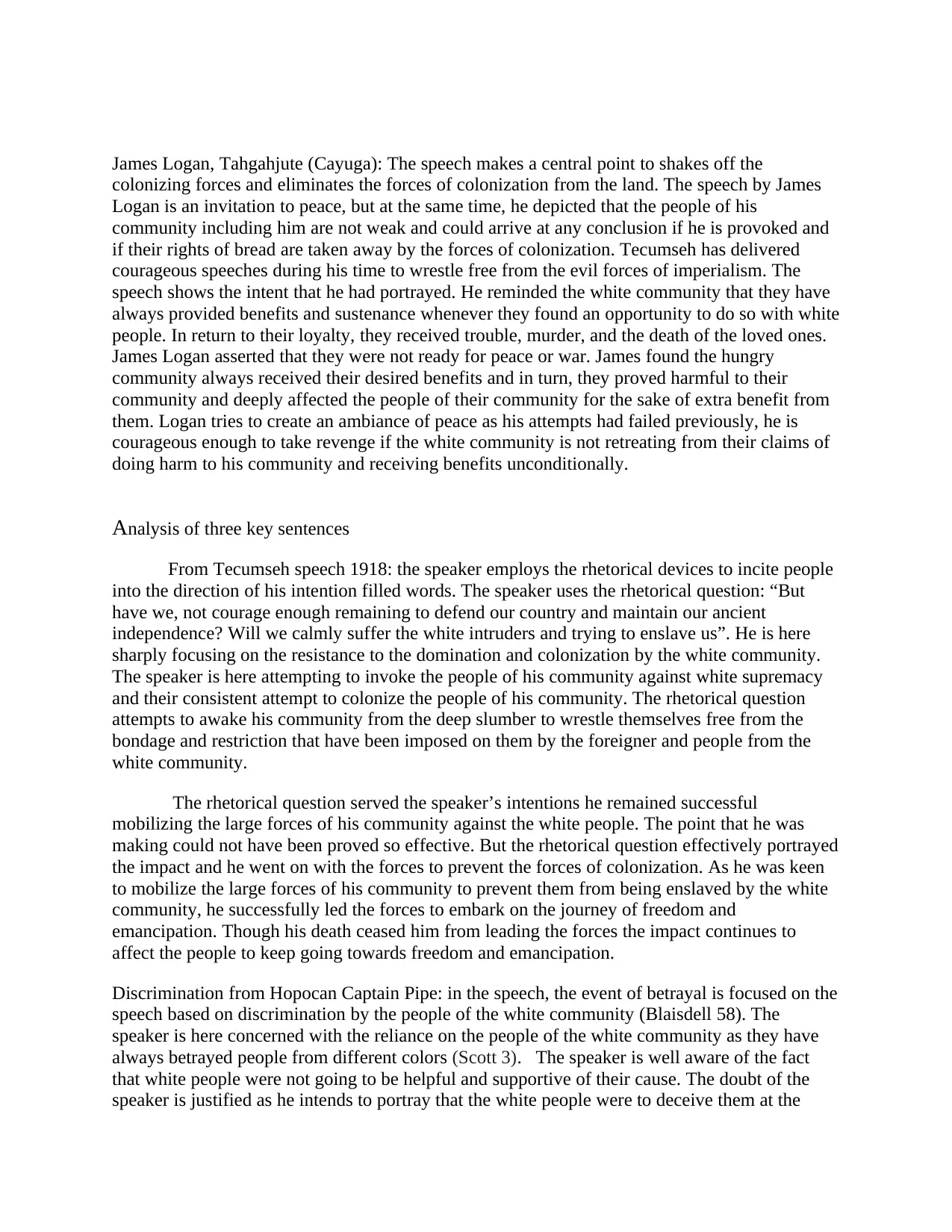
James Logan, Tahgahjute (Cayuga): The speech makes a central point to shakes off the
colonizing forces and eliminates the forces of colonization from the land. The speech by James
Logan is an invitation to peace, but at the same time, he depicted that the people of his
community including him are not weak and could arrive at any conclusion if he is provoked and
if their rights of bread are taken away by the forces of colonization. Tecumseh has delivered
courageous speeches during his time to wrestle free from the evil forces of imperialism. The
speech shows the intent that he had portrayed. He reminded the white community that they have
always provided benefits and sustenance whenever they found an opportunity to do so with white
people. In return to their loyalty, they received trouble, murder, and the death of the loved ones.
James Logan asserted that they were not ready for peace or war. James found the hungry
community always received their desired benefits and in turn, they proved harmful to their
community and deeply affected the people of their community for the sake of extra benefit from
them. Logan tries to create an ambiance of peace as his attempts had failed previously, he is
courageous enough to take revenge if the white community is not retreating from their claims of
doing harm to his community and receiving benefits unconditionally.
Analysis of three key sentences
From Tecumseh speech 1918: the speaker employs the rhetorical devices to incite people
into the direction of his intention filled words. The speaker uses the rhetorical question: “But
have we, not courage enough remaining to defend our country and maintain our ancient
independence? Will we calmly suffer the white intruders and trying to enslave us”. He is here
sharply focusing on the resistance to the domination and colonization by the white community.
The speaker is here attempting to invoke the people of his community against white supremacy
and their consistent attempt to colonize the people of his community. The rhetorical question
attempts to awake his community from the deep slumber to wrestle themselves free from the
bondage and restriction that have been imposed on them by the foreigner and people from the
white community.
The rhetorical question served the speaker’s intentions he remained successful
mobilizing the large forces of his community against the white people. The point that he was
making could not have been proved so effective. But the rhetorical question effectively portrayed
the impact and he went on with the forces to prevent the forces of colonization. As he was keen
to mobilize the large forces of his community to prevent them from being enslaved by the white
community, he successfully led the forces to embark on the journey of freedom and
emancipation. Though his death ceased him from leading the forces the impact continues to
affect the people to keep going towards freedom and emancipation.
Discrimination from Hopocan Captain Pipe: in the speech, the event of betrayal is focused on the
speech based on discrimination by the people of the white community (Blaisdell 58). The
speaker is here concerned with the reliance on the people of the white community as they have
always betrayed people from different colors (Scott 3). The speaker is well aware of the fact
that white people were not going to be helpful and supportive of their cause. The doubt of the
speaker is justified as he intends to portray that the white people were to deceive them at the
Document Page
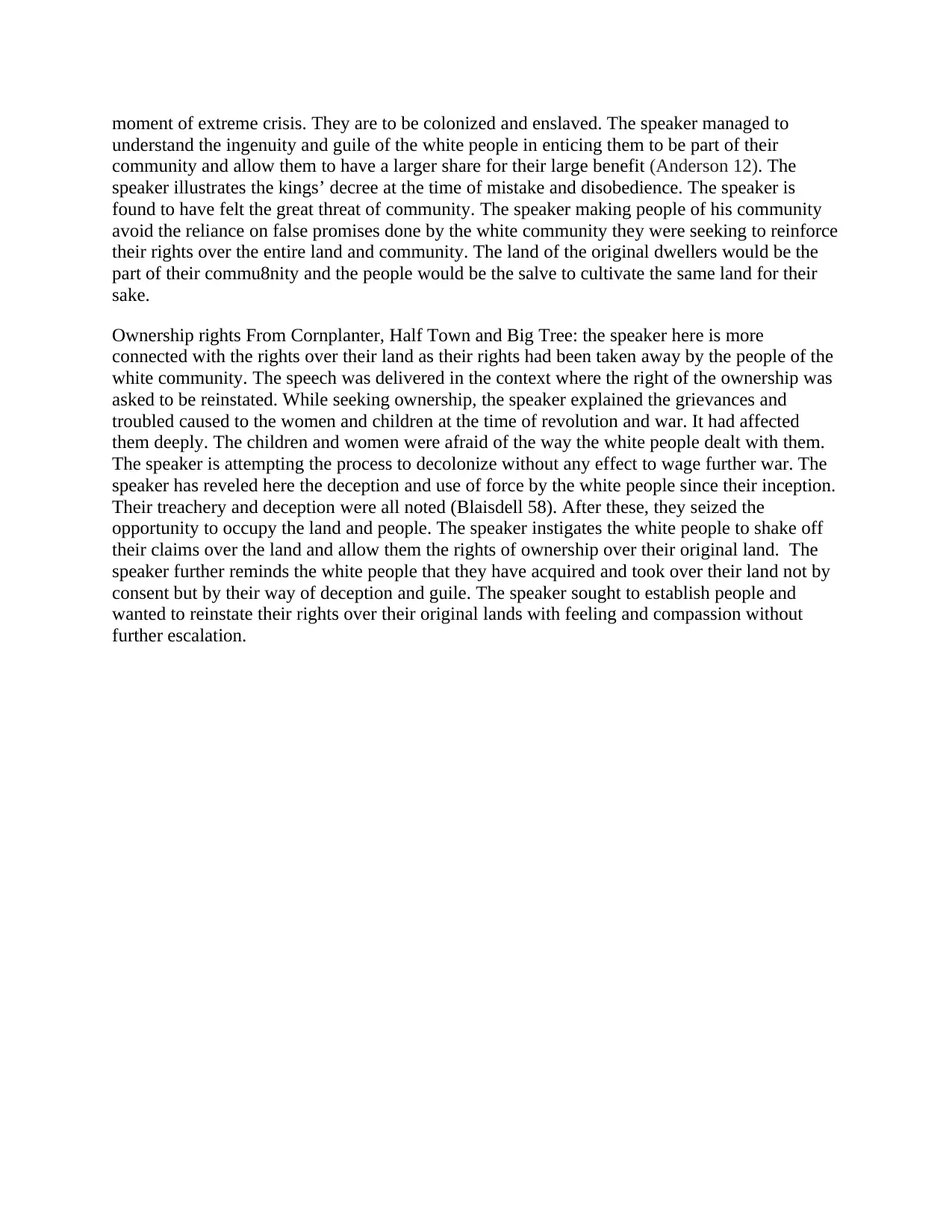
moment of extreme crisis. They are to be colonized and enslaved. The speaker managed to
understand the ingenuity and guile of the white people in enticing them to be part of their
community and allow them to have a larger share for their large benefit (Anderson 12). The
speaker illustrates the kings’ decree at the time of mistake and disobedience. The speaker is
found to have felt the great threat of community. The speaker making people of his community
avoid the reliance on false promises done by the white community they were seeking to reinforce
their rights over the entire land and community. The land of the original dwellers would be the
part of their commu8nity and the people would be the salve to cultivate the same land for their
sake.
Ownership rights From Cornplanter, Half Town and Big Tree: the speaker here is more
connected with the rights over their land as their rights had been taken away by the people of the
white community. The speech was delivered in the context where the right of the ownership was
asked to be reinstated. While seeking ownership, the speaker explained the grievances and
troubled caused to the women and children at the time of revolution and war. It had affected
them deeply. The children and women were afraid of the way the white people dealt with them.
The speaker is attempting the process to decolonize without any effect to wage further war. The
speaker has reveled here the deception and use of force by the white people since their inception.
Their treachery and deception were all noted (Blaisdell 58). After these, they seized the
opportunity to occupy the land and people. The speaker instigates the white people to shake off
their claims over the land and allow them the rights of ownership over their original land. The
speaker further reminds the white people that they have acquired and took over their land not by
consent but by their way of deception and guile. The speaker sought to establish people and
wanted to reinstate their rights over their original lands with feeling and compassion without
further escalation.
Document Page
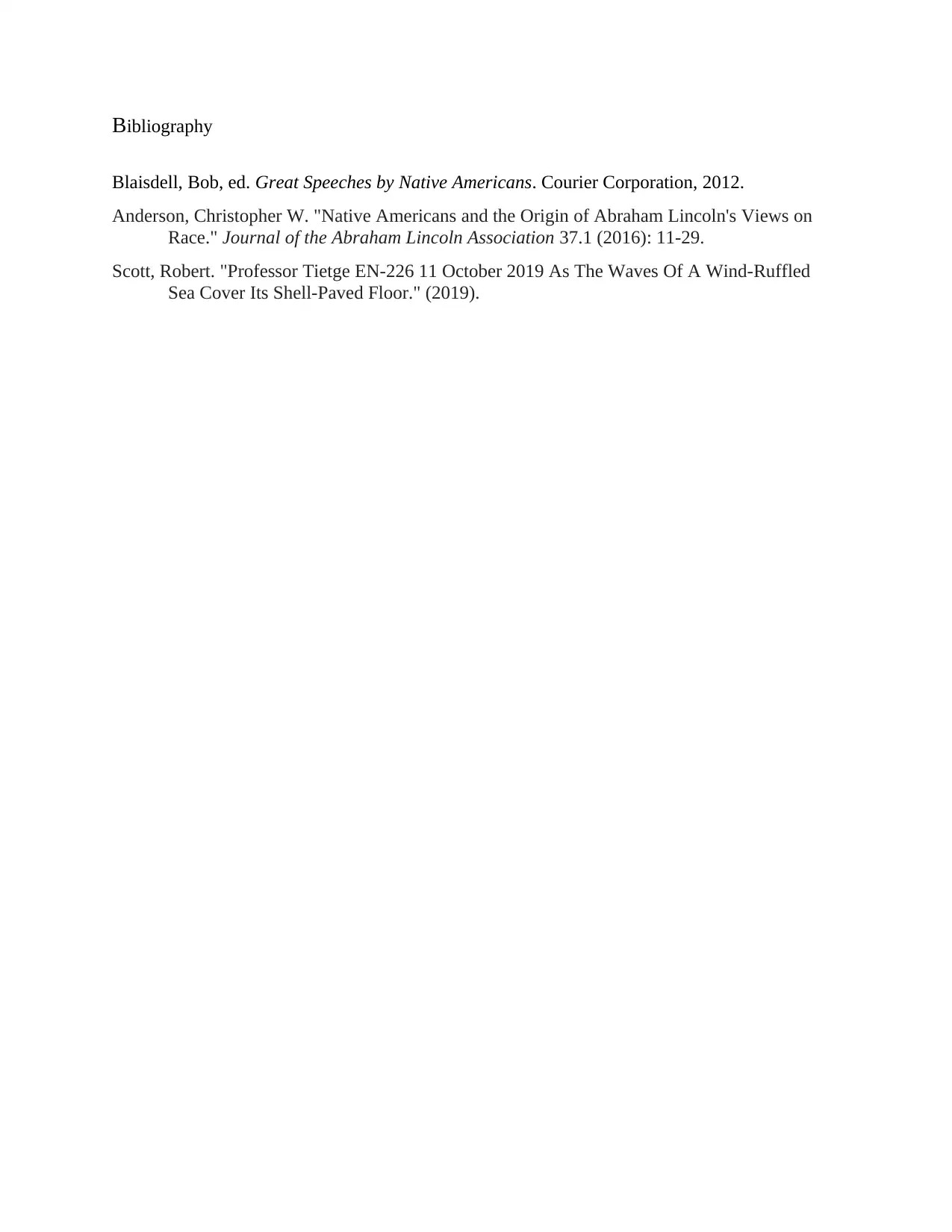
Bibliography
Blaisdell, Bob, ed. Great Speeches by Native Americans. Courier Corporation, 2012.
Anderson, Christopher W. "Native Americans and the Origin of Abraham Lincoln's Views on
Race." Journal of the Abraham Lincoln Association 37.1 (2016): 11-29.
Scott, Robert. "Professor Tietge EN-226 11 October 2019 As The Waves Of A Wind-Ruffled
Sea Cover Its Shell-Paved Floor." (2019).
chevron_up_icon
1 out of 4
circle_padding
hide_on_mobile
zoom_out_icon
[object Object]