In-Depth Analysis & Evaluation of Tesco PLC's Financial Strategy
VerifiedAdded on 2023/06/03
|11
|2585
|99
Report
AI Summary
This report provides a critical evaluation of Tesco PLC's financial strategy, analyzing its approach to raising and distributing funds over the past three years. It examines the company's fund-raising strategies, including the use of debt, equity, and retained profits, and assesses their impact on the capital structure. The report also evaluates Tesco's fund distribution strategies, such as investments, interest payments, and dividends, using financial ratios and relevant corporate finance theories like the Pecking Order Theory and the Linter Dividend policy. Ultimately, the report offers recommendations for improving Tesco's financial strategy, considering its strengths, weaknesses, and the competitive landscape. Desklib offers a wide array of study resources, including past papers and solved assignments to support students in their academic endeavors.

Accounting
Assignment
Assignment

Paraphrase This Document
Need a fresh take? Get an instant paraphrase of this document with our AI Paraphraser
1
Executive Summary
In the given assignment, the annual report of TESCO company has been downloaded and
analyzed for the past three years and the analysis has been done of the overall investment
strategies of the company and the way they have used their funds and invested their funds. Tesco
is one of the biggest multinational company in the world and has been in the retail business from
a long time. Fund raising and taking decisions with respect to that is an important part of any
company and thus that has been analyzed in this assignment.
1 | P a g e
Executive Summary
In the given assignment, the annual report of TESCO company has been downloaded and
analyzed for the past three years and the analysis has been done of the overall investment
strategies of the company and the way they have used their funds and invested their funds. Tesco
is one of the biggest multinational company in the world and has been in the retail business from
a long time. Fund raising and taking decisions with respect to that is an important part of any
company and thus that has been analyzed in this assignment.
1 | P a g e
2
Table of Contents
Executive Summary.....................................................................................................................................1
4.1 Strategy of the firm to raise funds.........................................................................................................3
4.2 Evaluation of the Strategy of the firm to raise funds.............................................................................3
4.3 Firm’s strategy on distribution of funds.................................................................................................4
4.4Evaluation of firm’s strategy on distribution of funds............................................................................4
5.Conclusion and Recommendations..........................................................................................................8
References.................................................................................................................................................10
2 | P a g e
Table of Contents
Executive Summary.....................................................................................................................................1
4.1 Strategy of the firm to raise funds.........................................................................................................3
4.2 Evaluation of the Strategy of the firm to raise funds.............................................................................3
4.3 Firm’s strategy on distribution of funds.................................................................................................4
4.4Evaluation of firm’s strategy on distribution of funds............................................................................4
5.Conclusion and Recommendations..........................................................................................................8
References.................................................................................................................................................10
2 | P a g e
⊘ This is a preview!⊘
Do you want full access?
Subscribe today to unlock all pages.

Trusted by 1+ million students worldwide
3
4.1 Strategy of the firm to raise funds
In case of Tesco the company has raised funds from various sources that includes debt, issue of
shares and retained profits. The company maintain a low debt ratio so that their credit position is
viable. Debt also helps them n dispersing the shareholders by management (Covaleski, et al.,
2003). These policies made by the company have an impact on the overall capital structure of the
company. The company has also indulged in mergers and acquisition and that is also an
important part of the policy management of the company. The company in the past have acquired
poor run businesses and converted them into profitable units based on its resources and
knowledge. These acquisitions by companies have an impact on the overall capital structure and
the flow of resources also. The company also has clear diversification strategies, they acquired
Giraffe a chain family restaurant so that they could enter that family business (Charles H, et al.,
2015). This helped in creating great synergies for Tesco as a company and it will also help in
generating more revenue for the company in many ways. Thus, we see that Tesco as a company
has indulged in many diverse techniques of raising finances that has helped them in being the
company that they are now.
4.2 Evaluation of the Strategy of the firm to raise funds.
Tesco as a company has diversified their sources of finance and have invested in such sources
that has helped in keeping their level of liquidity stable and accurate. It can also be seen that as a
company Tesco has invested both in funds that included debts and equity but they have never
escaped from taking risks on their part. Risk management is an important part of any business
and keeping finances at a level where the company can pay of their debts at a particular time
with their given funds is the most important aspect of it. Money should be used to make money
and diversification and mergers are great ideas to outgrow the inefficiencies that are present in a
3 | P a g e
4.1 Strategy of the firm to raise funds
In case of Tesco the company has raised funds from various sources that includes debt, issue of
shares and retained profits. The company maintain a low debt ratio so that their credit position is
viable. Debt also helps them n dispersing the shareholders by management (Covaleski, et al.,
2003). These policies made by the company have an impact on the overall capital structure of the
company. The company has also indulged in mergers and acquisition and that is also an
important part of the policy management of the company. The company in the past have acquired
poor run businesses and converted them into profitable units based on its resources and
knowledge. These acquisitions by companies have an impact on the overall capital structure and
the flow of resources also. The company also has clear diversification strategies, they acquired
Giraffe a chain family restaurant so that they could enter that family business (Charles H, et al.,
2015). This helped in creating great synergies for Tesco as a company and it will also help in
generating more revenue for the company in many ways. Thus, we see that Tesco as a company
has indulged in many diverse techniques of raising finances that has helped them in being the
company that they are now.
4.2 Evaluation of the Strategy of the firm to raise funds.
Tesco as a company has diversified their sources of finance and have invested in such sources
that has helped in keeping their level of liquidity stable and accurate. It can also be seen that as a
company Tesco has invested both in funds that included debts and equity but they have never
escaped from taking risks on their part. Risk management is an important part of any business
and keeping finances at a level where the company can pay of their debts at a particular time
with their given funds is the most important aspect of it. Money should be used to make money
and diversification and mergers are great ideas to outgrow the inefficiencies that are present in a
3 | P a g e
Paraphrase This Document
Need a fresh take? Get an instant paraphrase of this document with our AI Paraphraser
4
particular system of a poor unit and changed the same and used it for its growth and expansion
overall and converted it into a profitable unit. So we see that mergers and acquisition are great
methods by which companies can employ their resources and also diversification has helped
them in trying new business methods and ideas that has helped them in growing as a big
multinational company (Abdullah & Said, 2017).
4.3 Firm’s strategy on distribution of funds
The company has invested in both shares and debts and has also invested in various related
parties that has helped in managing the funds of the company and making it feasible for the
company to take risks by indulging in various hedge transcations that are related to securities at a
large. The company has indulged in transcations that includes hedge funds and options that are
transcated over the counter and these financial instruments have helped the company in gaining
lot of revenues (Belton, 2017). The company has also indulged in buy back of shares and have
issued the same to its employees which helps in keeping the debt equity ratio stable for the
company in many ways. It has indulged in mergers and accqusiition and diversification of
business units that has helped it in earning money through other sources and investing in such
units which are profitable to the company. So we see that there are various ways in which the
company has distributed their funds and an analysis of the same is given below (Boghossian,
2017).
4.4Evaluation of firm’s strategy on distribution of funds
The overall strategy of the firm to distribute their funds can be studied by analyzing the financial
position of the company with the help of ratios. The ratio analysis is one of the analytical
4 | P a g e
particular system of a poor unit and changed the same and used it for its growth and expansion
overall and converted it into a profitable unit. So we see that mergers and acquisition are great
methods by which companies can employ their resources and also diversification has helped
them in trying new business methods and ideas that has helped them in growing as a big
multinational company (Abdullah & Said, 2017).
4.3 Firm’s strategy on distribution of funds
The company has invested in both shares and debts and has also invested in various related
parties that has helped in managing the funds of the company and making it feasible for the
company to take risks by indulging in various hedge transcations that are related to securities at a
large. The company has indulged in transcations that includes hedge funds and options that are
transcated over the counter and these financial instruments have helped the company in gaining
lot of revenues (Belton, 2017). The company has also indulged in buy back of shares and have
issued the same to its employees which helps in keeping the debt equity ratio stable for the
company in many ways. It has indulged in mergers and accqusiition and diversification of
business units that has helped it in earning money through other sources and investing in such
units which are profitable to the company. So we see that there are various ways in which the
company has distributed their funds and an analysis of the same is given below (Boghossian,
2017).
4.4Evaluation of firm’s strategy on distribution of funds
The overall strategy of the firm to distribute their funds can be studied by analyzing the financial
position of the company with the help of ratios. The ratio analysis is one of the analytical
4 | P a g e
5
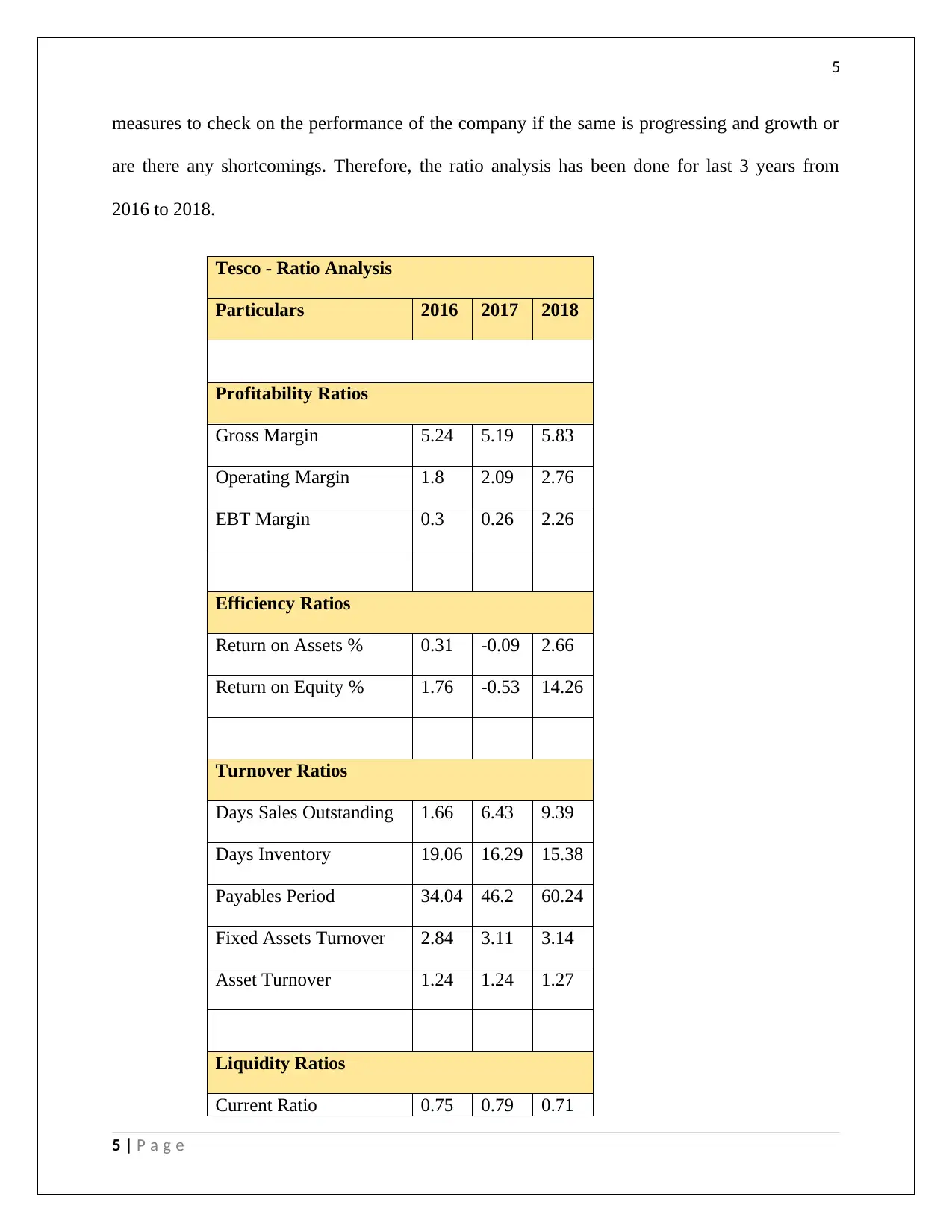
measures to check on the performance of the company if the same is progressing and growth or
are there any shortcomings. Therefore, the ratio analysis has been done for last 3 years from
2016 to 2018.
Tesco - Ratio Analysis
Particulars 2016 2017 2018
Profitability Ratios
Gross Margin 5.24 5.19 5.83
Operating Margin 1.8 2.09 2.76
EBT Margin 0.3 0.26 2.26
Efficiency Ratios
Return on Assets % 0.31 -0.09 2.66
Return on Equity % 1.76 -0.53 14.26
Turnover Ratios
Days Sales Outstanding 1.66 6.43 9.39
Days Inventory 19.06 16.29 15.38
Payables Period 34.04 46.2 60.24
Fixed Assets Turnover 2.84 3.11 3.14
Asset Turnover 1.24 1.24 1.27
Liquidity Ratios
Current Ratio 0.75 0.79 0.71
5 | P a g e
measures to check on the performance of the company if the same is progressing and growth or
are there any shortcomings. Therefore, the ratio analysis has been done for last 3 years from
2016 to 2018.
Tesco - Ratio Analysis
Particulars 2016 2017 2018
Profitability Ratios
Gross Margin 5.24 5.19 5.83
Operating Margin 1.8 2.09 2.76
EBT Margin 0.3 0.26 2.26
Efficiency Ratios
Return on Assets % 0.31 -0.09 2.66
Return on Equity % 1.76 -0.53 14.26
Turnover Ratios
Days Sales Outstanding 1.66 6.43 9.39
Days Inventory 19.06 16.29 15.38
Payables Period 34.04 46.2 60.24
Fixed Assets Turnover 2.84 3.11 3.14
Asset Turnover 1.24 1.24 1.27
Liquidity Ratios
Current Ratio 0.75 0.79 0.71
5 | P a g e
⊘ This is a preview!⊘
Do you want full access?
Subscribe today to unlock all pages.
Trusted by 1+ million students worldwide
6
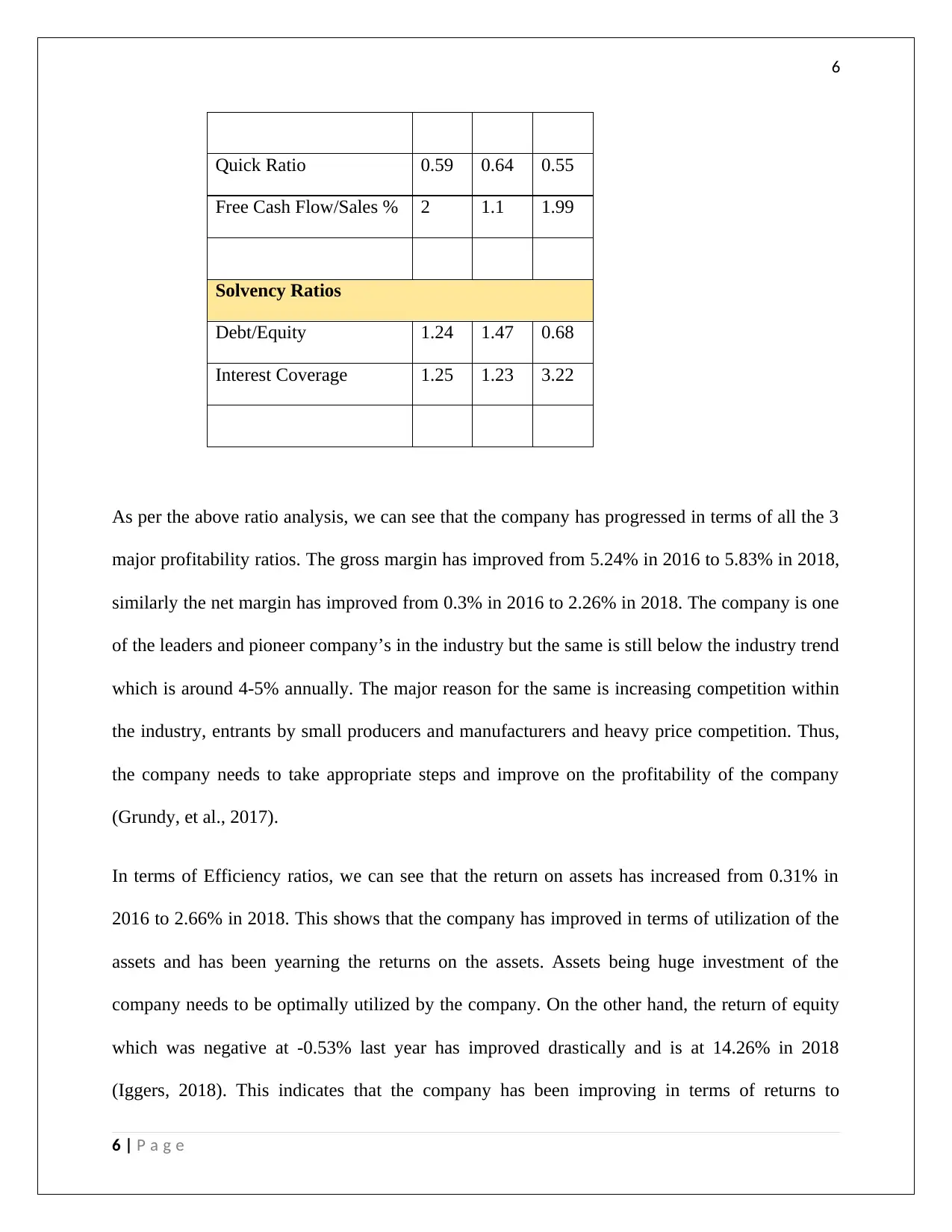
Quick Ratio 0.59 0.64 0.55
Free Cash Flow/Sales % 2 1.1 1.99
Solvency Ratios
Debt/Equity 1.24 1.47 0.68
Interest Coverage 1.25 1.23 3.22
As per the above ratio analysis, we can see that the company has progressed in terms of all the 3
major profitability ratios. The gross margin has improved from 5.24% in 2016 to 5.83% in 2018,
similarly the net margin has improved from 0.3% in 2016 to 2.26% in 2018. The company is one
of the leaders and pioneer company’s in the industry but the same is still below the industry trend
which is around 4-5% annually. The major reason for the same is increasing competition within
the industry, entrants by small producers and manufacturers and heavy price competition. Thus,
the company needs to take appropriate steps and improve on the profitability of the company
(Grundy, et al., 2017).
In terms of Efficiency ratios, we can see that the return on assets has increased from 0.31% in
2016 to 2.66% in 2018. This shows that the company has improved in terms of utilization of the
assets and has been yearning the returns on the assets. Assets being huge investment of the
company needs to be optimally utilized by the company. On the other hand, the return of equity
which was negative at -0.53% last year has improved drastically and is at 14.26% in 2018
(Iggers, 2018). This indicates that the company has been improving in terms of returns to
6 | P a g e
Quick Ratio 0.59 0.64 0.55
Free Cash Flow/Sales % 2 1.1 1.99
Solvency Ratios
Debt/Equity 1.24 1.47 0.68
Interest Coverage 1.25 1.23 3.22
As per the above ratio analysis, we can see that the company has progressed in terms of all the 3
major profitability ratios. The gross margin has improved from 5.24% in 2016 to 5.83% in 2018,
similarly the net margin has improved from 0.3% in 2016 to 2.26% in 2018. The company is one
of the leaders and pioneer company’s in the industry but the same is still below the industry trend
which is around 4-5% annually. The major reason for the same is increasing competition within
the industry, entrants by small producers and manufacturers and heavy price competition. Thus,
the company needs to take appropriate steps and improve on the profitability of the company
(Grundy, et al., 2017).
In terms of Efficiency ratios, we can see that the return on assets has increased from 0.31% in
2016 to 2.66% in 2018. This shows that the company has improved in terms of utilization of the
assets and has been yearning the returns on the assets. Assets being huge investment of the
company needs to be optimally utilized by the company. On the other hand, the return of equity
which was negative at -0.53% last year has improved drastically and is at 14.26% in 2018
(Iggers, 2018). This indicates that the company has been improving in terms of returns to
6 | P a g e
Paraphrase This Document
Need a fresh take? Get an instant paraphrase of this document with our AI Paraphraser
7
shareholders and investors and is thus meeting their expectation. The return on equity is much
more than the industry trends and it shows that the shares of the company have been performing
well due to improved performance and efficiency of operations (Kaufmann, 2017).
In terms of the turnover ratios, the daily sales outstanding which is the measure of the receivable
days and which shows for many days a receivable is overdue and is rolled up in a year, has
increased considerably from 1.66 times to 9.39 times and this is an indication that the company
has been efficient enough in receiving the sales made and the internal control in this regard has
been strong In terms of the solvency ratio which shows the proportion of loan and own capital in
the company, the company has done well in the recent past in decreasing the proportion of debt
in the capital. The same is evident from the debt equity ratio which has come down from 1.24
times in 2016 to 0.68 times in 2018.
The liquidity ratios is an indicator of the fact that in case the company is required to pay off the
short time liabilities on an urgent basis, then the company should be having sufficient current and
quick assets and the good operating cash flow to pay off the same (Coate & Mitschow, 2017).
The current ratio of the company has depleted from 0.75 times in 2016 to 0.71 times in 2018 as
well as the quick ratio (measure of readily convertible liquid assets to current liabilities) has
decreased from 0.59 times to 0.55 times in 2018. The same is much below the industry trend of 2
times and 1 time respectively. It is an indication that the company would not be able to meet off
its short term liabilities on time if at all there is a requirement to do so. The free cash flow to
sales ratio has however improved from 1.1% in 2017 to 2% in 2018 (Vieira, et al., 2017).
After the analytical review based on the above ratio analysis, we can apply financial theories to
study the capital structure of the company. Few of the theroies that have been discussed includes
7 | P a g e
shareholders and investors and is thus meeting their expectation. The return on equity is much
more than the industry trends and it shows that the shares of the company have been performing
well due to improved performance and efficiency of operations (Kaufmann, 2017).
In terms of the turnover ratios, the daily sales outstanding which is the measure of the receivable
days and which shows for many days a receivable is overdue and is rolled up in a year, has
increased considerably from 1.66 times to 9.39 times and this is an indication that the company
has been efficient enough in receiving the sales made and the internal control in this regard has
been strong In terms of the solvency ratio which shows the proportion of loan and own capital in
the company, the company has done well in the recent past in decreasing the proportion of debt
in the capital. The same is evident from the debt equity ratio which has come down from 1.24
times in 2016 to 0.68 times in 2018.
The liquidity ratios is an indicator of the fact that in case the company is required to pay off the
short time liabilities on an urgent basis, then the company should be having sufficient current and
quick assets and the good operating cash flow to pay off the same (Coate & Mitschow, 2017).
The current ratio of the company has depleted from 0.75 times in 2016 to 0.71 times in 2018 as
well as the quick ratio (measure of readily convertible liquid assets to current liabilities) has
decreased from 0.59 times to 0.55 times in 2018. The same is much below the industry trend of 2
times and 1 time respectively. It is an indication that the company would not be able to meet off
its short term liabilities on time if at all there is a requirement to do so. The free cash flow to
sales ratio has however improved from 1.1% in 2017 to 2% in 2018 (Vieira, et al., 2017).
After the analytical review based on the above ratio analysis, we can apply financial theories to
study the capital structure of the company. Few of the theroies that have been discussed includes
7 | P a g e
8
the Pecking Order Theory and the Linter and Dividend policy. The pecking order theory
considers that the cost of financing will increase along with the assymetrical information. Every
company has fund coming from three different sources that includes equity, debt and internal
funds. It states that finanes are used based on the basis of preferences and the first preference is
given to the internal financing and then the other two sources are used. In case of Tesco also it
can be seen that the company has followed the method of financing in which the main focus is
given to debt based financing and then equity has been considered. It does not resort to internal
financing to fund its operation, rather the company has indulged in raising shares and also taken
long term borrowings from relevant sources which forms the bigger part of its operations. The
other theories that helps in studying the capital position of the company is the dividend policy
which was proposed by Modigliani Miller again as pwe which the value of the company does not
change with the distribution of dividend as either ways it belongs to the investor and is either
distributed now or is reinvested by the company as is seen in the case of Tesco Plc (Webster,
2017). The Linter Theory discusses how companies set long term targets to comply with the
dividend payment options and that is related to the positive NPV of the company. It also
mentions that increase in aforesaid earnings is not always sutiable for the company. Thus the
dividend policy does not changes alot and the managers often considers the sustainable level of
earnings are suatinable or not. It can be seen that in case of Tesco the company has not changed
the dividend policy from past three years and also this supports the theory of Linter as the
earnings of the company are not sustainable enough to support the high dividends that the
company might think to pay off in the future. Thus we see that financial theories helps in
studying the indepth part of the capital structure of the company and its various aspects also
(Borit & Olsen, 2012).
8 | P a g e
the Pecking Order Theory and the Linter and Dividend policy. The pecking order theory
considers that the cost of financing will increase along with the assymetrical information. Every
company has fund coming from three different sources that includes equity, debt and internal
funds. It states that finanes are used based on the basis of preferences and the first preference is
given to the internal financing and then the other two sources are used. In case of Tesco also it
can be seen that the company has followed the method of financing in which the main focus is
given to debt based financing and then equity has been considered. It does not resort to internal
financing to fund its operation, rather the company has indulged in raising shares and also taken
long term borrowings from relevant sources which forms the bigger part of its operations. The
other theories that helps in studying the capital position of the company is the dividend policy
which was proposed by Modigliani Miller again as pwe which the value of the company does not
change with the distribution of dividend as either ways it belongs to the investor and is either
distributed now or is reinvested by the company as is seen in the case of Tesco Plc (Webster,
2017). The Linter Theory discusses how companies set long term targets to comply with the
dividend payment options and that is related to the positive NPV of the company. It also
mentions that increase in aforesaid earnings is not always sutiable for the company. Thus the
dividend policy does not changes alot and the managers often considers the sustainable level of
earnings are suatinable or not. It can be seen that in case of Tesco the company has not changed
the dividend policy from past three years and also this supports the theory of Linter as the
earnings of the company are not sustainable enough to support the high dividends that the
company might think to pay off in the future. Thus we see that financial theories helps in
studying the indepth part of the capital structure of the company and its various aspects also
(Borit & Olsen, 2012).
8 | P a g e
⊘ This is a preview!⊘
Do you want full access?
Subscribe today to unlock all pages.
Trusted by 1+ million students worldwide
9
5.Conclusion and Recommendations
Based on the overall analysis it can be said that the business aspects and fund raising technqoue
of the company is excellent but given that there is so much competition and people are indulging
in different ways by which they can increase their finances and invest in sources that can
generate income, it becomes imperative that they adopt methods by which they can change their
present structure and generate funds through other sources. It is important to take risk as there is
no return ithout risk and this should be the basic aim of the company and in case there are
situations the liquidity position should be maintained as that is vital. The shareholders should get
good return then only they will invest in the company. Hence all with good investing decisions
the company should also keep the demands of the shareholders of the company in mind and other
stakeholders also.
References
9 | P a g e
5.Conclusion and Recommendations
Based on the overall analysis it can be said that the business aspects and fund raising technqoue
of the company is excellent but given that there is so much competition and people are indulging
in different ways by which they can increase their finances and invest in sources that can
generate income, it becomes imperative that they adopt methods by which they can change their
present structure and generate funds through other sources. It is important to take risk as there is
no return ithout risk and this should be the basic aim of the company and in case there are
situations the liquidity position should be maintained as that is vital. The shareholders should get
good return then only they will invest in the company. Hence all with good investing decisions
the company should also keep the demands of the shareholders of the company in mind and other
stakeholders also.
References
9 | P a g e
Paraphrase This Document
Need a fresh take? Get an instant paraphrase of this document with our AI Paraphraser
10
Abdullah, W. & Said, R., 2017. Religious, Educational Background and Corporate Crime Tolerance by
Accounting Professionals. State-of-the-Art Theories and Empirical Evidence, pp. 129-149.
Belton, P., 2017. Competitive Strategy: Creating and Sustaining Superior Performance. London: Macat
International ltd.
Boghossian, P., 2017. The Socratic method, defeasibility, and doxastic responsibility. Educational
Philosophy and Theory, 50(3), pp. 244-253.
Borit, M. & Olsen, P., 2012. Evaluation framework for regulatory requirements related to data recording
and traceability designed to prevent illegal, unreported and unregulated fishing. Marine Policy, 36(1),
pp. 96-102.
Charles H, C., Giovanna, M., Dennis M, P. & Robin W, R., 2015. CSR disclosure: the more things
change…?. Accounting, Auditing & Accountability Journal, 28(1), pp. 14-35.
Coate, C. & Mitschow, M., 2017. Luca Pacioli and the Role of Accounting and Business: Early Lessons in
Social Responsibility. s.l.:s.n.
Covaleski, M., Evans, J., Luft, J. & Shields, M., 2003. Budegting Research Three Theoretical Prespectives
and Criteria for selective Integration. Journal of Management Accounting Research, 15(3), pp. 3-49.
Grundy, Q., Held, F. & Bero, L., 2017. A Social Network Analysis of the Financial Links Backing Health and
Fitness Apps. American Journal of Public Health.
Iggers, J., 2018. Good News, Bad News: Journalism Ethics And The Public Interest. s.l.:s.n.
Kaufmann, W., 2017. The Problem of Regulatory Unreasonableness. First ed. New York: Routledge.
Vieira, R., O’Dwyer, B. & Schneider, R., 2017. Aligning Strategy and Performance Management Systems.
SAGE Journals, 30(1).
Webster, T., 2017. Successful Ethical Decision-Making Practices from the Professional Accountants'
Perspective. ProQuest Dissertations Publishing.
10 | P a g e
Abdullah, W. & Said, R., 2017. Religious, Educational Background and Corporate Crime Tolerance by
Accounting Professionals. State-of-the-Art Theories and Empirical Evidence, pp. 129-149.
Belton, P., 2017. Competitive Strategy: Creating and Sustaining Superior Performance. London: Macat
International ltd.
Boghossian, P., 2017. The Socratic method, defeasibility, and doxastic responsibility. Educational
Philosophy and Theory, 50(3), pp. 244-253.
Borit, M. & Olsen, P., 2012. Evaluation framework for regulatory requirements related to data recording
and traceability designed to prevent illegal, unreported and unregulated fishing. Marine Policy, 36(1),
pp. 96-102.
Charles H, C., Giovanna, M., Dennis M, P. & Robin W, R., 2015. CSR disclosure: the more things
change…?. Accounting, Auditing & Accountability Journal, 28(1), pp. 14-35.
Coate, C. & Mitschow, M., 2017. Luca Pacioli and the Role of Accounting and Business: Early Lessons in
Social Responsibility. s.l.:s.n.
Covaleski, M., Evans, J., Luft, J. & Shields, M., 2003. Budegting Research Three Theoretical Prespectives
and Criteria for selective Integration. Journal of Management Accounting Research, 15(3), pp. 3-49.
Grundy, Q., Held, F. & Bero, L., 2017. A Social Network Analysis of the Financial Links Backing Health and
Fitness Apps. American Journal of Public Health.
Iggers, J., 2018. Good News, Bad News: Journalism Ethics And The Public Interest. s.l.:s.n.
Kaufmann, W., 2017. The Problem of Regulatory Unreasonableness. First ed. New York: Routledge.
Vieira, R., O’Dwyer, B. & Schneider, R., 2017. Aligning Strategy and Performance Management Systems.
SAGE Journals, 30(1).
Webster, T., 2017. Successful Ethical Decision-Making Practices from the Professional Accountants'
Perspective. ProQuest Dissertations Publishing.
10 | P a g e

1 out of 11


Related Documents


Your All-in-One AI-Powered Toolkit for Academic Success.
+13062052269
info@desklib.com
Available 24*7 on WhatsApp / Email
![[object Object]](/_next/static/media/star-bottom.7253800d.svg)
Unlock your academic potential
Copyright © 2020–2026 A2Z Services. All Rights Reserved. Developed and managed by ZUCOL.