Contribution Margin: Unveiling Company's Cost Structure

Verified

Added on  2020/04/21

|4
|820
|101
Homework Assignment
AI Summary
This assignment delves into the concept of contribution margin and its crucial role in understanding a company's cost structure. The analysis begins by defining contribution margin as the difference between sales revenue and variable costs, highlighting its significance in managerial decision-making. The assignment then explains how contribution margin reveals insights into a company's cost structure, particularly in relation to breakeven analysis, which is the point where total revenues equal total costs. The document provides a formula for calculating contribution margin per unit and illustrates the concept with a numerical example. It emphasizes how contribution margin helps in analyzing variable costs, assessing operating leverage, and making informed decisions about pricing, production levels, and overall profitability. The assignment references key accounting literature to support its concepts and provides a comprehensive understanding of contribution margin's importance in financial analysis.

Document Page
V2017.T4. 1.0
FNS50215 Diploma of Accounting/ FNSACC507/ 2017/ T4/ / Online Learning / WK 2Page 1 of 4
tabler-icon-diamond-filled.svg

Paraphrase This Document

Need a fresh take? Get an instant paraphrase of this document with our AI Paraphraser
Document Page
Task
What does contribution margin reveal about a company’s cost structure?
Contribution margin is the dollar contribution of the manufacturing company in its process.
Contribution margin per unit is calculated through deducting the total amount of the variable
cost into the total sales amount of the company. This contribution margin could be
calculated through the below given formula:
Contribution margin per unit = sales price per unit - variable cost per unit
This contribution margin helps an organization to manage and administer the various
decisions of the company. It helps the company to analyse that how the performance and the
position of the company could be revealed (DRURY, 2013).
This process helps the company to reveal about the cost structure of the company as the
contribution margin impact over the various decisions and the breakeven level of the
company. Breakeven level is the point where the company would not have to face any kind
of loss and the profit as well. This assist the company to identify the total cost of the
company and it also assist the company to make some better decisions about the
performance and the stability of the company.
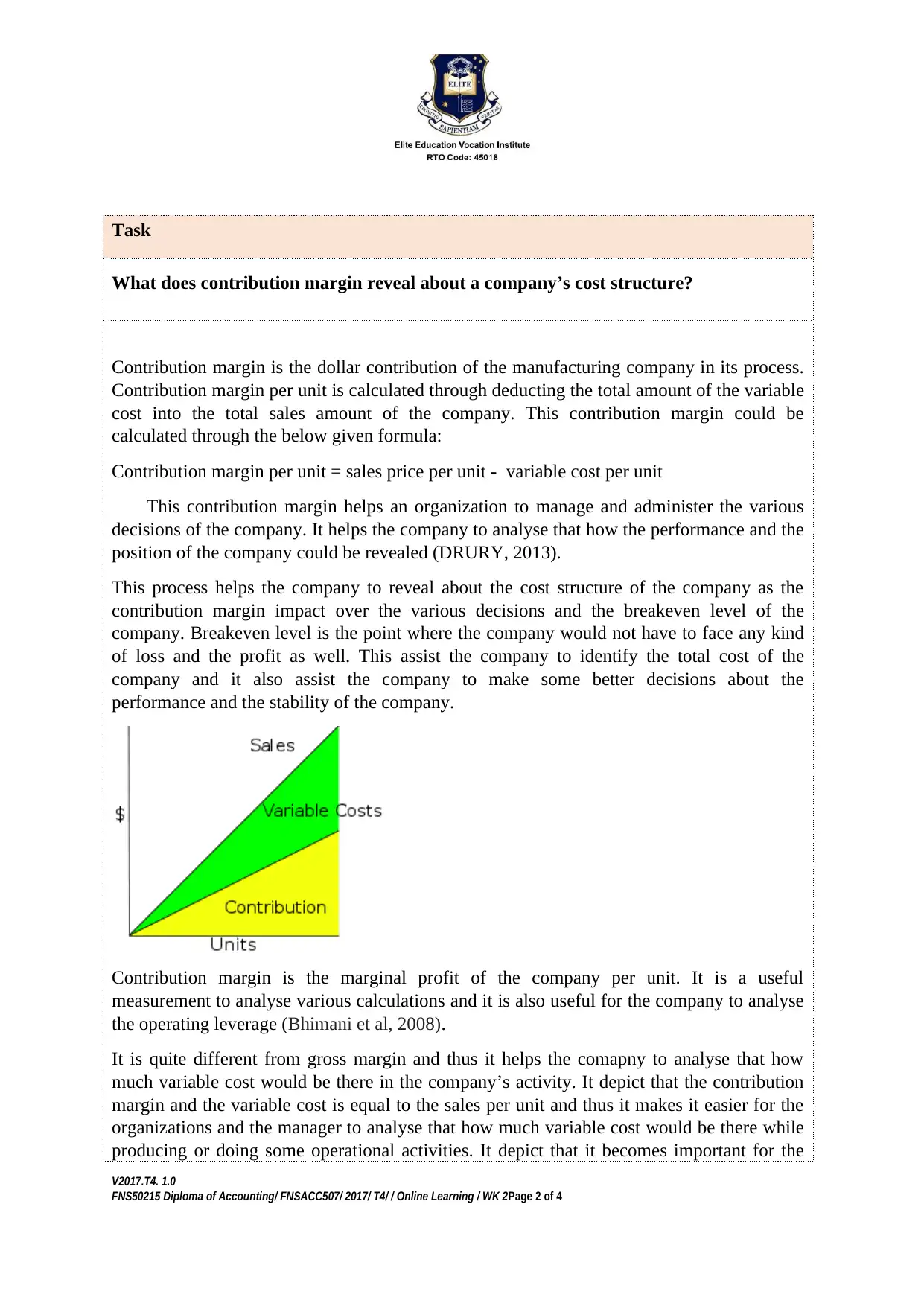
Contribution margin is the marginal profit of the company per unit. It is a useful
measurement to analyse various calculations and it is also useful for the company to analyse
the operating leverage (Bhimani et al, 2008).
It is quite different from gross margin and thus it helps the comapny to analyse that how
much variable cost would be there in the company’s activity. It depict that the contribution
margin and the variable cost is equal to the sales per unit and thus it makes it easier for the
organizations and the manager to analyse that how much variable cost would be there while
producing or doing some operational activities. It depict that it becomes important for the
V2017.T4. 1.0
FNS50215 Diploma of Accounting/ FNSACC507/ 2017/ T4/ / Online Learning / WK 2Page 2 of 4
Document Page
analyst to analyse and identify the various level of the cost so that the cost structure of the
company could easily be identified. Further, it has also been found that the contribution
margin per unit becomes important for the managers to analyse the cost structure of the
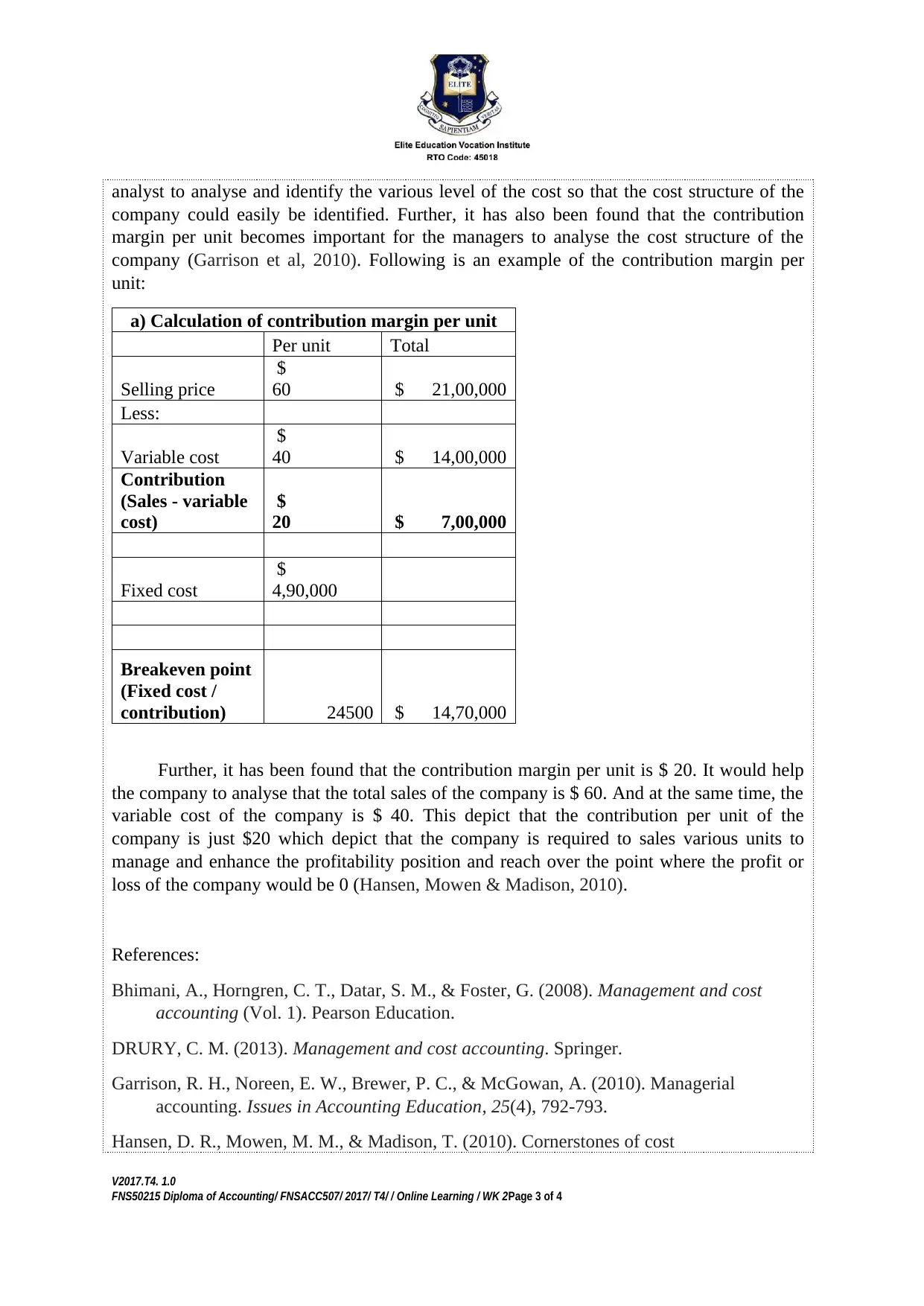
company (Garrison et al, 2010). Following is an example of the contribution margin per
unit:
a) Calculation of contribution margin per unit
Per unit Total
Selling price
$
60 $ 21,00,000
Less:
Variable cost
$
40 $ 14,00,000
Contribution
(Sales - variable
cost)
$
20 $ 7,00,000
Fixed cost
$
4,90,000
Breakeven point
(Fixed cost /
contribution) 24500 $ 14,70,000
Further, it has been found that the contribution margin per unit is $ 20. It would help
the company to analyse that the total sales of the company is $ 60. And at the same time, the
variable cost of the company is $ 40. This depict that the contribution per unit of the
company is just $20 which depict that the company is required to sales various units to
manage and enhance the profitability position and reach over the point where the profit or
loss of the company would be 0 (Hansen, Mowen & Madison, 2010).
References:
Bhimani, A., Horngren, C. T., Datar, S. M., & Foster, G. (2008). Management and cost
accounting (Vol. 1). Pearson Education.
DRURY, C. M. (2013). Management and cost accounting. Springer.
Garrison, R. H., Noreen, E. W., Brewer, P. C., & McGowan, A. (2010). Managerial
accounting. Issues in Accounting Education, 25(4), 792-793.
Hansen, D. R., Mowen, M. M., & Madison, T. (2010). Cornerstones of cost
V2017.T4. 1.0
FNS50215 Diploma of Accounting/ FNSACC507/ 2017/ T4/ / Online Learning / WK 2Page 3 of 4
Document Page
accounting. Issues in Accounting Education, 25(4), 790-791.
V2017.T4. 1.0
FNS50215 Diploma of Accounting/ FNSACC507/ 2017/ T4/ / Online Learning / WK 2Page 4 of 4
chevron_up_icon
1 out of 4
circle_padding
hide_on_mobile
zoom_out_icon
[object Object]