Analyzing Education for Differently Abled: IDS 400 Report

Verified

Added on  2022/10/04

|4
|822
|330
Report
AI Summary
This report, prepared for the IDS 400 course, examines the education of differently abled individuals, specifically those with hearing and speech disabilities, through the lenses of natural and social sciences. It emphasizes the impact of communication disabilities on learning, academic abilities, and social interaction. The analysis explores how natural sciences, including observation and the use of visually stimulating materials, and applied sciences, such as linguistics and behavioral psychology, can enhance educational experiences. The social lens highlights the importance of social workers and scientists in addressing social dynamics and ensuring equitable rights. The report underscores the need for inclusive educational practices that utilize both verbal and non-verbal communication methods, fostering social identity and overall development. It references several academic sources to support its arguments, advocating for a comprehensive approach to support the differently abled students.
Document Page
RUNNING HEAD: EDUCATION FOR THE DIFFERENTLY ABLED
EDUCATION FOR THE DIFFERENTLY ABLED
Name of Student
Name of University
Author note
tabler-icon-diamond-filled.svg

Paraphrase This Document

Need a fresh take? Get an instant paraphrase of this document with our AI Paraphraser
Document Page
1EDUCATION FOR THE DIFFERENTLY ABLED
EDUCATION FOR THE DIFFERENTLY ABLED
Relation of the issue to Natural and Applied sciences
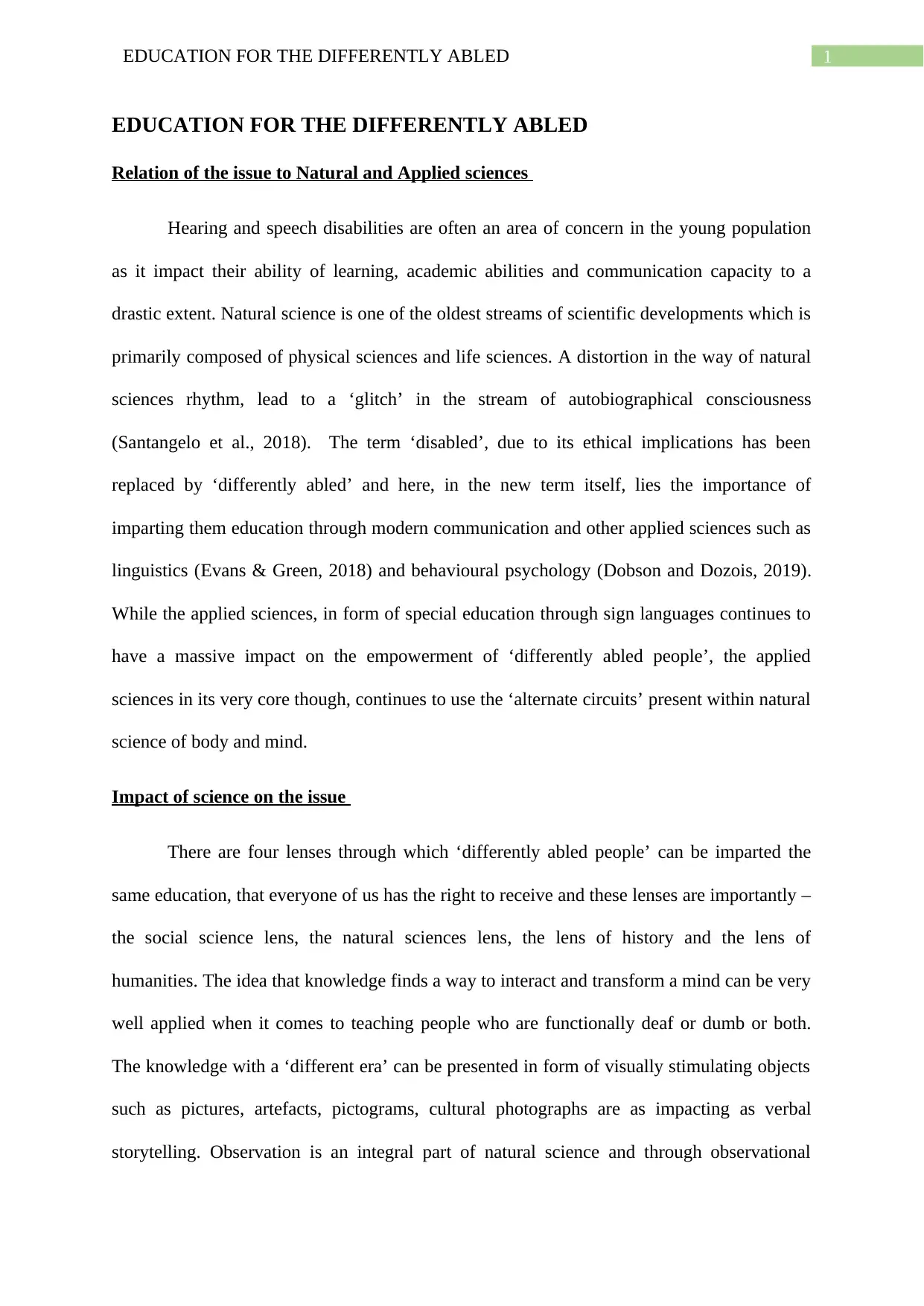
Hearing and speech disabilities are often an area of concern in the young population
as it impact their ability of learning, academic abilities and communication capacity to a
drastic extent. Natural science is one of the oldest streams of scientific developments which is
primarily composed of physical sciences and life sciences. A distortion in the way of natural
sciences rhythm, lead to a ‘glitch’ in the stream of autobiographical consciousness
(Santangelo et al., 2018). The term ‘disabled’, due to its ethical implications has been
replaced by ‘differently abled’ and here, in the new term itself, lies the importance of
imparting them education through modern communication and other applied sciences such as
linguistics (Evans & Green, 2018) and behavioural psychology (Dobson and Dozois, 2019).
While the applied sciences, in form of special education through sign languages continues to
have a massive impact on the empowerment of ‘differently abled people’, the applied
sciences in its very core though, continues to use the ‘alternate circuits’ present within natural
science of body and mind.
Impact of science on the issue
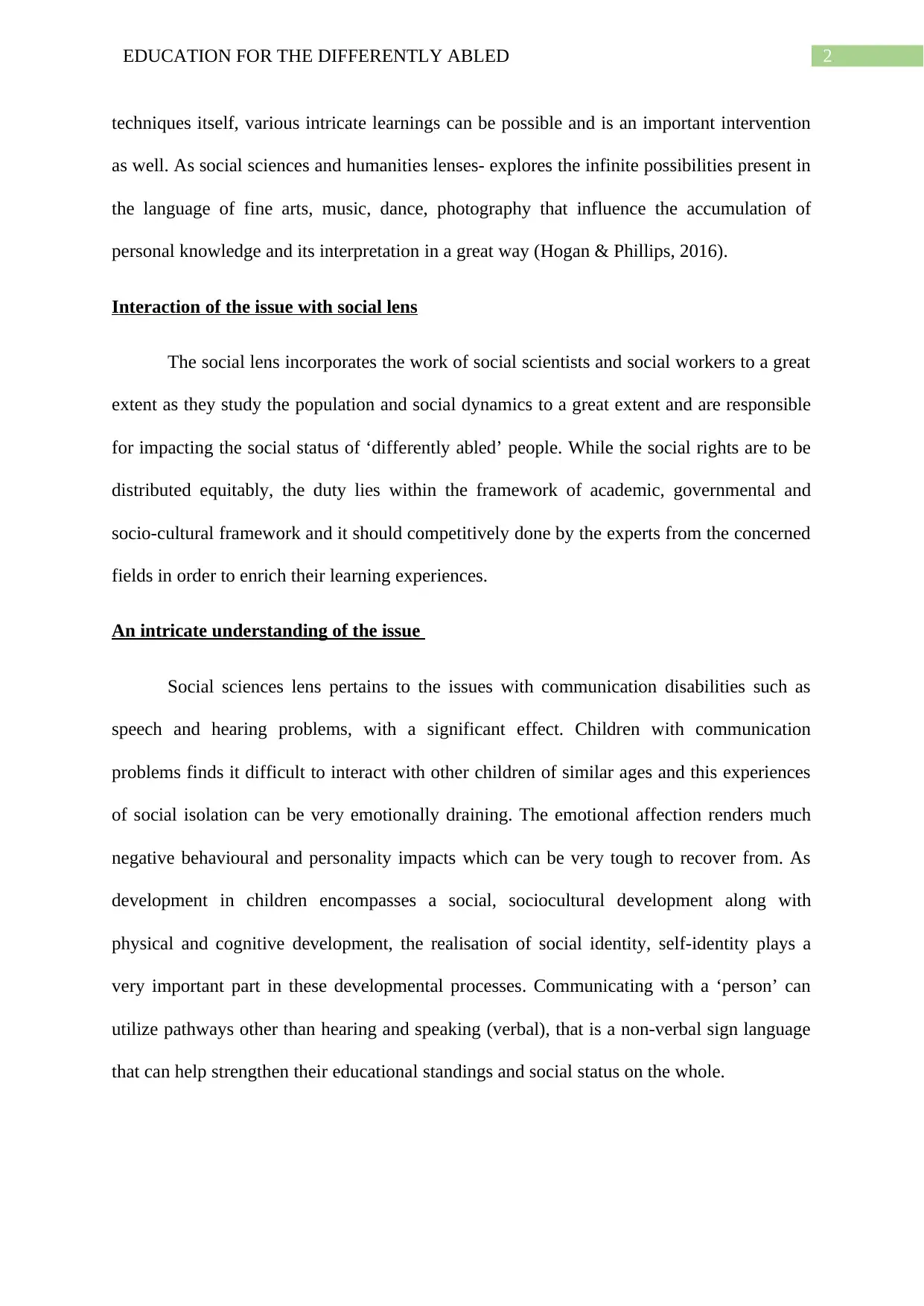
There are four lenses through which ‘differently abled people’ can be imparted the
same education, that everyone of us has the right to receive and these lenses are importantly –
the social science lens, the natural sciences lens, the lens of history and the lens of
humanities. The idea that knowledge finds a way to interact and transform a mind can be very
well applied when it comes to teaching people who are functionally deaf or dumb or both.
The knowledge with a ‘different era’ can be presented in form of visually stimulating objects
such as pictures, artefacts, pictograms, cultural photographs are as impacting as verbal
storytelling. Observation is an integral part of natural science and through observational
Document Page
2EDUCATION FOR THE DIFFERENTLY ABLED
techniques itself, various intricate learnings can be possible and is an important intervention
as well. As social sciences and humanities lenses- explores the infinite possibilities present in
the language of fine arts, music, dance, photography that influence the accumulation of
personal knowledge and its interpretation in a great way (Hogan & Phillips, 2016).
Interaction of the issue with social lens
The social lens incorporates the work of social scientists and social workers to a great
extent as they study the population and social dynamics to a great extent and are responsible
for impacting the social status of ‘differently abled’ people. While the social rights are to be
distributed equitably, the duty lies within the framework of academic, governmental and
socio-cultural framework and it should competitively done by the experts from the concerned
fields in order to enrich their learning experiences.
An intricate understanding of the issue
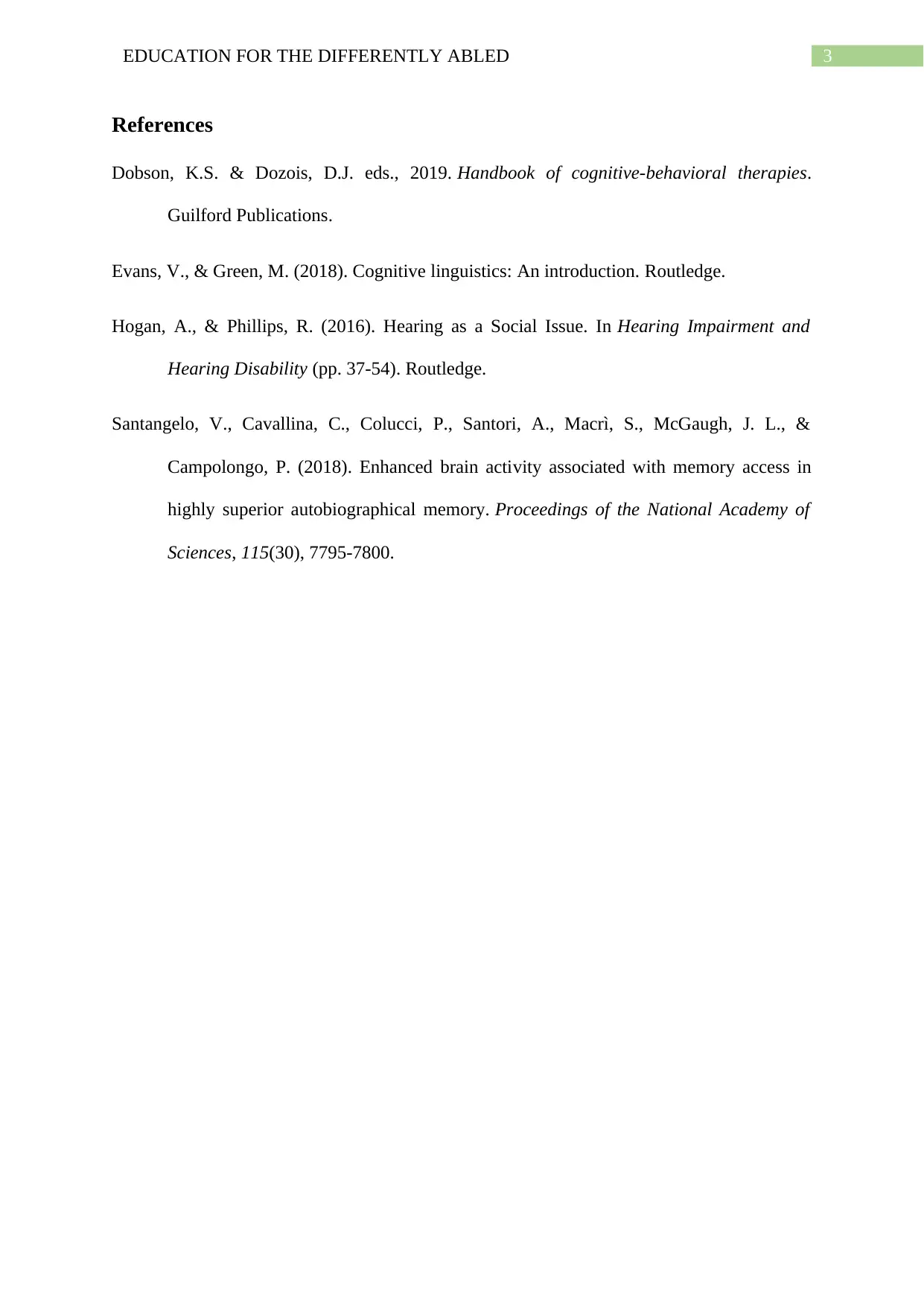
Social sciences lens pertains to the issues with communication disabilities such as
speech and hearing problems, with a significant effect. Children with communication
problems finds it difficult to interact with other children of similar ages and this experiences
of social isolation can be very emotionally draining. The emotional affection renders much
negative behavioural and personality impacts which can be very tough to recover from. As
development in children encompasses a social, sociocultural development along with
physical and cognitive development, the realisation of social identity, self-identity plays a
very important part in these developmental processes. Communicating with a ‘person’ can
utilize pathways other than hearing and speaking (verbal), that is a non-verbal sign language
that can help strengthen their educational standings and social status on the whole.
Document Page
3EDUCATION FOR THE DIFFERENTLY ABLED
References
Dobson, K.S. & Dozois, D.J. eds., 2019. Handbook of cognitive-behavioral therapies.
Guilford Publications.
Evans, V., & Green, M. (2018). Cognitive linguistics: An introduction. Routledge.
Hogan, A., & Phillips, R. (2016). Hearing as a Social Issue. In Hearing Impairment and
Hearing Disability (pp. 37-54). Routledge.
Santangelo, V., Cavallina, C., Colucci, P., Santori, A., Macrì, S., McGaugh, J. L., &
Campolongo, P. (2018). Enhanced brain activity associated with memory access in
highly superior autobiographical memory. Proceedings of the National Academy of
Sciences, 115(30), 7795-7800.
chevron_up_icon
1 out of 4
circle_padding
hide_on_mobile
zoom_out_icon
[object Object]