Attitudes Towards Obesity: Examining Implicit and Explicit Measures

Verified

Added on  2023/06/14

|4
|804
|309
Report
AI Summary
This report explores both implicit and explicit attitudes towards obesity, drawing on data from a small sample to highlight the correlation between these measures. It discusses how negative attitudes towards obese individuals manifest in discrimination across various settings, including employment, education, and media representation. The report also touches upon elements of planned behavior, such as subjective norms and perceived behavioral control, which influence attitudes and behaviors related to obesity. References to relevant studies further support the analysis of weight bias and its impact on individuals and society, providing a comprehensive overview of the psychological and social dimensions of attitudes towards obesity. Desklib provides access to similar solved assignments.
Document Page
Running head: ATTITUDE TOWARDS OBESITY 1
Attitude towards obesity
Student’s Name
Professor’s Name
Institution Affiliation
Date
tabler-icon-diamond-filled.svg

Paraphrase This Document

Need a fresh take? Get an instant paraphrase of this document with our AI Paraphraser
Document Page
ATTITUDE TOWARDS OBESITY 2
Implicit and explicit attitudes towards obesity
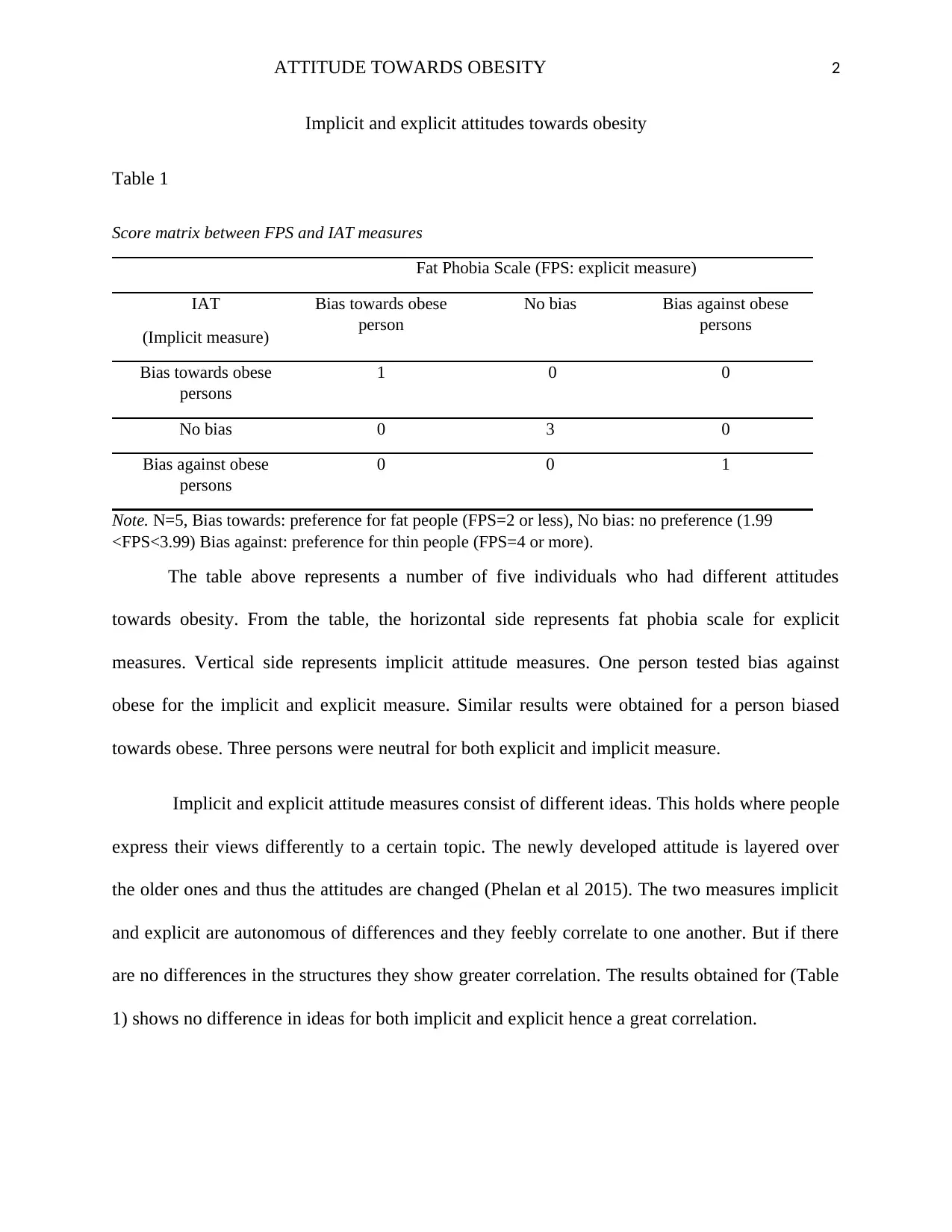
Table 1
Score matrix between FPS and IAT measures
Fat Phobia Scale (FPS: explicit measure)
IAT
(Implicit measure)
Bias towards obese
person
No bias Bias against obese
persons
Bias towards obese
persons
1 0 0
No bias 0 3 0
Bias against obese
persons
0 0 1
Note. N=5, Bias towards: preference for fat people (FPS=2 or less), No bias: no preference (1.99
<FPS<3.99) Bias against: preference for thin people (FPS=4 or more).
The table above represents a number of five individuals who had different attitudes
towards obesity. From the table, the horizontal side represents fat phobia scale for explicit
measures. Vertical side represents implicit attitude measures. One person tested bias against
obese for the implicit and explicit measure. Similar results were obtained for a person biased
towards obese. Three persons were neutral for both explicit and implicit measure.
Implicit and explicit attitude measures consist of different ideas. This holds where people
express their views differently to a certain topic. The newly developed attitude is layered over
the older ones and thus the attitudes are changed (Phelan et al 2015). The two measures implicit
and explicit are autonomous of differences and they feebly correlate to one another. But if there
are no differences in the structures they show greater correlation. The results obtained for (Table
1) shows no difference in ideas for both implicit and explicit hence a great correlation.
Document Page
ATTITUDE TOWARDS OBESITY 3
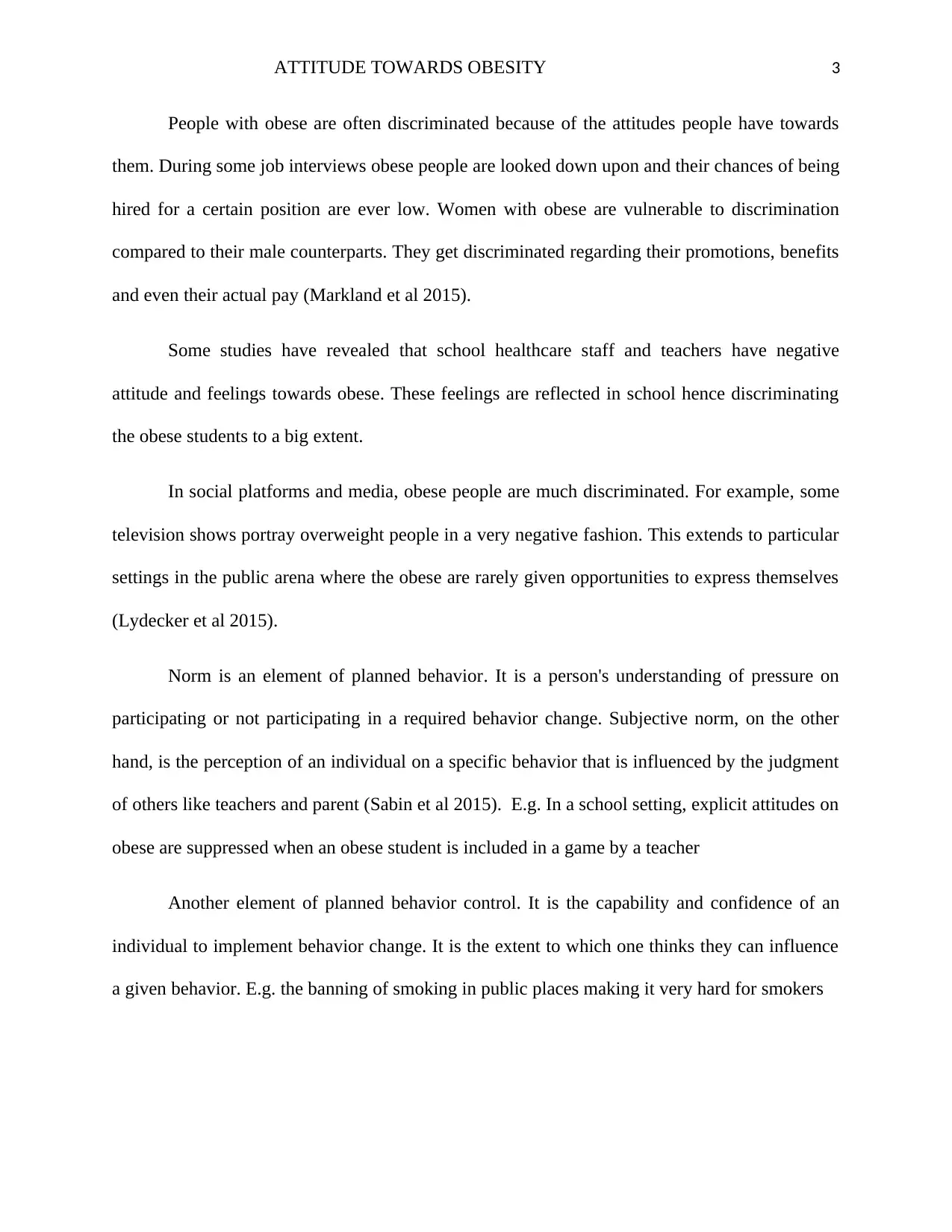
People with obese are often discriminated because of the attitudes people have towards
them. During some job interviews obese people are looked down upon and their chances of being
hired for a certain position are ever low. Women with obese are vulnerable to discrimination
compared to their male counterparts. They get discriminated regarding their promotions, benefits
and even their actual pay (Markland et al 2015).
Some studies have revealed that school healthcare staff and teachers have negative
attitude and feelings towards obese. These feelings are reflected in school hence discriminating
the obese students to a big extent.
In social platforms and media, obese people are much discriminated. For example, some
television shows portray overweight people in a very negative fashion. This extends to particular
settings in the public arena where the obese are rarely given opportunities to express themselves
(Lydecker et al 2015).
Norm is an element of planned behavior. It is a person's understanding of pressure on
participating or not participating in a required behavior change. Subjective norm, on the other
hand, is the perception of an individual on a specific behavior that is influenced by the judgment
of others like teachers and parent (Sabin et al 2015). E.g. In a school setting, explicit attitudes on
obese are suppressed when an obese student is included in a game by a teacher
Another element of planned behavior control. It is the capability and confidence of an
individual to implement behavior change. It is the extent to which one thinks they can influence
a given behavior. E.g. the banning of smoking in public places making it very hard for smokers
Document Page
ATTITUDE TOWARDS OBESITY 4
References
Sabin, J. A., Riskind, R. G., & Nosek, B. A. (2015). Health care providers’ implicit and explicit attitudes
toward lesbian women and gay men. American Journal of Public Health, 105(9), 1831-1841.
Markland, D., Hall, C. R., Duncan, L. R., & Simatovic, J. (2015). The effects of an imagery intervention
on implicit and explicit exercise attitudes. Psychology of Sport and Exercise, 17, 24-31.
Phelan, S. M., Burgess, D. J., Yeazel, M. W., Hellerstedt, W. L., Griffin, J. M., & Ryn, V. M. (2015).
Impact of weight bias and stigma on quality of care and outcomes for patients with obesity.
Obesity Reviews, 16(4), 319-326.
Lydecker, J. A., O'Brien, E., & Grilo, C. (2017). Parents’ Implicit and Explicit Attitudes Towards
Childhood Obesity. Journal of Adolescent Health, 60(2), S11-S12.
chevron_up_icon
1 out of 4
circle_padding
hide_on_mobile
zoom_out_icon
[object Object]