Symbolism, Color, and Form: Analyzing Cézanne's Sainte-Victoire

Verified

Added on  2023/03/20

|2
|455
|71
Report
AI Summary
This report provides an analysis of the symbolism within Paul Cézanne's painting, Mont Sainte-Victoire. The report explores how Cézanne employed symbolism to convey deeper meanings, focusing on his use of color, geometric forms, and the medium of oil paint. The analysis highlights how Cézanne used color temperature to create atmospheric perspective, blurring the lines between the mountain and the sky. It further discusses the use of geometric forms, which laid the foundation for Cubism, and how the characteristics of oil paint influenced his brushstrokes and color choices. The report references Cézanne's evolving style and the unfinished nature of the painting to emphasize the dynamic and ongoing nature of an artist's work. The report concludes by summarizing the key elements of symbolism in the painting, including color, geometric forms, and the use of oil as a medium.
Document Page
Surname 1
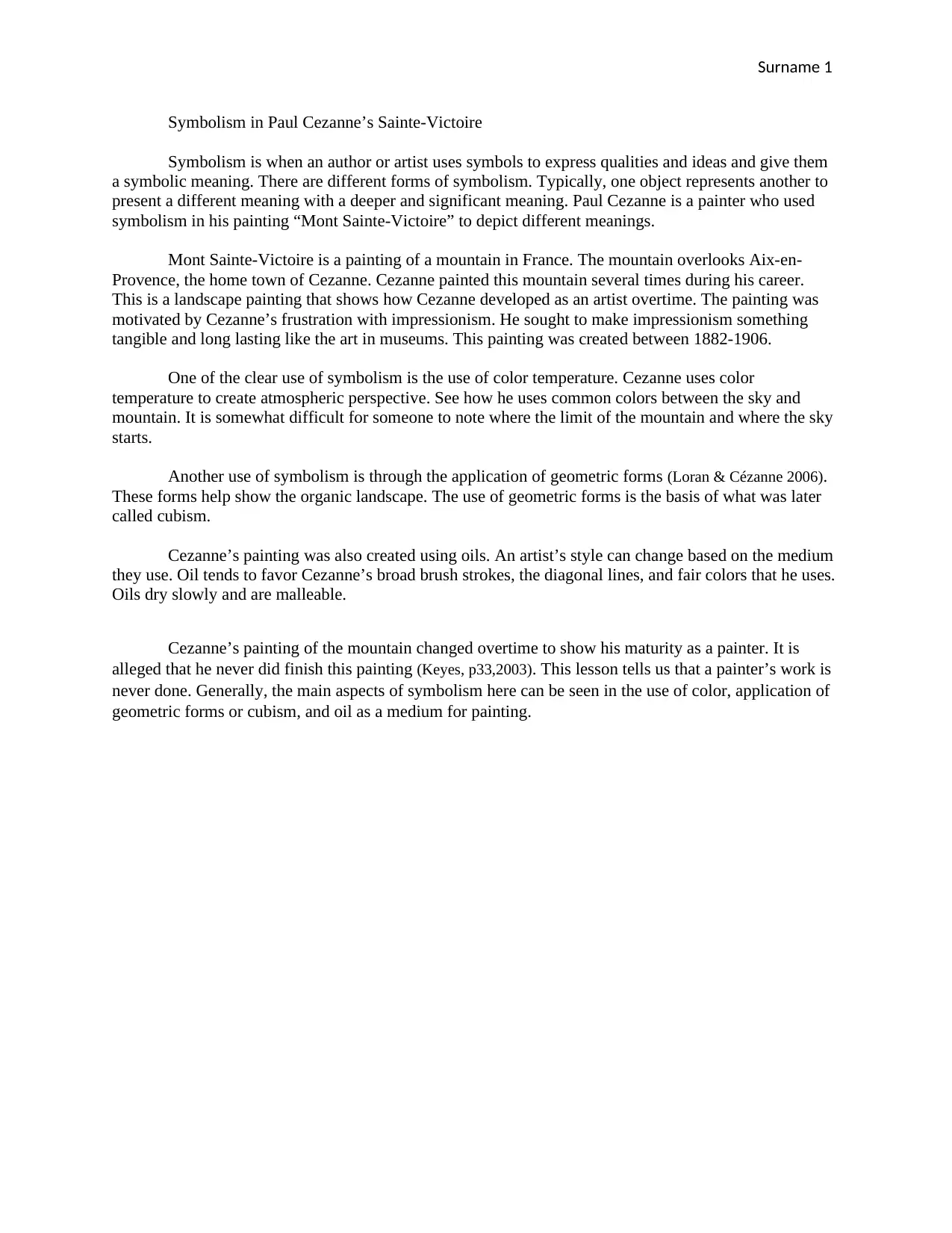
Symbolism in Paul Cezanne’s Sainte-Victoire
Symbolism is when an author or artist uses symbols to express qualities and ideas and give them
a symbolic meaning. There are different forms of symbolism. Typically, one object represents another to
present a different meaning with a deeper and significant meaning. Paul Cezanne is a painter who used
symbolism in his painting “Mont Sainte-Victoire” to depict different meanings.
Mont Sainte-Victoire is a painting of a mountain in France. The mountain overlooks Aix-en-
Provence, the home town of Cezanne. Cezanne painted this mountain several times during his career.
This is a landscape painting that shows how Cezanne developed as an artist overtime. The painting was
motivated by Cezanne’s frustration with impressionism. He sought to make impressionism something
tangible and long lasting like the art in museums. This painting was created between 1882-1906.
One of the clear use of symbolism is the use of color temperature. Cezanne uses color
temperature to create atmospheric perspective. See how he uses common colors between the sky and
mountain. It is somewhat difficult for someone to note where the limit of the mountain and where the sky
starts.
Another use of symbolism is through the application of geometric forms (Loran & Cézanne 2006).
These forms help show the organic landscape. The use of geometric forms is the basis of what was later
called cubism.
Cezanne’s painting was also created using oils. An artist’s style can change based on the medium
they use. Oil tends to favor Cezanne’s broad brush strokes, the diagonal lines, and fair colors that he uses.
Oils dry slowly and are malleable.
Cezanne’s painting of the mountain changed overtime to show his maturity as a painter. It is
alleged that he never did finish this painting (Keyes, p33,2003). This lesson tells us that a painter’s work is
never done. Generally, the main aspects of symbolism here can be seen in the use of color, application of
geometric forms or cubism, and oil as a medium for painting.
tabler-icon-diamond-filled.svg

Paraphrase This Document

Need a fresh take? Get an instant paraphrase of this document with our AI Paraphraser
Document Page
Surname 1
References
Keyes, George S. "Reconsideration of Late Variants of Cézanne's" Theme of Mont Sainte-Victoire"." Bulletin of the
Detroit Institute of Arts 77.12 (2003): 32-37.
Loran, E., & Cézanne, P. (2006). Cézanne's composition: analysis of his form with diagrams and photographs of his
motifs. Univ of California Press.
chevron_up_icon
1 out of 2
circle_padding
hide_on_mobile
zoom_out_icon
[object Object]