Analyzing Crowd Management in Events: Journal Study Report
VerifiedAdded on 2020/03/16
|15
|4382
|50
Report
AI Summary
This report provides a comprehensive analysis of crowd management within the event industry, addressing contemporary challenges and potential risks. It begins with an introduction to event types and success factors, followed by an examination of issues such as venue capacity, infrastructure limitations, economic factors, and the need for flexibility. The report delves into risk management, including crowd control, fire safety, technical failures, financial risks, and medical assistance. A literature review explores crowd disasters, focusing on the Love Parade incident and its contributing factors, such as crowd panic, design flaws, and management failures. Recommendations are provided to mitigate risks and improve event safety. The study emphasizes the importance of proactive planning, effective crowd control measures, and comprehensive risk assessment to ensure successful and safe events.

Event Management
Event Management
Event Management

Paraphrase This Document
Need a fresh take? Get an instant paraphrase of this document with our AI Paraphraser
Crowd Management: Journal Study P a g e | 1
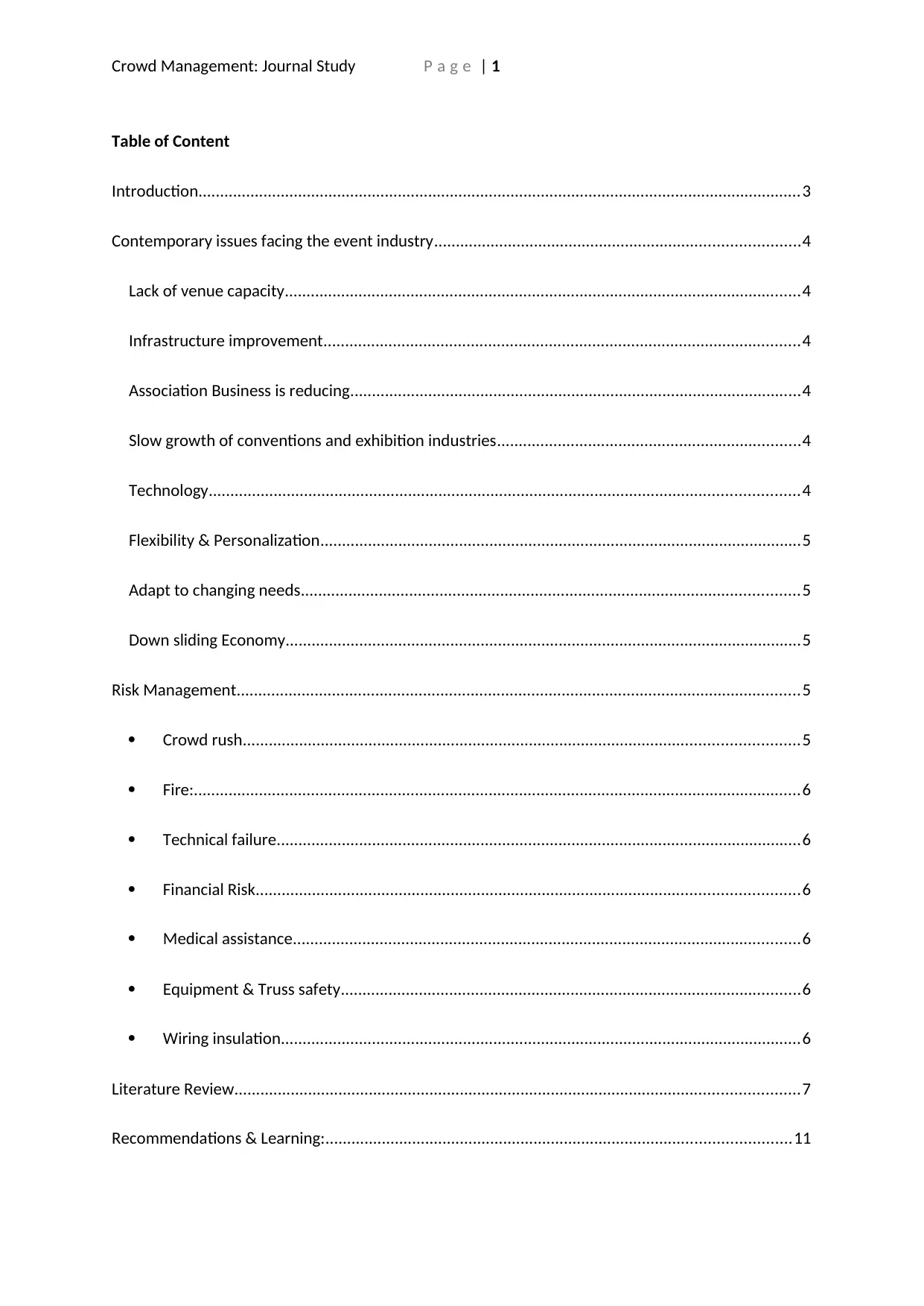
Table of Content
Introduction...........................................................................................................................................3
Contemporary issues facing the event industry....................................................................................4
Lack of venue capacity.......................................................................................................................4
Infrastructure improvement..............................................................................................................4
Association Business is reducing........................................................................................................4
Slow growth of conventions and exhibition industries......................................................................4
Technology........................................................................................................................................4
Flexibility & Personalization...............................................................................................................5
Adapt to changing needs...................................................................................................................5
Down sliding Economy.......................................................................................................................5
Risk Management..................................................................................................................................5
Crowd rush................................................................................................................................5
Fire:............................................................................................................................................6
Technical failure.........................................................................................................................6
Financial Risk.............................................................................................................................6
Medical assistance.....................................................................................................................6
Equipment & Truss safety..........................................................................................................6
Wiring insulation........................................................................................................................6
Literature Review..................................................................................................................................7
Recommendations & Learning:...........................................................................................................11
Table of Content
Introduction...........................................................................................................................................3
Contemporary issues facing the event industry....................................................................................4
Lack of venue capacity.......................................................................................................................4
Infrastructure improvement..............................................................................................................4
Association Business is reducing........................................................................................................4
Slow growth of conventions and exhibition industries......................................................................4
Technology........................................................................................................................................4
Flexibility & Personalization...............................................................................................................5
Adapt to changing needs...................................................................................................................5
Down sliding Economy.......................................................................................................................5
Risk Management..................................................................................................................................5
Crowd rush................................................................................................................................5
Fire:............................................................................................................................................6
Technical failure.........................................................................................................................6
Financial Risk.............................................................................................................................6
Medical assistance.....................................................................................................................6
Equipment & Truss safety..........................................................................................................6
Wiring insulation........................................................................................................................6
Literature Review..................................................................................................................................7
Recommendations & Learning:...........................................................................................................11

Crowd Management: Journal Study P a g e | 2
References:..........................................................................................................................................12
References:..........................................................................................................................................12
⊘ This is a preview!⊘
Do you want full access?
Subscribe today to unlock all pages.

Trusted by 1+ million students worldwide
Crowd Management: Journal Study P a g e | 3
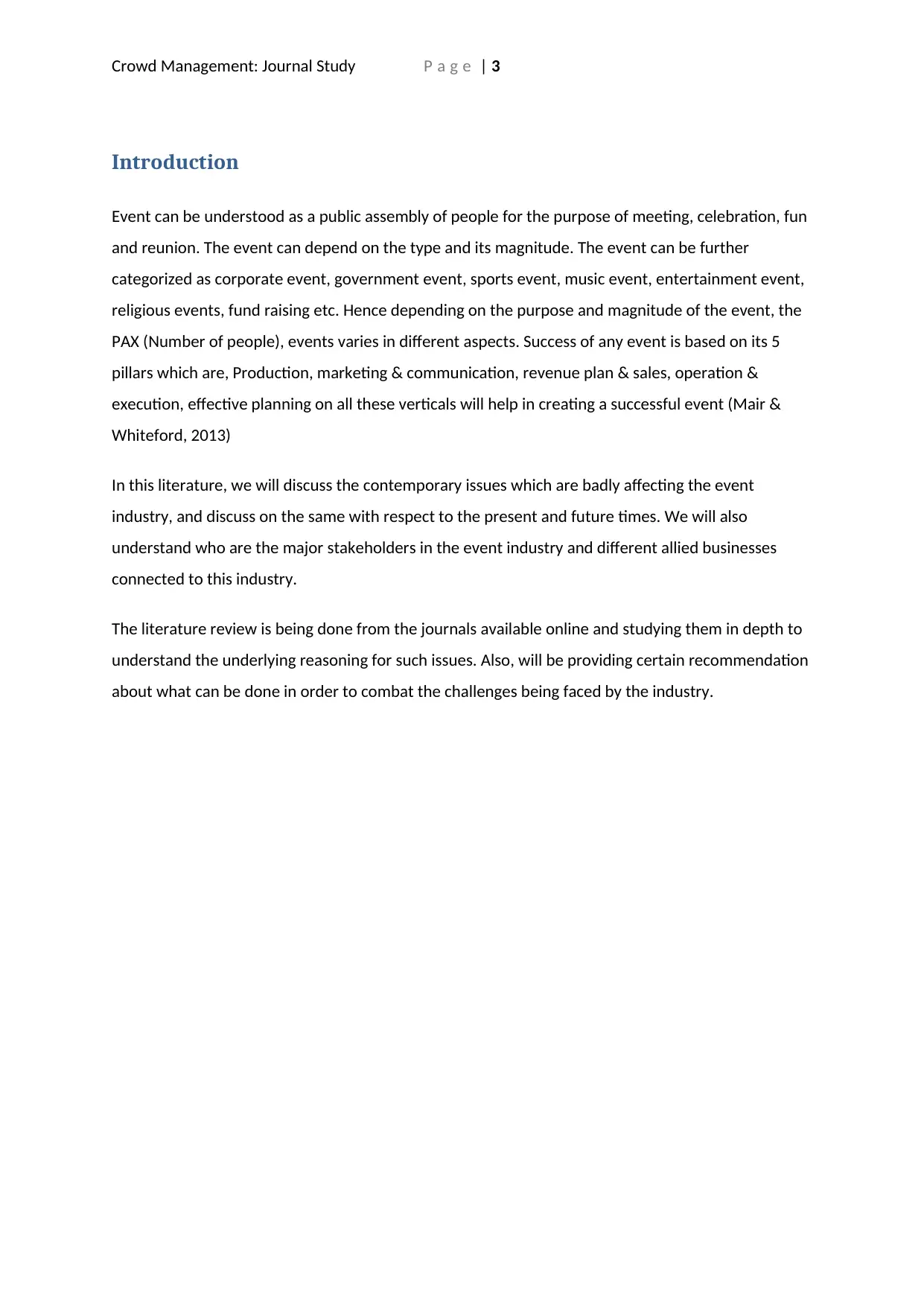
Introduction
Event can be understood as a public assembly of people for the purpose of meeting, celebration, fun
and reunion. The event can depend on the type and its magnitude. The event can be further
categorized as corporate event, government event, sports event, music event, entertainment event,
religious events, fund raising etc. Hence depending on the purpose and magnitude of the event, the
PAX (Number of people), events varies in different aspects. Success of any event is based on its 5
pillars which are, Production, marketing & communication, revenue plan & sales, operation &
execution, effective planning on all these verticals will help in creating a successful event (Mair &
Whiteford, 2013)
In this literature, we will discuss the contemporary issues which are badly affecting the event
industry, and discuss on the same with respect to the present and future times. We will also
understand who are the major stakeholders in the event industry and different allied businesses
connected to this industry.
The literature review is being done from the journals available online and studying them in depth to
understand the underlying reasoning for such issues. Also, will be providing certain recommendation
about what can be done in order to combat the challenges being faced by the industry.
Introduction
Event can be understood as a public assembly of people for the purpose of meeting, celebration, fun
and reunion. The event can depend on the type and its magnitude. The event can be further
categorized as corporate event, government event, sports event, music event, entertainment event,
religious events, fund raising etc. Hence depending on the purpose and magnitude of the event, the
PAX (Number of people), events varies in different aspects. Success of any event is based on its 5
pillars which are, Production, marketing & communication, revenue plan & sales, operation &
execution, effective planning on all these verticals will help in creating a successful event (Mair &
Whiteford, 2013)
In this literature, we will discuss the contemporary issues which are badly affecting the event
industry, and discuss on the same with respect to the present and future times. We will also
understand who are the major stakeholders in the event industry and different allied businesses
connected to this industry.
The literature review is being done from the journals available online and studying them in depth to
understand the underlying reasoning for such issues. Also, will be providing certain recommendation
about what can be done in order to combat the challenges being faced by the industry.
Paraphrase This Document
Need a fresh take? Get an instant paraphrase of this document with our AI Paraphraser
Crowd Management: Journal Study P a g e | 4
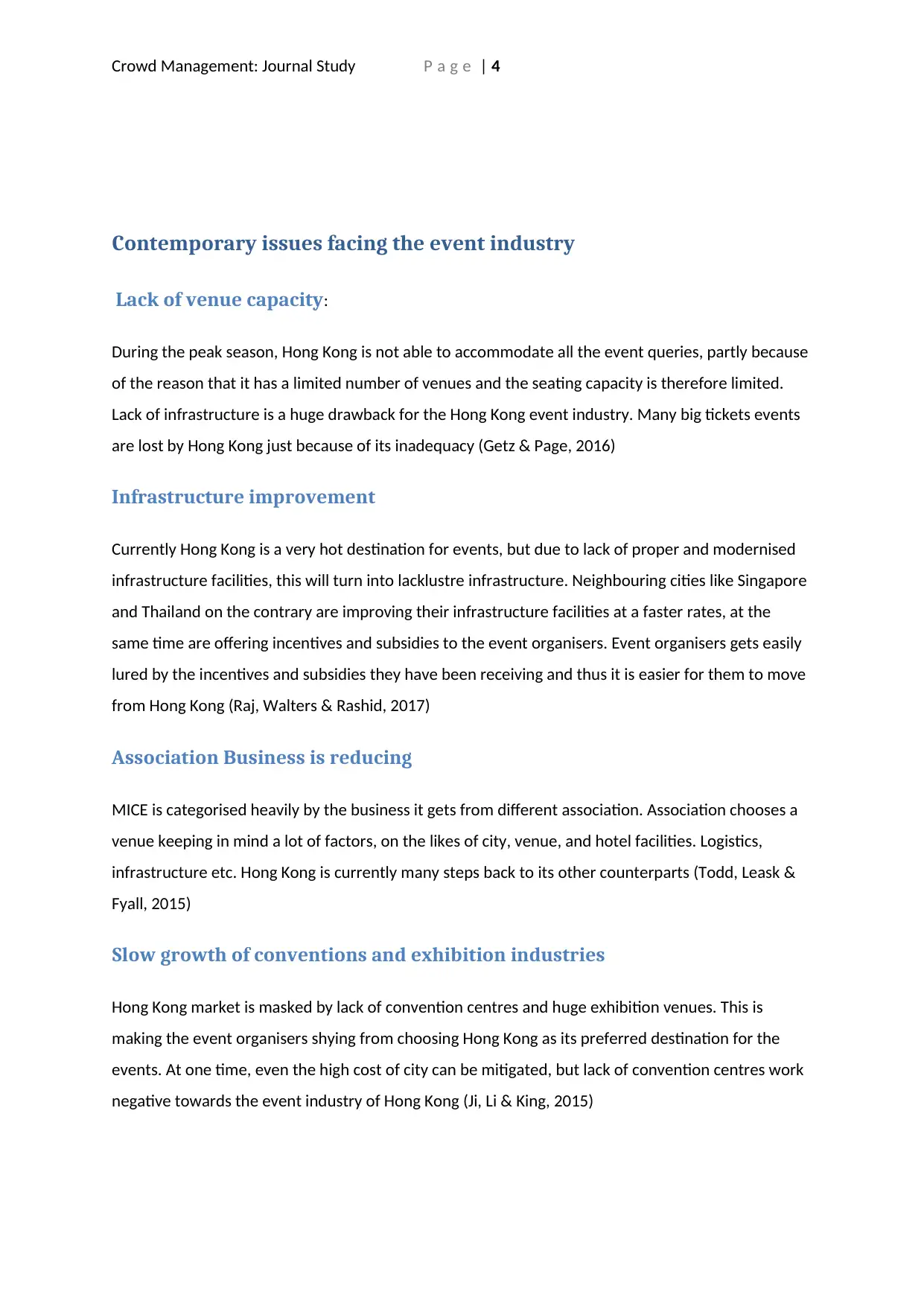
Contemporary issues facing the event industry
Lack of venue capacity:
During the peak season, Hong Kong is not able to accommodate all the event queries, partly because
of the reason that it has a limited number of venues and the seating capacity is therefore limited.
Lack of infrastructure is a huge drawback for the Hong Kong event industry. Many big tickets events
are lost by Hong Kong just because of its inadequacy (Getz & Page, 2016)
Infrastructure improvement
Currently Hong Kong is a very hot destination for events, but due to lack of proper and modernised
infrastructure facilities, this will turn into lacklustre infrastructure. Neighbouring cities like Singapore
and Thailand on the contrary are improving their infrastructure facilities at a faster rates, at the
same time are offering incentives and subsidies to the event organisers. Event organisers gets easily
lured by the incentives and subsidies they have been receiving and thus it is easier for them to move
from Hong Kong (Raj, Walters & Rashid, 2017)
Association Business is reducing
MICE is categorised heavily by the business it gets from different association. Association chooses a
venue keeping in mind a lot of factors, on the likes of city, venue, and hotel facilities. Logistics,
infrastructure etc. Hong Kong is currently many steps back to its other counterparts (Todd, Leask &
Fyall, 2015)
Slow growth of conventions and exhibition industries
Hong Kong market is masked by lack of convention centres and huge exhibition venues. This is
making the event organisers shying from choosing Hong Kong as its preferred destination for the
events. At one time, even the high cost of city can be mitigated, but lack of convention centres work
negative towards the event industry of Hong Kong (Ji, Li & King, 2015)
Contemporary issues facing the event industry
Lack of venue capacity:
During the peak season, Hong Kong is not able to accommodate all the event queries, partly because
of the reason that it has a limited number of venues and the seating capacity is therefore limited.
Lack of infrastructure is a huge drawback for the Hong Kong event industry. Many big tickets events
are lost by Hong Kong just because of its inadequacy (Getz & Page, 2016)
Infrastructure improvement
Currently Hong Kong is a very hot destination for events, but due to lack of proper and modernised
infrastructure facilities, this will turn into lacklustre infrastructure. Neighbouring cities like Singapore
and Thailand on the contrary are improving their infrastructure facilities at a faster rates, at the
same time are offering incentives and subsidies to the event organisers. Event organisers gets easily
lured by the incentives and subsidies they have been receiving and thus it is easier for them to move
from Hong Kong (Raj, Walters & Rashid, 2017)
Association Business is reducing
MICE is categorised heavily by the business it gets from different association. Association chooses a
venue keeping in mind a lot of factors, on the likes of city, venue, and hotel facilities. Logistics,
infrastructure etc. Hong Kong is currently many steps back to its other counterparts (Todd, Leask &
Fyall, 2015)
Slow growth of conventions and exhibition industries
Hong Kong market is masked by lack of convention centres and huge exhibition venues. This is
making the event organisers shying from choosing Hong Kong as its preferred destination for the
events. At one time, even the high cost of city can be mitigated, but lack of convention centres work
negative towards the event industry of Hong Kong (Ji, Li & King, 2015)
Crowd Management: Journal Study P a g e | 5
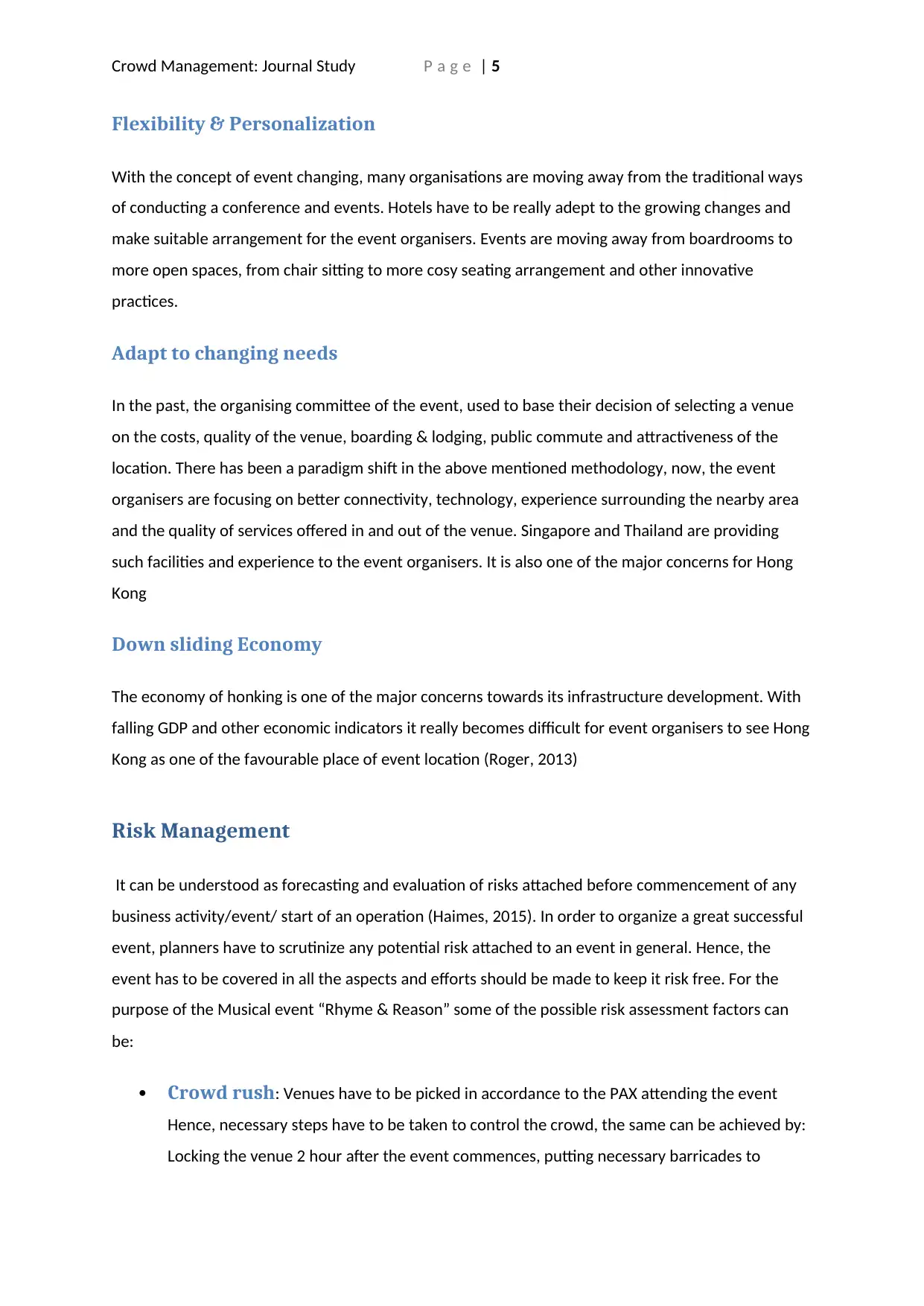
Flexibility & Personalization
With the concept of event changing, many organisations are moving away from the traditional ways
of conducting a conference and events. Hotels have to be really adept to the growing changes and
make suitable arrangement for the event organisers. Events are moving away from boardrooms to
more open spaces, from chair sitting to more cosy seating arrangement and other innovative
practices.
Adapt to changing needs
In the past, the organising committee of the event, used to base their decision of selecting a venue
on the costs, quality of the venue, boarding & lodging, public commute and attractiveness of the
location. There has been a paradigm shift in the above mentioned methodology, now, the event
organisers are focusing on better connectivity, technology, experience surrounding the nearby area
and the quality of services offered in and out of the venue. Singapore and Thailand are providing
such facilities and experience to the event organisers. It is also one of the major concerns for Hong
Kong
Down sliding Economy
The economy of honking is one of the major concerns towards its infrastructure development. With
falling GDP and other economic indicators it really becomes difficult for event organisers to see Hong
Kong as one of the favourable place of event location (Roger, 2013)
Risk Management
It can be understood as forecasting and evaluation of risks attached before commencement of any
business activity/event/ start of an operation (Haimes, 2015). In order to organize a great successful
event, planners have to scrutinize any potential risk attached to an event in general. Hence, the
event has to be covered in all the aspects and efforts should be made to keep it risk free. For the
purpose of the Musical event “Rhyme & Reason” some of the possible risk assessment factors can
be:
Crowd rush: Venues have to be picked in accordance to the PAX attending the event
Hence, necessary steps have to be taken to control the crowd, the same can be achieved by:
Locking the venue 2 hour after the event commences, putting necessary barricades to
Flexibility & Personalization
With the concept of event changing, many organisations are moving away from the traditional ways
of conducting a conference and events. Hotels have to be really adept to the growing changes and
make suitable arrangement for the event organisers. Events are moving away from boardrooms to
more open spaces, from chair sitting to more cosy seating arrangement and other innovative
practices.
Adapt to changing needs
In the past, the organising committee of the event, used to base their decision of selecting a venue
on the costs, quality of the venue, boarding & lodging, public commute and attractiveness of the
location. There has been a paradigm shift in the above mentioned methodology, now, the event
organisers are focusing on better connectivity, technology, experience surrounding the nearby area
and the quality of services offered in and out of the venue. Singapore and Thailand are providing
such facilities and experience to the event organisers. It is also one of the major concerns for Hong
Kong
Down sliding Economy
The economy of honking is one of the major concerns towards its infrastructure development. With
falling GDP and other economic indicators it really becomes difficult for event organisers to see Hong
Kong as one of the favourable place of event location (Roger, 2013)
Risk Management
It can be understood as forecasting and evaluation of risks attached before commencement of any
business activity/event/ start of an operation (Haimes, 2015). In order to organize a great successful
event, planners have to scrutinize any potential risk attached to an event in general. Hence, the
event has to be covered in all the aspects and efforts should be made to keep it risk free. For the
purpose of the Musical event “Rhyme & Reason” some of the possible risk assessment factors can
be:
Crowd rush: Venues have to be picked in accordance to the PAX attending the event
Hence, necessary steps have to be taken to control the crowd, the same can be achieved by:
Locking the venue 2 hour after the event commences, putting necessary barricades to
⊘ This is a preview!⊘
Do you want full access?
Subscribe today to unlock all pages.
Trusted by 1+ million students worldwide
Crowd Management: Journal Study P a g e | 6
control the crowd, getting security personal to manage the crowd and also to prevent any
chances of stampede.
Fire: The event involves a lot of equipment which can cause electric shock due to faulty
wiring or improper insulation, hence necessary safety has to be taken care of, and getting a
fire brigade outside the venue with a separate exit would help in the risk mitigation.
Technical failure: It is no surprise that, electrical equipment do have chances of power
failure or some other technical failure, hence genets and plan B should be kept ready for
such situations, also , a day prior a full-fledged dry run would be of great help.
Financial Risk: Planning of big events have a major costs attached to them ,in order to
foresee the expenses not going out of hand or the budget allocated to exceed, a separate
team has to be made to control only the finance and raise the alarm to the committee, in
case the expenses is crossing the line.
Medical assistance: A medical ambulance to be parked at the entrance of venue, to
take care of any medical emergency.
Equipment & Truss safety: The truss, which holds all the heavy equipment, in itself
is very heavy, hence an in ground basement team is a must and should to establish the
sturdiness of the truss and other heavy equipment’s which are hanging.
Wiring insulation: Special efforts have to be made to take care of proper insulation of
wiring in order to prevent from any damage to an individual.
Literature Review
Crowd Disaster seen as systematic failures: analysis of Love Parade disaster
Each year, crowd disasters happen in different areas of the world. Why such disaster does happens.
What is the magnitude and frequency of such disasters? What are the fatalities associated with it.
Does disaster occur because of irresponsibility of the people and their reckless behaviour? Or is it,
simply a breakdown of the coordination between different community of people involved in
managing and controlling the event. These questions will be addressed specific to crowd
management disaster occurred at Love Parade festival which happened on24th July 2010, giving rise
control the crowd, getting security personal to manage the crowd and also to prevent any
chances of stampede.
Fire: The event involves a lot of equipment which can cause electric shock due to faulty
wiring or improper insulation, hence necessary safety has to be taken care of, and getting a
fire brigade outside the venue with a separate exit would help in the risk mitigation.
Technical failure: It is no surprise that, electrical equipment do have chances of power
failure or some other technical failure, hence genets and plan B should be kept ready for
such situations, also , a day prior a full-fledged dry run would be of great help.
Financial Risk: Planning of big events have a major costs attached to them ,in order to
foresee the expenses not going out of hand or the budget allocated to exceed, a separate
team has to be made to control only the finance and raise the alarm to the committee, in
case the expenses is crossing the line.
Medical assistance: A medical ambulance to be parked at the entrance of venue, to
take care of any medical emergency.
Equipment & Truss safety: The truss, which holds all the heavy equipment, in itself
is very heavy, hence an in ground basement team is a must and should to establish the
sturdiness of the truss and other heavy equipment’s which are hanging.
Wiring insulation: Special efforts have to be made to take care of proper insulation of
wiring in order to prevent from any damage to an individual.
Literature Review
Crowd Disaster seen as systematic failures: analysis of Love Parade disaster
Each year, crowd disasters happen in different areas of the world. Why such disaster does happens.
What is the magnitude and frequency of such disasters? What are the fatalities associated with it.
Does disaster occur because of irresponsibility of the people and their reckless behaviour? Or is it,
simply a breakdown of the coordination between different community of people involved in
managing and controlling the event. These questions will be addressed specific to crowd
management disaster occurred at Love Parade festival which happened on24th July 2010, giving rise
Paraphrase This Document
Need a fresh take? Get an instant paraphrase of this document with our AI Paraphraser
Crowd Management: Journal Study P a g e | 7
to a new verbiage of “mass panic”, “international pushing”, “stampede” and “crowd crushes
”(Helbing & Mukerji, 2012)
In this journal review, we will establish that disaster at Love parade was not just a result of failure of
one or two things, but a failure in overall all the departments of the event arena. It was a combined
effect of many misunderstanding, no- cooperation and mismanagement in services. We would also
understand the reason behind such big disaster and what can be the preventive measures to control
such outcomes. Love Parade goes down in history as one of the most famous unsuccessful event,
which also provides a good teachings to the event organizers.
History of the event
The Love Parade is a popular electronic dance music festival in Germany that was first organized in
the year 1989 in Berlin, it continued in the same city until 2003. The event was further planned in
2007 in Berlin but was cancelled due to some trouble with the government. The last of the edition of
Love Parade took place in the year 2010, In Duisburg where 21 people died and more than 500 were
injured in the crowd disaster (Krausz & Bauckhage, 2012)
Description of the festival area:
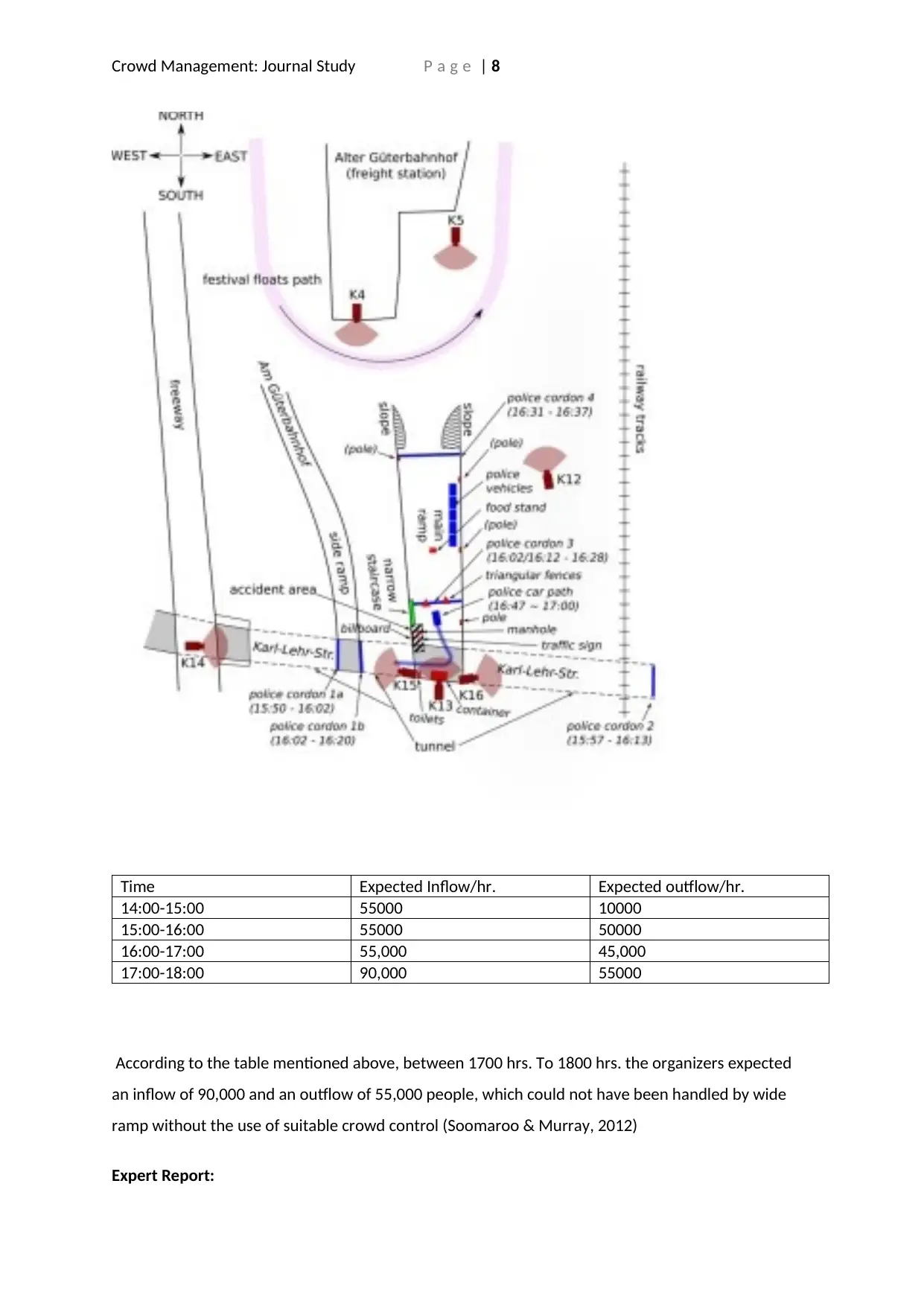
The festival area of the Love Parade in 2010 was approx. 100,000 square metres long and located in
the area of previous freight station city of Duisburg. In response to the concerns from the regulatory
authority that the area would be too small for the expected number of 1.4 million expected visitors,
the city therefore restricted the number of concurrent visitors to 250,000.
to a new verbiage of “mass panic”, “international pushing”, “stampede” and “crowd crushes
”(Helbing & Mukerji, 2012)
In this journal review, we will establish that disaster at Love parade was not just a result of failure of
one or two things, but a failure in overall all the departments of the event arena. It was a combined
effect of many misunderstanding, no- cooperation and mismanagement in services. We would also
understand the reason behind such big disaster and what can be the preventive measures to control
such outcomes. Love Parade goes down in history as one of the most famous unsuccessful event,
which also provides a good teachings to the event organizers.
History of the event
The Love Parade is a popular electronic dance music festival in Germany that was first organized in
the year 1989 in Berlin, it continued in the same city until 2003. The event was further planned in
2007 in Berlin but was cancelled due to some trouble with the government. The last of the edition of
Love Parade took place in the year 2010, In Duisburg where 21 people died and more than 500 were
injured in the crowd disaster (Krausz & Bauckhage, 2012)
Description of the festival area:
The festival area of the Love Parade in 2010 was approx. 100,000 square metres long and located in
the area of previous freight station city of Duisburg. In response to the concerns from the regulatory
authority that the area would be too small for the expected number of 1.4 million expected visitors,
the city therefore restricted the number of concurrent visitors to 250,000.
Crowd Management: Journal Study P a g e | 8
Time Expected Inflow/hr. Expected outflow/hr.
14:00-15:00 55000 10000
15:00-16:00 55000 50000
16:00-17:00 55,000 45,000
17:00-18:00 90,000 55000
According to the table mentioned above, between 1700 hrs. To 1800 hrs. the organizers expected
an inflow of 90,000 and an outflow of 55,000 people, which could not have been handled by wide
ramp without the use of suitable crowd control (Soomaroo & Murray, 2012)
Expert Report:
Time Expected Inflow/hr. Expected outflow/hr.
14:00-15:00 55000 10000
15:00-16:00 55000 50000
16:00-17:00 55,000 45,000
17:00-18:00 90,000 55000
According to the table mentioned above, between 1700 hrs. To 1800 hrs. the organizers expected
an inflow of 90,000 and an outflow of 55,000 people, which could not have been handled by wide
ramp without the use of suitable crowd control (Soomaroo & Murray, 2012)
Expert Report:
⊘ This is a preview!⊘
Do you want full access?
Subscribe today to unlock all pages.
Trusted by 1+ million students worldwide
Crowd Management: Journal Study P a g e | 9
It was explained by the expert that safe crowd condition can be usually assumed for
densities up to 2-3 people per meter per minute, allowing a maximum flow of people to be
82 people per metre per minute
Areas which are prone to high risk, or the areas which come with acceptable dangers and
has a constrained movement must be thoroughly analysed for risk, and if possible tried to be
avoided( Golas, Narain & Lin, 2014)
One of the important reason researches found for event hazard was inability to regulate the
flow of people in the festival area.
Design, information & crowd management were identified as three measures of influencing
the safety of crowds (Garcia, 2011)
Special attention has to be taken to keep the crowd density in control, once the crowd
density increases to 4 to 5 people per square metre per persons, congestion is bound to be
build amongst the crowd, which would further lead to event disaster.
It is a said reason, that a lot of noise, commotion and panic cause a natural desire to leave
the crowd. Inefficient sign posts and too much people made it extremely difficult for the
visitors to follow the exit signs and the narrow staircase, resulting in development of
extremely panic and pressure situation leading to a stampede.
Contributing Factors:
After the disaster in event, everybody was trying to hold some person, organization, management,
police etc. responsible for the disaster. But in actuality, it was a lot of collective contribution factors
responsible for the death of 21 people and injuries to the tune of 500. Let’s see some of the factors
responsible for it:
Crowd Panic-Such kind of disaster is often contributed as “mass panic”, the term which people used
to explain the disaster. This means that the disaster happens when the crowd goes mad and out of
control. Situation specific to Love Parade event, it was found that the panic was started much before
people were reaching out to the fences, visitors reaching for the containers and etc. It was further
concluded that all these activities started much before the time people were on the ramp and
already exposed to crowded condition (Ferscha & Zia, 2010)
Were People killed by others falling on them or above?
It was explained by the expert that safe crowd condition can be usually assumed for
densities up to 2-3 people per meter per minute, allowing a maximum flow of people to be
82 people per metre per minute
Areas which are prone to high risk, or the areas which come with acceptable dangers and
has a constrained movement must be thoroughly analysed for risk, and if possible tried to be
avoided( Golas, Narain & Lin, 2014)
One of the important reason researches found for event hazard was inability to regulate the
flow of people in the festival area.
Design, information & crowd management were identified as three measures of influencing
the safety of crowds (Garcia, 2011)
Special attention has to be taken to keep the crowd density in control, once the crowd
density increases to 4 to 5 people per square metre per persons, congestion is bound to be
build amongst the crowd, which would further lead to event disaster.
It is a said reason, that a lot of noise, commotion and panic cause a natural desire to leave
the crowd. Inefficient sign posts and too much people made it extremely difficult for the
visitors to follow the exit signs and the narrow staircase, resulting in development of
extremely panic and pressure situation leading to a stampede.
Contributing Factors:
After the disaster in event, everybody was trying to hold some person, organization, management,
police etc. responsible for the disaster. But in actuality, it was a lot of collective contribution factors
responsible for the death of 21 people and injuries to the tune of 500. Let’s see some of the factors
responsible for it:
Crowd Panic-Such kind of disaster is often contributed as “mass panic”, the term which people used
to explain the disaster. This means that the disaster happens when the crowd goes mad and out of
control. Situation specific to Love Parade event, it was found that the panic was started much before
people were reaching out to the fences, visitors reaching for the containers and etc. It was further
concluded that all these activities started much before the time people were on the ramp and
already exposed to crowded condition (Ferscha & Zia, 2010)
Were People killed by others falling on them or above?
Paraphrase This Document
Need a fresh take? Get an instant paraphrase of this document with our AI Paraphraser
Crowd Management: Journal Study P a g e | 10
This was an important question raised to the organizing authority, as to was falling people a reason
for killing of so many people? In was found that numerous people were stuck between the billboard
and the staircase, the populist or the media assumed that they were in stuck because they were
victim of falling people, who had fallen down recklessly on them, or were trying to climb the
staircase or the billboard, and in an attempt to do so, they fell off. Some people also suggested that
the staircase was blown, but no evidence was found of it. Also, looking at the video footage and
picture, falling people being as a reason of stampede could not be proved (Shahhoseini, Sarvi &
Saberi, 2016).
Occurrence of crowd turbulence:
Crowd management is extremely pivotal to success of any event. Love parade failed miserably in this
sector. Once people started falling, there was no control on it. The falling people were creating
obstacles to others and were endangering the lives or others and were themselves endangered by
falling people over them, resulting in a domino effect. A giant heap of falling people was created in
the event; it was an extremely painful scene to visualize. Falling people also resulted in causing
suffocation and people started having difficulty to breathe, further worsening the situation.
Claustrophobia became a sight on the festival area. In many reports, suffocation has been found the
reason for causing death of people, lungs were shut down of hundreds of people at the venue, so
much that they were unable to intake the oxygen essential for their survival (Turris & Lund, 2017)
Casual Interdependencies
Failure of flow control: To many critics and experts, the location chosen for Love parade event was
extremely surprising. Some of the reasons behind it were, the festival area was relatively small,
keeping in mind the people expected and the tickets sold. The area was further constrained by
railway tracks on one side and freeway on the other, resulting in a bottleneck situation near and
around the ramp during the peak hours, hence proving the point that the flow control was out of
control before even the start. Not only this, there were also a plethora of problems already
surrounding the event venue putting the event safety in jeopardy. One major problem identified
was, delay in the commencement of event, organizers could really not make up for the time lost and
the crowd getting out of hand right from the start. Hence mismanagement of the crowd and logistics
concerns and troubles were always in question, and one of the biggest contributing factor towards
the event hazard.
This was an important question raised to the organizing authority, as to was falling people a reason
for killing of so many people? In was found that numerous people were stuck between the billboard
and the staircase, the populist or the media assumed that they were in stuck because they were
victim of falling people, who had fallen down recklessly on them, or were trying to climb the
staircase or the billboard, and in an attempt to do so, they fell off. Some people also suggested that
the staircase was blown, but no evidence was found of it. Also, looking at the video footage and
picture, falling people being as a reason of stampede could not be proved (Shahhoseini, Sarvi &
Saberi, 2016).
Occurrence of crowd turbulence:
Crowd management is extremely pivotal to success of any event. Love parade failed miserably in this
sector. Once people started falling, there was no control on it. The falling people were creating
obstacles to others and were endangering the lives or others and were themselves endangered by
falling people over them, resulting in a domino effect. A giant heap of falling people was created in
the event; it was an extremely painful scene to visualize. Falling people also resulted in causing
suffocation and people started having difficulty to breathe, further worsening the situation.
Claustrophobia became a sight on the festival area. In many reports, suffocation has been found the
reason for causing death of people, lungs were shut down of hundreds of people at the venue, so
much that they were unable to intake the oxygen essential for their survival (Turris & Lund, 2017)
Casual Interdependencies
Failure of flow control: To many critics and experts, the location chosen for Love parade event was
extremely surprising. Some of the reasons behind it were, the festival area was relatively small,
keeping in mind the people expected and the tickets sold. The area was further constrained by
railway tracks on one side and freeway on the other, resulting in a bottleneck situation near and
around the ramp during the peak hours, hence proving the point that the flow control was out of
control before even the start. Not only this, there were also a plethora of problems already
surrounding the event venue putting the event safety in jeopardy. One major problem identified
was, delay in the commencement of event, organizers could really not make up for the time lost and
the crowd getting out of hand right from the start. Hence mismanagement of the crowd and logistics
concerns and troubles were always in question, and one of the biggest contributing factor towards
the event hazard.
Crowd Management: Journal Study P a g e | 11
Moreover, there was unnecessary wastage of time in reaching of the medical services, or the police
support. Network troubles and batteries caused issues in communication with the walkie talkie,
hence in absence of communication, the information passage could not happen, and the help was
unable to reach at the place required. One very surprising thing took place, amidst all this tension
and stress, the police shift kept on changing between 15:12 and 15:34 , making them loose the
control of the place and resulted in excessive wastage of time. Some reports suggested that the
organizers and the police were not well coordinated, thus resulting in lacunae in terms of their
cooperation. Also, police was not accustomed to such a situation, they have never been in such a
critical situation, so whatever help they did, and it was the best they could come up with (Reuter,
Marx & Pipek, 2011). Hence, in light of the points mentioned above, it can be pointed out that
failure of Love Parade was not because of mismanagement at one end, although it was a result of
collective failure.
Lack of overview by everybody: In situation of event crisis, one of the important and contributing
factors is lack of overview by everybody. Specific to Love parade event, minister of interior visited
the place around 15:06, and that time the place was literally stuffed with people, with no place to
move or event stand, despite noticing these signs, the minister left the premises much before the
incident. TO top all of this, the event authorities at 16:47 came out for an interview and declared the
event as success, despite death of 21 people and hundreds injured, also at 17:15, similar statement
was issued by city’s situation room. Thus, in such a situation, the evacuation happened in a triage
procedure (applying to war zones). As a consequence of which, many people could not get the
medical aid.
Dependent & Independent variable:
In context of the case study, independent variable was the crowd (Number of people), it was crowd
on which the entire success of the event was laid on. In order to understand, dependent variable is
the one, on which rest other factors depend, and is the function, on which other factors depend. For
example, crowd was an independent variable on which other event variables such as food, ticketing
counters, human resource etc. rely, heavily. Hence, in case, if the independent variable changes
other things also had to change. In Love Parade, the crowd grew in strong numbers, but the venue
capacity and other facilities were the same, resulting in a big hazard at event, claiming lives of over
20 people and leaving behind 500 people injured. The facilities like medical aid could not be
provided to the people who were injured, because of the shortage. Thus, event organizers have to
effectively take in account the independent variables as they have a huge impact on the dependent
Moreover, there was unnecessary wastage of time in reaching of the medical services, or the police
support. Network troubles and batteries caused issues in communication with the walkie talkie,
hence in absence of communication, the information passage could not happen, and the help was
unable to reach at the place required. One very surprising thing took place, amidst all this tension
and stress, the police shift kept on changing between 15:12 and 15:34 , making them loose the
control of the place and resulted in excessive wastage of time. Some reports suggested that the
organizers and the police were not well coordinated, thus resulting in lacunae in terms of their
cooperation. Also, police was not accustomed to such a situation, they have never been in such a
critical situation, so whatever help they did, and it was the best they could come up with (Reuter,
Marx & Pipek, 2011). Hence, in light of the points mentioned above, it can be pointed out that
failure of Love Parade was not because of mismanagement at one end, although it was a result of
collective failure.
Lack of overview by everybody: In situation of event crisis, one of the important and contributing
factors is lack of overview by everybody. Specific to Love parade event, minister of interior visited
the place around 15:06, and that time the place was literally stuffed with people, with no place to
move or event stand, despite noticing these signs, the minister left the premises much before the
incident. TO top all of this, the event authorities at 16:47 came out for an interview and declared the
event as success, despite death of 21 people and hundreds injured, also at 17:15, similar statement
was issued by city’s situation room. Thus, in such a situation, the evacuation happened in a triage
procedure (applying to war zones). As a consequence of which, many people could not get the
medical aid.
Dependent & Independent variable:
In context of the case study, independent variable was the crowd (Number of people), it was crowd
on which the entire success of the event was laid on. In order to understand, dependent variable is
the one, on which rest other factors depend, and is the function, on which other factors depend. For
example, crowd was an independent variable on which other event variables such as food, ticketing
counters, human resource etc. rely, heavily. Hence, in case, if the independent variable changes
other things also had to change. In Love Parade, the crowd grew in strong numbers, but the venue
capacity and other facilities were the same, resulting in a big hazard at event, claiming lives of over
20 people and leaving behind 500 people injured. The facilities like medical aid could not be
provided to the people who were injured, because of the shortage. Thus, event organizers have to
effectively take in account the independent variables as they have a huge impact on the dependent
⊘ This is a preview!⊘
Do you want full access?
Subscribe today to unlock all pages.
Trusted by 1+ million students worldwide

1 out of 15


Related Documents


Your All-in-One AI-Powered Toolkit for Academic Success.
+13062052269
info@desklib.com
Available 24*7 on WhatsApp / Email
![[object Object]](/_next/static/media/star-bottom.7253800d.svg)
Unlock your academic potential
Copyright © 2020–2026 A2Z Services. All Rights Reserved. Developed and managed by ZUCOL.