Analyzing Cultural Influence on Attribution: A Research-Based Essay

Verified

Added on  2023/04/07

|4
|698
|422
Essay
AI Summary
This essay analyzes the role of culture in attribution, drawing evidence from research articles by Norenzayan and Nisbett (2000) and Choi and Nisbett (1998). It discusses how cultural context, including beliefs, religion, and language, impacts attribution styles. The essay highlights differences between East Asian and Western perceivers, noting the former's increased likelihood of considering the social setting when explaining behavior. It contrasts individualistic cultures, which favor dispositional attributions, with collectivist cultures, which emphasize situational factors. Ultimately, the essay concludes that cultural differences significantly shape how individuals perceive and explain behavior.
Document Page
Running head: PAPER ANALYSIS
Cultural Exercise
Name of the Student
Name of the University
Author Note
tabler-icon-diamond-filled.svg

Paraphrase This Document

Need a fresh take? Get an instant paraphrase of this document with our AI Paraphraser
Document Page
1PAPER ANALYSIS
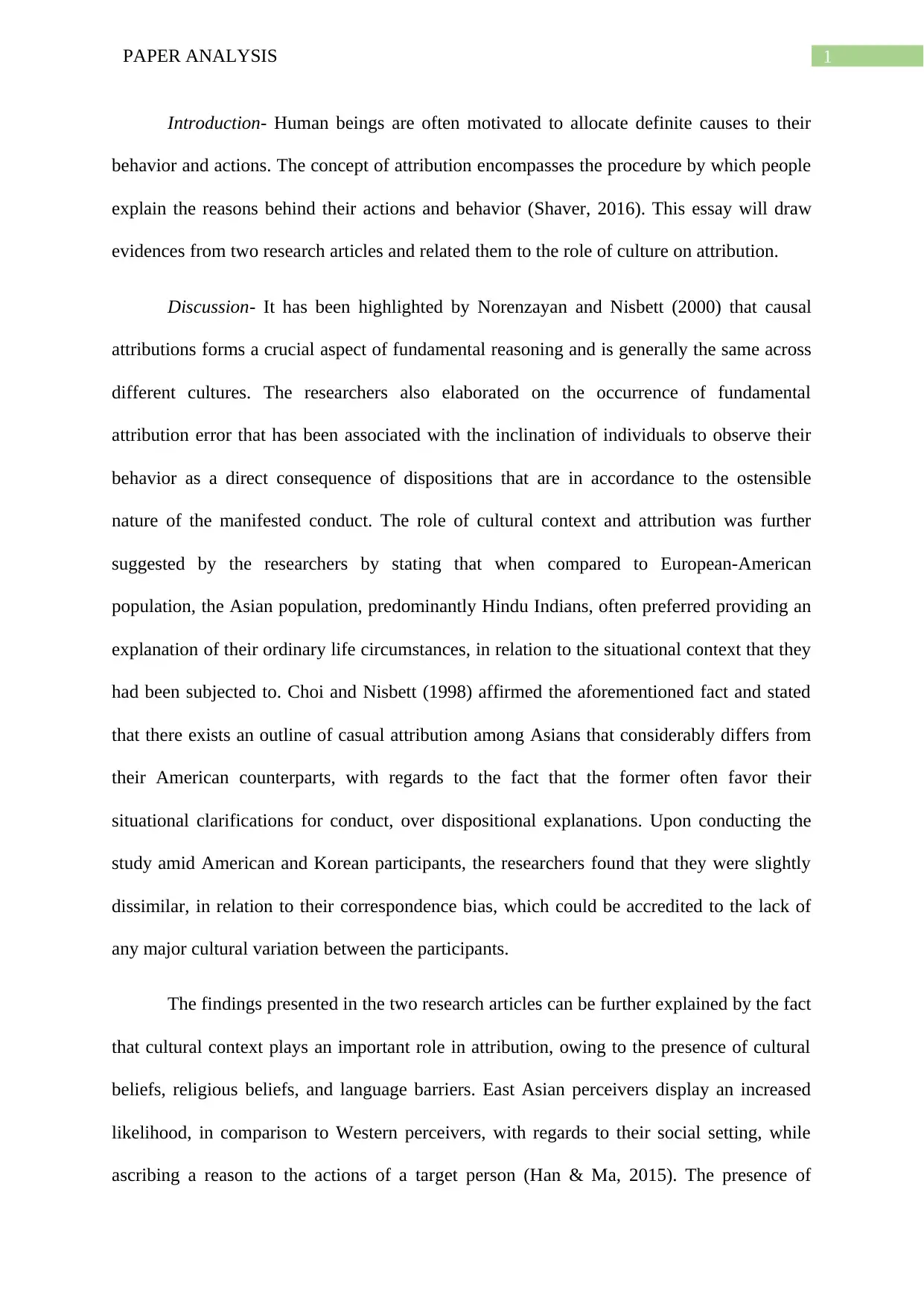
Introduction- Human beings are often motivated to allocate definite causes to their
behavior and actions. The concept of attribution encompasses the procedure by which people
explain the reasons behind their actions and behavior (Shaver, 2016). This essay will draw
evidences from two research articles and related them to the role of culture on attribution.
Discussion- It has been highlighted by Norenzayan and Nisbett (2000) that causal
attributions forms a crucial aspect of fundamental reasoning and is generally the same across
different cultures. The researchers also elaborated on the occurrence of fundamental
attribution error that has been associated with the inclination of individuals to observe their
behavior as a direct consequence of dispositions that are in accordance to the ostensible
nature of the manifested conduct. The role of cultural context and attribution was further
suggested by the researchers by stating that when compared to European-American
population, the Asian population, predominantly Hindu Indians, often preferred providing an
explanation of their ordinary life circumstances, in relation to the situational context that they
had been subjected to. Choi and Nisbett (1998) affirmed the aforementioned fact and stated
that there exists an outline of casual attribution among Asians that considerably differs from
their American counterparts, with regards to the fact that the former often favor their
situational clarifications for conduct, over dispositional explanations. Upon conducting the
study amid American and Korean participants, the researchers found that they were slightly
dissimilar, in relation to their correspondence bias, which could be accredited to the lack of
any major cultural variation between the participants.
The findings presented in the two research articles can be further explained by the fact
that cultural context plays an important role in attribution, owing to the presence of cultural
beliefs, religious beliefs, and language barriers. East Asian perceivers display an increased
likelihood, in comparison to Western perceivers, with regards to their social setting, while
ascribing a reason to the actions of a target person (Han & Ma, 2015). The presence of
Document Page
2PAPER ANALYSIS
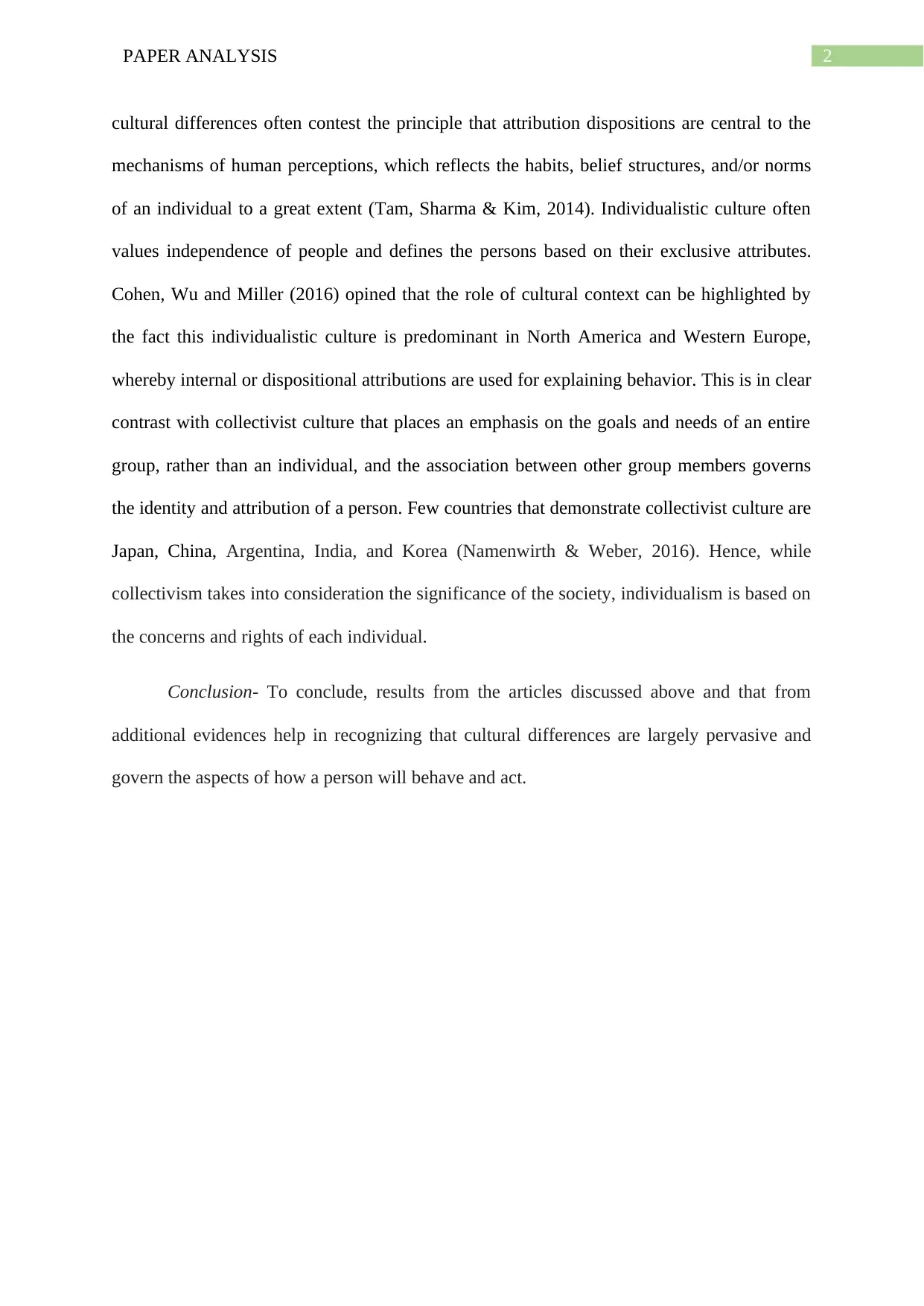
cultural differences often contest the principle that attribution dispositions are central to the
mechanisms of human perceptions, which reflects the habits, belief structures, and/or norms
of an individual to a great extent (Tam, Sharma & Kim, 2014). Individualistic culture often
values independence of people and defines the persons based on their exclusive attributes.
Cohen, Wu and Miller (2016) opined that the role of cultural context can be highlighted by
the fact this individualistic culture is predominant in North America and Western Europe,
whereby internal or dispositional attributions are used for explaining behavior. This is in clear
contrast with collectivist culture that places an emphasis on the goals and needs of an entire
group, rather than an individual, and the association between other group members governs
the identity and attribution of a person. Few countries that demonstrate collectivist culture are
Japan, China, Argentina, India, and Korea (Namenwirth & Weber, 2016). Hence, while
collectivism takes into consideration the significance of the society, individualism is based on
the concerns and rights of each individual.
Conclusion- To conclude, results from the articles discussed above and that from
additional evidences help in recognizing that cultural differences are largely pervasive and
govern the aspects of how a person will behave and act.
Document Page
3PAPER ANALYSIS
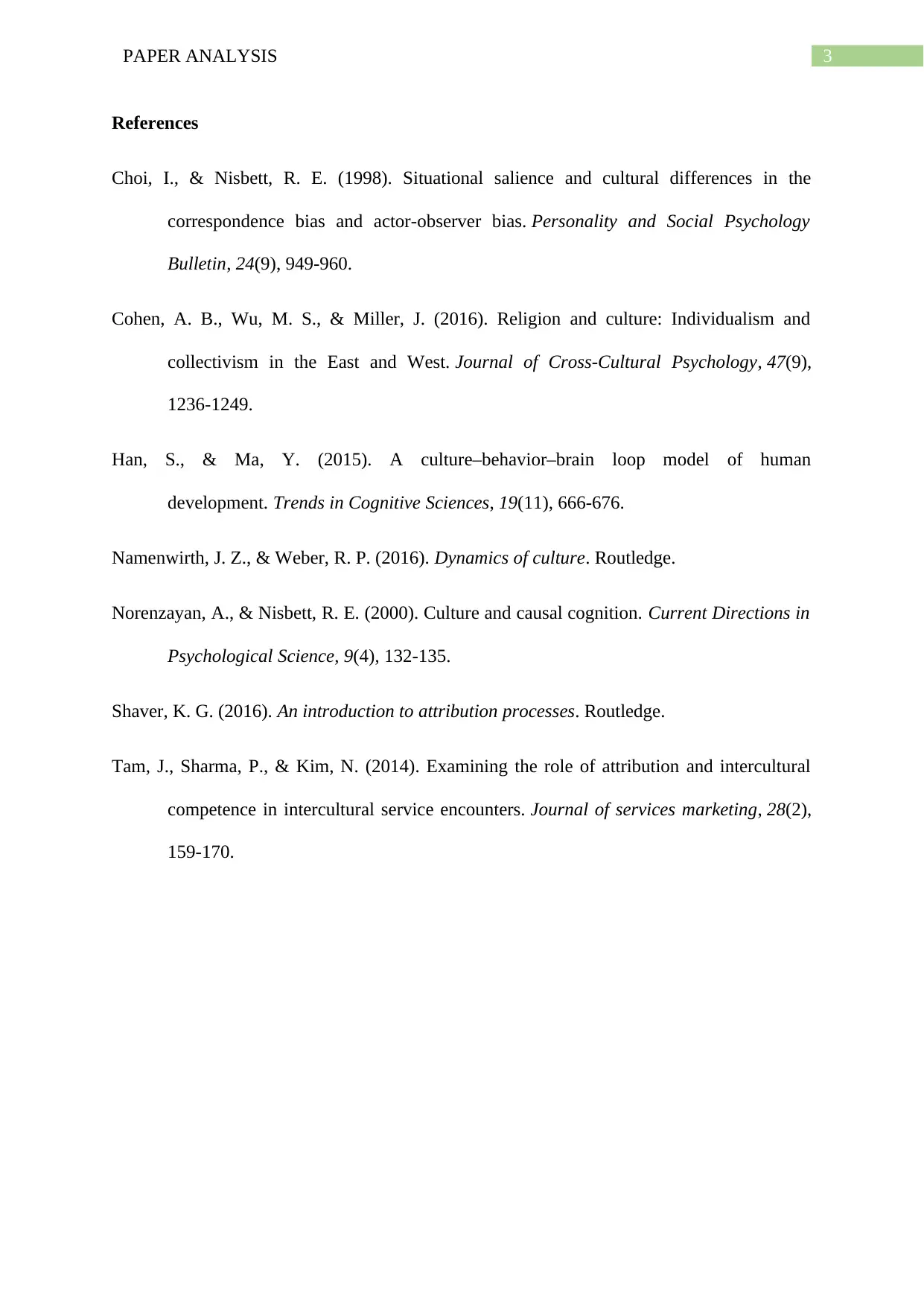
References
Choi, I., & Nisbett, R. E. (1998). Situational salience and cultural differences in the
correspondence bias and actor-observer bias. Personality and Social Psychology
Bulletin, 24(9), 949-960.
Cohen, A. B., Wu, M. S., & Miller, J. (2016). Religion and culture: Individualism and
collectivism in the East and West. Journal of Cross-Cultural Psychology, 47(9),
1236-1249.
Han, S., & Ma, Y. (2015). A culture–behavior–brain loop model of human
development. Trends in Cognitive Sciences, 19(11), 666-676.
Namenwirth, J. Z., & Weber, R. P. (2016). Dynamics of culture. Routledge.
Norenzayan, A., & Nisbett, R. E. (2000). Culture and causal cognition. Current Directions in
Psychological Science, 9(4), 132-135.
Shaver, K. G. (2016). An introduction to attribution processes. Routledge.
Tam, J., Sharma, P., & Kim, N. (2014). Examining the role of attribution and intercultural
competence in intercultural service encounters. Journal of services marketing, 28(2),
159-170.
chevron_up_icon
1 out of 4
circle_padding
hide_on_mobile
zoom_out_icon
[object Object]