Case Study: Analyzing a Deteriorating Inpatient Client's Condition

Verified

Added on  2022/11/17

|3
|1054
|449
Case Study
AI Summary
This assignment analyzes a case study of a deteriorating inpatient client, David John Connel, admitted for electrical cardioversion to treat atrial fibrillation. The analysis details the recording of vital signs (blood pressure, heart rate, ECG) to monitor the patient's condition and response to treatment. It identifies the healthcare professionals involved, including the doctor, Evaun Teoh, and nursing staff, and describes the cardioversion procedure, including the application of anesthesia and the use of defibrillation pads. The patient's positive outcome is highlighted, noting the return to a normal heart rhythm. The assignment also addresses required medications (anesthetic IV drugs), potential triggers for distress (dysfunctional sinus atrial node), and essential patient teaching regarding diet, exercise, and post-procedure precautions like avoiding driving. The analysis references the New 2019 ACC/AHA guideline for managing heart disease, emphasizing its guidance on healthy lifestyle and team-based measures to minimize cardiovascular risks and complications. The assignment provides a comprehensive overview of the patient's treatment, outcome, and the application of relevant medical guidelines.
Document Page
Running head: DETERIORATING INPATIENT CLIENT
Deteriorating Inpatient Client
Name
Institutional Affiliation
tabler-icon-diamond-filled.svg

Paraphrase This Document

Need a fresh take? Get an instant paraphrase of this document with our AI Paraphraser
Document Page
DETERIORATING INPATIENT CLIENT
Concept Map
DETERIORATING INPATIENT CLIENT
https://www.youtube.com/watch?v=zC7yVk4yklA (chosen)
https://www.youtube.com/watch?v=KIEFXJ8QHxw
https://www.youtube.com/watch?v=d7ymmR8WuYE
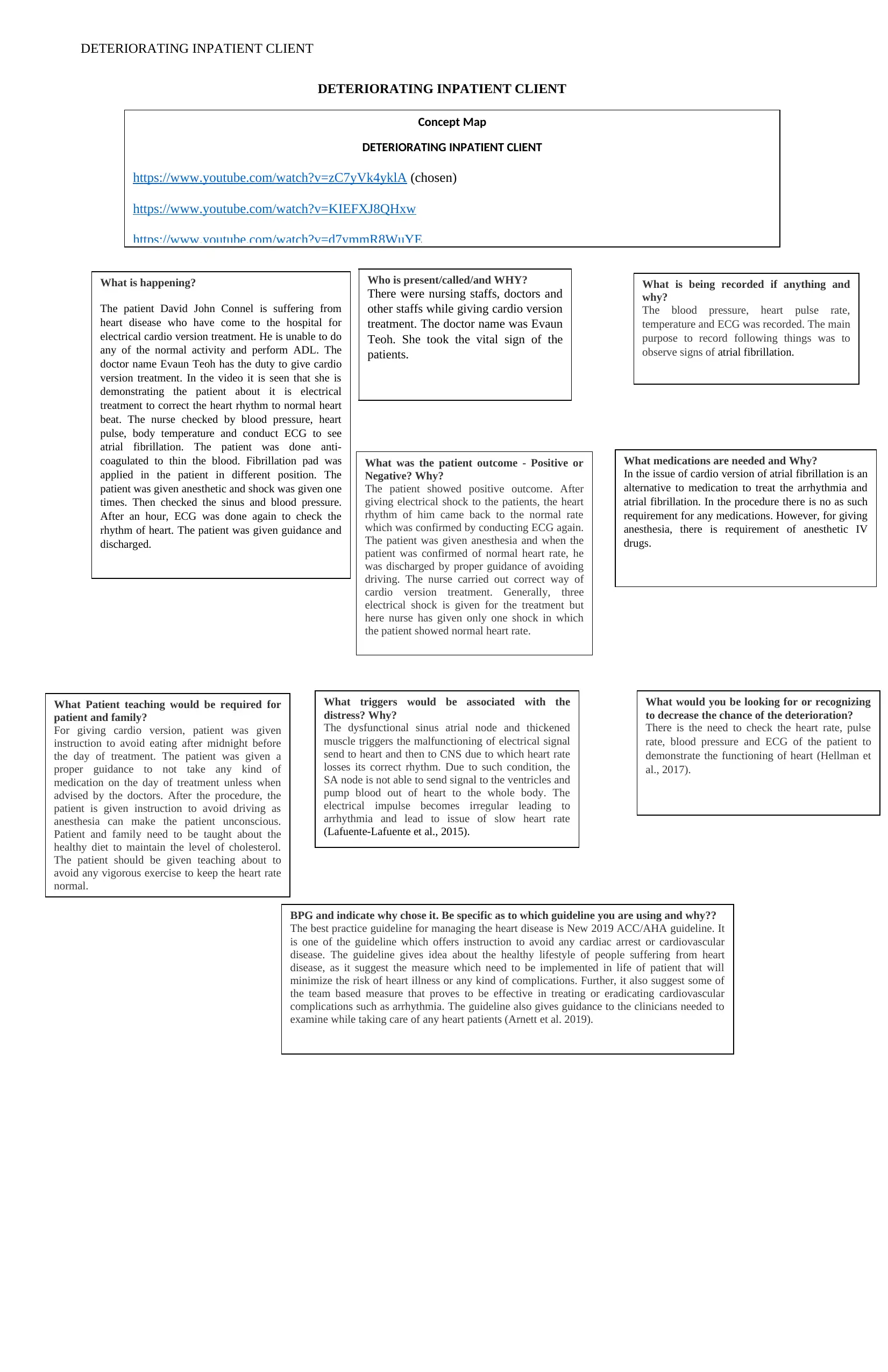
What is happening?
The patient David John Connel is suffering from
heart disease who have come to the hospital for
electrical cardio version treatment. He is unable to do
any of the normal activity and perform ADL. The
doctor name Evaun Teoh has the duty to give cardio
version treatment. In the video it is seen that she is
demonstrating the patient about it is electrical
treatment to correct the heart rhythm to normal heart
beat. The nurse checked by blood pressure, heart
pulse, body temperature and conduct ECG to see
atrial fibrillation. The patient was done anti-
coagulated to thin the blood. Fibrillation pad was
applied in the patient in different position. The
patient was given anesthetic and shock was given one
times. Then checked the sinus and blood pressure.
After an hour, ECG was done again to check the
rhythm of heart. The patient was given guidance and
discharged.
Who is present/called/and WHY?
There were nursing staffs, doctors and
other staffs while giving cardio version
treatment. The doctor name was Evaun
Teoh. She took the vital sign of the
patients.
What is being recorded if anything and
why?
The blood pressure, heart pulse rate,
temperature and ECG was recorded. The main
purpose to record following things was to
observe signs of atrial fibrillation.
What was the patient outcome - Positive or
Negative? Why?
The patient showed positive outcome. After
giving electrical shock to the patients, the heart
rhythm of him came back to the normal rate
which was confirmed by conducting ECG again.
The patient was given anesthesia and when the
patient was confirmed of normal heart rate, he
was discharged by proper guidance of avoiding
driving. The nurse carried out correct way of
cardio version treatment. Generally, three
electrical shock is given for the treatment but
here nurse has given only one shock in which
the patient showed normal heart rate.
What medications are needed and Why?
In the issue of cardio version of atrial fibrillation is an
alternative to medication to treat the arrhythmia and
atrial fibrillation. In the procedure there is no as such
requirement for any medications. However, for giving
anesthesia, there is requirement of anesthetic IV
drugs.
What Patient teaching would be required for
patient and family?
For giving cardio version, patient was given
instruction to avoid eating after midnight before
the day of treatment. The patient was given a
proper guidance to not take any kind of
medication on the day of treatment unless when
advised by the doctors. After the procedure, the
patient is given instruction to avoid driving as
anesthesia can make the patient unconscious.
Patient and family need to be taught about the
healthy diet to maintain the level of cholesterol.
The patient should be given teaching about to
avoid any vigorous exercise to keep the heart rate
normal.
What triggers would be associated with the
distress? Why?
The dysfunctional sinus atrial node and thickened
muscle triggers the malfunctioning of electrical signal
send to heart and then to CNS due to which heart rate
losses its correct rhythm. Due to such condition, the
SA node is not able to send signal to the ventricles and
pump blood out of heart to the whole body. The
electrical impulse becomes irregular leading to
arrhythmia and lead to issue of slow heart rate
(Lafuente‐Lafuente et al., 2015).
What would you be looking for or recognizing
to decrease the chance of the deterioration?
There is the need to check the heart rate, pulse
rate, blood pressure and ECG of the patient to
demonstrate the functioning of heart (Hellman et
al., 2017).
BPG and indicate why chose it. Be specific as to which guideline you are using and why??
The best practice guideline for managing the heart disease is New 2019 ACC/AHA guideline. It
is one of the guideline which offers instruction to avoid any cardiac arrest or cardiovascular
disease. The guideline gives idea about the healthy lifestyle of people suffering from heart
disease, as it suggest the measure which need to be implemented in life of patient that will
minimize the risk of heart illness or any kind of complications. Further, it also suggest some of
the team based measure that proves to be effective in treating or eradicating cardiovascular
complications such as arrhythmia. The guideline also gives guidance to the clinicians needed to
examine while taking care of any heart patients (Arnett et al. 2019).
Document Page
DETERIORATING INPATIENT CLIENT
References
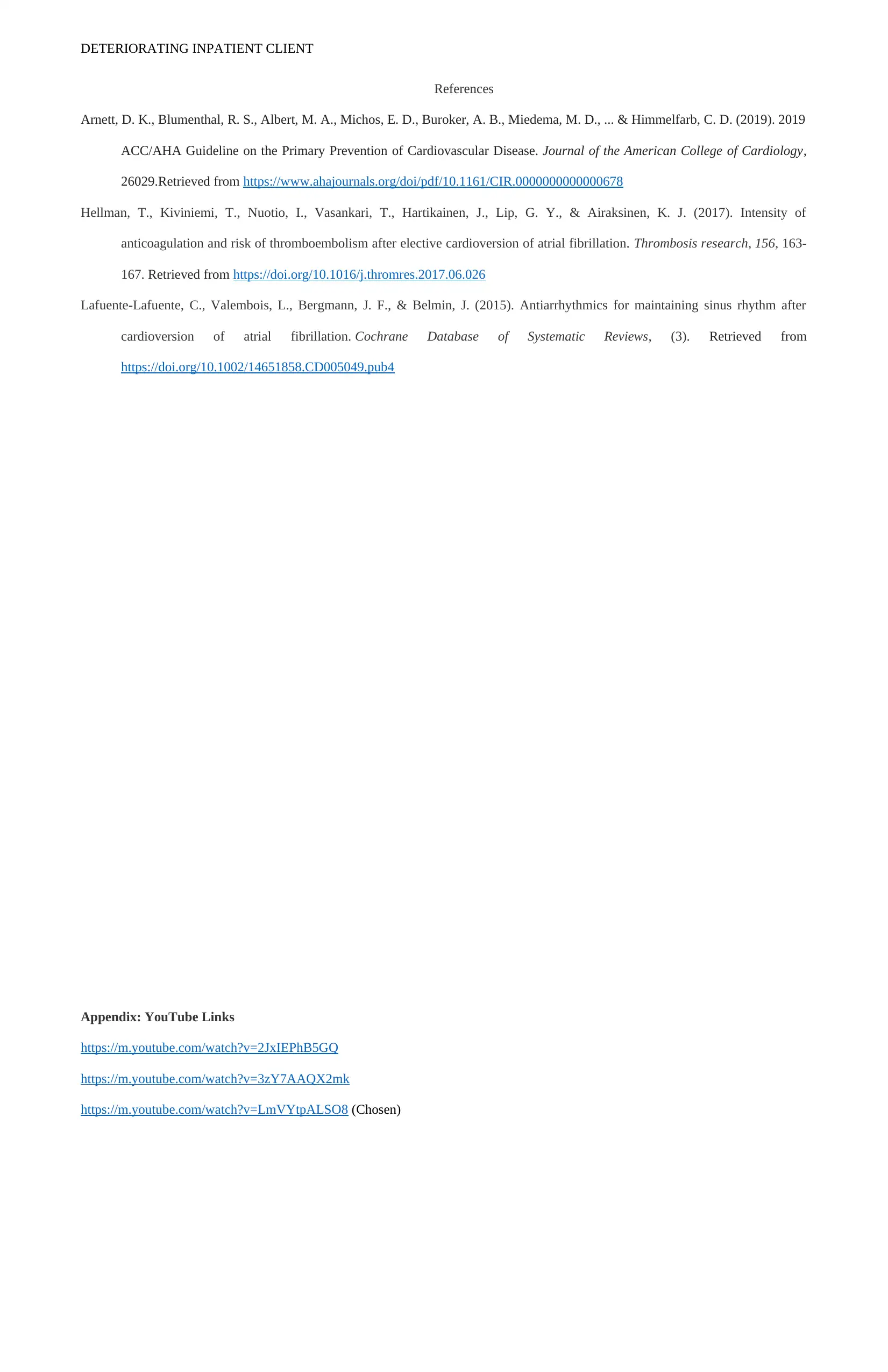
Arnett, D. K., Blumenthal, R. S., Albert, M. A., Michos, E. D., Buroker, A. B., Miedema, M. D., ... & Himmelfarb, C. D. (2019). 2019
ACC/AHA Guideline on the Primary Prevention of Cardiovascular Disease. Journal of the American College of Cardiology,
26029.Retrieved from https://www.ahajournals.org/doi/pdf/10.1161/CIR.0000000000000678
Hellman, T., Kiviniemi, T., Nuotio, I., Vasankari, T., Hartikainen, J., Lip, G. Y., & Airaksinen, K. J. (2017). Intensity of
anticoagulation and risk of thromboembolism after elective cardioversion of atrial fibrillation. Thrombosis research, 156, 163-
167. Retrieved from https://doi.org/10.1016/j.thromres.2017.06.026
Lafuente‐Lafuente, C., Valembois, L., Bergmann, J. F., & Belmin, J. (2015). Antiarrhythmics for maintaining sinus rhythm after
cardioversion of atrial fibrillation. Cochrane Database of Systematic Reviews, (3). Retrieved from
https://doi.org/10.1002/14651858.CD005049.pub4
Appendix: YouTube Links
https://m.youtube.com/watch?v=2JxIEPhB5GQ
https://m.youtube.com/watch?v=3zY7AAQX2mk
https://m.youtube.com/watch?v=LmVYtpALSO8 (Chosen)
chevron_up_icon
1 out of 3
circle_padding
hide_on_mobile
zoom_out_icon
[object Object]