Epidemiology: Analyzing Depression and Heart Disease Prevalence & Risk

Verified

Added on  2023/05/29

|7
|1482
|226
Homework Assignment
AI Summary
This assignment delves into the epidemiology of depression and heart disease, calculating point prevalence and incidence risk for depression based on provided data, highlighting differences between genders and age groups. It further examines the prevalence of heart disease in males and females, computes odds ratios for different levels of physical activity, and evaluates the study design used to assess the association between heart disease and physical activity. The assignment identifies potential sources of bias in the study, discusses the impact of confounding variables, and suggests improvements to the methodology. The analysis reveals significant differences in disease prevalence and risk factors, emphasizing the importance of targeted public health interventions. Desklib offers a range of similar solved assignments and study resources for students.
Document Page
EPIDEMIOLOGY
STUDENT ID:
[Pick the date]
tabler-icon-diamond-filled.svg

Paraphrase This Document

Need a fresh take? Get an instant paraphrase of this document with our AI Paraphraser
Document Page
Question 1
a) Point Prevalence of depression at beginning of 2017 (per 1000 population) = (Existing
cases at start of 2017/ Population at start of 2017)*1000 (Rothman, 2015).
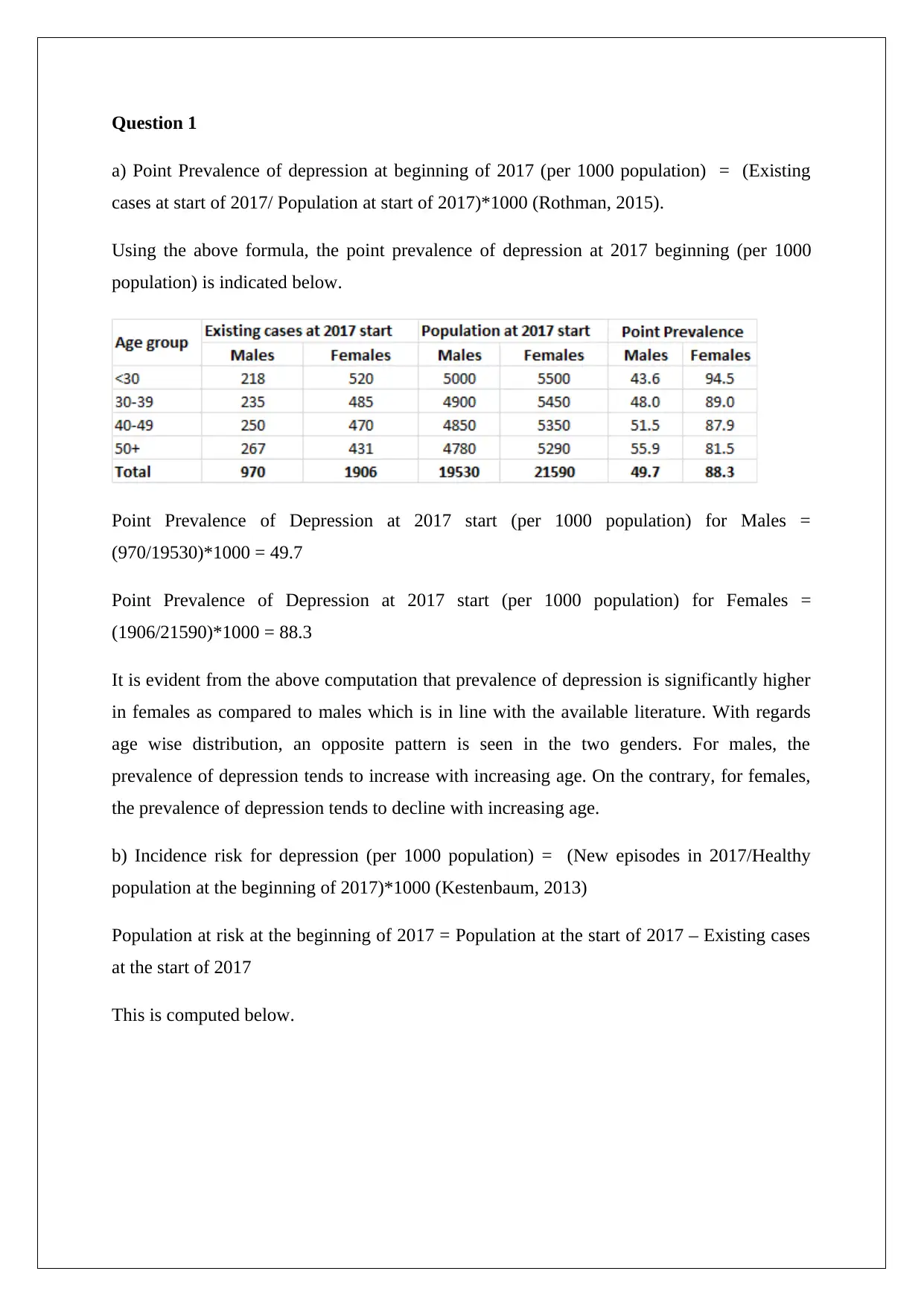
Using the above formula, the point prevalence of depression at 2017 beginning (per 1000
population) is indicated below.
Point Prevalence of Depression at 2017 start (per 1000 population) for Males =
(970/19530)*1000 = 49.7
Point Prevalence of Depression at 2017 start (per 1000 population) for Females =
(1906/21590)*1000 = 88.3
It is evident from the above computation that prevalence of depression is significantly higher
in females as compared to males which is in line with the available literature. With regards
age wise distribution, an opposite pattern is seen in the two genders. For males, the
prevalence of depression tends to increase with increasing age. On the contrary, for females,
the prevalence of depression tends to decline with increasing age.
b) Incidence risk for depression (per 1000 population) = (New episodes in 2017/Healthy
population at the beginning of 2017)*1000 (Kestenbaum, 2013)
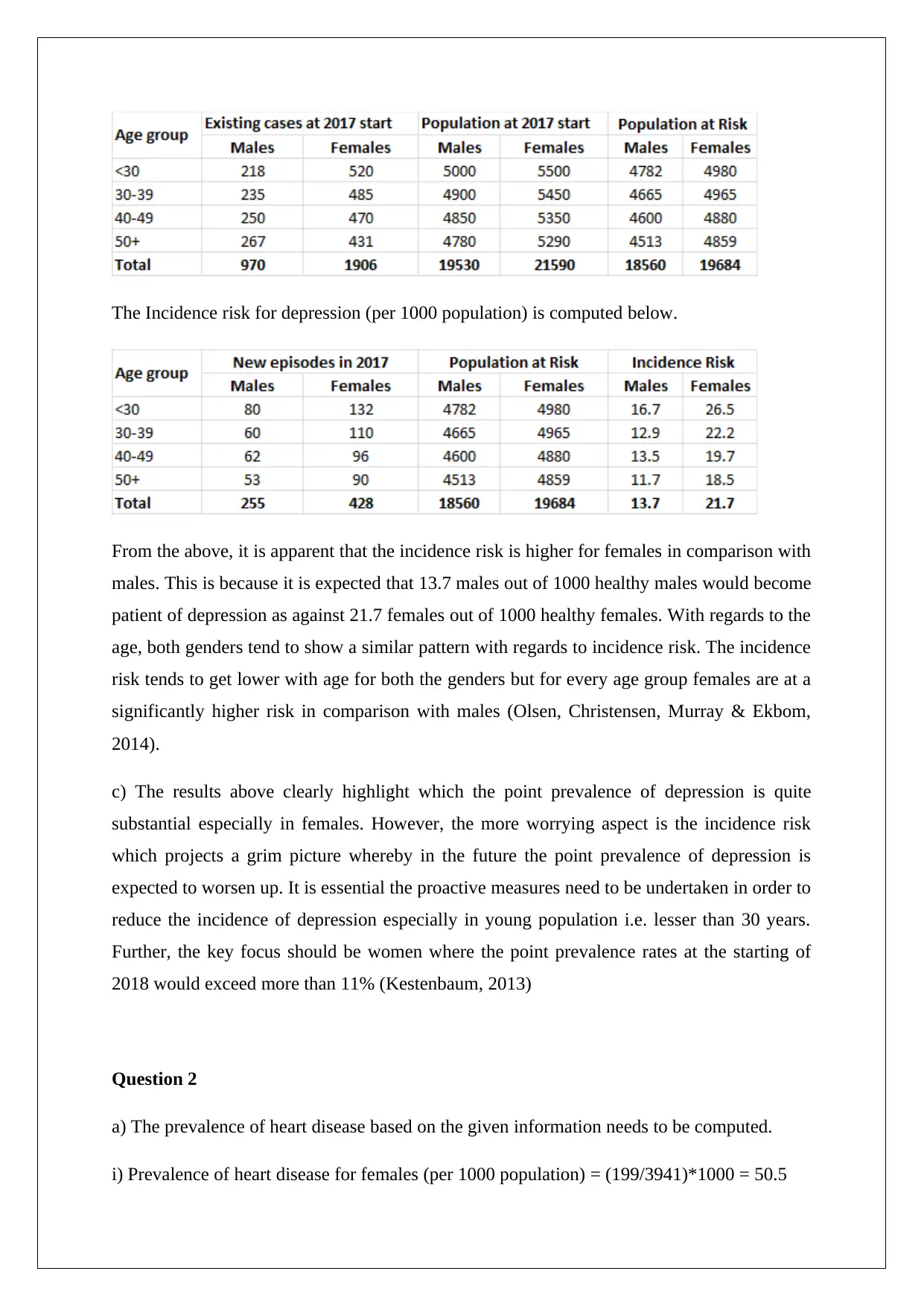
Population at risk at the beginning of 2017 = Population at the start of 2017 – Existing cases
at the start of 2017
This is computed below.
Document Page
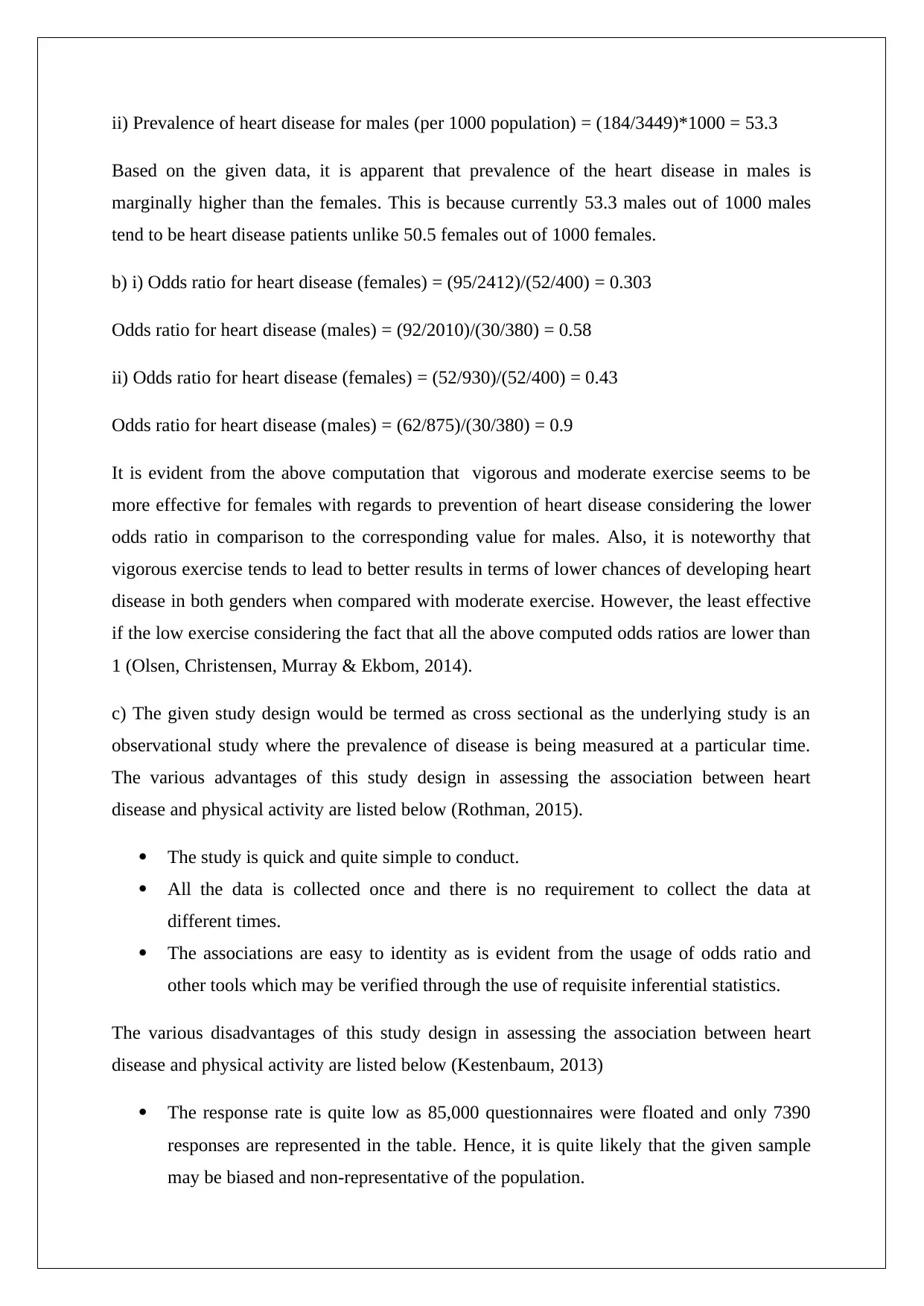
The Incidence risk for depression (per 1000 population) is computed below.
From the above, it is apparent that the incidence risk is higher for females in comparison with
males. This is because it is expected that 13.7 males out of 1000 healthy males would become
patient of depression as against 21.7 females out of 1000 healthy females. With regards to the
age, both genders tend to show a similar pattern with regards to incidence risk. The incidence
risk tends to get lower with age for both the genders but for every age group females are at a
significantly higher risk in comparison with males (Olsen, Christensen, Murray & Ekbom,
2014).
c) The results above clearly highlight which the point prevalence of depression is quite
substantial especially in females. However, the more worrying aspect is the incidence risk
which projects a grim picture whereby in the future the point prevalence of depression is
expected to worsen up. It is essential the proactive measures need to be undertaken in order to
reduce the incidence of depression especially in young population i.e. lesser than 30 years.
Further, the key focus should be women where the point prevalence rates at the starting of
2018 would exceed more than 11% (Kestenbaum, 2013)
Question 2
a) The prevalence of heart disease based on the given information needs to be computed.
i) Prevalence of heart disease for females (per 1000 population) = (199/3941)*1000 = 50.5
Document Page
ii) Prevalence of heart disease for males (per 1000 population) = (184/3449)*1000 = 53.3
Based on the given data, it is apparent that prevalence of the heart disease in males is
marginally higher than the females. This is because currently 53.3 males out of 1000 males
tend to be heart disease patients unlike 50.5 females out of 1000 females.
b) i) Odds ratio for heart disease (females) = (95/2412)/(52/400) = 0.303
Odds ratio for heart disease (males) = (92/2010)/(30/380) = 0.58
ii) Odds ratio for heart disease (females) = (52/930)/(52/400) = 0.43
Odds ratio for heart disease (males) = (62/875)/(30/380) = 0.9
It is evident from the above computation that vigorous and moderate exercise seems to be
more effective for females with regards to prevention of heart disease considering the lower
odds ratio in comparison to the corresponding value for males. Also, it is noteworthy that
vigorous exercise tends to lead to better results in terms of lower chances of developing heart
disease in both genders when compared with moderate exercise. However, the least effective
if the low exercise considering the fact that all the above computed odds ratios are lower than
1 (Olsen, Christensen, Murray & Ekbom, 2014).
c) The given study design would be termed as cross sectional as the underlying study is an
observational study where the prevalence of disease is being measured at a particular time.
The various advantages of this study design in assessing the association between heart
disease and physical activity are listed below (Rothman, 2015).
The study is quick and quite simple to conduct.
All the data is collected once and there is no requirement to collect the data at
different times.
The associations are easy to identity as is evident from the usage of odds ratio and
other tools which may be verified through the use of requisite inferential statistics.
The various disadvantages of this study design in assessing the association between heart
disease and physical activity are listed below (Kestenbaum, 2013)
The response rate is quite low as 85,000 questionnaires were floated and only 7390
responses are represented in the table. Hence, it is quite likely that the given sample
may be biased and non-representative of the population.
tabler-icon-diamond-filled.svg

Paraphrase This Document

Need a fresh take? Get an instant paraphrase of this document with our AI Paraphraser
Document Page
The different level of physical activity has not been objectively defined which can
potentially lead to subjectively, thereby adversely impacting the reliability of the
study.
The interpretation of association may be difficult as confounding variables may play a
disruptive role. This happens since there is no control case which serves as a
comparison.
d) With regards to the selection of sample, the source of bias is the low response rate owing
to which the actual sample is only a small portion of the intended sample. This therefore may
be biased as certain attributes may be overrepresented and underrepresented. Further, bias
may also arise with regards to the exposure to exercise as the levels of exercise i.e. low,.
Moderate and vigorous have not been objectively defined and hence the respondents would
interpret the exposure based on their subjective dispositions. Also, the outcome may be
biased owing to existence of confounding variables (Olsen, Christensen, Murray & Ekbom,
2014).
One of the potential change in the methodology relates to the sampling which must be
random stratified sampling whereby the responses received must be arranged in accordance
with their key attributed. The sample finally used for the study should have similar
distribution of key attributes as the underlying population. Also, the exposure levels i.e. the
exercise levels need to be defined in objective yet simple terms since the same meaning is
communicated to all the respondents thereby leading to more reliable results (Kestenbaum,
2013)
e) There is significant impact of confounding in the given study considering there are
variables such as age, food habits which may tend to act as confounding variables. Consider
the example of food habits. It may happen that healthier food habits tend to increase the
tendency to have a vigorous level of exercise and also is associated with lower risk of heart
disease. Another significant confounding variable would be age which can impact both the
exercise level and also the risk of heart disease. Obesity may also be another confounding
variable (Rothman, 2015).
In order to minimise the impact, it would make sense to consider the impact of these major
confounding aspects by measuring these so that a more thorough analysis may be carried out.
Document Page
Additionally, a control group may also be inserted with similar confounding variables
distribution as the sample so that the precise relation between the exercise level and risk of
heart disease can be better highlighted (Kestenbaum, 2013)
References
Kestenbaum, B. (2013) Epidemiology and Biostatistics (2nd ed.) Washington: Springer
Document Page
Olsen, J., Christensen, K., Murray, J,. & Ekbom, A. (2014) An Introduction to Epidemiology
for Health Professionals (2nd ed.) London: Springer
Rothman, K. (2015) Epidemiology- An Introduction (2nd ed.)New York: Oxford
chevron_up_icon
1 out of 7
circle_padding
hide_on_mobile
zoom_out_icon
[object Object]