Analyzing Economic Factors and Their Impact on Business Operations
VerifiedAdded on 2024/05/17
|10
|2790
|347
Report
AI Summary
This report examines the effects of economic growth, inflation, and unemployment on businesses, using Nike as a case study. It discusses the causes of economic growth, inflation, and unemployment, analyzing how firms respond to changes in economic growth and the effects of inflation and increased unemployment on firm strategies. The report highlights Nike's responses to business cycles, including innovation during expansions and stock clearance sales during recessions. It also explores how firms manage inflation through pricing strategies and cost management, and how unemployment affects staff turnover and human capital supply. The analysis provides insights into how businesses adapt to and navigate various economic conditions, with a focus on maintaining competitiveness and maximizing profitability. Desklib provides access to a wide range of solved assignments for students.
Business and Economy
1
1

Paraphrase This Document
Need a fresh take? Get an instant paraphrase of this document with our AI Paraphraser
Table of Contents
Introduction................................................................................................................................3
Task 1.........................................................................................................................................4
1.1 Discuss two possible causes of:...........................................................................................4
a) Economic growth...................................................................................................................4
b) Inflation..................................................................................................................................4
c) Unemployment.......................................................................................................................4
Task 2.........................................................................................................................................5
2.1 Analyse, using two examples, how firms may respond to changes in economic growth....5
2.2 Discuss two effects that inflation may have on firms and assess the strategies they may
use to deal with them..................................................................................................................5
2.3 Assess two effects of increased unemployment on a firm...................................................6
Conclusion..................................................................................................................................8
Reference List............................................................................................................................9
2
Introduction................................................................................................................................3
Task 1.........................................................................................................................................4
1.1 Discuss two possible causes of:...........................................................................................4
a) Economic growth...................................................................................................................4
b) Inflation..................................................................................................................................4
c) Unemployment.......................................................................................................................4
Task 2.........................................................................................................................................5
2.1 Analyse, using two examples, how firms may respond to changes in economic growth....5
2.2 Discuss two effects that inflation may have on firms and assess the strategies they may
use to deal with them..................................................................................................................5
2.3 Assess two effects of increased unemployment on a firm...................................................6
Conclusion..................................................................................................................................8
Reference List............................................................................................................................9
2
Introduction
With increased globalization, companies all around the world have had to focus on their
business operations in accordance with the measures that could maximize their sales growth
as well as their profit margins. This demands a high level of understanding the various
aspects of the economy, without which it would be utterly difficult for the companies to
achieve sustainable functioning. However, the aspects of inflation and unemployment have
always affected businesses from time to time, making it evident that businesses cannot just
function based on their strengths and need to have a suitable external environment as well.
This report has looked at the different ways in which economic growth, inflation and
unemployment have affected global companies. The company chosen as reference is Nike,
the world’s largest sportswear manufacturers and distributors. It will shed light on the initial
reasons that prompt the company to respond to changes in both their internal and external
environment, with much emphasis on the factors of the economy.
3
With increased globalization, companies all around the world have had to focus on their
business operations in accordance with the measures that could maximize their sales growth
as well as their profit margins. This demands a high level of understanding the various
aspects of the economy, without which it would be utterly difficult for the companies to
achieve sustainable functioning. However, the aspects of inflation and unemployment have
always affected businesses from time to time, making it evident that businesses cannot just
function based on their strengths and need to have a suitable external environment as well.
This report has looked at the different ways in which economic growth, inflation and
unemployment have affected global companies. The company chosen as reference is Nike,
the world’s largest sportswear manufacturers and distributors. It will shed light on the initial
reasons that prompt the company to respond to changes in both their internal and external
environment, with much emphasis on the factors of the economy.
3
⊘ This is a preview!⊘
Do you want full access?
Subscribe today to unlock all pages.

Trusted by 1+ million students worldwide
Task 1
1.1 Discuss two possible causes of:
a) Economic growth
b) Inflation
c) Unemployment
a) Economic growth: While the term can be defined as the growth in the total revenue of a
company or the increase in GDP of a nation, there are two basic causes of economic growth.
They are an increase in the aggregate demand (AD) and an increase in aggregate supply
(productive capacity). However, there are many factors which in turn affect the aggregate
demand and supply. Lower interest rates and higher spending by government are the two
most important factors that have a positive effect on a company’s aggregate demand
(Economicshelp.org, 2018). At the same time, financial stability of a country is another factor
that affects companies either established in those regions or seeking to set up shop in them.
On the other hand, an increase in working capital and the sheer number of employees
available for recruitment affect the aggregate supply or the productive capacity of a firm. In
addition, if employee productivity increases with time, companies are able to be ahead of
demand always.
b) Inflation: According to market analysts and leading economists, the two main reasons for
inflation are an increase in demand, so much so that a company sells out completely. Another
cause is the extreme shortage in supply with very high demands (The Balance, 2018).
However, these factors are not absolute in their own terms and have many contributing
factors. On one hand, an increase in demand may be facilitated by a growing economy.
People are willing to pay more for even petty services, prompting companies to increase their
prices. In addition, new and better technological advancements could also give rise to huge
demands, enabling companies to set prices as and how they see fit. On the other hand, a
shortage in supply with huge demands can be caused by natural disasters as well. Although
not ideal, government regulations on taxes as well as a monopoly, would give rise to
inflations because there would be a sole dic6tator setting prices as they see fit.
c) Unemployment: There are two basic causes of unemployment. One of them is the
unemployment resulting from recession and the other is the natural rate of unemployment. In
terms of a recession, two factors contribute to unemployment, namely, monetary factors and
fiscal tools. In an expansionary monetary policy, even central banks can drive down interest
rates to drive the aggregate demand in a forward direction whilst increasing the quantity of
money and loans. This allows the banks to justify unemployment from the perspectives of the
economy. On the other hand, the natural rate of unemployment is something that is greatly
attributed to the countries respectively that put forth many restrictions in terms of hire and
service. This is also thought to be one of the major reasons behind the European countries
always leading in their unemployment rates. According to statistics, in 2006, the US
4
1.1 Discuss two possible causes of:
a) Economic growth
b) Inflation
c) Unemployment
a) Economic growth: While the term can be defined as the growth in the total revenue of a
company or the increase in GDP of a nation, there are two basic causes of economic growth.
They are an increase in the aggregate demand (AD) and an increase in aggregate supply
(productive capacity). However, there are many factors which in turn affect the aggregate
demand and supply. Lower interest rates and higher spending by government are the two
most important factors that have a positive effect on a company’s aggregate demand
(Economicshelp.org, 2018). At the same time, financial stability of a country is another factor
that affects companies either established in those regions or seeking to set up shop in them.
On the other hand, an increase in working capital and the sheer number of employees
available for recruitment affect the aggregate supply or the productive capacity of a firm. In
addition, if employee productivity increases with time, companies are able to be ahead of
demand always.
b) Inflation: According to market analysts and leading economists, the two main reasons for
inflation are an increase in demand, so much so that a company sells out completely. Another
cause is the extreme shortage in supply with very high demands (The Balance, 2018).
However, these factors are not absolute in their own terms and have many contributing
factors. On one hand, an increase in demand may be facilitated by a growing economy.
People are willing to pay more for even petty services, prompting companies to increase their
prices. In addition, new and better technological advancements could also give rise to huge
demands, enabling companies to set prices as and how they see fit. On the other hand, a
shortage in supply with huge demands can be caused by natural disasters as well. Although
not ideal, government regulations on taxes as well as a monopoly, would give rise to
inflations because there would be a sole dic6tator setting prices as they see fit.
c) Unemployment: There are two basic causes of unemployment. One of them is the
unemployment resulting from recession and the other is the natural rate of unemployment. In
terms of a recession, two factors contribute to unemployment, namely, monetary factors and
fiscal tools. In an expansionary monetary policy, even central banks can drive down interest
rates to drive the aggregate demand in a forward direction whilst increasing the quantity of
money and loans. This allows the banks to justify unemployment from the perspectives of the
economy. On the other hand, the natural rate of unemployment is something that is greatly
attributed to the countries respectively that put forth many restrictions in terms of hire and
service. This is also thought to be one of the major reasons behind the European countries
always leading in their unemployment rates. According to statistics, in 2006, the US
4
Paraphrase This Document
Need a fresh take? Get an instant paraphrase of this document with our AI Paraphraser
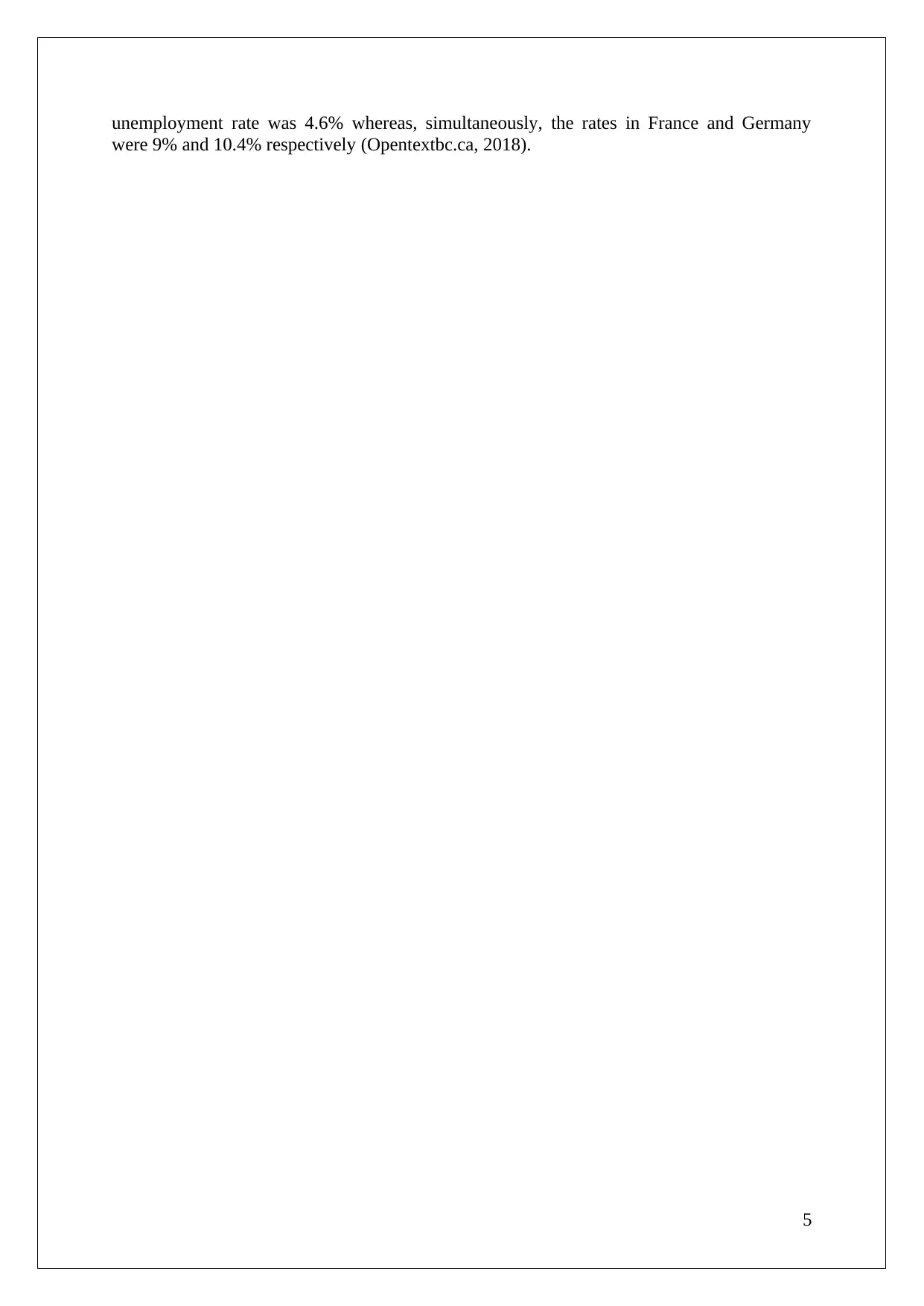
unemployment rate was 4.6% whereas, simultaneously, the rates in France and Germany
were 9% and 10.4% respectively (Opentextbc.ca, 2018).
5
were 9% and 10.4% respectively (Opentextbc.ca, 2018).
5
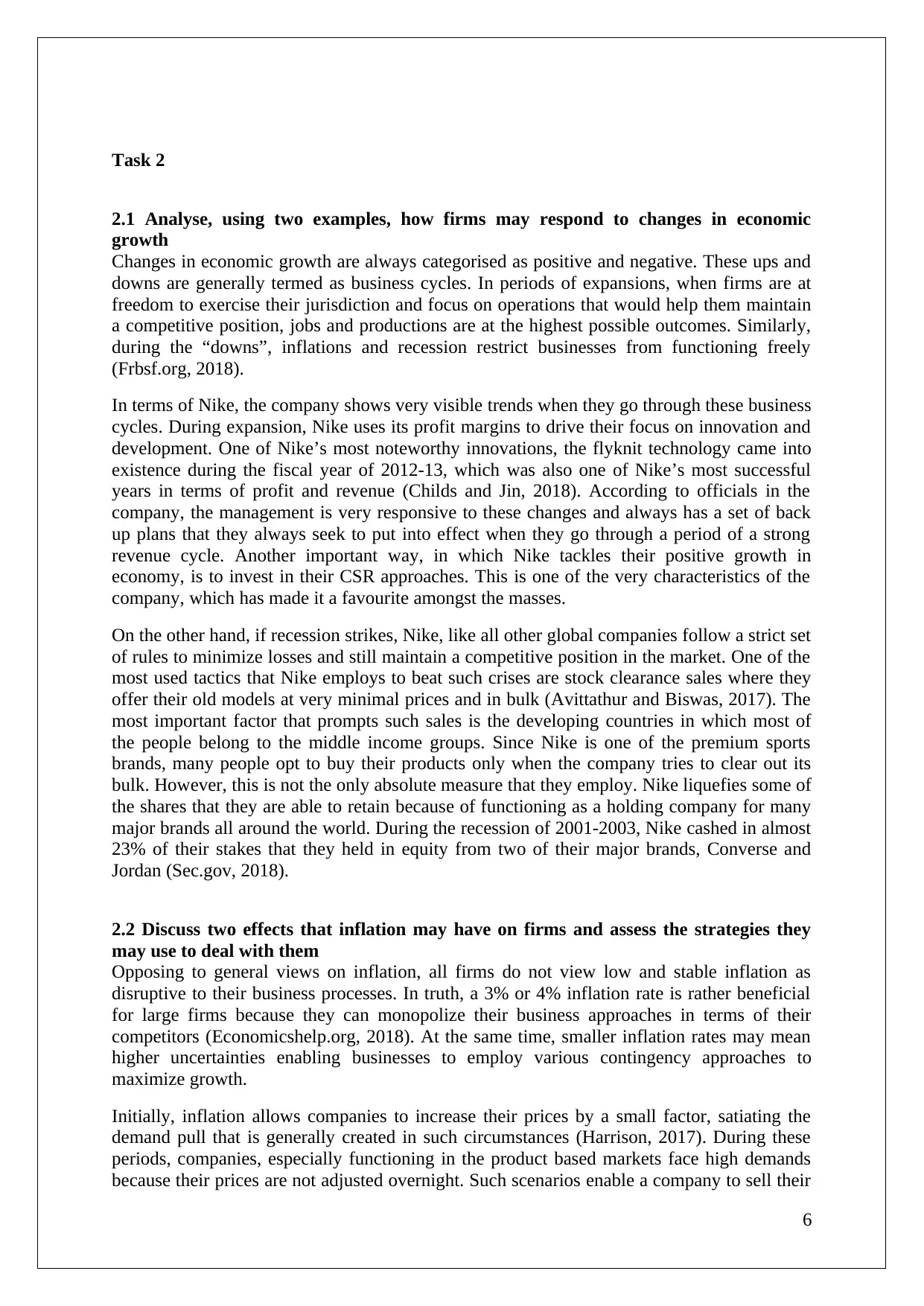
Task 2
2.1 Analyse, using two examples, how firms may respond to changes in economic
growth
Changes in economic growth are always categorised as positive and negative. These ups and
downs are generally termed as business cycles. In periods of expansions, when firms are at
freedom to exercise their jurisdiction and focus on operations that would help them maintain
a competitive position, jobs and productions are at the highest possible outcomes. Similarly,
during the “downs”, inflations and recession restrict businesses from functioning freely
(Frbsf.org, 2018).
In terms of Nike, the company shows very visible trends when they go through these business
cycles. During expansion, Nike uses its profit margins to drive their focus on innovation and
development. One of Nike’s most noteworthy innovations, the flyknit technology came into
existence during the fiscal year of 2012-13, which was also one of Nike’s most successful
years in terms of profit and revenue (Childs and Jin, 2018). According to officials in the
company, the management is very responsive to these changes and always has a set of back
up plans that they always seek to put into effect when they go through a period of a strong
revenue cycle. Another important way, in which Nike tackles their positive growth in
economy, is to invest in their CSR approaches. This is one of the very characteristics of the
company, which has made it a favourite amongst the masses.
On the other hand, if recession strikes, Nike, like all other global companies follow a strict set
of rules to minimize losses and still maintain a competitive position in the market. One of the
most used tactics that Nike employs to beat such crises are stock clearance sales where they
offer their old models at very minimal prices and in bulk (Avittathur and Biswas, 2017). The
most important factor that prompts such sales is the developing countries in which most of
the people belong to the middle income groups. Since Nike is one of the premium sports
brands, many people opt to buy their products only when the company tries to clear out its
bulk. However, this is not the only absolute measure that they employ. Nike liquefies some of
the shares that they are able to retain because of functioning as a holding company for many
major brands all around the world. During the recession of 2001-2003, Nike cashed in almost
23% of their stakes that they held in equity from two of their major brands, Converse and
Jordan (Sec.gov, 2018).
2.2 Discuss two effects that inflation may have on firms and assess the strategies they
may use to deal with them
Opposing to general views on inflation, all firms do not view low and stable inflation as
disruptive to their business processes. In truth, a 3% or 4% inflation rate is rather beneficial
for large firms because they can monopolize their business approaches in terms of their
competitors (Economicshelp.org, 2018). At the same time, smaller inflation rates may mean
higher uncertainties enabling businesses to employ various contingency approaches to
maximize growth.
Initially, inflation allows companies to increase their prices by a small factor, satiating the
demand pull that is generally created in such circumstances (Harrison, 2017). During these
periods, companies, especially functioning in the product based markets face high demands
because their prices are not adjusted overnight. Such scenarios enable a company to sell their
6
2.1 Analyse, using two examples, how firms may respond to changes in economic
growth
Changes in economic growth are always categorised as positive and negative. These ups and
downs are generally termed as business cycles. In periods of expansions, when firms are at
freedom to exercise their jurisdiction and focus on operations that would help them maintain
a competitive position, jobs and productions are at the highest possible outcomes. Similarly,
during the “downs”, inflations and recession restrict businesses from functioning freely
(Frbsf.org, 2018).
In terms of Nike, the company shows very visible trends when they go through these business
cycles. During expansion, Nike uses its profit margins to drive their focus on innovation and
development. One of Nike’s most noteworthy innovations, the flyknit technology came into
existence during the fiscal year of 2012-13, which was also one of Nike’s most successful
years in terms of profit and revenue (Childs and Jin, 2018). According to officials in the
company, the management is very responsive to these changes and always has a set of back
up plans that they always seek to put into effect when they go through a period of a strong
revenue cycle. Another important way, in which Nike tackles their positive growth in
economy, is to invest in their CSR approaches. This is one of the very characteristics of the
company, which has made it a favourite amongst the masses.
On the other hand, if recession strikes, Nike, like all other global companies follow a strict set
of rules to minimize losses and still maintain a competitive position in the market. One of the
most used tactics that Nike employs to beat such crises are stock clearance sales where they
offer their old models at very minimal prices and in bulk (Avittathur and Biswas, 2017). The
most important factor that prompts such sales is the developing countries in which most of
the people belong to the middle income groups. Since Nike is one of the premium sports
brands, many people opt to buy their products only when the company tries to clear out its
bulk. However, this is not the only absolute measure that they employ. Nike liquefies some of
the shares that they are able to retain because of functioning as a holding company for many
major brands all around the world. During the recession of 2001-2003, Nike cashed in almost
23% of their stakes that they held in equity from two of their major brands, Converse and
Jordan (Sec.gov, 2018).
2.2 Discuss two effects that inflation may have on firms and assess the strategies they
may use to deal with them
Opposing to general views on inflation, all firms do not view low and stable inflation as
disruptive to their business processes. In truth, a 3% or 4% inflation rate is rather beneficial
for large firms because they can monopolize their business approaches in terms of their
competitors (Economicshelp.org, 2018). At the same time, smaller inflation rates may mean
higher uncertainties enabling businesses to employ various contingency approaches to
maximize growth.
Initially, inflation allows companies to increase their prices by a small factor, satiating the
demand pull that is generally created in such circumstances (Harrison, 2017). During these
periods, companies, especially functioning in the product based markets face high demands
because their prices are not adjusted overnight. Such scenarios enable a company to sell their
6
⊘ This is a preview!⊘
Do you want full access?
Subscribe today to unlock all pages.
Trusted by 1+ million students worldwide
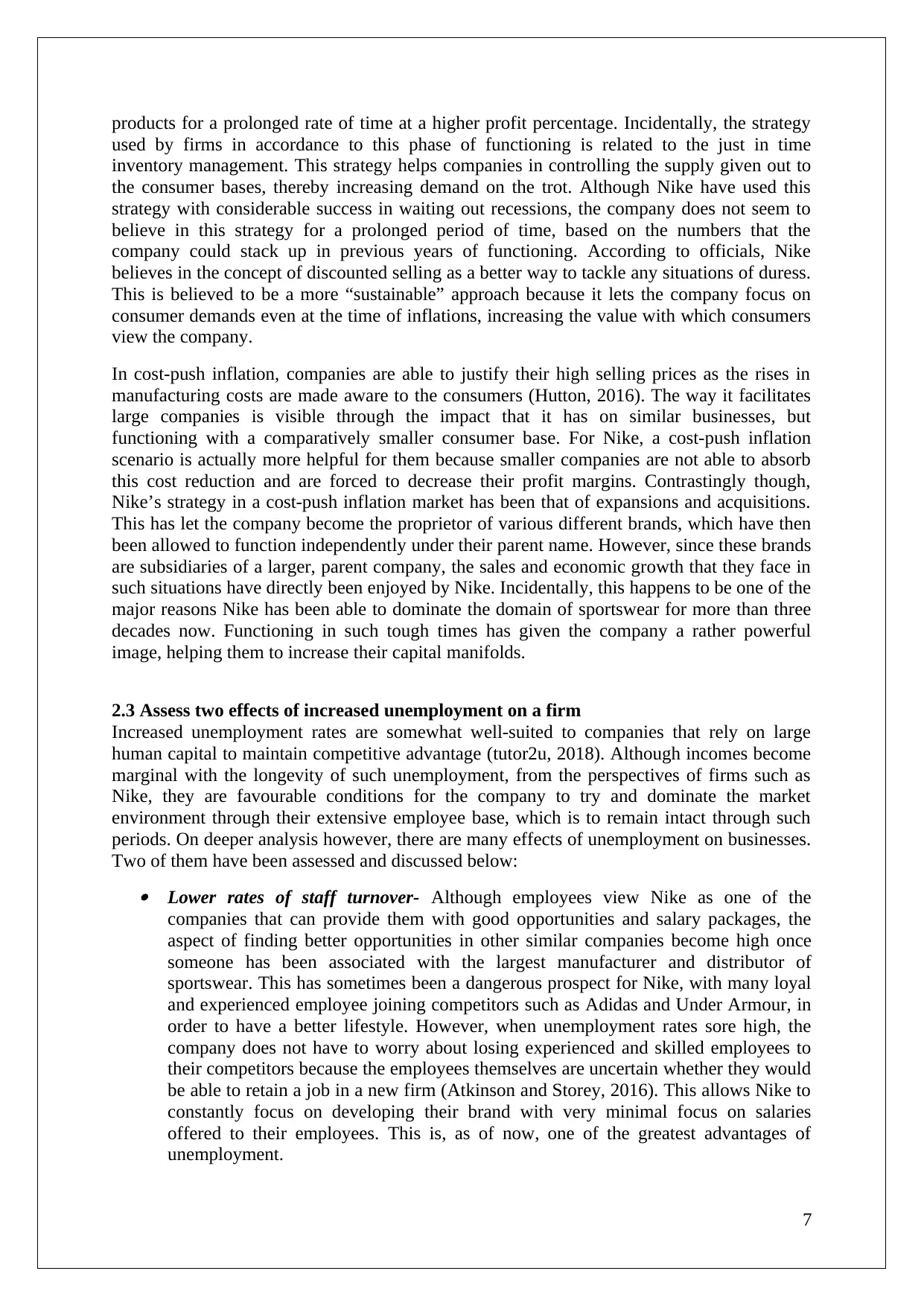
products for a prolonged rate of time at a higher profit percentage. Incidentally, the strategy
used by firms in accordance to this phase of functioning is related to the just in time
inventory management. This strategy helps companies in controlling the supply given out to
the consumer bases, thereby increasing demand on the trot. Although Nike have used this
strategy with considerable success in waiting out recessions, the company does not seem to
believe in this strategy for a prolonged period of time, based on the numbers that the
company could stack up in previous years of functioning. According to officials, Nike
believes in the concept of discounted selling as a better way to tackle any situations of duress.
This is believed to be a more “sustainable” approach because it lets the company focus on
consumer demands even at the time of inflations, increasing the value with which consumers
view the company.
In cost-push inflation, companies are able to justify their high selling prices as the rises in
manufacturing costs are made aware to the consumers (Hutton, 2016). The way it facilitates
large companies is visible through the impact that it has on similar businesses, but
functioning with a comparatively smaller consumer base. For Nike, a cost-push inflation
scenario is actually more helpful for them because smaller companies are not able to absorb
this cost reduction and are forced to decrease their profit margins. Contrastingly though,
Nike’s strategy in a cost-push inflation market has been that of expansions and acquisitions.
This has let the company become the proprietor of various different brands, which have then
been allowed to function independently under their parent name. However, since these brands
are subsidiaries of a larger, parent company, the sales and economic growth that they face in
such situations have directly been enjoyed by Nike. Incidentally, this happens to be one of the
major reasons Nike has been able to dominate the domain of sportswear for more than three
decades now. Functioning in such tough times has given the company a rather powerful
image, helping them to increase their capital manifolds.
2.3 Assess two effects of increased unemployment on a firm
Increased unemployment rates are somewhat well-suited to companies that rely on large
human capital to maintain competitive advantage (tutor2u, 2018). Although incomes become
marginal with the longevity of such unemployment, from the perspectives of firms such as
Nike, they are favourable conditions for the company to try and dominate the market
environment through their extensive employee base, which is to remain intact through such
periods. On deeper analysis however, there are many effects of unemployment on businesses.
Two of them have been assessed and discussed below: Lower rates of staff turnover- Although employees view Nike as one of the
companies that can provide them with good opportunities and salary packages, the
aspect of finding better opportunities in other similar companies become high once
someone has been associated with the largest manufacturer and distributor of
sportswear. This has sometimes been a dangerous prospect for Nike, with many loyal
and experienced employee joining competitors such as Adidas and Under Armour, in
order to have a better lifestyle. However, when unemployment rates sore high, the
company does not have to worry about losing experienced and skilled employees to
their competitors because the employees themselves are uncertain whether they would
be able to retain a job in a new firm (Atkinson and Storey, 2016). This allows Nike to
constantly focus on developing their brand with very minimal focus on salaries
offered to their employees. This is, as of now, one of the greatest advantages of
unemployment.
7
used by firms in accordance to this phase of functioning is related to the just in time
inventory management. This strategy helps companies in controlling the supply given out to
the consumer bases, thereby increasing demand on the trot. Although Nike have used this
strategy with considerable success in waiting out recessions, the company does not seem to
believe in this strategy for a prolonged period of time, based on the numbers that the
company could stack up in previous years of functioning. According to officials, Nike
believes in the concept of discounted selling as a better way to tackle any situations of duress.
This is believed to be a more “sustainable” approach because it lets the company focus on
consumer demands even at the time of inflations, increasing the value with which consumers
view the company.
In cost-push inflation, companies are able to justify their high selling prices as the rises in
manufacturing costs are made aware to the consumers (Hutton, 2016). The way it facilitates
large companies is visible through the impact that it has on similar businesses, but
functioning with a comparatively smaller consumer base. For Nike, a cost-push inflation
scenario is actually more helpful for them because smaller companies are not able to absorb
this cost reduction and are forced to decrease their profit margins. Contrastingly though,
Nike’s strategy in a cost-push inflation market has been that of expansions and acquisitions.
This has let the company become the proprietor of various different brands, which have then
been allowed to function independently under their parent name. However, since these brands
are subsidiaries of a larger, parent company, the sales and economic growth that they face in
such situations have directly been enjoyed by Nike. Incidentally, this happens to be one of the
major reasons Nike has been able to dominate the domain of sportswear for more than three
decades now. Functioning in such tough times has given the company a rather powerful
image, helping them to increase their capital manifolds.
2.3 Assess two effects of increased unemployment on a firm
Increased unemployment rates are somewhat well-suited to companies that rely on large
human capital to maintain competitive advantage (tutor2u, 2018). Although incomes become
marginal with the longevity of such unemployment, from the perspectives of firms such as
Nike, they are favourable conditions for the company to try and dominate the market
environment through their extensive employee base, which is to remain intact through such
periods. On deeper analysis however, there are many effects of unemployment on businesses.
Two of them have been assessed and discussed below: Lower rates of staff turnover- Although employees view Nike as one of the
companies that can provide them with good opportunities and salary packages, the
aspect of finding better opportunities in other similar companies become high once
someone has been associated with the largest manufacturer and distributor of
sportswear. This has sometimes been a dangerous prospect for Nike, with many loyal
and experienced employee joining competitors such as Adidas and Under Armour, in
order to have a better lifestyle. However, when unemployment rates sore high, the
company does not have to worry about losing experienced and skilled employees to
their competitors because the employees themselves are uncertain whether they would
be able to retain a job in a new firm (Atkinson and Storey, 2016). This allows Nike to
constantly focus on developing their brand with very minimal focus on salaries
offered to their employees. This is, as of now, one of the greatest advantages of
unemployment.
7
Paraphrase This Document
Need a fresh take? Get an instant paraphrase of this document with our AI Paraphraser
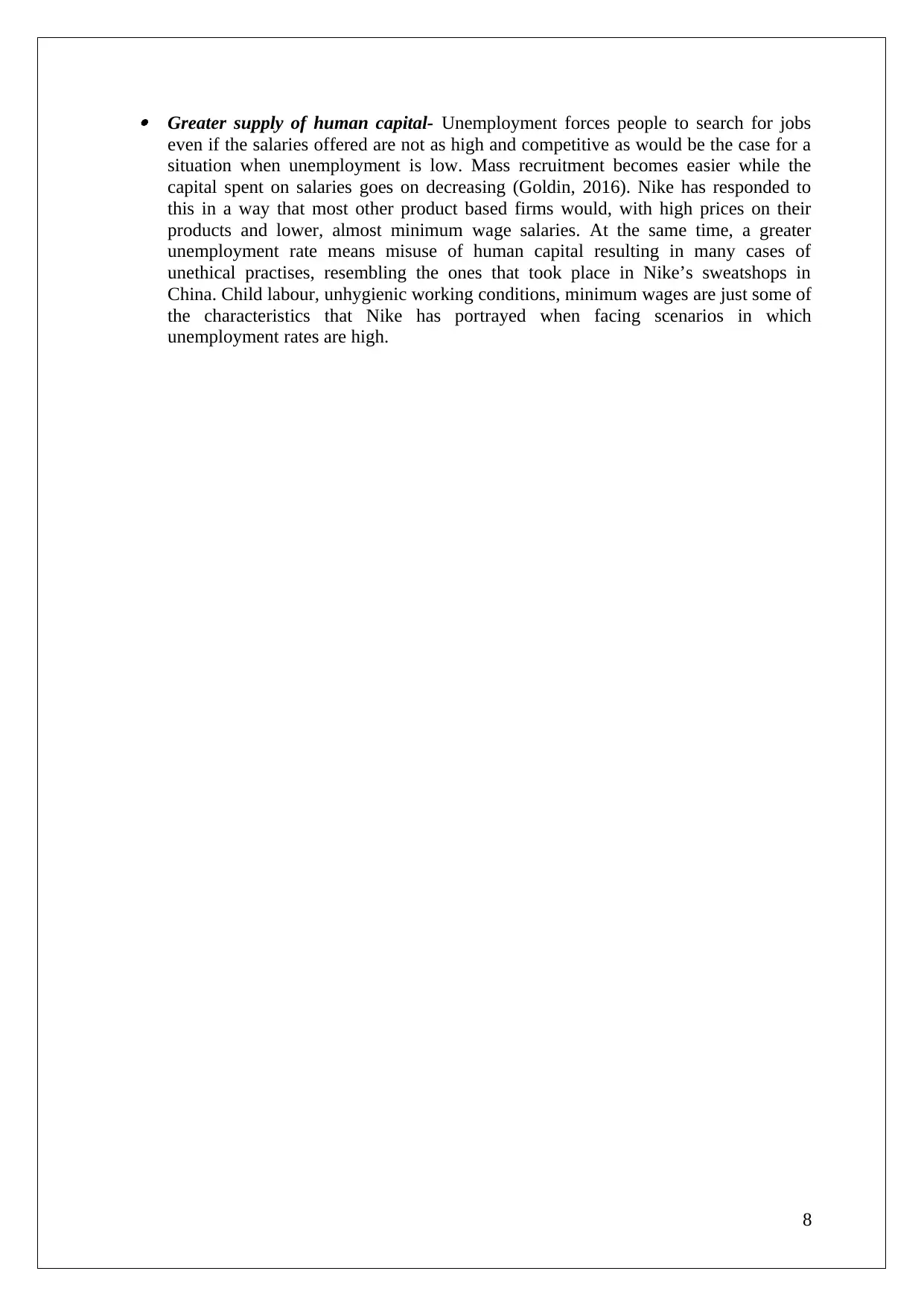
Greater supply of human capital- Unemployment forces people to search for jobs
even if the salaries offered are not as high and competitive as would be the case for a
situation when unemployment is low. Mass recruitment becomes easier while the
capital spent on salaries goes on decreasing (Goldin, 2016). Nike has responded to
this in a way that most other product based firms would, with high prices on their
products and lower, almost minimum wage salaries. At the same time, a greater
unemployment rate means misuse of human capital resulting in many cases of
unethical practises, resembling the ones that took place in Nike’s sweatshops in
China. Child labour, unhygienic working conditions, minimum wages are just some of
the characteristics that Nike has portrayed when facing scenarios in which
unemployment rates are high.
8
even if the salaries offered are not as high and competitive as would be the case for a
situation when unemployment is low. Mass recruitment becomes easier while the
capital spent on salaries goes on decreasing (Goldin, 2016). Nike has responded to
this in a way that most other product based firms would, with high prices on their
products and lower, almost minimum wage salaries. At the same time, a greater
unemployment rate means misuse of human capital resulting in many cases of
unethical practises, resembling the ones that took place in Nike’s sweatshops in
China. Child labour, unhygienic working conditions, minimum wages are just some of
the characteristics that Nike has portrayed when facing scenarios in which
unemployment rates are high.
8
Conclusion
The report has shed light on various aspects of the economy whilst maintaining a high
resemblance to real life scenarios and real world companies, the core reference being Nike.
Through this report it has become evident that although inflation, recession and
unemployment are considered negative factors, through correct implementation of strategies
and tactics, companies can turn it around, enabling businesses to function with even greater
sustainability. All data provided in the report are 100% authentic and has been taken from
very credible sources. However, any suggestions aimed at increasing its reliability and
authenticity are highly appreciated and welcome.
9
The report has shed light on various aspects of the economy whilst maintaining a high
resemblance to real life scenarios and real world companies, the core reference being Nike.
Through this report it has become evident that although inflation, recession and
unemployment are considered negative factors, through correct implementation of strategies
and tactics, companies can turn it around, enabling businesses to function with even greater
sustainability. All data provided in the report are 100% authentic and has been taken from
very credible sources. However, any suggestions aimed at increasing its reliability and
authenticity are highly appreciated and welcome.
9
⊘ This is a preview!⊘
Do you want full access?
Subscribe today to unlock all pages.
Trusted by 1+ million students worldwide
Reference List
Atkinson, J. and Storey, D.J. eds., 2016. Employment, the small firm and the labour market.
Routledge.
Avittathur, B. and Biswas, I., 2017. A note on limited clearance sale inventory
model. International Journal of Production Economics, 193, pp.647-653.
Childs, M. and Jin, B., 2018. Nike: An Innovation Journey. In Product Innovation in the
Global Fashion Industry (pp. 79-111). Palgrave Pivot, New York.
Economicshelp.org. (2018). [online] Available at:
https://www.economicshelp.org/macroeconomics/economic-growth/causes-economic-
growth/ [Accessed 20 Mar. 2018].
Economicshelp.org. (2018). [online] Available at:
https://www.economicshelp.org/blog/1017/inflation/how-does-inflation-affect-firms/
[Accessed 20 Mar. 2018].
Frbsf.org. (2018). Education | What are business cycles and how do they affect the economy?.
[online] Available at: https://www.frbsf.org/education/publications/doctor-econ/2002/may/
business-cycles-economy/ [Accessed 20 Mar. 2018].
Goldin, C., 2016. Human capital. Handbook of cliometrics, pp.55-86.
Harrison, A.J., 2017. Economics and land use planning. Routledge.
Hutton, G., 2016. Inflation and society (Vol. 7). Routledge.
Opentextbc.ca. (2018). 32.3 Causes of Unemployment around the World – Principles of
Economics. [online] Available at: https://opentextbc.ca/principlesofeconomics/chapter/32-3-
causes-of-unemployment-around-the-world/ [Accessed 20 Mar. 2018].
Sec.gov. (2018). SUBSIDIARIES OF THE REGISTRANT. [online] Available at:
https://www.sec.gov/Archives/edgar/data/320187/000119312510161874/dex21.htm
[Accessed 20 Mar. 2018].
The Balance. (2018). 2 Real Reasons for Inflation. [online] Available at:
https://www.thebalance.com/causes-of-inflation-3-real-reasons-for-rising-prices-3306094
[Accessed 20 Mar. 2018].
tutor2u. (2018). Q&A - How are businesses affected by unemployment? | tutor2u Business.
[online] Available at: https://www.tutor2u.net/business/blog/qa-how-are-businesses-affected-
by-unemployment [Accessed 20 Mar. 2018].
10
Atkinson, J. and Storey, D.J. eds., 2016. Employment, the small firm and the labour market.
Routledge.
Avittathur, B. and Biswas, I., 2017. A note on limited clearance sale inventory
model. International Journal of Production Economics, 193, pp.647-653.
Childs, M. and Jin, B., 2018. Nike: An Innovation Journey. In Product Innovation in the
Global Fashion Industry (pp. 79-111). Palgrave Pivot, New York.
Economicshelp.org. (2018). [online] Available at:
https://www.economicshelp.org/macroeconomics/economic-growth/causes-economic-
growth/ [Accessed 20 Mar. 2018].
Economicshelp.org. (2018). [online] Available at:
https://www.economicshelp.org/blog/1017/inflation/how-does-inflation-affect-firms/
[Accessed 20 Mar. 2018].
Frbsf.org. (2018). Education | What are business cycles and how do they affect the economy?.
[online] Available at: https://www.frbsf.org/education/publications/doctor-econ/2002/may/
business-cycles-economy/ [Accessed 20 Mar. 2018].
Goldin, C., 2016. Human capital. Handbook of cliometrics, pp.55-86.
Harrison, A.J., 2017. Economics and land use planning. Routledge.
Hutton, G., 2016. Inflation and society (Vol. 7). Routledge.
Opentextbc.ca. (2018). 32.3 Causes of Unemployment around the World – Principles of
Economics. [online] Available at: https://opentextbc.ca/principlesofeconomics/chapter/32-3-
causes-of-unemployment-around-the-world/ [Accessed 20 Mar. 2018].
Sec.gov. (2018). SUBSIDIARIES OF THE REGISTRANT. [online] Available at:
https://www.sec.gov/Archives/edgar/data/320187/000119312510161874/dex21.htm
[Accessed 20 Mar. 2018].
The Balance. (2018). 2 Real Reasons for Inflation. [online] Available at:
https://www.thebalance.com/causes-of-inflation-3-real-reasons-for-rising-prices-3306094
[Accessed 20 Mar. 2018].
tutor2u. (2018). Q&A - How are businesses affected by unemployment? | tutor2u Business.
[online] Available at: https://www.tutor2u.net/business/blog/qa-how-are-businesses-affected-
by-unemployment [Accessed 20 Mar. 2018].
10

1 out of 10


Related Documents


Your All-in-One AI-Powered Toolkit for Academic Success.
+13062052269
info@desklib.com
Available 24*7 on WhatsApp / Email
![[object Object]](/_next/static/media/star-bottom.7253800d.svg)
Unlock your academic potential
Copyright © 2020–2025 A2Z Services. All Rights Reserved. Developed and managed by ZUCOL.