Organizational Behavior and Leadership: Issues in Workplace
VerifiedAdded on 2023/06/11
|13
|3274
|153
Report
AI Summary
This report delves into the intricate relationship between organizational behavior and leadership, examining key elements such as work teams, communication, organizational culture and structure, and individual motivation and job satisfaction. It emphasizes the importance of effective leadership characteristics, drawing from both Christian principles and established theories like behavioral, trait, and power influence theories. The analysis highlights how leadership styles impact organizational success, emphasizing the need for strong, ethical, and communicative leaders. The report also explores various elements of organizational behavior, including structure, technology, environment, and people, within the context of different organizational behavior models like autocratic, supportive, custodial, and collegial frameworks, ultimately aiming to provide insights into fostering a positive and productive organizational environment. Desklib provides access to this and many other solved assignments.
Running head: ORGANIZATIONAL BEHAVIOUR 1
Issues on Organizational Behavior and Leadership.
Name.
Institutional Affiliation.
Issues on Organizational Behavior and Leadership.
Name.
Institutional Affiliation.

Paraphrase This Document
Need a fresh take? Get an instant paraphrase of this document with our AI Paraphraser
ORGANIZATIONAL BEHAVIOUR 2
Abstract.
Organizational behavior is a study case of the application of people, groups,
organizations and a private individual and how they are relation and how are their
actions. It is accomplished by looking at specific approaches which interprets every
aspect or issue pertaining the organizations and their relationships in terms of a whole
organizational, a whole group, a whole social system and more so the whole person and
its behaviour.The report tries to explain the work teams, communication, leadership and
power. Also the organizational culture and structure is viewed at large. Motivation,
personality and job satisfaction of an individual includes the topic of discussion in
relation to the organizational behaviors issues and leadership traits.
Abstract.
Organizational behavior is a study case of the application of people, groups,
organizations and a private individual and how they are relation and how are their
actions. It is accomplished by looking at specific approaches which interprets every
aspect or issue pertaining the organizations and their relationships in terms of a whole
organizational, a whole group, a whole social system and more so the whole person and
its behaviour.The report tries to explain the work teams, communication, leadership and
power. Also the organizational culture and structure is viewed at large. Motivation,
personality and job satisfaction of an individual includes the topic of discussion in
relation to the organizational behaviors issues and leadership traits.
ORGANIZATIONAL BEHAVIOUR 3
Issues on Organizational Behavior and Leadership
Introduction
There are several organizational behavior issues in relation to employment and
work place that compels tis study and complicates the area of study .This relates to the
relationship of the employees, the employer, a common work group or an organizations
and an individual relationship. However it is based majorly on leadership and behavior of
the personnel which it influences the people and group relationship at large. This is by
looking at a working place under the influence of different characters of beings working
under the same roof in an organizational setting. Mostly to analyses the situations in a
specific organization and what elements are considered to affect an organizational culture
in every structure of a group(Liu, Friedman & Hong, 2012). For the case of this report the
workplace of an employment field is put to relate with organizational behavior and how
the top leadership conducts themselves to ensure uniformity and progressive coexistence
among employers and the employees. On the same hand, leadership is from God. It is an
act of delivering service to people under the interests of Christ in their lives so that they
are able to accomplish the will of God through them.(Wagner & Hollenbeck, 2010).
These factors come in handy to ensure the correct organizational behaviors and
leadership skills as well. This report will analyze the appropriate perspectives and
principles for the relations, the structure and behavior within an organization such as in a
business situation.
Leadership.
Issues on Organizational Behavior and Leadership
Introduction
There are several organizational behavior issues in relation to employment and
work place that compels tis study and complicates the area of study .This relates to the
relationship of the employees, the employer, a common work group or an organizations
and an individual relationship. However it is based majorly on leadership and behavior of
the personnel which it influences the people and group relationship at large. This is by
looking at a working place under the influence of different characters of beings working
under the same roof in an organizational setting. Mostly to analyses the situations in a
specific organization and what elements are considered to affect an organizational culture
in every structure of a group(Liu, Friedman & Hong, 2012). For the case of this report the
workplace of an employment field is put to relate with organizational behavior and how
the top leadership conducts themselves to ensure uniformity and progressive coexistence
among employers and the employees. On the same hand, leadership is from God. It is an
act of delivering service to people under the interests of Christ in their lives so that they
are able to accomplish the will of God through them.(Wagner & Hollenbeck, 2010).
These factors come in handy to ensure the correct organizational behaviors and
leadership skills as well. This report will analyze the appropriate perspectives and
principles for the relations, the structure and behavior within an organization such as in a
business situation.
Leadership.
⊘ This is a preview!⊘
Do you want full access?
Subscribe today to unlock all pages.

Trusted by 1+ million students worldwide
ORGANIZATIONAL BEHAVIOUR 4
The behavior of the workers and the individual group organizations has a big
impact to the success and the process of achieving the goals set in a business. It is thus
necessary to establish leadership characteristics effectively to achieve the goals of the
organization through checking and observing the leadership of the organization and the
behavior in the same situation. A leader according to the Christian knowledge is a person
empowered by God through the holy spirit to direct the whole group of people and so the
leadership leads the group or an organization to a common goal and aim. For that matter,
leadership skills and principles are vital. For instance the bible values so much the
qualities of a leader whom is bestowed leadership role. Biblical principles expound the
qualities of a strong leader, such as being faithful and passionate to the role one has been
given and that is of leadership in a particular organization. Leaders should show their
ultimate skills of leading fully through showing directions and providing way forward in
a professional manner(Zhang & Chen, 2013). Also by exercising power in their capacity
through showing their capability to the rest of the individuals, organizations and
businesses. Jesus Christ exercised power and control in his leadership. It gave him a
sense of leadership and the ability to lead a multitude of men who trusted in the
leadership he delivered to the followers. This was a principle of service in leadership.
Formal and informal leadership are the main aspects of leadership. Informal leadership is
usually common among friends whereas formal leadership is best applicable to many
businesses and political organizations. In organization management, adequate leadership
skills of every individual are key in giving performance and the courage to take a stand is
effective in leadership which is fundamental in any particular organization.
Healthy Organizational Leadership.
The behavior of the workers and the individual group organizations has a big
impact to the success and the process of achieving the goals set in a business. It is thus
necessary to establish leadership characteristics effectively to achieve the goals of the
organization through checking and observing the leadership of the organization and the
behavior in the same situation. A leader according to the Christian knowledge is a person
empowered by God through the holy spirit to direct the whole group of people and so the
leadership leads the group or an organization to a common goal and aim. For that matter,
leadership skills and principles are vital. For instance the bible values so much the
qualities of a leader whom is bestowed leadership role. Biblical principles expound the
qualities of a strong leader, such as being faithful and passionate to the role one has been
given and that is of leadership in a particular organization. Leaders should show their
ultimate skills of leading fully through showing directions and providing way forward in
a professional manner(Zhang & Chen, 2013). Also by exercising power in their capacity
through showing their capability to the rest of the individuals, organizations and
businesses. Jesus Christ exercised power and control in his leadership. It gave him a
sense of leadership and the ability to lead a multitude of men who trusted in the
leadership he delivered to the followers. This was a principle of service in leadership.
Formal and informal leadership are the main aspects of leadership. Informal leadership is
usually common among friends whereas formal leadership is best applicable to many
businesses and political organizations. In organization management, adequate leadership
skills of every individual are key in giving performance and the courage to take a stand is
effective in leadership which is fundamental in any particular organization.
Healthy Organizational Leadership.
Paraphrase This Document
Need a fresh take? Get an instant paraphrase of this document with our AI Paraphraser
ORGANIZATIONAL BEHAVIOUR 5
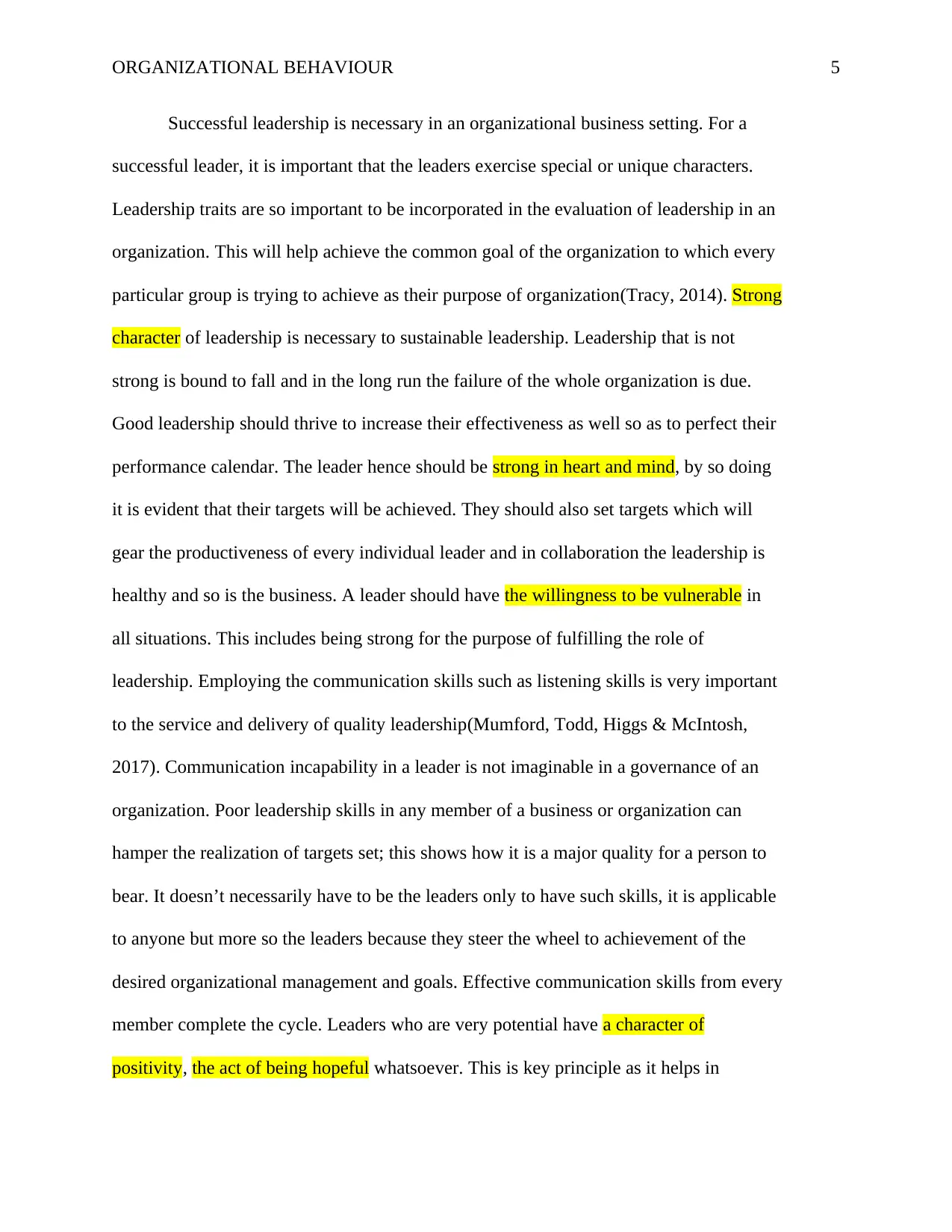
Successful leadership is necessary in an organizational business setting. For a
successful leader, it is important that the leaders exercise special or unique characters.
Leadership traits are so important to be incorporated in the evaluation of leadership in an
organization. This will help achieve the common goal of the organization to which every
particular group is trying to achieve as their purpose of organization(Tracy, 2014). Strong
character of leadership is necessary to sustainable leadership. Leadership that is not
strong is bound to fall and in the long run the failure of the whole organization is due.
Good leadership should thrive to increase their effectiveness as well so as to perfect their
performance calendar. The leader hence should be strong in heart and mind, by so doing
it is evident that their targets will be achieved. They should also set targets which will
gear the productiveness of every individual leader and in collaboration the leadership is
healthy and so is the business. A leader should have the willingness to be vulnerable in
all situations. This includes being strong for the purpose of fulfilling the role of
leadership. Employing the communication skills such as listening skills is very important
to the service and delivery of quality leadership(Mumford, Todd, Higgs & McIntosh,
2017). Communication incapability in a leader is not imaginable in a governance of an
organization. Poor leadership skills in any member of a business or organization can
hamper the realization of targets set; this shows how it is a major quality for a person to
bear. It doesn’t necessarily have to be the leaders only to have such skills, it is applicable
to anyone but more so the leaders because they steer the wheel to achievement of the
desired organizational management and goals. Effective communication skills from every
member complete the cycle. Leaders who are very potential have a character of
positivity, the act of being hopeful whatsoever. This is key principle as it helps in
Successful leadership is necessary in an organizational business setting. For a
successful leader, it is important that the leaders exercise special or unique characters.
Leadership traits are so important to be incorporated in the evaluation of leadership in an
organization. This will help achieve the common goal of the organization to which every
particular group is trying to achieve as their purpose of organization(Tracy, 2014). Strong
character of leadership is necessary to sustainable leadership. Leadership that is not
strong is bound to fall and in the long run the failure of the whole organization is due.
Good leadership should thrive to increase their effectiveness as well so as to perfect their
performance calendar. The leader hence should be strong in heart and mind, by so doing
it is evident that their targets will be achieved. They should also set targets which will
gear the productiveness of every individual leader and in collaboration the leadership is
healthy and so is the business. A leader should have the willingness to be vulnerable in
all situations. This includes being strong for the purpose of fulfilling the role of
leadership. Employing the communication skills such as listening skills is very important
to the service and delivery of quality leadership(Mumford, Todd, Higgs & McIntosh,
2017). Communication incapability in a leader is not imaginable in a governance of an
organization. Poor leadership skills in any member of a business or organization can
hamper the realization of targets set; this shows how it is a major quality for a person to
bear. It doesn’t necessarily have to be the leaders only to have such skills, it is applicable
to anyone but more so the leaders because they steer the wheel to achievement of the
desired organizational management and goals. Effective communication skills from every
member complete the cycle. Leaders who are very potential have a character of
positivity, the act of being hopeful whatsoever. This is key principle as it helps in
ORGANIZATIONAL BEHAVIOUR 6
motivation of the working group that the leader is leading. However it is not only for
leaders to be positive but every other individual as an organizational behavior, only that
the leader always have a bigger impact on management of the organization or the
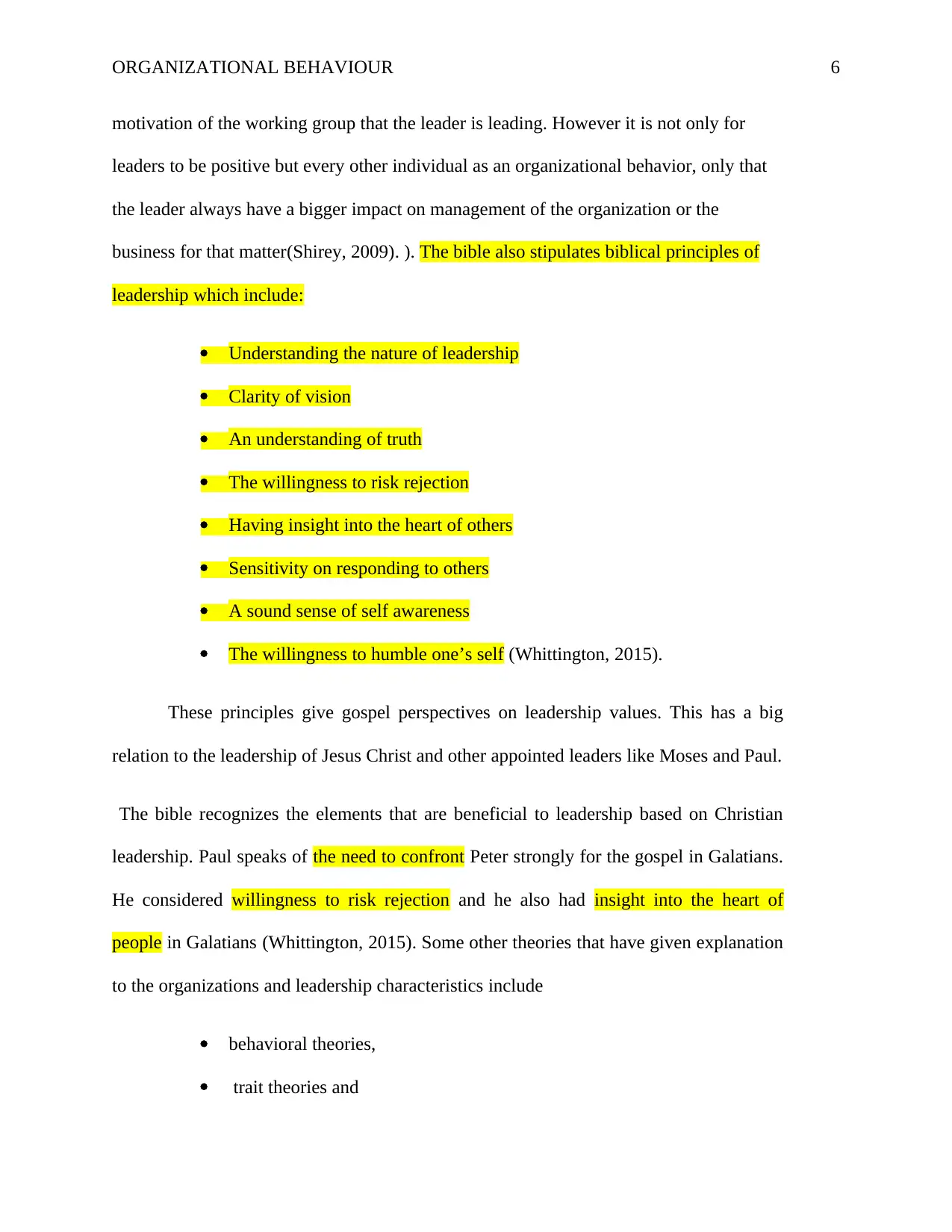
business for that matter(Shirey, 2009). ). The bible also stipulates biblical principles of
leadership which include:
Understanding the nature of leadership
Clarity of vision
An understanding of truth
The willingness to risk rejection
Having insight into the heart of others
Sensitivity on responding to others
A sound sense of self awareness
The willingness to humble one’s self (Whittington, 2015).
These principles give gospel perspectives on leadership values. This has a big
relation to the leadership of Jesus Christ and other appointed leaders like Moses and Paul.
The bible recognizes the elements that are beneficial to leadership based on Christian
leadership. Paul speaks of the need to confront Peter strongly for the gospel in Galatians.
He considered willingness to risk rejection and he also had insight into the heart of
people in Galatians (Whittington, 2015). Some other theories that have given explanation
to the organizations and leadership characteristics include
behavioral theories,
trait theories and
motivation of the working group that the leader is leading. However it is not only for
leaders to be positive but every other individual as an organizational behavior, only that
the leader always have a bigger impact on management of the organization or the
business for that matter(Shirey, 2009). ). The bible also stipulates biblical principles of
leadership which include:
Understanding the nature of leadership
Clarity of vision
An understanding of truth
The willingness to risk rejection
Having insight into the heart of others
Sensitivity on responding to others
A sound sense of self awareness
The willingness to humble one’s self (Whittington, 2015).
These principles give gospel perspectives on leadership values. This has a big
relation to the leadership of Jesus Christ and other appointed leaders like Moses and Paul.
The bible recognizes the elements that are beneficial to leadership based on Christian
leadership. Paul speaks of the need to confront Peter strongly for the gospel in Galatians.
He considered willingness to risk rejection and he also had insight into the heart of
people in Galatians (Whittington, 2015). Some other theories that have given explanation
to the organizations and leadership characteristics include
behavioral theories,
trait theories and
⊘ This is a preview!⊘
Do you want full access?
Subscribe today to unlock all pages.
Trusted by 1+ million students worldwide
ORGANIZATIONAL BEHAVIOUR 7
power and influence theories(Mroz, Yoerger & Allen, 2018).
These theories majorly focus on the character of an individual. Leaders have a common
characteristic personal, exceptional and capable to be leaders with many other skillful
traits which helped them become exemplary and in a position to lead a group of people in
an organization. As it were among Christians, there were people in the bible who were
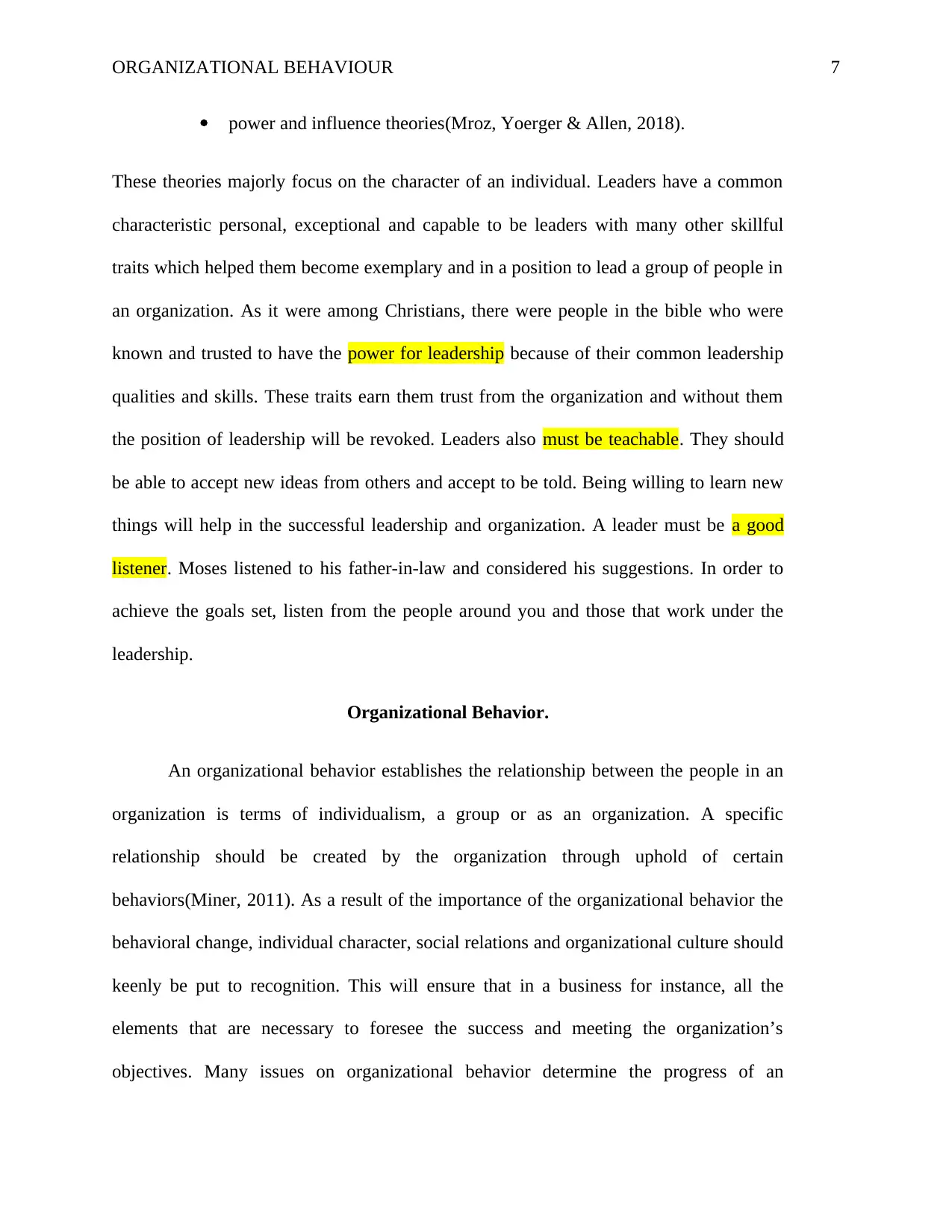
known and trusted to have the power for leadership because of their common leadership
qualities and skills. These traits earn them trust from the organization and without them
the position of leadership will be revoked. Leaders also must be teachable. They should
be able to accept new ideas from others and accept to be told. Being willing to learn new
things will help in the successful leadership and organization. A leader must be a good
listener. Moses listened to his father-in-law and considered his suggestions. In order to
achieve the goals set, listen from the people around you and those that work under the
leadership.
Organizational Behavior.
An organizational behavior establishes the relationship between the people in an
organization is terms of individualism, a group or as an organization. A specific
relationship should be created by the organization through uphold of certain
behaviors(Miner, 2011). As a result of the importance of the organizational behavior the
behavioral change, individual character, social relations and organizational culture should
keenly be put to recognition. This will ensure that in a business for instance, all the
elements that are necessary to foresee the success and meeting the organization’s
objectives. Many issues on organizational behavior determine the progress of an
power and influence theories(Mroz, Yoerger & Allen, 2018).
These theories majorly focus on the character of an individual. Leaders have a common
characteristic personal, exceptional and capable to be leaders with many other skillful
traits which helped them become exemplary and in a position to lead a group of people in
an organization. As it were among Christians, there were people in the bible who were
known and trusted to have the power for leadership because of their common leadership
qualities and skills. These traits earn them trust from the organization and without them
the position of leadership will be revoked. Leaders also must be teachable. They should
be able to accept new ideas from others and accept to be told. Being willing to learn new
things will help in the successful leadership and organization. A leader must be a good
listener. Moses listened to his father-in-law and considered his suggestions. In order to
achieve the goals set, listen from the people around you and those that work under the
leadership.
Organizational Behavior.
An organizational behavior establishes the relationship between the people in an
organization is terms of individualism, a group or as an organization. A specific
relationship should be created by the organization through uphold of certain
behaviors(Miner, 2011). As a result of the importance of the organizational behavior the
behavioral change, individual character, social relations and organizational culture should
keenly be put to recognition. This will ensure that in a business for instance, all the
elements that are necessary to foresee the success and meeting the organization’s
objectives. Many issues on organizational behavior determine the progress of an
Paraphrase This Document
Need a fresh take? Get an instant paraphrase of this document with our AI Paraphraser
ORGANIZATIONAL BEHAVIOUR 8
organization. As most of them are negative to the view of the cultural organization, they
will hinder the overall performance of the particular organization. On the other hand
when there is positive issue and elements in the organizational behavior then it greatly
influences the organization in a greater way until success is achieved. Organizational
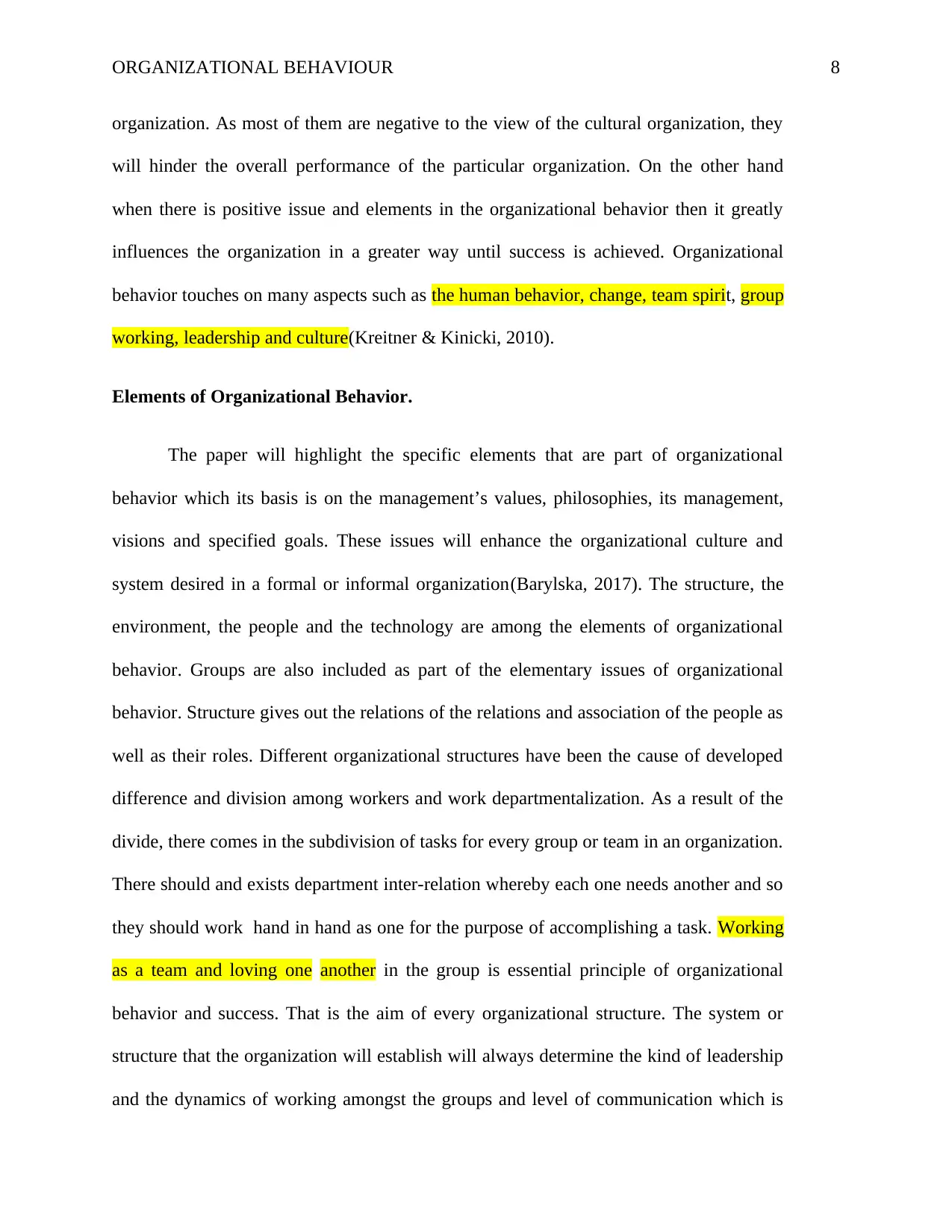
behavior touches on many aspects such as the human behavior, change, team spirit, group
working, leadership and culture(Kreitner & Kinicki, 2010).
Elements of Organizational Behavior.
The paper will highlight the specific elements that are part of organizational
behavior which its basis is on the management’s values, philosophies, its management,
visions and specified goals. These issues will enhance the organizational culture and
system desired in a formal or informal organization(Barylska, 2017). The structure, the
environment, the people and the technology are among the elements of organizational
behavior. Groups are also included as part of the elementary issues of organizational
behavior. Structure gives out the relations of the relations and association of the people as
well as their roles. Different organizational structures have been the cause of developed
difference and division among workers and work departmentalization. As a result of the
divide, there comes in the subdivision of tasks for every group or team in an organization.
There should and exists department inter-relation whereby each one needs another and so
they should work hand in hand as one for the purpose of accomplishing a task. Working
as a team and loving one another in the group is essential principle of organizational
behavior and success. That is the aim of every organizational structure. The system or
structure that the organization will establish will always determine the kind of leadership
and the dynamics of working amongst the groups and level of communication which is
organization. As most of them are negative to the view of the cultural organization, they
will hinder the overall performance of the particular organization. On the other hand
when there is positive issue and elements in the organizational behavior then it greatly
influences the organization in a greater way until success is achieved. Organizational
behavior touches on many aspects such as the human behavior, change, team spirit, group
working, leadership and culture(Kreitner & Kinicki, 2010).
Elements of Organizational Behavior.
The paper will highlight the specific elements that are part of organizational
behavior which its basis is on the management’s values, philosophies, its management,
visions and specified goals. These issues will enhance the organizational culture and
system desired in a formal or informal organization(Barylska, 2017). The structure, the
environment, the people and the technology are among the elements of organizational
behavior. Groups are also included as part of the elementary issues of organizational
behavior. Structure gives out the relations of the relations and association of the people as
well as their roles. Different organizational structures have been the cause of developed
difference and division among workers and work departmentalization. As a result of the
divide, there comes in the subdivision of tasks for every group or team in an organization.
There should and exists department inter-relation whereby each one needs another and so
they should work hand in hand as one for the purpose of accomplishing a task. Working
as a team and loving one another in the group is essential principle of organizational
behavior and success. That is the aim of every organizational structure. The system or
structure that the organization will establish will always determine the kind of leadership
and the dynamics of working amongst the groups and level of communication which is
ORGANIZATIONAL BEHAVIOUR 9
important to define in an organizational structure. This is the quality of work life every
worker perceives and it brings on motivation and hard work as it is encouraged in the
bible, and to the organization it is a benefit. Technology on the other hand becomes a
revolutionary to the production in a business setting for instance. Every organization has
adopted technology as a value as it will provide to the organization many goods and
services which influences the progress of the organization positively. Environment as one
of the elements of organizational behavior can be put in two ways, external and internal
environment (Robertson & Carleton, 2017). The internal environment includes all the
controllable issues that the organization can handle such as supplies. External
environment can be referred to as what the business cannot be able to manage and control
such as other organizations.
Models of organizational behavior.
Organizational behavior has its basis upon four frameworks .This models of
organizational behavior are autocratic, supportive, custodial and collegial.
Autocratic.
Is model of organizational behavior which is inclined to managerial authority. The
workers are relying to the Boss. The workers usually depend entirely on their leaders and
the leadership mainly for subsistence and for their job satisfaction and contentment. This
model is given a specific identification of low wages to people being led by a boss
because they are not much recognized by the bosses. This model proves the reason to low
or no performance at all. Their performance is usually minimal as they are only subjected
important to define in an organizational structure. This is the quality of work life every
worker perceives and it brings on motivation and hard work as it is encouraged in the
bible, and to the organization it is a benefit. Technology on the other hand becomes a
revolutionary to the production in a business setting for instance. Every organization has
adopted technology as a value as it will provide to the organization many goods and
services which influences the progress of the organization positively. Environment as one
of the elements of organizational behavior can be put in two ways, external and internal
environment (Robertson & Carleton, 2017). The internal environment includes all the
controllable issues that the organization can handle such as supplies. External
environment can be referred to as what the business cannot be able to manage and control
such as other organizations.
Models of organizational behavior.
Organizational behavior has its basis upon four frameworks .This models of
organizational behavior are autocratic, supportive, custodial and collegial.
Autocratic.
Is model of organizational behavior which is inclined to managerial authority. The
workers are relying to the Boss. The workers usually depend entirely on their leaders and
the leadership mainly for subsistence and for their job satisfaction and contentment. This
model is given a specific identification of low wages to people being led by a boss
because they are not much recognized by the bosses. This model proves the reason to low
or no performance at all. Their performance is usually minimal as they are only subjected
⊘ This is a preview!⊘
Do you want full access?
Subscribe today to unlock all pages.
Trusted by 1+ million students worldwide
ORGANIZATIONAL BEHAVIOUR 10
to discipline and their dependence to the boss(Luan & Reb, 2017).It is therefore exciting
if the boss becomes compassionate and responsible enough.
Supportive.
Focuses on the kind of leadership and in respect to managing orientation , support
of the workmates in every situation. This model focuses on giving orientation to
employees to performance, motivation and participation. As result the status and the
recognition of the employee is respected. The management ensures a proper and
conducive environment for the employees to work under. The workers in this model of
behavior will feel included in the organizational matters and this will motivate them to
work more efficiently(Fiss, Cambré & Marx, 2013) .
Custodial.
Custodial model refers to economic resources and is majorly money oriented
model. The workers are oriented however on the benefits, security advantages they
receive and they rely on the organization. As such, the performance is usually passive
cooperation(Birnbaum & LaCroix, 2008).
Collegial
Collegial model is a model that is specific to the relationship of the employees
and the management(Sun & Wen Pan, 2009). This is mostly created by the management
of the organization. It makes the employees feel that they are wanted, important and
functional and it is due to the contribution by the managers. In this model the perspective
to discipline and their dependence to the boss(Luan & Reb, 2017).It is therefore exciting
if the boss becomes compassionate and responsible enough.
Supportive.
Focuses on the kind of leadership and in respect to managing orientation , support
of the workmates in every situation. This model focuses on giving orientation to
employees to performance, motivation and participation. As result the status and the
recognition of the employee is respected. The management ensures a proper and
conducive environment for the employees to work under. The workers in this model of
behavior will feel included in the organizational matters and this will motivate them to
work more efficiently(Fiss, Cambré & Marx, 2013) .
Custodial.
Custodial model refers to economic resources and is majorly money oriented
model. The workers are oriented however on the benefits, security advantages they
receive and they rely on the organization. As such, the performance is usually passive
cooperation(Birnbaum & LaCroix, 2008).
Collegial
Collegial model is a model that is specific to the relationship of the employees
and the management(Sun & Wen Pan, 2009). This is mostly created by the management
of the organization. It makes the employees feel that they are wanted, important and
functional and it is due to the contribution by the managers. In this model the perspective
Paraphrase This Document
Need a fresh take? Get an instant paraphrase of this document with our AI Paraphraser
ORGANIZATIONAL BEHAVIOUR 11
of the management changes from being bosses to seeing themselves as partial
contributors to the accomplishment of the tasks set for the organization.
It is recommended that:
Always rely on God and have confidence in him.
Communication skills are upheld by every member of an organization.
Positive systems of culture be put to practice and made a customary
system in an organizational behavior.
Change in character and behavior of humans to the improvement and
quality delivery of performance too is necessary for a business
organization.
Exercising of leadership styles and behavioral science knowledge to
increase effectiveness of quality in organization development(Jurkiewicz,
2015).
Conclusion.
In conclusion, management training and learning from experience will subject the
organizations to a successful goal achievement and realizing of their targets. All models
of organizational behavior as illustrated give motivation to every individual to perform
and give the best to ensure quality service delivery and enhance the progress of success,
atleast that is the reason of formation of an organizational group. Human relationships
and the interactions of people are vital in an organization particularly in a business
situation. Leadership qualities however influence the organizational behavior greatly.
of the management changes from being bosses to seeing themselves as partial
contributors to the accomplishment of the tasks set for the organization.
It is recommended that:
Always rely on God and have confidence in him.
Communication skills are upheld by every member of an organization.
Positive systems of culture be put to practice and made a customary
system in an organizational behavior.
Change in character and behavior of humans to the improvement and
quality delivery of performance too is necessary for a business
organization.
Exercising of leadership styles and behavioral science knowledge to
increase effectiveness of quality in organization development(Jurkiewicz,
2015).
Conclusion.
In conclusion, management training and learning from experience will subject the
organizations to a successful goal achievement and realizing of their targets. All models
of organizational behavior as illustrated give motivation to every individual to perform
and give the best to ensure quality service delivery and enhance the progress of success,
atleast that is the reason of formation of an organizational group. Human relationships
and the interactions of people are vital in an organization particularly in a business
situation. Leadership qualities however influence the organizational behavior greatly.
ORGANIZATIONAL BEHAVIOUR 12
References.
Barylska, I. (2017). Images of person-organization fit: elements affecting employee
organizational behavior. Kelaniya Journal Of Management, 5(2), 17. doi:
10.4038/kjm.v5i2.7515
Birnbaum, M., & LaCroix, A. (2008). Dimension integration: Testing models without trade-offs.
Organizational Behavior And Human Decision Processes, 105(1), 122-133. doi:
10.1016/j.obhdp.2007.07.002
Fiss, P., Cambré, B., & Marx, A. (2013). Configurational theory and methods in organizational
research. Bingley, United Kingdom: Emerald.
Jurkiewicz, C. (2015). The Foundations of Organizational Evil. Hoboken: Taylor and Francis.
Kreitner, R., & Kinicki, A. (2010). Organizational behavior. Boston: McGraw-Hill/Irwin.
Liu, W., Friedman, R., & Hong, Y. (2012). Culture and accountability in negotiation:
Recognizing the importance of in-group relations. Organizational Behavior And Human
Decision Processes, 117(1), 221-234. doi: 10.1016/j.obhdp.2011.11.001
Luan, S., & Reb, J. (2017). Fast-and-frugal trees as noncompensatory models of performance-
based personnel decisions. Organizational Behavior And Human Decision Processes,
141, 29-42. doi: 10.1016/j.obhdp.2017.05.003
Miner, J. (2011). Organizational behavior 6. Armonk, N.Y.: M.E. Sharpe Inc.
Mroz, J., Yoerger, M., & Allen, J. (2018). Leadership in Workplace Meetings: The Intersection
of Leadership Styles and Follower Gender. Journal Of Leadership & Organizational
Studies, 154805181775054. doi: 10.1177/1548051817750542
Mumford, M., Todd, E., Higgs, C., & McIntosh, T. (2017). Cognitive skills and leadership
performance: The nine critical skills. The Leadership Quarterly, 28(1), 24-39. doi:
10.1016/j.leaqua.2016.10.012
Robertson, J., & Carleton, E. (2017). Uncovering How and When Environmental Leadership
Affects Employees’ Voluntary Pro-environmental Behavior. Journal Of Leadership &
Organizational Studies, 25(2), 197-210. doi: 10.1177/1548051817738940
Shirey, M. (2009). Authentic Leadership, Organizational Culture, and Healthy Work
Environments Critical Care Nursing Quarterly, 32(3), 189-198 doi:
10.1097/cnq.0b013e3181ab91db
References.
Barylska, I. (2017). Images of person-organization fit: elements affecting employee
organizational behavior. Kelaniya Journal Of Management, 5(2), 17. doi:
10.4038/kjm.v5i2.7515
Birnbaum, M., & LaCroix, A. (2008). Dimension integration: Testing models without trade-offs.
Organizational Behavior And Human Decision Processes, 105(1), 122-133. doi:
10.1016/j.obhdp.2007.07.002
Fiss, P., Cambré, B., & Marx, A. (2013). Configurational theory and methods in organizational
research. Bingley, United Kingdom: Emerald.
Jurkiewicz, C. (2015). The Foundations of Organizational Evil. Hoboken: Taylor and Francis.
Kreitner, R., & Kinicki, A. (2010). Organizational behavior. Boston: McGraw-Hill/Irwin.
Liu, W., Friedman, R., & Hong, Y. (2012). Culture and accountability in negotiation:
Recognizing the importance of in-group relations. Organizational Behavior And Human
Decision Processes, 117(1), 221-234. doi: 10.1016/j.obhdp.2011.11.001
Luan, S., & Reb, J. (2017). Fast-and-frugal trees as noncompensatory models of performance-
based personnel decisions. Organizational Behavior And Human Decision Processes,
141, 29-42. doi: 10.1016/j.obhdp.2017.05.003
Miner, J. (2011). Organizational behavior 6. Armonk, N.Y.: M.E. Sharpe Inc.
Mroz, J., Yoerger, M., & Allen, J. (2018). Leadership in Workplace Meetings: The Intersection
of Leadership Styles and Follower Gender. Journal Of Leadership & Organizational
Studies, 154805181775054. doi: 10.1177/1548051817750542
Mumford, M., Todd, E., Higgs, C., & McIntosh, T. (2017). Cognitive skills and leadership
performance: The nine critical skills. The Leadership Quarterly, 28(1), 24-39. doi:
10.1016/j.leaqua.2016.10.012
Robertson, J., & Carleton, E. (2017). Uncovering How and When Environmental Leadership
Affects Employees’ Voluntary Pro-environmental Behavior. Journal Of Leadership &
Organizational Studies, 25(2), 197-210. doi: 10.1177/1548051817738940
Shirey, M. (2009). Authentic Leadership, Organizational Culture, and Healthy Work
Environments Critical Care Nursing Quarterly, 32(3), 189-198 doi:
10.1097/cnq.0b013e3181ab91db
⊘ This is a preview!⊘
Do you want full access?
Subscribe today to unlock all pages.
Trusted by 1+ million students worldwide

1 out of 13


Related Documents


Your All-in-One AI-Powered Toolkit for Academic Success.
+13062052269
info@desklib.com
Available 24*7 on WhatsApp / Email
![[object Object]](/_next/static/media/star-bottom.7253800d.svg)
Unlock your academic potential
Copyright © 2020–2026 A2Z Services. All Rights Reserved. Developed and managed by ZUCOL.