Innovation & Creativity: Analyzing Security Application Innovation
VerifiedAdded on 2023/06/15
|11
|3078
|168
Report
AI Summary
This report provides an in-depth analysis of innovation and creativity applied to a newly designed security application intended for use during emergencies such as injuries, terrorist attacks, and illnesses. It explores the rationale behind launching the application, addresses challenges in existing solutions, and assesses how the application fits within the current ecosystem to meet market needs. The report examines potential internal and external drivers, conditions, and barriers to the innovation, along with an analysis of the innovation's implications and potential diffusion, considering factors like innovators, early adopters, and laggards. The analysis also differentiates between radical and incremental innovation, ultimately classifying the security application as a radical innovation with significant implications for improving emergency response and information dissemination.
Running Head: Innovation & Creativity
Innovation & Creativity
Innovation & Creativity

Paraphrase This Document
Need a fresh take? Get an instant paraphrase of this document with our AI Paraphraser
Innovation & Creativity P a g e | 1
Table of Content
Introduction to Innovation....................................................................................................................2
The Problem/ Missing part of the existing ecosystem...........................................................................3
Internal & External Drivers for Innovation.............................................................................................3
Internal drivers of Innovation............................................................................................................4
External drivers of innovation...........................................................................................................4
Barriers to innovation........................................................................................................................5
Lack of thought leadership....................................................................................................5
Risk involved-.........................................................................................................................5
Lack of resources...................................................................................................................5
Generational differences.......................................................................................................5
Implication of the innovation- An analysis............................................................................................6
Diffusion of innovation..........................................................................................................................7
Innovators..................................................................................................................................7
Early adopters............................................................................................................................7
Early majority.............................................................................................................................7
Late Majority.............................................................................................................................7
Laggards.....................................................................................................................................7
Conclusion.............................................................................................................................................7
References:............................................................................................................................................9
Table of Content
Introduction to Innovation....................................................................................................................2
The Problem/ Missing part of the existing ecosystem...........................................................................3
Internal & External Drivers for Innovation.............................................................................................3
Internal drivers of Innovation............................................................................................................4
External drivers of innovation...........................................................................................................4
Barriers to innovation........................................................................................................................5
Lack of thought leadership....................................................................................................5
Risk involved-.........................................................................................................................5
Lack of resources...................................................................................................................5
Generational differences.......................................................................................................5
Implication of the innovation- An analysis............................................................................................6
Diffusion of innovation..........................................................................................................................7
Innovators..................................................................................................................................7
Early adopters............................................................................................................................7
Early majority.............................................................................................................................7
Late Majority.............................................................................................................................7
Laggards.....................................................................................................................................7
Conclusion.............................................................................................................................................7
References:............................................................................................................................................9
Innovation & Creativity P a g e | 2
Introduction to Innovation
Innovation in the simplest from can be understood as application of new and better solutions that
can meet new requirements, unarticulated needs or the existing market needs. Innovation is both
science and an art and in its purest form always does something noble for the society (Davies, 2014).
It is the process of converting an idea into a good or a service which in turn creates value for its
customers. The 2 pillars of innovations are; idea to be replicable at an economical cost and it must
satisfy a specific market need of its target audience. Innovation involves application of information,
creativity and imagination with great initiative to derive higher or different values from existing
resources (Verganti, 2016)
Technology and innovation influence both the company and the society in totality, and this impact is
on-going. Entire industries can be created or disappeared very quickly because of new technologies
and innovation. For example the entire music industry changed in the span of 40 years, starting from
record (LP’s) to eight track tapes to cassette tapes, moving to compact discs, then MP3 and now
smartphones and iPod’s. It can also be said with an ease that technology and innovation influences
not only the technical aspects of businesses but also the behaviour and attitudes of individuals and
groups within the organization (Gawer & Cusumano, 2014)
For the purpose of this report, innovation and creativity will be applied to a newly designed
application for emergency pertaining to any injury, terrorist attack and sick people. The rationale
behind launching the application will be discussed, the challenges in the existing solutions and how
the application fits in the current ecosystem to satisfy the market needs. An analysis of the potential
internal and external drivers, conditions and barriers to the innovation pertaining to the security
application will form the basis of this report. Further, analysis and implication of the innovation and
its potential diffusion will also be discussed. Innovation and entrepreneurship go hand in hand;
hence it becomes really important to manage innovation for integrating technological, market and
organizational change.
Introduction to Innovation
Innovation in the simplest from can be understood as application of new and better solutions that
can meet new requirements, unarticulated needs or the existing market needs. Innovation is both
science and an art and in its purest form always does something noble for the society (Davies, 2014).
It is the process of converting an idea into a good or a service which in turn creates value for its
customers. The 2 pillars of innovations are; idea to be replicable at an economical cost and it must
satisfy a specific market need of its target audience. Innovation involves application of information,
creativity and imagination with great initiative to derive higher or different values from existing
resources (Verganti, 2016)
Technology and innovation influence both the company and the society in totality, and this impact is
on-going. Entire industries can be created or disappeared very quickly because of new technologies
and innovation. For example the entire music industry changed in the span of 40 years, starting from
record (LP’s) to eight track tapes to cassette tapes, moving to compact discs, then MP3 and now
smartphones and iPod’s. It can also be said with an ease that technology and innovation influences
not only the technical aspects of businesses but also the behaviour and attitudes of individuals and
groups within the organization (Gawer & Cusumano, 2014)
For the purpose of this report, innovation and creativity will be applied to a newly designed
application for emergency pertaining to any injury, terrorist attack and sick people. The rationale
behind launching the application will be discussed, the challenges in the existing solutions and how
the application fits in the current ecosystem to satisfy the market needs. An analysis of the potential
internal and external drivers, conditions and barriers to the innovation pertaining to the security
application will form the basis of this report. Further, analysis and implication of the innovation and
its potential diffusion will also be discussed. Innovation and entrepreneurship go hand in hand;
hence it becomes really important to manage innovation for integrating technological, market and
organizational change.
⊘ This is a preview!⊘
Do you want full access?
Subscribe today to unlock all pages.

Trusted by 1+ million students worldwide
Innovation & Creativity P a g e | 3
The Problem/ Missing part of the existing ecosystem
As explained in the introduction, innovation is not just exploiting new ideas, which leads to creation
of new product and services, but in actual it is bringing the innovation in to the market and solves
the missing puzzle of the ecosystem. Innovation is exploiting the new age technology and infusing it
with out-of -the box thinking to create new value and bring remarkable changes in the society. The
same out of the box intuitive and innovative thinking is the rationale behind launching a security
application which fixes the elementary problem in cases of emergency, a very noble thought and
concept (Leiponen, 2014)
The team wanted to launch an application for the purpose of security in case of emergencies. Before
formulating the idea for the up the problem in the existing solution provided by other marketers
were noticed. Some of the key challenges they could envision were:
In case of emergency, ambulance takes too much time to reach the accidental site.
Whenever there is a terrorist attack, the news is circulated after a lot of analysis and
introspection, which basically jeopardises the security of the people.
In case of personal injury at home, there are instances when one does not know what has to
be done.
Based on the abovementioned problems the team wanted to create a comprehensive application
which could tackle all these challenges and be an innovative and beneficial tool for the society.
Internal & External Drivers for Innovation
Innovation as a culture is being appreciated and embraced in organization in the present time.
Business managers are tasked with the responsibility of ensuring that the organization adapts,
maintains and ensures innovative culture in the organization. Innovation in an organization is a
function of both internal and external drivers; many experts have come up with models which can
explain these drivers of innovation (Singh, Chakaraboty & Roy, 2016). The various drivers of an
organization are employees, the organization, culture, processes within the organization, incentives
for innovation; psychological environment in the organization, economic climate, geopolitical
climate etc., and these factors can be further classified into internal and external drivers (Prange &
Pinho, 2017)
The Problem/ Missing part of the existing ecosystem
As explained in the introduction, innovation is not just exploiting new ideas, which leads to creation
of new product and services, but in actual it is bringing the innovation in to the market and solves
the missing puzzle of the ecosystem. Innovation is exploiting the new age technology and infusing it
with out-of -the box thinking to create new value and bring remarkable changes in the society. The
same out of the box intuitive and innovative thinking is the rationale behind launching a security
application which fixes the elementary problem in cases of emergency, a very noble thought and
concept (Leiponen, 2014)
The team wanted to launch an application for the purpose of security in case of emergencies. Before
formulating the idea for the up the problem in the existing solution provided by other marketers
were noticed. Some of the key challenges they could envision were:
In case of emergency, ambulance takes too much time to reach the accidental site.
Whenever there is a terrorist attack, the news is circulated after a lot of analysis and
introspection, which basically jeopardises the security of the people.
In case of personal injury at home, there are instances when one does not know what has to
be done.
Based on the abovementioned problems the team wanted to create a comprehensive application
which could tackle all these challenges and be an innovative and beneficial tool for the society.
Internal & External Drivers for Innovation
Innovation as a culture is being appreciated and embraced in organization in the present time.
Business managers are tasked with the responsibility of ensuring that the organization adapts,
maintains and ensures innovative culture in the organization. Innovation in an organization is a
function of both internal and external drivers; many experts have come up with models which can
explain these drivers of innovation (Singh, Chakaraboty & Roy, 2016). The various drivers of an
organization are employees, the organization, culture, processes within the organization, incentives
for innovation; psychological environment in the organization, economic climate, geopolitical
climate etc., and these factors can be further classified into internal and external drivers (Prange &
Pinho, 2017)
Paraphrase This Document
Need a fresh take? Get an instant paraphrase of this document with our AI Paraphraser
Innovation & Creativity P a g e | 4
Internal drivers of Innovation
The drivers of innovation which are well seeded inside the organization, individual employees,
culture of the organization, incentive for the innovation and the technology processes used in the
organization are some of the internal drivers of innovation. Individual employees and culture play
the most important role in harbouring the spirit of innovation in the organization (Love & Roper,
2015) similarly, internal drivers behind creating the security applications were:
The management has put innovation in the key rating areas of its employees, which means if
an employee needs to good on his appraisal he has to come up with some really cool
innovative ideas to boost the ranking. Hence the organizational policies were very much
conducive for innovation.
The senior management was always talking about brig new ideas on the table; the office
everywhere had pictures of innovators like Steve jobs, elon musk, mark Zuckerberg to create
that sort of environment.
The employees were hired based on their logical and analytical ability to solve a particular
problem, and they were ranked higher if their solutions were innovative, thus the screening
of candidates was very much in sync with the objectives of the organization.
The incentive policy was tweaked to boost innovation in the organization, a good monetary
incentive structure was in place to facilitate and motivate the employees for motivation.
External drivers of innovation
It is highly advisable to the organization to provide a highly conducive physical, psychological and
procedural environment to create and promote innovation in its culture. External drivers of
innovations are the factors which originate outside the organization, or, the factors which are
beyond the control of the organization. A lot of market factors like change in the customer
preference, new competitor introduction, saturation of the market, unfulfilled needs of the audience
etc. (West & Bogers, 2014). All these drivers in sum totality harbinger the road to innovation and
sustained innovation. Extrapolating on the theory, the external factors for drivers of innovation for
the security application are:
There was not a single comprehensive application tackling the problem of emergency in an
efficient manner.
All the application present in the market was cluttered with too many information, which did
not come handy during the time of emergency.
Internal drivers of Innovation
The drivers of innovation which are well seeded inside the organization, individual employees,
culture of the organization, incentive for the innovation and the technology processes used in the
organization are some of the internal drivers of innovation. Individual employees and culture play
the most important role in harbouring the spirit of innovation in the organization (Love & Roper,
2015) similarly, internal drivers behind creating the security applications were:
The management has put innovation in the key rating areas of its employees, which means if
an employee needs to good on his appraisal he has to come up with some really cool
innovative ideas to boost the ranking. Hence the organizational policies were very much
conducive for innovation.
The senior management was always talking about brig new ideas on the table; the office
everywhere had pictures of innovators like Steve jobs, elon musk, mark Zuckerberg to create
that sort of environment.
The employees were hired based on their logical and analytical ability to solve a particular
problem, and they were ranked higher if their solutions were innovative, thus the screening
of candidates was very much in sync with the objectives of the organization.
The incentive policy was tweaked to boost innovation in the organization, a good monetary
incentive structure was in place to facilitate and motivate the employees for motivation.
External drivers of innovation
It is highly advisable to the organization to provide a highly conducive physical, psychological and
procedural environment to create and promote innovation in its culture. External drivers of
innovations are the factors which originate outside the organization, or, the factors which are
beyond the control of the organization. A lot of market factors like change in the customer
preference, new competitor introduction, saturation of the market, unfulfilled needs of the audience
etc. (West & Bogers, 2014). All these drivers in sum totality harbinger the road to innovation and
sustained innovation. Extrapolating on the theory, the external factors for drivers of innovation for
the security application are:
There was not a single comprehensive application tackling the problem of emergency in an
efficient manner.
All the application present in the market was cluttered with too many information, which did
not come handy during the time of emergency.
Innovation & Creativity P a g e | 5
The market needed an application at the earliest which can be of help to them in case of
different emergency situation like feeling sick, injured or a terrorist attack.
The market ecosystem was conducive and the research showed the same.
Customers became tech savvy and had access to their smartphones at all times, they wanted
information to be mobile , hence it was a big lacunae between the current solutions
providers and the new to bridge the gap, the company successfully capitalized to that space.
The recent terror attacks in the UK required somebody to quickly come up with a solution
that would solve their problems and keep them informed.
Barriers to innovation
Innovation is a positive thing, it pushes the envelope set by the earlier set of people, and it is
extremely heart crushing to see barriers on the path of innovation, although, after figuring out the
barriers to innovation, organization should work in overcoming them (Thoma, 2017). Some of the
most common barriers to innovation are:
Lack of thought leadership-Innovators like Elon musk, Mark Zuckerberg are still
contributing towards innovation because they keep on breeding the same ideologies
amongst its workforce, giving them useful info on the new emerging market trends and so
on. In the absence of such thought leadership in the organization, the company falls flat with
doing the same thing they have been doing since a long time (Edler & Yeow, 2016)
Risk involved- Innovation comes with a lot of market risk attached to it, the risk of capital
financing, return on capital, diffusion of innovation, popularity of the new business etc.
comes along with innovation. A very big factor why some organization don’t go towards this
direction(Richter, 2015)
Lack of resources- Every company is not competent enough to give the kind of resources
which support innovation. Hence insufficient resources makes the process of innovation fall
back (Lee & Coughlin, 2015)
Generational differences- One of the major barrier towards the process of innovation,
people from different generations have different viewpoints towards innovation and thus
creates a cultural gap on the topic of innovation(Hadida & Paris, 2014)
Implication of the innovation- An analysis
In the present era almost every company talks about innovation, but there are just a few who take
the conversation forward and start actually doing innovation. The reality of the fact is that
The market needed an application at the earliest which can be of help to them in case of
different emergency situation like feeling sick, injured or a terrorist attack.
The market ecosystem was conducive and the research showed the same.
Customers became tech savvy and had access to their smartphones at all times, they wanted
information to be mobile , hence it was a big lacunae between the current solutions
providers and the new to bridge the gap, the company successfully capitalized to that space.
The recent terror attacks in the UK required somebody to quickly come up with a solution
that would solve their problems and keep them informed.
Barriers to innovation
Innovation is a positive thing, it pushes the envelope set by the earlier set of people, and it is
extremely heart crushing to see barriers on the path of innovation, although, after figuring out the
barriers to innovation, organization should work in overcoming them (Thoma, 2017). Some of the
most common barriers to innovation are:
Lack of thought leadership-Innovators like Elon musk, Mark Zuckerberg are still
contributing towards innovation because they keep on breeding the same ideologies
amongst its workforce, giving them useful info on the new emerging market trends and so
on. In the absence of such thought leadership in the organization, the company falls flat with
doing the same thing they have been doing since a long time (Edler & Yeow, 2016)
Risk involved- Innovation comes with a lot of market risk attached to it, the risk of capital
financing, return on capital, diffusion of innovation, popularity of the new business etc.
comes along with innovation. A very big factor why some organization don’t go towards this
direction(Richter, 2015)
Lack of resources- Every company is not competent enough to give the kind of resources
which support innovation. Hence insufficient resources makes the process of innovation fall
back (Lee & Coughlin, 2015)
Generational differences- One of the major barrier towards the process of innovation,
people from different generations have different viewpoints towards innovation and thus
creates a cultural gap on the topic of innovation(Hadida & Paris, 2014)
Implication of the innovation- An analysis
In the present era almost every company talks about innovation, but there are just a few who take
the conversation forward and start actually doing innovation. The reality of the fact is that
⊘ This is a preview!⊘
Do you want full access?
Subscribe today to unlock all pages.
Trusted by 1+ million students worldwide
Innovation & Creativity P a g e | 6
innovation haunts the organization because of the risk involved and the business feasibility of an
idea, the economic feasibility is a very important factor in innovation. Implication of innovation is
how a potential innovation can be implied in the existing ecosystem and what it means to the
market. Innovations are classified as product, process or a behavioural innovation depending on the
type of innovation. Discrimination has to be made between radical and incremental innovation to
understand the implication of innovation (An & Ahn, 2016)
Feature Incremental Innovation Radical Innovation
Significance Minor or little improvements in
the existing products or
services
Entirely new product line or
services, novelty in products
General guidelines Determined to solve the
problems in the predesigned
framework
Involves a fresh look at the old
problems with a different
thinking.
Knowledge base Specific Diversified or much more
explored.
Organization where innovation
takes place
Incumbent Outsiders and new entrants
Above model suggest the implication of innovation, if it is incremental or radical innovation. For the
purpose of the security application it is a totally radical innovation, hence its implications take a
fresher look at the existing problems. Some clearly identified implications are:
Better information in times of terrorist attack doing away with the problem of creating mass
panic and worsening the situation, with the help of this application people will be better
informed and the authorities could make a better judgement call.
The implication goes directly for the injured people, dialling 911 takes time and the help too
reaches in some time, the patient is unable to survive till that time, thus this application will
strongly imply that their needs and concerns are addressed.
The application is also facilitating information as to what should be the preventive measures
once should take during the time of emergency or any other critical situation, beneficial to
many people.
innovation haunts the organization because of the risk involved and the business feasibility of an
idea, the economic feasibility is a very important factor in innovation. Implication of innovation is
how a potential innovation can be implied in the existing ecosystem and what it means to the
market. Innovations are classified as product, process or a behavioural innovation depending on the
type of innovation. Discrimination has to be made between radical and incremental innovation to
understand the implication of innovation (An & Ahn, 2016)
Feature Incremental Innovation Radical Innovation
Significance Minor or little improvements in
the existing products or
services
Entirely new product line or
services, novelty in products
General guidelines Determined to solve the
problems in the predesigned
framework
Involves a fresh look at the old
problems with a different
thinking.
Knowledge base Specific Diversified or much more
explored.
Organization where innovation
takes place
Incumbent Outsiders and new entrants
Above model suggest the implication of innovation, if it is incremental or radical innovation. For the
purpose of the security application it is a totally radical innovation, hence its implications take a
fresher look at the existing problems. Some clearly identified implications are:
Better information in times of terrorist attack doing away with the problem of creating mass
panic and worsening the situation, with the help of this application people will be better
informed and the authorities could make a better judgement call.
The implication goes directly for the injured people, dialling 911 takes time and the help too
reaches in some time, the patient is unable to survive till that time, thus this application will
strongly imply that their needs and concerns are addressed.
The application is also facilitating information as to what should be the preventive measures
once should take during the time of emergency or any other critical situation, beneficial to
many people.
Paraphrase This Document
Need a fresh take? Get an instant paraphrase of this document with our AI Paraphraser
Innovation & Creativity P a g e | 7
Diffusion of innovation
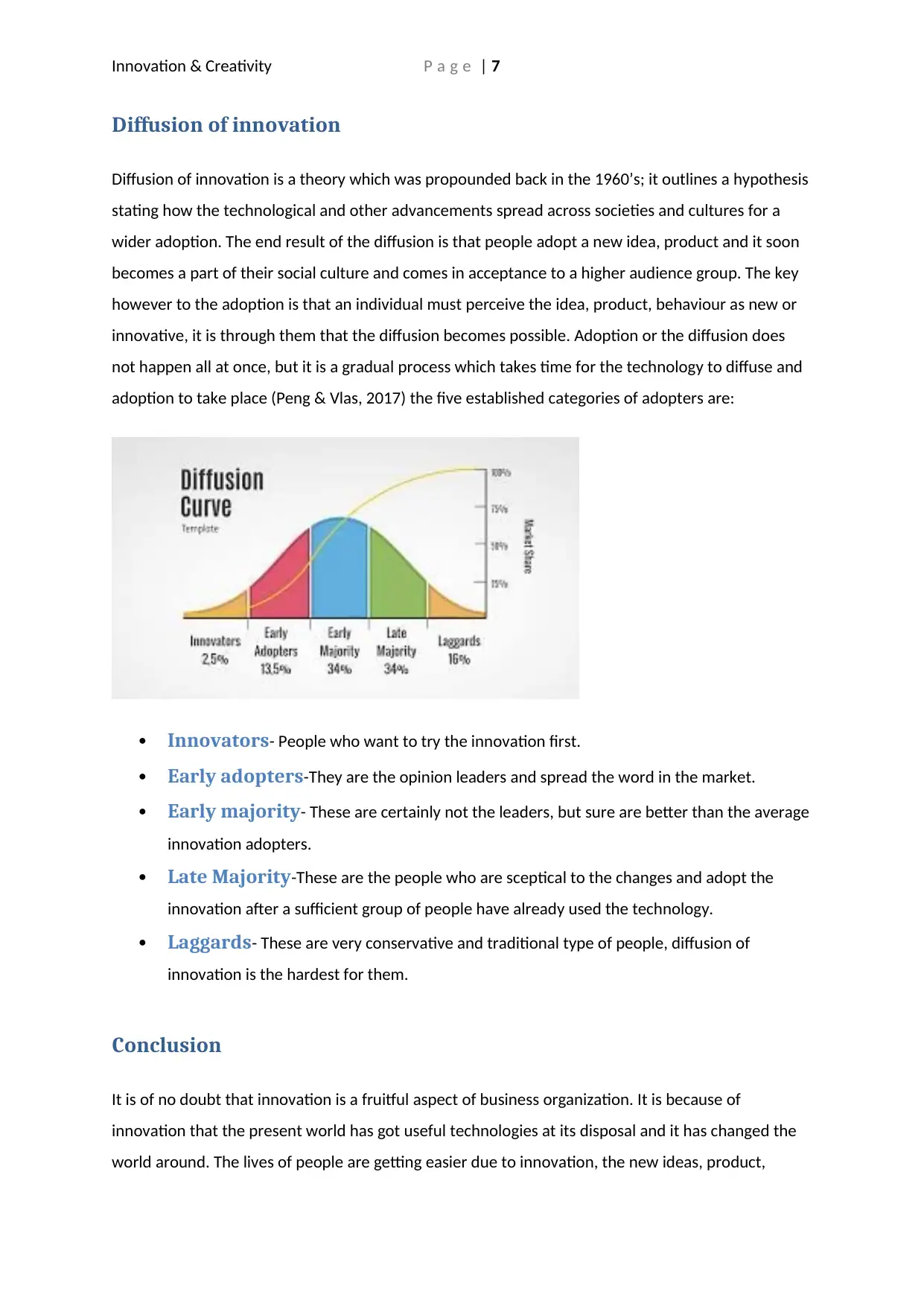
Diffusion of innovation is a theory which was propounded back in the 1960’s; it outlines a hypothesis
stating how the technological and other advancements spread across societies and cultures for a
wider adoption. The end result of the diffusion is that people adopt a new idea, product and it soon
becomes a part of their social culture and comes in acceptance to a higher audience group. The key
however to the adoption is that an individual must perceive the idea, product, behaviour as new or
innovative, it is through them that the diffusion becomes possible. Adoption or the diffusion does
not happen all at once, but it is a gradual process which takes time for the technology to diffuse and
adoption to take place (Peng & Vlas, 2017) the five established categories of adopters are:
Innovators- People who want to try the innovation first.
Early adopters-They are the opinion leaders and spread the word in the market.
Early majority- These are certainly not the leaders, but sure are better than the average
innovation adopters.
Late Majority-These are the people who are sceptical to the changes and adopt the
innovation after a sufficient group of people have already used the technology.
Laggards- These are very conservative and traditional type of people, diffusion of
innovation is the hardest for them.
Conclusion
It is of no doubt that innovation is a fruitful aspect of business organization. It is because of
innovation that the present world has got useful technologies at its disposal and it has changed the
world around. The lives of people are getting easier due to innovation, the new ideas, product,
Diffusion of innovation
Diffusion of innovation is a theory which was propounded back in the 1960’s; it outlines a hypothesis
stating how the technological and other advancements spread across societies and cultures for a
wider adoption. The end result of the diffusion is that people adopt a new idea, product and it soon
becomes a part of their social culture and comes in acceptance to a higher audience group. The key
however to the adoption is that an individual must perceive the idea, product, behaviour as new or
innovative, it is through them that the diffusion becomes possible. Adoption or the diffusion does
not happen all at once, but it is a gradual process which takes time for the technology to diffuse and
adoption to take place (Peng & Vlas, 2017) the five established categories of adopters are:
Innovators- People who want to try the innovation first.
Early adopters-They are the opinion leaders and spread the word in the market.
Early majority- These are certainly not the leaders, but sure are better than the average
innovation adopters.
Late Majority-These are the people who are sceptical to the changes and adopt the
innovation after a sufficient group of people have already used the technology.
Laggards- These are very conservative and traditional type of people, diffusion of
innovation is the hardest for them.
Conclusion
It is of no doubt that innovation is a fruitful aspect of business organization. It is because of
innovation that the present world has got useful technologies at its disposal and it has changed the
world around. The lives of people are getting easier due to innovation, the new ideas, product,
Innovation & Creativity P a g e | 8
goods; services have given the customer the ultimate satisfaction, something which they never
imagined of in the past. The rate at which innovation is getting diffused speaks in volume about the
positive aspects of innovation. The security app designed by the euphoric youth, who wanted to do
something good for the society has really landed a cool technology in the hands of its customer
audience. With the help of the application a customer can now take his safety in hand, be better
informed and act smartly in the situation of emergency. A well-researched and an effective
application in the hands of the consumers and an act of nobility, with an economical aspect attached
to it.
goods; services have given the customer the ultimate satisfaction, something which they never
imagined of in the past. The rate at which innovation is getting diffused speaks in volume about the
positive aspects of innovation. The security app designed by the euphoric youth, who wanted to do
something good for the society has really landed a cool technology in the hands of its customer
audience. With the help of the application a customer can now take his safety in hand, be better
informed and act smartly in the situation of emergency. A well-researched and an effective
application in the hands of the consumers and an act of nobility, with an economical aspect attached
to it.
⊘ This is a preview!⊘
Do you want full access?
Subscribe today to unlock all pages.
Trusted by 1+ million students worldwide
Innovation & Creativity P a g e | 9
References:
An, H. J., & Ahn, S. J. (2016). Emerging technologies—beyond the chasm: Assessing technological
forecasting and its implication for innovation management in Korea. Technological Forecasting and
Social Change, 102, 132-142.
Davies, A. (2014). Innovation and project management.
Edler, J., & Yeow, J. (2016). Connecting demand and supply: The role of intermediation in public
procurement of innovation. Research Policy, 45(2), 414-426.
Gawer, A., & Cusumano, M. A. (2014). Platforms and innovation. In The Oxford Handbook of
Innovation Management.
Hadida, A. L., & Paris, T. (2014). Managerial cognition and the value chain in the digital music
industry. Technological Forecasting and Social Change, 83, 84-97.
Lee, C., & Coughlin, J. F. (2015). PERSPECTIVE: Older adults' adoption of technology: an integrated
approach to identifying determinants and barriers. Journal of Product Innovation
Management, 32(5), 747-759.
Leiponen, A. (2014). Intellectual Property Rights, Standards, And the Management of Innovation.
Love, J. H., & Roper, S. (2015). SME innovation, exporting and growth: A review of existing
evidence. International Small Business Journal, 33(1), 28-48.
Peng, M. W., & Vlas, C. O. (2017). DIFFUSION OF A TWENTIETH-CENTURY INNOVATION. Academy of
Strategic Management Journal, 16(1), 172-174.
Prange, C., & Pinho, J. C. (2017). How personal and organizational drivers impact on SME
international performance: The mediating role of organizational innovation. International Business
Review.
Richter, M. (2013). German utilities and distributed PV: How to overcome barriers to business model
innovation. Renewable Energy, 55, 456-466.
References:
An, H. J., & Ahn, S. J. (2016). Emerging technologies—beyond the chasm: Assessing technological
forecasting and its implication for innovation management in Korea. Technological Forecasting and
Social Change, 102, 132-142.
Davies, A. (2014). Innovation and project management.
Edler, J., & Yeow, J. (2016). Connecting demand and supply: The role of intermediation in public
procurement of innovation. Research Policy, 45(2), 414-426.
Gawer, A., & Cusumano, M. A. (2014). Platforms and innovation. In The Oxford Handbook of
Innovation Management.
Hadida, A. L., & Paris, T. (2014). Managerial cognition and the value chain in the digital music
industry. Technological Forecasting and Social Change, 83, 84-97.
Lee, C., & Coughlin, J. F. (2015). PERSPECTIVE: Older adults' adoption of technology: an integrated
approach to identifying determinants and barriers. Journal of Product Innovation
Management, 32(5), 747-759.
Leiponen, A. (2014). Intellectual Property Rights, Standards, And the Management of Innovation.
Love, J. H., & Roper, S. (2015). SME innovation, exporting and growth: A review of existing
evidence. International Small Business Journal, 33(1), 28-48.
Peng, M. W., & Vlas, C. O. (2017). DIFFUSION OF A TWENTIETH-CENTURY INNOVATION. Academy of
Strategic Management Journal, 16(1), 172-174.
Prange, C., & Pinho, J. C. (2017). How personal and organizational drivers impact on SME
international performance: The mediating role of organizational innovation. International Business
Review.
Richter, M. (2013). German utilities and distributed PV: How to overcome barriers to business model
innovation. Renewable Energy, 55, 456-466.
Paraphrase This Document
Need a fresh take? Get an instant paraphrase of this document with our AI Paraphraser
Innovation & Creativity P a g e | 10
Singh, M. P., Chakraborty, A., & Roy, M. (2016). The link among innovation drivers, green innovation
and business performance: empirical evidence from a developing economy. World Review of
Science, Technology and Sustainable Development, 12(4), 316-334.
Thomä, J. (2017). DUI mode learning and barriers to innovation—A case from Germany. Research
Policy.
Verganti, R. (2016). Innovation of Meaning: Giving People Products to Love. MIT Press.
West, J., & Bogers, M. (2014). Leveraging external sources of innovation: a review of research on
open innovation. Journal of Product Innovation Management, 31(4), 814-831.
Singh, M. P., Chakraborty, A., & Roy, M. (2016). The link among innovation drivers, green innovation
and business performance: empirical evidence from a developing economy. World Review of
Science, Technology and Sustainable Development, 12(4), 316-334.
Thomä, J. (2017). DUI mode learning and barriers to innovation—A case from Germany. Research
Policy.
Verganti, R. (2016). Innovation of Meaning: Giving People Products to Love. MIT Press.
West, J., & Bogers, M. (2014). Leveraging external sources of innovation: a review of research on
open innovation. Journal of Product Innovation Management, 31(4), 814-831.

1 out of 11


Related Documents


![Innovation Theory Application: BrewDog Case Study Report, [University]](/_next/image/?url=https%3A%2F%2Fdesklib.com%2Fmedia%2Fimages%2Fgi%2Ffaaf6e5fa9b9466fb73a32cec25c50a0.jpg&w=256&q=75)


Your All-in-One AI-Powered Toolkit for Academic Success.
+13062052269
info@desklib.com
Available 24*7 on WhatsApp / Email
![[object Object]](/_next/static/media/star-bottom.7253800d.svg)
Unlock your academic potential
Copyright © 2020–2026 A2Z Services. All Rights Reserved. Developed and managed by ZUCOL.