The Psychology of Serial Killers: Analyzing Ted Bundy's Case
VerifiedAdded on 2021/05/31
|12
|2284
|413
Essay
AI Summary
This report provides a comprehensive analysis of the psychology of serial killers, focusing on the infamous case of Ted Bundy. It examines the biological, psychological, and sociological factors that may have contributed to Bundy's crimes, including his childhood experiences, potential chemical imbalances, and societal influences such as strain theory. The report also delves into the concept of victim blaming, exploring its origins and the ways in which victims are sometimes unfairly held responsible for the crimes committed against them. The analysis draws on various theories and research to provide a nuanced understanding of Bundy's motivations and the broader context of serial killing, including discussions of Freud's theory of the Unconscious and Sheldon's Somatotypes theory. The report concludes by emphasizing that victims should not be blamed for the actions of the perpetrators.
Running head: ANALYZING TED BUNDY, THE SERIAL KILLER’S PSYCHOLOGY
ANALYZING TED BUNDY, THE SERIAL KILLER’S PSYCHOLOGY
Name of the Student
Name of the University
Author note
ANALYZING TED BUNDY, THE SERIAL KILLER’S PSYCHOLOGY
Name of the Student
Name of the University
Author note

Paraphrase This Document
Need a fresh take? Get an instant paraphrase of this document with our AI Paraphraser
1
ANALYZING TED BUNDY, THE SERIAL KILLER’S PSYCHOLOGY
Executive summary
The chief purpose of this report was to analyze the psychology of serial killers and understand
the concept of victim blaming. The report provided a detailed evaluation of serial killing and
analyzed the serial killer; Ted Bundy for the U.S. Bundy was the most notorious serial killer in
the U.S. history who carried out those crimes during the 1970s. the report further attempted to
understand the biological factors, the psychological factors and the social factors that might have
prompted Bundy to commit those crimes. The report then explained the concept of victim
blaming and how the definition was vaguely used by people. The report concluded with an
overall summary of the analysis.
ANALYZING TED BUNDY, THE SERIAL KILLER’S PSYCHOLOGY
Executive summary
The chief purpose of this report was to analyze the psychology of serial killers and understand
the concept of victim blaming. The report provided a detailed evaluation of serial killing and
analyzed the serial killer; Ted Bundy for the U.S. Bundy was the most notorious serial killer in
the U.S. history who carried out those crimes during the 1970s. the report further attempted to
understand the biological factors, the psychological factors and the social factors that might have
prompted Bundy to commit those crimes. The report then explained the concept of victim
blaming and how the definition was vaguely used by people. The report concluded with an
overall summary of the analysis.
2
ANALYZING TED BUNDY, THE SERIAL KILLER’S PSYCHOLOGY
Table of Contents
Introduction......................................................................................................................................3
Background information of Ted Bundy and literature regarding serial killers...............................3
Influences on Crime and Serial Killers........................................................................................4
Victim Blaming...............................................................................................................................6
Conclusion.......................................................................................................................................7
References:......................................................................................................................................9
ANALYZING TED BUNDY, THE SERIAL KILLER’S PSYCHOLOGY
Table of Contents
Introduction......................................................................................................................................3
Background information of Ted Bundy and literature regarding serial killers...............................3
Influences on Crime and Serial Killers........................................................................................4
Victim Blaming...............................................................................................................................6
Conclusion.......................................................................................................................................7
References:......................................................................................................................................9
⊘ This is a preview!⊘
Do you want full access?
Subscribe today to unlock all pages.

Trusted by 1+ million students worldwide
3
ANALYZING TED BUNDY, THE SERIAL KILLER’S PSYCHOLOGY
Introduction
Serial killing is a crime of the highest magnitude that involves the killing of people
having similar characteristics by an individual. In history, there have been numerous accounts of
serial killing throughout the globe. Psychological experts and researchers have termed serial
killers as having serious mental imbalance that prompts them to commit such heinous crimes. On
the other hand, some engage in victim blaming, that is blaming the one on whom the heinous act
has befell.
The report will analyze the psychological, biological and social influences on serial
killers that instigate them to commit this crime. The chosen serial killer for the study is Theodore
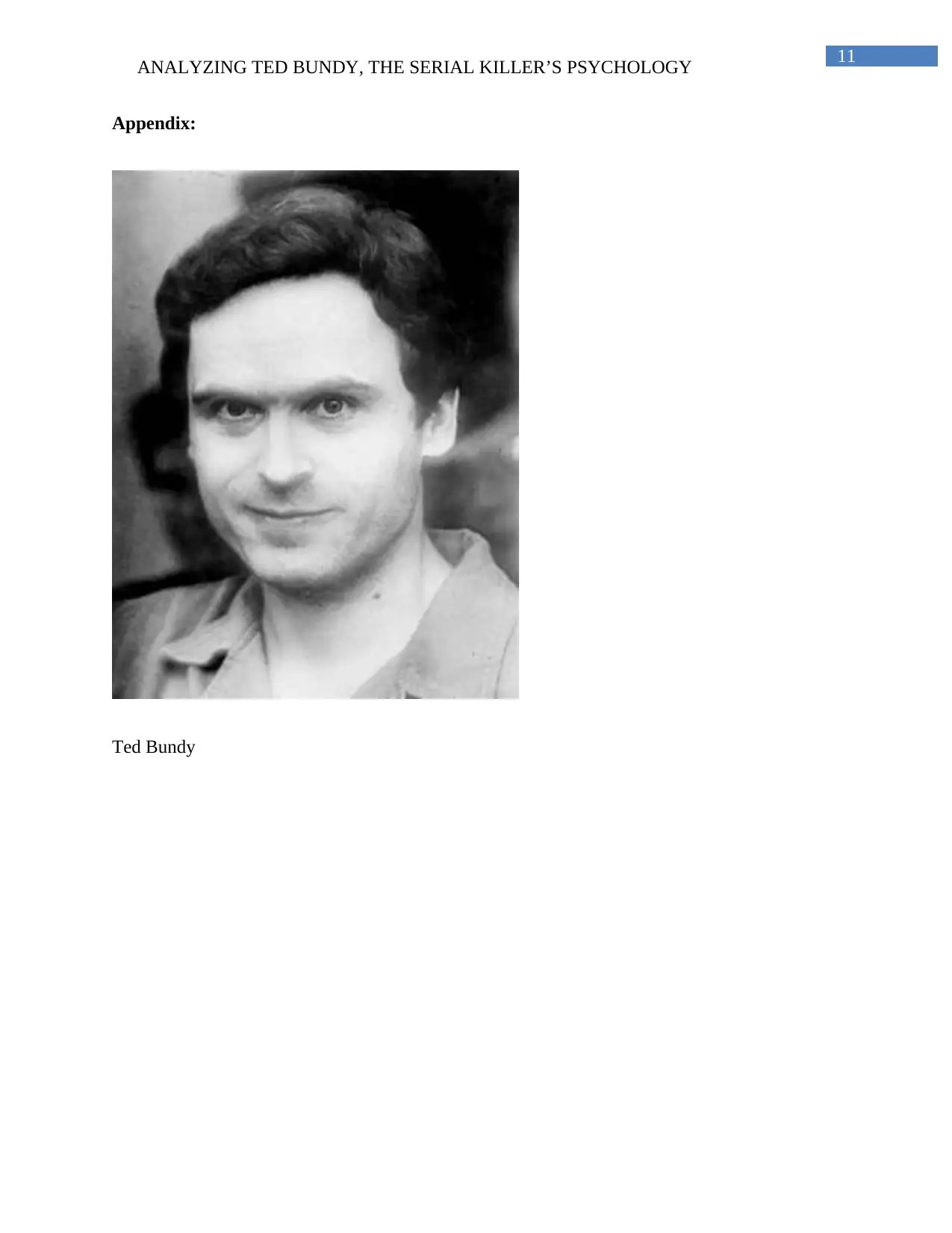
Robert Bundy, popularly known as Ted Bundy who was accused of more than thirty killings
during the 1970s in the United States (see Appendix). The report will then shift is focus towards
victim blaming and the blame culture in general. It will analyze the reason behind victim
blaming by including research literatures that explain this concept.
Background information of Ted Bundy and literature regarding serial killers
Serial killers have been defined as those who kill three or more victims and find major
cooling-off period between the killings. The serial killer kills its victims in a series broken by
gaps of 24 hours or more, demonstrating that each murder shortly gratifies whatever stimulates
the killer’s actions. Each succeeding killing ceases a different succession of behaviors. Mass
killings, on the other hand, refers to the murdering three or more victims at the same time (Silkes
n.d.). In contrast, spree killing involves the murder three or more that three victims at different
locations or time without any cooling off period between those.
ANALYZING TED BUNDY, THE SERIAL KILLER’S PSYCHOLOGY
Introduction
Serial killing is a crime of the highest magnitude that involves the killing of people
having similar characteristics by an individual. In history, there have been numerous accounts of
serial killing throughout the globe. Psychological experts and researchers have termed serial
killers as having serious mental imbalance that prompts them to commit such heinous crimes. On
the other hand, some engage in victim blaming, that is blaming the one on whom the heinous act
has befell.
The report will analyze the psychological, biological and social influences on serial
killers that instigate them to commit this crime. The chosen serial killer for the study is Theodore
Robert Bundy, popularly known as Ted Bundy who was accused of more than thirty killings
during the 1970s in the United States (see Appendix). The report will then shift is focus towards
victim blaming and the blame culture in general. It will analyze the reason behind victim
blaming by including research literatures that explain this concept.
Background information of Ted Bundy and literature regarding serial killers
Serial killers have been defined as those who kill three or more victims and find major
cooling-off period between the killings. The serial killer kills its victims in a series broken by
gaps of 24 hours or more, demonstrating that each murder shortly gratifies whatever stimulates
the killer’s actions. Each succeeding killing ceases a different succession of behaviors. Mass
killings, on the other hand, refers to the murdering three or more victims at the same time (Silkes
n.d.). In contrast, spree killing involves the murder three or more that three victims at different
locations or time without any cooling off period between those.
Paraphrase This Document
Need a fresh take? Get an instant paraphrase of this document with our AI Paraphraser
4
ANALYZING TED BUNDY, THE SERIAL KILLER’S PSYCHOLOGY
In the literature regarding serial killers, scholars have explained varying characteristics
that define them (Allely et al. 2014). The most common characteristics found in a serial killer
however include:
Exhibition of varying degrees of mental illness or psychopathic and defensive personality
Demonstration of authoritarian personality, which is derived from an ethnocentric
perspective of the world
Expression of the emotional, physical and sexual abuse received during childhood by any
member of the family
Demonstration of fetishism, necrophilia and paraphilia, that is, extremely strong tendency
to involve in sexual activity with a corpse
The chosen case for this report, Ted Bundy, was a serial killer of the 1970s from the
United States of America. Bundy was born on November 24, 1946 in Burlington, Vermont to
Eleanor Louis Cowell, his biological mother. He did not know who his father was and that
caused some disturbance in his mind. Eleanor was unmarried when she gave birth to Bundy and
that caused discomfort to her extremely religious family. Owing to this reason, her father, Sam
Cowell, gave her to the ‘unwed mother’ facility (Imdb.com 2018). Born and brought up at the
unwed mother facility, Bundy had little exposure to a normal life any child would have. It is
believed that the motivation behind his criminal acts was break up with his former college love
interest Stephanie Brooks. Almost all the victims of Bundy resembled Stephanie.
Influences on Crime and Serial Killers
Theorists and researchers claim that many influences work behind the intentions of a
serial killer. At first, the killings might be approached from a biological perspective. The
biological approach might include the chemical imbalances and the genetic influences. Choi and
Lee (2014) define chemical imbalance as the main reason behind the crimes committed by serial
ANALYZING TED BUNDY, THE SERIAL KILLER’S PSYCHOLOGY
In the literature regarding serial killers, scholars have explained varying characteristics
that define them (Allely et al. 2014). The most common characteristics found in a serial killer
however include:
Exhibition of varying degrees of mental illness or psychopathic and defensive personality
Demonstration of authoritarian personality, which is derived from an ethnocentric
perspective of the world
Expression of the emotional, physical and sexual abuse received during childhood by any
member of the family
Demonstration of fetishism, necrophilia and paraphilia, that is, extremely strong tendency
to involve in sexual activity with a corpse
The chosen case for this report, Ted Bundy, was a serial killer of the 1970s from the
United States of America. Bundy was born on November 24, 1946 in Burlington, Vermont to
Eleanor Louis Cowell, his biological mother. He did not know who his father was and that
caused some disturbance in his mind. Eleanor was unmarried when she gave birth to Bundy and
that caused discomfort to her extremely religious family. Owing to this reason, her father, Sam
Cowell, gave her to the ‘unwed mother’ facility (Imdb.com 2018). Born and brought up at the
unwed mother facility, Bundy had little exposure to a normal life any child would have. It is
believed that the motivation behind his criminal acts was break up with his former college love
interest Stephanie Brooks. Almost all the victims of Bundy resembled Stephanie.
Influences on Crime and Serial Killers
Theorists and researchers claim that many influences work behind the intentions of a
serial killer. At first, the killings might be approached from a biological perspective. The
biological approach might include the chemical imbalances and the genetic influences. Choi and
Lee (2014) define chemical imbalance as the main reason behind the crimes committed by serial
5
ANALYZING TED BUNDY, THE SERIAL KILLER’S PSYCHOLOGY
killers. As per the authors’ views, certain imbalances in the mind occur due to higher rate of
sexual tendency, inferiority complex or a drive to try things that occur only in fascination. Bundy
was the child of an unmarried mother and he had spent most of his childhood in an enclosure. He
was exposed to pornography from a very small age, as he himself had confessed that might have
led to a chemical imbalance in his mind.
The Somatotypes theory proposed by Sheldon also provides helpful insights into the
characteristics of criminals. According to Sheldon’s theory, criminal behavior can be associated
with the physical built of an individual. He demarcated three types of physically built individuals
– the ectomorph or thinly built individuals, the endomorph or obese individuals and the
mesomorph or muscular individuals (Stewart et al. 2014). Sheldon claimed that since ectomorphs
were thin or skinny, they were introverted and controlled and the endomorphs were more riotous
and relaxed and the mesomorph was adventurous and energetic. Out of the three personalities,
the mesomorphs hence were most likely to indulge in criminal behaviors. Although Sheldon’s
theory provided a solid ground for later theorists to understand criminal behavior, it failed to
recognize the psychological influences. Ted Bundy presents a clear example that Sheldon’s
Somatotypes theory did not explain his serial killings because he was not very muscular and was
an introvert (Ekmekcioglu et al. 2015).
Another theory that could explain Bundy’s psychology behind the killings is Sigmund
Freud’s theory of the Unconscious. In Freud’s views, the human mind has three levels- the
conscious, the unconscious and the subconscious mind. The Unconscious mind keeps those
desires and memories of the humans that they do not want to recall again. Ted Bundy had several
such desires and events that he had kept in his unconscious mind including the revelation that his
mother had lied to him and the end of relationship with Stephanie Brooks, his ex-lover. Freud
ANALYZING TED BUNDY, THE SERIAL KILLER’S PSYCHOLOGY
killers. As per the authors’ views, certain imbalances in the mind occur due to higher rate of
sexual tendency, inferiority complex or a drive to try things that occur only in fascination. Bundy
was the child of an unmarried mother and he had spent most of his childhood in an enclosure. He
was exposed to pornography from a very small age, as he himself had confessed that might have
led to a chemical imbalance in his mind.
The Somatotypes theory proposed by Sheldon also provides helpful insights into the
characteristics of criminals. According to Sheldon’s theory, criminal behavior can be associated
with the physical built of an individual. He demarcated three types of physically built individuals
– the ectomorph or thinly built individuals, the endomorph or obese individuals and the
mesomorph or muscular individuals (Stewart et al. 2014). Sheldon claimed that since ectomorphs
were thin or skinny, they were introverted and controlled and the endomorphs were more riotous
and relaxed and the mesomorph was adventurous and energetic. Out of the three personalities,
the mesomorphs hence were most likely to indulge in criminal behaviors. Although Sheldon’s
theory provided a solid ground for later theorists to understand criminal behavior, it failed to
recognize the psychological influences. Ted Bundy presents a clear example that Sheldon’s
Somatotypes theory did not explain his serial killings because he was not very muscular and was
an introvert (Ekmekcioglu et al. 2015).
Another theory that could explain Bundy’s psychology behind the killings is Sigmund
Freud’s theory of the Unconscious. In Freud’s views, the human mind has three levels- the
conscious, the unconscious and the subconscious mind. The Unconscious mind keeps those
desires and memories of the humans that they do not want to recall again. Ted Bundy had several
such desires and events that he had kept in his unconscious mind including the revelation that his
mother had lied to him and the end of relationship with Stephanie Brooks, his ex-lover. Freud
⊘ This is a preview!⊘
Do you want full access?
Subscribe today to unlock all pages.
Trusted by 1+ million students worldwide
6
ANALYZING TED BUNDY, THE SERIAL KILLER’S PSYCHOLOGY
asserted that the unconscious mind governs human behavior more prominently than the
conscious and the subconscious mid (Raj 2017). Therefore, it is clearly seen that Bundy’s
motivation behind killing the victims came from his unconscious mind.
After analyzing the biological and psychological approaches to understanding Ted
Bundy, it becomes all the more important to analyze the sociological influences. Various theories
of sociology are present in them literature that might help in comprehending his motives. One
such theory is the Strain Theory introduced by Robert K Merton (Agnew 2015). The theory
affirms that individuals sometimes succumb to the pressure of achieving goals put on them by
the society. In this way, the individual is strained and it consequently commits a crime. Now,
Bundy was born to a single mother in an unwed mother facility with no identity of his father. He
felt neglect from the society and found solace in committing those crimes.
Victim Blaming
Those who fall prey to the malicious intentions of others are referred to as the victims. In
Ted Bundy’s case, all those ladies and young girls whom he had killed and raped were the
victims. However, the victims are seen as being equally guilty of the crime and are blamed for it.
William Ryan, a psychologist coined the phrase ‘victim blaming’ in 1971 in a book titled
Blaming the Victim (Chagnon 2017).Victimology studies have attempted to alleviate the opinion
of victims as perpetrators. It is nonetheless important to note that the definition is somewhat
vague and does not cover the complete reality. Although in most cases the victims are
unjustifiably blamed, many such cases are there as well where the victims have been found to be
the actual perpetrators. Some argue that it is wrong on both sides of the crime – the offender and
ANALYZING TED BUNDY, THE SERIAL KILLER’S PSYCHOLOGY
asserted that the unconscious mind governs human behavior more prominently than the
conscious and the subconscious mid (Raj 2017). Therefore, it is clearly seen that Bundy’s
motivation behind killing the victims came from his unconscious mind.
After analyzing the biological and psychological approaches to understanding Ted
Bundy, it becomes all the more important to analyze the sociological influences. Various theories
of sociology are present in them literature that might help in comprehending his motives. One
such theory is the Strain Theory introduced by Robert K Merton (Agnew 2015). The theory
affirms that individuals sometimes succumb to the pressure of achieving goals put on them by
the society. In this way, the individual is strained and it consequently commits a crime. Now,
Bundy was born to a single mother in an unwed mother facility with no identity of his father. He
felt neglect from the society and found solace in committing those crimes.
Victim Blaming
Those who fall prey to the malicious intentions of others are referred to as the victims. In
Ted Bundy’s case, all those ladies and young girls whom he had killed and raped were the
victims. However, the victims are seen as being equally guilty of the crime and are blamed for it.
William Ryan, a psychologist coined the phrase ‘victim blaming’ in 1971 in a book titled
Blaming the Victim (Chagnon 2017).Victimology studies have attempted to alleviate the opinion
of victims as perpetrators. It is nonetheless important to note that the definition is somewhat
vague and does not cover the complete reality. Although in most cases the victims are
unjustifiably blamed, many such cases are there as well where the victims have been found to be
the actual perpetrators. Some argue that it is wrong on both sides of the crime – the offender and
Paraphrase This Document
Need a fresh take? Get an instant paraphrase of this document with our AI Paraphraser
7
ANALYZING TED BUNDY, THE SERIAL KILLER’S PSYCHOLOGY
the victimized – to generalize the situation. The offender is blamed for committing the crime
whereas the victim is blamed for not being careful enough or instigating the crime.
To understand the concept of victim blaming more precisely, it might be helpful to learn
about the Positivist and Radical Victimology theories. Positivist Victimology was proposed by
David Myers and had three important characteristics (Ferrão et al. 2016). First is identifying the
aspects in the individuals or their surroundings that lead to non-random threat of victimization.
Second is the focus on violent crimes on interpersonal level and third is the victim identification
in cases where they are held responsible for their victimization. Radical victimology on the other
hand, explains the reactions of the society to victims and the crime and its preference for
innocent victims (Walklate 2017). The theory further explains the victimization of the victim’s
family. In such cases, the traumatized victims are further affected.
Therefore, one can assert that victim blaming has a faulty definition and that the victims
turn out to be the perpetrators but creating a blame culture by always blaming the victim must
stop.
Conclusion
In concluding remarks, it can be asserted that in cases of serial killings, the victims are
not to be blamed because they do not hold any association with the perpetrator. Ted Bundy’s
mother and those who had lied to him and did not give him a normal childhood could be blamed
for his mental distortion. The essay provided a detailed analysis of criminological psychology
by undertaking the case of Ted Bundy, the infamous American serial killer. The essay at first
provided an explanation about serial killings and contrasted it with mass and spree killings. It
further presented a background of the serial killer and tried to analyze, through different
ANALYZING TED BUNDY, THE SERIAL KILLER’S PSYCHOLOGY
the victimized – to generalize the situation. The offender is blamed for committing the crime
whereas the victim is blamed for not being careful enough or instigating the crime.
To understand the concept of victim blaming more precisely, it might be helpful to learn
about the Positivist and Radical Victimology theories. Positivist Victimology was proposed by
David Myers and had three important characteristics (Ferrão et al. 2016). First is identifying the
aspects in the individuals or their surroundings that lead to non-random threat of victimization.
Second is the focus on violent crimes on interpersonal level and third is the victim identification
in cases where they are held responsible for their victimization. Radical victimology on the other
hand, explains the reactions of the society to victims and the crime and its preference for
innocent victims (Walklate 2017). The theory further explains the victimization of the victim’s
family. In such cases, the traumatized victims are further affected.
Therefore, one can assert that victim blaming has a faulty definition and that the victims
turn out to be the perpetrators but creating a blame culture by always blaming the victim must
stop.
Conclusion
In concluding remarks, it can be asserted that in cases of serial killings, the victims are
not to be blamed because they do not hold any association with the perpetrator. Ted Bundy’s
mother and those who had lied to him and did not give him a normal childhood could be blamed
for his mental distortion. The essay provided a detailed analysis of criminological psychology
by undertaking the case of Ted Bundy, the infamous American serial killer. The essay at first
provided an explanation about serial killings and contrasted it with mass and spree killings. It
further presented a background of the serial killer and tried to analyze, through different
8
ANALYZING TED BUNDY, THE SERIAL KILLER’S PSYCHOLOGY
sociological and psychological theories, the causes behind his killings. In the later sections, the
essay provided an explanation of the concept of victim blaming, the blame culture and the two
theories of positivist and radical victimology. Further studies on victim blaming is suggested.
ANALYZING TED BUNDY, THE SERIAL KILLER’S PSYCHOLOGY
sociological and psychological theories, the causes behind his killings. In the later sections, the
essay provided an explanation of the concept of victim blaming, the blame culture and the two
theories of positivist and radical victimology. Further studies on victim blaming is suggested.
⊘ This is a preview!⊘
Do you want full access?
Subscribe today to unlock all pages.
Trusted by 1+ million students worldwide
9
ANALYZING TED BUNDY, THE SERIAL KILLER’S PSYCHOLOGY
References:
Agnew, R., 2015. Using general strain theory to explain crime in Asian societies. Asian Journal
of Criminology, 10(2), pp.131-147.
Allely, C.S., Minnis, H., Thompson, L., Wilson, P. and Gillberg, C., 2014. Neurodevelopmental
and psychosocial risk factors in serial killers and mass murderers. Aggression and violent
behavior, 19(3), pp.288-301.
Chagnon, N.J., 2017. Racialized Culpability: Victim Blaming and State Violence. In Race,
Ethnicity and Law (pp. 199-219). Emerald Publishing Limited.
Ekmekcioglu, C., Devletlian, S., Blasche, G. and Kundi, M., 2015. Is there an association
between the body mass index and interpersonal violent behavior?. Journal of forensic
sciences, 60(5), pp.1350-1354.
Ferrão, M.C., Gonçalves, G., Giger, J.C. and Parreira, T., 2016. Of Rape and Other Demons: The
Impact of the Victim's Eye Size and Observer's Gender on the Attributions of
Responsibility. Psychological Topics, 25(2), p.157.
Imdb.com (2018). Ted Bundy. [online] IMDb. Available at:
https://www.imdb.com/name/nm0120421/bio [Accessed 15 May 2018].
Raj, M.S., 2017. A Psychoanalytical Reading of Norman Bates in Robert Bloch’s
Psycho. Imperial Journal of Interdisciplinary Research, 3(5).
Silkes, M., Exploring the Phenomenon of Serial Killing from a Psychological Standpoint A
Review of the Literature.
ANALYZING TED BUNDY, THE SERIAL KILLER’S PSYCHOLOGY
References:
Agnew, R., 2015. Using general strain theory to explain crime in Asian societies. Asian Journal
of Criminology, 10(2), pp.131-147.
Allely, C.S., Minnis, H., Thompson, L., Wilson, P. and Gillberg, C., 2014. Neurodevelopmental
and psychosocial risk factors in serial killers and mass murderers. Aggression and violent
behavior, 19(3), pp.288-301.
Chagnon, N.J., 2017. Racialized Culpability: Victim Blaming and State Violence. In Race,
Ethnicity and Law (pp. 199-219). Emerald Publishing Limited.
Ekmekcioglu, C., Devletlian, S., Blasche, G. and Kundi, M., 2015. Is there an association
between the body mass index and interpersonal violent behavior?. Journal of forensic
sciences, 60(5), pp.1350-1354.
Ferrão, M.C., Gonçalves, G., Giger, J.C. and Parreira, T., 2016. Of Rape and Other Demons: The
Impact of the Victim's Eye Size and Observer's Gender on the Attributions of
Responsibility. Psychological Topics, 25(2), p.157.
Imdb.com (2018). Ted Bundy. [online] IMDb. Available at:
https://www.imdb.com/name/nm0120421/bio [Accessed 15 May 2018].
Raj, M.S., 2017. A Psychoanalytical Reading of Norman Bates in Robert Bloch’s
Psycho. Imperial Journal of Interdisciplinary Research, 3(5).
Silkes, M., Exploring the Phenomenon of Serial Killing from a Psychological Standpoint A
Review of the Literature.
Paraphrase This Document
Need a fresh take? Get an instant paraphrase of this document with our AI Paraphraser
10
ANALYZING TED BUNDY, THE SERIAL KILLER’S PSYCHOLOGY
Stewart, A., Crockett, P., Nevill, A. and Benson, P., 2014. Somatotype: a more sophisticated
approach to body image work with eating disorder sufferers. Advances in Eating Disorders:
Theory, Research and Practice, 2(2), pp.125-135.
Walklate, S., 2017. Reflections on ‘Victims’ and ‘Victimisation’: An Autobiography of Ideas.
In Criminal Justice Research: Inspiration Influence and Ideation (pp. 31-49). Routledge.
ANALYZING TED BUNDY, THE SERIAL KILLER’S PSYCHOLOGY
Stewart, A., Crockett, P., Nevill, A. and Benson, P., 2014. Somatotype: a more sophisticated
approach to body image work with eating disorder sufferers. Advances in Eating Disorders:
Theory, Research and Practice, 2(2), pp.125-135.
Walklate, S., 2017. Reflections on ‘Victims’ and ‘Victimisation’: An Autobiography of Ideas.
In Criminal Justice Research: Inspiration Influence and Ideation (pp. 31-49). Routledge.
11
ANALYZING TED BUNDY, THE SERIAL KILLER’S PSYCHOLOGY
Appendix:
Ted Bundy
ANALYZING TED BUNDY, THE SERIAL KILLER’S PSYCHOLOGY
Appendix:
Ted Bundy
⊘ This is a preview!⊘
Do you want full access?
Subscribe today to unlock all pages.
Trusted by 1+ million students worldwide

1 out of 12


Related Documents


Your All-in-One AI-Powered Toolkit for Academic Success.
+13062052269
info@desklib.com
Available 24*7 on WhatsApp / Email
![[object Object]](/_next/static/media/star-bottom.7253800d.svg)
Unlock your academic potential
Copyright © 2020–2026 A2Z Services. All Rights Reserved. Developed and managed by ZUCOL.