Strategic Assessment of Tesco's Environment Using Key Frameworks
VerifiedAdded on 2022/10/11
|24
|6593
|13
Report
AI Summary
This report provides a detailed assessment of Tesco's business environment using various strategic frameworks. It includes a SWOT analysis to evaluate Tesco's internal strengths and weaknesses, as well as external opportunities and threats. The PESTLE framework is used to analyze the macro-environmental factors affecting Tesco, while Porter's Five Forces framework provides insights into the competitive dynamics of the UK retail industry. The report also examines Tesco's strategies using McKinsey's 7-S framework and proposes changes to the organizational structure, supported by 'Before and After' organizational charts. Recommendations are made to improve Tesco's operations, and the report concludes with key findings and implications for the company's future.
Running head: ASSESSMENT OF TESCO ENVIRONMENT
ASSESSMENT OF TESCO ENVIRONMENT
Name of the Student
Name of the University
Author Note
ASSESSMENT OF TESCO ENVIRONMENT
Name of the Student
Name of the University
Author Note

Paraphrase This Document
Need a fresh take? Get an instant paraphrase of this document with our AI Paraphraser
1ASSESSMENT OF TESCO ENVIRONMENT
Executive Summary
The report is based on the detailed assessment of the firm named Tesco that operates in the
retail market of the UK. The assessment has been done with the support of application of
diverse structures or tools. The SWOT framework is used for studying the internal
environment of Tesco. The exterior or macro environment is observed with the assistance of
PESTLE framework. Porter’s five forces framework is used for getting a detailed picture of
the retail industry of UK in which Tesco operates. The strategies that have been used by
Tesco are also studied with the support that is provided by McKinsey’s 7-S framework. The
recommendations are based on changes that can be applied to the operations of Tesco. The
changes in organizational structure of Tesco will be suggested by developing the “Before and
After” organizational charts of the organization.
Executive Summary
The report is based on the detailed assessment of the firm named Tesco that operates in the
retail market of the UK. The assessment has been done with the support of application of
diverse structures or tools. The SWOT framework is used for studying the internal
environment of Tesco. The exterior or macro environment is observed with the assistance of
PESTLE framework. Porter’s five forces framework is used for getting a detailed picture of
the retail industry of UK in which Tesco operates. The strategies that have been used by
Tesco are also studied with the support that is provided by McKinsey’s 7-S framework. The
recommendations are based on changes that can be applied to the operations of Tesco. The
changes in organizational structure of Tesco will be suggested by developing the “Before and
After” organizational charts of the organization.
2ASSESSMENT OF TESCO ENVIRONMENT
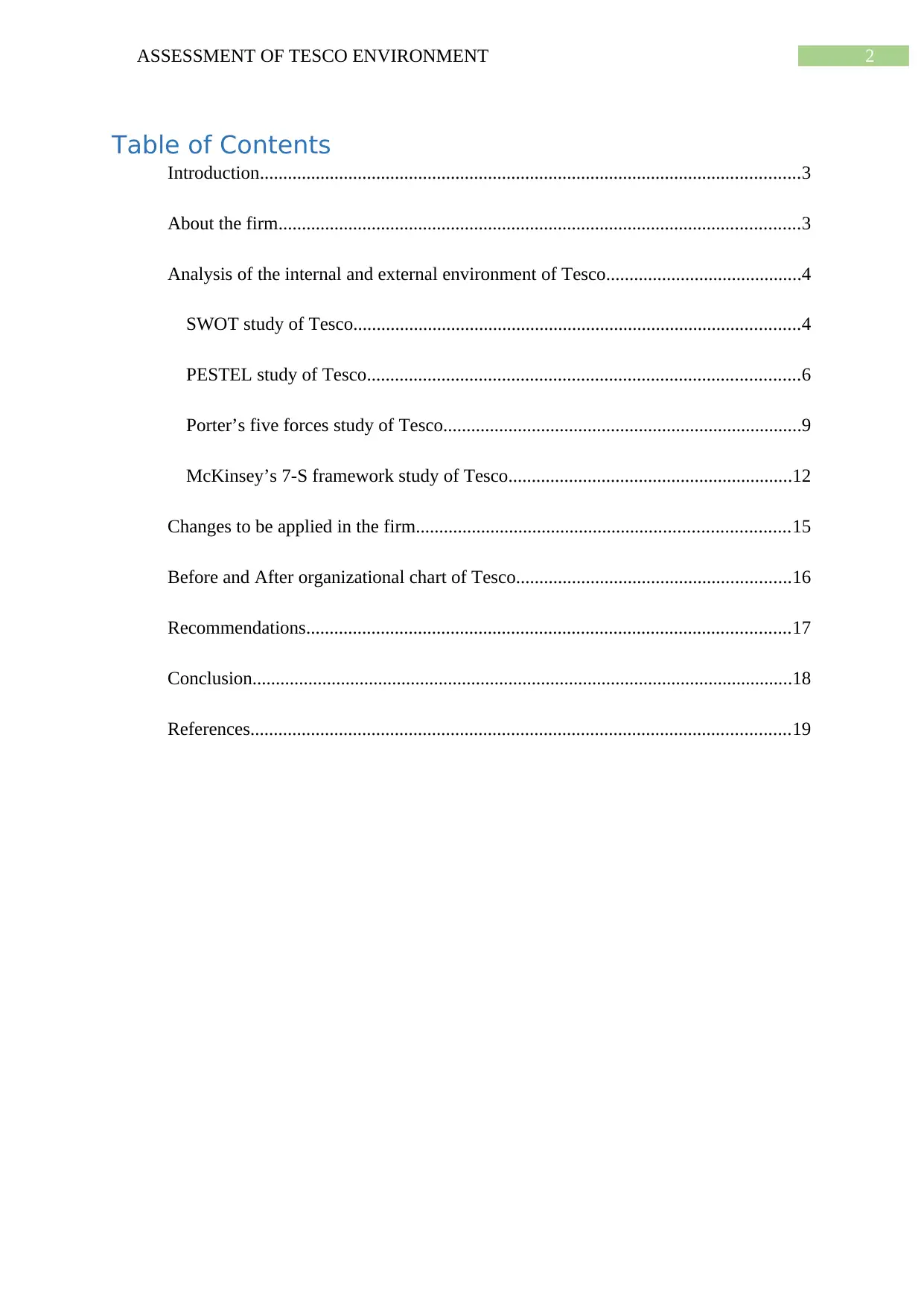
Table of Contents
Introduction....................................................................................................................3
About the firm................................................................................................................3
Analysis of the internal and external environment of Tesco..........................................4
SWOT study of Tesco................................................................................................4
PESTEL study of Tesco.............................................................................................6
Porter’s five forces study of Tesco.............................................................................9
McKinsey’s 7-S framework study of Tesco.............................................................12
Changes to be applied in the firm................................................................................15
Before and After organizational chart of Tesco...........................................................16
Recommendations........................................................................................................17
Conclusion....................................................................................................................18
References....................................................................................................................19
Table of Contents
Introduction....................................................................................................................3
About the firm................................................................................................................3
Analysis of the internal and external environment of Tesco..........................................4
SWOT study of Tesco................................................................................................4
PESTEL study of Tesco.............................................................................................6
Porter’s five forces study of Tesco.............................................................................9
McKinsey’s 7-S framework study of Tesco.............................................................12
Changes to be applied in the firm................................................................................15
Before and After organizational chart of Tesco...........................................................16
Recommendations........................................................................................................17
Conclusion....................................................................................................................18
References....................................................................................................................19
⊘ This is a preview!⊘
Do you want full access?
Subscribe today to unlock all pages.

Trusted by 1+ million students worldwide
3ASSESSMENT OF TESCO ENVIRONMENT
Introduction
Organizational analysis is commonly known as industrial analysis that is considered
to be a method which is applied in order to review the development, personnel, work
environment and operations that are performed by a business organization. The review is
mainly performed at the time of crisis or a demonstration based project that is based on the
development of regular operations. A periodic and detailed analysis of the organization is
able to play a vital part in influencing the outputs that are gained from different activities
(Aguinis, Edwards and Bradley 2017). The study of a firm is mainly focussed on structure
and the design and the ways by which the systems, functionality and capacity are able to
affect the results of the operations. Proper development of an organizational analysis is
considered to be an important part of the methods by which current processes can be
controlled and future course of operations can be decided as well (Albers, Wohlgezogen and
Zajac 2016).
The report will be built on the study of the internal and external situation of a firm
with the help of effective models. The analysis will further lead to recommendations that can
be offered based on proper improvement of the operations of the organization in the future.
The firm that has been taken into concern for study is Tesco PLC which is a retail
organization operating in the UK and many different countries of the world as well
(Tesco.com 2019).
About the firm
Tesco PLC is multinational retail British firm that mainly provides common
merchandise and groceries. The headquarters of Tesco is located in Welwyn Garden City,
Hertfordshire, England, United Kingdom. Tesco has been successful in gaining the third
biggest place in retail industry in terms of the incomes that are received by the company.
Introduction
Organizational analysis is commonly known as industrial analysis that is considered
to be a method which is applied in order to review the development, personnel, work
environment and operations that are performed by a business organization. The review is
mainly performed at the time of crisis or a demonstration based project that is based on the
development of regular operations. A periodic and detailed analysis of the organization is
able to play a vital part in influencing the outputs that are gained from different activities
(Aguinis, Edwards and Bradley 2017). The study of a firm is mainly focussed on structure
and the design and the ways by which the systems, functionality and capacity are able to
affect the results of the operations. Proper development of an organizational analysis is
considered to be an important part of the methods by which current processes can be
controlled and future course of operations can be decided as well (Albers, Wohlgezogen and
Zajac 2016).
The report will be built on the study of the internal and external situation of a firm
with the help of effective models. The analysis will further lead to recommendations that can
be offered based on proper improvement of the operations of the organization in the future.
The firm that has been taken into concern for study is Tesco PLC which is a retail
organization operating in the UK and many different countries of the world as well
(Tesco.com 2019).
About the firm
Tesco PLC is multinational retail British firm that mainly provides common
merchandise and groceries. The headquarters of Tesco is located in Welwyn Garden City,
Hertfordshire, England, United Kingdom. Tesco has been successful in gaining the third
biggest place in retail industry in terms of the incomes that are received by the company.
Paraphrase This Document
Need a fresh take? Get an instant paraphrase of this document with our AI Paraphraser
4ASSESSMENT OF TESCO ENVIRONMENT
Tesco currently operates its stores in seven countries across Europe and Asia and has also
gained the place of a market lead in the retail industry (Tesco.com 2019). Tesco was
established in the year 1919 by Jack Cohen in the type of a group of market shops. The name
of the firm had first came into existence in the year 1924 after founder of Tesco had
purchased a shipment containing tea from T.E. Stockwell. The first major store of Tesco was
started in Burnt Oak, Barnet. The business of Tesco had thereby started expanding rapidly
and the by the year 1939 the firm had greater than 100 Tesco shops in the country
(Tesco.com 2019).
Analysis of the internal and external environment of Tesco
SWOT study of Tesco
Strengths – The powerful retail brand name that has been developed by Tesco is
considered to be a major strength of the organization. Tesco is also known in the retail market
for providing value for money to the customers along with high levels of convenience and a
extensive range of products as well. The firm has been successful in the development of a
huge network of stores in various parts of the world which aim at offering the best levels of
products to the customers (Albrecht et al. 2015). Innovative business methods have been used
by Tesco in the creation of different stores like, Tesco Express and Tesco Metro. The local
convenient stores have provided high levels of convenience to the customers so that they are
able to procure the required products. The other major strengths that have been gained by the
organization include, joint ventures and online shopping (Baker and Saren 2016). The loyalty
packages that have been formed by Tesco are able to appeal huge number of consumers from
various areas of the world. The Clubcard that has been introduced by Tesco plays a major
part in the development of long term based relationships with the customers (Barrick et al.
2015).
Tesco currently operates its stores in seven countries across Europe and Asia and has also
gained the place of a market lead in the retail industry (Tesco.com 2019). Tesco was
established in the year 1919 by Jack Cohen in the type of a group of market shops. The name
of the firm had first came into existence in the year 1924 after founder of Tesco had
purchased a shipment containing tea from T.E. Stockwell. The first major store of Tesco was
started in Burnt Oak, Barnet. The business of Tesco had thereby started expanding rapidly
and the by the year 1939 the firm had greater than 100 Tesco shops in the country
(Tesco.com 2019).
Analysis of the internal and external environment of Tesco
SWOT study of Tesco
Strengths – The powerful retail brand name that has been developed by Tesco is
considered to be a major strength of the organization. Tesco is also known in the retail market
for providing value for money to the customers along with high levels of convenience and a
extensive range of products as well. The firm has been successful in the development of a
huge network of stores in various parts of the world which aim at offering the best levels of
products to the customers (Albrecht et al. 2015). Innovative business methods have been used
by Tesco in the creation of different stores like, Tesco Express and Tesco Metro. The local
convenient stores have provided high levels of convenience to the customers so that they are
able to procure the required products. The other major strengths that have been gained by the
organization include, joint ventures and online shopping (Baker and Saren 2016). The loyalty
packages that have been formed by Tesco are able to appeal huge number of consumers from
various areas of the world. The Clubcard that has been introduced by Tesco plays a major
part in the development of long term based relationships with the customers (Barrick et al.
2015).
5ASSESSMENT OF TESCO ENVIRONMENT
Weaknesses – The diversified model of business operations developed by Tesco
includes many different types of products like, books, food, clothing, furniture, petrol,
financial and insurance services. This is considered to be a key weakness of the firm and the
profit of Tesco has been affected in a negative way by the bad debts related from the credit
cards. The high levels of the household incomes have also proved to be a key issue based on
the operations of Tesco in the retail market (Bergh et al. 2016). Tesco also lacks experience
in some of the markets that the organizations aim to enter, like the own brands of
smartphones and the tablets. Tesco also has to spend huge amounts of cash in the new web
based skills, IT and the restoration of the stores as well (Chatterji et al. 2016). The price
reduction strategies that are currently being used by Tesco need to be changed in order to
increase the investments that can be made in the improvement of operations. The lack of low
priced products can also have an adverse impact on the sales (CARTWRIGHT and Cooper
2016).
Opportunities – Tesco is offered with major levels of opportunities in order to
enhance the future processes in retail market. The development of functions of Tesco in
different markets like digital entertainment will be able to provide growth opportunities to
Tesco. Tesco can also aim at offering its own-brand tablets and the smartphones that can
intersect with the investments that are made in South Korea, Malaysia, China, Thailand
(Cusumano, Kahl and Suarez 2015). The levels of flexibility of Tesco and its operations can
be increased in an effective way with the backing that is offered by online shopping based
activities performed by the organization. Tesco can also aim at fulfilling the demands and
needs of the customers with the expansion based operations in online shopping sector
(Deresky 2017). The branding activities of Tesco and the value that is offered to the
customers can be taken into consideration in order to offer the products and convenience to
them. The overseas expansion of Tesco can increase with the start of its operations in
Weaknesses – The diversified model of business operations developed by Tesco
includes many different types of products like, books, food, clothing, furniture, petrol,
financial and insurance services. This is considered to be a key weakness of the firm and the
profit of Tesco has been affected in a negative way by the bad debts related from the credit
cards. The high levels of the household incomes have also proved to be a key issue based on
the operations of Tesco in the retail market (Bergh et al. 2016). Tesco also lacks experience
in some of the markets that the organizations aim to enter, like the own brands of
smartphones and the tablets. Tesco also has to spend huge amounts of cash in the new web
based skills, IT and the restoration of the stores as well (Chatterji et al. 2016). The price
reduction strategies that are currently being used by Tesco need to be changed in order to
increase the investments that can be made in the improvement of operations. The lack of low
priced products can also have an adverse impact on the sales (CARTWRIGHT and Cooper
2016).
Opportunities – Tesco is offered with major levels of opportunities in order to
enhance the future processes in retail market. The development of functions of Tesco in
different markets like digital entertainment will be able to provide growth opportunities to
Tesco. Tesco can also aim at offering its own-brand tablets and the smartphones that can
intersect with the investments that are made in South Korea, Malaysia, China, Thailand
(Cusumano, Kahl and Suarez 2015). The levels of flexibility of Tesco and its operations can
be increased in an effective way with the backing that is offered by online shopping based
activities performed by the organization. Tesco can also aim at fulfilling the demands and
needs of the customers with the expansion based operations in online shopping sector
(Deresky 2017). The branding activities of Tesco and the value that is offered to the
customers can be taken into consideration in order to offer the products and convenience to
them. The overseas expansion of Tesco can increase with the start of its operations in
⊘ This is a preview!⊘
Do you want full access?
Subscribe today to unlock all pages.
Trusted by 1+ million students worldwide
6ASSESSMENT OF TESCO ENVIRONMENT
countries like Australia. The levels of competition that will be faced by Tesco in the newly
expanded countries will be highly price sensitive in nature (Eva et al. 2018).
Threats – Tesco is currently facing major levels of threats in retail market and the
number one position that has been held by the organization in UK grocery sector will be
threatened as well. Tesco also faces constant opposition from the main retail firms like, Asda,
Sainsbury’s, Morrison’s, Aldi and Lidl. A major threat that Tesco faces is based on the
resistance that is provided to Wal-Mart from the take-over of Asda. Proper branding of the
stores of Asda have been started increasing in the retail industry of the UK (Felix,
Rauschnabel and Hinsch 2017). Wal-Mart is considered to be the biggest competitor of Tesco
on a global basis. Wal-Mart has been able to gain the necessary levels of resources, skills,
funds and experiences that can cause major problems for Tesco. The growth plans of Tesco
can be influenced in a negative way by the increased preference of small grocery shops
among the customers (Frow et al. 2015).
The study of Tesco with the help of SWOT structure has been able to offer a thorough
picture of the issues that are being faced by the organization and the methods that can be
implemented in order to mitigate the risks and issues. The levels of economic awareness and
consistent planning are considered to be significant aspects that can have an influence on the
future processes of Tesco (Frynas and Mellahi 2015).
PESTEL study of Tesco
Political factors – Tesco functions in a global surroundings with the shops that
operate in around six countries within Europe including, UK, Hungary, Slovakia, Poland,
Czech Republic, Turkey. Tesco also has its operations in the countries of Asia like, Thailand,
Japan, South Korea, Taiwan and Malaysia. The performance of the organization is affected in
an enormous way by different legislative and political situations that prevail in the countries.
countries like Australia. The levels of competition that will be faced by Tesco in the newly
expanded countries will be highly price sensitive in nature (Eva et al. 2018).
Threats – Tesco is currently facing major levels of threats in retail market and the
number one position that has been held by the organization in UK grocery sector will be
threatened as well. Tesco also faces constant opposition from the main retail firms like, Asda,
Sainsbury’s, Morrison’s, Aldi and Lidl. A major threat that Tesco faces is based on the
resistance that is provided to Wal-Mart from the take-over of Asda. Proper branding of the
stores of Asda have been started increasing in the retail industry of the UK (Felix,
Rauschnabel and Hinsch 2017). Wal-Mart is considered to be the biggest competitor of Tesco
on a global basis. Wal-Mart has been able to gain the necessary levels of resources, skills,
funds and experiences that can cause major problems for Tesco. The growth plans of Tesco
can be influenced in a negative way by the increased preference of small grocery shops
among the customers (Frow et al. 2015).
The study of Tesco with the help of SWOT structure has been able to offer a thorough
picture of the issues that are being faced by the organization and the methods that can be
implemented in order to mitigate the risks and issues. The levels of economic awareness and
consistent planning are considered to be significant aspects that can have an influence on the
future processes of Tesco (Frynas and Mellahi 2015).
PESTEL study of Tesco
Political factors – Tesco functions in a global surroundings with the shops that
operate in around six countries within Europe including, UK, Hungary, Slovakia, Poland,
Czech Republic, Turkey. Tesco also has its operations in the countries of Asia like, Thailand,
Japan, South Korea, Taiwan and Malaysia. The performance of the organization is affected in
an enormous way by different legislative and political situations that prevail in the countries.
Paraphrase This Document
Need a fresh take? Get an instant paraphrase of this document with our AI Paraphraser
7ASSESSMENT OF TESCO ENVIRONMENT
Government also encourages the retailers in order to offer many different job based
opportunities that include, lower-paid, local and flexible job options (Galpin, Whitttington
and Bell 2015). The organization is able to meet the demands of various groupings of the
population that include elder citizens, working parents and the students as well. Retailing has
a huge influence on individuals and the job based factors as it is a highly labour intensive
sector. The industry has high levels of staff turnover and improvement of degrees of loyalty
need to be increased as well (Gond et al. 2016).
Economic factors – The economic condition of different countries have a huge
impact on the operations of Tesco. Various factors that have an influence on Tesco include
prices, profits, costs and demands. A major factor that affects Tesco and its profitability
levels is the high levels of unemployment in the country (Helfat and Martin 2015). The
economic facets are not under the control of Tesco, however, the economy can influence on
the marketing mix and performance of the firm. Tesco is reliant on the UK retail industry in a
huge manner in spite of the growth that has been depicted by the international business
environment. Tesco will thereby be affected in a negative way by the food market in the UK
(Hitt, Ireland and Hoskisson 2016).
Social factors – The social variations that took place in the UK have led to the
movement of Tesco towards ‘bulk’ and ‘one-stop’ shopping based activities. Tesco has
improved amount of the non-food items that are available for selling in different stores of the
organization. The demographic changes that take place in the UK including aging population,
the upsurge in the female workforce have influenced the merchants in the country and the
focus on services and value-added products have also been enhanced (Hübner, Kuhn and
Wollenburg 2016). The focus is provided to the operational improvements that are able to
drive the costs out of business operations of organizations. The services and goods that are
demanded by consumers are considered to be a major function of social habituation and the
Government also encourages the retailers in order to offer many different job based
opportunities that include, lower-paid, local and flexible job options (Galpin, Whitttington
and Bell 2015). The organization is able to meet the demands of various groupings of the
population that include elder citizens, working parents and the students as well. Retailing has
a huge influence on individuals and the job based factors as it is a highly labour intensive
sector. The industry has high levels of staff turnover and improvement of degrees of loyalty
need to be increased as well (Gond et al. 2016).
Economic factors – The economic condition of different countries have a huge
impact on the operations of Tesco. Various factors that have an influence on Tesco include
prices, profits, costs and demands. A major factor that affects Tesco and its profitability
levels is the high levels of unemployment in the country (Helfat and Martin 2015). The
economic facets are not under the control of Tesco, however, the economy can influence on
the marketing mix and performance of the firm. Tesco is reliant on the UK retail industry in a
huge manner in spite of the growth that has been depicted by the international business
environment. Tesco will thereby be affected in a negative way by the food market in the UK
(Hitt, Ireland and Hoskisson 2016).
Social factors – The social variations that took place in the UK have led to the
movement of Tesco towards ‘bulk’ and ‘one-stop’ shopping based activities. Tesco has
improved amount of the non-food items that are available for selling in different stores of the
organization. The demographic changes that take place in the UK including aging population,
the upsurge in the female workforce have influenced the merchants in the country and the
focus on services and value-added products have also been enhanced (Hübner, Kuhn and
Wollenburg 2016). The focus is provided to the operational improvements that are able to
drive the costs out of business operations of organizations. The services and goods that are
demanded by consumers are considered to be a major function of social habituation and the
8ASSESSMENT OF TESCO ENVIRONMENT
consequent beliefs and attitudes. Health awareness levels have increased among consumers in
the UK and attitudes towards food have changed that in turn influences Tesco (Joseph,
Klingebiel and Wilson 2016).
Technological factors – Technology is considered to be a key macro environmental
variable that is able to influence development of products provided by Tesco. New
technologies are able to provide benefits to the firm and the consumers as well. Satisfaction
of consumers rises due to accessibility of the services and goods and shopping becomes more
convenient and personalised in nature. The initiative named Efficient Consumer Response or
ECR has offered a modification that is apparent in proper administration of the food based
supply chains (Krishnan, Geyskens and Steenkamp 2016). The technologies that have been
implemented by Tesco include, wireless devices, electronic shelf labelling, intelligent scale,
radio frequency identification (RFID) and self-check-out machine. The stores of Tesco have
also adopted Electronic Point of Sale (EPoS), electronic scanners and Electronic Funds
Transfer (EFTPoS) that are capable of improving levels of competence of stocking and
distribution actions (Namada 2018).
Environmental factors – The pressure on different organizations and managers have
started increasing from the year 2003 in order to recognize the responsibility that they have
towards the society. Major societal issues had influenced the food based retailers and this is
considered to be a key area in which the organizations need to develop their operations in a
socially responsible manner. The trend that has been recognized in this case is mainly based
on the ethical stance that has been taken by the organizations in order to fulfil the obligations
that the organizations have towards the stakeholders (Neubert, Hunter and Tolentino 2016).
Corporate social responsibility of Tesco is mainly built on the methods by which a company
is able to exceed least obligations of the stakeholders that are specified with the help of
different regulations and corporate governance based activities as well. In the year 2003
consequent beliefs and attitudes. Health awareness levels have increased among consumers in
the UK and attitudes towards food have changed that in turn influences Tesco (Joseph,
Klingebiel and Wilson 2016).
Technological factors – Technology is considered to be a key macro environmental
variable that is able to influence development of products provided by Tesco. New
technologies are able to provide benefits to the firm and the consumers as well. Satisfaction
of consumers rises due to accessibility of the services and goods and shopping becomes more
convenient and personalised in nature. The initiative named Efficient Consumer Response or
ECR has offered a modification that is apparent in proper administration of the food based
supply chains (Krishnan, Geyskens and Steenkamp 2016). The technologies that have been
implemented by Tesco include, wireless devices, electronic shelf labelling, intelligent scale,
radio frequency identification (RFID) and self-check-out machine. The stores of Tesco have
also adopted Electronic Point of Sale (EPoS), electronic scanners and Electronic Funds
Transfer (EFTPoS) that are capable of improving levels of competence of stocking and
distribution actions (Namada 2018).
Environmental factors – The pressure on different organizations and managers have
started increasing from the year 2003 in order to recognize the responsibility that they have
towards the society. Major societal issues had influenced the food based retailers and this is
considered to be a key area in which the organizations need to develop their operations in a
socially responsible manner. The trend that has been recognized in this case is mainly based
on the ethical stance that has been taken by the organizations in order to fulfil the obligations
that the organizations have towards the stakeholders (Neubert, Hunter and Tolentino 2016).
Corporate social responsibility of Tesco is mainly built on the methods by which a company
is able to exceed least obligations of the stakeholders that are specified with the help of
different regulations and corporate governance based activities as well. In the year 2003
⊘ This is a preview!⊘
Do you want full access?
Subscribe today to unlock all pages.
Trusted by 1+ million students worldwide
9ASSESSMENT OF TESCO ENVIRONMENT
government had implemented the new strategy that is related to sustainable consumption and
effective levels of production in order to cut the levels of waste and also reduce
environmental damage (Ortiz‐de‐Mandojana and Bansal 2016). A legislation had also been
passed in order to levy a tax on the advertisement of fatty and highly administered foods as
well. The fat-tax had a direct impact on the product ranges that are offered by Tesco and have
also influenced the relationships with the customers and suppliers as well (O'Neill, Beauvais
and Scholl 2016).
Legal factors – The policies and government legislations have been able to influence
the performance depicted by Tesco. The Food Retailing Commission or FRC has suggested a
Code of Practice that is enforced and can be set up in order to ban different practices like
gaining payments from the suppliers and agreed prices without any notice. The powerful
competitors of Tesco with the recognized brands have created a major threat related to
intense levels of price wars and the requirement based on product differentiation as well
(Pearlson, Saunders and Galletta 2016). The policies of the government for reduction of the
power of buyers is able to limit the entry of organizations to the sector with controls like
license necessities and the limits related to admittance to the raw materials. The application
of pricing policies that are politically accurate requires Tesco to offer the customers with
proper reduction in the prices on purchase of fuel and amount that is spent on the groceries at
the stores. The prices on the endorsed goods are lowered and the stores are mainly raised in
order to compensate the reduction of profits (Prajogo 2016).
Porter’s five forces study of Tesco
Threats of the new entrants – The grocery market of the UK is mainly subjugated by
the few number of players that include, Asda, Tesco, Safeway and Sainsbury’s which
possesses 70% share in the market. The small retail chains like Waitrose, Somerfield and
Budgens with around 10% share in retail market as well. In the last thirty years, grocery
government had implemented the new strategy that is related to sustainable consumption and
effective levels of production in order to cut the levels of waste and also reduce
environmental damage (Ortiz‐de‐Mandojana and Bansal 2016). A legislation had also been
passed in order to levy a tax on the advertisement of fatty and highly administered foods as
well. The fat-tax had a direct impact on the product ranges that are offered by Tesco and have
also influenced the relationships with the customers and suppliers as well (O'Neill, Beauvais
and Scholl 2016).
Legal factors – The policies and government legislations have been able to influence
the performance depicted by Tesco. The Food Retailing Commission or FRC has suggested a
Code of Practice that is enforced and can be set up in order to ban different practices like
gaining payments from the suppliers and agreed prices without any notice. The powerful
competitors of Tesco with the recognized brands have created a major threat related to
intense levels of price wars and the requirement based on product differentiation as well
(Pearlson, Saunders and Galletta 2016). The policies of the government for reduction of the
power of buyers is able to limit the entry of organizations to the sector with controls like
license necessities and the limits related to admittance to the raw materials. The application
of pricing policies that are politically accurate requires Tesco to offer the customers with
proper reduction in the prices on purchase of fuel and amount that is spent on the groceries at
the stores. The prices on the endorsed goods are lowered and the stores are mainly raised in
order to compensate the reduction of profits (Prajogo 2016).
Porter’s five forces study of Tesco
Threats of the new entrants – The grocery market of the UK is mainly subjugated by
the few number of players that include, Asda, Tesco, Safeway and Sainsbury’s which
possesses 70% share in the market. The small retail chains like Waitrose, Somerfield and
Budgens with around 10% share in retail market as well. In the last thirty years, grocery
Paraphrase This Document
Need a fresh take? Get an instant paraphrase of this document with our AI Paraphraser
10ASSESSMENT OF TESCO ENVIRONMENT
market is transformed into a business that is supermarket-dominated in nature. Most of the
large chains have been able to build the power based on high levels of operational
competence, major spending based on marketing mix and one-stop shopping as well (Punt et
al. 2016). The powerful force of new organizations has a major influence on small and
traditional shops like the bakers and butchers. A strong barrier is provided to the new
organizations who wish to enter grocery market in the UK. The levels of difficulty for new
companies in order to raise the sufficient capital are considered to be quite high due to the
development of supply chains. Huge investments are also required for the formation of large
chains of retail organizations like Tesco (Rao and Tilt 2016). Advanced technologies are
implemented for the control systems of stocks and the checkouts that are able to impact the
existing and new organizations as well. The different barriers that are faced by new
companies include variation levels and the economies of scale that have been achieved by the
large organizations like, Tesco and Asda. The aggressive functioning strategies in proper
product development, better distribution and promotional activity are an important part of the
operations of Tesco (Rugman and Verbeke 2017).
Bargaining power of the suppliers – The force related to negotiating power that has
been gained by the suppliers can be affected by the grocery chains and the fear related to
losing the business to various large superstores. The leading positions that have been gained
by the organizations like Asda and Tesco in proper negotiation of the better promotional
prices from the suppliers which small and individual chains cannot match in an effective
manner (Teece, Peteraf and Leih 2016). The UK based suppliers on the other hand are also
endangered by growth in the ability of retailers in order to source the products from abroad
deals that are cheaper. The association that has been developed with the sellers will have
similar effects in reducing strategic freedom of an organization and affecting the margins as
market is transformed into a business that is supermarket-dominated in nature. Most of the
large chains have been able to build the power based on high levels of operational
competence, major spending based on marketing mix and one-stop shopping as well (Punt et
al. 2016). The powerful force of new organizations has a major influence on small and
traditional shops like the bakers and butchers. A strong barrier is provided to the new
organizations who wish to enter grocery market in the UK. The levels of difficulty for new
companies in order to raise the sufficient capital are considered to be quite high due to the
development of supply chains. Huge investments are also required for the formation of large
chains of retail organizations like Tesco (Rao and Tilt 2016). Advanced technologies are
implemented for the control systems of stocks and the checkouts that are able to impact the
existing and new organizations as well. The different barriers that are faced by new
companies include variation levels and the economies of scale that have been achieved by the
large organizations like, Tesco and Asda. The aggressive functioning strategies in proper
product development, better distribution and promotional activity are an important part of the
operations of Tesco (Rugman and Verbeke 2017).
Bargaining power of the suppliers – The force related to negotiating power that has
been gained by the suppliers can be affected by the grocery chains and the fear related to
losing the business to various large superstores. The leading positions that have been gained
by the organizations like Asda and Tesco in proper negotiation of the better promotional
prices from the suppliers which small and individual chains cannot match in an effective
manner (Teece, Peteraf and Leih 2016). The UK based suppliers on the other hand are also
endangered by growth in the ability of retailers in order to source the products from abroad
deals that are cheaper. The association that has been developed with the sellers will have
similar effects in reducing strategic freedom of an organization and affecting the margins as
11ASSESSMENT OF TESCO ENVIRONMENT
well. The force based on competitive challenge has decreased profit based margins for the
suppliers and the supermarket chains as well (West, Ford and Ibrahim 2015).
Bargaining power of the customers – The standardization of products that are
provided by a firm can lead to the reduction of switching costs and the buyers become more
powerful in nature. The loyalty card that has been developed by Tesco named Clubcard is
considered to be a key aspect that is able to attract customers towards the organization. The
profitability levels of Tesco are also increased with the implementation of customer retention
strategy that is developed by the firm (Wirtz et al. 2016). The needs of customers are
analysed, low prices implemented, in-store promotions are developed and constant in-store
information can also be provided to customers with the strategies that are developed by
Tesco. The food retailing industry is however facing many changes due to the increase in
demands of consumers and competition that is provided by the other organizations as well
(Neubert, Hunter and Tolentino 2016). The strategic expansion of the organization in new
market based areas have led to the increase in problems that are faced by the food retail
organizations. Tesco also faces major threats from major retail organizations that currently
operate in the retail market the United Kingdom (Frynas and Mellahi 2015).
Competitive rivalry levels – The environment on grocery market has depicted
significant levels of growth in the last few years and larger organizations are dominating the
market as well. The upsurge in levels of retail concentration has been able to enhance the
competition that is faced by the organization. The buying based power of food retailing based
industry is mainly based on the presence various organizations that provide similar products
to the customers at competitive prices (Wirtz et al. 2016). Tesco however aims at acquiring
detailed information based on the customers in order to offer them with the best products.
The competitiveness in retail market is high and the development of innovative solutions is
helpful to gain a larger share in the market. Innovation is thereby considered to be a major
well. The force based on competitive challenge has decreased profit based margins for the
suppliers and the supermarket chains as well (West, Ford and Ibrahim 2015).
Bargaining power of the customers – The standardization of products that are
provided by a firm can lead to the reduction of switching costs and the buyers become more
powerful in nature. The loyalty card that has been developed by Tesco named Clubcard is
considered to be a key aspect that is able to attract customers towards the organization. The
profitability levels of Tesco are also increased with the implementation of customer retention
strategy that is developed by the firm (Wirtz et al. 2016). The needs of customers are
analysed, low prices implemented, in-store promotions are developed and constant in-store
information can also be provided to customers with the strategies that are developed by
Tesco. The food retailing industry is however facing many changes due to the increase in
demands of consumers and competition that is provided by the other organizations as well
(Neubert, Hunter and Tolentino 2016). The strategic expansion of the organization in new
market based areas have led to the increase in problems that are faced by the food retail
organizations. Tesco also faces major threats from major retail organizations that currently
operate in the retail market the United Kingdom (Frynas and Mellahi 2015).
Competitive rivalry levels – The environment on grocery market has depicted
significant levels of growth in the last few years and larger organizations are dominating the
market as well. The upsurge in levels of retail concentration has been able to enhance the
competition that is faced by the organization. The buying based power of food retailing based
industry is mainly based on the presence various organizations that provide similar products
to the customers at competitive prices (Wirtz et al. 2016). Tesco however aims at acquiring
detailed information based on the customers in order to offer them with the best products.
The competitiveness in retail market is high and the development of innovative solutions is
helpful to gain a larger share in the market. Innovation is thereby considered to be a major
⊘ This is a preview!⊘
Do you want full access?
Subscribe today to unlock all pages.
Trusted by 1+ million students worldwide

1 out of 24


Related Documents


Your All-in-One AI-Powered Toolkit for Academic Success.
+13062052269
info@desklib.com
Available 24*7 on WhatsApp / Email
![[object Object]](/_next/static/media/star-bottom.7253800d.svg)
Unlock your academic potential
Copyright © 2020–2026 A2Z Services. All Rights Reserved. Developed and managed by ZUCOL.