Ancient Greek Architectural Forms: A Reflection on Met Exhibition

Verified

Added on  2023/04/26

|5
|879
|427
Essay
AI Summary
This essay reflects on ancient Greek architectural forms, focusing on an example from the Metropolitan Museum of Art's Ancient Greece Architecture Gallery. It describes the selected marble akroterion monument of Timotheos and Nikon, explaining its origins and context within ancient Greek culture, emphasizing the Doric and Ionic orders, the use of marble, and the sophisticated geometry employed by Greek architects. The essay also discusses the influence of Greek architecture on contemporary architecture, highlighting the enduring impact of Greek art, religion, philosophy, and architectural styles on European and Western culture. It concludes by noting the ability of architectural tradition to link diverse cultures across time and space.
Document Page
Running head: ANCIENT GREEK ARCHITECTURAL FORMS
Ancient Greek Architectural Forms
Name of the Student
Name of the University
Author Note
tabler-icon-diamond-filled.svg

Paraphrase This Document

Need a fresh take? Get an instant paraphrase of this document with our AI Paraphraser
Document Page
1ANCIENT GREEK ARCHITECURAL FORMS
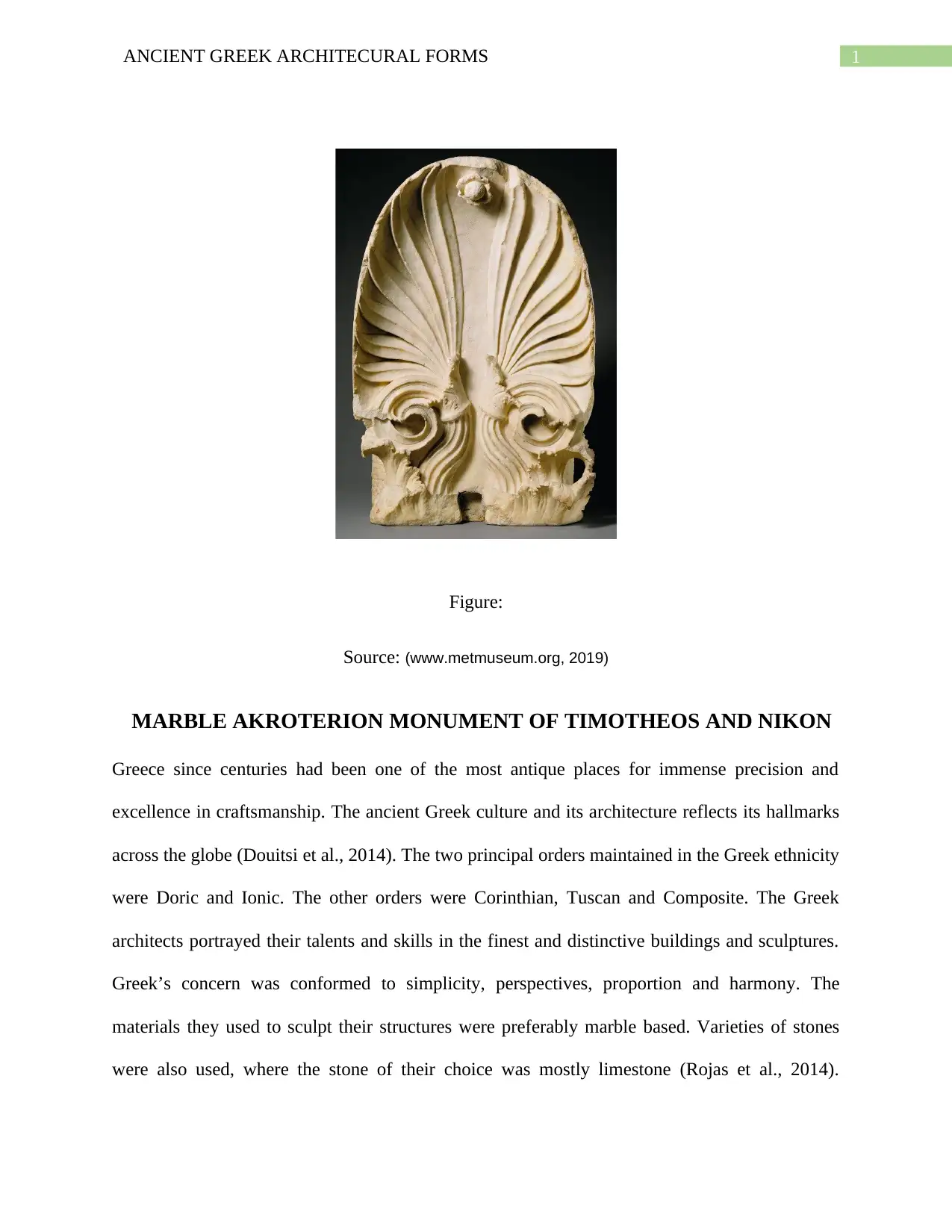
Figure:
Source: (www.metmuseum.org, 2019)
MARBLE AKROTERION MONUMENT OF TIMOTHEOS AND NIKON
Greece since centuries had been one of the most antique places for immense precision and
excellence in craftsmanship. The ancient Greek culture and its architecture reflects its hallmarks
across the globe (Douitsi et al., 2014). The two principal orders maintained in the Greek ethnicity
were Doric and Ionic. The other orders were Corinthian, Tuscan and Composite. The Greek
architects portrayed their talents and skills in the finest and distinctive buildings and sculptures.
Greek’s concern was conformed to simplicity, perspectives, proportion and harmony. The
materials they used to sculpt their structures were preferably marble based. Varieties of stones
were also used, where the stone of their choice was mostly limestone (Rojas et al., 2014).
Document Page
2ANCIENT GREEK ARCHITECURAL FORMS
Whatsoever sculptures the Greek carved, all reflected depth of serenity and their depth of
magnificent Doric and Ionic orders were all commence of excellence.
The architecture of Greece was not only restricted to building, monuments and
sculptures, there are also exceptionally beautifully crafted and carved Temples, Treasures and
Stoas. The architects used sophisticated geometry and optical tricks to depict in its art (Ricks &
Magdalino, 2016). Along with the boring of marble in its exterior it also used limestones and tufa
for carving its columns. Its interiors were so characteristically hand worked that even today’s
generation could not discover and weave such beauty through depiction. The sculptors from
Greek mainland and carved such freestanding and relieved sculptures had portrayed perfection
through every perspective way (Chin, 2015).
This sculpture is one of the prestigious sculptures of ancient Greece which was carved in
the classical period back then in 350-325 BC. This particular criterion classifies a stone sculpture
with marble as its main medium. The cultures entangled with it are basically Greek and Attic. .
According to the inscriptions of the monumental sculpture it was discovered that this grave was
sculpted in the honour of Timotheos and Nikon. Nikon was supposedly his son. It then happened
to be in a political district named Kephale. The front portion of the acroterion is decorated with
the geometries of palmate where its stems rise as spiral tendrils from a bed of acanthus leaves. At
the extreme top of the shelled liked case, is a flower, which once had a painted stem (Lazzarinni
et al., 2014). This entire structure of the grave is as spectating as its flawlessness. Greek culture
with its unimaginable patience and skills which the architects had put in to enhanced greatly
through its art. The architectural order governs the entire components of the sculpture as a result
even a piece of the Greek workmanship is significant to its integral overall structure. The vertical
arrangement and depiction of the sculpture symbolizes unified forms of symmetry and harmony.
Document Page
3ANCIENT GREEK ARCHITECURAL FORMS
The classic architecture and its contemporary influence still control the major perspective of
Greece. And its ethnicity and authenticity evolve through them. The art, its religion and
philosophy and its architectural styles highly influence the European contemporary as well as the
western world and culture. For many of us across the globe, architecture might seem very easy
and we shall take it for granted but beautiful things generally come out in the most ubiquitous
ways. Thereby the architectural tradition and designing reflect the ability of linking discrete
cultures together with time and space. Eventually it’s also a true fact (Lindtke et al., 2015).
tabler-icon-diamond-filled.svg

Paraphrase This Document

Need a fresh take? Get an instant paraphrase of this document with our AI Paraphraser
Document Page
4ANCIENT GREEK ARCHITECURAL FORMS
References
Chin, M. J. H. (2015). Honours for historians: historiography and civic identity in the Hellenistic and
Roman polis: third century BCE to third century CE.
Douitsi, A. (2017). Funeral Monuments in Macedonia during the Archaic and Classical periods.
Lazzarini, L., & Marconi, C. (2014). A new analysis of major Greek sculptures in the Metropolitan
Museum: petrological and stylistic. Metropolitan Museum Journal, 49(1), 117-140.
Lindtke, D., & Buerkle, C. A. (2015). The genetic architecture of hybrid incompatibilities and their effect on
barriers to introgression in secondary contact. Evolution, 69(8), 1987-2004.
Ricks, D., & Magdalino, P. (2016). Byzantium and the modern Greek identity. Routledge.
Rojas, F., & Sergueenkova, V. (2014). Traces of Tarhuntas: Greek, Roman, and Byzantine Interaction
with Hittite Monuments. Journal of Mediterranean Archaeology, 27(2), 135-160.
www.metmuseum.org. (2019). Retrieved from
https://www.metmuseum.org/toah/works-of-art/07.286.107/https://www.metmuseum.org/toah/
works-of-art/07.286.107/
chevron_up_icon
1 out of 5
circle_padding
hide_on_mobile
zoom_out_icon
[object Object]