Greek and Roman Civilization: An Analysis of the Ancient Polis

Verified

Added on  2022/09/18

|3
|393
|39
Homework Assignment
AI Summary
This assignment delves into the significance of the Polis in ancient Greek civilization. The paper begins by highlighting the geographical and political landscape of ancient Greece, emphasizing the mountainous terrain and the resulting formation of independent city-states. It then explores the concept of the Polis, detailing its role as a fortified area and its function in providing protection and fostering community development. The assignment explains the independence of each Polis and its impact on the regional governance. It further discusses the significance of the Agora and the Acropolis and how they contributed to the political and social structure of ancient Greece. The assignment concludes by emphasizing the importance of the Polis in maintaining governance and the regional differences. The assignment also includes references from the sources which were used to conduct the research.
Document Page
Running head: ENGLISH
Greek and Roman Civilization
Name of the Student:
Name of University:
Author Note
tabler-icon-diamond-filled.svg

Paraphrase This Document

Need a fresh take? Get an instant paraphrase of this document with our AI Paraphraser
Document Page
2
ENGLISH
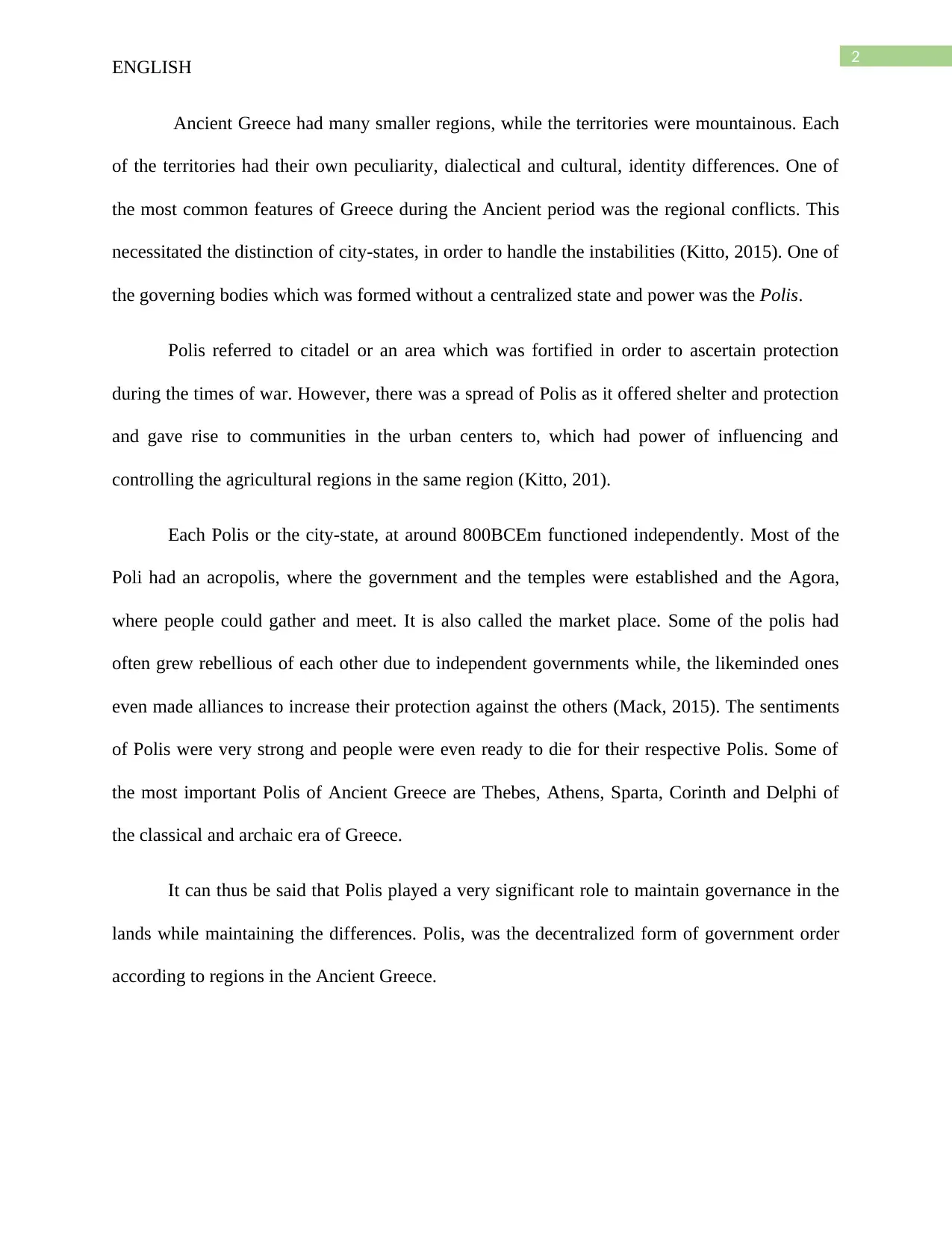
Ancient Greece had many smaller regions, while the territories were mountainous. Each
of the territories had their own peculiarity, dialectical and cultural, identity differences. One of
the most common features of Greece during the Ancient period was the regional conflicts. This
necessitated the distinction of city-states, in order to handle the instabilities (Kitto, 2015). One of
the governing bodies which was formed without a centralized state and power was the Polis.
Polis referred to citadel or an area which was fortified in order to ascertain protection
during the times of war. However, there was a spread of Polis as it offered shelter and protection
and gave rise to communities in the urban centers to, which had power of influencing and
controlling the agricultural regions in the same region (Kitto, 201).
Each Polis or the city-state, at around 800BCEm functioned independently. Most of the
Poli had an acropolis, where the government and the temples were established and the Agora,
where people could gather and meet. It is also called the market place. Some of the polis had
often grew rebellious of each other due to independent governments while, the likeminded ones
even made alliances to increase their protection against the others (Mack, 2015). The sentiments
of Polis were very strong and people were even ready to die for their respective Polis. Some of
the most important Polis of Ancient Greece are Thebes, Athens, Sparta, Corinth and Delphi of
the classical and archaic era of Greece.
It can thus be said that Polis played a very significant role to maintain governance in the
lands while maintaining the differences. Polis, was the decentralized form of government order
according to regions in the Ancient Greece.
Document Page
3
ENGLISH
References
Kitto, H. D. (2015). The polis. In The City Reader (pp. 63-68). Routledge.
Mack, W. J. B. G. (2015). Proxeny and Polis: institutional networks in the ancient Greek world.
Oxford University Press, USA.
chevron_up_icon
1 out of 3
circle_padding
hide_on_mobile
zoom_out_icon
[object Object]