Report on Animal Livestock Industry, Biosecurity, and Outbreaks
VerifiedAdded on 2023/01/06
|10
|3102
|27
Report
AI Summary
This report delves into the animal livestock industry, focusing on agriculture and its specific subsidiary. It identifies and applies various biosecurity measures to protect animal livestock, particularly horses, from diseases like Equine Encephalitis, within the context of Australian policies. The report examines the roles of biosecurity agencies in managing outbreaks, such as the recent Eastern Equine Encephalitis outbreak in the United States, and discusses the processes and aspects of the industry affected by such breaches. It further analyzes the efficiency of biosecurity practices, relating them to Australian biosecurity aims and strategies, concluding with recommendations for enhancing these measures to safeguard animal health and the agricultural sector. The report highlights the significance of insect repellents, protective screens, inoculation programs, improved nutrition, and limiting animal-to-animal contact as key biosecurity measures. Additionally, it discusses the roles of key agencies like Animal Health Australia and the Department of Agriculture, Water, and Environment in dealing with outbreaks.
ANIMAL
LIVESTOCK
LIVESTOCK

Paraphrase This Document
Need a fresh take? Get an instant paraphrase of this document with our AI Paraphraser
Contents
Introduction......................................................................................................................................4
Industry (Agriculture - Animal Livestock)......................................................................................4
Bio-security measures that should be applied.................................................................................5
Recent outbreak and discuss which process/aspect of this industry or business was affected by
this breach........................................................................................................................................6
Role of the different bio-security agencies involved in dealing with this outbreak........................7
How best to increase the efficiency of the above-mentioned practices and bio security measures
and relate them to the Australian bio security aims or strategies....................................................8
CONCLUSION................................................................................................................................9
References......................................................................................................................................10
Introduction......................................................................................................................................4
Industry (Agriculture - Animal Livestock)......................................................................................4
Bio-security measures that should be applied.................................................................................5
Recent outbreak and discuss which process/aspect of this industry or business was affected by
this breach........................................................................................................................................6
Role of the different bio-security agencies involved in dealing with this outbreak........................7
How best to increase the efficiency of the above-mentioned practices and bio security measures
and relate them to the Australian bio security aims or strategies....................................................8
CONCLUSION................................................................................................................................9
References......................................................................................................................................10

⊘ This is a preview!⊘
Do you want full access?
Subscribe today to unlock all pages.

Trusted by 1+ million students worldwide
Introduction
This report will be delivering information in relation with a particular industry that is
agriculture and the specific subsidiary of this particular industry that has been taken into
consideration is animal livestock. On the other hand, different bio security measures will be
identified and applied on existing Australian policies to keep animal livestock safe from various
diseases and maladies. Including this, report will also be focusing on different roles of a security
agencies and there will be a discussion is also so being taken into consideration of outbreak
particular disease i.e. Equine Encephalitis. Lastly, different efficiency level of various
biosecurity measures will be discussed.
Industry (Agriculture - Animal Livestock)
The particular industries that has been taken into consideration in this report is agriculture,
where the focus will be on animal livestock which are considered to be the domesticated animals
that helps in raising agricultural setting (Hu, Park & Reecy, 2019). Basically, these animals help
in in producing labour along with different range of commodities like eggs, milk, meat, fur, wool
and leather. On the other hand, this particular term specifically referred to bred for consumption
and also why sometimes to be called as farmed ruminants like goats, cattle and so on. However,
just like outbreak of COVID-19 where the whole world is dealing with, it has been analysed that
there are ample number of animal related diseases have also came in front like food to mouth
disease and so on, which resulted into negative impact on agriculture industry at both national
and international level (Neethirajan & Kelton, 2017). In present context, the particular animal on
which this whole investigation will be based on Horses which comes under livestock category in
United States. Recent outbreak of disease named as Eastern Equine Encephalitis (EEE) has
affected the agricultural industry of United States, which was first time recognised in
Massachusetts in the year of 1831. Because of this particular outbreak of disease named as
eastern equine encephalitis, agricultural industry has faced ample number of difficulties like it
can cost a farmer beyond the cost of horses and poultry. There were many decisions that was
changed by political parties of United States in the year of 1831 when approximately 75 horses
died mysteriously. The basic reason behind the that was viral encephalitis, which was
continuously costing really very high to farmers using horses as their transport channel because
This report will be delivering information in relation with a particular industry that is
agriculture and the specific subsidiary of this particular industry that has been taken into
consideration is animal livestock. On the other hand, different bio security measures will be
identified and applied on existing Australian policies to keep animal livestock safe from various
diseases and maladies. Including this, report will also be focusing on different roles of a security
agencies and there will be a discussion is also so being taken into consideration of outbreak
particular disease i.e. Equine Encephalitis. Lastly, different efficiency level of various
biosecurity measures will be discussed.
Industry (Agriculture - Animal Livestock)
The particular industries that has been taken into consideration in this report is agriculture,
where the focus will be on animal livestock which are considered to be the domesticated animals
that helps in raising agricultural setting (Hu, Park & Reecy, 2019). Basically, these animals help
in in producing labour along with different range of commodities like eggs, milk, meat, fur, wool
and leather. On the other hand, this particular term specifically referred to bred for consumption
and also why sometimes to be called as farmed ruminants like goats, cattle and so on. However,
just like outbreak of COVID-19 where the whole world is dealing with, it has been analysed that
there are ample number of animal related diseases have also came in front like food to mouth
disease and so on, which resulted into negative impact on agriculture industry at both national
and international level (Neethirajan & Kelton, 2017). In present context, the particular animal on
which this whole investigation will be based on Horses which comes under livestock category in
United States. Recent outbreak of disease named as Eastern Equine Encephalitis (EEE) has
affected the agricultural industry of United States, which was first time recognised in
Massachusetts in the year of 1831. Because of this particular outbreak of disease named as
eastern equine encephalitis, agricultural industry has faced ample number of difficulties like it
can cost a farmer beyond the cost of horses and poultry. There were many decisions that was
changed by political parties of United States in the year of 1831 when approximately 75 horses
died mysteriously. The basic reason behind the that was viral encephalitis, which was
continuously costing really very high to farmers using horses as their transport channel because
Paraphrase This Document
Need a fresh take? Get an instant paraphrase of this document with our AI Paraphraser
in earlier times no motors were utilised to transport raw materials, final products and so on (Ruan
& Li, 2017).
This impacted negatively on agriculture industry of United States because agencies like
South Carolina department of health and environmental control (DHEC) Tata testing the blood
samples were they have announced that Eastern Equine Encephalitis (EEE) which is considered
to be mosquito borne illness was found among 11 horses in 8 South Carolina counties where
Berkeley, Horry, Aiken, Colleton, Florence, Jasper, Marion, Lexington and so on were the
counties which this particular virus was found.
Bio-security measures that should be applied
Biosecurity is being referred to the steps taken for prevention or measures in order to stop
reduce the introduction of harmful organisms or spread of viruses among different species like
plants, animal and human. It has been analysed that bio security measures are required to be
implemented so that reduction within the risk of chances of an infection in equine species can
easily be done (Halachmi & Guarino, 2016). Basically, equine encephalitis is said to be a disease
which is caused by specific kind of mosquito. The primal approach that can be considered by any
country in order to reduce the chances of spreading of this particular disease is to reduce the
mosquito population. On the other hand, there are ample number of bio security measures that
can be taken into consideration in Australia in order to prevent Equine Encephalitis and some of
these are presented underneath:
When it comes to reduce the infection among horses then the particular bio security
measure, that can be taken into consideration is to use insect repellent with them stable.
This will help Australian horses to reduce the chances of getting infected by Equine
Encephalitis.
Another biosecurity measure, which is required to be taken into consideration is using
screens on windows and doors with no holes in the stable that will help horses to reduce
the chances of getting stung by mosquitos (Grandin, 2019).
Including this, drilling holes in bottom of water holding containers is also said to be a
crucial biosecurity measure that would help in reducing the chances of horses getting
bitten by mosquitoes.
Inoculation is considered to be the initial step to anticipation is to keep horses on an
inoculation program that considers his/her activity (joy horse, show creature, working
& Li, 2017).
This impacted negatively on agriculture industry of United States because agencies like
South Carolina department of health and environmental control (DHEC) Tata testing the blood
samples were they have announced that Eastern Equine Encephalitis (EEE) which is considered
to be mosquito borne illness was found among 11 horses in 8 South Carolina counties where
Berkeley, Horry, Aiken, Colleton, Florence, Jasper, Marion, Lexington and so on were the
counties which this particular virus was found.
Bio-security measures that should be applied
Biosecurity is being referred to the steps taken for prevention or measures in order to stop
reduce the introduction of harmful organisms or spread of viruses among different species like
plants, animal and human. It has been analysed that bio security measures are required to be
implemented so that reduction within the risk of chances of an infection in equine species can
easily be done (Halachmi & Guarino, 2016). Basically, equine encephalitis is said to be a disease
which is caused by specific kind of mosquito. The primal approach that can be considered by any
country in order to reduce the chances of spreading of this particular disease is to reduce the
mosquito population. On the other hand, there are ample number of bio security measures that
can be taken into consideration in Australia in order to prevent Equine Encephalitis and some of
these are presented underneath:
When it comes to reduce the infection among horses then the particular bio security
measure, that can be taken into consideration is to use insect repellent with them stable.
This will help Australian horses to reduce the chances of getting infected by Equine
Encephalitis.
Another biosecurity measure, which is required to be taken into consideration is using
screens on windows and doors with no holes in the stable that will help horses to reduce
the chances of getting stung by mosquitos (Grandin, 2019).
Including this, drilling holes in bottom of water holding containers is also said to be a
crucial biosecurity measure that would help in reducing the chances of horses getting
bitten by mosquitoes.
Inoculation is considered to be the initial step to anticipation is to keep horses on an
inoculation program that considers his/her activity (joy horse, show creature, working
creature, partner), general wellbeing status (age, history of ailment, and so forth),
measure of movement, and area (a few districts present more danger of sickness than
others). This inoculation program ought to be talked about and actualized with
veterinarian.
Stress may lead horses towards insusceptible frameworks and make them more
vulnerable to disease. Another bio security measure that came in front was to improve
nutrition where satisfactory nourishment keeping horses solid and sound and gives him
the apparatuses he needs to fend off potential diseases (Sweeney & Watts, 2018).
Continuation in the practice of biosecurity where proper utilisation of the entirety of
assets to figure out what parts of horses’s everyday life puts them in danger for malady
and build up an arrangement for lessening those dangers like Equine Encephalitis.
Limit horse-to-horses and horses to-human communication is also said to be another
crucial step to reduce the chances for a horse to get Equine Encephalitis. Basically, one is
more difficult than one might expect given the gregarious idea of the horses yet is
imperative to horse wellbeing. Horses and people can be transporters for the
microorganisms that cause sickness (Friggens & Puillet, 2017). Build up gatherings of
horses on Australians games like horse riding and so on are required to be lessen and it is
also needed towards urge all people to abstain from interfacing with numerous creatures
without sanitizing between contact.
Recent outbreak and discuss which process/aspect of this industry or business
was affected by this breach
The South Carolina Department of Health and Environmental Control (DHEC) declared that
Eastern Equine Encephalitis (EEE), a mosquito-borne ailment, has been distinguished in 11
horses in 8 South Carolina provinces in the Lowcountry, Midlands, and Pee Dee areas from July
10 to August 21, 2020.
The EEE infection enhances itself in nature during spring and summer by being
communicated between dark followed mosquitoes (Culiseta melanura) and different tree-
roosting feathered creatures in forested freshwater swamps. Since dark followed mosquitoes
flourish in these marshes in the northeastern and southern pieces of the state, EEE infection is all
the more regularly identified in the Lowcountry, Midlands, and locales.
measure of movement, and area (a few districts present more danger of sickness than
others). This inoculation program ought to be talked about and actualized with
veterinarian.
Stress may lead horses towards insusceptible frameworks and make them more
vulnerable to disease. Another bio security measure that came in front was to improve
nutrition where satisfactory nourishment keeping horses solid and sound and gives him
the apparatuses he needs to fend off potential diseases (Sweeney & Watts, 2018).
Continuation in the practice of biosecurity where proper utilisation of the entirety of
assets to figure out what parts of horses’s everyday life puts them in danger for malady
and build up an arrangement for lessening those dangers like Equine Encephalitis.
Limit horse-to-horses and horses to-human communication is also said to be another
crucial step to reduce the chances for a horse to get Equine Encephalitis. Basically, one is
more difficult than one might expect given the gregarious idea of the horses yet is
imperative to horse wellbeing. Horses and people can be transporters for the
microorganisms that cause sickness (Friggens & Puillet, 2017). Build up gatherings of
horses on Australians games like horse riding and so on are required to be lessen and it is
also needed towards urge all people to abstain from interfacing with numerous creatures
without sanitizing between contact.
Recent outbreak and discuss which process/aspect of this industry or business
was affected by this breach
The South Carolina Department of Health and Environmental Control (DHEC) declared that
Eastern Equine Encephalitis (EEE), a mosquito-borne ailment, has been distinguished in 11
horses in 8 South Carolina provinces in the Lowcountry, Midlands, and Pee Dee areas from July
10 to August 21, 2020.
The EEE infection enhances itself in nature during spring and summer by being
communicated between dark followed mosquitoes (Culiseta melanura) and different tree-
roosting feathered creatures in forested freshwater swamps. Since dark followed mosquitoes
flourish in these marshes in the northeastern and southern pieces of the state, EEE infection is all
the more regularly identified in the Lowcountry, Midlands, and locales.
⊘ This is a preview!⊘
Do you want full access?
Subscribe today to unlock all pages.
Trusted by 1+ million students worldwide
During pre-fall and fall, the infection is gained by other mosquito species in the wake of
having benefited from EEE-infection contaminated feathered creatures. These other mosquito
species are then ready to send EEE infection to individuals and different creatures, for example,
horses. The infection can't be communicated legitimately from horses to individuals or from
horses to mosquitoes.
In horses, EEE infection takes two to five days to cause manifestations and has a 90 percent
casualty rate. The infection causes bumbling and helpless coordination, failure to rise, loss of
motion, head squeezing, revolving around and seizures. Veterinarians in South Carolina much of
the time prescribe inoculation before likely presentation to mosquito chomps and supporter
immunizations to guarantee suitable insusceptibility levels (Hostiou & Allain, 2017).
Counselling with veterinarian for immunization direction. In North America, EEE has been
viewed as endemic for decades. This ailment is more common in the South-eastern regions of US
with a high casualty rate. In any case, since 2005, the geographic scope of the infection has
spread northwards and 8.7% seroprevalence was accounted for in horses in Southern areas in
2012. On the other hand, it has been found that Madariaga infection (MADV) is the new species
assignment for the South American detaches of EEE infection (recently alluded to as EEE
ancestries II, III, and IV) similarly to distinctive pathogenesis and biology and hereditary
disparity from North American strains. In America (Central and Southern region), a very few
episodes of MADV with low casualty rate have been accounted for somewhere in the range of
the1930s and 1990s. More as of late, bigger flare-ups of higher dreariness and mortality have
occurred.10–12 In Brazil, high casualty rate flare-ups were accounted for somewhere in the
range of 2008 and 2009 with 229 horses affected.13 In 2010, seroprevalence of MADV in horses
was accounted for to be 26.3% in Panama and 9.9% in Brazil.
Role of the different bio-security agencies involved in dealing with this
outbreak
Eastern equine encephalitis is the virus that can cause nonspecific illness and encephalitis in
equids among various animals like horses, burros, donkeys, zebras and so on. This virus also
impacts birds and occasionally mammals as well and for this no particular treatment is available
and depending on the viruses and form of disease and for this the case fatality rate gets high
around 90% (Yaro & Groth, 2016). In regard of this various agencies plays an important role in
having benefited from EEE-infection contaminated feathered creatures. These other mosquito
species are then ready to send EEE infection to individuals and different creatures, for example,
horses. The infection can't be communicated legitimately from horses to individuals or from
horses to mosquitoes.
In horses, EEE infection takes two to five days to cause manifestations and has a 90 percent
casualty rate. The infection causes bumbling and helpless coordination, failure to rise, loss of
motion, head squeezing, revolving around and seizures. Veterinarians in South Carolina much of
the time prescribe inoculation before likely presentation to mosquito chomps and supporter
immunizations to guarantee suitable insusceptibility levels (Hostiou & Allain, 2017).
Counselling with veterinarian for immunization direction. In North America, EEE has been
viewed as endemic for decades. This ailment is more common in the South-eastern regions of US
with a high casualty rate. In any case, since 2005, the geographic scope of the infection has
spread northwards and 8.7% seroprevalence was accounted for in horses in Southern areas in
2012. On the other hand, it has been found that Madariaga infection (MADV) is the new species
assignment for the South American detaches of EEE infection (recently alluded to as EEE
ancestries II, III, and IV) similarly to distinctive pathogenesis and biology and hereditary
disparity from North American strains. In America (Central and Southern region), a very few
episodes of MADV with low casualty rate have been accounted for somewhere in the range of
the1930s and 1990s. More as of late, bigger flare-ups of higher dreariness and mortality have
occurred.10–12 In Brazil, high casualty rate flare-ups were accounted for somewhere in the
range of 2008 and 2009 with 229 horses affected.13 In 2010, seroprevalence of MADV in horses
was accounted for to be 26.3% in Panama and 9.9% in Brazil.
Role of the different bio-security agencies involved in dealing with this
outbreak
Eastern equine encephalitis is the virus that can cause nonspecific illness and encephalitis in
equids among various animals like horses, burros, donkeys, zebras and so on. This virus also
impacts birds and occasionally mammals as well and for this no particular treatment is available
and depending on the viruses and form of disease and for this the case fatality rate gets high
around 90% (Yaro & Groth, 2016). In regard of this various agencies plays an important role in
Paraphrase This Document
Need a fresh take? Get an instant paraphrase of this document with our AI Paraphraser
terms of dealing with this outbreak named Eastern equine encephalitis which are mentioned as
underneath:
Animal Health of Australia (AHA): In regard of this the state government is responsible for
Quarantine and at the national animal health affairs as they are responsible for controlling the
diseases. In terms of this animal health in Australia plays an important role in order to control the
outbreak among horses as detect surveillance on priority basis which is influenced by risk of
food safety livestock productivity market access and public health. In terms of this the prominent
monitoring and surveillance activities are managed by the agency itself and also target define
disease in order to involve the response that clinically impact animals and their health (Sasson,
2016). For this the major role of animal health in Australia plays towards the disease is that the
provide proper medicines and Vaccine of this disease to each and every Clinic and Hospital by
which doctors can prominently take care of horses. Along with this they also tend to develop
prominent strategies that offer Framework for animal diseases surveillance and planning that
include disease threats to the human health and wildlife health (Fontanesi, 2016). Furthermore,
the key objective of the strategy is the frequent identification of exotic and re-emerging
infectious disease for the national and international significance.
Department of agriculture, water and environment: This department develop plans for the
Australian livestock industries and government which is the prominent requirement for the
emergency animal disease response agreement and it need proper funding resource allocation
and proper risk management (Llonch & Turner, 2017). By considering the outbreak in Australia
among the horses spread rapidly that can harm the life of animals and for this the concerning
department developed prominent guidelines and strategies in order to protect their animals and
also provide financial help to the hospitals and clinics in terms of taking care of horses in order
to overcome the disease. This agency and livestock Industries take initiative in terms of
increasing awareness regarding the disease undertaking the biosecurity practices in order to
protect against the emergency of animal diseases (Mottram, 2016). For this the undertake new
governance arrangements and the replacement of existing mandatory intervention targets with
the prominent risk-return approach towards the bio security management. In relation with this by
security Australia began an import risk analysis for the importation of horses undertaking their
condition.
underneath:
Animal Health of Australia (AHA): In regard of this the state government is responsible for
Quarantine and at the national animal health affairs as they are responsible for controlling the
diseases. In terms of this animal health in Australia plays an important role in order to control the
outbreak among horses as detect surveillance on priority basis which is influenced by risk of
food safety livestock productivity market access and public health. In terms of this the prominent
monitoring and surveillance activities are managed by the agency itself and also target define
disease in order to involve the response that clinically impact animals and their health (Sasson,
2016). For this the major role of animal health in Australia plays towards the disease is that the
provide proper medicines and Vaccine of this disease to each and every Clinic and Hospital by
which doctors can prominently take care of horses. Along with this they also tend to develop
prominent strategies that offer Framework for animal diseases surveillance and planning that
include disease threats to the human health and wildlife health (Fontanesi, 2016). Furthermore,
the key objective of the strategy is the frequent identification of exotic and re-emerging
infectious disease for the national and international significance.
Department of agriculture, water and environment: This department develop plans for the
Australian livestock industries and government which is the prominent requirement for the
emergency animal disease response agreement and it need proper funding resource allocation
and proper risk management (Llonch & Turner, 2017). By considering the outbreak in Australia
among the horses spread rapidly that can harm the life of animals and for this the concerning
department developed prominent guidelines and strategies in order to protect their animals and
also provide financial help to the hospitals and clinics in terms of taking care of horses in order
to overcome the disease. This agency and livestock Industries take initiative in terms of
increasing awareness regarding the disease undertaking the biosecurity practices in order to
protect against the emergency of animal diseases (Mottram, 2016). For this the undertake new
governance arrangements and the replacement of existing mandatory intervention targets with
the prominent risk-return approach towards the bio security management. In relation with this by
security Australia began an import risk analysis for the importation of horses undertaking their
condition.
How best to increase the efficiency of the above-mentioned practices and bio
security measures and relate them to the Australian bio security aims or
strategies.
The particular vaccine that has already been formulated by different veterans and scientist in
relation with EEE, are of some of the other type of diseases like Western Equine Encephalitis
virus, tetanus and so on. However, there is no cure for this particular disease has came in front,
therefore it can be said that prevention that has already been utilised by Australia's bio security
agencies like they have formulated a guideline like using insect repellent, reducing the amount of
sending water in the best means for prevention, and so on. this particular strategy and including
some of the other strategies like keeping animals quarantined for a period of time and so on has
helped Australia in reducing the chances of outbreak of this kind of diseases (Carvalho &
Anghinoni, 2018).
Department of agriculture water and the environment has given the information that
following particular guidelines like keeping holes in the sections where water resists, utilisation
of repellent, and so on has helped Australia in keeping local horses safe even when they are
travelling from one country to another like United States, Europe and so on (de Souza Filho & de
Faccio Carvalho, 2019).
CONCLUSION
With the help of above mentioned report, it is being concluded that taking into different
practices like Inoculation programs, keeping distance, mosquito repellent and so on, may
effectively reduce the chances of spread of Equine Encephalitis. On the other hand, continuous
improvement among biosecurity measures and different interventions will help Australia to keep
itself safe from various contagious diseases that may lead animal livestock to extinction related
position.
security measures and relate them to the Australian bio security aims or
strategies.
The particular vaccine that has already been formulated by different veterans and scientist in
relation with EEE, are of some of the other type of diseases like Western Equine Encephalitis
virus, tetanus and so on. However, there is no cure for this particular disease has came in front,
therefore it can be said that prevention that has already been utilised by Australia's bio security
agencies like they have formulated a guideline like using insect repellent, reducing the amount of
sending water in the best means for prevention, and so on. this particular strategy and including
some of the other strategies like keeping animals quarantined for a period of time and so on has
helped Australia in reducing the chances of outbreak of this kind of diseases (Carvalho &
Anghinoni, 2018).
Department of agriculture water and the environment has given the information that
following particular guidelines like keeping holes in the sections where water resists, utilisation
of repellent, and so on has helped Australia in keeping local horses safe even when they are
travelling from one country to another like United States, Europe and so on (de Souza Filho & de
Faccio Carvalho, 2019).
CONCLUSION
With the help of above mentioned report, it is being concluded that taking into different
practices like Inoculation programs, keeping distance, mosquito repellent and so on, may
effectively reduce the chances of spread of Equine Encephalitis. On the other hand, continuous
improvement among biosecurity measures and different interventions will help Australia to keep
itself safe from various contagious diseases that may lead animal livestock to extinction related
position.
⊘ This is a preview!⊘
Do you want full access?
Subscribe today to unlock all pages.
Trusted by 1+ million students worldwide
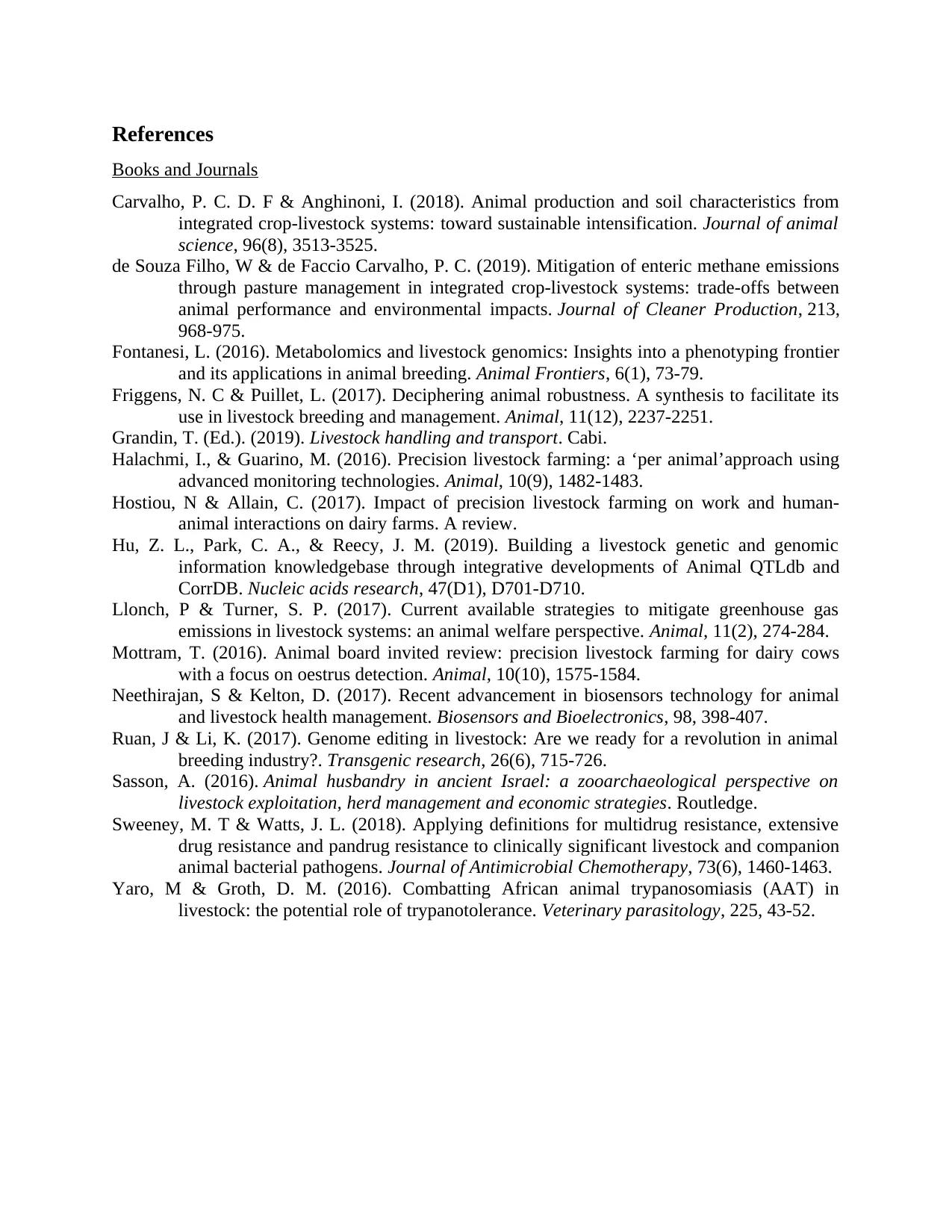
References
Books and Journals
Carvalho, P. C. D. F & Anghinoni, I. (2018). Animal production and soil characteristics from
integrated crop-livestock systems: toward sustainable intensification. Journal of animal
science, 96(8), 3513-3525.
de Souza Filho, W & de Faccio Carvalho, P. C. (2019). Mitigation of enteric methane emissions
through pasture management in integrated crop-livestock systems: trade-offs between
animal performance and environmental impacts. Journal of Cleaner Production, 213,
968-975.
Fontanesi, L. (2016). Metabolomics and livestock genomics: Insights into a phenotyping frontier
and its applications in animal breeding. Animal Frontiers, 6(1), 73-79.
Friggens, N. C & Puillet, L. (2017). Deciphering animal robustness. A synthesis to facilitate its
use in livestock breeding and management. Animal, 11(12), 2237-2251.
Grandin, T. (Ed.). (2019). Livestock handling and transport. Cabi.
Halachmi, I., & Guarino, M. (2016). Precision livestock farming: a ‘per animal’approach using
advanced monitoring technologies. Animal, 10(9), 1482-1483.
Hostiou, N & Allain, C. (2017). Impact of precision livestock farming on work and human-
animal interactions on dairy farms. A review.
Hu, Z. L., Park, C. A., & Reecy, J. M. (2019). Building a livestock genetic and genomic
information knowledgebase through integrative developments of Animal QTLdb and
CorrDB. Nucleic acids research, 47(D1), D701-D710.
Llonch, P & Turner, S. P. (2017). Current available strategies to mitigate greenhouse gas
emissions in livestock systems: an animal welfare perspective. Animal, 11(2), 274-284.
Mottram, T. (2016). Animal board invited review: precision livestock farming for dairy cows
with a focus on oestrus detection. Animal, 10(10), 1575-1584.
Neethirajan, S & Kelton, D. (2017). Recent advancement in biosensors technology for animal
and livestock health management. Biosensors and Bioelectronics, 98, 398-407.
Ruan, J & Li, K. (2017). Genome editing in livestock: Are we ready for a revolution in animal
breeding industry?. Transgenic research, 26(6), 715-726.
Sasson, A. (2016). Animal husbandry in ancient Israel: a zooarchaeological perspective on
livestock exploitation, herd management and economic strategies. Routledge.
Sweeney, M. T & Watts, J. L. (2018). Applying definitions for multidrug resistance, extensive
drug resistance and pandrug resistance to clinically significant livestock and companion
animal bacterial pathogens. Journal of Antimicrobial Chemotherapy, 73(6), 1460-1463.
Yaro, M & Groth, D. M. (2016). Combatting African animal trypanosomiasis (AAT) in
livestock: the potential role of trypanotolerance. Veterinary parasitology, 225, 43-52.
Books and Journals
Carvalho, P. C. D. F & Anghinoni, I. (2018). Animal production and soil characteristics from
integrated crop-livestock systems: toward sustainable intensification. Journal of animal
science, 96(8), 3513-3525.
de Souza Filho, W & de Faccio Carvalho, P. C. (2019). Mitigation of enteric methane emissions
through pasture management in integrated crop-livestock systems: trade-offs between
animal performance and environmental impacts. Journal of Cleaner Production, 213,
968-975.
Fontanesi, L. (2016). Metabolomics and livestock genomics: Insights into a phenotyping frontier
and its applications in animal breeding. Animal Frontiers, 6(1), 73-79.
Friggens, N. C & Puillet, L. (2017). Deciphering animal robustness. A synthesis to facilitate its
use in livestock breeding and management. Animal, 11(12), 2237-2251.
Grandin, T. (Ed.). (2019). Livestock handling and transport. Cabi.
Halachmi, I., & Guarino, M. (2016). Precision livestock farming: a ‘per animal’approach using
advanced monitoring technologies. Animal, 10(9), 1482-1483.
Hostiou, N & Allain, C. (2017). Impact of precision livestock farming on work and human-
animal interactions on dairy farms. A review.
Hu, Z. L., Park, C. A., & Reecy, J. M. (2019). Building a livestock genetic and genomic
information knowledgebase through integrative developments of Animal QTLdb and
CorrDB. Nucleic acids research, 47(D1), D701-D710.
Llonch, P & Turner, S. P. (2017). Current available strategies to mitigate greenhouse gas
emissions in livestock systems: an animal welfare perspective. Animal, 11(2), 274-284.
Mottram, T. (2016). Animal board invited review: precision livestock farming for dairy cows
with a focus on oestrus detection. Animal, 10(10), 1575-1584.
Neethirajan, S & Kelton, D. (2017). Recent advancement in biosensors technology for animal
and livestock health management. Biosensors and Bioelectronics, 98, 398-407.
Ruan, J & Li, K. (2017). Genome editing in livestock: Are we ready for a revolution in animal
breeding industry?. Transgenic research, 26(6), 715-726.
Sasson, A. (2016). Animal husbandry in ancient Israel: a zooarchaeological perspective on
livestock exploitation, herd management and economic strategies. Routledge.
Sweeney, M. T & Watts, J. L. (2018). Applying definitions for multidrug resistance, extensive
drug resistance and pandrug resistance to clinically significant livestock and companion
animal bacterial pathogens. Journal of Antimicrobial Chemotherapy, 73(6), 1460-1463.
Yaro, M & Groth, D. M. (2016). Combatting African animal trypanosomiasis (AAT) in
livestock: the potential role of trypanotolerance. Veterinary parasitology, 225, 43-52.

1 out of 10


Your All-in-One AI-Powered Toolkit for Academic Success.
+13062052269
info@desklib.com
Available 24*7 on WhatsApp / Email
![[object Object]](/_next/static/media/star-bottom.7253800d.svg)
Unlock your academic potential
Copyright © 2020–2026 A2Z Services. All Rights Reserved. Developed and managed by ZUCOL.