Animal Physiology Lab Report: Experiments on Animal Physiology
VerifiedAdded on 2021/04/19
|8
|1440
|282
Report
AI Summary
This laboratory report details three experiments in animal physiology. The first experiment investigates sodium uptake and loss in freshwater crayfish, focusing on osmoregulation and the relationship between the crayfish and its environment. The second experiment explores kidney function, including the role of nephrons, hormone production, and waste excretion. The third experiment examines the selective permeability of mammalian red blood cells, including their response to varying osmotic concentrations and the phenomenon of hemolysis. The report includes methods, results, and discussions for each experiment, along with relevant references. The experiments cover critical aspects of animal physiology, providing insights into how animals maintain internal balance and respond to their environment.
Running head: LABORATORY REPORT 1
Laboratory Report
Students Name
University Affiliate
Laboratory Report
Students Name
University Affiliate
Paraphrase This Document
Need a fresh take? Get an instant paraphrase of this document with our AI Paraphraser

LABORATORY REPORT 2
LABORATORY REPORT
Animal physiology is the study of chemical and physical interior functions of animals.
Expt 1: Sodium Uptake and Loss in Fresh Water Crayfish
Introduction
Crayfish absorbs sodium and chloride ions from very dilute solutions. Absorption is continuous
as part of salt balance mechanism. There is a salt balance when the salt uptake rate equals the
total salt lost. The crayfish for this experiment was acclimated to low sodium concentration for
two weeks. This experiment intends to investigate how sodium is absorbed and lost by crayfish
to its environment.
Methods
1. The Crayfish was rinsed off with distilled water and its weight recorded.
2. It was placed in the measured volume of the appropriate experimental sodium
concentration.
3. After five minutes time 0 sample was taken by removing a 5ml water sample into a clean
tube and time recorded. This step was repeated at 30, 60 and 90 minutes.
4. Using the correct worksheet calibration curve, values were entered into the grey cells,
and sample photometer readings were added to obtain sodium concentration for the
sample.
5. The values for the medium sodium concentration and uptake rate were then entered on
the class results table on the whiteboard before leaving the laboratory.
6. On week two, a worksheet was provided and the data was filled in to complete it.
7. All the green cells were filled
LABORATORY REPORT
Animal physiology is the study of chemical and physical interior functions of animals.
Expt 1: Sodium Uptake and Loss in Fresh Water Crayfish
Introduction
Crayfish absorbs sodium and chloride ions from very dilute solutions. Absorption is continuous
as part of salt balance mechanism. There is a salt balance when the salt uptake rate equals the
total salt lost. The crayfish for this experiment was acclimated to low sodium concentration for
two weeks. This experiment intends to investigate how sodium is absorbed and lost by crayfish
to its environment.
Methods
1. The Crayfish was rinsed off with distilled water and its weight recorded.
2. It was placed in the measured volume of the appropriate experimental sodium
concentration.
3. After five minutes time 0 sample was taken by removing a 5ml water sample into a clean
tube and time recorded. This step was repeated at 30, 60 and 90 minutes.
4. Using the correct worksheet calibration curve, values were entered into the grey cells,
and sample photometer readings were added to obtain sodium concentration for the
sample.
5. The values for the medium sodium concentration and uptake rate were then entered on
the class results table on the whiteboard before leaving the laboratory.
6. On week two, a worksheet was provided and the data was filled in to complete it.
7. All the green cells were filled

LABORATORY REPORT 3
8. The mean and standard error values were calculated both for the sodium concentration in
the water and sodium influx rate.
9. Passive sodium loss was determined, and Jmax values were derived
Results
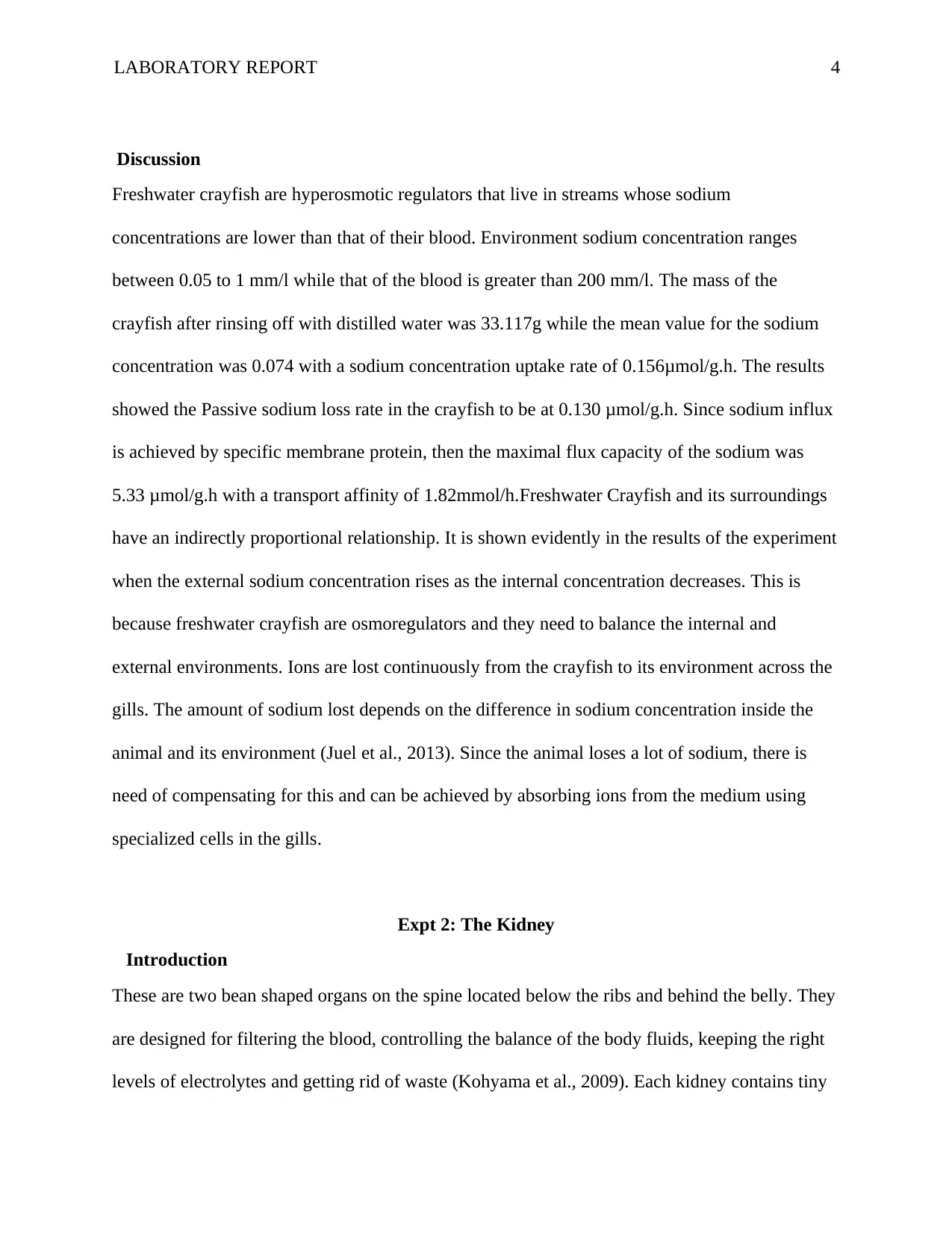
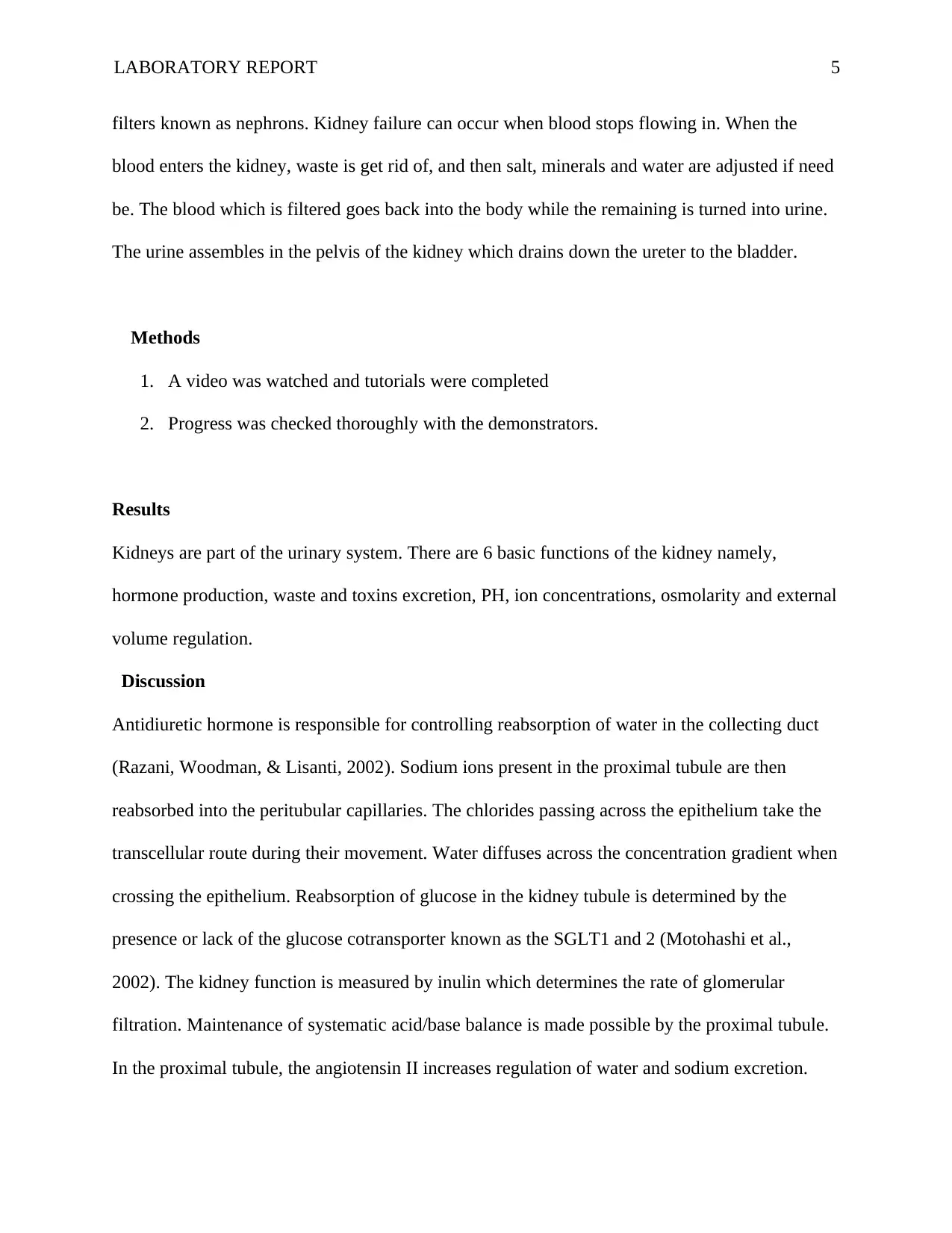
The results are as shown below
8. The mean and standard error values were calculated both for the sodium concentration in
the water and sodium influx rate.
9. Passive sodium loss was determined, and Jmax values were derived
Results
The results are as shown below
⊘ This is a preview!⊘
Do you want full access?
Subscribe today to unlock all pages.

Trusted by 1+ million students worldwide

LABORATORY REPORT 4
Discussion
Freshwater crayfish are hyperosmotic regulators that live in streams whose sodium
concentrations are lower than that of their blood. Environment sodium concentration ranges
between 0.05 to 1 mm/l while that of the blood is greater than 200 mm/l. The mass of the
crayfish after rinsing off with distilled water was 33.117g while the mean value for the sodium
concentration was 0.074 with a sodium concentration uptake rate of 0.156μmol/g.h. The results
showed the Passive sodium loss rate in the crayfish to be at 0.130 μmol/g.h. Since sodium influx
is achieved by specific membrane protein, then the maximal flux capacity of the sodium was
5.33 μmol/g.h with a transport affinity of 1.82mmol/h.Freshwater Crayfish and its surroundings
have an indirectly proportional relationship. It is shown evidently in the results of the experiment
when the external sodium concentration rises as the internal concentration decreases. This is
because freshwater crayfish are osmoregulators and they need to balance the internal and
external environments. Ions are lost continuously from the crayfish to its environment across the
gills. The amount of sodium lost depends on the difference in sodium concentration inside the
animal and its environment (Juel et al., 2013). Since the animal loses a lot of sodium, there is
need of compensating for this and can be achieved by absorbing ions from the medium using
specialized cells in the gills.
Expt 2: The Kidney
Introduction
These are two bean shaped organs on the spine located below the ribs and behind the belly. They
are designed for filtering the blood, controlling the balance of the body fluids, keeping the right
levels of electrolytes and getting rid of waste (Kohyama et al., 2009). Each kidney contains tiny
Discussion
Freshwater crayfish are hyperosmotic regulators that live in streams whose sodium
concentrations are lower than that of their blood. Environment sodium concentration ranges
between 0.05 to 1 mm/l while that of the blood is greater than 200 mm/l. The mass of the
crayfish after rinsing off with distilled water was 33.117g while the mean value for the sodium
concentration was 0.074 with a sodium concentration uptake rate of 0.156μmol/g.h. The results
showed the Passive sodium loss rate in the crayfish to be at 0.130 μmol/g.h. Since sodium influx
is achieved by specific membrane protein, then the maximal flux capacity of the sodium was
5.33 μmol/g.h with a transport affinity of 1.82mmol/h.Freshwater Crayfish and its surroundings
have an indirectly proportional relationship. It is shown evidently in the results of the experiment
when the external sodium concentration rises as the internal concentration decreases. This is
because freshwater crayfish are osmoregulators and they need to balance the internal and
external environments. Ions are lost continuously from the crayfish to its environment across the
gills. The amount of sodium lost depends on the difference in sodium concentration inside the
animal and its environment (Juel et al., 2013). Since the animal loses a lot of sodium, there is
need of compensating for this and can be achieved by absorbing ions from the medium using
specialized cells in the gills.
Expt 2: The Kidney
Introduction
These are two bean shaped organs on the spine located below the ribs and behind the belly. They
are designed for filtering the blood, controlling the balance of the body fluids, keeping the right
levels of electrolytes and getting rid of waste (Kohyama et al., 2009). Each kidney contains tiny
Paraphrase This Document
Need a fresh take? Get an instant paraphrase of this document with our AI Paraphraser

LABORATORY REPORT 5
filters known as nephrons. Kidney failure can occur when blood stops flowing in. When the
blood enters the kidney, waste is get rid of, and then salt, minerals and water are adjusted if need
be. The blood which is filtered goes back into the body while the remaining is turned into urine.
The urine assembles in the pelvis of the kidney which drains down the ureter to the bladder.
Methods
1. A video was watched and tutorials were completed
2. Progress was checked thoroughly with the demonstrators.
Results
Kidneys are part of the urinary system. There are 6 basic functions of the kidney namely,
hormone production, waste and toxins excretion, PH, ion concentrations, osmolarity and external
volume regulation.
Discussion
Antidiuretic hormone is responsible for controlling reabsorption of water in the collecting duct
(Razani, Woodman, & Lisanti, 2002). Sodium ions present in the proximal tubule are then
reabsorbed into the peritubular capillaries. The chlorides passing across the epithelium take the
transcellular route during their movement. Water diffuses across the concentration gradient when
crossing the epithelium. Reabsorption of glucose in the kidney tubule is determined by the
presence or lack of the glucose cotransporter known as the SGLT1 and 2 (Motohashi et al.,
2002). The kidney function is measured by inulin which determines the rate of glomerular
filtration. Maintenance of systematic acid/base balance is made possible by the proximal tubule.
In the proximal tubule, the angiotensin II increases regulation of water and sodium excretion.
filters known as nephrons. Kidney failure can occur when blood stops flowing in. When the
blood enters the kidney, waste is get rid of, and then salt, minerals and water are adjusted if need
be. The blood which is filtered goes back into the body while the remaining is turned into urine.
The urine assembles in the pelvis of the kidney which drains down the ureter to the bladder.
Methods
1. A video was watched and tutorials were completed
2. Progress was checked thoroughly with the demonstrators.
Results
Kidneys are part of the urinary system. There are 6 basic functions of the kidney namely,
hormone production, waste and toxins excretion, PH, ion concentrations, osmolarity and external
volume regulation.
Discussion
Antidiuretic hormone is responsible for controlling reabsorption of water in the collecting duct
(Razani, Woodman, & Lisanti, 2002). Sodium ions present in the proximal tubule are then
reabsorbed into the peritubular capillaries. The chlorides passing across the epithelium take the
transcellular route during their movement. Water diffuses across the concentration gradient when
crossing the epithelium. Reabsorption of glucose in the kidney tubule is determined by the
presence or lack of the glucose cotransporter known as the SGLT1 and 2 (Motohashi et al.,
2002). The kidney function is measured by inulin which determines the rate of glomerular
filtration. Maintenance of systematic acid/base balance is made possible by the proximal tubule.
In the proximal tubule, the angiotensin II increases regulation of water and sodium excretion.

LABORATORY REPORT 6
Expt 3: Mammalian red blood cells selective permeability
Introduction
The protein inside red blood cells is hemoglobin and it carries oxygen. They are inside the bone
marrow and lives for about 120 days before death (Perico et al., 2004).
Methods
1. 0.1ml of mammalian blood was diluted using 5 ml of saline which was isotonic in a glass
test-tube and mixed.
2. 0.1ml of blood was diluted using 5 ml tap water and mixed.
3. The same volume of blood in step 2 was added to 5 ml of each of the isosmotic test
solutes.
Results
Color changed to light yellow and transparent.
Discussion
Membranes of the red blood cells are is-osmotic with the blood plasma and have high
permeability to water. Osmotic concentration of the cell is encompasses proteins and other
solutes that cannot cross the blood cell membrane and are impermeable. It also contains
permeable sodium and chloride ions. Due to this, there is a gradient for sodium ions to diffuse
from plasma into the cells. The cell therefore needs to correct this by pumping out excess sodium
ions through the sodium pump. When placed in a hypo-osmotic solution, water moves into the
cell leading to swelling and eventually bursting of the cell. The bursting of the cell is known as
hemolysis (Pörtner, Langenbuch, & Reipschläger, 2004). Hemoglobin is released into the
Expt 3: Mammalian red blood cells selective permeability
Introduction
The protein inside red blood cells is hemoglobin and it carries oxygen. They are inside the bone
marrow and lives for about 120 days before death (Perico et al., 2004).
Methods
1. 0.1ml of mammalian blood was diluted using 5 ml of saline which was isotonic in a glass
test-tube and mixed.
2. 0.1ml of blood was diluted using 5 ml tap water and mixed.
3. The same volume of blood in step 2 was added to 5 ml of each of the isosmotic test
solutes.
Results
Color changed to light yellow and transparent.
Discussion
Membranes of the red blood cells are is-osmotic with the blood plasma and have high
permeability to water. Osmotic concentration of the cell is encompasses proteins and other
solutes that cannot cross the blood cell membrane and are impermeable. It also contains
permeable sodium and chloride ions. Due to this, there is a gradient for sodium ions to diffuse
from plasma into the cells. The cell therefore needs to correct this by pumping out excess sodium
ions through the sodium pump. When placed in a hypo-osmotic solution, water moves into the
cell leading to swelling and eventually bursting of the cell. The bursting of the cell is known as
hemolysis (Pörtner, Langenbuch, & Reipschläger, 2004). Hemoglobin is released into the
⊘ This is a preview!⊘
Do you want full access?
Subscribe today to unlock all pages.

Trusted by 1+ million students worldwide

LABORATORY REPORT 7
solution when the cell ruptures. Hemolysis is directly proportional to the permeability of the
solute. Hemolysis is caused by streptomycin enzyme.
solution when the cell ruptures. Hemolysis is directly proportional to the permeability of the
solute. Hemolysis is caused by streptomycin enzyme.
Paraphrase This Document
Need a fresh take? Get an instant paraphrase of this document with our AI Paraphraser

LABORATORY REPORT 8
References
Juel, C., Lundby, C., Sander, M., Calbet, J. A. L., & Hall, G. V. (2003). Human skeletal muscle
and erythrocyte proteins involved in acid‐base homeostasis: adaptations to chronic hypoxia. The
Journal of physiology, 548(2), 639-648.
Kohyama, M., Ise, W., Edelson, B. T., Wilker, P. R., Hildner, K., Mejia, C., ... & Murphy, K. M.
(2009). Role for Spi-C in the development of red pulp macrophages and splenic iron
homeostasis. Nature, 457(7227), 318.
Motohashi, H., Sakurai, Y., Saito, H., Masuda, S., Urakami, Y., Goto, M., ... & Inui, K. I. (2002).
Gene expression levels and immunolocalization of organic ion transporters in the human kidney.
Journal of the American Society of Nephrology, 13(4), 866-874.
Perico, N., Cattaneo, D., Sayegh, M. H., & Remuzzi, G. (2004). Delayed graft function in kidney
transplantation. The Lancet, 364(9447), 1814-1827.
Pörtner, H. O., Langenbuch, M., & Reipschläger, A. (2004). Biological impact of elevated ocean
CO 2 concentrations: lessons from animal physiology and earth history. Journal of
Oceanography, 60(4), 705-718.
Razani, B., Woodman, S. E., & Lisanti, M. P. (2002). Caveolae: from cell biology to animal
physiology. Pharmacological reviews, 54(3), 431-467.
References
Juel, C., Lundby, C., Sander, M., Calbet, J. A. L., & Hall, G. V. (2003). Human skeletal muscle
and erythrocyte proteins involved in acid‐base homeostasis: adaptations to chronic hypoxia. The
Journal of physiology, 548(2), 639-648.
Kohyama, M., Ise, W., Edelson, B. T., Wilker, P. R., Hildner, K., Mejia, C., ... & Murphy, K. M.
(2009). Role for Spi-C in the development of red pulp macrophages and splenic iron
homeostasis. Nature, 457(7227), 318.
Motohashi, H., Sakurai, Y., Saito, H., Masuda, S., Urakami, Y., Goto, M., ... & Inui, K. I. (2002).
Gene expression levels and immunolocalization of organic ion transporters in the human kidney.
Journal of the American Society of Nephrology, 13(4), 866-874.
Perico, N., Cattaneo, D., Sayegh, M. H., & Remuzzi, G. (2004). Delayed graft function in kidney
transplantation. The Lancet, 364(9447), 1814-1827.
Pörtner, H. O., Langenbuch, M., & Reipschläger, A. (2004). Biological impact of elevated ocean
CO 2 concentrations: lessons from animal physiology and earth history. Journal of
Oceanography, 60(4), 705-718.
Razani, B., Woodman, S. E., & Lisanti, M. P. (2002). Caveolae: from cell biology to animal
physiology. Pharmacological reviews, 54(3), 431-467.
1 out of 8
Your All-in-One AI-Powered Toolkit for Academic Success.
+13062052269
info@desklib.com
Available 24*7 on WhatsApp / Email
Unlock your academic potential
Copyright © 2020–2025 A2Z Services. All Rights Reserved. Developed and managed by ZUCOL.