University of Florida PHI 2630 Essay: Animal Rights and Ethics
VerifiedAdded on 2022/08/17
|4
|1355
|48
Essay
AI Summary
This essay, written by Morgan Weintraub for a Philosophy course (PHI 2630) at the University of Florida, addresses the controversial topic of animal rights. The essay examines the argument that animals, due to their lack of rational and moral thinking, should not possess the same rights as humans. It explores the counter-argument by comparing the situation of animals to that of disabled people, who also may lack certain cognitive abilities. The essay draws upon the work of Carl Cohen, who argues against animal rights based on their inability to make moral judgments and participate in a moral community. Weintraub discusses the differences between animals and humans, highlighting the importance of self-legislation and moral reasoning in the context of rights. The essay concludes with the author's personal reflections on the topic, acknowledging the importance of kindness toward animals while ultimately supporting the view that animals should not be granted the same rights as humans. The essay effectively presents the arguments for and against animal rights and provides a critical analysis of the relevant philosophical concepts.
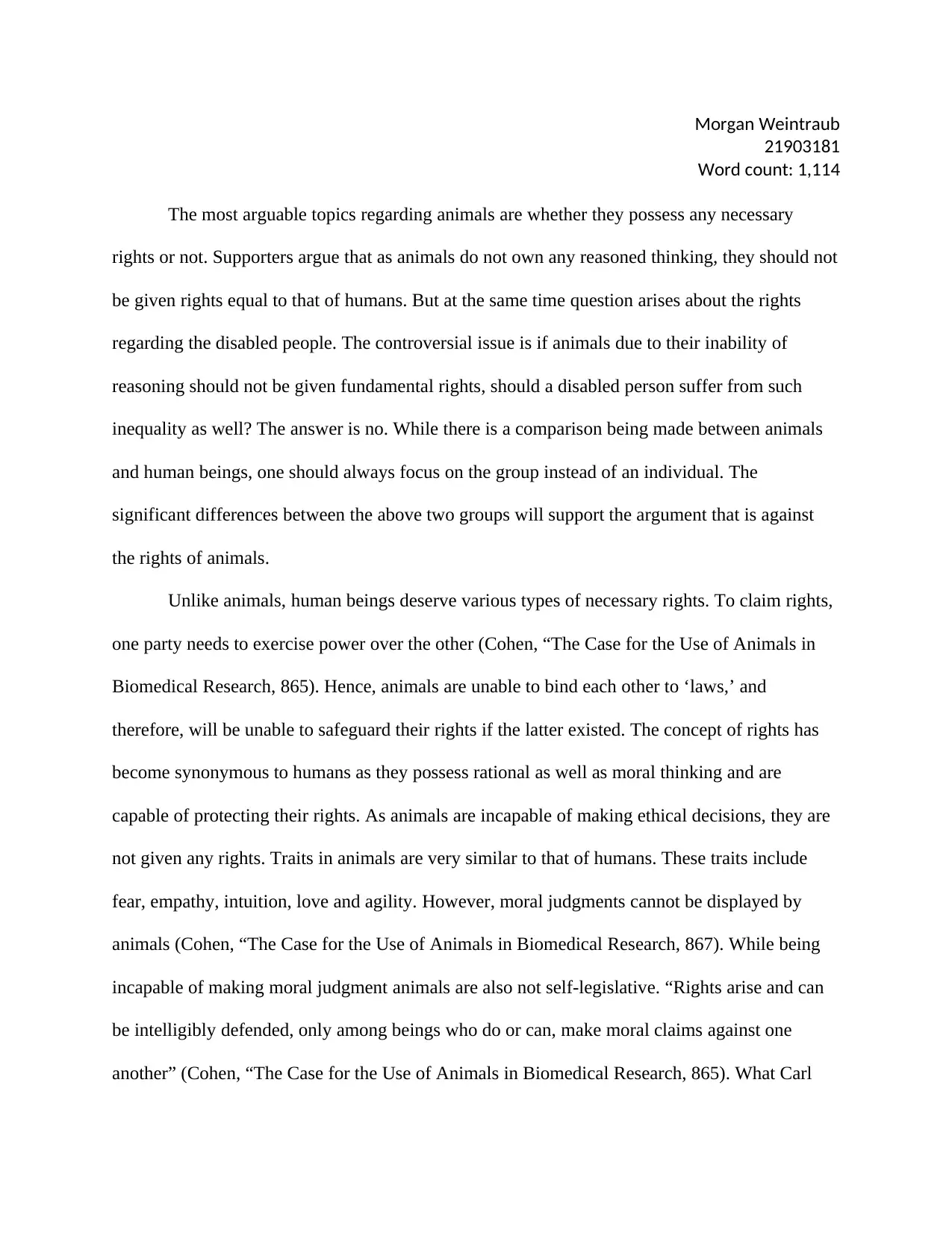
Morgan Weintraub
21903181
Word count: 1,114
The most arguable topics regarding animals are whether they possess any necessary
rights or not. Supporters argue that as animals do not own any reasoned thinking, they should not
be given rights equal to that of humans. But at the same time question arises about the rights
regarding the disabled people. The controversial issue is if animals due to their inability of
reasoning should not be given fundamental rights, should a disabled person suffer from such
inequality as well? The answer is no. While there is a comparison being made between animals
and human beings, one should always focus on the group instead of an individual. The
significant differences between the above two groups will support the argument that is against
the rights of animals.
Unlike animals, human beings deserve various types of necessary rights. To claim rights,
one party needs to exercise power over the other (Cohen, “The Case for the Use of Animals in
Biomedical Research, 865). Hence, animals are unable to bind each other to ‘laws,’ and
therefore, will be unable to safeguard their rights if the latter existed. The concept of rights has
become synonymous to humans as they possess rational as well as moral thinking and are
capable of protecting their rights. As animals are incapable of making ethical decisions, they are
not given any rights. Traits in animals are very similar to that of humans. These traits include
fear, empathy, intuition, love and agility. However, moral judgments cannot be displayed by
animals (Cohen, “The Case for the Use of Animals in Biomedical Research, 867). While being
incapable of making moral judgment animals are also not self-legislative. “Rights arise and can
be intelligibly defended, only among beings who do or can, make moral claims against one
another” (Cohen, “The Case for the Use of Animals in Biomedical Research, 865). What Carl
21903181
Word count: 1,114
The most arguable topics regarding animals are whether they possess any necessary
rights or not. Supporters argue that as animals do not own any reasoned thinking, they should not
be given rights equal to that of humans. But at the same time question arises about the rights
regarding the disabled people. The controversial issue is if animals due to their inability of
reasoning should not be given fundamental rights, should a disabled person suffer from such
inequality as well? The answer is no. While there is a comparison being made between animals
and human beings, one should always focus on the group instead of an individual. The
significant differences between the above two groups will support the argument that is against
the rights of animals.
Unlike animals, human beings deserve various types of necessary rights. To claim rights,
one party needs to exercise power over the other (Cohen, “The Case for the Use of Animals in
Biomedical Research, 865). Hence, animals are unable to bind each other to ‘laws,’ and
therefore, will be unable to safeguard their rights if the latter existed. The concept of rights has
become synonymous to humans as they possess rational as well as moral thinking and are
capable of protecting their rights. As animals are incapable of making ethical decisions, they are
not given any rights. Traits in animals are very similar to that of humans. These traits include
fear, empathy, intuition, love and agility. However, moral judgments cannot be displayed by
animals (Cohen, “The Case for the Use of Animals in Biomedical Research, 867). While being
incapable of making moral judgment animals are also not self-legislative. “Rights arise and can
be intelligibly defended, only among beings who do or can, make moral claims against one
another” (Cohen, “The Case for the Use of Animals in Biomedical Research, 865). What Carl
Paraphrase This Document
Need a fresh take? Get an instant paraphrase of this document with our AI Paraphraser

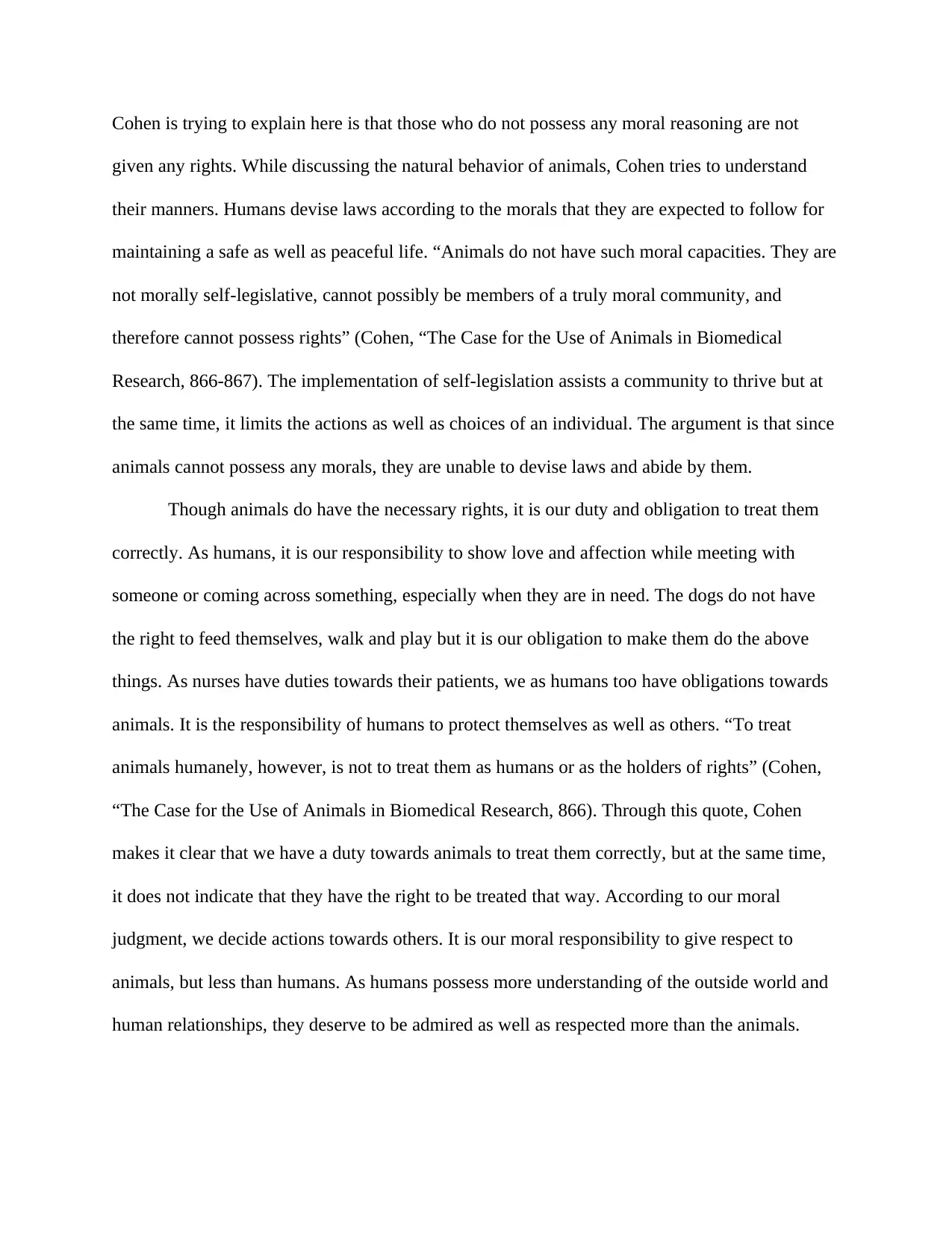
Cohen is trying to explain here is that those who do not possess any moral reasoning are not
given any rights. While discussing the natural behavior of animals, Cohen tries to understand
their manners. Humans devise laws according to the morals that they are expected to follow for
maintaining a safe as well as peaceful life. “Animals do not have such moral capacities. They are
not morally self-legislative, cannot possibly be members of a truly moral community, and
therefore cannot possess rights” (Cohen, “The Case for the Use of Animals in Biomedical
Research, 866-867). The implementation of self-legislation assists a community to thrive but at
the same time, it limits the actions as well as choices of an individual. The argument is that since
animals cannot possess any morals, they are unable to devise laws and abide by them.
Though animals do have the necessary rights, it is our duty and obligation to treat them
correctly. As humans, it is our responsibility to show love and affection while meeting with
someone or coming across something, especially when they are in need. The dogs do not have
the right to feed themselves, walk and play but it is our obligation to make them do the above
things. As nurses have duties towards their patients, we as humans too have obligations towards
animals. It is the responsibility of humans to protect themselves as well as others. “To treat
animals humanely, however, is not to treat them as humans or as the holders of rights” (Cohen,
“The Case for the Use of Animals in Biomedical Research, 866). Through this quote, Cohen
makes it clear that we have a duty towards animals to treat them correctly, but at the same time,
it does not indicate that they have the right to be treated that way. According to our moral
judgment, we decide actions towards others. It is our moral responsibility to give respect to
animals, but less than humans. As humans possess more understanding of the outside world and
human relationships, they deserve to be admired as well as respected more than the animals.
given any rights. While discussing the natural behavior of animals, Cohen tries to understand
their manners. Humans devise laws according to the morals that they are expected to follow for
maintaining a safe as well as peaceful life. “Animals do not have such moral capacities. They are
not morally self-legislative, cannot possibly be members of a truly moral community, and
therefore cannot possess rights” (Cohen, “The Case for the Use of Animals in Biomedical
Research, 866-867). The implementation of self-legislation assists a community to thrive but at
the same time, it limits the actions as well as choices of an individual. The argument is that since
animals cannot possess any morals, they are unable to devise laws and abide by them.
Though animals do have the necessary rights, it is our duty and obligation to treat them
correctly. As humans, it is our responsibility to show love and affection while meeting with
someone or coming across something, especially when they are in need. The dogs do not have
the right to feed themselves, walk and play but it is our obligation to make them do the above
things. As nurses have duties towards their patients, we as humans too have obligations towards
animals. It is the responsibility of humans to protect themselves as well as others. “To treat
animals humanely, however, is not to treat them as humans or as the holders of rights” (Cohen,
“The Case for the Use of Animals in Biomedical Research, 866). Through this quote, Cohen
makes it clear that we have a duty towards animals to treat them correctly, but at the same time,
it does not indicate that they have the right to be treated that way. According to our moral
judgment, we decide actions towards others. It is our moral responsibility to give respect to
animals, but less than humans. As humans possess more understanding of the outside world and
human relationships, they deserve to be admired as well as respected more than the animals.

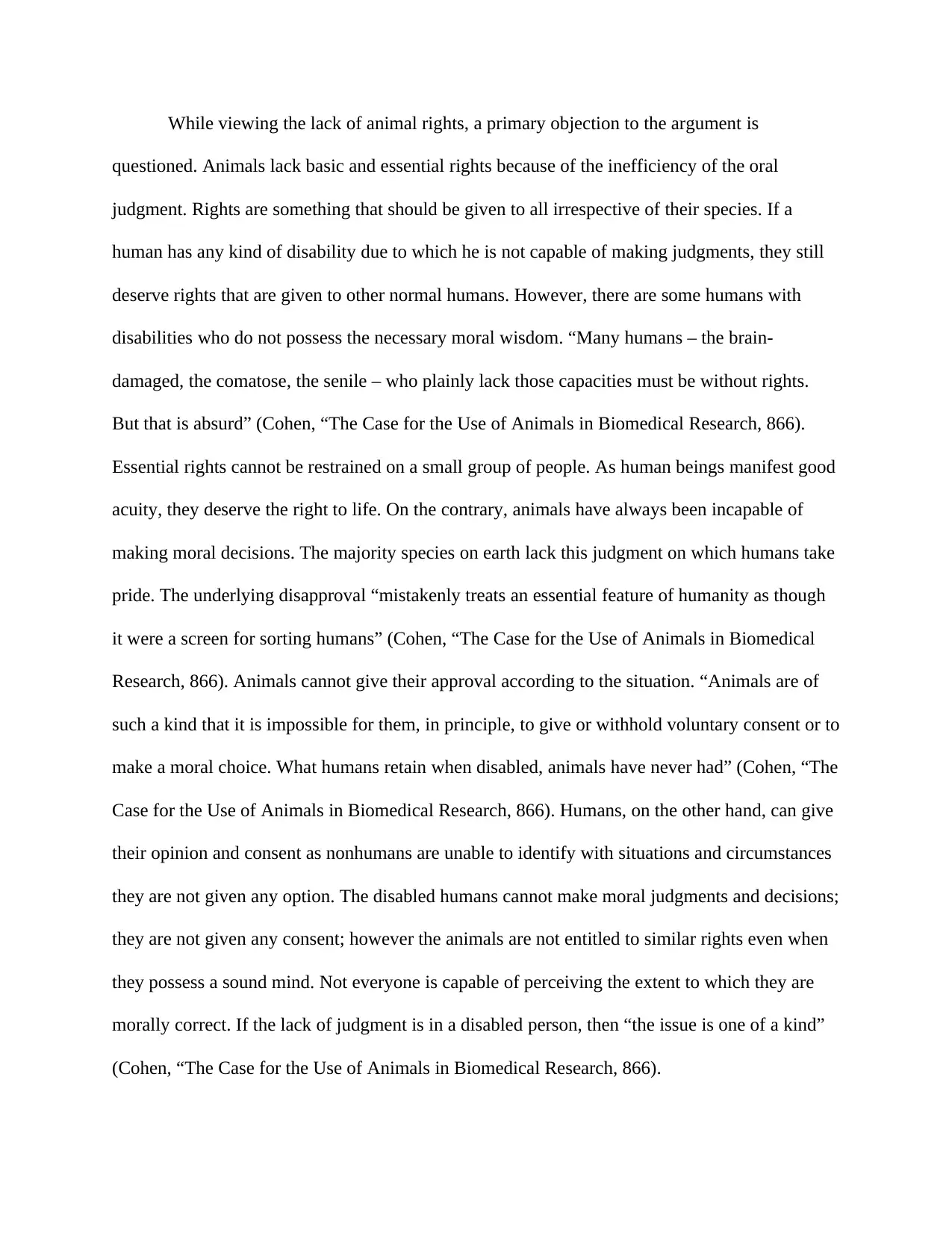
While viewing the lack of animal rights, a primary objection to the argument is
questioned. Animals lack basic and essential rights because of the inefficiency of the oral
judgment. Rights are something that should be given to all irrespective of their species. If a
human has any kind of disability due to which he is not capable of making judgments, they still
deserve rights that are given to other normal humans. However, there are some humans with
disabilities who do not possess the necessary moral wisdom. “Many humans – the brain-
damaged, the comatose, the senile – who plainly lack those capacities must be without rights.
But that is absurd” (Cohen, “The Case for the Use of Animals in Biomedical Research, 866).
Essential rights cannot be restrained on a small group of people. As human beings manifest good
acuity, they deserve the right to life. On the contrary, animals have always been incapable of
making moral decisions. The majority species on earth lack this judgment on which humans take
pride. The underlying disapproval “mistakenly treats an essential feature of humanity as though
it were a screen for sorting humans” (Cohen, “The Case for the Use of Animals in Biomedical
Research, 866). Animals cannot give their approval according to the situation. “Animals are of
such a kind that it is impossible for them, in principle, to give or withhold voluntary consent or to
make a moral choice. What humans retain when disabled, animals have never had” (Cohen, “The
Case for the Use of Animals in Biomedical Research, 866). Humans, on the other hand, can give
their opinion and consent as nonhumans are unable to identify with situations and circumstances
they are not given any option. The disabled humans cannot make moral judgments and decisions;
they are not given any consent; however the animals are not entitled to similar rights even when
they possess a sound mind. Not everyone is capable of perceiving the extent to which they are
morally correct. If the lack of judgment is in a disabled person, then “the issue is one of a kind”
(Cohen, “The Case for the Use of Animals in Biomedical Research, 866).
questioned. Animals lack basic and essential rights because of the inefficiency of the oral
judgment. Rights are something that should be given to all irrespective of their species. If a
human has any kind of disability due to which he is not capable of making judgments, they still
deserve rights that are given to other normal humans. However, there are some humans with
disabilities who do not possess the necessary moral wisdom. “Many humans – the brain-
damaged, the comatose, the senile – who plainly lack those capacities must be without rights.
But that is absurd” (Cohen, “The Case for the Use of Animals in Biomedical Research, 866).
Essential rights cannot be restrained on a small group of people. As human beings manifest good
acuity, they deserve the right to life. On the contrary, animals have always been incapable of
making moral decisions. The majority species on earth lack this judgment on which humans take
pride. The underlying disapproval “mistakenly treats an essential feature of humanity as though
it were a screen for sorting humans” (Cohen, “The Case for the Use of Animals in Biomedical
Research, 866). Animals cannot give their approval according to the situation. “Animals are of
such a kind that it is impossible for them, in principle, to give or withhold voluntary consent or to
make a moral choice. What humans retain when disabled, animals have never had” (Cohen, “The
Case for the Use of Animals in Biomedical Research, 866). Humans, on the other hand, can give
their opinion and consent as nonhumans are unable to identify with situations and circumstances
they are not given any option. The disabled humans cannot make moral judgments and decisions;
they are not given any consent; however the animals are not entitled to similar rights even when
they possess a sound mind. Not everyone is capable of perceiving the extent to which they are
morally correct. If the lack of judgment is in a disabled person, then “the issue is one of a kind”
(Cohen, “The Case for the Use of Animals in Biomedical Research, 866).
⊘ This is a preview!⊘
Do you want full access?
Subscribe today to unlock all pages.

Trusted by 1+ million students worldwide

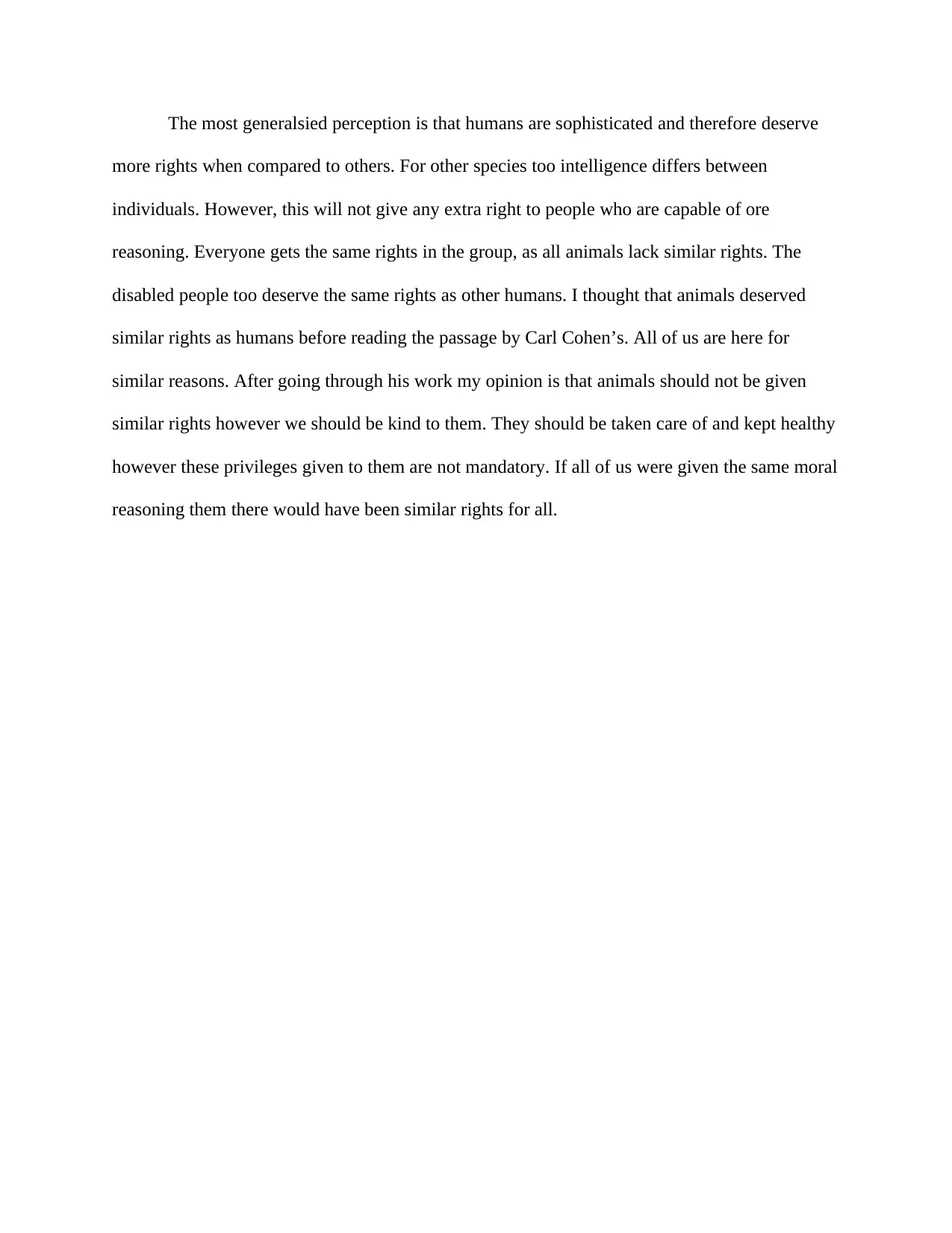
The most generalsied perception is that humans are sophisticated and therefore deserve
more rights when compared to others. For other species too intelligence differs between
individuals. However, this will not give any extra right to people who are capable of ore
reasoning. Everyone gets the same rights in the group, as all animals lack similar rights. The
disabled people too deserve the same rights as other humans. I thought that animals deserved
similar rights as humans before reading the passage by Carl Cohen’s. All of us are here for
similar reasons. After going through his work my opinion is that animals should not be given
similar rights however we should be kind to them. They should be taken care of and kept healthy
however these privileges given to them are not mandatory. If all of us were given the same moral
reasoning them there would have been similar rights for all.
more rights when compared to others. For other species too intelligence differs between
individuals. However, this will not give any extra right to people who are capable of ore
reasoning. Everyone gets the same rights in the group, as all animals lack similar rights. The
disabled people too deserve the same rights as other humans. I thought that animals deserved
similar rights as humans before reading the passage by Carl Cohen’s. All of us are here for
similar reasons. After going through his work my opinion is that animals should not be given
similar rights however we should be kind to them. They should be taken care of and kept healthy
however these privileges given to them are not mandatory. If all of us were given the same moral
reasoning them there would have been similar rights for all.
1 out of 4
Related Documents
Your All-in-One AI-Powered Toolkit for Academic Success.
+13062052269
info@desklib.com
Available 24*7 on WhatsApp / Email
Unlock your academic potential
Copyright © 2020–2025 A2Z Services. All Rights Reserved. Developed and managed by ZUCOL.