2020 Spring Term Report: Animal Welfare and Biosafety Programs

Verified

Added on  2022/08/24

|6
|1229
|16
Report
AI Summary
This report, prepared for a course on research compliance, delves into the interconnected systems, policies, and procedures governing laboratory animal practices in the United States. It focuses on the common issues between animal welfare programs and biosafety programs, highlighting the involvement of regulatory bodies like the Public Health Service and the U.S. government. The report discusses the challenges associated with transgenic animals, radiation exposure, and the need for proper precautions and control measures. It emphasizes the importance of maintaining biosafety levels, implementing balanced business policies, and securing government funding for research and animal care. The author concludes with a call for immediate action to address concerns regarding animal welfare and biosafety, emphasizing the need for proper administration and funding to ensure responsible and ethical research practices.
Document Page
Running head: RESEARCH AND OVERSIGHT OF ANIMAL AND BIOSAFETY PROGRAM
RESEARCH AND OVERSIGHT OF ANIMAL AND BIOSAFETY PROGRAM
Name of the Student
Name of the University
Author Note
tabler-icon-diamond-filled.svg

Paraphrase This Document

Need a fresh take? Get an instant paraphrase of this document with our AI Paraphraser
Document Page
1RESEARCH AND OVERSIGHT OF ANIMAL AND BIOSAFETY PROGRAM
Introduction
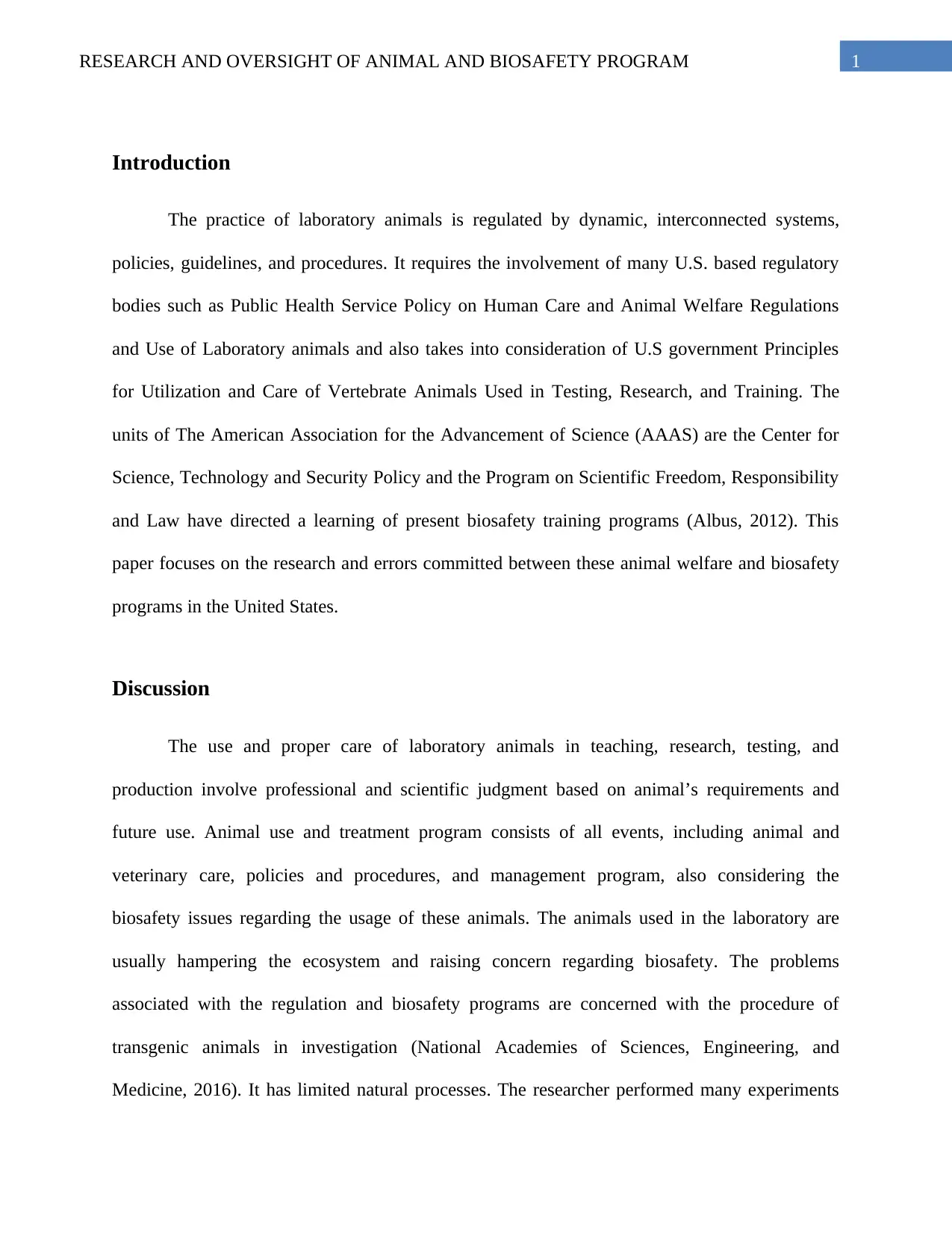
The practice of laboratory animals is regulated by dynamic, interconnected systems,
policies, guidelines, and procedures. It requires the involvement of many U.S. based regulatory
bodies such as Public Health Service Policy on Human Care and Animal Welfare Regulations
and Use of Laboratory animals and also takes into consideration of U.S government Principles
for Utilization and Care of Vertebrate Animals Used in Testing, Research, and Training. The
units of The American Association for the Advancement of Science (AAAS) are the Center for
Science, Technology and Security Policy and the Program on Scientific Freedom, Responsibility
and Law have directed a learning of present biosafety training programs (Albus, 2012). This
paper focuses on the research and errors committed between these animal welfare and biosafety
programs in the United States.
Discussion
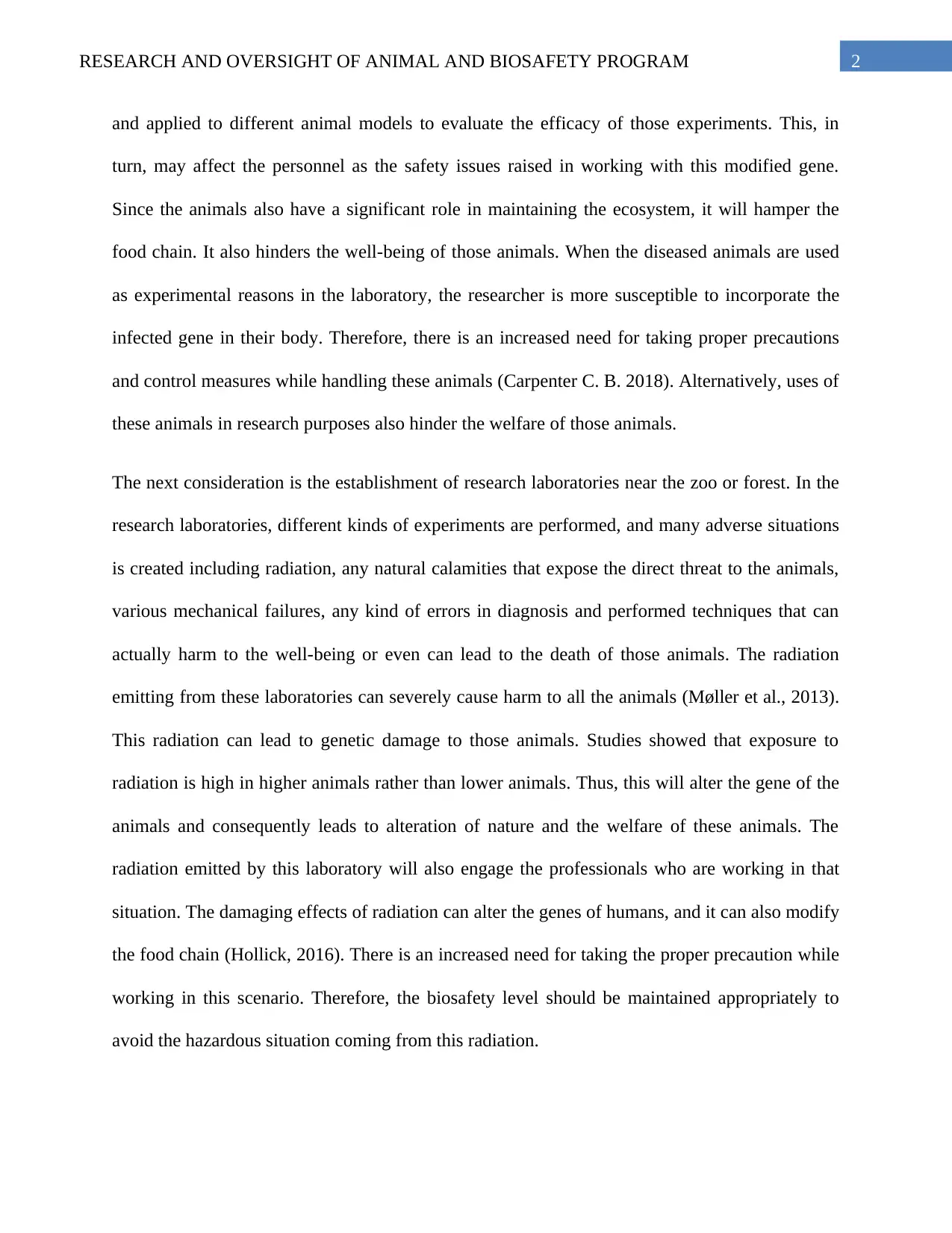
The use and proper care of laboratory animals in teaching, research, testing, and
production involve professional and scientific judgment based on animal’s requirements and
future use. Animal use and treatment program consists of all events, including animal and
veterinary care, policies and procedures, and management program, also considering the
biosafety issues regarding the usage of these animals. The animals used in the laboratory are
usually hampering the ecosystem and raising concern regarding biosafety. The problems
associated with the regulation and biosafety programs are concerned with the procedure of
transgenic animals in investigation (National Academies of Sciences, Engineering, and
Medicine, 2016). It has limited natural processes. The researcher performed many experiments
Document Page
2RESEARCH AND OVERSIGHT OF ANIMAL AND BIOSAFETY PROGRAM
and applied to different animal models to evaluate the efficacy of those experiments. This, in
turn, may affect the personnel as the safety issues raised in working with this modified gene.
Since the animals also have a significant role in maintaining the ecosystem, it will hamper the
food chain. It also hinders the well-being of those animals. When the diseased animals are used
as experimental reasons in the laboratory, the researcher is more susceptible to incorporate the
infected gene in their body. Therefore, there is an increased need for taking proper precautions
and control measures while handling these animals (Carpenter C. B. 2018). Alternatively, uses of
these animals in research purposes also hinder the welfare of those animals.
The next consideration is the establishment of research laboratories near the zoo or forest. In the
research laboratories, different kinds of experiments are performed, and many adverse situations
is created including radiation, any natural calamities that expose the direct threat to the animals,
various mechanical failures, any kind of errors in diagnosis and performed techniques that can
actually harm to the well-being or even can lead to the death of those animals. The radiation
emitting from these laboratories can severely cause harm to all the animals (Møller et al., 2013).
This radiation can lead to genetic damage to those animals. Studies showed that exposure to
radiation is high in higher animals rather than lower animals. Thus, this will alter the gene of the
animals and consequently leads to alteration of nature and the welfare of these animals. The
radiation emitted by this laboratory will also engage the professionals who are working in that
situation. The damaging effects of radiation can alter the genes of humans, and it can also modify
the food chain (Hollick, 2016). There is an increased need for taking the proper precaution while
working in this scenario. Therefore, the biosafety level should be maintained appropriately to
avoid the hazardous situation coming from this radiation.
Document Page
3RESEARCH AND OVERSIGHT OF ANIMAL AND BIOSAFETY PROGRAM
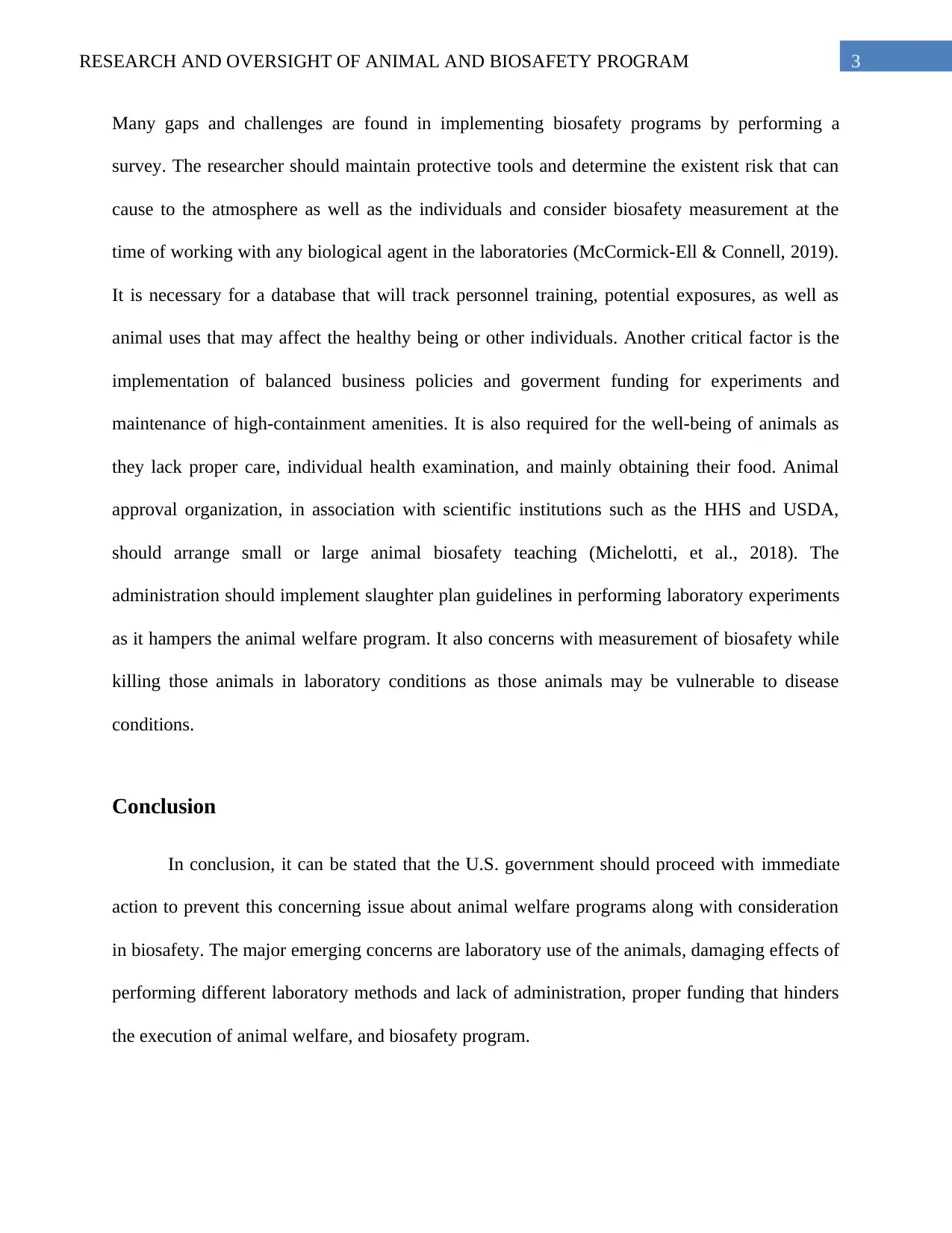
Many gaps and challenges are found in implementing biosafety programs by performing a
survey. The researcher should maintain protective tools and determine the existent risk that can
cause to the atmosphere as well as the individuals and consider biosafety measurement at the
time of working with any biological agent in the laboratories (McCormick-Ell & Connell, 2019).
It is necessary for a database that will track personnel training, potential exposures, as well as
animal uses that may affect the healthy being or other individuals. Another critical factor is the
implementation of balanced business policies and goverment funding for experiments and
maintenance of high-containment amenities. It is also required for the well-being of animals as
they lack proper care, individual health examination, and mainly obtaining their food. Animal
approval organization, in association with scientific institutions such as the HHS and USDA,
should arrange small or large animal biosafety teaching (Michelotti, et al., 2018). The
administration should implement slaughter plan guidelines in performing laboratory experiments
as it hampers the animal welfare program. It also concerns with measurement of biosafety while
killing those animals in laboratory conditions as those animals may be vulnerable to disease
conditions.
Conclusion
In conclusion, it can be stated that the U.S. government should proceed with immediate
action to prevent this concerning issue about animal welfare programs along with consideration
in biosafety. The major emerging concerns are laboratory use of the animals, damaging effects of
performing different laboratory methods and lack of administration, proper funding that hinders
the execution of animal welfare, and biosafety program.
tabler-icon-diamond-filled.svg

Paraphrase This Document

Need a fresh take? Get an instant paraphrase of this document with our AI Paraphraser
Document Page
4RESEARCH AND OVERSIGHT OF ANIMAL AND BIOSAFETY PROGRAM
References
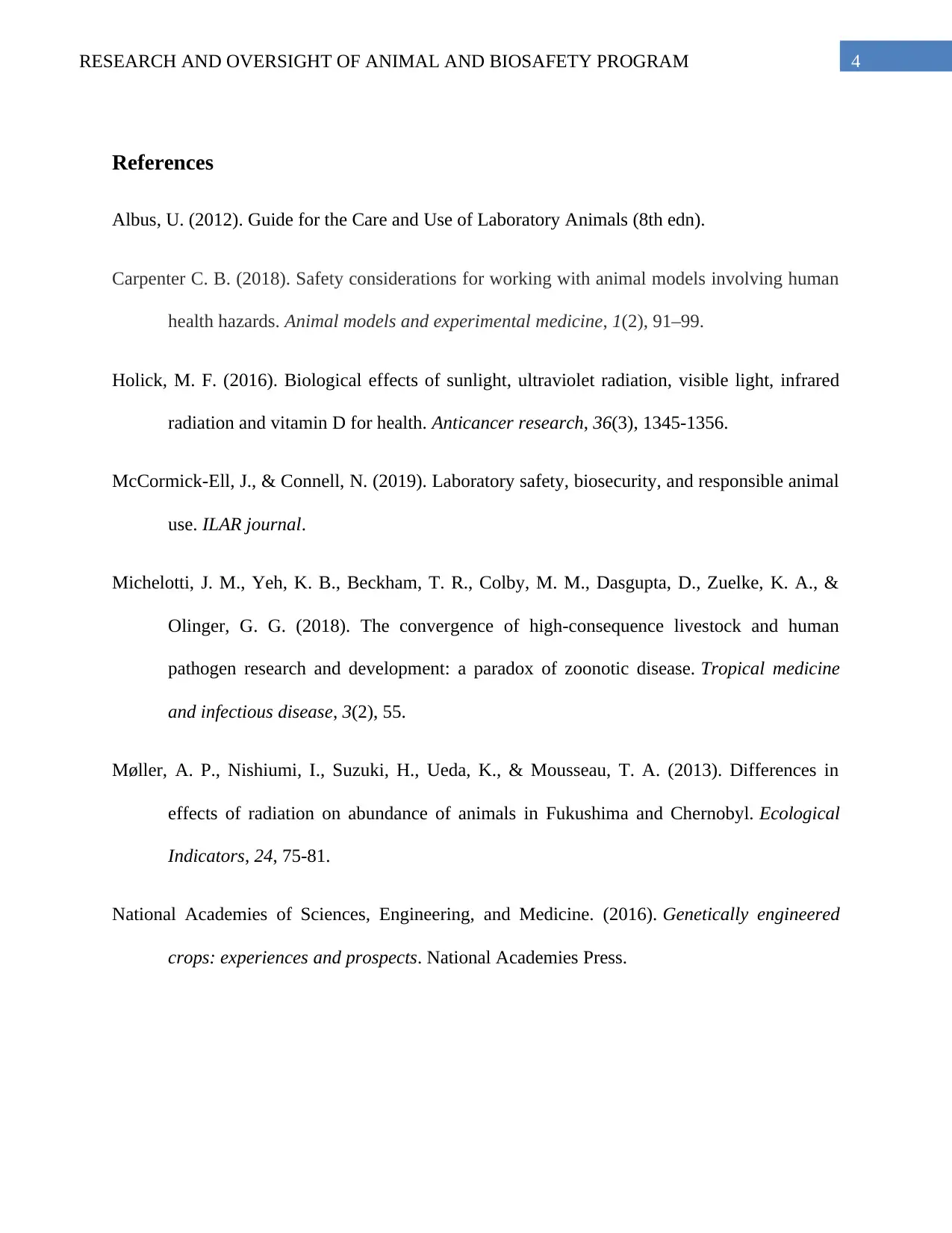
Albus, U. (2012). Guide for the Care and Use of Laboratory Animals (8th edn).
Carpenter C. B. (2018). Safety considerations for working with animal models involving human
health hazards. Animal models and experimental medicine, 1(2), 91–99.
Holick, M. F. (2016). Biological effects of sunlight, ultraviolet radiation, visible light, infrared
radiation and vitamin D for health. Anticancer research, 36(3), 1345-1356.
McCormick-Ell, J., & Connell, N. (2019). Laboratory safety, biosecurity, and responsible animal
use. ILAR journal.
Michelotti, J. M., Yeh, K. B., Beckham, T. R., Colby, M. M., Dasgupta, D., Zuelke, K. A., &
Olinger, G. G. (2018). The convergence of high-consequence livestock and human
pathogen research and development: a paradox of zoonotic disease. Tropical medicine
and infectious disease, 3(2), 55.
Møller, A. P., Nishiumi, I., Suzuki, H., Ueda, K., & Mousseau, T. A. (2013). Differences in
effects of radiation on abundance of animals in Fukushima and Chernobyl. Ecological
Indicators, 24, 75-81.
National Academies of Sciences, Engineering, and Medicine. (2016). Genetically engineered
crops: experiences and prospects. National Academies Press.
Document Page
5RESEARCH AND OVERSIGHT OF ANIMAL AND BIOSAFETY PROGRAM
chevron_up_icon
1 out of 6
circle_padding
hide_on_mobile
zoom_out_icon
[object Object]