Report on Annetts v Australian Stations Pty Ltd: Negligence Case Study
VerifiedAdded on 2019/11/19
|12
|2962
|426
Report
AI Summary
This report provides a comprehensive analysis of the case Annetts v Australian Stations (2002) 211 CLR 317, focusing on the legal principles of negligence and duty of care within the Australian legal system. The case involves a claim of psychiatric injury by parents following the death of their son, who was employed by the defendant. The report outlines the facts of the case, including the son's employment in Western Australia and his subsequent disappearance and death. It then details the defendant's arguments, which centered on the lack of foreseeability of psychiatric injury and the absence of a breached duty of care to the parents. The report highlights the application of legal precedents like Donoghue v Stevenson and Caparo Industries plc v Dickman. The court's judgment, which rejected the plaintiff's appeal, is discussed, emphasizing the lack of a duty of care owed to the parents and the absence of the necessary elements to establish negligence. The report concludes with a critical analysis of the court's decision, examining the legal implications and reasoning behind the judgment.
qwertyuiopasdfghjklzxcvbnmqwertyui
opasdfghjklzxcvbnmqwertyuiopasdfgh
jklzxcvbnmqwertyuiopasdfghjklzxcvb
nmqwertyuiopasdfghjklzxcvbnmqwer
tyuiopasdfghjklzxcvbnmqwertyuiopas
dfghjklzxcvbnmqwertyuiopasdfghjklzx
cvbnmqwertyuiopasdfghjklzxcvbnmq
wertyuiopasdfghjklzxcvbnmqwertyuio
pasdfghjklzxcvbnmqwertyuiopasdfghj
Business Law
Annetts v Australian Stations Pty Ltd (2001)
12-Sep-17
(Student Details: )
opasdfghjklzxcvbnmqwertyuiopasdfgh
jklzxcvbnmqwertyuiopasdfghjklzxcvb
nmqwertyuiopasdfghjklzxcvbnmqwer
tyuiopasdfghjklzxcvbnmqwertyuiopas
dfghjklzxcvbnmqwertyuiopasdfghjklzx
cvbnmqwertyuiopasdfghjklzxcvbnmq
wertyuiopasdfghjklzxcvbnmqwertyuio
pasdfghjklzxcvbnmqwertyuiopasdfghj
Business Law
Annetts v Australian Stations Pty Ltd (2001)
12-Sep-17
(Student Details: )

Paraphrase This Document
Need a fresh take? Get an instant paraphrase of this document with our AI Paraphraser
Executive Summary
Negligence is a tort which attracts civil penalties in Australia. There are certain elements which
have to be shown to be present by the person who makes a claim of negligence and included in
these are foreseeability, duty of care and the relationship between the two parties. Annetts v
Australian Station is a prominent case of Australia where the court rejected the claims made by
the plaintiff as they believed that the duty of care was owed by the defendant only to the son
of the plaintiff and that too in a reasonable manner. Also, the duty of care which the defendant
owed to the plaintiff was not breached in this case as the risk of harm was not reasonably
foreseeable. In this report, a discussion has been carried on whereby the case of Annetts v
Australian Station is highlighted in terms of the facts of the case, the arguments of the
defendant, the decision of the court and a critical analysis of the same.
Negligence is a tort which attracts civil penalties in Australia. There are certain elements which
have to be shown to be present by the person who makes a claim of negligence and included in
these are foreseeability, duty of care and the relationship between the two parties. Annetts v
Australian Station is a prominent case of Australia where the court rejected the claims made by
the plaintiff as they believed that the duty of care was owed by the defendant only to the son
of the plaintiff and that too in a reasonable manner. Also, the duty of care which the defendant
owed to the plaintiff was not breached in this case as the risk of harm was not reasonably
foreseeable. In this report, a discussion has been carried on whereby the case of Annetts v
Australian Station is highlighted in terms of the facts of the case, the arguments of the
defendant, the decision of the court and a critical analysis of the same.
Contents
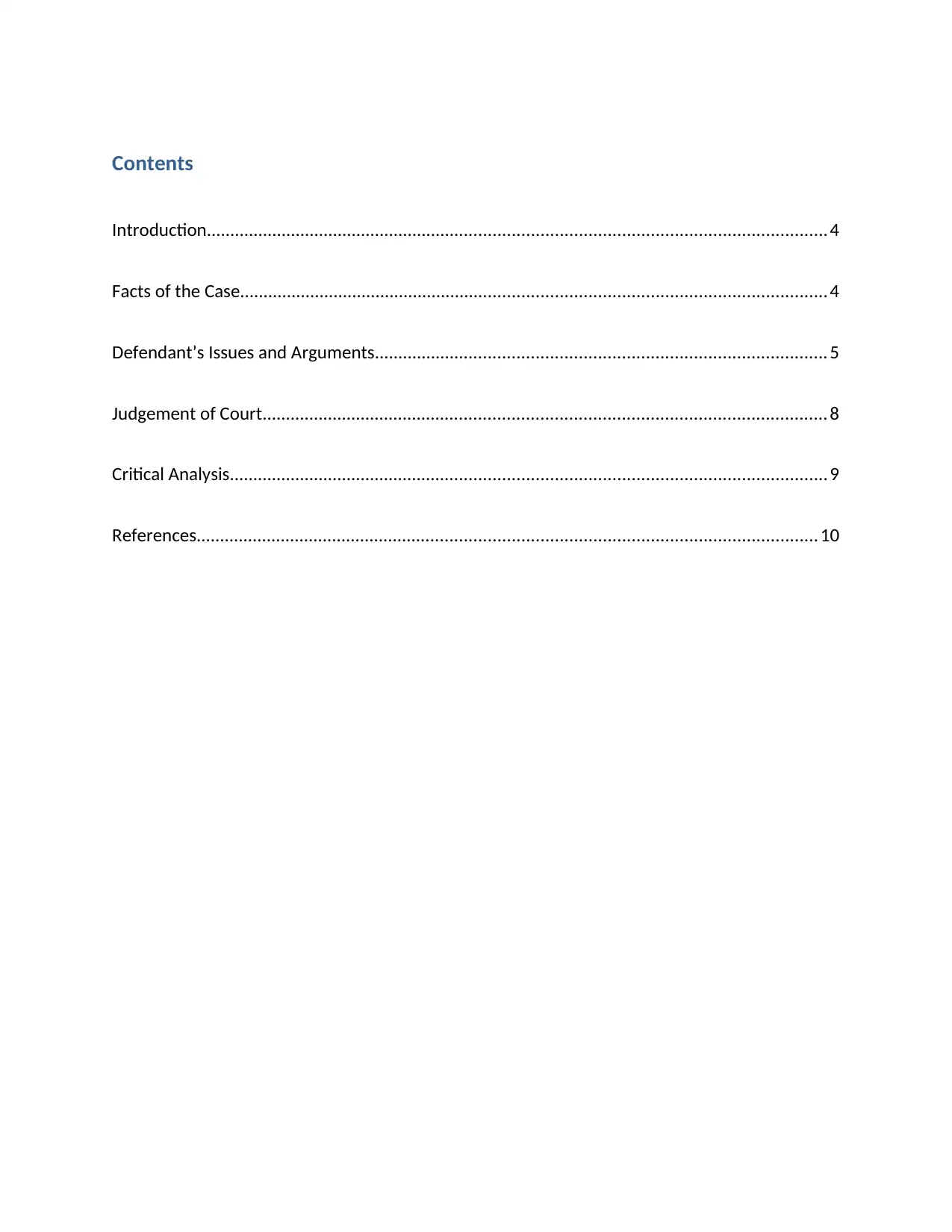
Introduction...................................................................................................................................4
Facts of the Case............................................................................................................................4
Defendant’s Issues and Arguments............................................................................................... 5
Judgement of Court....................................................................................................................... 8
Critical Analysis.............................................................................................................................. 9
References................................................................................................................................... 10
Introduction...................................................................................................................................4
Facts of the Case............................................................................................................................4
Defendant’s Issues and Arguments............................................................................................... 5
Judgement of Court....................................................................................................................... 8
Critical Analysis.............................................................................................................................. 9
References................................................................................................................................... 10
⊘ This is a preview!⊘
Do you want full access?
Subscribe today to unlock all pages.

Trusted by 1+ million students worldwide
Introduction
Psychiatric injury is something for which the damages are granted under tort of negligence. A
leading case where the psychiatric injury was contested was the case of Annetts v Australian
Station (2002) 211 CLR 317. In Annetts v Australian Station, the duty of care owed to the son of
the plaintiff was established as the child died as a result of the mental harm which took place
when he ran away. The plaintiff in this case had made a claim that they had received psychiatric
injury as a result of the breach of duty of care of the defendant. However, the court did not
uphold these claims and out rightly quashed the claims made by the plaintiff of this case
(Sappideen, 2009).
In this report, the case has been discussed and the side of the defendant has been taken. Apart
from giving the facts of the case, the arguments raised and the decision of the case, the
decision has been critically analysed to decide if the undertaken decision has been right.
Facts of the Case
The name of plaintiff’s son was James Annetts who had departed from his home back in Aug
1986, which was in NSW and at that time, he was only 16 year old (Quizlet, 2017). He had left
his home to go to WA for working with the defendant. Before James left for WA, his mother had
a word with the defendant and asked about the working conditions at WA. She was assured by
the defendant that his son would be properly supervised and was set to work in Flora Valley,
Psychiatric injury is something for which the damages are granted under tort of negligence. A
leading case where the psychiatric injury was contested was the case of Annetts v Australian
Station (2002) 211 CLR 317. In Annetts v Australian Station, the duty of care owed to the son of
the plaintiff was established as the child died as a result of the mental harm which took place
when he ran away. The plaintiff in this case had made a claim that they had received psychiatric
injury as a result of the breach of duty of care of the defendant. However, the court did not
uphold these claims and out rightly quashed the claims made by the plaintiff of this case
(Sappideen, 2009).
In this report, the case has been discussed and the side of the defendant has been taken. Apart
from giving the facts of the case, the arguments raised and the decision of the case, the
decision has been critically analysed to decide if the undertaken decision has been right.
Facts of the Case
The name of plaintiff’s son was James Annetts who had departed from his home back in Aug
1986, which was in NSW and at that time, he was only 16 year old (Quizlet, 2017). He had left
his home to go to WA for working with the defendant. Before James left for WA, his mother had
a word with the defendant and asked about the working conditions at WA. She was assured by
the defendant that his son would be properly supervised and was set to work in Flora Valley,
Paraphrase This Document
Need a fresh take? Get an instant paraphrase of this document with our AI Paraphraser
where he would get a shared room and would be looked after in a proper manner (Federation
Press, 2017).
For seven weeks, James continued to work to work at Flora Valley. On Oct 13, 1986, James was
sent to work at a place which was 100 kilometres away from his promised place of work,
despite the earlier assurances to James’s mother. On Dec 03, 1986, it came to light that James
had disappeared and was believed to be in danger of injury/ death. James’s parents, who were
the plaintiff in this case, were informed about their son being missing on Dec 06, 1986 and that
took over the phone where they were told that James ran away, by a NSW police officer. Upon
hearing this tragic news, James’s father collapsed and James’s mother continued the telephonic
conversation. On April 09, 1987, James’s skeleton was discovered and after the examination of
it, it was revealed that James has died due to hypothermia, exhaustion and dehydration on Dec
04, 1986. And he had died in a place which was quite far from the place where he was
supposed to work, as he died in Gibson Desert (Federation Press, 2017). The plaintiff blamed
the defendant for the death of their son and also for the psychiatric injury which they sustained
as a result of the tragic news (Health Law Central, 2017).
Defendant’s Issues and Arguments
From the very beginning, the employer denied the allegation made by the plaintiff and stated
that a duty of care was not breached, which was only owed to James and so the claim of
plaintiff that a duty of care was also owed to them was denied by the defendant.
Press, 2017).
For seven weeks, James continued to work to work at Flora Valley. On Oct 13, 1986, James was
sent to work at a place which was 100 kilometres away from his promised place of work,
despite the earlier assurances to James’s mother. On Dec 03, 1986, it came to light that James
had disappeared and was believed to be in danger of injury/ death. James’s parents, who were
the plaintiff in this case, were informed about their son being missing on Dec 06, 1986 and that
took over the phone where they were told that James ran away, by a NSW police officer. Upon
hearing this tragic news, James’s father collapsed and James’s mother continued the telephonic
conversation. On April 09, 1987, James’s skeleton was discovered and after the examination of
it, it was revealed that James has died due to hypothermia, exhaustion and dehydration on Dec
04, 1986. And he had died in a place which was quite far from the place where he was
supposed to work, as he died in Gibson Desert (Federation Press, 2017). The plaintiff blamed
the defendant for the death of their son and also for the psychiatric injury which they sustained
as a result of the tragic news (Health Law Central, 2017).
Defendant’s Issues and Arguments
From the very beginning, the employer denied the allegation made by the plaintiff and stated
that a duty of care was not breached, which was only owed to James and so the claim of
plaintiff that a duty of care was also owed to them was denied by the defendant.
For establishing that a duty of care was not owed in this case, the defendant referred to the
basics of negligence, and followed the procedure which is required to make a claim of
negligence (Harvey and Marston, 2009). For making a case of negligence, there is a need to
show that a duty of care was owed which was violated, and this violation resulted in a loss,
which was not remote, and which was foreseeable in a reasonable manner, where the injury
was in direct causation to the violation (Gibson and Fraser, 2014). The English case of Donoghue
v Stevenson [1932] UKHL 100 was referred to here. In this case, the defendant was said to have
owed a duty of care to the plaintiff due to the proximity of their relationship and the loss being
reasonably foreseeable (Abbott, Pendlebury and Wardman, 2007). In the current matter, there
was an absence of the psychiatric injury being reasonably foreseeable as the defendant could
have never known that hearing this news; a psychiatric injury would be caused as the death of
James was also not reasonably foreseeable. Hence, only a duty of care could be shown towards
James, owing to the proximity and relationship of employer employee but not towards the
plaintiff of this case. Also, the duty of care towards James was fulfilled whereby the defendant
provided safe working conditions and took so many steps to locate him when he doubted that
James could be in danger (Austlii, 2017).
Reference was also made to Caparo Industries plc v Dickman [1990] 2 AC 605, where the three
fold risk was stated (Lunney and Oliphant, 2013). As per this test, there is a need to show that
risk of harm was reasonably foreseeable, there was proximity between parties and the
imposition of penalties would be fair (E-Law Resources, 2017). It has already been shown that a
duty of care was not owed to the plaintiff. The risk of psychiatric injury was not reasonably
basics of negligence, and followed the procedure which is required to make a claim of
negligence (Harvey and Marston, 2009). For making a case of negligence, there is a need to
show that a duty of care was owed which was violated, and this violation resulted in a loss,
which was not remote, and which was foreseeable in a reasonable manner, where the injury
was in direct causation to the violation (Gibson and Fraser, 2014). The English case of Donoghue
v Stevenson [1932] UKHL 100 was referred to here. In this case, the defendant was said to have
owed a duty of care to the plaintiff due to the proximity of their relationship and the loss being
reasonably foreseeable (Abbott, Pendlebury and Wardman, 2007). In the current matter, there
was an absence of the psychiatric injury being reasonably foreseeable as the defendant could
have never known that hearing this news; a psychiatric injury would be caused as the death of
James was also not reasonably foreseeable. Hence, only a duty of care could be shown towards
James, owing to the proximity and relationship of employer employee but not towards the
plaintiff of this case. Also, the duty of care towards James was fulfilled whereby the defendant
provided safe working conditions and took so many steps to locate him when he doubted that
James could be in danger (Austlii, 2017).
Reference was also made to Caparo Industries plc v Dickman [1990] 2 AC 605, where the three
fold risk was stated (Lunney and Oliphant, 2013). As per this test, there is a need to show that
risk of harm was reasonably foreseeable, there was proximity between parties and the
imposition of penalties would be fair (E-Law Resources, 2017). It has already been shown that a
duty of care was not owed to the plaintiff. The risk of psychiatric injury was not reasonably
⊘ This is a preview!⊘
Do you want full access?
Subscribe today to unlock all pages.
Trusted by 1+ million students worldwide
foreseeable. And due to the lack of these two tests, the imposition of penalties cannot be
deemed as fair (Austlii, 2017).
The case of Wyong Shire Council v. Shirt (1980) 146 CLR 40 was also highlighted by the
defendant for showing the foreseeability of risk of harm. As per this case, the view of a prudent
person has to be considering for judging if the risk was reasonably present (Jade, 2017). In the
present case, even a prudent person, let alone the defendant, could not have reasonably
foreseen that after running away from the work, the employee would die after being lost in the
Gibson Desert. This was because James was assigned a different work place and the worker was
found dead at a very faraway place. So, this risk of harm was not reasonably foreseeable. Also,
the psychiatric injury was not caused to James, for which a claim can be made against the
defendant (Austlii, 2017).
The proximity of the relationship and reasonable foreseeability was highlighted by Justice
Deane in Jaensch v Coffey [1984] HCA 52. In this case, the judge stated that a person would be
considered as having the capacity of foreseeing a specific thing once the particular situation
was properly analysed. In this regard, the type of relationship on the basis of which the lawful
duty is attached is to be considered from which the reasonable care has to be understood. And
for these purposes, the interest of other people also had to be taken into consideration. Hence,
on the basis of this case, the foreseeability of the loss and the nature of relationship are
required to establish negligence (Swarb, 2015).
In order to take into consideration the relationship between James and the defendant, the type
of work which was given to James, had to be analysed (Robertson and Tilbury, 2016). The
deemed as fair (Austlii, 2017).
The case of Wyong Shire Council v. Shirt (1980) 146 CLR 40 was also highlighted by the
defendant for showing the foreseeability of risk of harm. As per this case, the view of a prudent
person has to be considering for judging if the risk was reasonably present (Jade, 2017). In the
present case, even a prudent person, let alone the defendant, could not have reasonably
foreseen that after running away from the work, the employee would die after being lost in the
Gibson Desert. This was because James was assigned a different work place and the worker was
found dead at a very faraway place. So, this risk of harm was not reasonably foreseeable. Also,
the psychiatric injury was not caused to James, for which a claim can be made against the
defendant (Austlii, 2017).
The proximity of the relationship and reasonable foreseeability was highlighted by Justice
Deane in Jaensch v Coffey [1984] HCA 52. In this case, the judge stated that a person would be
considered as having the capacity of foreseeing a specific thing once the particular situation
was properly analysed. In this regard, the type of relationship on the basis of which the lawful
duty is attached is to be considered from which the reasonable care has to be understood. And
for these purposes, the interest of other people also had to be taken into consideration. Hence,
on the basis of this case, the foreseeability of the loss and the nature of relationship are
required to establish negligence (Swarb, 2015).
In order to take into consideration the relationship between James and the defendant, the type
of work which was given to James, had to be analysed (Robertson and Tilbury, 2016). The
Paraphrase This Document
Need a fresh take? Get an instant paraphrase of this document with our AI Paraphraser
defendant owed an obligation of care towards James, only in context of his working conditions
and the thing covered within his work and was not to be stretched beyond work. Eloping of
James, which ultimately led to his untimely death, was not a thing which could be deemed as
violation of duty of care of the defendant. James was the one who violated the obligation of
care, towards himself. And in case the defendant is held liable for this, it would not be just as an
employer cannot reasonably foresee if an employee would run away. Thus, the lack of
foreseeability would mean no duty of care or its breach (Austlii, 2017).
To establish psychiatric injury in this case, it has to be shown that this was a result of a direct
perception or an abrupt fright which occurred right after the accident. The news of James
disappearing was given to his parents in a step based method. This information was given over
a period of time and at a distance from the accident place. So, there was an absence of things
which could be stated as being immediate or a thing of shock. The plaintiff did not witness the
starvation or the exhaustion of their child which could have caused a sudden shock. Sudden
shock was something where the child immediately fell off the cliff. Hence, the element of shock
was also not present to contribute to psychiatric injury, thus, defeating the claim of injury of
the plaintiff (Austlii, 2017).
Judgement of Court
The unanimous decision of the Court of Appeal of the Supreme Court of Western Australia in
this case remains a key decision till present date. The decision was delivered by Ipp J where he
rejected the appeal of the plaintiff and stated that the defendant did not owe a duty of care
and the thing covered within his work and was not to be stretched beyond work. Eloping of
James, which ultimately led to his untimely death, was not a thing which could be deemed as
violation of duty of care of the defendant. James was the one who violated the obligation of
care, towards himself. And in case the defendant is held liable for this, it would not be just as an
employer cannot reasonably foresee if an employee would run away. Thus, the lack of
foreseeability would mean no duty of care or its breach (Austlii, 2017).
To establish psychiatric injury in this case, it has to be shown that this was a result of a direct
perception or an abrupt fright which occurred right after the accident. The news of James
disappearing was given to his parents in a step based method. This information was given over
a period of time and at a distance from the accident place. So, there was an absence of things
which could be stated as being immediate or a thing of shock. The plaintiff did not witness the
starvation or the exhaustion of their child which could have caused a sudden shock. Sudden
shock was something where the child immediately fell off the cliff. Hence, the element of shock
was also not present to contribute to psychiatric injury, thus, defeating the claim of injury of
the plaintiff (Austlii, 2017).
Judgement of Court
The unanimous decision of the Court of Appeal of the Supreme Court of Western Australia in
this case remains a key decision till present date. The decision was delivered by Ipp J where he
rejected the appeal of the plaintiff and stated that the defendant did not owe a duty of care
towards the plaintiff as the psychiatric injury of the plaintiff was not something which could
have been reasonably foreseen, nor was a duty of care owed by the defendant to the plaintiff.
There was an absence of the shock element which could have resulted in a psychiatric injury as
there was an absence of abrupt sensory perception, which had to result from the breached
duty of care in temporal and physical way. For establishing a case of psychiatric injury, it had to
be shown that the plaintiff was so distressful that the psychiatric injury was caused (Allens,
2017).
And on the basis of these points and the arguments raised by the defendant, the Court of
Appeals denied the appeal made by the plaintiff. This was because in common parlance, the risk
of harm was not foreseeable in a reasonable manner in this case, and allowing a case of
psychiatric injury to be made against the defendant, just because the parent lost their child was
an unfair thing to do, for the defendant. There was a need to differentiate between a loss of
child from an ordinary incident and a shocking incident to make a claim of recognized
psychiatric injury. Also, there was a sheer lack of proximity between the plaintiff and defendant
where the actions of one could have affected another in sense of time and space. The court also
took into consideration that he occurrence of James’s death and the psychiatric injury of the
plaintiff was quite far to be blamed upon the duty of care violation. The court requested the
plaintiff to accept the passing away of their son and that James’s death was not the fault of the
defendant. Ultimately, the appeal of the plaintiff was rejected due to the lack of element of
negligence and the lack of duty of care of the defendant towards the plaintiff (Allens, 2017).
have been reasonably foreseen, nor was a duty of care owed by the defendant to the plaintiff.
There was an absence of the shock element which could have resulted in a psychiatric injury as
there was an absence of abrupt sensory perception, which had to result from the breached
duty of care in temporal and physical way. For establishing a case of psychiatric injury, it had to
be shown that the plaintiff was so distressful that the psychiatric injury was caused (Allens,
2017).
And on the basis of these points and the arguments raised by the defendant, the Court of
Appeals denied the appeal made by the plaintiff. This was because in common parlance, the risk
of harm was not foreseeable in a reasonable manner in this case, and allowing a case of
psychiatric injury to be made against the defendant, just because the parent lost their child was
an unfair thing to do, for the defendant. There was a need to differentiate between a loss of
child from an ordinary incident and a shocking incident to make a claim of recognized
psychiatric injury. Also, there was a sheer lack of proximity between the plaintiff and defendant
where the actions of one could have affected another in sense of time and space. The court also
took into consideration that he occurrence of James’s death and the psychiatric injury of the
plaintiff was quite far to be blamed upon the duty of care violation. The court requested the
plaintiff to accept the passing away of their son and that James’s death was not the fault of the
defendant. Ultimately, the appeal of the plaintiff was rejected due to the lack of element of
negligence and the lack of duty of care of the defendant towards the plaintiff (Allens, 2017).
⊘ This is a preview!⊘
Do you want full access?
Subscribe today to unlock all pages.
Trusted by 1+ million students worldwide
Critical Analysis
The decision was a remarkable one in the view of the writer, due to the fact that the court
differentiated from the emotional burden of this case and gave a practical decision where they
rightly upheld that the death of James could not have been reasonably foreseen by any of the
parties, which even included the plaintiff of this case. No one could have guessed that James
would run away and would meet such a horrific end. Had there been some signs where there
was even a slight possibility of such happening, the defendant could have been made liable.
But, the defendant did everything in his power to ensure James was safe in a general manner
and upon a threat on James’s life, he took special efforts to save him. The claim of psychiatric
injury was a wrong one as a duty of care was only owed by the defendant to James and not to
the plaintiff due to a lack of foreseeability, the lack of proximity and relationship between the
two parties. In short, the defendant was rightly ruled in favour by the court, in this case.
The decision was a remarkable one in the view of the writer, due to the fact that the court
differentiated from the emotional burden of this case and gave a practical decision where they
rightly upheld that the death of James could not have been reasonably foreseen by any of the
parties, which even included the plaintiff of this case. No one could have guessed that James
would run away and would meet such a horrific end. Had there been some signs where there
was even a slight possibility of such happening, the defendant could have been made liable.
But, the defendant did everything in his power to ensure James was safe in a general manner
and upon a threat on James’s life, he took special efforts to save him. The claim of psychiatric
injury was a wrong one as a duty of care was only owed by the defendant to James and not to
the plaintiff due to a lack of foreseeability, the lack of proximity and relationship between the
two parties. In short, the defendant was rightly ruled in favour by the court, in this case.
Paraphrase This Document
Need a fresh take? Get an instant paraphrase of this document with our AI Paraphraser
References
Abbott, K., Pendlebury, N., and Wardman, K. (2007) Business Law. 8th ed. London: Thomson.
Allens. (2017) 2001 Annual Review of Insurance Law - Duty of Care, General Tortious and Trade
Practices Act Liability. [Online] Allens. Available from:
http://www.allens.com.au/pubs/ari/2001/care.htm [Accessed on: 12/09/17]
Austlii. (2017) Tame v New South Wales [2002] HCA 35; 211 CLR 317; 191 ALR 449; 76 ALJR
1348 (5 September 2002). [Online] Austlii. Available from:
http://www.austlii.edu.au/cgi-bin/sinodisp/au/cases/cth/HCA/2002/35.html?
stem=0&synonyms=0&query=Annetts%20v%20Australian%20Station [Accessed on: 12/09/17]
E-Law Resources. (2017) Caparo Industries PLC v Dickman [1990] 2 AC 605 House of Lords.
[Online] E-Law Resources. Available from: http://www.healthlawcentral.com/cases/tame-v-
new-south-wales/ [Accessed on: 12/09/17]
Federation Press. (2017) Tame v New South Wales Annetts v Australian Stations Pty Ltd.
[Online] Federation Press. Available from: http://www.federationpress.com.au/pdf/Tame%20v
%20New%20South%20Wales.pdf [Accessed on: 12/09/17]
Gibson, A., and Fraser, D. (2014) Business Law 2014. 8th ed. Melbourne: Pearson Education
Australia.
Harvey, B., and Marston, J. (2009) Cases and Commentary on Tort. 6th ed. New York: Oxford
University Press.
Abbott, K., Pendlebury, N., and Wardman, K. (2007) Business Law. 8th ed. London: Thomson.
Allens. (2017) 2001 Annual Review of Insurance Law - Duty of Care, General Tortious and Trade
Practices Act Liability. [Online] Allens. Available from:
http://www.allens.com.au/pubs/ari/2001/care.htm [Accessed on: 12/09/17]
Austlii. (2017) Tame v New South Wales [2002] HCA 35; 211 CLR 317; 191 ALR 449; 76 ALJR
1348 (5 September 2002). [Online] Austlii. Available from:
http://www.austlii.edu.au/cgi-bin/sinodisp/au/cases/cth/HCA/2002/35.html?
stem=0&synonyms=0&query=Annetts%20v%20Australian%20Station [Accessed on: 12/09/17]
E-Law Resources. (2017) Caparo Industries PLC v Dickman [1990] 2 AC 605 House of Lords.
[Online] E-Law Resources. Available from: http://www.healthlawcentral.com/cases/tame-v-
new-south-wales/ [Accessed on: 12/09/17]
Federation Press. (2017) Tame v New South Wales Annetts v Australian Stations Pty Ltd.
[Online] Federation Press. Available from: http://www.federationpress.com.au/pdf/Tame%20v
%20New%20South%20Wales.pdf [Accessed on: 12/09/17]
Gibson, A., and Fraser, D. (2014) Business Law 2014. 8th ed. Melbourne: Pearson Education
Australia.
Harvey, B., and Marston, J. (2009) Cases and Commentary on Tort. 6th ed. New York: Oxford
University Press.
Health Law Central. (2017) Tame v New South Wales; Annetts v Australian Stations Pty Limited
[2002] HCA 35. [Online] Health Law Central. Available from:
http://www.healthlawcentral.com/cases/tame-v-new-south-wales/ [Accessed on: 12/09/17]
Jade. (2017) Wyong Shire Council v Shirt. [Online] Jade. Available from:
https://jade.io/article/66842 [Accessed on: 12/09/17]
Latimer, P. (2012) Australian Business Law 2012. 31st ed. Sydney, NSW: CCH Australia Limited.
Lunney, M., and Oliphant, K. (2013) Tort Law: Text and Materials. 5th ed. Oxford: Oxford
University Press.
Quizlet. (2017) Torts B Lecture #1-->Pure Psychiatric Harm. [Online] Quizlet. Available from:
https://quizlet.com/45679268/torts-b-lecture-1-pure-psychiatric-harm-flash-cards/ [Accessed
on: 12/09/17]
Robertson, A., and Tilbury, M. (2016) Divergences in Private Law. Oxford: Hart Publishing.
Sappideen, C., at al. (2009) Torts, Commentary and Materials. 10th ed. Pyrmont: Lawbook Co,
pp. 255-63.
Swarb. (2015) Jaensch v Coffey; 20 Aug 1984. [Online] Swarb. Available from:
http://swarb.co.uk/jaensch-v-coffey-20-aug-1984/ [Accessed on: 12/09/17]
[2002] HCA 35. [Online] Health Law Central. Available from:
http://www.healthlawcentral.com/cases/tame-v-new-south-wales/ [Accessed on: 12/09/17]
Jade. (2017) Wyong Shire Council v Shirt. [Online] Jade. Available from:
https://jade.io/article/66842 [Accessed on: 12/09/17]
Latimer, P. (2012) Australian Business Law 2012. 31st ed. Sydney, NSW: CCH Australia Limited.
Lunney, M., and Oliphant, K. (2013) Tort Law: Text and Materials. 5th ed. Oxford: Oxford
University Press.
Quizlet. (2017) Torts B Lecture #1-->Pure Psychiatric Harm. [Online] Quizlet. Available from:
https://quizlet.com/45679268/torts-b-lecture-1-pure-psychiatric-harm-flash-cards/ [Accessed
on: 12/09/17]
Robertson, A., and Tilbury, M. (2016) Divergences in Private Law. Oxford: Hart Publishing.
Sappideen, C., at al. (2009) Torts, Commentary and Materials. 10th ed. Pyrmont: Lawbook Co,
pp. 255-63.
Swarb. (2015) Jaensch v Coffey; 20 Aug 1984. [Online] Swarb. Available from:
http://swarb.co.uk/jaensch-v-coffey-20-aug-1984/ [Accessed on: 12/09/17]
⊘ This is a preview!⊘
Do you want full access?
Subscribe today to unlock all pages.
Trusted by 1+ million students worldwide

1 out of 12


Related Documents


Your All-in-One AI-Powered Toolkit for Academic Success.
+13062052269
info@desklib.com
Available 24*7 on WhatsApp / Email
![[object Object]](/_next/static/media/star-bottom.7253800d.svg)
Unlock your academic potential
Copyright © 2020–2026 A2Z Services. All Rights Reserved. Developed and managed by ZUCOL.