Principles of Strategic Communication: An Annotated Bibliography
VerifiedAdded on 2023/04/08
|9
|1915
|135
Annotated Bibliography
AI Summary
This annotated bibliography explores the critical principles of strategic communication, focusing on the importance of the target audience. It delves into three articles, analyzing their perspectives on targeted communication, the role of shared strategic communication in ethical practices, and the impact of social media on strategic communication campaigns. The bibliography highlights how understanding and addressing the needs of the target audience is crucial for successful strategic communication in business organizations. The analysis covers the strengths and weaknesses of each article, providing a comprehensive overview of the literature in the field. Desklib is a platform where students can find solved assignments and past papers.

Running head: PRINCIPLES OF STRATEGIC COMMUNICATION
Principles of Strategic Communication
Name of the Student-
Name of the University-
Author note-
Principles of Strategic Communication
Name of the Student-
Name of the University-
Author note-

Paraphrase This Document
Need a fresh take? Get an instant paraphrase of this document with our AI Paraphraser
1
PRINCIPLES OF STRATEGIC COMMUNICATION
Introduction
Aiming to understand the importance of target audience in the implementation of
‘strategic communication’, the paper will delve into a discussion of the relevant articles
associated with the topic. The following paragraphs will argue for the idea that the constituent
principle of ‘target audience’ forms a crucial role in realizing strategic communication in
business organizations.
Falkheimer, J., &Heide, M. (2014). From public relations to strategic communication in
Sweden: The emergence of a transboundary field of knowledge. Nordicom Review, 35(2),
123-138.
According to the opinion of the authors, the aspects of strategic communication in
business enterprises is related to the aspect of targeted communication to achieve the goals. The
purpose of this article is to depict the importance of the implementation of strategic
communication processes for targeted communication. The article also sheds light on the trans-
boundary nature of the practices of strategic communication. A closer examination will reveal
that the article delves deeper into the aspect of the target groups as discharging a crucial role in
the implementation of strategic communication. The article strives to present the idea that
strategic communication is integral because it amalgamates the communication and management
concepts. The article also sheds light on the aspect of addressing the target groups that is brought
forth by the implementation of strategic communication practices. The article also sheds light on
the dominance of strategic communication over ‘public relations’ in addressing the needs of the
target groups and audience. Recent studies are also emblematic of the idea that the principle of
‘target audience’ is one of the most important constituents of strategic communication. As the
phrase depicts, ‘target audience’ in strategic communication refers to the customers, stakeholders
PRINCIPLES OF STRATEGIC COMMUNICATION
Introduction
Aiming to understand the importance of target audience in the implementation of
‘strategic communication’, the paper will delve into a discussion of the relevant articles
associated with the topic. The following paragraphs will argue for the idea that the constituent
principle of ‘target audience’ forms a crucial role in realizing strategic communication in
business organizations.
Falkheimer, J., &Heide, M. (2014). From public relations to strategic communication in
Sweden: The emergence of a transboundary field of knowledge. Nordicom Review, 35(2),
123-138.
According to the opinion of the authors, the aspects of strategic communication in
business enterprises is related to the aspect of targeted communication to achieve the goals. The
purpose of this article is to depict the importance of the implementation of strategic
communication processes for targeted communication. The article also sheds light on the trans-
boundary nature of the practices of strategic communication. A closer examination will reveal
that the article delves deeper into the aspect of the target groups as discharging a crucial role in
the implementation of strategic communication. The article strives to present the idea that
strategic communication is integral because it amalgamates the communication and management
concepts. The article also sheds light on the aspect of addressing the target groups that is brought
forth by the implementation of strategic communication practices. The article also sheds light on
the dominance of strategic communication over ‘public relations’ in addressing the needs of the
target groups and audience. Recent studies are also emblematic of the idea that the principle of
‘target audience’ is one of the most important constituents of strategic communication. As the
phrase depicts, ‘target audience’ in strategic communication refers to the customers, stakeholders

2
PRINCIPLES OF STRATEGIC COMMUNICATION
and media (Todorova, 2015). The above-mentioned article focusses upon the fact that the
implementation of ‘strategic communication’ depends on altering or influencing the prevalent
views of the ‘target audience’. Recent studies are also emblematic of the notion that it is
extremely crucial for business organizations to deliver and cater to the needs of the ‘target
audience’. Strategic communication enables the business organizations to communicate the
various ideologies as well as the changes incorporated in the organizations.
A closer examination of the article will reveal that while following a clear and concise
language, the article strives to shed light on the various nuances of targeted communication
through strategic communication. The article is directed towards the target readers of the
pursuers as well as the practitioners of strategic communication in business enterprises. This
article can prove to be useful in gauging the need for targeted communication and strategic
communication principles. A closer look at the article will also project that the authors have
endeavored to collate the Swedish industrial practices with respect to ‘targeted strategic
communication’. It can be said that the authors of this article are biased towards the operations
and practices of strategic communication in Sweden. However, the authors fail to look into the
other crucial principles related to strategic communication. This is a limitation of the article. The
ideas presented by the authors can be related to the ideas presented by other authors. Recent
studies depict the fact that targeted communication also forms a crucial part in the business
communication processes (Murshed-e-Jahan, Belton & Viswanathan, 2014).
One of the major strengths of this article is that it provides a holistic insight into the
principle of strategic communication, that is, target audience and target group. An elaborate
portrayal of the aspect of ‘target audience’ paves the way for a comprehensive understanding of
the nuances of ‘strategic communication’ in business enterprises. A weakness of the article is
PRINCIPLES OF STRATEGIC COMMUNICATION
and media (Todorova, 2015). The above-mentioned article focusses upon the fact that the
implementation of ‘strategic communication’ depends on altering or influencing the prevalent
views of the ‘target audience’. Recent studies are also emblematic of the notion that it is
extremely crucial for business organizations to deliver and cater to the needs of the ‘target
audience’. Strategic communication enables the business organizations to communicate the
various ideologies as well as the changes incorporated in the organizations.
A closer examination of the article will reveal that while following a clear and concise
language, the article strives to shed light on the various nuances of targeted communication
through strategic communication. The article is directed towards the target readers of the
pursuers as well as the practitioners of strategic communication in business enterprises. This
article can prove to be useful in gauging the need for targeted communication and strategic
communication principles. A closer look at the article will also project that the authors have
endeavored to collate the Swedish industrial practices with respect to ‘targeted strategic
communication’. It can be said that the authors of this article are biased towards the operations
and practices of strategic communication in Sweden. However, the authors fail to look into the
other crucial principles related to strategic communication. This is a limitation of the article. The
ideas presented by the authors can be related to the ideas presented by other authors. Recent
studies depict the fact that targeted communication also forms a crucial part in the business
communication processes (Murshed-e-Jahan, Belton & Viswanathan, 2014).
One of the major strengths of this article is that it provides a holistic insight into the
principle of strategic communication, that is, target audience and target group. An elaborate
portrayal of the aspect of ‘target audience’ paves the way for a comprehensive understanding of
the nuances of ‘strategic communication’ in business enterprises. A weakness of the article is
⊘ This is a preview!⊘
Do you want full access?
Subscribe today to unlock all pages.

Trusted by 1+ million students worldwide

3
PRINCIPLES OF STRATEGIC COMMUNICATION
that it does not delve deeper into the other principles of strategic communication. However, this
article is a must read to garner the required knowledge about the target audience.
Lock, I., Seele, P., & Heath, R. L. (2016). Where grass has no roots: The concept of ‘shared
strategic communication’as an answer to unethical astroturf lobbying. International
Journal of Strategic Communication, 10(2), 87-100.
According to the opinion of the authors, it is seen that strategic communication can be
traced with the corporate social responsibility of various business organizations. The authors
move onto mention that the aspect of strategic communication is related to the deletion if
unethical lobbying amidst various groups. It is also seen that the chief component of strategic
communication, that is, ‘target audience’ is intrinsically linked to the strategic objectives of the
communication processes. The article also presents the idea that in various business enterprises,
the strategic communication is linked to the corporate social policies and implementation. Shared
strategic communication refers to the notion of establishing a shared relation within the target
audience of business organizations. Recent studies also project the fact that it is crucial for
business organizations to incorporate shared strategic communication to achieve the objectives
(Thomas & Stephens, 2015).
A closer analysis of the article will reveal that it is directed towards the target readership
of the pursuers of management practices. In addition to this, a scrutiny of the language employed
by the articled will project that the authors have strived to elaborate upon shared strategic
communication, in an accurate manner. Further, the article also conjures myriad concrete
examples to justify the stance. The adequate review if the existing literature serves to justify the
proclamations of the authors. A closer examination will project that the authors of this article are
biased towards the presentation of the concept of ‘shared strategic communication’. However,
PRINCIPLES OF STRATEGIC COMMUNICATION
that it does not delve deeper into the other principles of strategic communication. However, this
article is a must read to garner the required knowledge about the target audience.
Lock, I., Seele, P., & Heath, R. L. (2016). Where grass has no roots: The concept of ‘shared
strategic communication’as an answer to unethical astroturf lobbying. International
Journal of Strategic Communication, 10(2), 87-100.
According to the opinion of the authors, it is seen that strategic communication can be
traced with the corporate social responsibility of various business organizations. The authors
move onto mention that the aspect of strategic communication is related to the deletion if
unethical lobbying amidst various groups. It is also seen that the chief component of strategic
communication, that is, ‘target audience’ is intrinsically linked to the strategic objectives of the
communication processes. The article also presents the idea that in various business enterprises,
the strategic communication is linked to the corporate social policies and implementation. Shared
strategic communication refers to the notion of establishing a shared relation within the target
audience of business organizations. Recent studies also project the fact that it is crucial for
business organizations to incorporate shared strategic communication to achieve the objectives
(Thomas & Stephens, 2015).
A closer analysis of the article will reveal that it is directed towards the target readership
of the pursuers of management practices. In addition to this, a scrutiny of the language employed
by the articled will project that the authors have strived to elaborate upon shared strategic
communication, in an accurate manner. Further, the article also conjures myriad concrete
examples to justify the stance. The adequate review if the existing literature serves to justify the
proclamations of the authors. A closer examination will project that the authors of this article are
biased towards the presentation of the concept of ‘shared strategic communication’. However,
Paraphrase This Document
Need a fresh take? Get an instant paraphrase of this document with our AI Paraphraser

4
PRINCIPLES OF STRATEGIC COMMUNICATION
the author fails to delve deeper into the other principles of strategic communication in business
organization.
One of the major strength of this article is that it permits the scope for an in-depth
analysis of the secondary literature. Another strength of this article is that it provides an elaborate
view of shred strategic communication and audience. Further, the article emphasized upon the A
weakness of this article is that it does not take into consideration the primary sources of
information and data for the research. However, the article provides necessary information and is
a must read to understand the subtle nuances of ‘shared’ strategic communication.
Yang, K. C., & Kang, Y. (2015). Exploring big data and privacy in strategic
communication campaigns: A cross-cultural study of mobile social media users’ daily
experiences. International Journal of Strategic Communication, 9(2), 87-101.
A closer examination of the article will project that the authors have strived to link the
broad conceptions of strategic communication and the means of technology. The article also
emphasizes upon the aspect of the realization of strategic communication through the
information conveyed through social media options. The authors also emphasize upon the ideas
related to the importance of target audience in realizing the goals of ‘strategic communication’.
The proper usage of ‘social media’ helps in the realization of the objectives and in improving the
efficiency of the communication channels. The article also focuses on the concept of the
campaigns of ‘strategic communication’ that is directed towards the target audience and recipient
of the information. In order to elaborate the central idea of the article, the authors harp upon the
ideas related to ‘targeted communication’. The article provides examples of the targeted mobile
communication, where the target population is the customers of various business enterprises. It is
also seen that the implementation of ‘strategic communication’ is related to serving the needs of
PRINCIPLES OF STRATEGIC COMMUNICATION
the author fails to delve deeper into the other principles of strategic communication in business
organization.
One of the major strength of this article is that it permits the scope for an in-depth
analysis of the secondary literature. Another strength of this article is that it provides an elaborate
view of shred strategic communication and audience. Further, the article emphasized upon the A
weakness of this article is that it does not take into consideration the primary sources of
information and data for the research. However, the article provides necessary information and is
a must read to understand the subtle nuances of ‘shared’ strategic communication.
Yang, K. C., & Kang, Y. (2015). Exploring big data and privacy in strategic
communication campaigns: A cross-cultural study of mobile social media users’ daily
experiences. International Journal of Strategic Communication, 9(2), 87-101.
A closer examination of the article will project that the authors have strived to link the
broad conceptions of strategic communication and the means of technology. The article also
emphasizes upon the aspect of the realization of strategic communication through the
information conveyed through social media options. The authors also emphasize upon the ideas
related to the importance of target audience in realizing the goals of ‘strategic communication’.
The proper usage of ‘social media’ helps in the realization of the objectives and in improving the
efficiency of the communication channels. The article also focuses on the concept of the
campaigns of ‘strategic communication’ that is directed towards the target audience and recipient
of the information. In order to elaborate the central idea of the article, the authors harp upon the
ideas related to ‘targeted communication’. The article provides examples of the targeted mobile
communication, where the target population is the customers of various business enterprises. It is
also seen that the implementation of ‘strategic communication’ is related to serving the needs of

5
PRINCIPLES OF STRATEGIC COMMUNICATION
the ‘targeted audience’. This can also be explained in terms of the successful strategic
communication campaigns that can be achieved by communicating with the specified ‘target
groups’. Recent studies are emblematic of the notion that the implementation of strategic
communication also entails the notion of addressing the ‘target groups’ of customers, retailers
and stakeholders (Royle & Laing, 2014).
A closer examination of the article will project that the language employed in the article
serves to shed light on the important aspects of ‘targeted communication’. It is also seen that the
authors of the article are biased towards the presentation of development of social media in the
aspects related to strategic communication to the targeted audience. The authors fail to focus on
the important aspects of the different channels of strategic communication. However, it can be
said that the prevalent ideas in the article point towards the importance of social media in
implementing strategic communication. Recent studies have projected that the rampant usage of
social media tools can assist in targeting and addressing the target audience (Ashley & Tuten,
2015).
One of the major strengths of this article is that it delves deeper into the aspect of the
usage of social media in strategic communication. This permits the readers to learn about the
effective methods of perpetrating strategic communication in various business organizations.
Another strength of this article is that it traces the development of the social media usage in the
period of history. Thus, the article provides a comprehensive view of the relational aspects of
social media and the implementation of the strategies of ‘strategic communication’. However,
the major weakness of this article is that it does not emphasize upon the perspective and stance
of the business organizations. Despite the weakness vested in the article, it is a must read because
PRINCIPLES OF STRATEGIC COMMUNICATION
the ‘targeted audience’. This can also be explained in terms of the successful strategic
communication campaigns that can be achieved by communicating with the specified ‘target
groups’. Recent studies are emblematic of the notion that the implementation of strategic
communication also entails the notion of addressing the ‘target groups’ of customers, retailers
and stakeholders (Royle & Laing, 2014).
A closer examination of the article will project that the language employed in the article
serves to shed light on the important aspects of ‘targeted communication’. It is also seen that the
authors of the article are biased towards the presentation of development of social media in the
aspects related to strategic communication to the targeted audience. The authors fail to focus on
the important aspects of the different channels of strategic communication. However, it can be
said that the prevalent ideas in the article point towards the importance of social media in
implementing strategic communication. Recent studies have projected that the rampant usage of
social media tools can assist in targeting and addressing the target audience (Ashley & Tuten,
2015).
One of the major strengths of this article is that it delves deeper into the aspect of the
usage of social media in strategic communication. This permits the readers to learn about the
effective methods of perpetrating strategic communication in various business organizations.
Another strength of this article is that it traces the development of the social media usage in the
period of history. Thus, the article provides a comprehensive view of the relational aspects of
social media and the implementation of the strategies of ‘strategic communication’. However,
the major weakness of this article is that it does not emphasize upon the perspective and stance
of the business organizations. Despite the weakness vested in the article, it is a must read because
⊘ This is a preview!⊘
Do you want full access?
Subscribe today to unlock all pages.
Trusted by 1+ million students worldwide

6
PRINCIPLES OF STRATEGIC COMMUNICATION
it provides a holistic view of the targeted strategic communication through social media
implements.
Thus, it can be said that the above-mentioned articles serve to delineate the role of
targeted audience in strategic communication in business enterprises.
Conclusion
After analyzing the above-discussed ideas, it can be concluded that the three articles
present the important ideas related to strategic communication in relation to ‘target audience’. It
can also be concluded that the first article delves deeper into the aspect of the role of ‘target
audience’. The second article focused on the importance of targeted strategic communication in
erasing the turf-lobbying. The third article also emphasizes on the idea that the use of social
media and mobile communication can help in the implementation of the strategic communication
in meeting the demands of the ‘target audience’. Thus, it can be concluded that the importance of
targeted strategic communication is established by the three articles.
PRINCIPLES OF STRATEGIC COMMUNICATION
it provides a holistic view of the targeted strategic communication through social media
implements.
Thus, it can be said that the above-mentioned articles serve to delineate the role of
targeted audience in strategic communication in business enterprises.
Conclusion
After analyzing the above-discussed ideas, it can be concluded that the three articles
present the important ideas related to strategic communication in relation to ‘target audience’. It
can also be concluded that the first article delves deeper into the aspect of the role of ‘target
audience’. The second article focused on the importance of targeted strategic communication in
erasing the turf-lobbying. The third article also emphasizes on the idea that the use of social
media and mobile communication can help in the implementation of the strategic communication
in meeting the demands of the ‘target audience’. Thus, it can be concluded that the importance of
targeted strategic communication is established by the three articles.
Paraphrase This Document
Need a fresh take? Get an instant paraphrase of this document with our AI Paraphraser
7
PRINCIPLES OF STRATEGIC COMMUNICATION
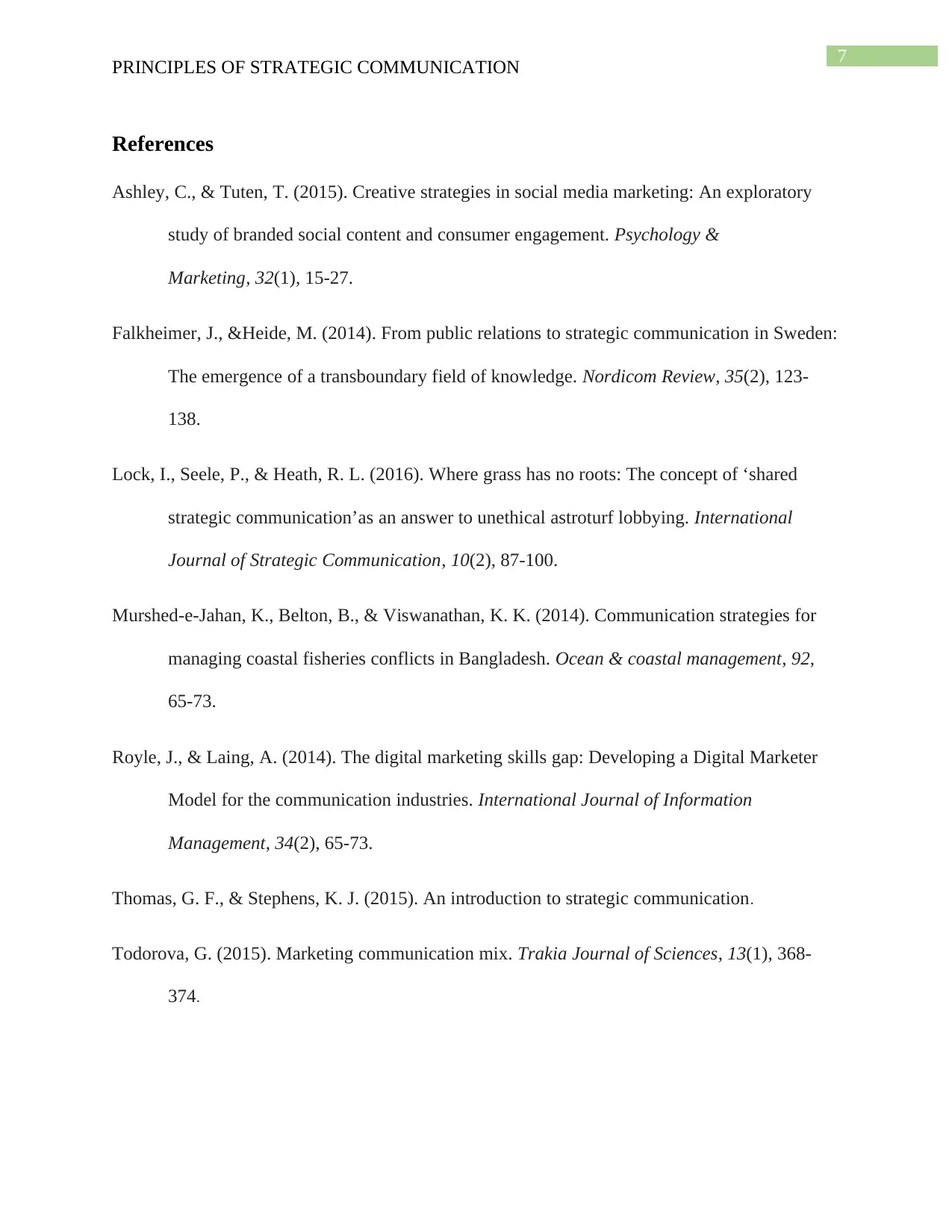
References
Ashley, C., & Tuten, T. (2015). Creative strategies in social media marketing: An exploratory
study of branded social content and consumer engagement. Psychology &
Marketing, 32(1), 15-27.
Falkheimer, J., &Heide, M. (2014). From public relations to strategic communication in Sweden:
The emergence of a transboundary field of knowledge. Nordicom Review, 35(2), 123-
138.
Lock, I., Seele, P., & Heath, R. L. (2016). Where grass has no roots: The concept of ‘shared
strategic communication’as an answer to unethical astroturf lobbying. International
Journal of Strategic Communication, 10(2), 87-100.
Murshed-e-Jahan, K., Belton, B., & Viswanathan, K. K. (2014). Communication strategies for
managing coastal fisheries conflicts in Bangladesh. Ocean & coastal management, 92,
65-73.
Royle, J., & Laing, A. (2014). The digital marketing skills gap: Developing a Digital Marketer
Model for the communication industries. International Journal of Information
Management, 34(2), 65-73.
Thomas, G. F., & Stephens, K. J. (2015). An introduction to strategic communication.
Todorova, G. (2015). Marketing communication mix. Trakia Journal of Sciences, 13(1), 368-
374.
PRINCIPLES OF STRATEGIC COMMUNICATION
References
Ashley, C., & Tuten, T. (2015). Creative strategies in social media marketing: An exploratory
study of branded social content and consumer engagement. Psychology &
Marketing, 32(1), 15-27.
Falkheimer, J., &Heide, M. (2014). From public relations to strategic communication in Sweden:
The emergence of a transboundary field of knowledge. Nordicom Review, 35(2), 123-
138.
Lock, I., Seele, P., & Heath, R. L. (2016). Where grass has no roots: The concept of ‘shared
strategic communication’as an answer to unethical astroturf lobbying. International
Journal of Strategic Communication, 10(2), 87-100.
Murshed-e-Jahan, K., Belton, B., & Viswanathan, K. K. (2014). Communication strategies for
managing coastal fisheries conflicts in Bangladesh. Ocean & coastal management, 92,
65-73.
Royle, J., & Laing, A. (2014). The digital marketing skills gap: Developing a Digital Marketer
Model for the communication industries. International Journal of Information
Management, 34(2), 65-73.
Thomas, G. F., & Stephens, K. J. (2015). An introduction to strategic communication.
Todorova, G. (2015). Marketing communication mix. Trakia Journal of Sciences, 13(1), 368-
374.

8
PRINCIPLES OF STRATEGIC COMMUNICATION
Yang, K. C., & Kang, Y. (2015). Exploring big data and privacy in strategic communication
campaigns: A cross-cultural study of mobile social media users’ daily
experiences. International Journal of Strategic Communication, 9(2), 87-101
PRINCIPLES OF STRATEGIC COMMUNICATION
Yang, K. C., & Kang, Y. (2015). Exploring big data and privacy in strategic communication
campaigns: A cross-cultural study of mobile social media users’ daily
experiences. International Journal of Strategic Communication, 9(2), 87-101
⊘ This is a preview!⊘
Do you want full access?
Subscribe today to unlock all pages.
Trusted by 1+ million students worldwide

1 out of 9


Related Documents


Your All-in-One AI-Powered Toolkit for Academic Success.
+13062052269
info@desklib.com
Available 24*7 on WhatsApp / Email
![[object Object]](/_next/static/media/star-bottom.7253800d.svg)
Unlock your academic potential
Copyright © 2020–2026 A2Z Services. All Rights Reserved. Developed and managed by ZUCOL.