Annotated Bibliography: Japanese Martial Arts' Influence on Culture
VerifiedAdded on 2023/05/31
|8
|2178
|75
Annotated Bibliography
AI Summary
This annotated bibliography examines the influence of Japanese martial arts on Japanese culture. It analyzes five scholarly sources, including books and articles, focusing on the historical, religious, psychological, and social dimensions. The sources explore how martial arts, such as Ninjutsu, have been shaped by and have shaped Japanese culture, examining their role in education, popular culture, and the development of a warrior ethos. The bibliography covers various perspectives, from philosophical and artistic interpretations to psychological and sociological analyses, providing a comprehensive understanding of martial arts' multifaceted impact. The annotations include summaries, arguments, conclusions, research methodologies, author backgrounds, and relevance to the topic, offering insights into how martial arts have been integrated into Japanese society and tradition. The bibliography highlights the importance of martial arts as a cultural practice and a teaching tool, reflecting on their evolution, impact, and continuing relevance in modern Japan.
Running Head: ASIAN AMERICAN STUDIES
ASIAN AMERICAN STUDIES
Name of the Student:
Name of University:
Author Note:
ASIAN AMERICAN STUDIES
Name of the Student:
Name of University:
Author Note:

Paraphrase This Document
Need a fresh take? Get an instant paraphrase of this document with our AI Paraphraser
1ASIAN AMERICAN STUDIES
Allen, Barry. Striking Beauty: A Philosophical Look at the Asian Martial Arts. Columbia
University Press, 2015.
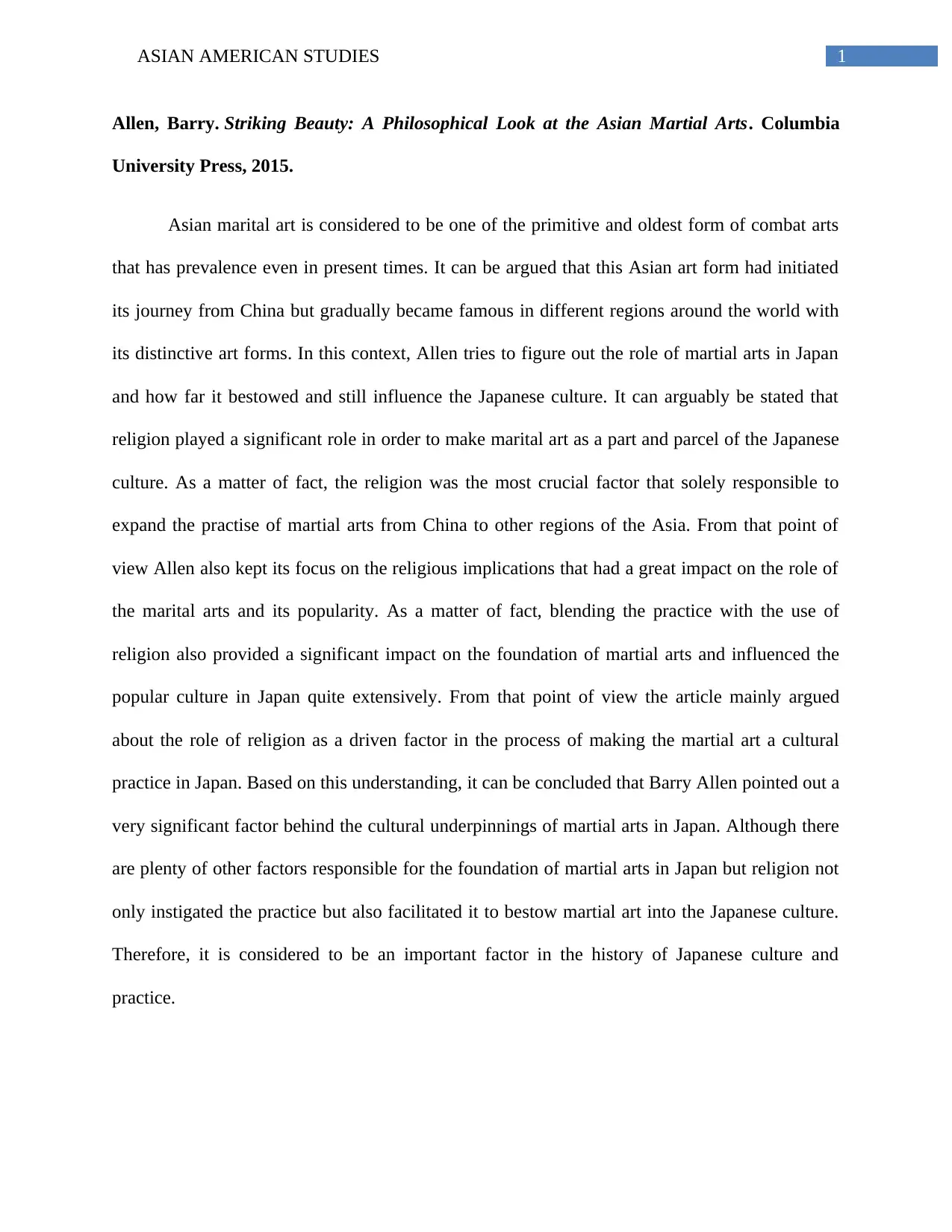
Asian marital art is considered to be one of the primitive and oldest form of combat arts
that has prevalence even in present times. It can be argued that this Asian art form had initiated
its journey from China but gradually became famous in different regions around the world with
its distinctive art forms. In this context, Allen tries to figure out the role of martial arts in Japan
and how far it bestowed and still influence the Japanese culture. It can arguably be stated that
religion played a significant role in order to make marital art as a part and parcel of the Japanese
culture. As a matter of fact, the religion was the most crucial factor that solely responsible to
expand the practise of martial arts from China to other regions of the Asia. From that point of
view Allen also kept its focus on the religious implications that had a great impact on the role of
the marital arts and its popularity. As a matter of fact, blending the practice with the use of
religion also provided a significant impact on the foundation of martial arts and influenced the
popular culture in Japan quite extensively. From that point of view the article mainly argued
about the role of religion as a driven factor in the process of making the martial art a cultural
practice in Japan. Based on this understanding, it can be concluded that Barry Allen pointed out a
very significant factor behind the cultural underpinnings of martial arts in Japan. Although there
are plenty of other factors responsible for the foundation of martial arts in Japan but religion not
only instigated the practice but also facilitated it to bestow martial art into the Japanese culture.
Therefore, it is considered to be an important factor in the history of Japanese culture and
practice.
Allen, Barry. Striking Beauty: A Philosophical Look at the Asian Martial Arts. Columbia
University Press, 2015.
Asian marital art is considered to be one of the primitive and oldest form of combat arts
that has prevalence even in present times. It can be argued that this Asian art form had initiated
its journey from China but gradually became famous in different regions around the world with
its distinctive art forms. In this context, Allen tries to figure out the role of martial arts in Japan
and how far it bestowed and still influence the Japanese culture. It can arguably be stated that
religion played a significant role in order to make marital art as a part and parcel of the Japanese
culture. As a matter of fact, the religion was the most crucial factor that solely responsible to
expand the practise of martial arts from China to other regions of the Asia. From that point of
view Allen also kept its focus on the religious implications that had a great impact on the role of
the marital arts and its popularity. As a matter of fact, blending the practice with the use of
religion also provided a significant impact on the foundation of martial arts and influenced the
popular culture in Japan quite extensively. From that point of view the article mainly argued
about the role of religion as a driven factor in the process of making the martial art a cultural
practice in Japan. Based on this understanding, it can be concluded that Barry Allen pointed out a
very significant factor behind the cultural underpinnings of martial arts in Japan. Although there
are plenty of other factors responsible for the foundation of martial arts in Japan but religion not
only instigated the practice but also facilitated it to bestow martial art into the Japanese culture.
Therefore, it is considered to be an important factor in the history of Japanese culture and
practice.
2ASIAN AMERICAN STUDIES
Graves, David C. "Martial Arts and the Artworld." The Monist 99, no. 1 (2016): 13-25.
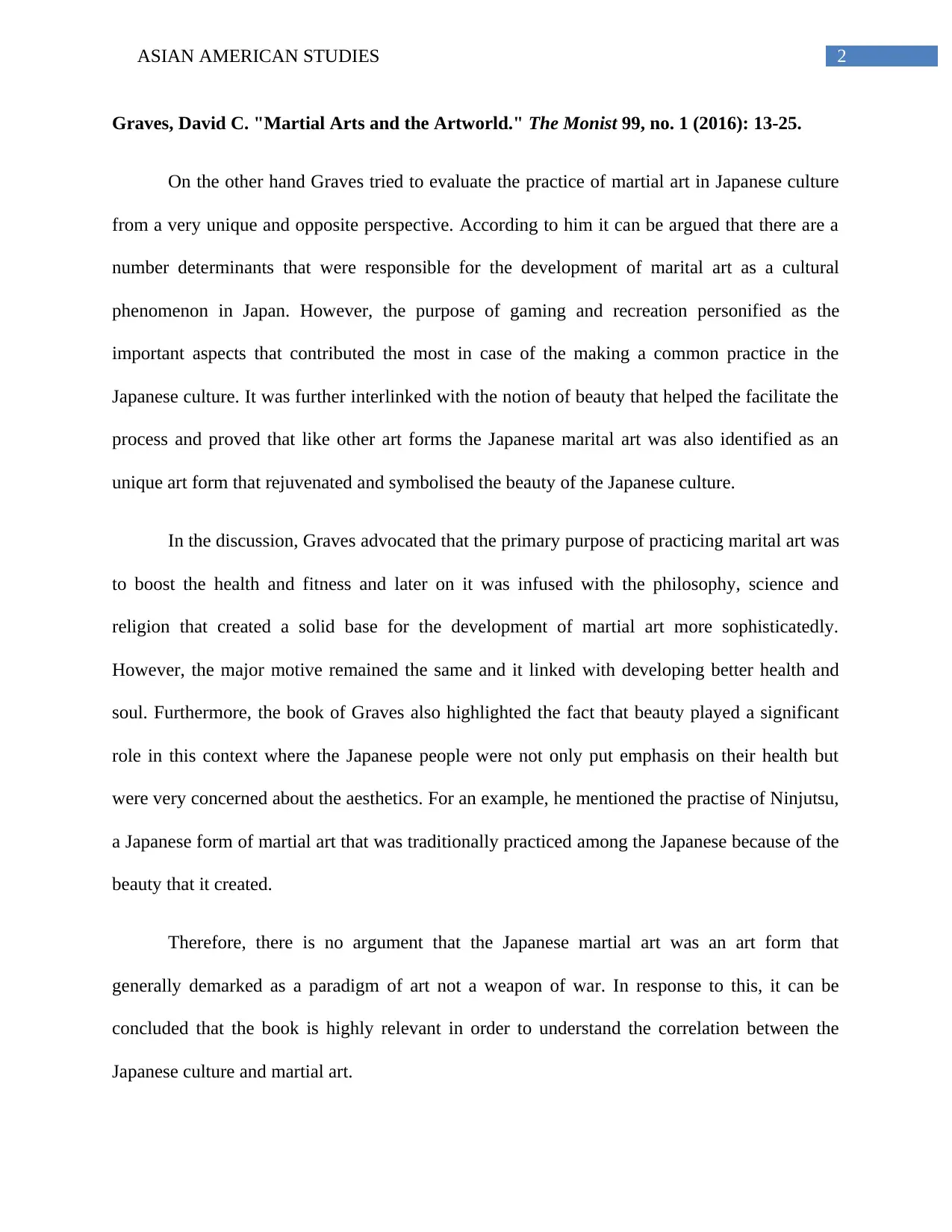
On the other hand Graves tried to evaluate the practice of martial art in Japanese culture
from a very unique and opposite perspective. According to him it can be argued that there are a
number determinants that were responsible for the development of marital art as a cultural
phenomenon in Japan. However, the purpose of gaming and recreation personified as the
important aspects that contributed the most in case of the making a common practice in the
Japanese culture. It was further interlinked with the notion of beauty that helped the facilitate the
process and proved that like other art forms the Japanese marital art was also identified as an
unique art form that rejuvenated and symbolised the beauty of the Japanese culture.
In the discussion, Graves advocated that the primary purpose of practicing marital art was
to boost the health and fitness and later on it was infused with the philosophy, science and
religion that created a solid base for the development of martial art more sophisticatedly.
However, the major motive remained the same and it linked with developing better health and
soul. Furthermore, the book of Graves also highlighted the fact that beauty played a significant
role in this context where the Japanese people were not only put emphasis on their health but
were very concerned about the aesthetics. For an example, he mentioned the practise of Ninjutsu,
a Japanese form of martial art that was traditionally practiced among the Japanese because of the
beauty that it created.
Therefore, there is no argument that the Japanese martial art was an art form that
generally demarked as a paradigm of art not a weapon of war. In response to this, it can be
concluded that the book is highly relevant in order to understand the correlation between the
Japanese culture and martial art.
Graves, David C. "Martial Arts and the Artworld." The Monist 99, no. 1 (2016): 13-25.
On the other hand Graves tried to evaluate the practice of martial art in Japanese culture
from a very unique and opposite perspective. According to him it can be argued that there are a
number determinants that were responsible for the development of marital art as a cultural
phenomenon in Japan. However, the purpose of gaming and recreation personified as the
important aspects that contributed the most in case of the making a common practice in the
Japanese culture. It was further interlinked with the notion of beauty that helped the facilitate the
process and proved that like other art forms the Japanese marital art was also identified as an
unique art form that rejuvenated and symbolised the beauty of the Japanese culture.
In the discussion, Graves advocated that the primary purpose of practicing marital art was
to boost the health and fitness and later on it was infused with the philosophy, science and
religion that created a solid base for the development of martial art more sophisticatedly.
However, the major motive remained the same and it linked with developing better health and
soul. Furthermore, the book of Graves also highlighted the fact that beauty played a significant
role in this context where the Japanese people were not only put emphasis on their health but
were very concerned about the aesthetics. For an example, he mentioned the practise of Ninjutsu,
a Japanese form of martial art that was traditionally practiced among the Japanese because of the
beauty that it created.
Therefore, there is no argument that the Japanese martial art was an art form that
generally demarked as a paradigm of art not a weapon of war. In response to this, it can be
concluded that the book is highly relevant in order to understand the correlation between the
Japanese culture and martial art.
⊘ This is a preview!⊘
Do you want full access?
Subscribe today to unlock all pages.

Trusted by 1+ million students worldwide
3ASIAN AMERICAN STUDIES
Nagy, Stephen Robert. "Japanese Martial Arts as Popular Culture: Teaching Opportunity
and Challenge." Asian Studies3, no. 1 (2015): 83-102.
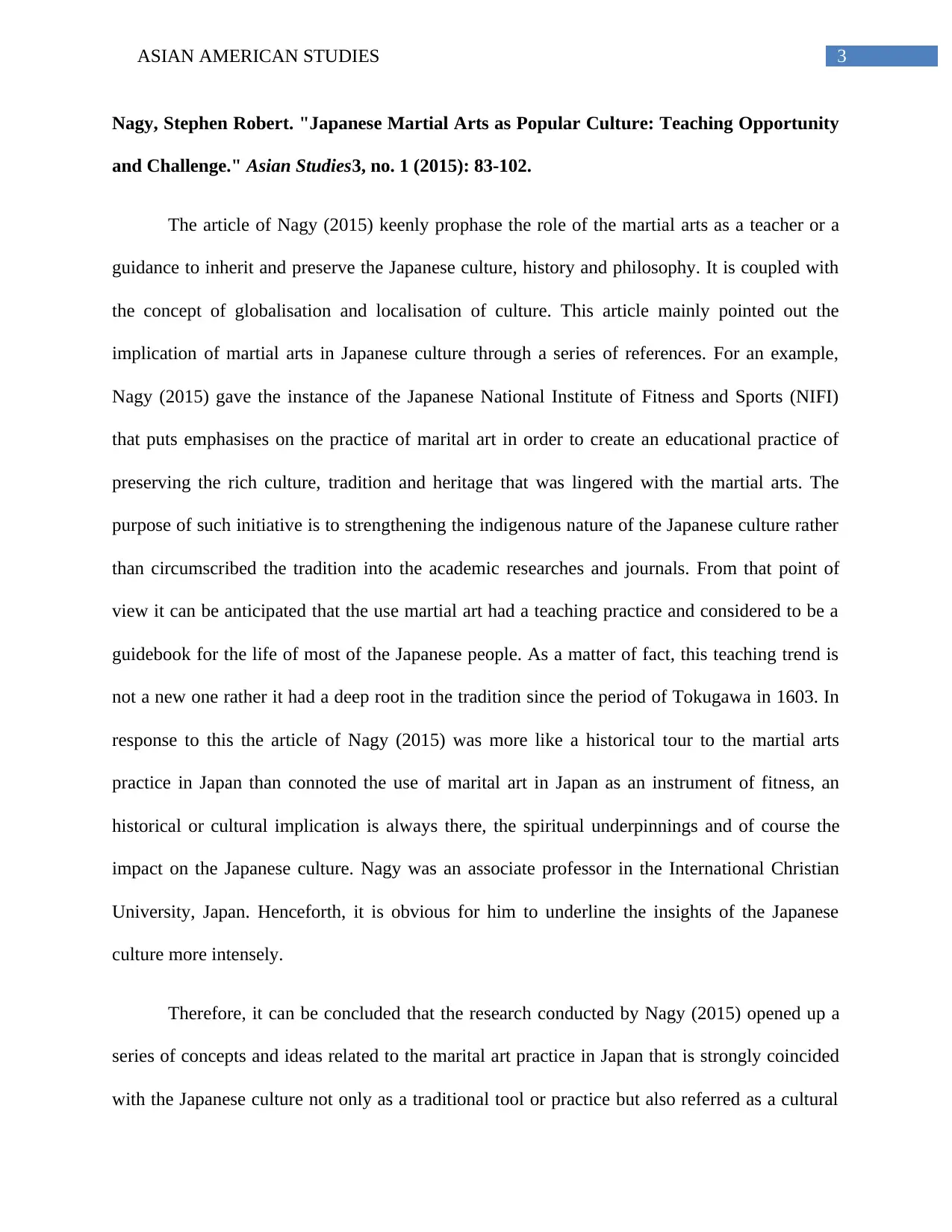
The article of Nagy (2015) keenly prophase the role of the martial arts as a teacher or a
guidance to inherit and preserve the Japanese culture, history and philosophy. It is coupled with
the concept of globalisation and localisation of culture. This article mainly pointed out the
implication of martial arts in Japanese culture through a series of references. For an example,
Nagy (2015) gave the instance of the Japanese National Institute of Fitness and Sports (NIFI)
that puts emphasises on the practice of marital art in order to create an educational practice of
preserving the rich culture, tradition and heritage that was lingered with the martial arts. The
purpose of such initiative is to strengthening the indigenous nature of the Japanese culture rather
than circumscribed the tradition into the academic researches and journals. From that point of
view it can be anticipated that the use martial art had a teaching practice and considered to be a
guidebook for the life of most of the Japanese people. As a matter of fact, this teaching trend is
not a new one rather it had a deep root in the tradition since the period of Tokugawa in 1603. In
response to this the article of Nagy (2015) was more like a historical tour to the martial arts
practice in Japan than connoted the use of marital art in Japan as an instrument of fitness, an
historical or cultural implication is always there, the spiritual underpinnings and of course the
impact on the Japanese culture. Nagy was an associate professor in the International Christian
University, Japan. Henceforth, it is obvious for him to underline the insights of the Japanese
culture more intensely.
Therefore, it can be concluded that the research conducted by Nagy (2015) opened up a
series of concepts and ideas related to the marital art practice in Japan that is strongly coincided
with the Japanese culture not only as a traditional tool or practice but also referred as a cultural
Nagy, Stephen Robert. "Japanese Martial Arts as Popular Culture: Teaching Opportunity
and Challenge." Asian Studies3, no. 1 (2015): 83-102.
The article of Nagy (2015) keenly prophase the role of the martial arts as a teacher or a
guidance to inherit and preserve the Japanese culture, history and philosophy. It is coupled with
the concept of globalisation and localisation of culture. This article mainly pointed out the
implication of martial arts in Japanese culture through a series of references. For an example,
Nagy (2015) gave the instance of the Japanese National Institute of Fitness and Sports (NIFI)
that puts emphasises on the practice of marital art in order to create an educational practice of
preserving the rich culture, tradition and heritage that was lingered with the martial arts. The
purpose of such initiative is to strengthening the indigenous nature of the Japanese culture rather
than circumscribed the tradition into the academic researches and journals. From that point of
view it can be anticipated that the use martial art had a teaching practice and considered to be a
guidebook for the life of most of the Japanese people. As a matter of fact, this teaching trend is
not a new one rather it had a deep root in the tradition since the period of Tokugawa in 1603. In
response to this the article of Nagy (2015) was more like a historical tour to the martial arts
practice in Japan than connoted the use of marital art in Japan as an instrument of fitness, an
historical or cultural implication is always there, the spiritual underpinnings and of course the
impact on the Japanese culture. Nagy was an associate professor in the International Christian
University, Japan. Henceforth, it is obvious for him to underline the insights of the Japanese
culture more intensely.
Therefore, it can be concluded that the research conducted by Nagy (2015) opened up a
series of concepts and ideas related to the marital art practice in Japan that is strongly coincided
with the Japanese culture not only as a traditional tool or practice but also referred as a cultural
Paraphrase This Document
Need a fresh take? Get an instant paraphrase of this document with our AI Paraphraser
4ASIAN AMERICAN STUDIES
backbone be teaching the people. Henceforth, the article is highly significant and has relevance
in this discussion.
Cynarski, Wojciech J., Jong-Hoon Yu, Krzysztof Warchol, and Pavol Bartik. "Martial arts
in psycho-physical culture." Ido Movement for Culture. Journal of Martial Arts
Anthropology15, no. 4 (2015): 3-38.
As far as different theories regarding the impact of martial art in the Japanese culture are
concerned Cynarski et al. 2015 propounded a different theory based on blend of both psychology
and physical exercises. In this context, it can be argued that Cynarski et al. 2015 put emphasis on
the humanistic theory of Martial Arts. They never denied the fact that spirituality and religion
influenced the martial art since its inception and that influence the popular culture of Japan
significantly. However, the dynamic orientation of martial art must not circumscribe itself into
the very understanding of spirituality or beauty or some cognate themes of physical training
rather it was also relied on the psychological foundation that moved the Japanese people heavily.
The article tried to elaborate the fact that it was a cultural exchange of maturing and socialisation
that the authors were termed as ‘inculturation’ that assimilated a foreign culture with the
Japanese popular culture. Moreover, from the perspective of social ideas it can also be seen that
the martial art created a higher social strata or categorisation that was easily camouflaged into
the traditional social system of Japan. Particularly the warrior or the elite paradigm envisaged a
clear understanding of the social differentiation and made it popular in the country. From that
perspective it is ostensibly clear that the psychological implication of marital art had surely some
impression on the Japanese people and as a result of that they were interested to incorporate that
practice into the traditional system. All the authors were popular in their respective subjects and
backbone be teaching the people. Henceforth, the article is highly significant and has relevance
in this discussion.
Cynarski, Wojciech J., Jong-Hoon Yu, Krzysztof Warchol, and Pavol Bartik. "Martial arts
in psycho-physical culture." Ido Movement for Culture. Journal of Martial Arts
Anthropology15, no. 4 (2015): 3-38.
As far as different theories regarding the impact of martial art in the Japanese culture are
concerned Cynarski et al. 2015 propounded a different theory based on blend of both psychology
and physical exercises. In this context, it can be argued that Cynarski et al. 2015 put emphasis on
the humanistic theory of Martial Arts. They never denied the fact that spirituality and religion
influenced the martial art since its inception and that influence the popular culture of Japan
significantly. However, the dynamic orientation of martial art must not circumscribe itself into
the very understanding of spirituality or beauty or some cognate themes of physical training
rather it was also relied on the psychological foundation that moved the Japanese people heavily.
The article tried to elaborate the fact that it was a cultural exchange of maturing and socialisation
that the authors were termed as ‘inculturation’ that assimilated a foreign culture with the
Japanese popular culture. Moreover, from the perspective of social ideas it can also be seen that
the martial art created a higher social strata or categorisation that was easily camouflaged into
the traditional social system of Japan. Particularly the warrior or the elite paradigm envisaged a
clear understanding of the social differentiation and made it popular in the country. From that
perspective it is ostensibly clear that the psychological implication of marital art had surely some
impression on the Japanese people and as a result of that they were interested to incorporate that
practice into the traditional system. All the authors were popular in their respective subjects and
5ASIAN AMERICAN STUDIES
were linked with their respective universities. Their profound knowledge in the martial art
culture made the research more authentic.
The above discussion rightly pointed out psycho-physical factor that was dedicatedly
injected the beneficial and positive factors of the martial art into the Japanese culture. Moreover,
the humanistic attributes of the martial art was also depicted into the discussion that intertwined
with the Japanese tradition intricately. Therefore, it can be concluded that there was a deep
rooted influence of the martial art in Japanese culture and from that point of view this article is
clearly relevant and important also.
Boyd, Oscar. 2018. "An Insider's Guide To Surviving The World Of Japanese Martial Arts
The Japan Times". The Japan Times.
https://www.japantimes.co.jp/culture/2018/10/20/books/insiders-guide-surviving-world-
japanese-martial-arts/#.W-r2RpMzbIV.
This article is more related to the research of Alexander Bennett and tried to explore
every aspects of his work. However, deliberately or unintentionally the author Boyd (2018)
revealed the true meaning of martial art in the Japanese culture and its vitality that pushed the
practice still exists. It was like a interpretation of the outside world on the practice of martial art
and its implication and impacts on the Japanese culture. From an outsider’s perspective it seems
like a martial art that the entire Japanese culture is familiar with but the concept is not so lucid or
linear. There are several schools of martial art with their specific form of martial arts and it is not
so easy to become an expert of martial art. It requires huge physical fitness, sharp in mind and
patience. In addition to this, reviewing the book of Alexander Bennett also delivers an insight
into the practice of martial art and clear out all the misconceptions and myths that circled around
were linked with their respective universities. Their profound knowledge in the martial art
culture made the research more authentic.
The above discussion rightly pointed out psycho-physical factor that was dedicatedly
injected the beneficial and positive factors of the martial art into the Japanese culture. Moreover,
the humanistic attributes of the martial art was also depicted into the discussion that intertwined
with the Japanese tradition intricately. Therefore, it can be concluded that there was a deep
rooted influence of the martial art in Japanese culture and from that point of view this article is
clearly relevant and important also.
Boyd, Oscar. 2018. "An Insider's Guide To Surviving The World Of Japanese Martial Arts
The Japan Times". The Japan Times.
https://www.japantimes.co.jp/culture/2018/10/20/books/insiders-guide-surviving-world-
japanese-martial-arts/#.W-r2RpMzbIV.
This article is more related to the research of Alexander Bennett and tried to explore
every aspects of his work. However, deliberately or unintentionally the author Boyd (2018)
revealed the true meaning of martial art in the Japanese culture and its vitality that pushed the
practice still exists. It was like a interpretation of the outside world on the practice of martial art
and its implication and impacts on the Japanese culture. From an outsider’s perspective it seems
like a martial art that the entire Japanese culture is familiar with but the concept is not so lucid or
linear. There are several schools of martial art with their specific form of martial arts and it is not
so easy to become an expert of martial art. It requires huge physical fitness, sharp in mind and
patience. In addition to this, reviewing the book of Alexander Bennett also delivers an insight
into the practice of martial art and clear out all the misconceptions and myths that circled around
⊘ This is a preview!⊘
Do you want full access?
Subscribe today to unlock all pages.
Trusted by 1+ million students worldwide
6ASIAN AMERICAN STUDIES
Japanese martial art from a long period of time. In fact, the book puts aa great deal of emphasis
on the present day practice of martial art in Japan and the popular perception regarding this
practice. From that point of view, it seems very important for the outside world to get
acknowledged with the fathom of Japanese martial arts and its vitality in the Japanese culture.
Moreover, the book is more of a personal diary or experience that helps the reader to find out the
real picture through a non-Japanese interpretation. In fact, Oscar Boyd is a veteran journalist of
Japan Times who is well known for dealing with the Japanese culture so that it seems to an
authentic news article that share some lights on the martial art and Japanese culture.
Henceforth, it can be argued that the article is very relevant to highlight the relationship
between the Japanese culture and marital art and shattered all the misconceptions and myths so
that the readers can get a real essence of what Japanese martial art culture is. From that point of
view, it can be concluded that the article is highly relevant and significant by not only reveals
different aspects of the Japanese martial arts practice but also portrays an international viewpoint
of the importance of martial art on Japanese culture.
Japanese martial art from a long period of time. In fact, the book puts aa great deal of emphasis
on the present day practice of martial art in Japan and the popular perception regarding this
practice. From that point of view, it seems very important for the outside world to get
acknowledged with the fathom of Japanese martial arts and its vitality in the Japanese culture.
Moreover, the book is more of a personal diary or experience that helps the reader to find out the
real picture through a non-Japanese interpretation. In fact, Oscar Boyd is a veteran journalist of
Japan Times who is well known for dealing with the Japanese culture so that it seems to an
authentic news article that share some lights on the martial art and Japanese culture.
Henceforth, it can be argued that the article is very relevant to highlight the relationship
between the Japanese culture and marital art and shattered all the misconceptions and myths so
that the readers can get a real essence of what Japanese martial art culture is. From that point of
view, it can be concluded that the article is highly relevant and significant by not only reveals
different aspects of the Japanese martial arts practice but also portrays an international viewpoint
of the importance of martial art on Japanese culture.
Paraphrase This Document
Need a fresh take? Get an instant paraphrase of this document with our AI Paraphraser
7ASIAN AMERICAN STUDIES
Bibliography
Allen, Barry. Striking Beauty: A Philosophical Look at the Asian Martial Arts. Columbia
University Press, 2015.
Boyd, Oscar. 2018. "An Insider's Guide To Surviving The World Of Japanese Martial Arts The
Japan Times". The Japan Times.
https://www.japantimes.co.jp/culture/2018/10/20/books/insiders-guide-surviving-world-
japanese-martial-arts/#.W-r2RpMzbIV.
Cynarski, Wojciech J., Jong-Hoon Yu, Krzysztof Warchol, and Pavol Bartik. "Martial arts in
psycho-physical culture." Ido Movement for Culture. Journal of Martial Arts Anthropology15,
no. 4 (2015): 3-38.
Graves, David C. "Martial Arts and the Artworld." The Monist 99, no. 1 (2016): 13-25.
Nagy, Stephen Robert. "Japanese Martial Arts as Popular Culture: Teaching Opportunity and
Challenge." Asian Studies3, no. 1 (2015): 83-102.
Bibliography
Allen, Barry. Striking Beauty: A Philosophical Look at the Asian Martial Arts. Columbia
University Press, 2015.
Boyd, Oscar. 2018. "An Insider's Guide To Surviving The World Of Japanese Martial Arts The
Japan Times". The Japan Times.
https://www.japantimes.co.jp/culture/2018/10/20/books/insiders-guide-surviving-world-
japanese-martial-arts/#.W-r2RpMzbIV.
Cynarski, Wojciech J., Jong-Hoon Yu, Krzysztof Warchol, and Pavol Bartik. "Martial arts in
psycho-physical culture." Ido Movement for Culture. Journal of Martial Arts Anthropology15,
no. 4 (2015): 3-38.
Graves, David C. "Martial Arts and the Artworld." The Monist 99, no. 1 (2016): 13-25.
Nagy, Stephen Robert. "Japanese Martial Arts as Popular Culture: Teaching Opportunity and
Challenge." Asian Studies3, no. 1 (2015): 83-102.

1 out of 8


Your All-in-One AI-Powered Toolkit for Academic Success.
+13062052269
info@desklib.com
Available 24*7 on WhatsApp / Email
![[object Object]](/_next/static/media/star-bottom.7253800d.svg)
Unlock your academic potential
Copyright © 2020–2026 A2Z Services. All Rights Reserved. Developed and managed by ZUCOL.