1101NRS Assignment 2: Annotated Bibliography of Nursing Articles
VerifiedAdded on 2022/08/11
|7
|1293
|41
Annotated Bibliography
AI Summary
This annotated bibliography analyzes three journal articles focused on communication in nursing. The first article examines communication differences between nurses and other healthcare professionals, highlighting the importance of acceptance, engagement, caring, and empathy. The second article addresses the challenges of intercultural communication, particularly in the context of cultural diversity in Australia, and the impact of prejudice and stereotyping. The third article explores the use of electronic devices for communication, revealing both advantages such as improved efficiency and disadvantages like data security concerns and lack of face-to-face interaction. The bibliography includes an introduction outlining its structure and aims, followed by detailed annotations of each article, and a conclusion summarizing key findings and recommendations for implementing effective communication strategies in nursing practice.
2020
ANNOTATED
BIBLIOGRAPHY
Student’s Details
ANNOTATED
BIBLIOGRAPHY
Student’s Details
Paraphrase This Document
Need a fresh take? Get an instant paraphrase of this document with our AI Paraphraser

ANNOTATED BIBLIOGRAPHY 1
Table of Contents
Introduction......................................................................................................................................2
Analysis...........................................................................................................................................2
Conclusion.......................................................................................................................................5
Bibliography....................................................................................................................................6
Table of Contents
Introduction......................................................................................................................................2
Analysis...........................................................................................................................................2
Conclusion.......................................................................................................................................5
Bibliography....................................................................................................................................6

ANNOTATED BIBLIOGRAPHY 2
Introduction
A list of citations of various literature sources such as books, documents, and articles
known as annotated bibliography, which have a brief descriptive and evaluative discussion of
each citation in one and two paragraphs. The annotation bibliography aims to provide
information about the relevance, quality, and accuracy of the source to a reader. In the
annotation bibliography structure, center idea of the source or study, theme, finding and
conclusions have been discussed (CUL, 2020). This discussion comprises annotated bibliography
of three nursing journal articles on effective communication. “The international voice of nursing
journal research, theory and practices”, “Nurse Education in practices” and “Leading global
nursing research” research articles have been analyzed and discussed here.
Analysis
Article 1
The first article entitled "Differences in communication within the nursing group and
with members of other professions at a hospital unit aims to identify communication differences
between nurses and other healthcare professionals”. This research article is based on the
difficulties faced by the nurses in the introduction of interdisciplinary collaboration within
hospitals setting during performing their job or task. A cross-sectional survey analysis has been
done to carry out this research and the questionnaire had been filled through nurse professionals
including nurses and assistant nurses. The questionnaire was contented 12 factors, and there were
significant differences between these 12 factors in the study. Nurses have been characterized as
acceptance, engagement, caring and empathy in communication as higher scoring factors
Introduction
A list of citations of various literature sources such as books, documents, and articles
known as annotated bibliography, which have a brief descriptive and evaluative discussion of
each citation in one and two paragraphs. The annotation bibliography aims to provide
information about the relevance, quality, and accuracy of the source to a reader. In the
annotation bibliography structure, center idea of the source or study, theme, finding and
conclusions have been discussed (CUL, 2020). This discussion comprises annotated bibliography
of three nursing journal articles on effective communication. “The international voice of nursing
journal research, theory and practices”, “Nurse Education in practices” and “Leading global
nursing research” research articles have been analyzed and discussed here.
Analysis
Article 1
The first article entitled "Differences in communication within the nursing group and
with members of other professions at a hospital unit aims to identify communication differences
between nurses and other healthcare professionals”. This research article is based on the
difficulties faced by the nurses in the introduction of interdisciplinary collaboration within
hospitals setting during performing their job or task. A cross-sectional survey analysis has been
done to carry out this research and the questionnaire had been filled through nurse professionals
including nurses and assistant nurses. The questionnaire was contented 12 factors, and there were
significant differences between these 12 factors in the study. Nurses have been characterized as
acceptance, engagement, caring and empathy in communication as higher scoring factors
⊘ This is a preview!⊘
Do you want full access?
Subscribe today to unlock all pages.

Trusted by 1+ million students worldwide

ANNOTATED BIBLIOGRAPHY 3
whereas low scoring on the same factors has been characterized in communication with other
healthcare professionals.
Thus, Study revealed that nurse professionals are more loyal, accepting and criticizes
communication when they have communication with each other rather than communication with
other professionals. According to the research study, nurses experience mixed behaviors and
emotions that affect their communications with healthcare professionals such as GP, mental
health professionals and specialist doctors from other professions. Decisiveness and resignation
of other healthcare professionals also influence the behavior and communication of nurses.
Because nurses are key elements to create collaboration between diverse disciplines in the
healthcare system thus communications skills are imperative in nurses to enhance patient-centric
services (André, Nøst, & Frigstad, 2016).
Article 2
Another research article namely “Strategies used by nurses, academics, and students to
overcome intercultural communication challenges”. This study identifies that perception from
cultural diversity leads prejudice which is a major hurdle for nurses and other healthcare
professionals. This prejudice affects adversely to learning of the learners and healthcare
practices of nurses. Differences in dress up and physical appearance give a sense of alienation
and a sense of rejection to nurses. In Australia, South Indian migrant nurses also faced alienation,
racism, and isolation at their workplace which also leads to inequality and discrimination in the
country. According to study, cultural diversity also leads to differences in behavior which
includes verbal and non-verbal communication. Australian nurses and healthcare professionals
whereas low scoring on the same factors has been characterized in communication with other
healthcare professionals.
Thus, Study revealed that nurse professionals are more loyal, accepting and criticizes
communication when they have communication with each other rather than communication with
other professionals. According to the research study, nurses experience mixed behaviors and
emotions that affect their communications with healthcare professionals such as GP, mental
health professionals and specialist doctors from other professions. Decisiveness and resignation
of other healthcare professionals also influence the behavior and communication of nurses.
Because nurses are key elements to create collaboration between diverse disciplines in the
healthcare system thus communications skills are imperative in nurses to enhance patient-centric
services (André, Nøst, & Frigstad, 2016).
Article 2
Another research article namely “Strategies used by nurses, academics, and students to
overcome intercultural communication challenges”. This study identifies that perception from
cultural diversity leads prejudice which is a major hurdle for nurses and other healthcare
professionals. This prejudice affects adversely to learning of the learners and healthcare
practices of nurses. Differences in dress up and physical appearance give a sense of alienation
and a sense of rejection to nurses. In Australia, South Indian migrant nurses also faced alienation,
racism, and isolation at their workplace which also leads to inequality and discrimination in the
country. According to study, cultural diversity also leads to differences in behavior which
includes verbal and non-verbal communication. Australian nurses and healthcare professionals
Paraphrase This Document
Need a fresh take? Get an instant paraphrase of this document with our AI Paraphraser

ANNOTATED BIBLIOGRAPHY 4
have biased behavior towards Indian nurses and presume that Indian nurses hvae lack of
commitment despite their hard work.
Stereotyping behaviors of people for culture also leads to inaccurate and biased
interpretations of other’s behaviors. The Stereotyping behavior leads problems for nurses and
learner or students that others react negatively towards them which gives a feeling of isolation,
sense of being misunderstood, and an assumption of inability of carrying out skills. Besides,
language is also a major challenge for specifically initiating conversation and asking queries to
clarify the information by the learners and nurse, which results in adequate examinations of
clinical performance by the academician. This study also comprises some suggestions to improve
equality such as the development of intercultural awareness, skills, and knowledge, organizing
seminars and workshops to avoid cultural boundaries at the workplace and providing facilities of
feedback of experiences in academics and healthcare institutions (Henderson, Barker, & Mak,
2017).
Article 3
Similarly, the research article namely 'The use of electronic devices for communication
with colleagues and other healthcare professionals – nursing professionals' perspectives, aims to
identify the communication experiences of nursing professionals with other healthcare
professionals including colleagues using electronic devices such as emails for communication.
As of today's technologically advanced environment, electronic communication is a common
method in professional and daily life. This study revealed that email is the most commonly used
communication methods in nursing healthcare professional. Electronic communication in
healthcare professionals and nurses is helpful in improving personnel competences, in
have biased behavior towards Indian nurses and presume that Indian nurses hvae lack of
commitment despite their hard work.
Stereotyping behaviors of people for culture also leads to inaccurate and biased
interpretations of other’s behaviors. The Stereotyping behavior leads problems for nurses and
learner or students that others react negatively towards them which gives a feeling of isolation,
sense of being misunderstood, and an assumption of inability of carrying out skills. Besides,
language is also a major challenge for specifically initiating conversation and asking queries to
clarify the information by the learners and nurse, which results in adequate examinations of
clinical performance by the academician. This study also comprises some suggestions to improve
equality such as the development of intercultural awareness, skills, and knowledge, organizing
seminars and workshops to avoid cultural boundaries at the workplace and providing facilities of
feedback of experiences in academics and healthcare institutions (Henderson, Barker, & Mak,
2017).
Article 3
Similarly, the research article namely 'The use of electronic devices for communication
with colleagues and other healthcare professionals – nursing professionals' perspectives, aims to
identify the communication experiences of nursing professionals with other healthcare
professionals including colleagues using electronic devices such as emails for communication.
As of today's technologically advanced environment, electronic communication is a common
method in professional and daily life. This study revealed that email is the most commonly used
communication methods in nursing healthcare professional. Electronic communication in
healthcare professionals and nurses is helpful in improving personnel competences, in

ANNOTATED BIBLIOGRAPHY 5
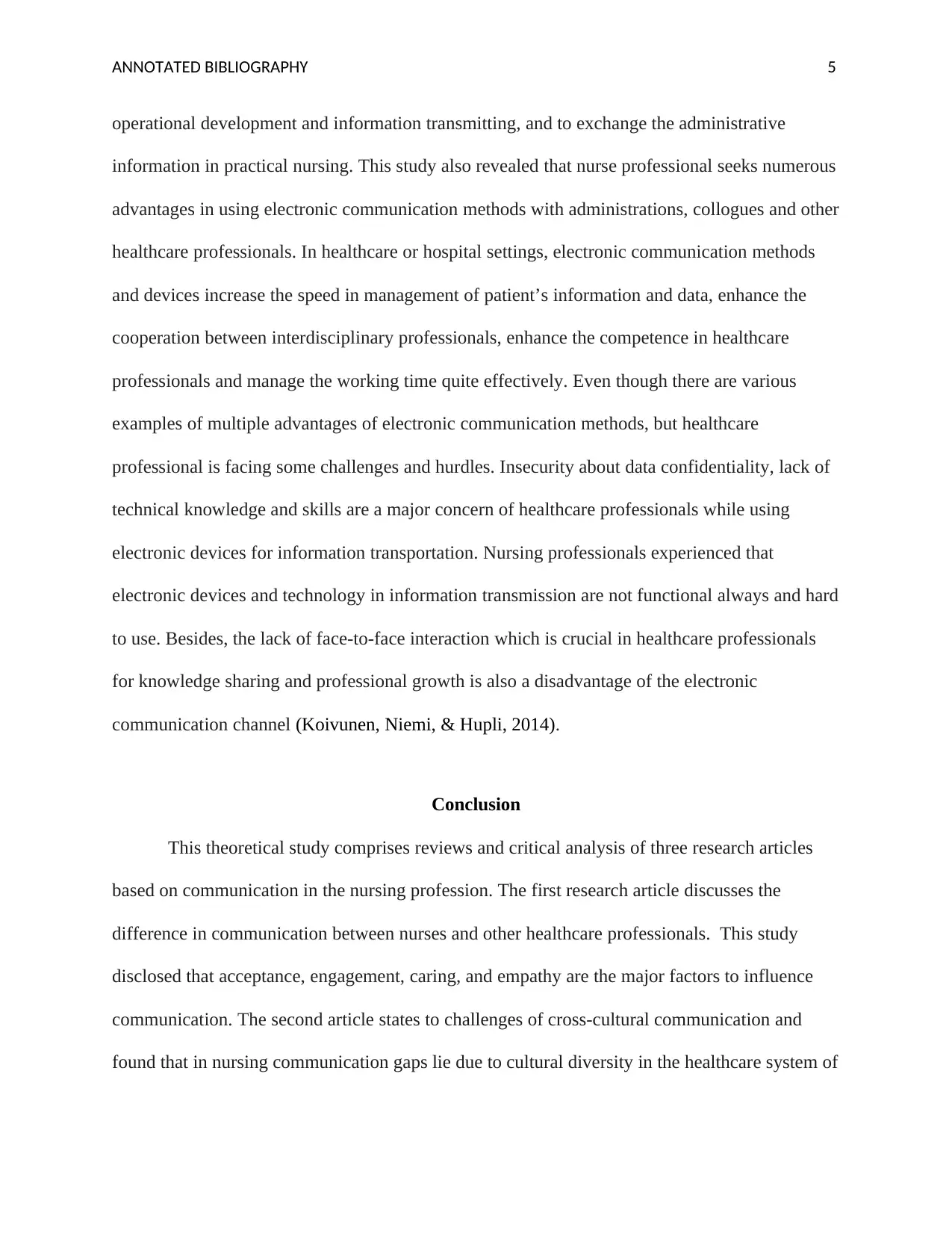
operational development and information transmitting, and to exchange the administrative
information in practical nursing. This study also revealed that nurse professional seeks numerous
advantages in using electronic communication methods with administrations, collogues and other
healthcare professionals. In healthcare or hospital settings, electronic communication methods
and devices increase the speed in management of patient’s information and data, enhance the
cooperation between interdisciplinary professionals, enhance the competence in healthcare
professionals and manage the working time quite effectively. Even though there are various
examples of multiple advantages of electronic communication methods, but healthcare
professional is facing some challenges and hurdles. Insecurity about data confidentiality, lack of
technical knowledge and skills are a major concern of healthcare professionals while using
electronic devices for information transportation. Nursing professionals experienced that
electronic devices and technology in information transmission are not functional always and hard
to use. Besides, the lack of face‐to‐face interaction which is crucial in healthcare professionals
for knowledge sharing and professional growth is also a disadvantage of the electronic
communication channel (Koivunen, Niemi, & Hupli, 2014).
Conclusion
This theoretical study comprises reviews and critical analysis of three research articles
based on communication in the nursing profession. The first research article discusses the
difference in communication between nurses and other healthcare professionals. This study
disclosed that acceptance, engagement, caring, and empathy are the major factors to influence
communication. The second article states to challenges of cross-cultural communication and
found that in nursing communication gaps lie due to cultural diversity in the healthcare system of
operational development and information transmitting, and to exchange the administrative
information in practical nursing. This study also revealed that nurse professional seeks numerous
advantages in using electronic communication methods with administrations, collogues and other
healthcare professionals. In healthcare or hospital settings, electronic communication methods
and devices increase the speed in management of patient’s information and data, enhance the
cooperation between interdisciplinary professionals, enhance the competence in healthcare
professionals and manage the working time quite effectively. Even though there are various
examples of multiple advantages of electronic communication methods, but healthcare
professional is facing some challenges and hurdles. Insecurity about data confidentiality, lack of
technical knowledge and skills are a major concern of healthcare professionals while using
electronic devices for information transportation. Nursing professionals experienced that
electronic devices and technology in information transmission are not functional always and hard
to use. Besides, the lack of face‐to‐face interaction which is crucial in healthcare professionals
for knowledge sharing and professional growth is also a disadvantage of the electronic
communication channel (Koivunen, Niemi, & Hupli, 2014).
Conclusion
This theoretical study comprises reviews and critical analysis of three research articles
based on communication in the nursing profession. The first research article discusses the
difference in communication between nurses and other healthcare professionals. This study
disclosed that acceptance, engagement, caring, and empathy are the major factors to influence
communication. The second article states to challenges of cross-cultural communication and
found that in nursing communication gaps lie due to cultural diversity in the healthcare system of
⊘ This is a preview!⊘
Do you want full access?
Subscribe today to unlock all pages.

Trusted by 1+ million students worldwide

ANNOTATED BIBLIOGRAPHY 6
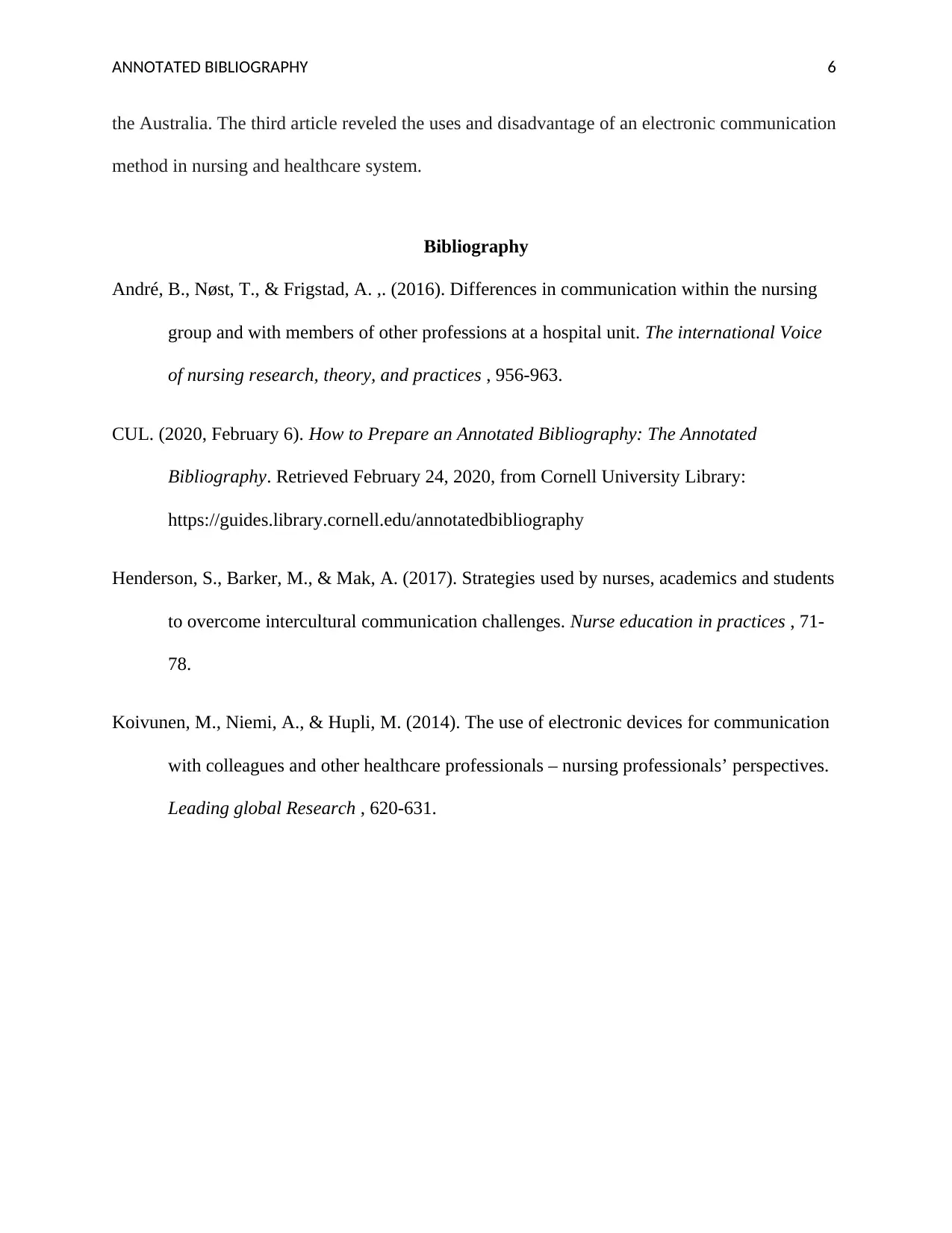
the Australia. The third article reveled the uses and disadvantage of an electronic communication
method in nursing and healthcare system.
Bibliography
André, B., Nøst, T., & Frigstad, A. ,. (2016). Differences in communication within the nursing
group and with members of other professions at a hospital unit. The international Voice
of nursing research, theory, and practices , 956-963.
CUL. (2020, February 6). How to Prepare an Annotated Bibliography: The Annotated
Bibliography. Retrieved February 24, 2020, from Cornell University Library:
https://guides.library.cornell.edu/annotatedbibliography
Henderson, S., Barker, M., & Mak, A. (2017). Strategies used by nurses, academics and students
to overcome intercultural communication challenges. Nurse education in practices , 71-
78.
Koivunen, M., Niemi, A., & Hupli, M. (2014). The use of electronic devices for communication
with colleagues and other healthcare professionals – nursing professionals’ perspectives.
Leading global Research , 620-631.
the Australia. The third article reveled the uses and disadvantage of an electronic communication
method in nursing and healthcare system.
Bibliography
André, B., Nøst, T., & Frigstad, A. ,. (2016). Differences in communication within the nursing
group and with members of other professions at a hospital unit. The international Voice
of nursing research, theory, and practices , 956-963.
CUL. (2020, February 6). How to Prepare an Annotated Bibliography: The Annotated
Bibliography. Retrieved February 24, 2020, from Cornell University Library:
https://guides.library.cornell.edu/annotatedbibliography
Henderson, S., Barker, M., & Mak, A. (2017). Strategies used by nurses, academics and students
to overcome intercultural communication challenges. Nurse education in practices , 71-
78.
Koivunen, M., Niemi, A., & Hupli, M. (2014). The use of electronic devices for communication
with colleagues and other healthcare professionals – nursing professionals’ perspectives.
Leading global Research , 620-631.
1 out of 7
Related Documents
Your All-in-One AI-Powered Toolkit for Academic Success.
+13062052269
info@desklib.com
Available 24*7 on WhatsApp / Email
Unlock your academic potential
Copyright © 2020–2026 A2Z Services. All Rights Reserved. Developed and managed by ZUCOL.