Annotated Bibliography: Psychology of Religion - Mental Health
VerifiedAdded on 2023/03/30
|6
|1177
|431
Annotated Bibliography
AI Summary
This annotated bibliography explores the psychology of religion, focusing on three key areas: the merits of religion in treating mental health issues, the impact of religion on individuals and society, and the nature of religious development across the human lifespan. The bibliography includes summaries and analyses of several journal articles. For mental health, the role of incorporating religion/spirituality into treatment is examined, particularly for minority populations and those with schizophrenia, alongside the benefits of spiritual support groups. Regarding societal impact, the effects of mixed-religion relationships in Northern Ireland and the relationship between religiosity and sexual behavior are explored. Finally, the nature of religious development is investigated through studies on conceptions of God and the Devil across different age groups and the influence of childhood religious affiliation on alcohol consumption in adulthood. The findings suggest complex relationships between religion, mental health, behavior, and development, highlighting the importance of considering religious and cultural contexts in psychological research.
Running head: Psychology of Religion 1
Psychology of Religion
Students Name
Institutional Affiliation
Psychology of Religion
Students Name
Institutional Affiliation
Paraphrase This Document
Need a fresh take? Get an instant paraphrase of this document with our AI Paraphraser

Psychology of Religion 2
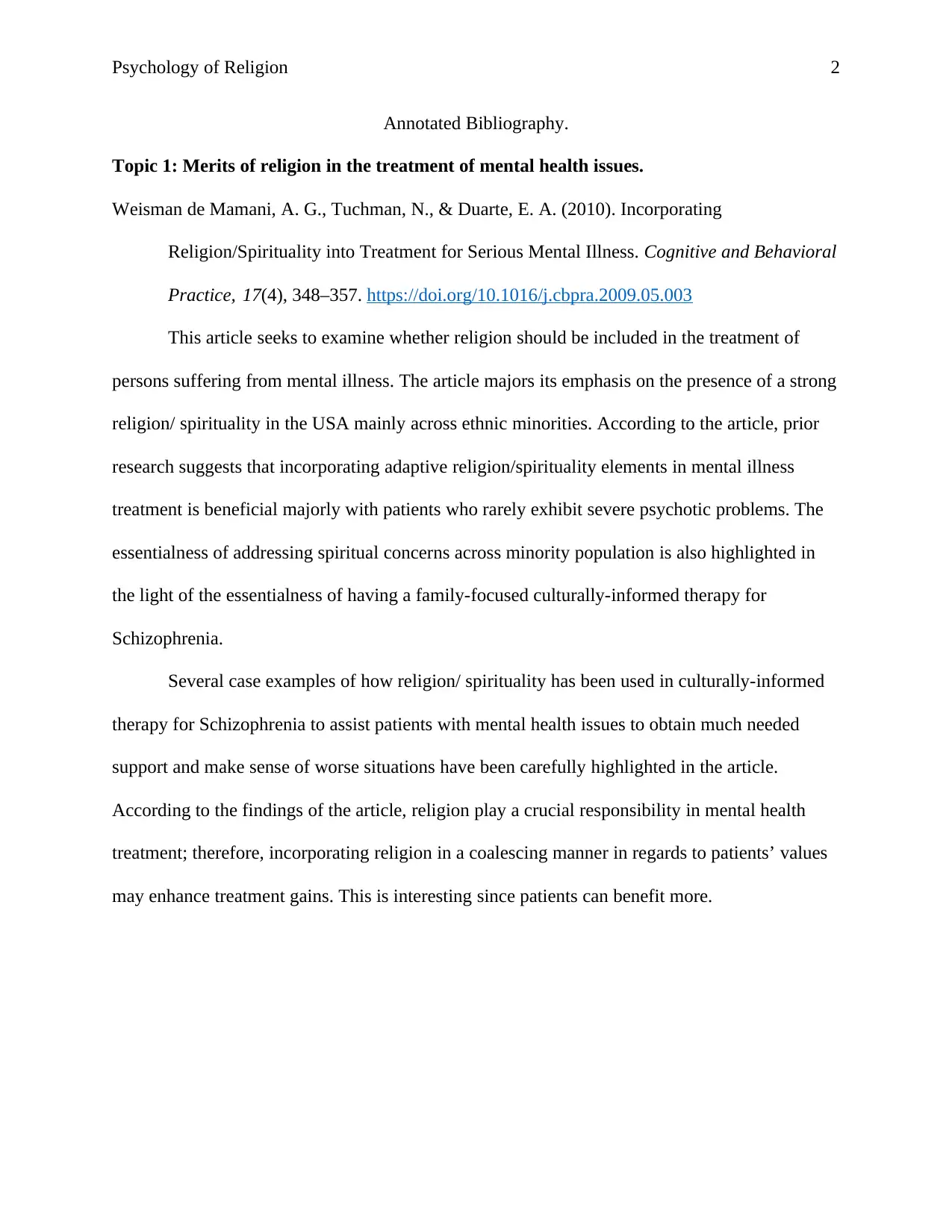
Annotated Bibliography.
Topic 1: Merits of religion in the treatment of mental health issues.
Weisman de Mamani, A. G., Tuchman, N., & Duarte, E. A. (2010). Incorporating
Religion/Spirituality into Treatment for Serious Mental Illness. Cognitive and Behavioral
Practice, 17(4), 348–357. https://doi.org/10.1016/j.cbpra.2009.05.003
This article seeks to examine whether religion should be included in the treatment of
persons suffering from mental illness. The article majors its emphasis on the presence of a strong
religion/ spirituality in the USA mainly across ethnic minorities. According to the article, prior
research suggests that incorporating adaptive religion/spirituality elements in mental illness
treatment is beneficial majorly with patients who rarely exhibit severe psychotic problems. The
essentialness of addressing spiritual concerns across minority population is also highlighted in
the light of the essentialness of having a family-focused culturally-informed therapy for
Schizophrenia.
Several case examples of how religion/ spirituality has been used in culturally-informed
therapy for Schizophrenia to assist patients with mental health issues to obtain much needed
support and make sense of worse situations have been carefully highlighted in the article.
According to the findings of the article, religion play a crucial responsibility in mental health
treatment; therefore, incorporating religion in a coalescing manner in regards to patients’ values
may enhance treatment gains. This is interesting since patients can benefit more.
Annotated Bibliography.
Topic 1: Merits of religion in the treatment of mental health issues.
Weisman de Mamani, A. G., Tuchman, N., & Duarte, E. A. (2010). Incorporating
Religion/Spirituality into Treatment for Serious Mental Illness. Cognitive and Behavioral
Practice, 17(4), 348–357. https://doi.org/10.1016/j.cbpra.2009.05.003
This article seeks to examine whether religion should be included in the treatment of
persons suffering from mental illness. The article majors its emphasis on the presence of a strong
religion/ spirituality in the USA mainly across ethnic minorities. According to the article, prior
research suggests that incorporating adaptive religion/spirituality elements in mental illness
treatment is beneficial majorly with patients who rarely exhibit severe psychotic problems. The
essentialness of addressing spiritual concerns across minority population is also highlighted in
the light of the essentialness of having a family-focused culturally-informed therapy for
Schizophrenia.
Several case examples of how religion/ spirituality has been used in culturally-informed
therapy for Schizophrenia to assist patients with mental health issues to obtain much needed
support and make sense of worse situations have been carefully highlighted in the article.
According to the findings of the article, religion play a crucial responsibility in mental health
treatment; therefore, incorporating religion in a coalescing manner in regards to patients’ values
may enhance treatment gains. This is interesting since patients can benefit more.

Psychology of Religion 3
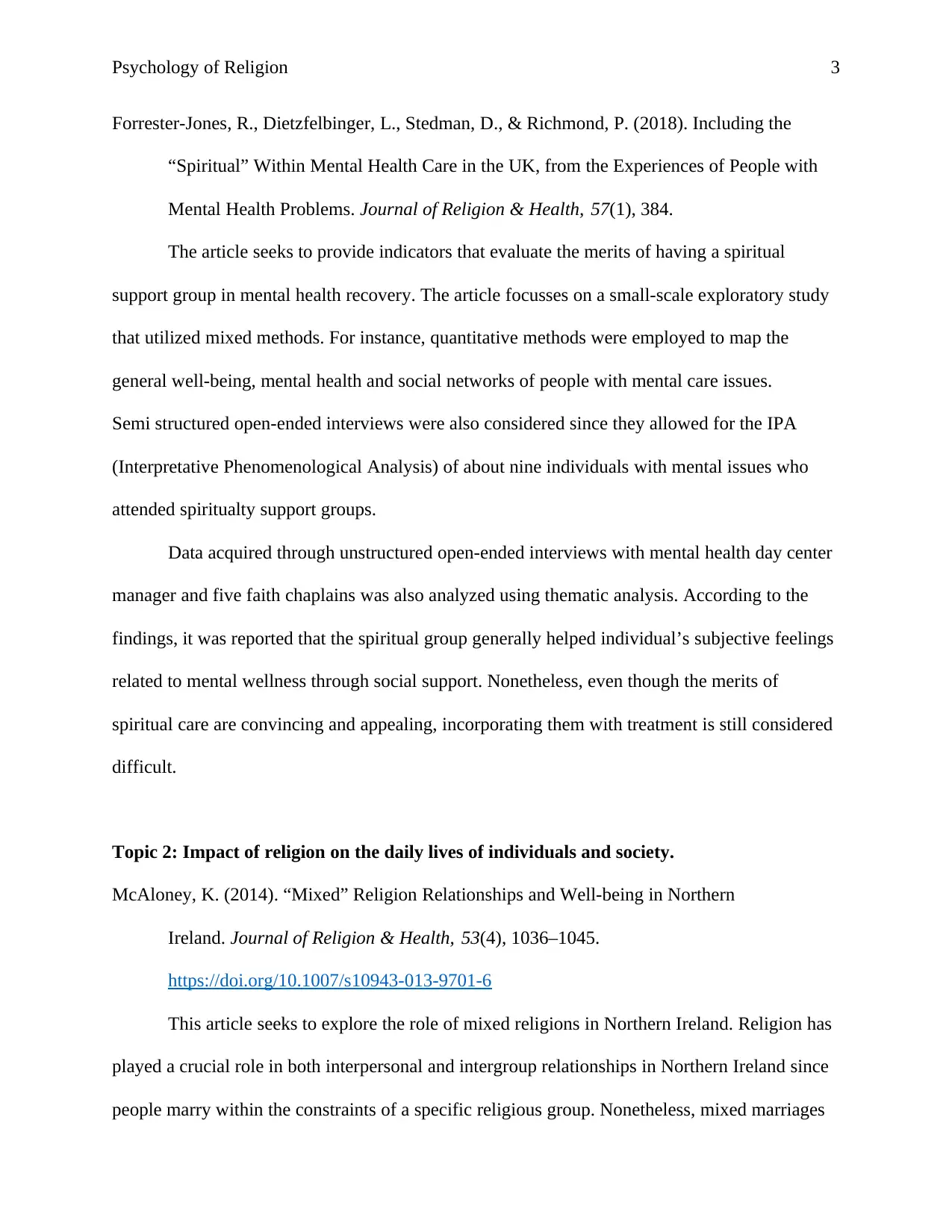
Forrester-Jones, R., Dietzfelbinger, L., Stedman, D., & Richmond, P. (2018). Including the
“Spiritual” Within Mental Health Care in the UK, from the Experiences of People with
Mental Health Problems. Journal of Religion & Health, 57(1), 384.
The article seeks to provide indicators that evaluate the merits of having a spiritual
support group in mental health recovery. The article focusses on a small-scale exploratory study
that utilized mixed methods. For instance, quantitative methods were employed to map the
general well-being, mental health and social networks of people with mental care issues.
Semi structured open-ended interviews were also considered since they allowed for the IPA
(Interpretative Phenomenological Analysis) of about nine individuals with mental issues who
attended spiritualty support groups.
Data acquired through unstructured open-ended interviews with mental health day center
manager and five faith chaplains was also analyzed using thematic analysis. According to the
findings, it was reported that the spiritual group generally helped individual’s subjective feelings
related to mental wellness through social support. Nonetheless, even though the merits of
spiritual care are convincing and appealing, incorporating them with treatment is still considered
difficult.
Topic 2: Impact of religion on the daily lives of individuals and society.
McAloney, K. (2014). “Mixed” Religion Relationships and Well-being in Northern
Ireland. Journal of Religion & Health, 53(4), 1036–1045.
https://doi.org/10.1007/s10943-013-9701-6
This article seeks to explore the role of mixed religions in Northern Ireland. Religion has
played a crucial role in both interpersonal and intergroup relationships in Northern Ireland since
people marry within the constraints of a specific religious group. Nonetheless, mixed marriages
Forrester-Jones, R., Dietzfelbinger, L., Stedman, D., & Richmond, P. (2018). Including the
“Spiritual” Within Mental Health Care in the UK, from the Experiences of People with
Mental Health Problems. Journal of Religion & Health, 57(1), 384.
The article seeks to provide indicators that evaluate the merits of having a spiritual
support group in mental health recovery. The article focusses on a small-scale exploratory study
that utilized mixed methods. For instance, quantitative methods were employed to map the
general well-being, mental health and social networks of people with mental care issues.
Semi structured open-ended interviews were also considered since they allowed for the IPA
(Interpretative Phenomenological Analysis) of about nine individuals with mental issues who
attended spiritualty support groups.
Data acquired through unstructured open-ended interviews with mental health day center
manager and five faith chaplains was also analyzed using thematic analysis. According to the
findings, it was reported that the spiritual group generally helped individual’s subjective feelings
related to mental wellness through social support. Nonetheless, even though the merits of
spiritual care are convincing and appealing, incorporating them with treatment is still considered
difficult.
Topic 2: Impact of religion on the daily lives of individuals and society.
McAloney, K. (2014). “Mixed” Religion Relationships and Well-being in Northern
Ireland. Journal of Religion & Health, 53(4), 1036–1045.
https://doi.org/10.1007/s10943-013-9701-6
This article seeks to explore the role of mixed religions in Northern Ireland. Religion has
played a crucial role in both interpersonal and intergroup relationships in Northern Ireland since
people marry within the constraints of a specific religious group. Nonetheless, mixed marriages
⊘ This is a preview!⊘
Do you want full access?
Subscribe today to unlock all pages.

Trusted by 1+ million students worldwide

Psychology of Religion 4
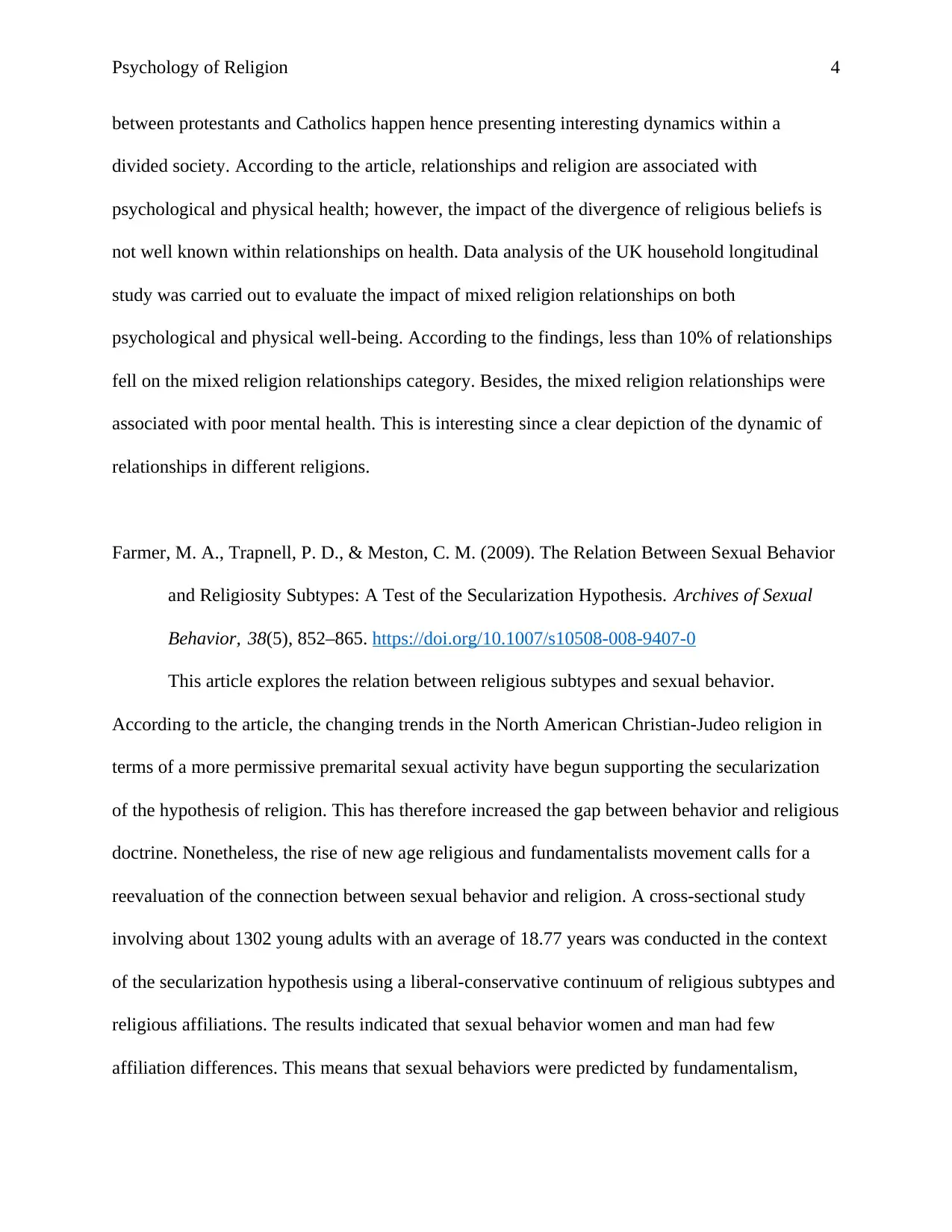
between protestants and Catholics happen hence presenting interesting dynamics within a
divided society. According to the article, relationships and religion are associated with
psychological and physical health; however, the impact of the divergence of religious beliefs is
not well known within relationships on health. Data analysis of the UK household longitudinal
study was carried out to evaluate the impact of mixed religion relationships on both
psychological and physical well-being. According to the findings, less than 10% of relationships
fell on the mixed religion relationships category. Besides, the mixed religion relationships were
associated with poor mental health. This is interesting since a clear depiction of the dynamic of
relationships in different religions.
Farmer, M. A., Trapnell, P. D., & Meston, C. M. (2009). The Relation Between Sexual Behavior
and Religiosity Subtypes: A Test of the Secularization Hypothesis. Archives of Sexual
Behavior, 38(5), 852–865. https://doi.org/10.1007/s10508-008-9407-0
This article explores the relation between religious subtypes and sexual behavior.
According to the article, the changing trends in the North American Christian-Judeo religion in
terms of a more permissive premarital sexual activity have begun supporting the secularization
of the hypothesis of religion. This has therefore increased the gap between behavior and religious
doctrine. Nonetheless, the rise of new age religious and fundamentalists movement calls for a
reevaluation of the connection between sexual behavior and religion. A cross-sectional study
involving about 1302 young adults with an average of 18.77 years was conducted in the context
of the secularization hypothesis using a liberal-conservative continuum of religious subtypes and
religious affiliations. The results indicated that sexual behavior women and man had few
affiliation differences. This means that sexual behaviors were predicted by fundamentalism,
between protestants and Catholics happen hence presenting interesting dynamics within a
divided society. According to the article, relationships and religion are associated with
psychological and physical health; however, the impact of the divergence of religious beliefs is
not well known within relationships on health. Data analysis of the UK household longitudinal
study was carried out to evaluate the impact of mixed religion relationships on both
psychological and physical well-being. According to the findings, less than 10% of relationships
fell on the mixed religion relationships category. Besides, the mixed religion relationships were
associated with poor mental health. This is interesting since a clear depiction of the dynamic of
relationships in different religions.
Farmer, M. A., Trapnell, P. D., & Meston, C. M. (2009). The Relation Between Sexual Behavior
and Religiosity Subtypes: A Test of the Secularization Hypothesis. Archives of Sexual
Behavior, 38(5), 852–865. https://doi.org/10.1007/s10508-008-9407-0
This article explores the relation between religious subtypes and sexual behavior.
According to the article, the changing trends in the North American Christian-Judeo religion in
terms of a more permissive premarital sexual activity have begun supporting the secularization
of the hypothesis of religion. This has therefore increased the gap between behavior and religious
doctrine. Nonetheless, the rise of new age religious and fundamentalists movement calls for a
reevaluation of the connection between sexual behavior and religion. A cross-sectional study
involving about 1302 young adults with an average of 18.77 years was conducted in the context
of the secularization hypothesis using a liberal-conservative continuum of religious subtypes and
religious affiliations. The results indicated that sexual behavior women and man had few
affiliation differences. This means that sexual behaviors were predicted by fundamentalism,
Paraphrase This Document
Need a fresh take? Get an instant paraphrase of this document with our AI Paraphraser

Psychology of Religion 5
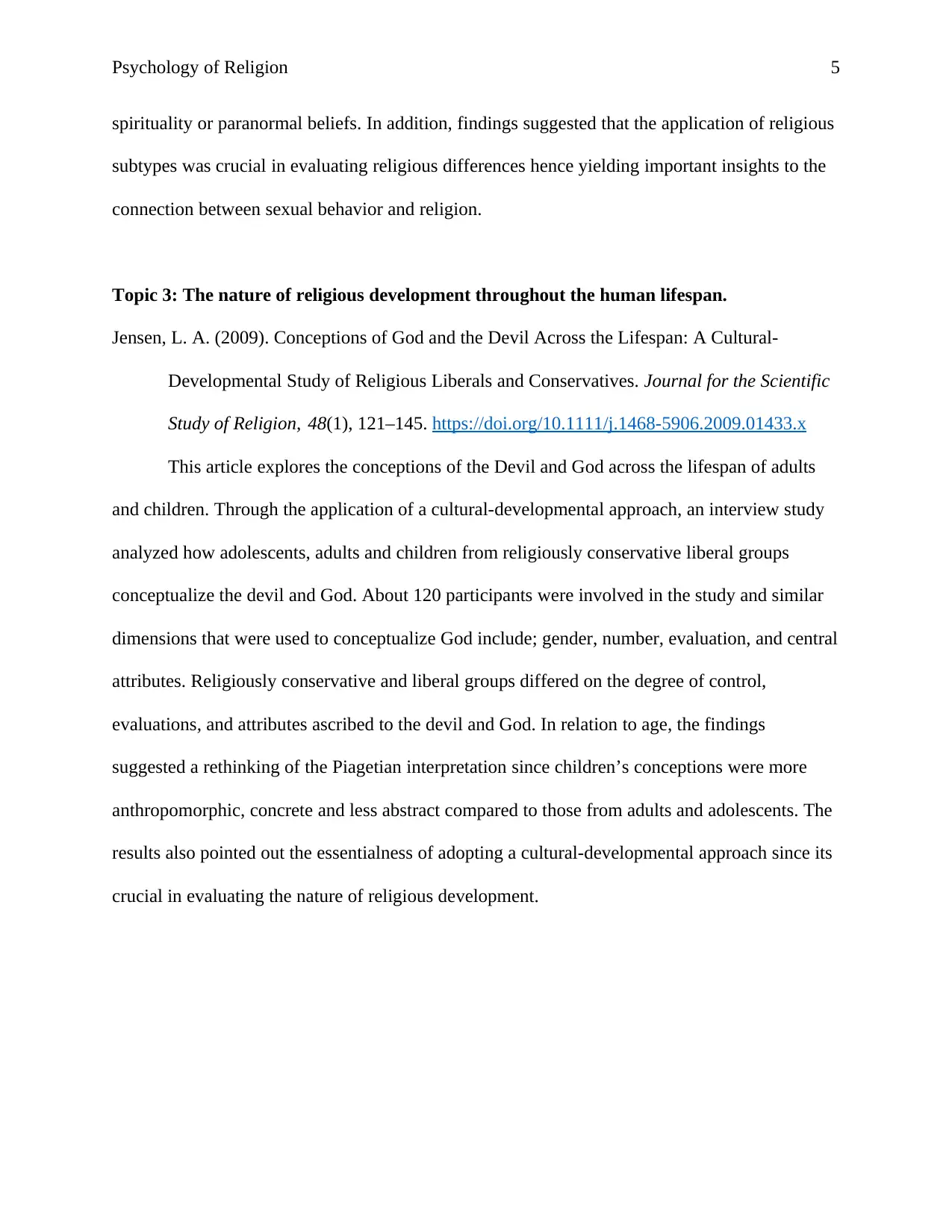
spirituality or paranormal beliefs. In addition, findings suggested that the application of religious
subtypes was crucial in evaluating religious differences hence yielding important insights to the
connection between sexual behavior and religion.
Topic 3: The nature of religious development throughout the human lifespan.
Jensen, L. A. (2009). Conceptions of God and the Devil Across the Lifespan: A Cultural-
Developmental Study of Religious Liberals and Conservatives. Journal for the Scientific
Study of Religion, 48(1), 121–145. https://doi.org/10.1111/j.1468-5906.2009.01433.x
This article explores the conceptions of the Devil and God across the lifespan of adults
and children. Through the application of a cultural-developmental approach, an interview study
analyzed how adolescents, adults and children from religiously conservative liberal groups
conceptualize the devil and God. About 120 participants were involved in the study and similar
dimensions that were used to conceptualize God include; gender, number, evaluation, and central
attributes. Religiously conservative and liberal groups differed on the degree of control,
evaluations, and attributes ascribed to the devil and God. In relation to age, the findings
suggested a rethinking of the Piagetian interpretation since children’s conceptions were more
anthropomorphic, concrete and less abstract compared to those from adults and adolescents. The
results also pointed out the essentialness of adopting a cultural-developmental approach since its
crucial in evaluating the nature of religious development.
spirituality or paranormal beliefs. In addition, findings suggested that the application of religious
subtypes was crucial in evaluating religious differences hence yielding important insights to the
connection between sexual behavior and religion.
Topic 3: The nature of religious development throughout the human lifespan.
Jensen, L. A. (2009). Conceptions of God and the Devil Across the Lifespan: A Cultural-
Developmental Study of Religious Liberals and Conservatives. Journal for the Scientific
Study of Religion, 48(1), 121–145. https://doi.org/10.1111/j.1468-5906.2009.01433.x
This article explores the conceptions of the Devil and God across the lifespan of adults
and children. Through the application of a cultural-developmental approach, an interview study
analyzed how adolescents, adults and children from religiously conservative liberal groups
conceptualize the devil and God. About 120 participants were involved in the study and similar
dimensions that were used to conceptualize God include; gender, number, evaluation, and central
attributes. Religiously conservative and liberal groups differed on the degree of control,
evaluations, and attributes ascribed to the devil and God. In relation to age, the findings
suggested a rethinking of the Piagetian interpretation since children’s conceptions were more
anthropomorphic, concrete and less abstract compared to those from adults and adolescents. The
results also pointed out the essentialness of adopting a cultural-developmental approach since its
crucial in evaluating the nature of religious development.

Psychology of Religion 6
Koenig, L. B., Haber, J. R., & Jacob, T. (2011). Childhood religious affiliation and alcohol use
and abuse across the lifespan in alcohol-dependent men. Psychology of Addictive
Behaviors, 25(3), 381–389. https://doi.org/10.1037/a0024774
This article seeks to determine the relationships between childhood religious affiliations
and the consumption of alcohol across the lifespan of a person. The sample for the study was
collected from the Vietnam Era Twin Registry and involved about 931 men with an average of
51 years. The data involved the lifetime drinking history of the men and was collected primarily
through interviews. On the other hand, the childhood religious affiliations were obtained from
the men’s partner/ spouse. Various variables were applied to analyze the data. From the results, it
was discovered that there were significant differences on regular drinking, quantity frequency
scores, and abstinence among individuals in differentiating religions. In addition, the group had
highest levels of abstinence while the non-religious group had more alcohol. This means that
there were consistent patterns that pointed out that childhood religious affiliations had a
significant effect on alcohol consumption even on adults. These findings are therefore of
particular interest.
Koenig, L. B., Haber, J. R., & Jacob, T. (2011). Childhood religious affiliation and alcohol use
and abuse across the lifespan in alcohol-dependent men. Psychology of Addictive
Behaviors, 25(3), 381–389. https://doi.org/10.1037/a0024774
This article seeks to determine the relationships between childhood religious affiliations
and the consumption of alcohol across the lifespan of a person. The sample for the study was
collected from the Vietnam Era Twin Registry and involved about 931 men with an average of
51 years. The data involved the lifetime drinking history of the men and was collected primarily
through interviews. On the other hand, the childhood religious affiliations were obtained from
the men’s partner/ spouse. Various variables were applied to analyze the data. From the results, it
was discovered that there were significant differences on regular drinking, quantity frequency
scores, and abstinence among individuals in differentiating religions. In addition, the group had
highest levels of abstinence while the non-religious group had more alcohol. This means that
there were consistent patterns that pointed out that childhood religious affiliations had a
significant effect on alcohol consumption even on adults. These findings are therefore of
particular interest.
⊘ This is a preview!⊘
Do you want full access?
Subscribe today to unlock all pages.

Trusted by 1+ million students worldwide
1 out of 6
Related Documents
Your All-in-One AI-Powered Toolkit for Academic Success.
+13062052269
info@desklib.com
Available 24*7 on WhatsApp / Email
Unlock your academic potential
Copyright © 2020–2026 A2Z Services. All Rights Reserved. Developed and managed by ZUCOL.