NCLE_CITY GSBS6001: Annotated Bibliography on Rational Decision-Making
VerifiedAdded on 2022/08/15
|9
|2511
|25
Annotated Bibliography
AI Summary
This annotated bibliography examines the critical role of rational decision-making within uncertain business environments, drawing from three key research articles. The introduction highlights the importance of rational choices in navigating business complexities, particularly when dealing with risk, uncertainty, and the need for effective management. The first article, by Tuckett & Nikolic (2017), explores the application of the conviction narrative theory in decision-making under uncertainty. The second article, by Bolisani & Bratianu (2017), focuses on knowledge strategy planning as an integrated approach to managing uncertainty and turbulence. Finally, the third article, by Laine & Galkina (2017), investigates the interplay of effectuation and causation in decision-making within the context of Russian SMEs facing institutional uncertainty. Each annotation provides an overview of the article's aim, methodology, findings, significance, strengths, and weaknesses. The conclusion synthesizes the key themes, emphasizing the importance of rational decision-making, the use of knowledge, and the limitations of decision-making processes in complex business scenarios. The bibliography underscores the necessity for businesses to adopt structured approaches, leverage expert knowledge, and evaluate alternatives effectively, especially when faced with turbulent conditions.

Running head: ANNOTATED BIBLIOGRAPHY
Annotated Bibliography
Name of the Student
Name of the University
Author note
Annotated Bibliography
Name of the Student
Name of the University
Author note
Paraphrase This Document
Need a fresh take? Get an instant paraphrase of this document with our AI Paraphraser

1ANNOTATED BIBLIOGRAPHY
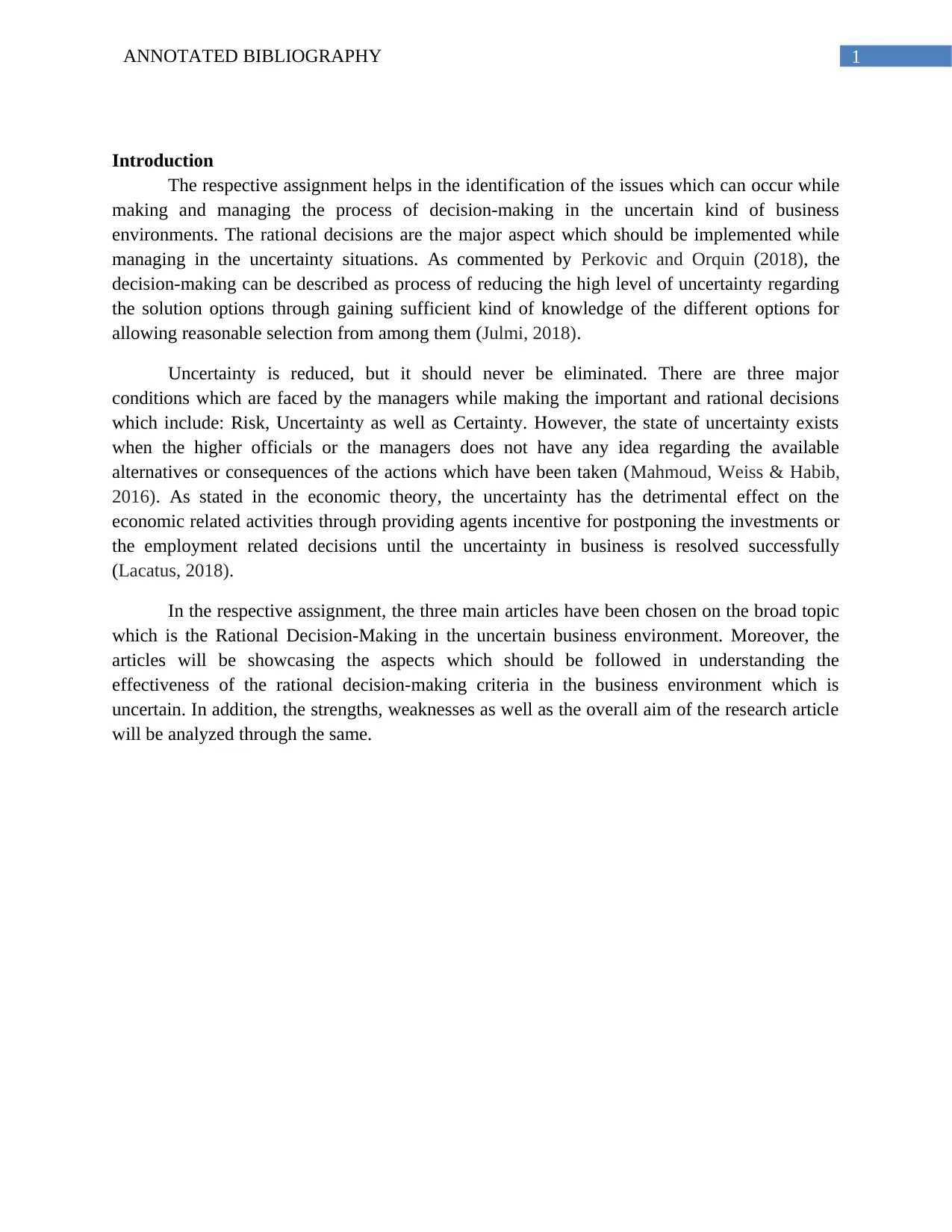
Introduction
The respective assignment helps in the identification of the issues which can occur while
making and managing the process of decision-making in the uncertain kind of business
environments. The rational decisions are the major aspect which should be implemented while
managing in the uncertainty situations. As commented by Perkovic and Orquin (2018), the
decision-making can be described as process of reducing the high level of uncertainty regarding
the solution options through gaining sufficient kind of knowledge of the different options for
allowing reasonable selection from among them (Julmi, 2018).
Uncertainty is reduced, but it should never be eliminated. There are three major
conditions which are faced by the managers while making the important and rational decisions
which include: Risk, Uncertainty as well as Certainty. However, the state of uncertainty exists
when the higher officials or the managers does not have any idea regarding the available
alternatives or consequences of the actions which have been taken (Mahmoud, Weiss & Habib,
2016). As stated in the economic theory, the uncertainty has the detrimental effect on the
economic related activities through providing agents incentive for postponing the investments or
the employment related decisions until the uncertainty in business is resolved successfully
(Lacatus, 2018).
In the respective assignment, the three main articles have been chosen on the broad topic
which is the Rational Decision-Making in the uncertain business environment. Moreover, the
articles will be showcasing the aspects which should be followed in understanding the
effectiveness of the rational decision-making criteria in the business environment which is
uncertain. In addition, the strengths, weaknesses as well as the overall aim of the research article
will be analyzed through the same.
Introduction
The respective assignment helps in the identification of the issues which can occur while
making and managing the process of decision-making in the uncertain kind of business
environments. The rational decisions are the major aspect which should be implemented while
managing in the uncertainty situations. As commented by Perkovic and Orquin (2018), the
decision-making can be described as process of reducing the high level of uncertainty regarding
the solution options through gaining sufficient kind of knowledge of the different options for
allowing reasonable selection from among them (Julmi, 2018).
Uncertainty is reduced, but it should never be eliminated. There are three major
conditions which are faced by the managers while making the important and rational decisions
which include: Risk, Uncertainty as well as Certainty. However, the state of uncertainty exists
when the higher officials or the managers does not have any idea regarding the available
alternatives or consequences of the actions which have been taken (Mahmoud, Weiss & Habib,
2016). As stated in the economic theory, the uncertainty has the detrimental effect on the
economic related activities through providing agents incentive for postponing the investments or
the employment related decisions until the uncertainty in business is resolved successfully
(Lacatus, 2018).
In the respective assignment, the three main articles have been chosen on the broad topic
which is the Rational Decision-Making in the uncertain business environment. Moreover, the
articles will be showcasing the aspects which should be followed in understanding the
effectiveness of the rational decision-making criteria in the business environment which is
uncertain. In addition, the strengths, weaknesses as well as the overall aim of the research article
will be analyzed through the same.

2ANNOTATED BIBLIOGRAPHY
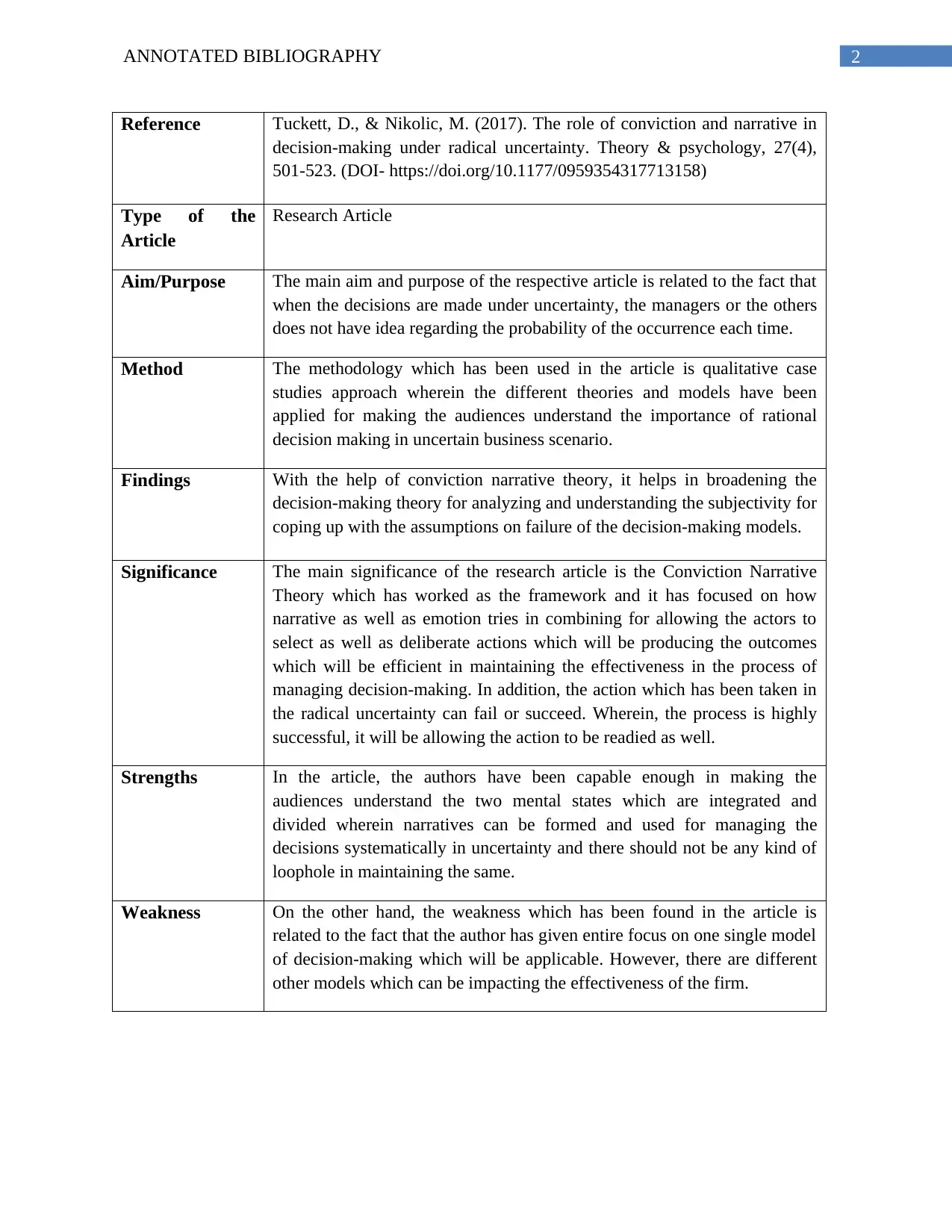
Reference Tuckett, D., & Nikolic, M. (2017). The role of conviction and narrative in
decision-making under radical uncertainty. Theory & psychology, 27(4),
501-523. (DOI- https://doi.org/10.1177/0959354317713158)
Type of the
Article
Research Article
Aim/Purpose The main aim and purpose of the respective article is related to the fact that
when the decisions are made under uncertainty, the managers or the others
does not have idea regarding the probability of the occurrence each time.
Method The methodology which has been used in the article is qualitative case
studies approach wherein the different theories and models have been
applied for making the audiences understand the importance of rational
decision making in uncertain business scenario.
Findings With the help of conviction narrative theory, it helps in broadening the
decision-making theory for analyzing and understanding the subjectivity for
coping up with the assumptions on failure of the decision-making models.
Significance The main significance of the research article is the Conviction Narrative
Theory which has worked as the framework and it has focused on how
narrative as well as emotion tries in combining for allowing the actors to
select as well as deliberate actions which will be producing the outcomes
which will be efficient in maintaining the effectiveness in the process of
managing decision-making. In addition, the action which has been taken in
the radical uncertainty can fail or succeed. Wherein, the process is highly
successful, it will be allowing the action to be readied as well.
Strengths In the article, the authors have been capable enough in making the
audiences understand the two mental states which are integrated and
divided wherein narratives can be formed and used for managing the
decisions systematically in uncertainty and there should not be any kind of
loophole in maintaining the same.
Weakness On the other hand, the weakness which has been found in the article is
related to the fact that the author has given entire focus on one single model
of decision-making which will be applicable. However, there are different
other models which can be impacting the effectiveness of the firm.
Reference Tuckett, D., & Nikolic, M. (2017). The role of conviction and narrative in
decision-making under radical uncertainty. Theory & psychology, 27(4),
501-523. (DOI- https://doi.org/10.1177/0959354317713158)
Type of the
Article
Research Article
Aim/Purpose The main aim and purpose of the respective article is related to the fact that
when the decisions are made under uncertainty, the managers or the others
does not have idea regarding the probability of the occurrence each time.
Method The methodology which has been used in the article is qualitative case
studies approach wherein the different theories and models have been
applied for making the audiences understand the importance of rational
decision making in uncertain business scenario.
Findings With the help of conviction narrative theory, it helps in broadening the
decision-making theory for analyzing and understanding the subjectivity for
coping up with the assumptions on failure of the decision-making models.
Significance The main significance of the research article is the Conviction Narrative
Theory which has worked as the framework and it has focused on how
narrative as well as emotion tries in combining for allowing the actors to
select as well as deliberate actions which will be producing the outcomes
which will be efficient in maintaining the effectiveness in the process of
managing decision-making. In addition, the action which has been taken in
the radical uncertainty can fail or succeed. Wherein, the process is highly
successful, it will be allowing the action to be readied as well.
Strengths In the article, the authors have been capable enough in making the
audiences understand the two mental states which are integrated and
divided wherein narratives can be formed and used for managing the
decisions systematically in uncertainty and there should not be any kind of
loophole in maintaining the same.
Weakness On the other hand, the weakness which has been found in the article is
related to the fact that the author has given entire focus on one single model
of decision-making which will be applicable. However, there are different
other models which can be impacting the effectiveness of the firm.
⊘ This is a preview!⊘
Do you want full access?
Subscribe today to unlock all pages.

Trusted by 1+ million students worldwide

3ANNOTATED BIBLIOGRAPHY
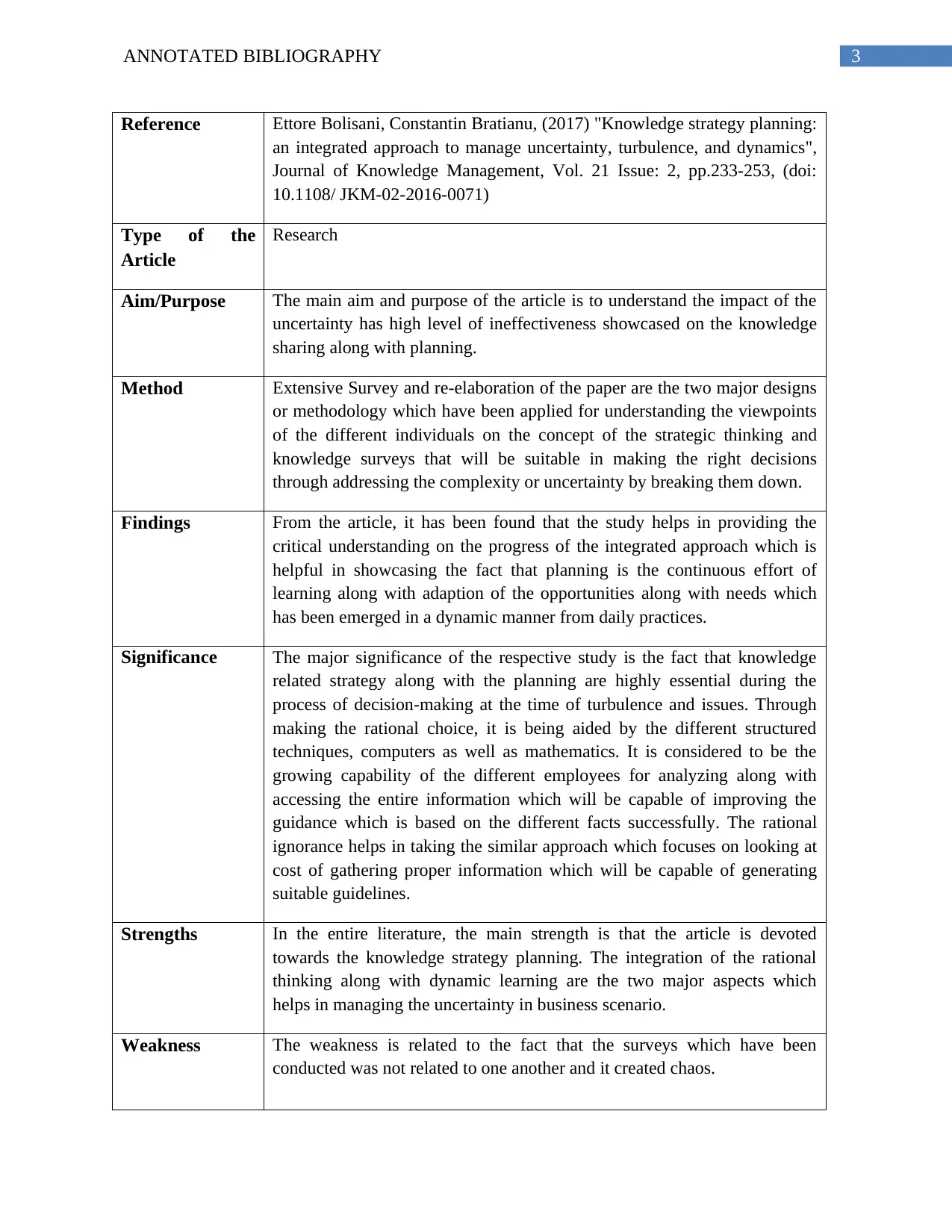
Reference Ettore Bolisani, Constantin Bratianu, (2017) "Knowledge strategy planning:
an integrated approach to manage uncertainty, turbulence, and dynamics",
Journal of Knowledge Management, Vol. 21 Issue: 2, pp.233-253, (doi:
10.1108/ JKM-02-2016-0071)
Type of the
Article
Research
Aim/Purpose The main aim and purpose of the article is to understand the impact of the
uncertainty has high level of ineffectiveness showcased on the knowledge
sharing along with planning.
Method Extensive Survey and re-elaboration of the paper are the two major designs
or methodology which have been applied for understanding the viewpoints
of the different individuals on the concept of the strategic thinking and
knowledge surveys that will be suitable in making the right decisions
through addressing the complexity or uncertainty by breaking them down.
Findings From the article, it has been found that the study helps in providing the
critical understanding on the progress of the integrated approach which is
helpful in showcasing the fact that planning is the continuous effort of
learning along with adaption of the opportunities along with needs which
has been emerged in a dynamic manner from daily practices.
Significance The major significance of the respective study is the fact that knowledge
related strategy along with the planning are highly essential during the
process of decision-making at the time of turbulence and issues. Through
making the rational choice, it is being aided by the different structured
techniques, computers as well as mathematics. It is considered to be the
growing capability of the different employees for analyzing along with
accessing the entire information which will be capable of improving the
guidance which is based on the different facts successfully. The rational
ignorance helps in taking the similar approach which focuses on looking at
cost of gathering proper information which will be capable of generating
suitable guidelines.
Strengths In the entire literature, the main strength is that the article is devoted
towards the knowledge strategy planning. The integration of the rational
thinking along with dynamic learning are the two major aspects which
helps in managing the uncertainty in business scenario.
Weakness The weakness is related to the fact that the surveys which have been
conducted was not related to one another and it created chaos.
Reference Ettore Bolisani, Constantin Bratianu, (2017) "Knowledge strategy planning:
an integrated approach to manage uncertainty, turbulence, and dynamics",
Journal of Knowledge Management, Vol. 21 Issue: 2, pp.233-253, (doi:
10.1108/ JKM-02-2016-0071)
Type of the
Article
Research
Aim/Purpose The main aim and purpose of the article is to understand the impact of the
uncertainty has high level of ineffectiveness showcased on the knowledge
sharing along with planning.
Method Extensive Survey and re-elaboration of the paper are the two major designs
or methodology which have been applied for understanding the viewpoints
of the different individuals on the concept of the strategic thinking and
knowledge surveys that will be suitable in making the right decisions
through addressing the complexity or uncertainty by breaking them down.
Findings From the article, it has been found that the study helps in providing the
critical understanding on the progress of the integrated approach which is
helpful in showcasing the fact that planning is the continuous effort of
learning along with adaption of the opportunities along with needs which
has been emerged in a dynamic manner from daily practices.
Significance The major significance of the respective study is the fact that knowledge
related strategy along with the planning are highly essential during the
process of decision-making at the time of turbulence and issues. Through
making the rational choice, it is being aided by the different structured
techniques, computers as well as mathematics. It is considered to be the
growing capability of the different employees for analyzing along with
accessing the entire information which will be capable of improving the
guidance which is based on the different facts successfully. The rational
ignorance helps in taking the similar approach which focuses on looking at
cost of gathering proper information which will be capable of generating
suitable guidelines.
Strengths In the entire literature, the main strength is that the article is devoted
towards the knowledge strategy planning. The integration of the rational
thinking along with dynamic learning are the two major aspects which
helps in managing the uncertainty in business scenario.
Weakness The weakness is related to the fact that the surveys which have been
conducted was not related to one another and it created chaos.
Paraphrase This Document
Need a fresh take? Get an instant paraphrase of this document with our AI Paraphraser

4ANNOTATED BIBLIOGRAPHY
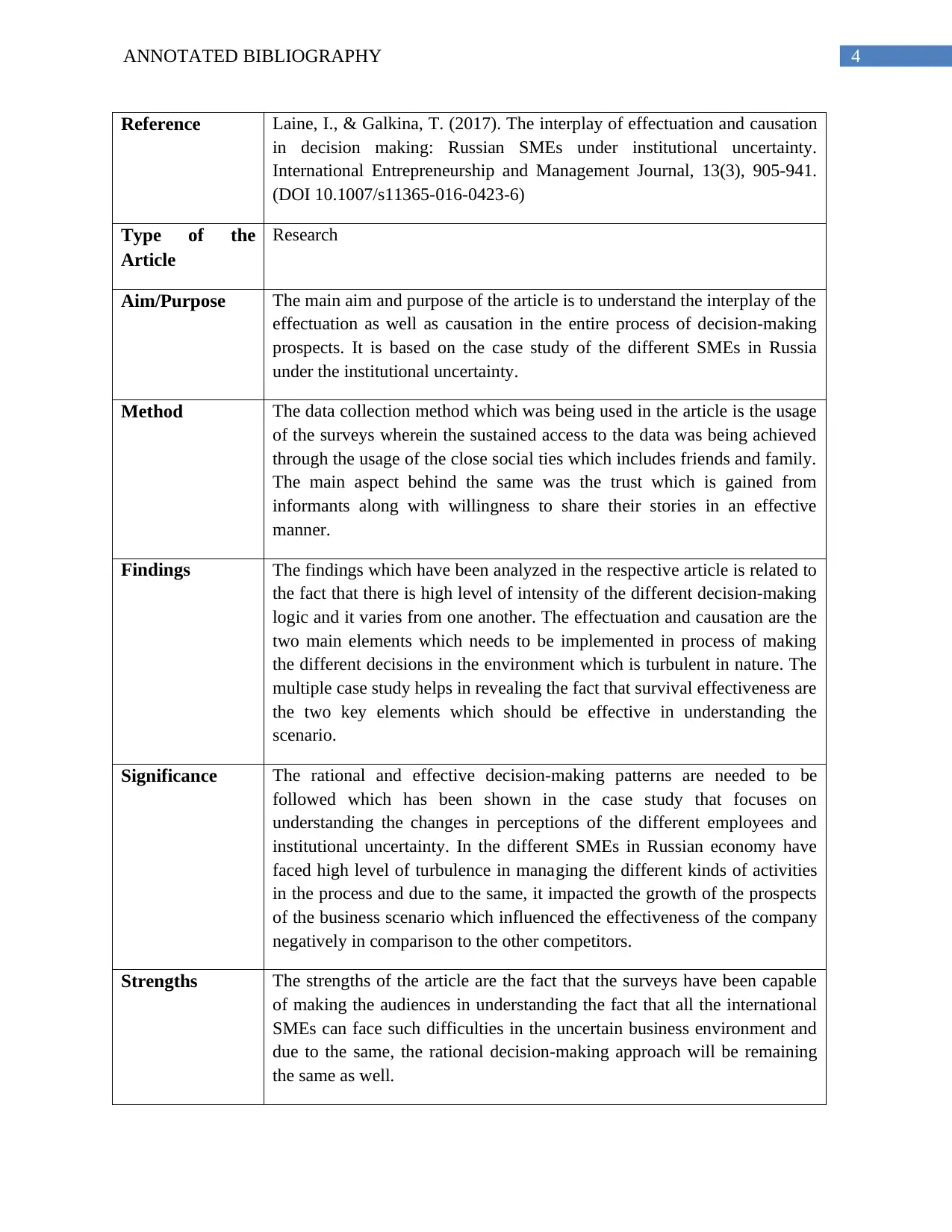
Reference Laine, I., & Galkina, T. (2017). The interplay of effectuation and causation
in decision making: Russian SMEs under institutional uncertainty.
International Entrepreneurship and Management Journal, 13(3), 905-941.
(DOI 10.1007/s11365-016-0423-6)
Type of the
Article
Research
Aim/Purpose The main aim and purpose of the article is to understand the interplay of the
effectuation as well as causation in the entire process of decision-making
prospects. It is based on the case study of the different SMEs in Russia
under the institutional uncertainty.
Method The data collection method which was being used in the article is the usage
of the surveys wherein the sustained access to the data was being achieved
through the usage of the close social ties which includes friends and family.
The main aspect behind the same was the trust which is gained from
informants along with willingness to share their stories in an effective
manner.
Findings The findings which have been analyzed in the respective article is related to
the fact that there is high level of intensity of the different decision-making
logic and it varies from one another. The effectuation and causation are the
two main elements which needs to be implemented in process of making
the different decisions in the environment which is turbulent in nature. The
multiple case study helps in revealing the fact that survival effectiveness are
the two key elements which should be effective in understanding the
scenario.
Significance The rational and effective decision-making patterns are needed to be
followed which has been shown in the case study that focuses on
understanding the changes in perceptions of the different employees and
institutional uncertainty. In the different SMEs in Russian economy have
faced high level of turbulence in managing the different kinds of activities
in the process and due to the same, it impacted the growth of the prospects
of the business scenario which influenced the effectiveness of the company
negatively in comparison to the other competitors.
Strengths The strengths of the article are the fact that the surveys have been capable
of making the audiences in understanding the fact that all the international
SMEs can face such difficulties in the uncertain business environment and
due to the same, the rational decision-making approach will be remaining
the same as well.
Reference Laine, I., & Galkina, T. (2017). The interplay of effectuation and causation
in decision making: Russian SMEs under institutional uncertainty.
International Entrepreneurship and Management Journal, 13(3), 905-941.
(DOI 10.1007/s11365-016-0423-6)
Type of the
Article
Research
Aim/Purpose The main aim and purpose of the article is to understand the interplay of the
effectuation as well as causation in the entire process of decision-making
prospects. It is based on the case study of the different SMEs in Russia
under the institutional uncertainty.
Method The data collection method which was being used in the article is the usage
of the surveys wherein the sustained access to the data was being achieved
through the usage of the close social ties which includes friends and family.
The main aspect behind the same was the trust which is gained from
informants along with willingness to share their stories in an effective
manner.
Findings The findings which have been analyzed in the respective article is related to
the fact that there is high level of intensity of the different decision-making
logic and it varies from one another. The effectuation and causation are the
two main elements which needs to be implemented in process of making
the different decisions in the environment which is turbulent in nature. The
multiple case study helps in revealing the fact that survival effectiveness are
the two key elements which should be effective in understanding the
scenario.
Significance The rational and effective decision-making patterns are needed to be
followed which has been shown in the case study that focuses on
understanding the changes in perceptions of the different employees and
institutional uncertainty. In the different SMEs in Russian economy have
faced high level of turbulence in managing the different kinds of activities
in the process and due to the same, it impacted the growth of the prospects
of the business scenario which influenced the effectiveness of the company
negatively in comparison to the other competitors.
Strengths The strengths of the article are the fact that the surveys have been capable
of making the audiences in understanding the fact that all the international
SMEs can face such difficulties in the uncertain business environment and
due to the same, the rational decision-making approach will be remaining
the same as well.

5ANNOTATED BIBLIOGRAPHY
Weakness On the other hand, the major weakness which has been seen in the article is
that the author has tried to base his thinking mainly on the different surveys
which have been conducted for the SMEs in Russia. However, the case can
be different in case of other companies present in the other countries and
the situation can be demanding other kinds of approaches which has not
been mentioned.
Weakness On the other hand, the major weakness which has been seen in the article is
that the author has tried to base his thinking mainly on the different surveys
which have been conducted for the SMEs in Russia. However, the case can
be different in case of other companies present in the other countries and
the situation can be demanding other kinds of approaches which has not
been mentioned.
⊘ This is a preview!⊘
Do you want full access?
Subscribe today to unlock all pages.

Trusted by 1+ million students worldwide

6ANNOTATED BIBLIOGRAPHY
Conclusion
Therefore, from the analysis of the three articles on the rational decision-making in the
uncertain business environment is the most intelligent aspect which should be followed as it will
be impacting the effectiveness of the company properly. The choice to decide rationally helps in
supporting the decision-maker through making the full utilization of the knowledge which is
involved with the entire choice that is specific and open. It is highly important while making the
high value decisions which can be benefitted from the assistance of the tools, processes along
with knowledge related to experts. In addition, the three articles vary from one another, however,
the theme is similar in three cases and it follows the similar kinds of theories and models in
making the audiences understand the same.
Rational Decision-Making is considered to be one of the most famous steps which needs
to be followed by the business officials for making choice between the different alternatives. The
process of the rational decision-making mainly favors the proper logic, analysis and objectivity
that enhances the growth of the company and making analysis of the same is essential in nature.
However, there are few limitations of the rational decision-making in the context of managing
the decisions in the uncertain business environment that will be capable of managing the scenario
in a more effective manner. Defining of the problem, identifying the criteria for developing the
decisions are the two major approaches which will be capable of gaining appropriateness in
improving the scenario during the time of turbulence.
Evaluation of the alternatives are the key elements which needs to be implemented by the
companies while making decisions in the turbulence phase as it will be providing them with the
brief overview on the different alternatives which are available and it can be used by them for
generating the successful outcomes. The effectiveness and causation are the two elements which
needs to be implemented in the rational and irrational decision-making process for gaining
effectiveness in the process.
Conclusion
Therefore, from the analysis of the three articles on the rational decision-making in the
uncertain business environment is the most intelligent aspect which should be followed as it will
be impacting the effectiveness of the company properly. The choice to decide rationally helps in
supporting the decision-maker through making the full utilization of the knowledge which is
involved with the entire choice that is specific and open. It is highly important while making the
high value decisions which can be benefitted from the assistance of the tools, processes along
with knowledge related to experts. In addition, the three articles vary from one another, however,
the theme is similar in three cases and it follows the similar kinds of theories and models in
making the audiences understand the same.
Rational Decision-Making is considered to be one of the most famous steps which needs
to be followed by the business officials for making choice between the different alternatives. The
process of the rational decision-making mainly favors the proper logic, analysis and objectivity
that enhances the growth of the company and making analysis of the same is essential in nature.
However, there are few limitations of the rational decision-making in the context of managing
the decisions in the uncertain business environment that will be capable of managing the scenario
in a more effective manner. Defining of the problem, identifying the criteria for developing the
decisions are the two major approaches which will be capable of gaining appropriateness in
improving the scenario during the time of turbulence.
Evaluation of the alternatives are the key elements which needs to be implemented by the
companies while making decisions in the turbulence phase as it will be providing them with the
brief overview on the different alternatives which are available and it can be used by them for
generating the successful outcomes. The effectiveness and causation are the two elements which
needs to be implemented in the rational and irrational decision-making process for gaining
effectiveness in the process.
Paraphrase This Document
Need a fresh take? Get an instant paraphrase of this document with our AI Paraphraser

7ANNOTATED BIBLIOGRAPHY
References and Bibliography
Abubakar, A. M., Elrehail, H., Alatailat, M. A., & Elçi, A. (2019). Knowledge management,
decision-making style and organizational performance. Journal of Innovation &
Knowledge, 4(2), 104-114.
Chen, W. J., & Zou, Y. (2017). Rational Decision Making Models with Incomplete Information
Based on Interval-valued Fuzzy Soft Sets. Journal of Computers, 28(1), 193-207.
Cook, C., & Gonzales, H. (2016). Australian individual decision styles, intuitive and rational
decision making in business. International Proceeding of Economics Development and
Research, 86, 93-100.
Djulbegovic, B., Elqayam, S., & Dale, W. (2018). Rational decision making in medicine:
implications for overuse and underuse. Journal of evaluation in clinical practice, 24(3),
655-665.
Ettore Bolisani, Constantin Bratianu, (2017) "Knowledge strategy planning: an integrated
approach to manage uncertainty, turbulence, and dynamics", Journal of Knowledge
Management, Vol. 21 Issue: 2, pp.233-253, (doi: 10.1108/ JKM-02-2016-0071)
Gati, I., Levin, N., & Landman-Tal, S. (2019). Decision-making models and career guidance.
In International handbook of career guidance (pp. 115-145). Springer, Cham.
Hales, J., Matsumura, E. M., Moser, D. V., & Payne, R. (2016). Becoming sustainable: A
rational decision based on sound information and effective processes?. Journal of
Management Accounting Research, 28(2), 13-28.
References and Bibliography
Abubakar, A. M., Elrehail, H., Alatailat, M. A., & Elçi, A. (2019). Knowledge management,
decision-making style and organizational performance. Journal of Innovation &
Knowledge, 4(2), 104-114.
Chen, W. J., & Zou, Y. (2017). Rational Decision Making Models with Incomplete Information
Based on Interval-valued Fuzzy Soft Sets. Journal of Computers, 28(1), 193-207.
Cook, C., & Gonzales, H. (2016). Australian individual decision styles, intuitive and rational
decision making in business. International Proceeding of Economics Development and
Research, 86, 93-100.
Djulbegovic, B., Elqayam, S., & Dale, W. (2018). Rational decision making in medicine:
implications for overuse and underuse. Journal of evaluation in clinical practice, 24(3),
655-665.
Ettore Bolisani, Constantin Bratianu, (2017) "Knowledge strategy planning: an integrated
approach to manage uncertainty, turbulence, and dynamics", Journal of Knowledge
Management, Vol. 21 Issue: 2, pp.233-253, (doi: 10.1108/ JKM-02-2016-0071)
Gati, I., Levin, N., & Landman-Tal, S. (2019). Decision-making models and career guidance.
In International handbook of career guidance (pp. 115-145). Springer, Cham.
Hales, J., Matsumura, E. M., Moser, D. V., & Payne, R. (2016). Becoming sustainable: A
rational decision based on sound information and effective processes?. Journal of
Management Accounting Research, 28(2), 13-28.

8ANNOTATED BIBLIOGRAPHY
Jarrahi, M. H. (2018). Artificial intelligence and the future of work: Human-AI symbiosis in
organizational decision making. Business Horizons, 61(4), 577-586.
Julmi, C. (2019). When rational decision-making becomes irrational: a critical assessment and
re-conceptualization of intuition effectiveness. Business Research, 12(1), 291-314.
Lacatus, M. L. (2018). Rational and irrational processes in decision making: An economic
perspective. Mental Health: Global Challenges Journal, 1(1), 51-57.
Laine, I., & Galkina, T. (2017). The interplay of effectuation and causation in decision making:
Russian SMEs under institutional uncertainty. International Entrepreneurship and
Management Journal, 13(3), 905-941. (DOI 10.1007/s11365-016-0423-6)
Mahmoud, M. S., Weiss, A., & Habib, K. N. (2016). Myopic choice or rational decision making?
An investigation into mode choice preference structures in competitive modal
arrangements in a multimodal urban area, the City of Toronto. Canadian Journal of Civil
Engineering, 43(5), 420-428.
Perkovic, S., & Orquin, J. L. (2018). Implicit statistical learning in real-world environments
leads to ecologically rational decision making. Psychological Science, 29(1), 34-44.
Tuckett, D., & Nikolic, M. (2017). The role of conviction and narrative in decision-making under
radical uncertainty. Theory & psychology, 27(4), 501-523. (DOI-
https://doi.org/10.1177/0959354317713158)
Jarrahi, M. H. (2018). Artificial intelligence and the future of work: Human-AI symbiosis in
organizational decision making. Business Horizons, 61(4), 577-586.
Julmi, C. (2019). When rational decision-making becomes irrational: a critical assessment and
re-conceptualization of intuition effectiveness. Business Research, 12(1), 291-314.
Lacatus, M. L. (2018). Rational and irrational processes in decision making: An economic
perspective. Mental Health: Global Challenges Journal, 1(1), 51-57.
Laine, I., & Galkina, T. (2017). The interplay of effectuation and causation in decision making:
Russian SMEs under institutional uncertainty. International Entrepreneurship and
Management Journal, 13(3), 905-941. (DOI 10.1007/s11365-016-0423-6)
Mahmoud, M. S., Weiss, A., & Habib, K. N. (2016). Myopic choice or rational decision making?
An investigation into mode choice preference structures in competitive modal
arrangements in a multimodal urban area, the City of Toronto. Canadian Journal of Civil
Engineering, 43(5), 420-428.
Perkovic, S., & Orquin, J. L. (2018). Implicit statistical learning in real-world environments
leads to ecologically rational decision making. Psychological Science, 29(1), 34-44.
Tuckett, D., & Nikolic, M. (2017). The role of conviction and narrative in decision-making under
radical uncertainty. Theory & psychology, 27(4), 501-523. (DOI-
https://doi.org/10.1177/0959354317713158)
⊘ This is a preview!⊘
Do you want full access?
Subscribe today to unlock all pages.

Trusted by 1+ million students worldwide
1 out of 9
Related Documents
Your All-in-One AI-Powered Toolkit for Academic Success.
+13062052269
info@desklib.com
Available 24*7 on WhatsApp / Email
Unlock your academic potential
Copyright © 2020–2025 A2Z Services. All Rights Reserved. Developed and managed by ZUCOL.