Annotated Bibliography: Cyber Bullying in Adolescent Psychology

Verified

Added on Ā 2020/05/11

|5
|610
|61
Annotated Bibliography
AI Summary
This annotated bibliography examines the multifaceted issue of cyber bullying, drawing on two key sources to provide a comprehensive overview. The first source, by Hinduja and Patchin (2012), investigates the prevalence of cyber bullying among adolescents, revealing that while not an epidemic, it affects a significant portion of youth. The authors highlight the correlation between school climate and bullying rates, emphasizing the need for educators to foster supportive environments. The second source, by Goff (2011), focuses on cyber bullying in Australian schools, discussing the challenges schools face in addressing this issue, particularly outside of school hours. Goff points out gaps in the current codes of conduct and suggests community-based educational practices to combat the problem effectively. Both sources contribute to a deeper understanding of cyber bullying's impact and the strategies needed for prevention and intervention, offering valuable insights for educators, parents, and policymakers.
Document Page
Running head: CYBER BULLYING
Cyber Bullying
Name of the Student
Name of the University
Author Note
tabler-icon-diamond-filled.svg

Paraphrase This Document

Need a fresh take? Get an instant paraphrase of this document with our AI Paraphraser
Document Page
1
CYBER BULLYING
Annotated Bibliography
Document Page
2
CYBER BULLYING
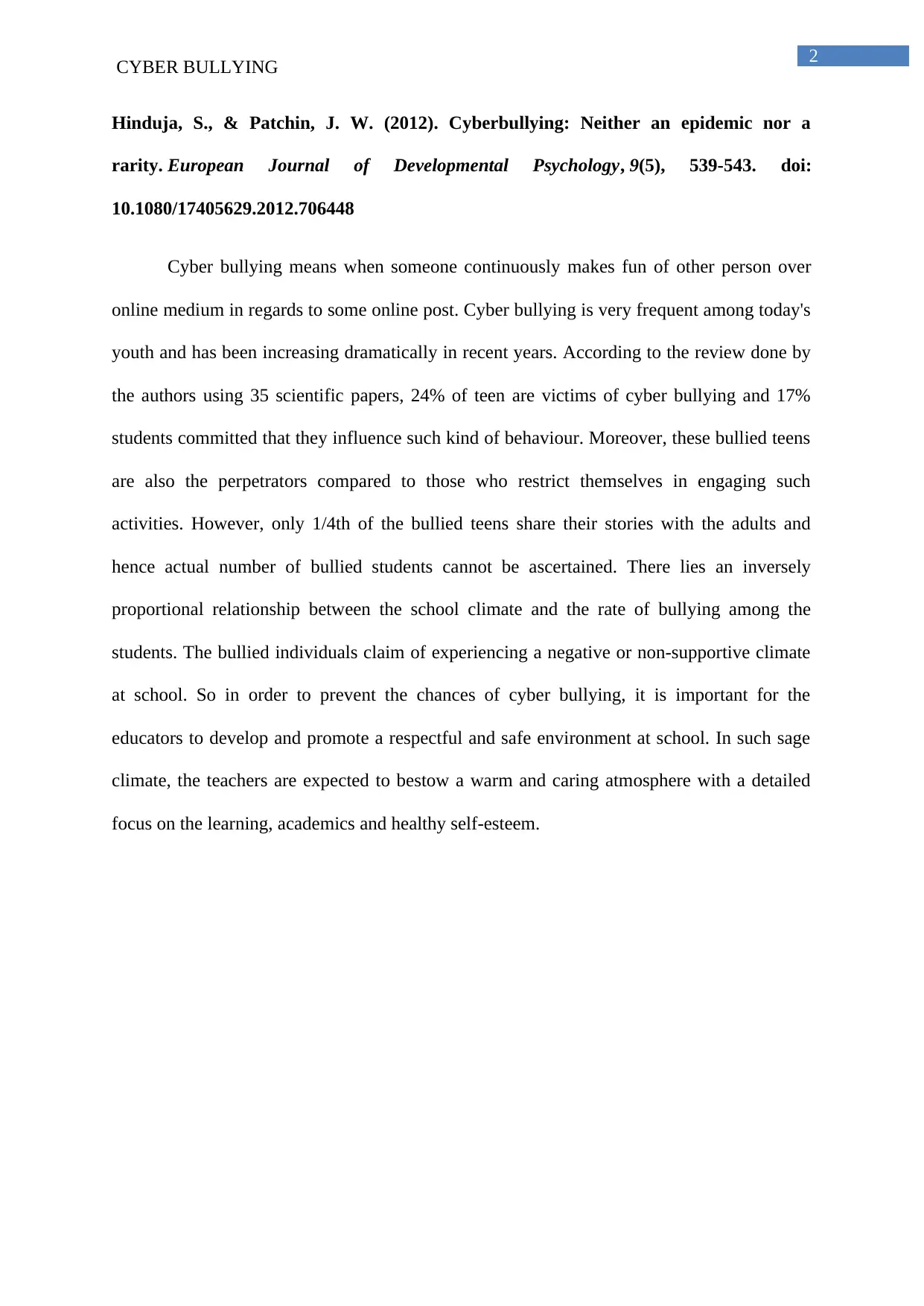
Hinduja, S., & Patchin, J. W. (2012). Cyberbullying: Neither an epidemic nor a
rarity. European Journal of Developmental Psychology, 9(5), 539-543. doi:
10.1080/17405629.2012.706448
Cyber bullying means when someone continuously makes fun of other person over
online medium in regards to some online post. Cyber bullying is very frequent among today's
youth and has been increasing dramatically in recent years. According to the review done by
the authors using 35 scientific papers, 24% of teen are victims of cyber bullying and 17%
students committed that they influence such kind of behaviour. Moreover, these bullied teens
are also the perpetrators compared to those who restrict themselves in engaging such
activities. However, only 1/4th of the bullied teens share their stories with the adults and
hence actual number of bullied students cannot be ascertained. There lies an inversely
proportional relationship between the school climate and the rate of bullying among the
students. The bullied individuals claim of experiencing a negative or non-supportive climate
at school. So in order to prevent the chances of cyber bullying, it is important for the
educators to develop and promote a respectful and safe environment at school. In such sage
climate, the teachers are expected to bestow a warm and caring atmosphere with a detailed
focus on the learning, academics and healthy self-esteem.
Document Page
3
CYBER BULLYING
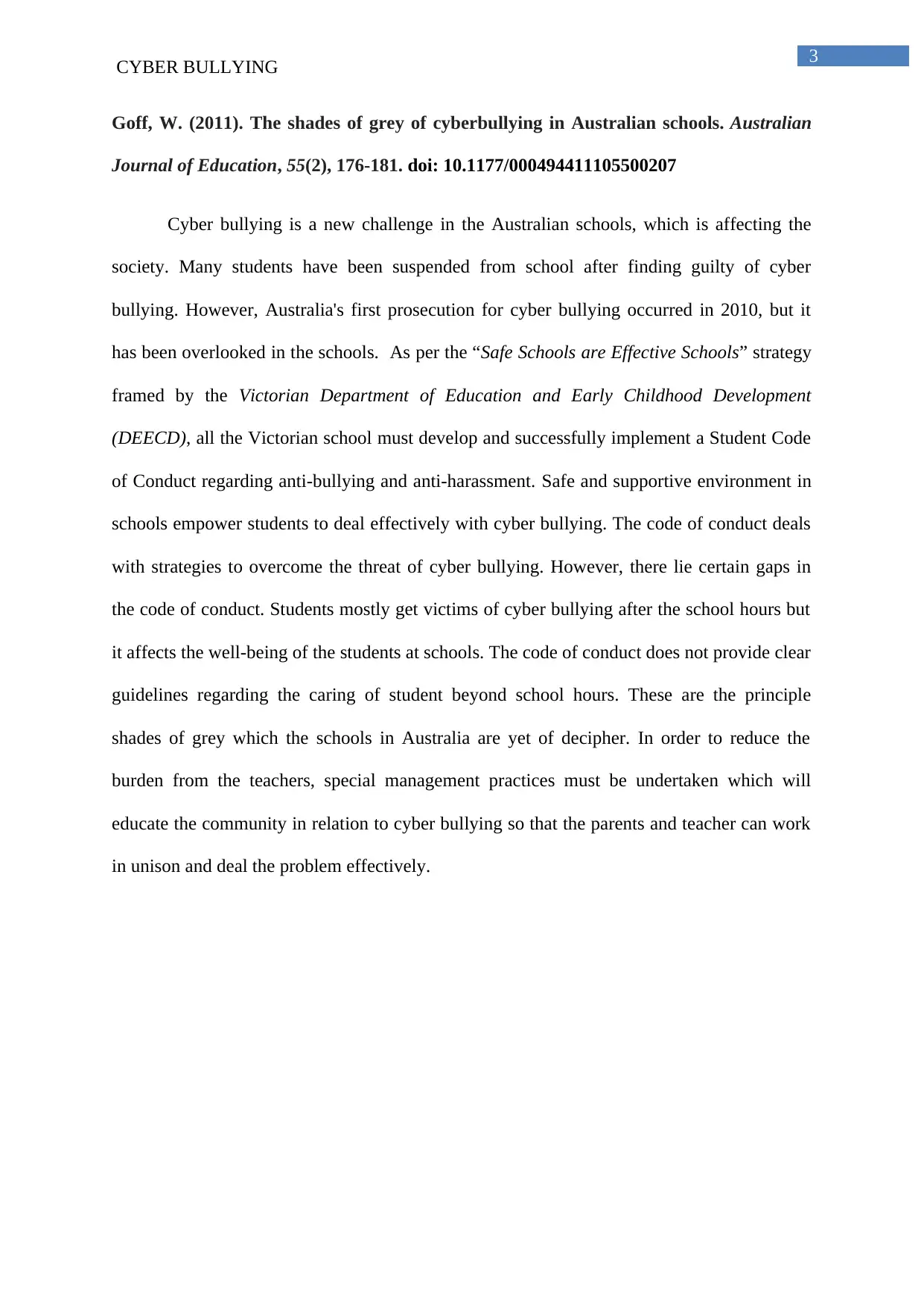
Goff, W. (2011). The shades of grey of cyberbullying in Australian schools. Australian
Journal of Education, 55(2), 176-181. doi: 10.1177/000494411105500207
Cyber bullying is a new challenge in the Australian schools, which is affecting the
society. Many students have been suspended from school after finding guilty of cyber
bullying. However, Australia's first prosecution for cyber bullying occurred in 2010, but it
has been overlooked in the schools. As per the ā€œSafe Schools are Effective Schoolsā€ strategy
framed by the Victorian Department of Education and Early Childhood Development
(DEECD), all the Victorian school must develop and successfully implement a Student Code
of Conduct regarding anti-bullying and anti-harassment. Safe and supportive environment in
schools empower students to deal effectively with cyber bullying. The code of conduct deals
with strategies to overcome the threat of cyber bullying. However, there lie certain gaps in
the code of conduct. Students mostly get victims of cyber bullying after the school hours but
it affects the well-being of the students at schools. The code of conduct does not provide clear
guidelines regarding the caring of student beyond school hours. These are the principle
shades of grey which the schools in Australia are yet of decipher. In order to reduce the
burden from the teachers, special management practices must be undertaken which will
educate the community in relation to cyber bullying so that the parents and teacher can work
in unison and deal the problem effectively.
tabler-icon-diamond-filled.svg

Paraphrase This Document

Need a fresh take? Get an instant paraphrase of this document with our AI Paraphraser
Document Page
4
CYBER BULLYING
References
Goff, W. (2011). The shades of grey of cyberbullying in Australian schools. Australian
Journal of Education, 55(2), 176-181. Doi: 10.1177/000494411105500207
Hinduja, S., & Patchin, J. W. (2012). Cyberbullying: Neither an epidemic nor a
rarity. European Journal of Developmental Psychology, 9(5), 539-543. doi:
10.1080/17405629.2012.706448
chevron_up_icon
1 out of 5
circle_padding
hide_on_mobile
zoom_out_icon
[object Object]