Annotated Bibliography: Analyzing Robert Frost's Poems and Imagery

Verified

Added on  2021/12/19

|4
|599
|29
Annotated Bibliography
AI Summary
This annotated bibliography examines the poems of Robert Frost, focusing on the use of figurative language and imagery. The bibliography includes analyses of 'Fire and Ice,' discussing its rhyming scheme, iambic tetrameter and dimeter, and the poem's themes of desire, hate, and the end of the world. It references works by Pambudi and Maryadi, who focus on the poem's intrinsic and extrinsic elements, and Damanhuri, who analyzes the poem's figurative language and parallelism. The bibliography also references other relevant sources such as Lombardo, O'Brien, Roberts, and Wulandari, providing a comprehensive overview of the literary analysis of Frost's poetry. This assignment is designed to provide a detailed analysis of the poems and the literary devices used by Robert Frost.
Document Page
Running head: Annotated Bibliography
Annotated Bibliography
Name of the Student
Name of the University
Author Note
tabler-icon-diamond-filled.svg

Paraphrase This Document

Need a fresh take? Get an instant paraphrase of this document with our AI Paraphraser
Document Page
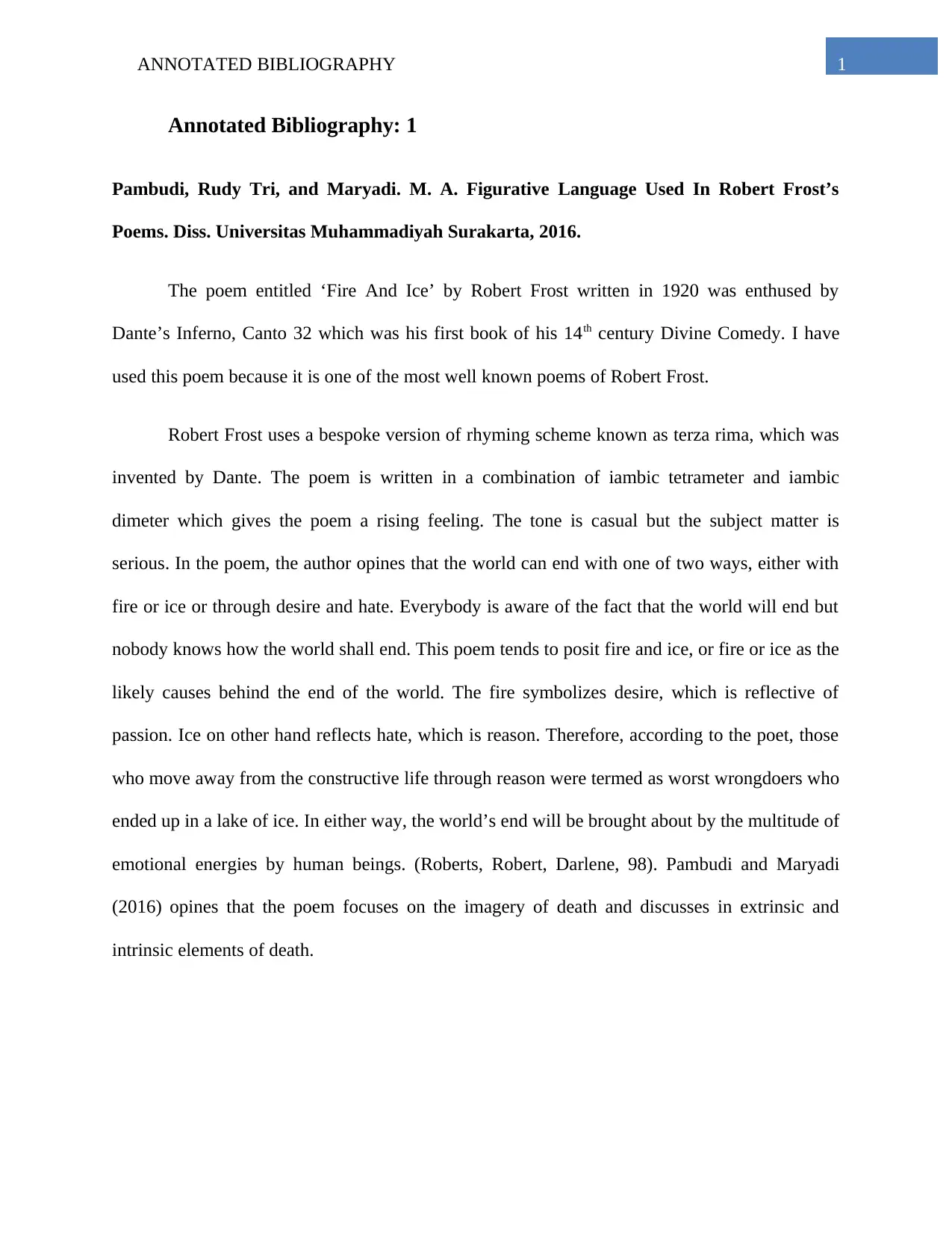
1ANNOTATED BIBLIOGRAPHY
Annotated Bibliography: 1
Pambudi, Rudy Tri, and Maryadi. M. A. Figurative Language Used In Robert Frost’s
Poems. Diss. Universitas Muhammadiyah Surakarta, 2016.
The poem entitled ‘Fire And Ice’ by Robert Frost written in 1920 was enthused by
Dante’s Inferno, Canto 32 which was his first book of his 14th century Divine Comedy. I have
used this poem because it is one of the most well known poems of Robert Frost.
Robert Frost uses a bespoke version of rhyming scheme known as terza rima, which was
invented by Dante. The poem is written in a combination of iambic tetrameter and iambic
dimeter which gives the poem a rising feeling. The tone is casual but the subject matter is
serious. In the poem, the author opines that the world can end with one of two ways, either with
fire or ice or through desire and hate. Everybody is aware of the fact that the world will end but
nobody knows how the world shall end. This poem tends to posit fire and ice, or fire or ice as the
likely causes behind the end of the world. The fire symbolizes desire, which is reflective of
passion. Ice on other hand reflects hate, which is reason. Therefore, according to the poet, those
who move away from the constructive life through reason were termed as worst wrongdoers who
ended up in a lake of ice. In either way, the world’s end will be brought about by the multitude of
emotional energies by human beings. (Roberts, Robert, Darlene, 98). Pambudi and Maryadi
(2016) opines that the poem focuses on the imagery of death and discusses in extrinsic and
intrinsic elements of death.
Document Page
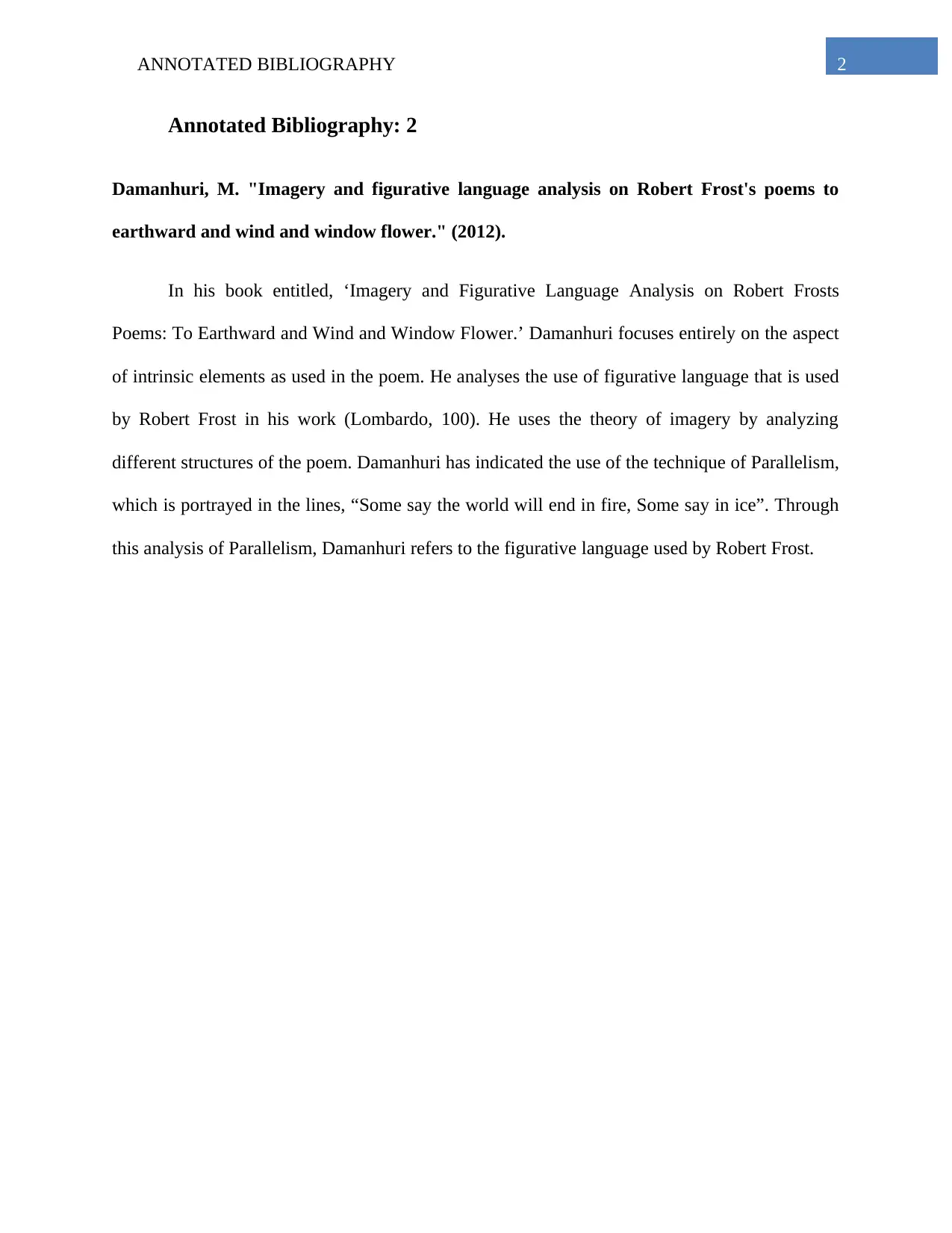
2ANNOTATED BIBLIOGRAPHY
Annotated Bibliography: 2
Damanhuri, M. "Imagery and figurative language analysis on Robert Frost's poems to
earthward and wind and window flower." (2012).
In his book entitled, ‘Imagery and Figurative Language Analysis on Robert Frosts
Poems: To Earthward and Wind and Window Flower.’ Damanhuri focuses entirely on the aspect
of intrinsic elements as used in the poem. He analyses the use of figurative language that is used
by Robert Frost in his work (Lombardo, 100). He uses the theory of imagery by analyzing
different structures of the poem. Damanhuri has indicated the use of the technique of Parallelism,
which is portrayed in the lines, “Some say the world will end in fire, Some say in ice”. Through
this analysis of Parallelism, Damanhuri refers to the figurative language used by Robert Frost.
Document Page
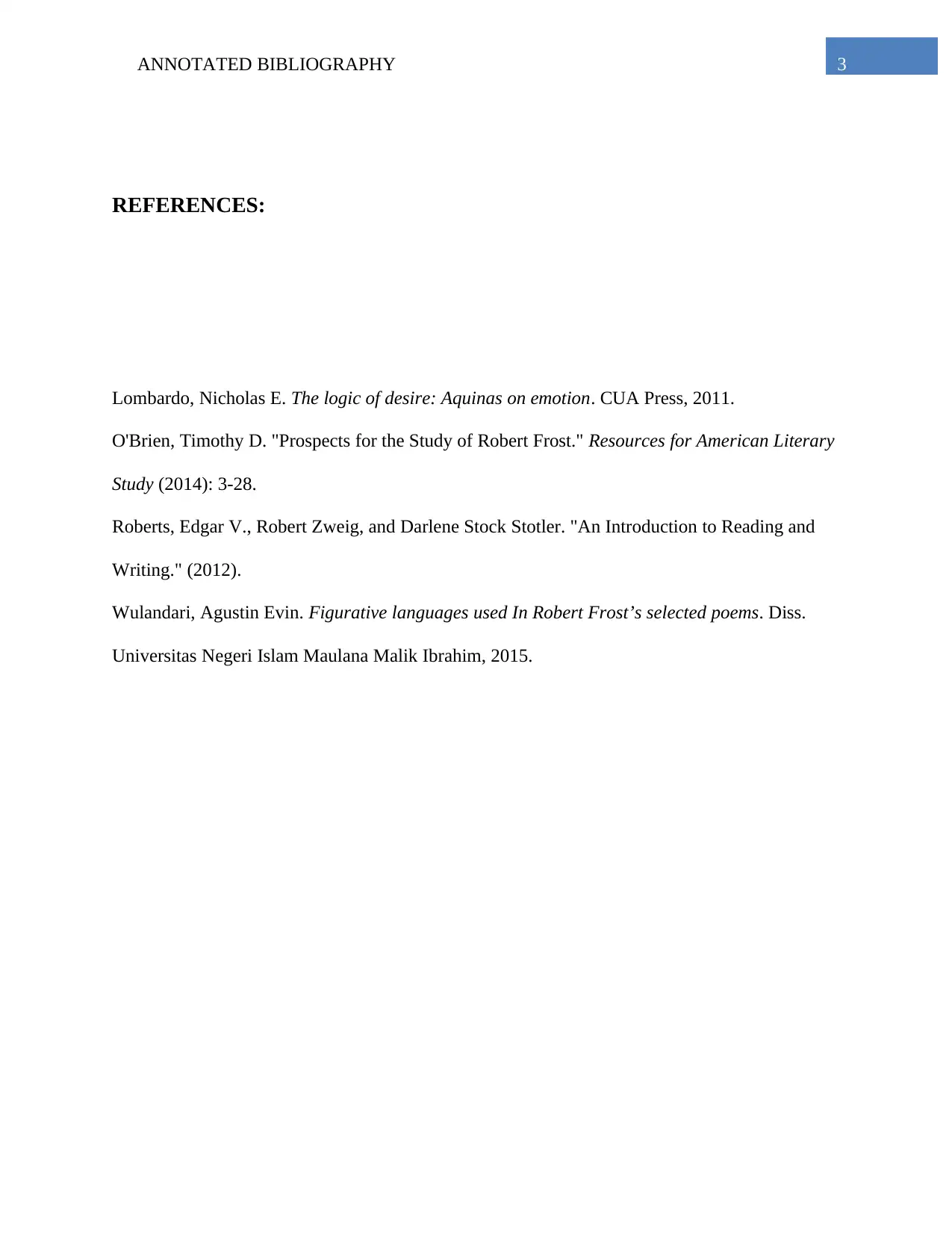
3ANNOTATED BIBLIOGRAPHY
REFERENCES:
Lombardo, Nicholas E. The logic of desire: Aquinas on emotion. CUA Press, 2011.
O'Brien, Timothy D. "Prospects for the Study of Robert Frost." Resources for American Literary
Study (2014): 3-28.
Roberts, Edgar V., Robert Zweig, and Darlene Stock Stotler. "An Introduction to Reading and
Writing." (2012).
Wulandari, Agustin Evin. Figurative languages used In Robert Frost’s selected poems. Diss.
Universitas Negeri Islam Maulana Malik Ibrahim, 2015.
chevron_up_icon
1 out of 4
circle_padding
hide_on_mobile
zoom_out_icon
[object Object]