Annotated Bibliography: Mental Health, LGBTQ+ Community, and Policies
VerifiedAdded on 2022/06/09
|11
|4527
|11
Annotated Bibliography
AI Summary
This annotated bibliography examines four articles focusing on the mental health of the LGBTQ+ community. The first article highlights the mental health needs of LGBTQ+ youth, emphasizing the impact of societal factors like victimization and prejudice, and identifies key strategies for support, including family and school involvement. The second article stresses the importance of educating healthcare providers about the cultural competencies required to address the unique needs of the LGBTQ+ population, including health disparities and the need for tailored training programs. The third article explores the history of LGBTQ+ rights and suggests ways to create a culturally safe healthcare system through education and self-reflection, with a focus on nursing education and simulations. Finally, the fourth article discusses the role of government, school, and medical policies in addressing mental health disparities within the LGBTQ+ community, emphasizing the need for societal changes in attitudes and beliefs to achieve meaningful progress. The bibliography provides a comprehensive overview of the challenges and potential solutions related to LGBTQ+ mental health, offering valuable insights for healthcare professionals, educators, and policymakers.
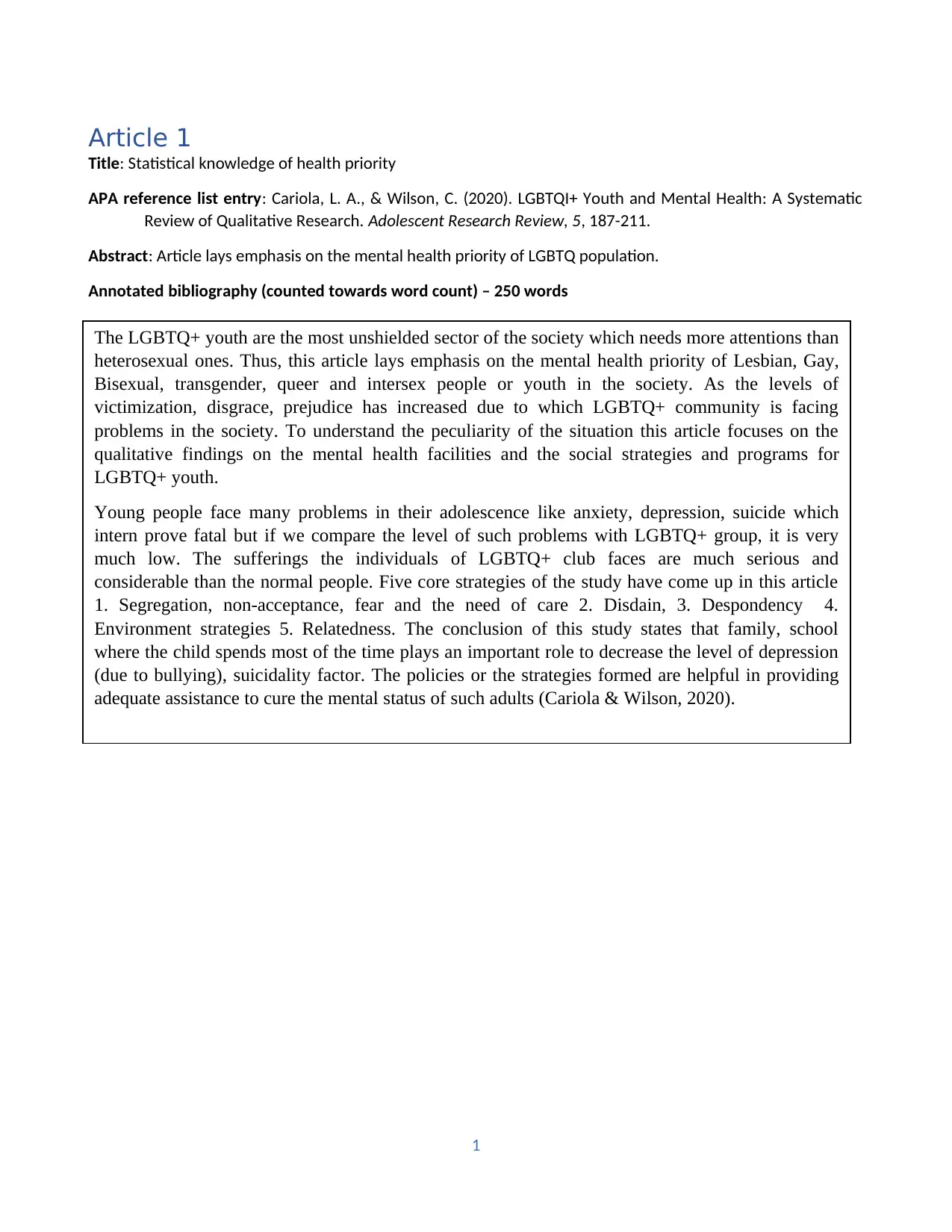
Article 1
Title: Statistical knowledge of health priority
APA reference list entry: Cariola, L. A., & Wilson, C. (2020). LGBTQI+ Youth and Mental Health: A Systematic
Review of Qualitative Research. Adolescent Research Review, 5, 187-211.
Abstract: Article lays emphasis on the mental health priority of LGBTQ population.
Annotated bibliography (counted towards word count) – 250 words
1
The LGBTQ+ youth are the most unshielded sector of the society which needs more attentions than
heterosexual ones. Thus, this article lays emphasis on the mental health priority of Lesbian, Gay,
Bisexual, transgender, queer and intersex people or youth in the society. As the levels of
victimization, disgrace, prejudice has increased due to which LGBTQ+ community is facing
problems in the society. To understand the peculiarity of the situation this article focuses on the
qualitative findings on the mental health facilities and the social strategies and programs for
LGBTQ+ youth.
Young people face many problems in their adolescence like anxiety, depression, suicide which
intern prove fatal but if we compare the level of such problems with LGBTQ+ group, it is very
much low. The sufferings the individuals of LGBTQ+ club faces are much serious and
considerable than the normal people. Five core strategies of the study have come up in this article
1. Segregation, non-acceptance, fear and the need of care 2. Disdain, 3. Despondency 4.
Environment strategies 5. Relatedness. The conclusion of this study states that family, school
where the child spends most of the time plays an important role to decrease the level of depression
(due to bullying), suicidality factor. The policies or the strategies formed are helpful in providing
adequate assistance to cure the mental status of such adults (Cariola & Wilson, 2020).
Title: Statistical knowledge of health priority
APA reference list entry: Cariola, L. A., & Wilson, C. (2020). LGBTQI+ Youth and Mental Health: A Systematic
Review of Qualitative Research. Adolescent Research Review, 5, 187-211.
Abstract: Article lays emphasis on the mental health priority of LGBTQ population.
Annotated bibliography (counted towards word count) – 250 words
1
The LGBTQ+ youth are the most unshielded sector of the society which needs more attentions than
heterosexual ones. Thus, this article lays emphasis on the mental health priority of Lesbian, Gay,
Bisexual, transgender, queer and intersex people or youth in the society. As the levels of
victimization, disgrace, prejudice has increased due to which LGBTQ+ community is facing
problems in the society. To understand the peculiarity of the situation this article focuses on the
qualitative findings on the mental health facilities and the social strategies and programs for
LGBTQ+ youth.
Young people face many problems in their adolescence like anxiety, depression, suicide which
intern prove fatal but if we compare the level of such problems with LGBTQ+ group, it is very
much low. The sufferings the individuals of LGBTQ+ club faces are much serious and
considerable than the normal people. Five core strategies of the study have come up in this article
1. Segregation, non-acceptance, fear and the need of care 2. Disdain, 3. Despondency 4.
Environment strategies 5. Relatedness. The conclusion of this study states that family, school
where the child spends most of the time plays an important role to decrease the level of depression
(due to bullying), suicidality factor. The policies or the strategies formed are helpful in providing
adequate assistance to cure the mental status of such adults (Cariola & Wilson, 2020).

Paraphrase This Document
Need a fresh take? Get an instant paraphrase of this document with our AI Paraphraser
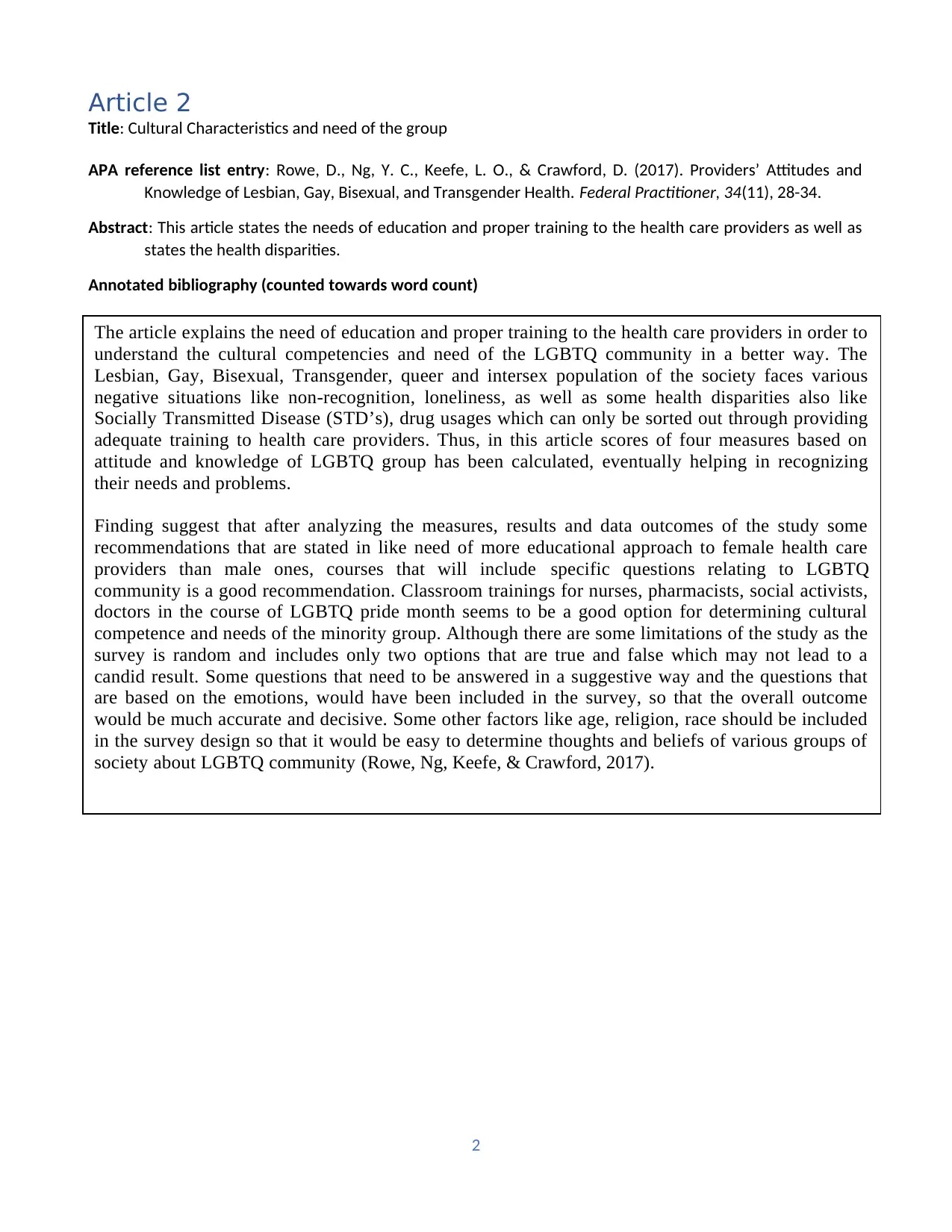
Article 2
Title: Cultural Characteristics and need of the group
APA reference list entry: Rowe, D., Ng, Y. C., Keefe, L. O., & Crawford, D. (2017). Providers’ Attitudes and
Knowledge of Lesbian, Gay, Bisexual, and Transgender Health. Federal Practitioner, 34(11), 28-34.
Abstract: This article states the needs of education and proper training to the health care providers as well as
states the health disparities.
Annotated bibliography (counted towards word count)
2
The article explains the need of education and proper training to the health care providers in order to
understand the cultural competencies and need of the LGBTQ community in a better way. The
Lesbian, Gay, Bisexual, Transgender, queer and intersex population of the society faces various
negative situations like non-recognition, loneliness, as well as some health disparities also like
Socially Transmitted Disease (STD’s), drug usages which can only be sorted out through providing
adequate training to health care providers. Thus, in this article scores of four measures based on
attitude and knowledge of LGBTQ group has been calculated, eventually helping in recognizing
their needs and problems.
Finding suggest that after analyzing the measures, results and data outcomes of the study some
recommendations that are stated in like need of more educational approach to female health care
providers than male ones, courses that will include specific questions relating to LGBTQ
community is a good recommendation. Classroom trainings for nurses, pharmacists, social activists,
doctors in the course of LGBTQ pride month seems to be a good option for determining cultural
competence and needs of the minority group. Although there are some limitations of the study as the
survey is random and includes only two options that are true and false which may not lead to a
candid result. Some questions that need to be answered in a suggestive way and the questions that
are based on the emotions, would have been included in the survey, so that the overall outcome
would be much accurate and decisive. Some other factors like age, religion, race should be included
in the survey design so that it would be easy to determine thoughts and beliefs of various groups of
society about LGBTQ community (Rowe, Ng, Keefe, & Crawford, 2017).
Title: Cultural Characteristics and need of the group
APA reference list entry: Rowe, D., Ng, Y. C., Keefe, L. O., & Crawford, D. (2017). Providers’ Attitudes and
Knowledge of Lesbian, Gay, Bisexual, and Transgender Health. Federal Practitioner, 34(11), 28-34.
Abstract: This article states the needs of education and proper training to the health care providers as well as
states the health disparities.
Annotated bibliography (counted towards word count)
2
The article explains the need of education and proper training to the health care providers in order to
understand the cultural competencies and need of the LGBTQ community in a better way. The
Lesbian, Gay, Bisexual, Transgender, queer and intersex population of the society faces various
negative situations like non-recognition, loneliness, as well as some health disparities also like
Socially Transmitted Disease (STD’s), drug usages which can only be sorted out through providing
adequate training to health care providers. Thus, in this article scores of four measures based on
attitude and knowledge of LGBTQ group has been calculated, eventually helping in recognizing
their needs and problems.
Finding suggest that after analyzing the measures, results and data outcomes of the study some
recommendations that are stated in like need of more educational approach to female health care
providers than male ones, courses that will include specific questions relating to LGBTQ
community is a good recommendation. Classroom trainings for nurses, pharmacists, social activists,
doctors in the course of LGBTQ pride month seems to be a good option for determining cultural
competence and needs of the minority group. Although there are some limitations of the study as the
survey is random and includes only two options that are true and false which may not lead to a
candid result. Some questions that need to be answered in a suggestive way and the questions that
are based on the emotions, would have been included in the survey, so that the overall outcome
would be much accurate and decisive. Some other factors like age, religion, race should be included
in the survey design so that it would be easy to determine thoughts and beliefs of various groups of
society about LGBTQ community (Rowe, Ng, Keefe, & Crawford, 2017).
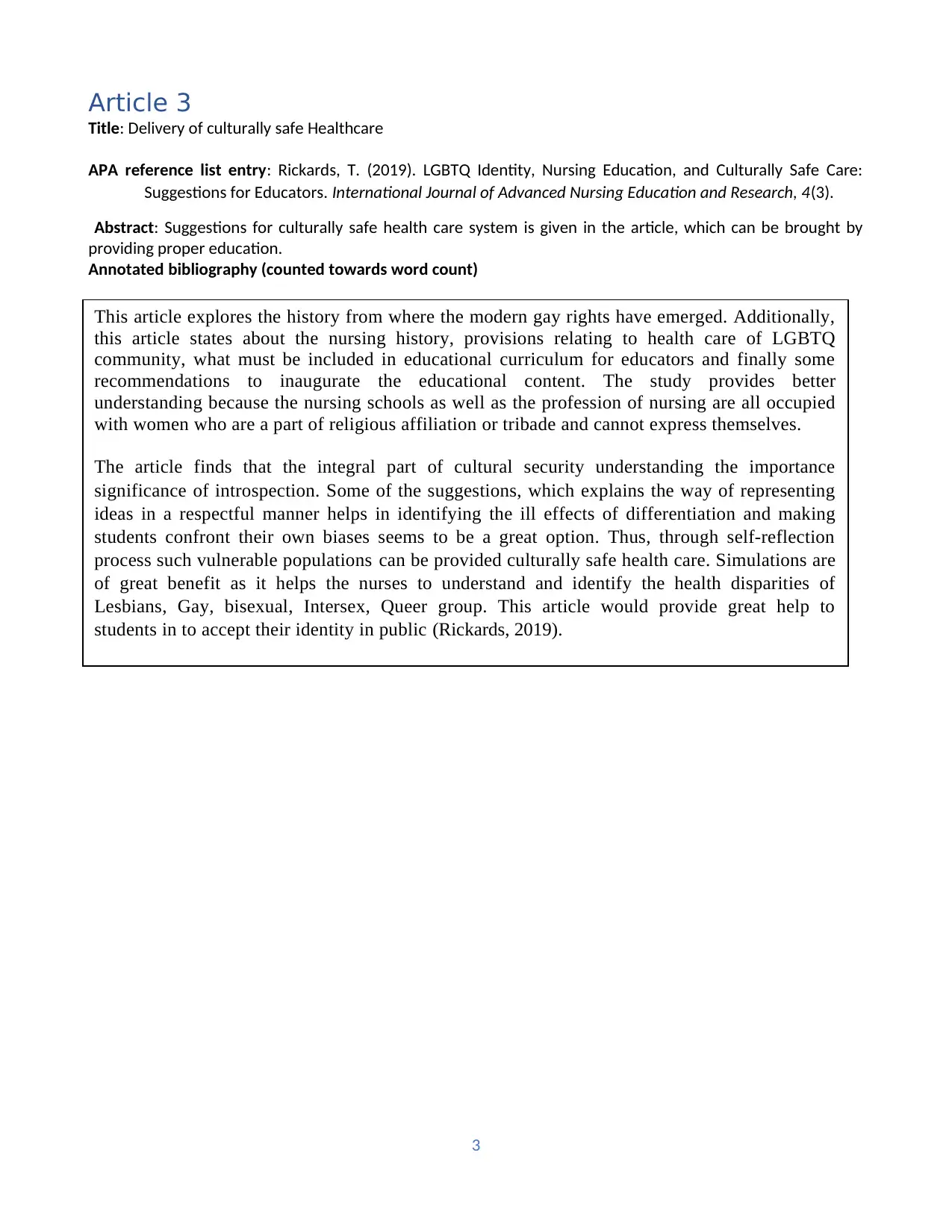
Article 3
Title: Delivery of culturally safe Healthcare
APA reference list entry: Rickards, T. (2019). LGBTQ Identity, Nursing Education, and Culturally Safe Care:
Suggestions for Educators. International Journal of Advanced Nursing Education and Research, 4(3).
Abstract: Suggestions for culturally safe health care system is given in the article, which can be brought by
providing proper education.
Annotated bibliography (counted towards word count)
3
This article explores the history from where the modern gay rights have emerged. Additionally,
this article states about the nursing history, provisions relating to health care of LGBTQ
community, what must be included in educational curriculum for educators and finally some
recommendations to inaugurate the educational content. The study provides better
understanding because the nursing schools as well as the profession of nursing are all occupied
with women who are a part of religious affiliation or tribade and cannot express themselves.
The article finds that the integral part of cultural security understanding the importance
significance of introspection. Some of the suggestions, which explains the way of representing
ideas in a respectful manner helps in identifying the ill effects of differentiation and making
students confront their own biases seems to be a great option. Thus, through self-reflection
process such vulnerable populations can be provided culturally safe health care. Simulations are
of great benefit as it helps the nurses to understand and identify the health disparities of
Lesbians, Gay, bisexual, Intersex, Queer group. This article would provide great help to
students in to accept their identity in public (Rickards, 2019).
Title: Delivery of culturally safe Healthcare
APA reference list entry: Rickards, T. (2019). LGBTQ Identity, Nursing Education, and Culturally Safe Care:
Suggestions for Educators. International Journal of Advanced Nursing Education and Research, 4(3).
Abstract: Suggestions for culturally safe health care system is given in the article, which can be brought by
providing proper education.
Annotated bibliography (counted towards word count)
3
This article explores the history from where the modern gay rights have emerged. Additionally,
this article states about the nursing history, provisions relating to health care of LGBTQ
community, what must be included in educational curriculum for educators and finally some
recommendations to inaugurate the educational content. The study provides better
understanding because the nursing schools as well as the profession of nursing are all occupied
with women who are a part of religious affiliation or tribade and cannot express themselves.
The article finds that the integral part of cultural security understanding the importance
significance of introspection. Some of the suggestions, which explains the way of representing
ideas in a respectful manner helps in identifying the ill effects of differentiation and making
students confront their own biases seems to be a great option. Thus, through self-reflection
process such vulnerable populations can be provided culturally safe health care. Simulations are
of great benefit as it helps the nurses to understand and identify the health disparities of
Lesbians, Gay, bisexual, Intersex, Queer group. This article would provide great help to
students in to accept their identity in public (Rickards, 2019).
⊘ This is a preview!⊘
Do you want full access?
Subscribe today to unlock all pages.

Trusted by 1+ million students worldwide
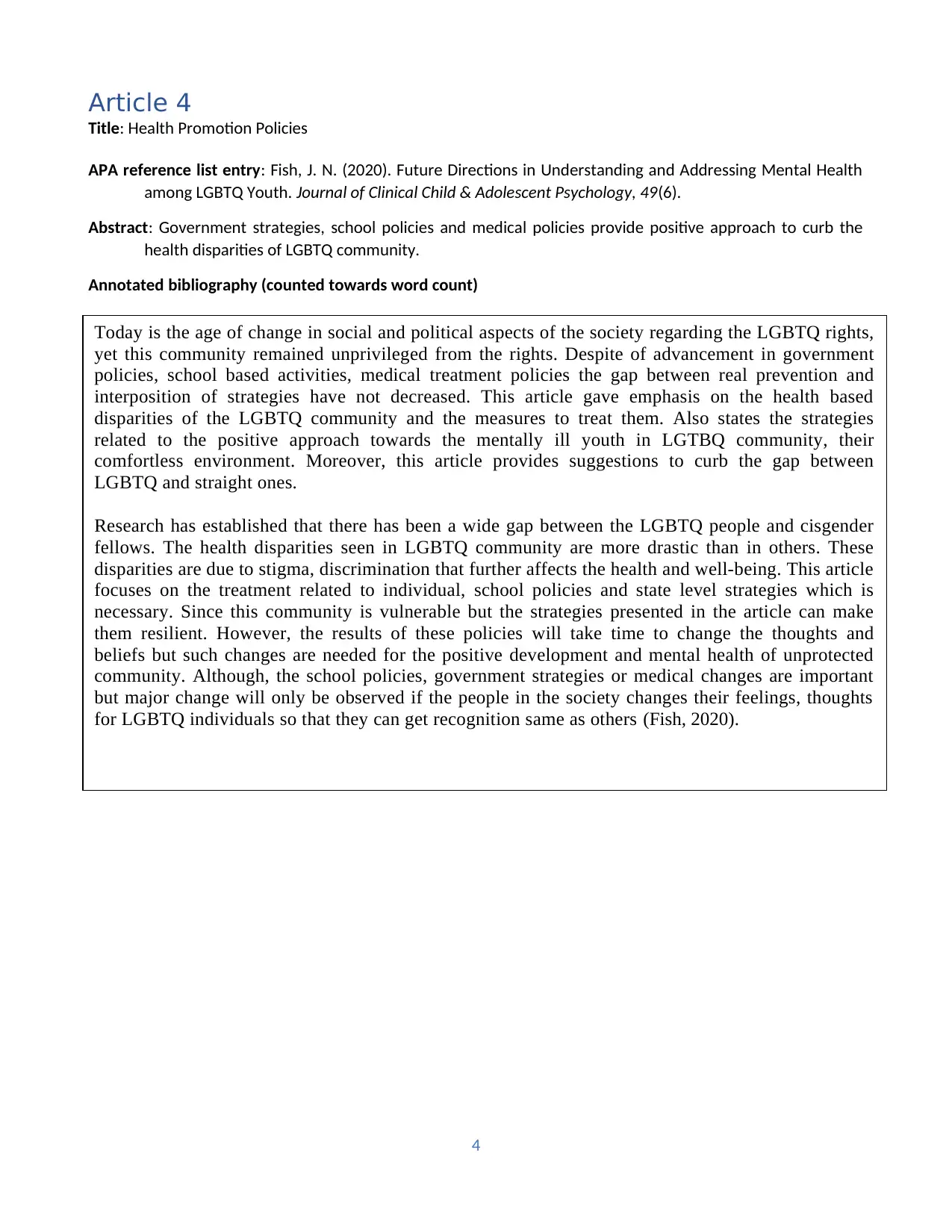
Article 4
Title: Health Promotion Policies
APA reference list entry: Fish, J. N. (2020). Future Directions in Understanding and Addressing Mental Health
among LGBTQ Youth. Journal of Clinical Child & Adolescent Psychology, 49(6).
Abstract: Government strategies, school policies and medical policies provide positive approach to curb the
health disparities of LGBTQ community.
Annotated bibliography (counted towards word count)
4
Today is the age of change in social and political aspects of the society regarding the LGBTQ rights,
yet this community remained unprivileged from the rights. Despite of advancement in government
policies, school based activities, medical treatment policies the gap between real prevention and
interposition of strategies have not decreased. This article gave emphasis on the health based
disparities of the LGBTQ community and the measures to treat them. Also states the strategies
related to the positive approach towards the mentally ill youth in LGTBQ community, their
comfortless environment. Moreover, this article provides suggestions to curb the gap between
LGBTQ and straight ones.
Research has established that there has been a wide gap between the LGBTQ people and cisgender
fellows. The health disparities seen in LGBTQ community are more drastic than in others. These
disparities are due to stigma, discrimination that further affects the health and well-being. This article
focuses on the treatment related to individual, school policies and state level strategies which is
necessary. Since this community is vulnerable but the strategies presented in the article can make
them resilient. However, the results of these policies will take time to change the thoughts and
beliefs but such changes are needed for the positive development and mental health of unprotected
community. Although, the school policies, government strategies or medical changes are important
but major change will only be observed if the people in the society changes their feelings, thoughts
for LGBTQ individuals so that they can get recognition same as others (Fish, 2020).
Title: Health Promotion Policies
APA reference list entry: Fish, J. N. (2020). Future Directions in Understanding and Addressing Mental Health
among LGBTQ Youth. Journal of Clinical Child & Adolescent Psychology, 49(6).
Abstract: Government strategies, school policies and medical policies provide positive approach to curb the
health disparities of LGBTQ community.
Annotated bibliography (counted towards word count)
4
Today is the age of change in social and political aspects of the society regarding the LGBTQ rights,
yet this community remained unprivileged from the rights. Despite of advancement in government
policies, school based activities, medical treatment policies the gap between real prevention and
interposition of strategies have not decreased. This article gave emphasis on the health based
disparities of the LGBTQ community and the measures to treat them. Also states the strategies
related to the positive approach towards the mentally ill youth in LGTBQ community, their
comfortless environment. Moreover, this article provides suggestions to curb the gap between
LGBTQ and straight ones.
Research has established that there has been a wide gap between the LGBTQ people and cisgender
fellows. The health disparities seen in LGBTQ community are more drastic than in others. These
disparities are due to stigma, discrimination that further affects the health and well-being. This article
focuses on the treatment related to individual, school policies and state level strategies which is
necessary. Since this community is vulnerable but the strategies presented in the article can make
them resilient. However, the results of these policies will take time to change the thoughts and
beliefs but such changes are needed for the positive development and mental health of unprotected
community. Although, the school policies, government strategies or medical changes are important
but major change will only be observed if the people in the society changes their feelings, thoughts
for LGBTQ individuals so that they can get recognition same as others (Fish, 2020).
Paraphrase This Document
Need a fresh take? Get an instant paraphrase of this document with our AI Paraphraser
Article 5
Title: Health Determinants of LGBTQ Community
APA reference list entry: Theiss, J., Williamson, A., Trott, J., & Regenstein, M. (2018). Addressing Social
Determinants Of Health Through Medical-Legal Partnerships. Determinants of Health, 37(3).
Abstract: Legal medical partnership is coming up as an important help for LGBTQ community.
Annotated bibliography (counted towards word count)
5
Food uncertainty, education and employment barriers, and scant housing conditions are all examples
of complex social and environmental factors that perpetuate health disparities in the United States.
The partnership in which legal aid specialists and medical specialist are involved in health care
settings to address social complications that lead to poor health outcomes and health inequalities.
These Medical-legal collaborations are very useful and present in many health care corporations.
This article draws research upon the legal-medical partnership that seems to be a good combination
to curb the disparities of LGBTQ community. After observing the situation legal practitioners were
seen more vigilant about helping the community to the next level, were once resisted by health care
professionals to make them involve. In order to curb the challenges mentioned, trainings to the
clinical and staff members of the needs of the patients to the legal medical duo is required.
Financing proves to be a major consideration for such kind of approach as new sources must be
needed to execute the plan from legal as well as health care sector. Thus, such a partnership is
difficult to work upon as standardized clinics, practice and trainings, financial support needed to be
consistent still the change in the health condition of the vulnerable group have shown that medical
and legal partners are giving their best to achieve the goal (Theiss, Williamson, Trott, & Regenstein,
2018).
Title: Health Determinants of LGBTQ Community
APA reference list entry: Theiss, J., Williamson, A., Trott, J., & Regenstein, M. (2018). Addressing Social
Determinants Of Health Through Medical-Legal Partnerships. Determinants of Health, 37(3).
Abstract: Legal medical partnership is coming up as an important help for LGBTQ community.
Annotated bibliography (counted towards word count)
5
Food uncertainty, education and employment barriers, and scant housing conditions are all examples
of complex social and environmental factors that perpetuate health disparities in the United States.
The partnership in which legal aid specialists and medical specialist are involved in health care
settings to address social complications that lead to poor health outcomes and health inequalities.
These Medical-legal collaborations are very useful and present in many health care corporations.
This article draws research upon the legal-medical partnership that seems to be a good combination
to curb the disparities of LGBTQ community. After observing the situation legal practitioners were
seen more vigilant about helping the community to the next level, were once resisted by health care
professionals to make them involve. In order to curb the challenges mentioned, trainings to the
clinical and staff members of the needs of the patients to the legal medical duo is required.
Financing proves to be a major consideration for such kind of approach as new sources must be
needed to execute the plan from legal as well as health care sector. Thus, such a partnership is
difficult to work upon as standardized clinics, practice and trainings, financial support needed to be
consistent still the change in the health condition of the vulnerable group have shown that medical
and legal partners are giving their best to achieve the goal (Theiss, Williamson, Trott, & Regenstein,
2018).
Significance of health priority
The health priority that will be discussed in this campaign is Mental Health. In 2001, it has been
declared by world health organization that stigma and associated discrimination for people suffering
from mental and behavioral disorders are two crucial aspects of the society which are needed to be
resolved immediately. Mental health is the most important factor in human life as it impacts the
survival of the individual. For instance, mental ill health results in lower employment, higher
unemployment which consequently high rate of poverty. It has direct economic effects as well as
indirect also (Fit Mind, Fit Job: from evidence to practice in mental health and work, 2015).
Group in Focus
The focus of this campaign of mental health will be on LGBTQ+ community. The acronym LGBTQ+
refers to the Lesbian, Gay, Bisexual, transgender, Queer, Questioning, Intersex community are the most
vulnerable sect of the society having an assorted varieties of identity and sexual inclination (The Royal
australian and New Zealand College of Pscychaitrists, 2021). Although this community never gets
included in large scale surveys but they are the one who suffer from mental disparities more often. One
study was conducted which stated that LGBTQ people use mental health aid 2.5 times more than
straight compeers (Mhanational, 2021).
Aim
Since 4.5% of U.S. population is identified as lesbian, gay, bisexual and over 39% of such people have
reported with mental illness (NBC News, 2018). Thus, the objective set out of this campaign is to make
socioeconomic and culturally safe environment for LGBTQ community which is the need of the hour.
6
The health priority that will be discussed in this campaign is Mental Health. In 2001, it has been
declared by world health organization that stigma and associated discrimination for people suffering
from mental and behavioral disorders are two crucial aspects of the society which are needed to be
resolved immediately. Mental health is the most important factor in human life as it impacts the
survival of the individual. For instance, mental ill health results in lower employment, higher
unemployment which consequently high rate of poverty. It has direct economic effects as well as
indirect also (Fit Mind, Fit Job: from evidence to practice in mental health and work, 2015).
Group in Focus
The focus of this campaign of mental health will be on LGBTQ+ community. The acronym LGBTQ+
refers to the Lesbian, Gay, Bisexual, transgender, Queer, Questioning, Intersex community are the most
vulnerable sect of the society having an assorted varieties of identity and sexual inclination (The Royal
australian and New Zealand College of Pscychaitrists, 2021). Although this community never gets
included in large scale surveys but they are the one who suffer from mental disparities more often. One
study was conducted which stated that LGBTQ people use mental health aid 2.5 times more than
straight compeers (Mhanational, 2021).
Aim
Since 4.5% of U.S. population is identified as lesbian, gay, bisexual and over 39% of such people have
reported with mental illness (NBC News, 2018). Thus, the objective set out of this campaign is to make
socioeconomic and culturally safe environment for LGBTQ community which is the need of the hour.
6
⊘ This is a preview!⊘
Do you want full access?
Subscribe today to unlock all pages.
Trusted by 1+ million students worldwide
Steps
From depression and bipolar disorder to schizophrenia, dementia or other psychoses mental health
affects each and every person of the society regardless of sect, gender, race, color or community
(World Health Organizatiion, 2019). And this can be majorly seen in LGBTQ+ group who needs much
more attention. Thus, such campaigns are very helpful in removing disgraceful characterization and
initiating fruitful conversation on mental health problems.
1. Recognition - Identification of LGBTQ+ individuals as they are diverse and varied as well as their
needs. Provide free of cost mental health checkup to such vulnerable group and then ask them to share
the same with other people of their community. Thus, recognition means getting acceptance which
intern helps in maintaining dignity of those people (Government of Western Australia Department of
Health, 2021).
2. Spreading hope- the people of LGBTQ club who are suffering from mental illness can be reached
out for providing them motivation or to make them feel better. For providing the encouragement and
improving the proficiency level, members of LGBTQ+ community should be employed as they
actually know the pain and needs of their people. As they can share their own stories and can be a
shoulder to lean upon (Human Rights Campaign, 2019).
3. Awareness session- Most importantly a guest lecture can be prepared for other sectors of the
society, to make them aware about the background and present mental health conditions of LGBTQ+
community. Moreover, imparting information related to laws for spreading awareness related to their
mental health.
7
From depression and bipolar disorder to schizophrenia, dementia or other psychoses mental health
affects each and every person of the society regardless of sect, gender, race, color or community
(World Health Organizatiion, 2019). And this can be majorly seen in LGBTQ+ group who needs much
more attention. Thus, such campaigns are very helpful in removing disgraceful characterization and
initiating fruitful conversation on mental health problems.
1. Recognition - Identification of LGBTQ+ individuals as they are diverse and varied as well as their
needs. Provide free of cost mental health checkup to such vulnerable group and then ask them to share
the same with other people of their community. Thus, recognition means getting acceptance which
intern helps in maintaining dignity of those people (Government of Western Australia Department of
Health, 2021).
2. Spreading hope- the people of LGBTQ club who are suffering from mental illness can be reached
out for providing them motivation or to make them feel better. For providing the encouragement and
improving the proficiency level, members of LGBTQ+ community should be employed as they
actually know the pain and needs of their people. As they can share their own stories and can be a
shoulder to lean upon (Human Rights Campaign, 2019).
3. Awareness session- Most importantly a guest lecture can be prepared for other sectors of the
society, to make them aware about the background and present mental health conditions of LGBTQ+
community. Moreover, imparting information related to laws for spreading awareness related to their
mental health.
7
Paraphrase This Document
Need a fresh take? Get an instant paraphrase of this document with our AI Paraphraser
Relevant people for spreading knowledge
Socioeconomic and cultural factors have a detrimental effect on the mental health of many LGBTQ
persons. Many members of the LGBTQI community experience unfairness, denial of civil and human
rights, harassment, and non-acceptance from family, which can result in alarming symptoms. The key
Contributors for stabilizing the mental health of the LGBTQ+ community are Doctors, nurses, people
from LGBTQ+ community, social activists. Doctors and nurses can provide help in hand for them by
providing mental illness therapies through analyzing their thought process, prescribing them meditation
and yoga (Milford, 2021). And in any critical situation they can provide effective medications and
emotional assistance too. People from LGBTQ community should take initiatives by themselves to
spread further awareness relating to the needs and pain of their community by increasing their
participation socially. Social activist should include members from LGBTQ club so that they can be
directed in right and effective direction to know their needs and desires that can be worked upon.
Cultural safety has emerged long back with the existence of indigenous and non-indigenous people
which means the environment which inculcates respect, share principles, diverse culture, diverse
dialogues and languages without any discrimination against sex, colour, creed, caste and race. Cultural
safety is an approach which may enhance empowerment, education to make the society peaceful
(Community Research Centre, 2017). Thus, the above mentioned draft can be helpful as it may enhance
the respect for culture as there is increase in recognition of LGBTQ community their acceptance in the
society will increase. There will be no assault on their identity and will be treated with dignity. The
people belonging to the particular community for spreading hope is a good option as they can
understand the needs and wants of their clan members and eventually can respond to them in a more
effective way. Some of the dignified people in the society like doctors, nurses, social activists can help
8
Socioeconomic and cultural factors have a detrimental effect on the mental health of many LGBTQ
persons. Many members of the LGBTQI community experience unfairness, denial of civil and human
rights, harassment, and non-acceptance from family, which can result in alarming symptoms. The key
Contributors for stabilizing the mental health of the LGBTQ+ community are Doctors, nurses, people
from LGBTQ+ community, social activists. Doctors and nurses can provide help in hand for them by
providing mental illness therapies through analyzing their thought process, prescribing them meditation
and yoga (Milford, 2021). And in any critical situation they can provide effective medications and
emotional assistance too. People from LGBTQ community should take initiatives by themselves to
spread further awareness relating to the needs and pain of their community by increasing their
participation socially. Social activist should include members from LGBTQ club so that they can be
directed in right and effective direction to know their needs and desires that can be worked upon.
Cultural safety has emerged long back with the existence of indigenous and non-indigenous people
which means the environment which inculcates respect, share principles, diverse culture, diverse
dialogues and languages without any discrimination against sex, colour, creed, caste and race. Cultural
safety is an approach which may enhance empowerment, education to make the society peaceful
(Community Research Centre, 2017). Thus, the above mentioned draft can be helpful as it may enhance
the respect for culture as there is increase in recognition of LGBTQ community their acceptance in the
society will increase. There will be no assault on their identity and will be treated with dignity. The
people belonging to the particular community for spreading hope is a good option as they can
understand the needs and wants of their clan members and eventually can respond to them in a more
effective way. Some of the dignified people in the society like doctors, nurses, social activists can help
8
to spread awareness in a better understanding way as they have touched the lives of LGBTQ club
minutely. Thus, culturally safe environment is the need of the hour as these steps can play a significant
role in identifying and eliminating stereotypical obstacles enhance trust level, helped them to involve in
two way dialogues where goal is to share information (Intstudentsup, 2021).
9
minutely. Thus, culturally safe environment is the need of the hour as these steps can play a significant
role in identifying and eliminating stereotypical obstacles enhance trust level, helped them to involve in
two way dialogues where goal is to share information (Intstudentsup, 2021).
9
⊘ This is a preview!⊘
Do you want full access?
Subscribe today to unlock all pages.
Trusted by 1+ million students worldwide
References
Fit Mind, Fit Job: from evidence to practice in mental health and work. (2015). Organization for Economic Co-
operation and Development (OECD).
Cariola, L. A., & Wilson, C. (2020). LGBTQI+ Youth and Mental Health: A Systematic Review of Qualitative
Research. Adolescent Research Review, 5, 187-211.
Community Research Centre. (2017). 8 Ways You Can Raise Community Awareness during Mental Health
Month. Retrieved from Community Research Centre: https://www.communityreachcenter.org/blog/8-
ways-can-raise-community-awareness-mental-health-month/
Fish, J. N. (2020). Future Directions in Understanding and Addressing Mental Health among LGBTQ Youth.
Journal of Clinical Child & Adolescent Psychology, 49(6).
Government of Western Australia Department of Health. (2021). Western Australian LGBTQ Health Strategy
2019-2024. Retrieved from Government of Western Australia Department of Health:
https://ww2.health.wa.gov.au/~/media/Files/Corporate/general%20documents/Health
%20Networks/PDF/LGBTI-Health-Strategy-2019-2024.pdf
Human Rights Campaign. (2019). Three Ways to Combat Mental Health Stigma in LGBTQ Communities.
Retrieved from Human Rights Campaign: https://www.hrc.org/news/three-ways-to-combat-mental-
health-stigma-in-lgbtq-communities
Intstudentsup. (2021). Cultural Safety. Retrieved from Intstudentsup:
https://www.intstudentsup.org/diversity/cultural_safety/
Mhanational. (2021). MHA Mental Health America. Retrieved from Mhanational:
https://www.mhanational.org/issues/lgbtq-communities-and-mental-health
Milford, J. (2021). Increasing LGBTQ Cultural Competence in Primary Care Providers. Retrieved from The
Scholarship: https://thescholarship.ecu.edu/handle/10342/8962
NBC News. (2018). A record 4.5 percent of U.S. adults identify as LGBT. Retrieved from NBC News:
https://www.nbcnews.com/feature/nbc-out/record-4-5-percent-u-s-adults-identify-lgbt-gallup-
n877486
Rickards, T. (2019). LGBTQ Identity, Nursing Education, and Culturally Safe Care: Suggestions for Educators.
International Journal of Advanced Nursing Education and Research, 4(3).
Rowe, D., Ng, Y. C., Keefe, L. O., & Crawford, D. (2017). Providers’ Attitudes and Knowledge of Lesbian, Gay,
Bisexual, and Transgender Health. Federal Practioner, 34(11), 28-34.
The Royal australian and New Zealand College of Pscychaitrists. (2021). Recognising and addressing the mental
health needs of the LGBTIQ+ population. Retrieved from The Royal australian and New Zealand College
of Pscychaitrists: https://www.ranzcp.org/news-policy/policy-and-advocacy/position-statements/
mental-health-needs-lgbtiq
Theiss, J., Williamson, A., Trott, J., & Regenstein, M. (2018). Addressing Social Determinants Of Health Through
Medical-Legal Partnerships. Deteriminents of Health, 37(3).
10
Fit Mind, Fit Job: from evidence to practice in mental health and work. (2015). Organization for Economic Co-
operation and Development (OECD).
Cariola, L. A., & Wilson, C. (2020). LGBTQI+ Youth and Mental Health: A Systematic Review of Qualitative
Research. Adolescent Research Review, 5, 187-211.
Community Research Centre. (2017). 8 Ways You Can Raise Community Awareness during Mental Health
Month. Retrieved from Community Research Centre: https://www.communityreachcenter.org/blog/8-
ways-can-raise-community-awareness-mental-health-month/
Fish, J. N. (2020). Future Directions in Understanding and Addressing Mental Health among LGBTQ Youth.
Journal of Clinical Child & Adolescent Psychology, 49(6).
Government of Western Australia Department of Health. (2021). Western Australian LGBTQ Health Strategy
2019-2024. Retrieved from Government of Western Australia Department of Health:
https://ww2.health.wa.gov.au/~/media/Files/Corporate/general%20documents/Health
%20Networks/PDF/LGBTI-Health-Strategy-2019-2024.pdf
Human Rights Campaign. (2019). Three Ways to Combat Mental Health Stigma in LGBTQ Communities.
Retrieved from Human Rights Campaign: https://www.hrc.org/news/three-ways-to-combat-mental-
health-stigma-in-lgbtq-communities
Intstudentsup. (2021). Cultural Safety. Retrieved from Intstudentsup:
https://www.intstudentsup.org/diversity/cultural_safety/
Mhanational. (2021). MHA Mental Health America. Retrieved from Mhanational:
https://www.mhanational.org/issues/lgbtq-communities-and-mental-health
Milford, J. (2021). Increasing LGBTQ Cultural Competence in Primary Care Providers. Retrieved from The
Scholarship: https://thescholarship.ecu.edu/handle/10342/8962
NBC News. (2018). A record 4.5 percent of U.S. adults identify as LGBT. Retrieved from NBC News:
https://www.nbcnews.com/feature/nbc-out/record-4-5-percent-u-s-adults-identify-lgbt-gallup-
n877486
Rickards, T. (2019). LGBTQ Identity, Nursing Education, and Culturally Safe Care: Suggestions for Educators.
International Journal of Advanced Nursing Education and Research, 4(3).
Rowe, D., Ng, Y. C., Keefe, L. O., & Crawford, D. (2017). Providers’ Attitudes and Knowledge of Lesbian, Gay,
Bisexual, and Transgender Health. Federal Practioner, 34(11), 28-34.
The Royal australian and New Zealand College of Pscychaitrists. (2021). Recognising and addressing the mental
health needs of the LGBTIQ+ population. Retrieved from The Royal australian and New Zealand College
of Pscychaitrists: https://www.ranzcp.org/news-policy/policy-and-advocacy/position-statements/
mental-health-needs-lgbtiq
Theiss, J., Williamson, A., Trott, J., & Regenstein, M. (2018). Addressing Social Determinants Of Health Through
Medical-Legal Partnerships. Deteriminents of Health, 37(3).
10
Paraphrase This Document
Need a fresh take? Get an instant paraphrase of this document with our AI Paraphraser

World Health Organizatiion. (2019). Mental disorders. Retrieved from World Health Organizatiion:
https://www.who.int/news-room/fact-sheets/detail/mental-disorders
11
https://www.who.int/news-room/fact-sheets/detail/mental-disorders
11

1 out of 11


Your All-in-One AI-Powered Toolkit for Academic Success.
+13062052269
info@desklib.com
Available 24*7 on WhatsApp / Email
![[object Object]](/_next/static/media/star-bottom.7253800d.svg)
Unlock your academic potential
Copyright © 2020–2026 A2Z Services. All Rights Reserved. Developed and managed by ZUCOL.