The Anorexic Body: Understanding Social and Media Influences
VerifiedAdded on 2023/06/08
|11
|3374
|322
Report
AI Summary
This report provides an overview of anorexia nervosa, highlighting the significant social influences that contribute to its development. It examines how media representations of male and female bodies, along with societal expectations, impact individuals' perceptions of their own bodies, leading to body dissatisfaction and disordered eating behaviors. The report also discusses the scope of science and medicine in treating anorexia, the relationship between body, art, and media, and theoretical perspectives on body and embodiment. It emphasizes the importance of addressing unrealistic body standards and promoting self-love to combat the negative impact of social influences on body image and mental health. Desklib offers a platform to access this and many other solved assignments for students.
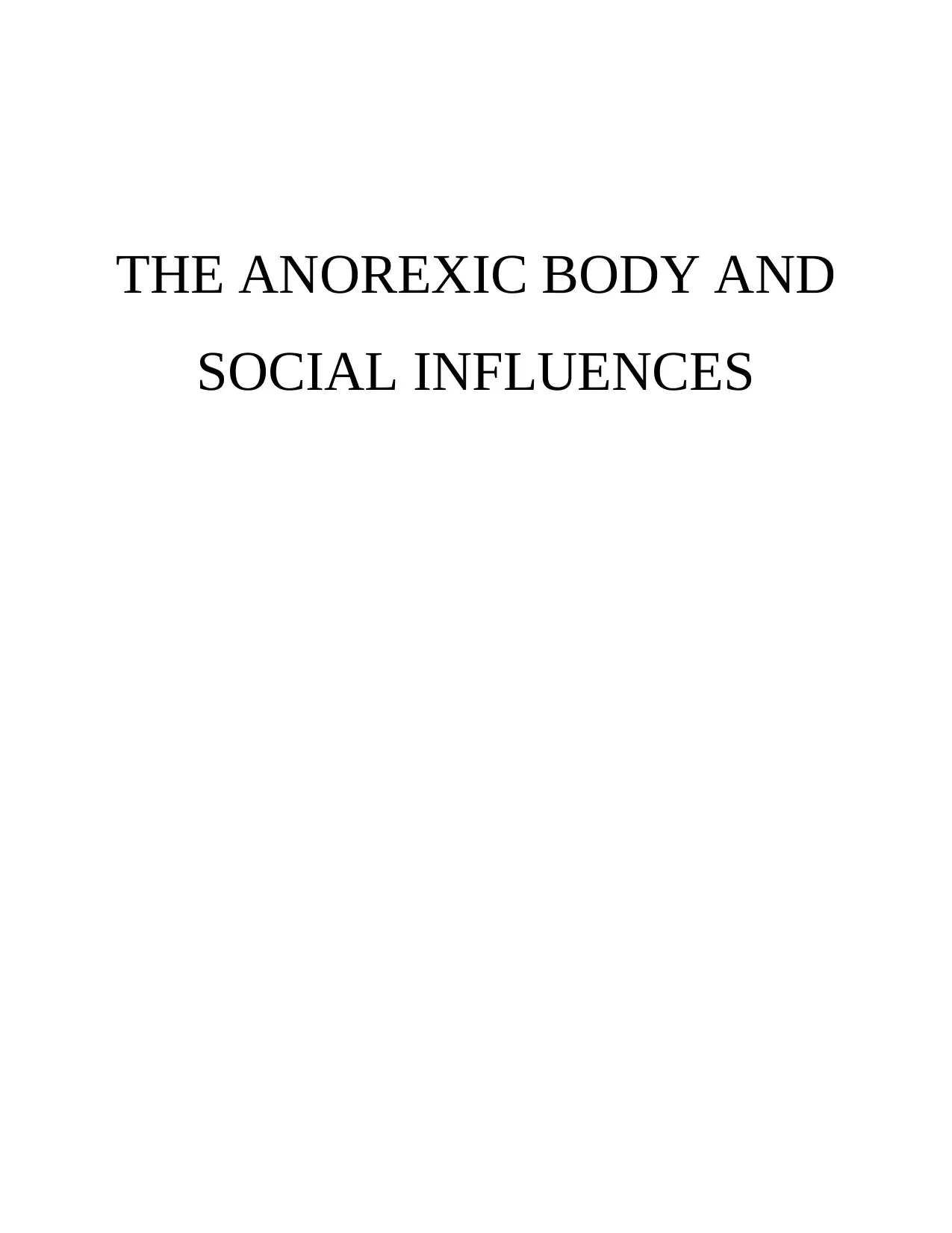
THE ANOREXIC BODY AND
SOCIAL INFLUENCES
SOCIAL INFLUENCES

Paraphrase This Document
Need a fresh take? Get an instant paraphrase of this document with our AI Paraphraser
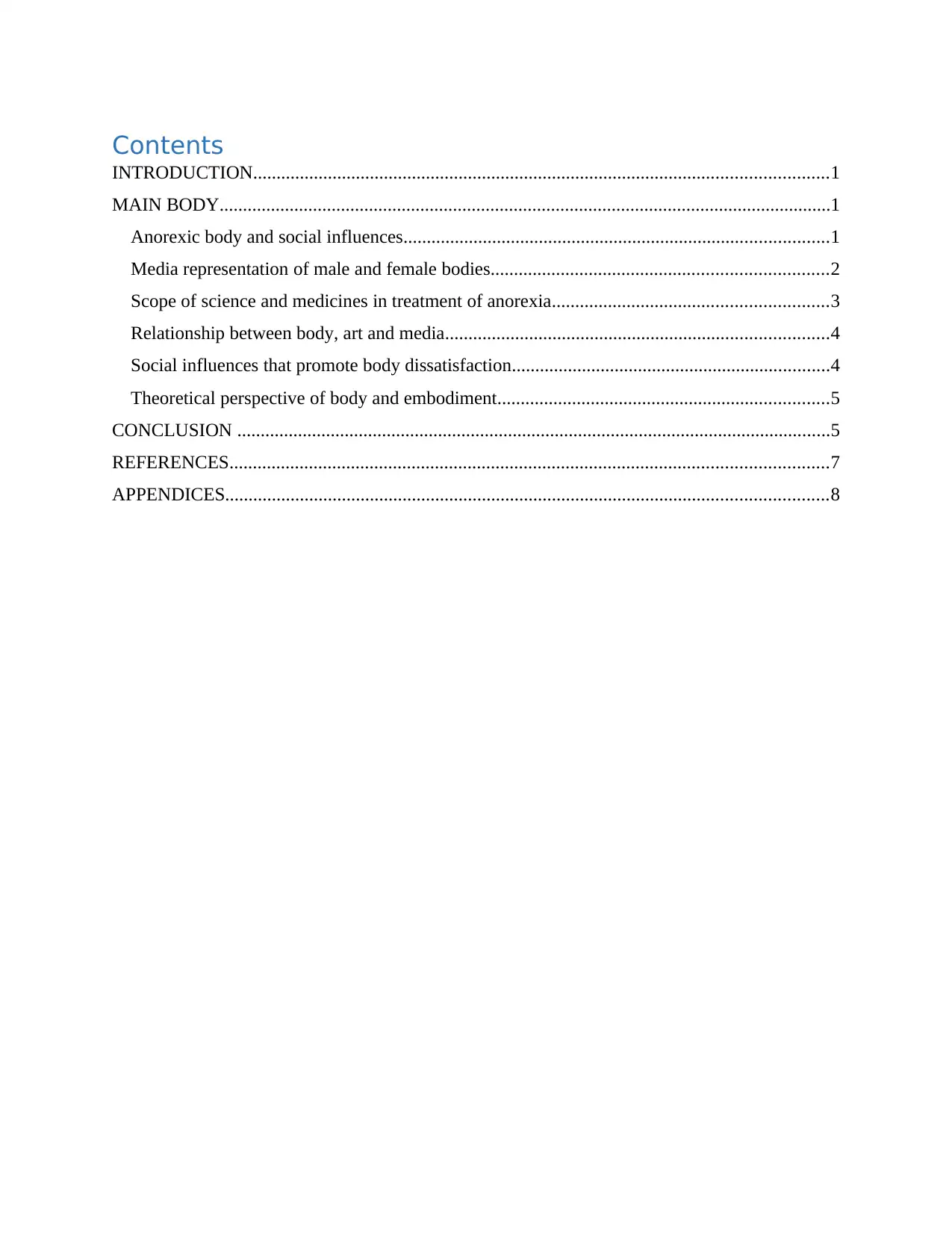
Contents
INTRODUCTION...........................................................................................................................1
MAIN BODY...................................................................................................................................1
Anorexic body and social influences...........................................................................................1
Media representation of male and female bodies........................................................................2
Scope of science and medicines in treatment of anorexia...........................................................3
Relationship between body, art and media..................................................................................4
Social influences that promote body dissatisfaction....................................................................4
Theoretical perspective of body and embodiment.......................................................................5
CONCLUSION ...............................................................................................................................5
REFERENCES................................................................................................................................7
APPENDICES.................................................................................................................................8
INTRODUCTION...........................................................................................................................1
MAIN BODY...................................................................................................................................1
Anorexic body and social influences...........................................................................................1
Media representation of male and female bodies........................................................................2
Scope of science and medicines in treatment of anorexia...........................................................3
Relationship between body, art and media..................................................................................4
Social influences that promote body dissatisfaction....................................................................4
Theoretical perspective of body and embodiment.......................................................................5
CONCLUSION ...............................................................................................................................5
REFERENCES................................................................................................................................7
APPENDICES.................................................................................................................................8

⊘ This is a preview!⊘
Do you want full access?
Subscribe today to unlock all pages.

Trusted by 1+ million students worldwide
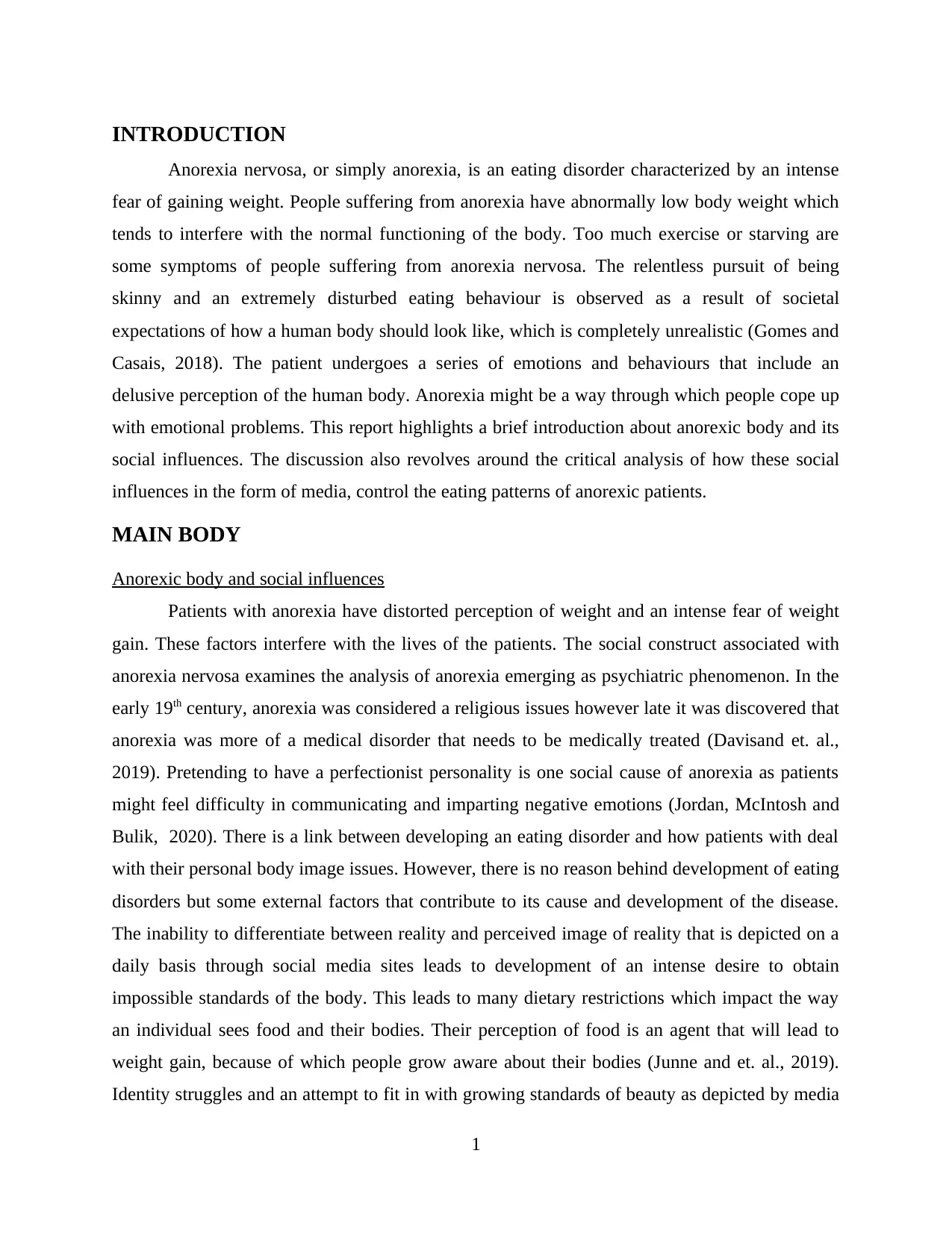
INTRODUCTION
Anorexia nervosa, or simply anorexia, is an eating disorder characterized by an intense
fear of gaining weight. People suffering from anorexia have abnormally low body weight which
tends to interfere with the normal functioning of the body. Too much exercise or starving are
some symptoms of people suffering from anorexia nervosa. The relentless pursuit of being
skinny and an extremely disturbed eating behaviour is observed as a result of societal
expectations of how a human body should look like, which is completely unrealistic (Gomes and
Casais, 2018). The patient undergoes a series of emotions and behaviours that include an
delusive perception of the human body. Anorexia might be a way through which people cope up
with emotional problems. This report highlights a brief introduction about anorexic body and its
social influences. The discussion also revolves around the critical analysis of how these social
influences in the form of media, control the eating patterns of anorexic patients.
MAIN BODY
Anorexic body and social influences
Patients with anorexia have distorted perception of weight and an intense fear of weight
gain. These factors interfere with the lives of the patients. The social construct associated with
anorexia nervosa examines the analysis of anorexia emerging as psychiatric phenomenon. In the
early 19th century, anorexia was considered a religious issues however late it was discovered that
anorexia was more of a medical disorder that needs to be medically treated (Davisand et. al.,
2019). Pretending to have a perfectionist personality is one social cause of anorexia as patients
might feel difficulty in communicating and imparting negative emotions (Jordan, McIntosh and
Bulik, 2020). There is a link between developing an eating disorder and how patients with deal
with their personal body image issues. However, there is no reason behind development of eating
disorders but some external factors that contribute to its cause and development of the disease.
The inability to differentiate between reality and perceived image of reality that is depicted on a
daily basis through social media sites leads to development of an intense desire to obtain
impossible standards of the body. This leads to many dietary restrictions which impact the way
an individual sees food and their bodies. Their perception of food is an agent that will lead to
weight gain, because of which people grow aware about their bodies (Junne and et. al., 2019).
Identity struggles and an attempt to fit in with growing standards of beauty as depicted by media
1
Anorexia nervosa, or simply anorexia, is an eating disorder characterized by an intense
fear of gaining weight. People suffering from anorexia have abnormally low body weight which
tends to interfere with the normal functioning of the body. Too much exercise or starving are
some symptoms of people suffering from anorexia nervosa. The relentless pursuit of being
skinny and an extremely disturbed eating behaviour is observed as a result of societal
expectations of how a human body should look like, which is completely unrealistic (Gomes and
Casais, 2018). The patient undergoes a series of emotions and behaviours that include an
delusive perception of the human body. Anorexia might be a way through which people cope up
with emotional problems. This report highlights a brief introduction about anorexic body and its
social influences. The discussion also revolves around the critical analysis of how these social
influences in the form of media, control the eating patterns of anorexic patients.
MAIN BODY
Anorexic body and social influences
Patients with anorexia have distorted perception of weight and an intense fear of weight
gain. These factors interfere with the lives of the patients. The social construct associated with
anorexia nervosa examines the analysis of anorexia emerging as psychiatric phenomenon. In the
early 19th century, anorexia was considered a religious issues however late it was discovered that
anorexia was more of a medical disorder that needs to be medically treated (Davisand et. al.,
2019). Pretending to have a perfectionist personality is one social cause of anorexia as patients
might feel difficulty in communicating and imparting negative emotions (Jordan, McIntosh and
Bulik, 2020). There is a link between developing an eating disorder and how patients with deal
with their personal body image issues. However, there is no reason behind development of eating
disorders but some external factors that contribute to its cause and development of the disease.
The inability to differentiate between reality and perceived image of reality that is depicted on a
daily basis through social media sites leads to development of an intense desire to obtain
impossible standards of the body. This leads to many dietary restrictions which impact the way
an individual sees food and their bodies. Their perception of food is an agent that will lead to
weight gain, because of which people grow aware about their bodies (Junne and et. al., 2019).
Identity struggles and an attempt to fit in with growing standards of beauty as depicted by media
1
Paraphrase This Document
Need a fresh take? Get an instant paraphrase of this document with our AI Paraphraser
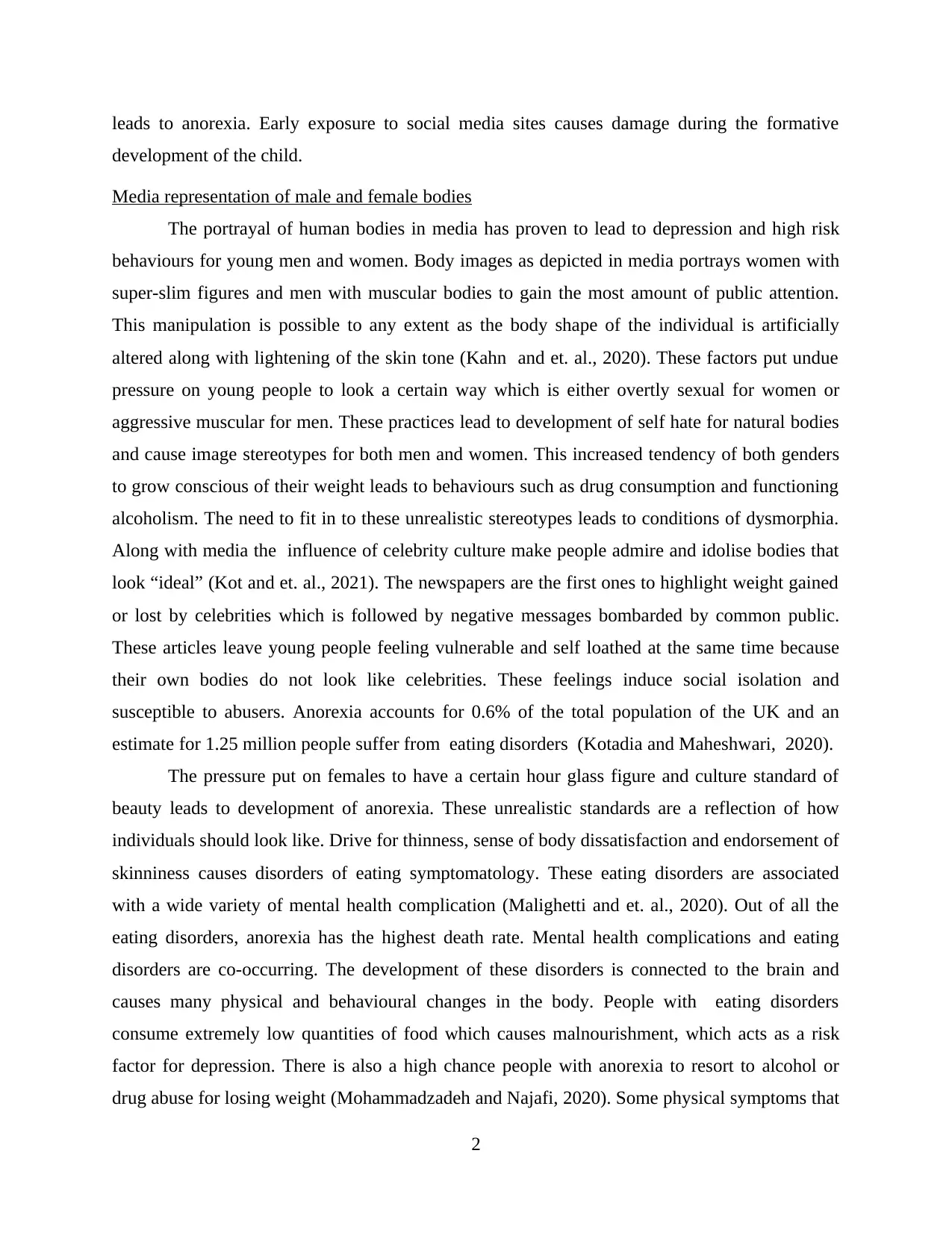
leads to anorexia. Early exposure to social media sites causes damage during the formative
development of the child.
Media representation of male and female bodies
The portrayal of human bodies in media has proven to lead to depression and high risk
behaviours for young men and women. Body images as depicted in media portrays women with
super-slim figures and men with muscular bodies to gain the most amount of public attention.
This manipulation is possible to any extent as the body shape of the individual is artificially
altered along with lightening of the skin tone (Kahn and et. al., 2020). These factors put undue
pressure on young people to look a certain way which is either overtly sexual for women or
aggressive muscular for men. These practices lead to development of self hate for natural bodies
and cause image stereotypes for both men and women. This increased tendency of both genders
to grow conscious of their weight leads to behaviours such as drug consumption and functioning
alcoholism. The need to fit in to these unrealistic stereotypes leads to conditions of dysmorphia.
Along with media the influence of celebrity culture make people admire and idolise bodies that
look “ideal” (Kot and et. al., 2021). The newspapers are the first ones to highlight weight gained
or lost by celebrities which is followed by negative messages bombarded by common public.
These articles leave young people feeling vulnerable and self loathed at the same time because
their own bodies do not look like celebrities. These feelings induce social isolation and
susceptible to abusers. Anorexia accounts for 0.6% of the total population of the UK and an
estimate for 1.25 million people suffer from eating disorders (Kotadia and Maheshwari, 2020).
The pressure put on females to have a certain hour glass figure and culture standard of
beauty leads to development of anorexia. These unrealistic standards are a reflection of how
individuals should look like. Drive for thinness, sense of body dissatisfaction and endorsement of
skinniness causes disorders of eating symptomatology. These eating disorders are associated
with a wide variety of mental health complication (Malighetti and et. al., 2020). Out of all the
eating disorders, anorexia has the highest death rate. Mental health complications and eating
disorders are co-occurring. The development of these disorders is connected to the brain and
causes many physical and behavioural changes in the body. People with eating disorders
consume extremely low quantities of food which causes malnourishment, which acts as a risk
factor for depression. There is also a high chance people with anorexia to resort to alcohol or
drug abuse for losing weight (Mohammadzadeh and Najafi, 2020). Some physical symptoms that
2
development of the child.
Media representation of male and female bodies
The portrayal of human bodies in media has proven to lead to depression and high risk
behaviours for young men and women. Body images as depicted in media portrays women with
super-slim figures and men with muscular bodies to gain the most amount of public attention.
This manipulation is possible to any extent as the body shape of the individual is artificially
altered along with lightening of the skin tone (Kahn and et. al., 2020). These factors put undue
pressure on young people to look a certain way which is either overtly sexual for women or
aggressive muscular for men. These practices lead to development of self hate for natural bodies
and cause image stereotypes for both men and women. This increased tendency of both genders
to grow conscious of their weight leads to behaviours such as drug consumption and functioning
alcoholism. The need to fit in to these unrealistic stereotypes leads to conditions of dysmorphia.
Along with media the influence of celebrity culture make people admire and idolise bodies that
look “ideal” (Kot and et. al., 2021). The newspapers are the first ones to highlight weight gained
or lost by celebrities which is followed by negative messages bombarded by common public.
These articles leave young people feeling vulnerable and self loathed at the same time because
their own bodies do not look like celebrities. These feelings induce social isolation and
susceptible to abusers. Anorexia accounts for 0.6% of the total population of the UK and an
estimate for 1.25 million people suffer from eating disorders (Kotadia and Maheshwari, 2020).
The pressure put on females to have a certain hour glass figure and culture standard of
beauty leads to development of anorexia. These unrealistic standards are a reflection of how
individuals should look like. Drive for thinness, sense of body dissatisfaction and endorsement of
skinniness causes disorders of eating symptomatology. These eating disorders are associated
with a wide variety of mental health complication (Malighetti and et. al., 2020). Out of all the
eating disorders, anorexia has the highest death rate. Mental health complications and eating
disorders are co-occurring. The development of these disorders is connected to the brain and
causes many physical and behavioural changes in the body. People with eating disorders
consume extremely low quantities of food which causes malnourishment, which acts as a risk
factor for depression. There is also a high chance people with anorexia to resort to alcohol or
drug abuse for losing weight (Mohammadzadeh and Najafi, 2020). Some physical symptoms that
2
are experienced by patients with restricted diet include feeling cold, poor levels of concentration
and development of chronic health conditions (Wong, Dirghangi and Hart, 2019). There is a
possibility of emergence of hormonal problems as body produces these hormones from food.
Some of the common hormonal problems caused by anorexia include hypothyroidism, abnormal
menstruation, diabetes and osteoporosis. These disorders worsen the presence of other medical
conditions and make people starve to death at times. Therefore, it is extremely important to
acknowledge the presence of anorexia and opt for the right treatment to help the body recover
from the struggles (Mundt, 2020).
Scope of science and medicines in treatment of anorexia
Proper treatment for an eating disorder as dangerous as anorexia is extremely important.
In older times, due to lack of awareness about this disease, there were not many treatment
methods available that could treat this deadly disorder. However, in recent times, there have been
many advancements in the field of medicine that have helped patients recover such as talk
therapy or administration of medications (Kopala‐Sibley and Zuroff, 2020). There are various
ways through which this disorder can be diagnosed such as by physical examination,
measurement of BMI, complete blood count (CBC), psychological evaluation and x-rays to
check bone density, heart irregularities etc. Treatment methods for anorexia include combined
efforts of doctors and mental health professionals (Newman, 2020). Educating patients about
nutrition and ongoing psychotherapy has proven to be really effective in treating patients. The
primary aim of treatment is restore the healthy weight of the patient which can initial require the
use of feeding tubes which is followed by working on behavioural strategies of the patient to
change their perception about their own bodies. Restoring regular patterns of eating and
appropriate information about maintaining a healthy. Medical attention along with
psychotherapy is an evidence based treatment for teenagers with anorexia. Family based therapy
and individual therapy can help young people develop a healthy relationship with food and
enable them to restore their healthy weight. Changing the distorted beliefs of patients by
supporting behaviours that promote weight gain in a healthy way. A combination of
antidepressants and other psychiatric medications can help in treating mental health issues
associated with eating disorders (Pehlivanturk-Kizilkan and et. al., 2021).
3
and development of chronic health conditions (Wong, Dirghangi and Hart, 2019). There is a
possibility of emergence of hormonal problems as body produces these hormones from food.
Some of the common hormonal problems caused by anorexia include hypothyroidism, abnormal
menstruation, diabetes and osteoporosis. These disorders worsen the presence of other medical
conditions and make people starve to death at times. Therefore, it is extremely important to
acknowledge the presence of anorexia and opt for the right treatment to help the body recover
from the struggles (Mundt, 2020).
Scope of science and medicines in treatment of anorexia
Proper treatment for an eating disorder as dangerous as anorexia is extremely important.
In older times, due to lack of awareness about this disease, there were not many treatment
methods available that could treat this deadly disorder. However, in recent times, there have been
many advancements in the field of medicine that have helped patients recover such as talk
therapy or administration of medications (Kopala‐Sibley and Zuroff, 2020). There are various
ways through which this disorder can be diagnosed such as by physical examination,
measurement of BMI, complete blood count (CBC), psychological evaluation and x-rays to
check bone density, heart irregularities etc. Treatment methods for anorexia include combined
efforts of doctors and mental health professionals (Newman, 2020). Educating patients about
nutrition and ongoing psychotherapy has proven to be really effective in treating patients. The
primary aim of treatment is restore the healthy weight of the patient which can initial require the
use of feeding tubes which is followed by working on behavioural strategies of the patient to
change their perception about their own bodies. Restoring regular patterns of eating and
appropriate information about maintaining a healthy. Medical attention along with
psychotherapy is an evidence based treatment for teenagers with anorexia. Family based therapy
and individual therapy can help young people develop a healthy relationship with food and
enable them to restore their healthy weight. Changing the distorted beliefs of patients by
supporting behaviours that promote weight gain in a healthy way. A combination of
antidepressants and other psychiatric medications can help in treating mental health issues
associated with eating disorders (Pehlivanturk-Kizilkan and et. al., 2021).
3
⊘ This is a preview!⊘
Do you want full access?
Subscribe today to unlock all pages.
Trusted by 1+ million students worldwide
Relationship between body, art and media
The human body is involved in the functioning of basic life processes that are essential
for survival. However, due to these unrealistic expectation of beauty and body standards, people
tend to alter their bodies, clothes to fit in with the expectations of society. This causes more harm
than good as to hide insecurities about oneself individuals can resort to extreme measures such as
plastic surgeries which causes more harm than good. Body art is generally associated with
problems of gender identities however under the influence of mainstream media people tend to
opt for cosmetic surgeries, tattooing etc. which can sometimes prove to be harmful and can be
related with body negative image about oneself (Ramírez-Cifuentes and et. al., 2021). This
negative perception about human bodies give rise to eating disorders and disturb the natural
functioning of the body which also acts as a site for expressing identities. Therefore, respecting
natural human bodies and embracing flaws, instead of editing them out of pictures to create a
sense of perfectionism which is a hoax. Expressing identities of oneself to enhance their fanciful
side and develop new art concepts. For many individuals, body is a temple for expressing their
creative side which enables them to develop a healthy relationship with their own self (Yoon,
Kleinman, Mertz and Brannick, 2019).
Social influences that promote body dissatisfaction
The concept of body as a result of impact of social influences is to possess a flawless and
thin bodies. Mainstream media focuses on having a perfect body and represents it as the only
form which is desirable (Shilton and et. al., 2020). Failing to comply with these body standards
leads to developing an eating disorder as anorexia. These influences can be celebrities, models,
or reality stars that are perceived as pleasant, successful and confident only because of their
bodies. This conception of having an ideal body and being successful is more focused on
women. In order to achieve these so called highly desirable bodies women opt for extreme diets,
use of emetics and laxatives and other harmful behaviours which have a negative impact on the
overall health. The effect of social influences is triggered by the media, social media
applications, verbal comment etc. Therefore, it is crucial to disseminate the idealization of
extremely thin bodies and developing a healthy relationship towards natural bodies should be
promoted. Advertising of unattainable bodies should be prevented as it acts as a triggering
symptom of eating disorders (Stern, 2018). The influence of peers and family is also important
to shatter these unrealistic body expectations. Young men and women should be assessed
4
The human body is involved in the functioning of basic life processes that are essential
for survival. However, due to these unrealistic expectation of beauty and body standards, people
tend to alter their bodies, clothes to fit in with the expectations of society. This causes more harm
than good as to hide insecurities about oneself individuals can resort to extreme measures such as
plastic surgeries which causes more harm than good. Body art is generally associated with
problems of gender identities however under the influence of mainstream media people tend to
opt for cosmetic surgeries, tattooing etc. which can sometimes prove to be harmful and can be
related with body negative image about oneself (Ramírez-Cifuentes and et. al., 2021). This
negative perception about human bodies give rise to eating disorders and disturb the natural
functioning of the body which also acts as a site for expressing identities. Therefore, respecting
natural human bodies and embracing flaws, instead of editing them out of pictures to create a
sense of perfectionism which is a hoax. Expressing identities of oneself to enhance their fanciful
side and develop new art concepts. For many individuals, body is a temple for expressing their
creative side which enables them to develop a healthy relationship with their own self (Yoon,
Kleinman, Mertz and Brannick, 2019).
Social influences that promote body dissatisfaction
The concept of body as a result of impact of social influences is to possess a flawless and
thin bodies. Mainstream media focuses on having a perfect body and represents it as the only
form which is desirable (Shilton and et. al., 2020). Failing to comply with these body standards
leads to developing an eating disorder as anorexia. These influences can be celebrities, models,
or reality stars that are perceived as pleasant, successful and confident only because of their
bodies. This conception of having an ideal body and being successful is more focused on
women. In order to achieve these so called highly desirable bodies women opt for extreme diets,
use of emetics and laxatives and other harmful behaviours which have a negative impact on the
overall health. The effect of social influences is triggered by the media, social media
applications, verbal comment etc. Therefore, it is crucial to disseminate the idealization of
extremely thin bodies and developing a healthy relationship towards natural bodies should be
promoted. Advertising of unattainable bodies should be prevented as it acts as a triggering
symptom of eating disorders (Stern, 2018). The influence of peers and family is also important
to shatter these unrealistic body expectations. Young men and women should be assessed
4
Paraphrase This Document
Need a fresh take? Get an instant paraphrase of this document with our AI Paraphraser
regularly for low self-esteem and the desire to be extremely thin. As much as the media
advertises unattainable bodies, if the focus is shifted towards promotion of self love, the feelings
of self- loath and body dissatisfaction can be healed (Ritschel and Sheppard, 2018).
Theoretical perspective of body and embodiment
Embodiment is considered as a cognitive perspective that helps in delivery of cognitive
abilities based on physical bodies and the functioning of human brain to be able to manage body.
The theory of embodiment states that bodily experiences of an individual help in emotional
processing of thoughts and feelings that can impact the functioning of the body. In pyschology, it
lays emphasis on the experiences of an individual and their relation with subjectivity. Some of
the various philosophical approaches to the human body include, empiricism, idealism and
existentialism (Westermair and et. al., 2021). These theories bring out the behaviour, learning
and development of the cognitive functions that are based on the human body or body's
interactions with external stimuli. The sense of cultural acquisition and perception reflects on the
working of these interactive processes. Another theory is called the body theory which reflects
upon the analysis of the conceptions of human body based on real-life experiences. This theory is
one of the traditional theories of personal identity. The distinguished notion of mind and the
body is said to have emerged out of intellectual and spiritual history of Buddhism. There are
three different types of body theories- 1: Freud's “bounded theory”, which states the concept of
body through the impression of a “bounded body”. 2: Michel Foucault's theory of body which
focuses on perception of body as a site of discipline and control. 3: Healthism, is another theory
of the body whose approaches are more focused on health and diseases in reference to that of the
individual (Yoshida and et. al., 2022).
CONCLUSION
From the above report it can be concluded that a healthy body image is important to help
in development of a self-esteem in younger generation. On the other hand, body dissatisfaction is
associated with low self confidence which leads to negative self talk and mood swings. The role
of mainstream media is extremely crucial in making or breaking the concept of idealization of
skinny or think bodies as it leads to development of eating disorders such as anorexia to an
extent where it can be fatal. Out of all the factors influencing body images in teenagers, culture,
and family attitudes play an extremely crucial role in whether young generation will accept or
5
advertises unattainable bodies, if the focus is shifted towards promotion of self love, the feelings
of self- loath and body dissatisfaction can be healed (Ritschel and Sheppard, 2018).
Theoretical perspective of body and embodiment
Embodiment is considered as a cognitive perspective that helps in delivery of cognitive
abilities based on physical bodies and the functioning of human brain to be able to manage body.
The theory of embodiment states that bodily experiences of an individual help in emotional
processing of thoughts and feelings that can impact the functioning of the body. In pyschology, it
lays emphasis on the experiences of an individual and their relation with subjectivity. Some of
the various philosophical approaches to the human body include, empiricism, idealism and
existentialism (Westermair and et. al., 2021). These theories bring out the behaviour, learning
and development of the cognitive functions that are based on the human body or body's
interactions with external stimuli. The sense of cultural acquisition and perception reflects on the
working of these interactive processes. Another theory is called the body theory which reflects
upon the analysis of the conceptions of human body based on real-life experiences. This theory is
one of the traditional theories of personal identity. The distinguished notion of mind and the
body is said to have emerged out of intellectual and spiritual history of Buddhism. There are
three different types of body theories- 1: Freud's “bounded theory”, which states the concept of
body through the impression of a “bounded body”. 2: Michel Foucault's theory of body which
focuses on perception of body as a site of discipline and control. 3: Healthism, is another theory
of the body whose approaches are more focused on health and diseases in reference to that of the
individual (Yoshida and et. al., 2022).
CONCLUSION
From the above report it can be concluded that a healthy body image is important to help
in development of a self-esteem in younger generation. On the other hand, body dissatisfaction is
associated with low self confidence which leads to negative self talk and mood swings. The role
of mainstream media is extremely crucial in making or breaking the concept of idealization of
skinny or think bodies as it leads to development of eating disorders such as anorexia to an
extent where it can be fatal. Out of all the factors influencing body images in teenagers, culture,
and family attitudes play an extremely crucial role in whether young generation will accept or
5
reject their own body. Proper understanding of the negative effect of culture and media upon
young people can help in shedding light on the root causes of negative body image issues and
how these issues can be acknowledged.
6
young people can help in shedding light on the root causes of negative body image issues and
how these issues can be acknowledged.
6
⊘ This is a preview!⊘
Do you want full access?
Subscribe today to unlock all pages.
Trusted by 1+ million students worldwide
REFERENCES
Books and Journals:
Gomes, R.F. and Casais, B., 2018. Feelings generated by threat appeals in social marketing: Text
and emoji analysis of user reactions to anorexia nervosa campaigns in social
media. International Review on Public and Nonprofit Marketing, 15(4), pp.591-607.
Jordan, J., McIntosh, V.V. and Bulik, C.M., 2020. Specialist Supportive Clinical Management
for anorexia nervosa: what it is (and what it is not). Australasian Psychiatry, 28(2),
pp.156-159.
Junne, F., and et.al., 2019. The importance of body image disturbances for the outcome of
outpatient psychotherapy in patients with anorexia nervosa: Results of the ANTOP‐
study. European Eating Disorders Review, 27(1), pp.49-58.
Kahn, M., and et.al., 2020. Early changes in depression predict outcomes of inpatient adolescent
anorexia nervosa. Eating and Weight Disorders-Studies on Anorexia, Bulimia and
Obesity, 25(3), pp.777-785.
Kot, E., and et.al., 2021. Self‐disgust and disgust sensitivity are increased in anorexia nervosa
inpatients, but only self‐disgust mediates between comorbid and core
psychopathology. European Eating Disorders Review, 29(6), pp.879-892.
Kotadia, H. and Maheshwari, A., 2020. Anorexia nervosa in a preadolescent male. Journal of
Indian Association for Child & Adolescent Mental Health, 16(4).
Malighetti, C., and et.al., 2020. Manipulating body size distortions and negative body-related
memories in patients with Anorexia Nervosa: A virtual reality-based pilot study. Annual
Review of CyberTherapy and Telemedicine.
Mundt, A.P., 2020. Commentary on “Phenomenology of Corporeality (and Spatiality) in
Anorexia Nervosa with a Reference to the Problem of Its Temporality”. Time and Body:
Phenomenological and Psychopathological Approaches, p.282.
Newman, V., 2020. Co-Occurring Eating Disorders and Orthorexia Nervosa. In Adolescent
Nutrition (pp. 617-628). Springer, Cham.
Pehlivanturk-Kizilkan, M., and et.al., 2021. 93. Predictors of Bone Mineral Density in
Adolescents With Atypical Anorexia Nervosa. Journal of Adolescent Health, 68(2),
pp.S49-S50.
Ramírez-Cifuentes, D., and et.al., 2021. Correction: Characterization of Anorexia Nervosa on
Social Media: Textual, Visual, Relational, Behavioral, and Demographical
Analysis. Journal of Medical Internet Research, 23(10), p.e33447.
Shilton, T., and et.al., 2020. A retrospective case series of electroconvulsive therapy in the
management of comorbid depression and anorexia nervosa. International Journal of
Eating Disorders, 53(2), pp.210-218.
Stern, J.M., 2018. Transcultural aspects of eating disorders and body image disturbance. Nordic
Journal of Psychiatry, 72(sup1), pp.S23-S26.
Westermair, A.L., and et.al., 2021. Palliative psychiatry for severe and enduring anorexia
nervosa includes but goes beyond harm reduction. The American Journal of
Bioethics, 21(7), pp.60-62.
Yoshida, K., and et.al., 2022. Candida brain abscesses in a patient with anorexia nervosa
receiving total parenteral nutrition. Clinical Neurology and Neurosurgery, 212,
p.107058.
7
Books and Journals:
Gomes, R.F. and Casais, B., 2018. Feelings generated by threat appeals in social marketing: Text
and emoji analysis of user reactions to anorexia nervosa campaigns in social
media. International Review on Public and Nonprofit Marketing, 15(4), pp.591-607.
Jordan, J., McIntosh, V.V. and Bulik, C.M., 2020. Specialist Supportive Clinical Management
for anorexia nervosa: what it is (and what it is not). Australasian Psychiatry, 28(2),
pp.156-159.
Junne, F., and et.al., 2019. The importance of body image disturbances for the outcome of
outpatient psychotherapy in patients with anorexia nervosa: Results of the ANTOP‐
study. European Eating Disorders Review, 27(1), pp.49-58.
Kahn, M., and et.al., 2020. Early changes in depression predict outcomes of inpatient adolescent
anorexia nervosa. Eating and Weight Disorders-Studies on Anorexia, Bulimia and
Obesity, 25(3), pp.777-785.
Kot, E., and et.al., 2021. Self‐disgust and disgust sensitivity are increased in anorexia nervosa
inpatients, but only self‐disgust mediates between comorbid and core
psychopathology. European Eating Disorders Review, 29(6), pp.879-892.
Kotadia, H. and Maheshwari, A., 2020. Anorexia nervosa in a preadolescent male. Journal of
Indian Association for Child & Adolescent Mental Health, 16(4).
Malighetti, C., and et.al., 2020. Manipulating body size distortions and negative body-related
memories in patients with Anorexia Nervosa: A virtual reality-based pilot study. Annual
Review of CyberTherapy and Telemedicine.
Mundt, A.P., 2020. Commentary on “Phenomenology of Corporeality (and Spatiality) in
Anorexia Nervosa with a Reference to the Problem of Its Temporality”. Time and Body:
Phenomenological and Psychopathological Approaches, p.282.
Newman, V., 2020. Co-Occurring Eating Disorders and Orthorexia Nervosa. In Adolescent
Nutrition (pp. 617-628). Springer, Cham.
Pehlivanturk-Kizilkan, M., and et.al., 2021. 93. Predictors of Bone Mineral Density in
Adolescents With Atypical Anorexia Nervosa. Journal of Adolescent Health, 68(2),
pp.S49-S50.
Ramírez-Cifuentes, D., and et.al., 2021. Correction: Characterization of Anorexia Nervosa on
Social Media: Textual, Visual, Relational, Behavioral, and Demographical
Analysis. Journal of Medical Internet Research, 23(10), p.e33447.
Shilton, T., and et.al., 2020. A retrospective case series of electroconvulsive therapy in the
management of comorbid depression and anorexia nervosa. International Journal of
Eating Disorders, 53(2), pp.210-218.
Stern, J.M., 2018. Transcultural aspects of eating disorders and body image disturbance. Nordic
Journal of Psychiatry, 72(sup1), pp.S23-S26.
Westermair, A.L., and et.al., 2021. Palliative psychiatry for severe and enduring anorexia
nervosa includes but goes beyond harm reduction. The American Journal of
Bioethics, 21(7), pp.60-62.
Yoshida, K., and et.al., 2022. Candida brain abscesses in a patient with anorexia nervosa
receiving total parenteral nutrition. Clinical Neurology and Neurosurgery, 212,
p.107058.
7
Paraphrase This Document
Need a fresh take? Get an instant paraphrase of this document with our AI Paraphraser
Ritschel, L.A. and Sheppard, C.S., 2018. Hope and depression. The Oxford handbook of hope,
pp.209-219.
Yoon, S., Kleinman, M., Mertz, J. and Brannick, M., 2019. Is social network site usage related to
depression? A meta-analysis of Facebook–depression relations. Journal of affective
disorders, 248, pp.65-72.
Kopala‐Sibley, D.C. and Zuroff, D.C., 2020. The self and depression: Four psychological
theories and their potential neural correlates. Journal of Personality, 88(1), pp.14-30.
Wong, A.E., Dirghangi, S.R. and Hart, S.R., 2019. Self-concept clarity mediates the effects of
adverse childhood experiences on adult suicide behavior, depression, loneliness, perceived
stress, and life distress. Self and Identity, 18(3), pp.247-266.
Davisand et. al., 2019. Examining pathways between bully victimization, depression, & school
belonging among early adolescents. Journal of Child and Family Studies, 28(9), pp.2365-
2378.
Mohammadzadeh, A. and Najafi, M., 2020. The comparison of death anxiety, obsession, and
depression between Muslim population with positive and negative religious
coping. Journal of religion and health, 59(2), pp.1055-1064.
Online:
APPENDICES
Anorexia nervosa is a synonym of thinness and is promoted with the help of mainstream
media and fashion shows are an integral part of these fashion businesses.
High street brands make clothes in sample sizes for models to wear which requires them
to be and thinner in order to fit in these small clothes.
It is estimated that approximately 40% of these fashion models all around the world
suffer from anorexia nervosa and are consistently required to loose weight by their
agencies or other influences in the industry.
Fashion shows dictate the body sizes that rule over the minds of young men and women
forcing them to follow extreme diet to in fit in these standards of beauty.
8
pp.209-219.
Yoon, S., Kleinman, M., Mertz, J. and Brannick, M., 2019. Is social network site usage related to
depression? A meta-analysis of Facebook–depression relations. Journal of affective
disorders, 248, pp.65-72.
Kopala‐Sibley, D.C. and Zuroff, D.C., 2020. The self and depression: Four psychological
theories and their potential neural correlates. Journal of Personality, 88(1), pp.14-30.
Wong, A.E., Dirghangi, S.R. and Hart, S.R., 2019. Self-concept clarity mediates the effects of
adverse childhood experiences on adult suicide behavior, depression, loneliness, perceived
stress, and life distress. Self and Identity, 18(3), pp.247-266.
Davisand et. al., 2019. Examining pathways between bully victimization, depression, & school
belonging among early adolescents. Journal of Child and Family Studies, 28(9), pp.2365-
2378.
Mohammadzadeh, A. and Najafi, M., 2020. The comparison of death anxiety, obsession, and
depression between Muslim population with positive and negative religious
coping. Journal of religion and health, 59(2), pp.1055-1064.
Online:
APPENDICES
Anorexia nervosa is a synonym of thinness and is promoted with the help of mainstream
media and fashion shows are an integral part of these fashion businesses.
High street brands make clothes in sample sizes for models to wear which requires them
to be and thinner in order to fit in these small clothes.
It is estimated that approximately 40% of these fashion models all around the world
suffer from anorexia nervosa and are consistently required to loose weight by their
agencies or other influences in the industry.
Fashion shows dictate the body sizes that rule over the minds of young men and women
forcing them to follow extreme diet to in fit in these standards of beauty.
8

1 out of 11


Related Documents


Your All-in-One AI-Powered Toolkit for Academic Success.
+13062052269
info@desklib.com
Available 24*7 on WhatsApp / Email
![[object Object]](/_next/static/media/star-bottom.7253800d.svg)
Unlock your academic potential
Copyright © 2020–2026 A2Z Services. All Rights Reserved. Developed and managed by ZUCOL.