Scientific Literature Review: Antarctic Circumpolar Current Analysis
VerifiedAdded on 2023/01/20
|26
|5185
|75
Report
AI Summary
This report provides a scientific literature review and detailed analysis of the Antarctic Circumpolar Current (ACC), the largest and strongest ocean current, encompassing the Indian, Pacific, and Atlantic Oceans. The report investigates the ACC's dynamics, formation, and effects on global climate patterns, including its role in maintaining the Antarctic ice sheet and influencing the formation of ice ages. It examines the impact of westerly winds, ozone layer depletion, and global warming on the ACC's strength and movement, and the resultant effects on the climate. The report also discusses the subtropical and Antarctic convergences and the impact of the opening of the Tasmanian Gateway. The analysis includes figures illustrating current movement and the Antarctic frozen continent, and explores the implications of ACC changes on sea levels and climate stability. Overall, the report highlights the critical role of the ACC in the global climate system and the potential consequences of its alteration due to human activities.
Antarctica Circumpolar Current 1
ANTARCTIC CIRCUMPOLAR CURRENT
Name
Institution
ANTARCTIC CIRCUMPOLAR CURRENT
Name
Institution

Paraphrase This Document
Need a fresh take? Get an instant paraphrase of this document with our AI Paraphraser
Antarctica Circumpolar Current 2
Scientific Literature Review
An interest to know what actually is behind the continuous, directed movement of water in
oceans is so vital in understanding natural phenomenon. Therefore Ocean current is a continuous
directed movement of ocean water which is generated by several forces in water. This forces
may be as a result of moving winds, breaking waves, Coriolis effects, cabling, salinity and
temperature differences. The direction and strength of these currents is determined by factors
such as shoreline configuration, interaction with other currents and depth contours. Therefore the
ocean currents over time plays a dominant role of determine the climatic pattern of a particular
region.
Generally ocean current can be divided into two, namely; Ocean surface water currents and deep
ocean water currents. Most of the surface oceanic currents are wind driven. In the northern
hemisphere they develop clockwise spirals while in southern hemisphere anti-clockwise rotation.
Temperature and density gradient controls the deep ocean currents. Research by S.R.Rintoul in
Encyclopedia of Ocean Science shows that most of the surface Oceanic Currents are warm and
they originate near the equator. On the other hand cold water originate from near the poles.
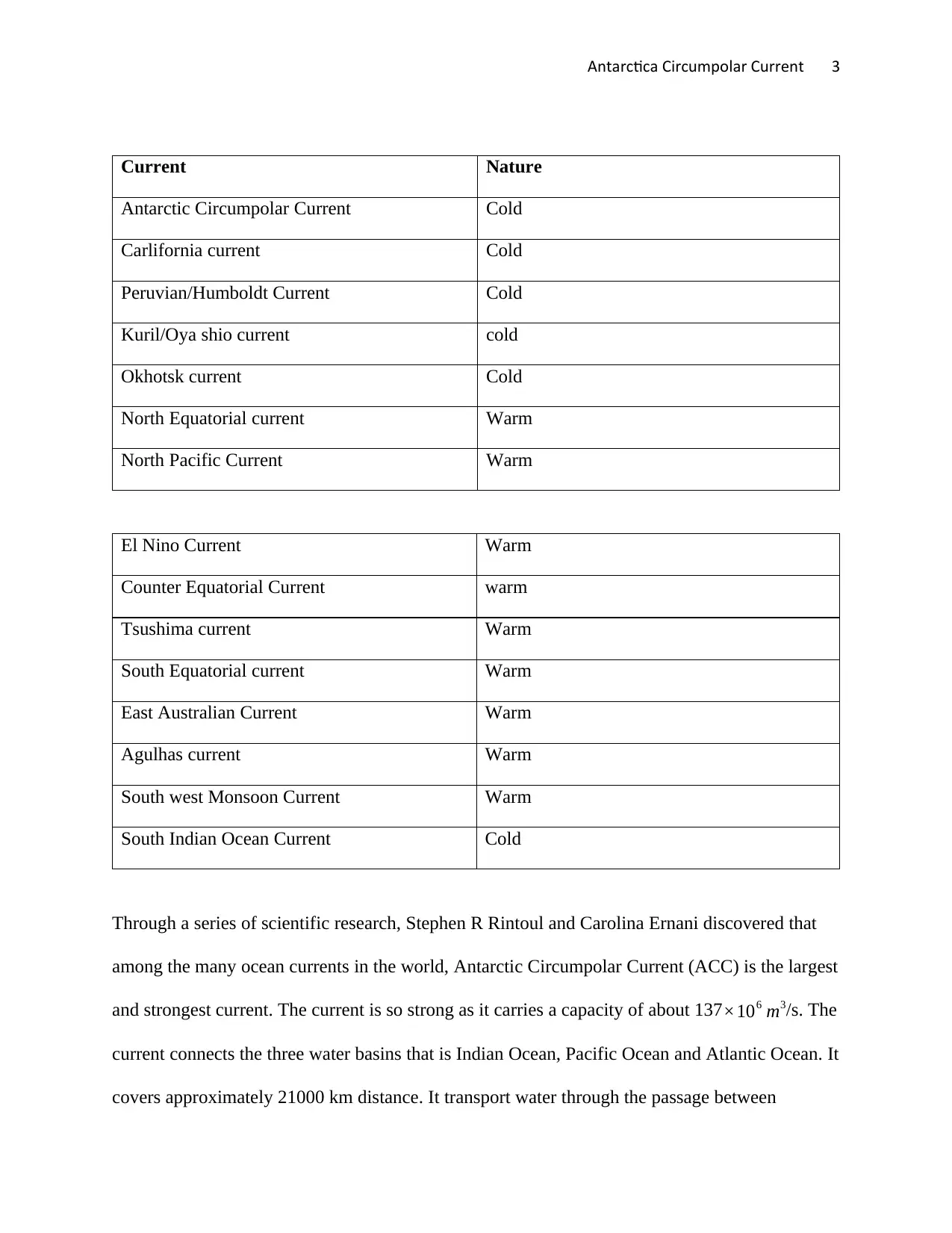
There are many Ocean currents that exist in the Oceans. They vary in direction of flow, area
under coverage and the strength. The most common Ocean currents on earth as per Alan R.
Longhurt in the book “Ecological Geography of the Sea” are shown in table 1 below. The table
comprises of the common ocean currents across the oceans of the world with their nature
described.
Scientific Literature Review
An interest to know what actually is behind the continuous, directed movement of water in
oceans is so vital in understanding natural phenomenon. Therefore Ocean current is a continuous
directed movement of ocean water which is generated by several forces in water. This forces
may be as a result of moving winds, breaking waves, Coriolis effects, cabling, salinity and
temperature differences. The direction and strength of these currents is determined by factors
such as shoreline configuration, interaction with other currents and depth contours. Therefore the
ocean currents over time plays a dominant role of determine the climatic pattern of a particular
region.
Generally ocean current can be divided into two, namely; Ocean surface water currents and deep
ocean water currents. Most of the surface oceanic currents are wind driven. In the northern
hemisphere they develop clockwise spirals while in southern hemisphere anti-clockwise rotation.
Temperature and density gradient controls the deep ocean currents. Research by S.R.Rintoul in
Encyclopedia of Ocean Science shows that most of the surface Oceanic Currents are warm and
they originate near the equator. On the other hand cold water originate from near the poles.
There are many Ocean currents that exist in the Oceans. They vary in direction of flow, area
under coverage and the strength. The most common Ocean currents on earth as per Alan R.
Longhurt in the book “Ecological Geography of the Sea” are shown in table 1 below. The table
comprises of the common ocean currents across the oceans of the world with their nature
described.
Antarctica Circumpolar Current 3
Current Nature
Antarctic Circumpolar Current Cold
Carlifornia current Cold
Peruvian/Humboldt Current Cold
Kuril/Oya shio current cold
Okhotsk current Cold
North Equatorial current Warm
North Pacific Current Warm
El Nino Current Warm
Counter Equatorial Current warm
Tsushima current Warm
South Equatorial current Warm
East Australian Current Warm
Agulhas current Warm
South west Monsoon Current Warm
South Indian Ocean Current Cold
Through a series of scientific research, Stephen R Rintoul and Carolina Ernani discovered that
among the many ocean currents in the world, Antarctic Circumpolar Current (ACC) is the largest
and strongest current. The current is so strong as it carries a capacity of about 137 ×106 m3/s. The
current connects the three water basins that is Indian Ocean, Pacific Ocean and Atlantic Ocean. It
covers approximately 21000 km distance. It transport water through the passage between
Current Nature
Antarctic Circumpolar Current Cold
Carlifornia current Cold
Peruvian/Humboldt Current Cold
Kuril/Oya shio current cold
Okhotsk current Cold
North Equatorial current Warm
North Pacific Current Warm
El Nino Current Warm
Counter Equatorial Current warm
Tsushima current Warm
South Equatorial current Warm
East Australian Current Warm
Agulhas current Warm
South west Monsoon Current Warm
South Indian Ocean Current Cold
Through a series of scientific research, Stephen R Rintoul and Carolina Ernani discovered that
among the many ocean currents in the world, Antarctic Circumpolar Current (ACC) is the largest
and strongest current. The current is so strong as it carries a capacity of about 137 ×106 m3/s. The
current connects the three water basins that is Indian Ocean, Pacific Ocean and Atlantic Ocean. It
covers approximately 21000 km distance. It transport water through the passage between
⊘ This is a preview!⊘
Do you want full access?
Subscribe today to unlock all pages.

Trusted by 1+ million students worldwide
Antarctica Circumpolar Current 4
Antarctica Peninsula and South America (Drake Passage). The detailed analysis of the Antarctic
Circumpolar Current (ACC) is covered below.
`
Question 1
Dynamic of ACC Over time Antarctic Circumpolar Current (ACC) is a very strong current
which flows within the whole world/globe. The current surrounds the continent of Antarctic ,
that’s where its name was derived. The current continues as it flows eastwards to cover t5he
southern portions of Indian , Atlantic and Pacific Oceans. ACC was first discovered by a British
astronomer by the name Edmond Halley. This happened during his survey to the above named
regions in period 1699-1700 HMS paramour expedition. His discovery was seconded by
Mariners james Cookin 1772-1775, Russian by the name Thaddeus Bellingshausen in 1819-
1821.
Pradal & Gnanadesikan (2014), ACC is one of the most rudimentary and mightiest current of
the oceans . it poses a relative speed of 20cm/s. the current has the capability to transport large
amount of water than any other current in the world. The current has a depth which ranges from
2000-4000m below the sea level while covering a width of about 2000km. The eastward flow of
ACC is strongly driven by Westerly winds. However note that the average wind speed within the
region between the latitude 41°S and 61°S ranges between 16 to 25 knots while the very strong
currents lies within the latitudes 45°S and 55°S.
Basing on historical facts, zonal variation ought to be the basis that can generally define the
current boundaries of ACC in the southern oceans. The same variation has enable classification
Antarctica Peninsula and South America (Drake Passage). The detailed analysis of the Antarctic
Circumpolar Current (ACC) is covered below.
`
Question 1
Dynamic of ACC Over time Antarctic Circumpolar Current (ACC) is a very strong current
which flows within the whole world/globe. The current surrounds the continent of Antarctic ,
that’s where its name was derived. The current continues as it flows eastwards to cover t5he
southern portions of Indian , Atlantic and Pacific Oceans. ACC was first discovered by a British
astronomer by the name Edmond Halley. This happened during his survey to the above named
regions in period 1699-1700 HMS paramour expedition. His discovery was seconded by
Mariners james Cookin 1772-1775, Russian by the name Thaddeus Bellingshausen in 1819-
1821.
Pradal & Gnanadesikan (2014), ACC is one of the most rudimentary and mightiest current of
the oceans . it poses a relative speed of 20cm/s. the current has the capability to transport large
amount of water than any other current in the world. The current has a depth which ranges from
2000-4000m below the sea level while covering a width of about 2000km. The eastward flow of
ACC is strongly driven by Westerly winds. However note that the average wind speed within the
region between the latitude 41°S and 61°S ranges between 16 to 25 knots while the very strong
currents lies within the latitudes 45°S and 55°S.
Basing on historical facts, zonal variation ought to be the basis that can generally define the
current boundaries of ACC in the southern oceans. The same variation has enable classification
Paraphrase This Document
Need a fresh take? Get an instant paraphrase of this document with our AI Paraphraser
Antarctica Circumpolar Current 5
of regions bordered with fronts. Considering the northern part of ACC we have the Subtropical
Fronts(SBF), which covers between 36°S and 47°S. Within this region the average Sea Surface
Temperature (SST) ranges from about 12°C to 8°C. Sali8nity in this region also decreases from
34.9 to 34.6. The other zone surrounding the ACC include Sub Antarctic Zone (SAZ), Polar
Frontal Zone (PFZ) in addition to Zone of Antarctic (AZ) (Small, Tomas & Bryan 2014, p.
828).
Yang, Galbraith & Palter (2014),argue that Westerly winds possess huge wind force near the
water surface. ACC current on the other hand which is approximately in geostrophic equilibrium
has its inclined layers. The layers have a constant density and the inclination is meant to balance
the height elevation of the current’s northward sea surface. Therefore the ACC come as result of
being in line with the prevailing westerly winds and the resulting geographic current. The
stronger gradient gives to emission of strong flow leading to formation of fronts.
ACC has come along with very many effects on the current climatic pattern. The increased
human activities which entirely lead to ozone layer depletion is a major threat in conjunction
with the ACC. With the depletion of the ozone layer, westerly winds carry more heat which end
up melting the snow in the Antarctica. Ozone layer depletion and greenhouse effect are the
driving force behind the increased magnitude of the Antarctic Circumpolar.
Resent research shows that the current will increase in strength and move towards the polar in
the 21st century. The effect of this prediction is that it will displace large amount of water in the
arctic polar. The proof of the prediction can be simulated by the image below.
of regions bordered with fronts. Considering the northern part of ACC we have the Subtropical
Fronts(SBF), which covers between 36°S and 47°S. Within this region the average Sea Surface
Temperature (SST) ranges from about 12°C to 8°C. Sali8nity in this region also decreases from
34.9 to 34.6. The other zone surrounding the ACC include Sub Antarctic Zone (SAZ), Polar
Frontal Zone (PFZ) in addition to Zone of Antarctic (AZ) (Small, Tomas & Bryan 2014, p.
828).
Yang, Galbraith & Palter (2014),argue that Westerly winds possess huge wind force near the
water surface. ACC current on the other hand which is approximately in geostrophic equilibrium
has its inclined layers. The layers have a constant density and the inclination is meant to balance
the height elevation of the current’s northward sea surface. Therefore the ACC come as result of
being in line with the prevailing westerly winds and the resulting geographic current. The
stronger gradient gives to emission of strong flow leading to formation of fronts.
ACC has come along with very many effects on the current climatic pattern. The increased
human activities which entirely lead to ozone layer depletion is a major threat in conjunction
with the ACC. With the depletion of the ozone layer, westerly winds carry more heat which end
up melting the snow in the Antarctica. Ozone layer depletion and greenhouse effect are the
driving force behind the increased magnitude of the Antarctic Circumpolar.
Resent research shows that the current will increase in strength and move towards the polar in
the 21st century. The effect of this prediction is that it will displace large amount of water in the
arctic polar. The proof of the prediction can be simulated by the image below.
Antarctica Circumpolar Current 6
Figure 1: Current movement towards the poles
The most recent research has shown that the southern edge of ACC as viewed by oceanographers
has clearly indicated the boundary between warm Atlantic, Indian and Pacific Oceans and
Antarctica cold waters. However further research has shown that the boundary is shifting due
adverse factors such as westerly winds and global warming.
Question 2
Formation of ice age by ACC
Figure 1: Current movement towards the poles
The most recent research has shown that the southern edge of ACC as viewed by oceanographers
has clearly indicated the boundary between warm Atlantic, Indian and Pacific Oceans and
Antarctica cold waters. However further research has shown that the boundary is shifting due
adverse factors such as westerly winds and global warming.
Question 2
Formation of ice age by ACC
⊘ This is a preview!⊘
Do you want full access?
Subscribe today to unlock all pages.
Trusted by 1+ million students worldwide
Antarctica Circumpolar Current 7
Yuan, Kaplan & Cane (2018), denotes that Antarctica is seen as frozen continent surrounded by
icy water as per the view from the satellite. ACC over time has led to very many dynamic within
the coastal oceans. The major change among many other is maintaining the Antarctica region
cool and frozen. The volume of water being carried by the ACC Averagely range between 165
million to 182 million cubic meters of water from west to east. The water temperature in the
oceans rises slowly at the beginning while it resume with a very sharp gradient. ACC therefore
contributes much to the maintaining of steady iocy temperature in the Antarctica by maintaining
the boundaries. This is the root course of formation of ice age in Antarctica. As the ocean waters
of gets cold, the ocean density increases and the water become more salty. Below is the figure
that illustrates how the Antarctic is surrounded by Ocean waters.
Figure 2: Antarctica frozen continent
Yuan, Kaplan & Cane (2018), denotes that Antarctica is seen as frozen continent surrounded by
icy water as per the view from the satellite. ACC over time has led to very many dynamic within
the coastal oceans. The major change among many other is maintaining the Antarctica region
cool and frozen. The volume of water being carried by the ACC Averagely range between 165
million to 182 million cubic meters of water from west to east. The water temperature in the
oceans rises slowly at the beginning while it resume with a very sharp gradient. ACC therefore
contributes much to the maintaining of steady iocy temperature in the Antarctica by maintaining
the boundaries. This is the root course of formation of ice age in Antarctica. As the ocean waters
of gets cold, the ocean density increases and the water become more salty. Below is the figure
that illustrates how the Antarctic is surrounded by Ocean waters.
Figure 2: Antarctica frozen continent
Paraphrase This Document
Need a fresh take? Get an instant paraphrase of this document with our AI Paraphraser
Antarctica Circumpolar Current 8
Question 3
Effects of ACC to the climate
ACC over time has impacted either positively or negatively to the global climatic patterns. ACC
has come along with very much effect on the current climatic pattern. Human activities have
increased of which some ha contributed entirely to ozone layer depletion. It is a major threat in
conjunction with the ACC. With the depletion of the ozone layer, westerly winds carry more heat
which end up melting the snow in the Antarctica. Ozone layer depletion and greenhouse effect
are the driving force behind the increased magnitude of the Antarctic Circumpolar Current.
Resent research shows that the current will increase in strength and move towards the polar in
the 21st century. The effect of this prediction is that it will displace large amount of water in the
arctic polar.
ACC which is not as well immune to change has affected the southern oceans water masses. It
has waters to be warm and fresh in the top most surface of the waterbodies of about 2000m.
Antarctic bottom water which constitutes the deepest layer within the ocean has also been
confirmed warm and fresh due to the circumpolar current of Antarctic.
The increased strength of the circumpolar Antarctic current has been evidenced with increase in
the strength of wind of increment percentage of about 40% over the past 40 years. This has
further resulted in increase in eddies that move towards the poles. The common hotspot areas
Question 3
Effects of ACC to the climate
ACC over time has impacted either positively or negatively to the global climatic patterns. ACC
has come along with very much effect on the current climatic pattern. Human activities have
increased of which some ha contributed entirely to ozone layer depletion. It is a major threat in
conjunction with the ACC. With the depletion of the ozone layer, westerly winds carry more heat
which end up melting the snow in the Antarctica. Ozone layer depletion and greenhouse effect
are the driving force behind the increased magnitude of the Antarctic Circumpolar Current.
Resent research shows that the current will increase in strength and move towards the polar in
the 21st century. The effect of this prediction is that it will displace large amount of water in the
arctic polar.
ACC which is not as well immune to change has affected the southern oceans water masses. It
has waters to be warm and fresh in the top most surface of the waterbodies of about 2000m.
Antarctic bottom water which constitutes the deepest layer within the ocean has also been
confirmed warm and fresh due to the circumpolar current of Antarctic.
The increased strength of the circumpolar Antarctic current has been evidenced with increase in
the strength of wind of increment percentage of about 40% over the past 40 years. This has
further resulted in increase in eddies that move towards the poles. The common hotspot areas
Antarctica Circumpolar Current 9
which have been adversely affected by these changes include, Kerulen Plateau, Drake Passage,
Tasmania and new Zeeland.
Based on the research done by Wolfe & Cessi (2014), they denote that Antarctic Circumpolar
Current has therefore greatly brought impact to the modern climatic paten over time. We have
observed many changes already. The question that can be generated after all this observation is
how this increased transfer of heat across the ACC will impact the rate of global sea level and the
stability of the Antarctic ice sheet. Consequently the ACC has been the main cause for the
maintained ice sheet in the Antarctic Polar Regions.
Water and heat budget
The amount of water and heat from all sources that enter the atmosphere must be equal to the
same amount of heat and water from the atmosphere to the earth. Any variation to these results
into increase in atmospheric temperature and amount of water vapour in the atmosphere. Global
water budget is natural hazard. Large amount of Water get evaporated from the Ocean which
can entirely cover the whole globe at relative water depth of about one meter. However the water
eventually condenses and fall back to the earth surface in form of rain.
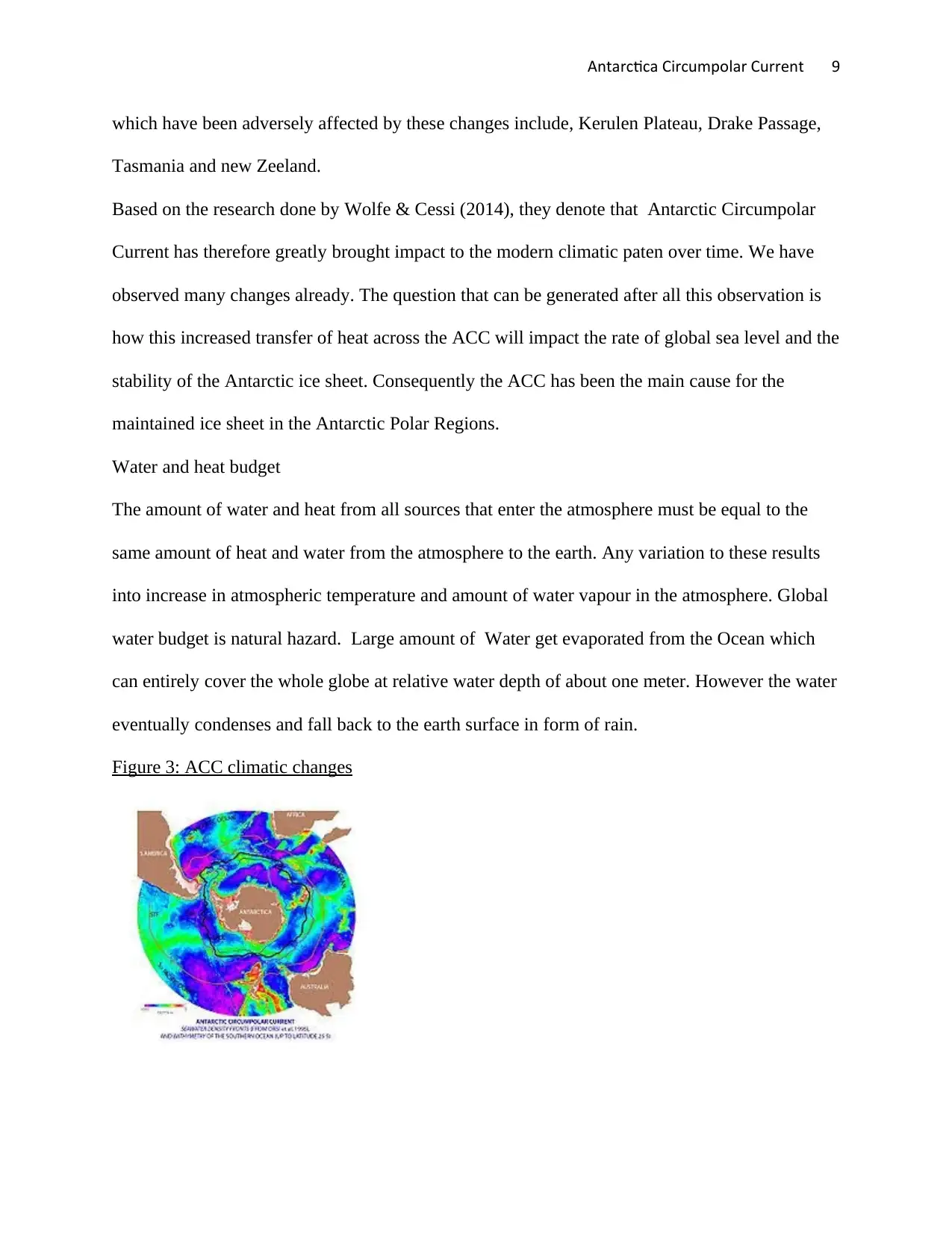
Figure 3: ACC climatic changes
which have been adversely affected by these changes include, Kerulen Plateau, Drake Passage,
Tasmania and new Zeeland.
Based on the research done by Wolfe & Cessi (2014), they denote that Antarctic Circumpolar
Current has therefore greatly brought impact to the modern climatic paten over time. We have
observed many changes already. The question that can be generated after all this observation is
how this increased transfer of heat across the ACC will impact the rate of global sea level and the
stability of the Antarctic ice sheet. Consequently the ACC has been the main cause for the
maintained ice sheet in the Antarctic Polar Regions.
Water and heat budget
The amount of water and heat from all sources that enter the atmosphere must be equal to the
same amount of heat and water from the atmosphere to the earth. Any variation to these results
into increase in atmospheric temperature and amount of water vapour in the atmosphere. Global
water budget is natural hazard. Large amount of Water get evaporated from the Ocean which
can entirely cover the whole globe at relative water depth of about one meter. However the water
eventually condenses and fall back to the earth surface in form of rain.
Figure 3: ACC climatic changes
⊘ This is a preview!⊘
Do you want full access?
Subscribe today to unlock all pages.
Trusted by 1+ million students worldwide
Antarctica Circumpolar Current 10
Part 2
Question 4
Introduction
The opening up of Tasmanian Gateway comes along with many changes. It led to the tectonic
opening up of the oceanic gateways. ACC therefore occupies this particular circumglobal
pathway in the southern oceans. Tasmanian gateway opened long time ago(33.5 million years
ago) . The onset of ACC brought about the major changes in ocean circulation. Of the changes
are discussed below.
The subtropical convergence
This is a zone found between latitudes 38°S and 42°S. this lies beneath the zero wind-stress curl.
The zone is a result of tightening up of the isotherms in the range of temperature between 15°C
and 12°C. The zone is characterized with eddies that can take altitude width up to 5° and a band
of strong mesoscale meanders. Meanders extend their strength to the south of Africa, East of
Patagonia, New Zeeland and Tasmania (Maffre 2018, pp.1209 )
Subtropical convergent Zone is evident in Indian Ocean, South Atlantic Ocean and West Pacific
Ocean. Meeting of superficial tropical water driven by ACC is the root cause for the subtropical
convergence.
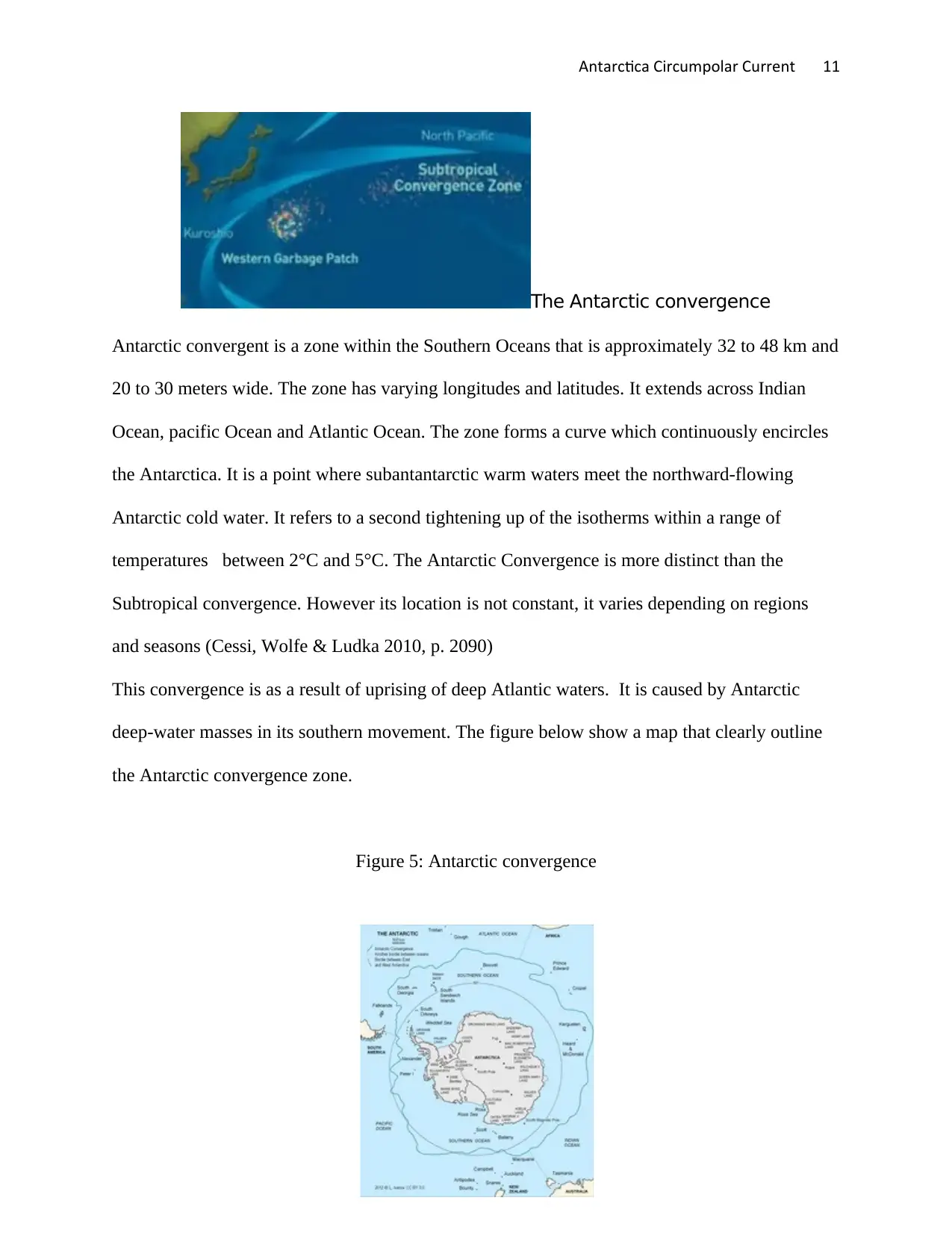
Figure 4: subtropical convergence zone
Part 2
Question 4
Introduction
The opening up of Tasmanian Gateway comes along with many changes. It led to the tectonic
opening up of the oceanic gateways. ACC therefore occupies this particular circumglobal
pathway in the southern oceans. Tasmanian gateway opened long time ago(33.5 million years
ago) . The onset of ACC brought about the major changes in ocean circulation. Of the changes
are discussed below.
The subtropical convergence
This is a zone found between latitudes 38°S and 42°S. this lies beneath the zero wind-stress curl.
The zone is a result of tightening up of the isotherms in the range of temperature between 15°C
and 12°C. The zone is characterized with eddies that can take altitude width up to 5° and a band
of strong mesoscale meanders. Meanders extend their strength to the south of Africa, East of
Patagonia, New Zeeland and Tasmania (Maffre 2018, pp.1209 )
Subtropical convergent Zone is evident in Indian Ocean, South Atlantic Ocean and West Pacific
Ocean. Meeting of superficial tropical water driven by ACC is the root cause for the subtropical
convergence.
Figure 4: subtropical convergence zone
Paraphrase This Document
Need a fresh take? Get an instant paraphrase of this document with our AI Paraphraser
Antarctica Circumpolar Current 11
The Antarctic convergence
Antarctic convergent is a zone within the Southern Oceans that is approximately 32 to 48 km and
20 to 30 meters wide. The zone has varying longitudes and latitudes. It extends across Indian
Ocean, pacific Ocean and Atlantic Ocean. The zone forms a curve which continuously encircles
the Antarctica. It is a point where subantantarctic warm waters meet the northward-flowing
Antarctic cold water. It refers to a second tightening up of the isotherms within a range of
temperatures between 2°C and 5°C. The Antarctic Convergence is more distinct than the
Subtropical convergence. However its location is not constant, it varies depending on regions
and seasons (Cessi, Wolfe & Ludka 2010, p. 2090)
This convergence is as a result of uprising of deep Atlantic waters. It is caused by Antarctic
deep-water masses in its southern movement. The figure below show a map that clearly outline
the Antarctic convergence zone.
Figure 5: Antarctic convergence
The Antarctic convergence
Antarctic convergent is a zone within the Southern Oceans that is approximately 32 to 48 km and
20 to 30 meters wide. The zone has varying longitudes and latitudes. It extends across Indian
Ocean, pacific Ocean and Atlantic Ocean. The zone forms a curve which continuously encircles
the Antarctica. It is a point where subantantarctic warm waters meet the northward-flowing
Antarctic cold water. It refers to a second tightening up of the isotherms within a range of
temperatures between 2°C and 5°C. The Antarctic Convergence is more distinct than the
Subtropical convergence. However its location is not constant, it varies depending on regions
and seasons (Cessi, Wolfe & Ludka 2010, p. 2090)
This convergence is as a result of uprising of deep Atlantic waters. It is caused by Antarctic
deep-water masses in its southern movement. The figure below show a map that clearly outline
the Antarctic convergence zone.
Figure 5: Antarctic convergence
Antarctica Circumpolar Current 12
The Antarctic divergence
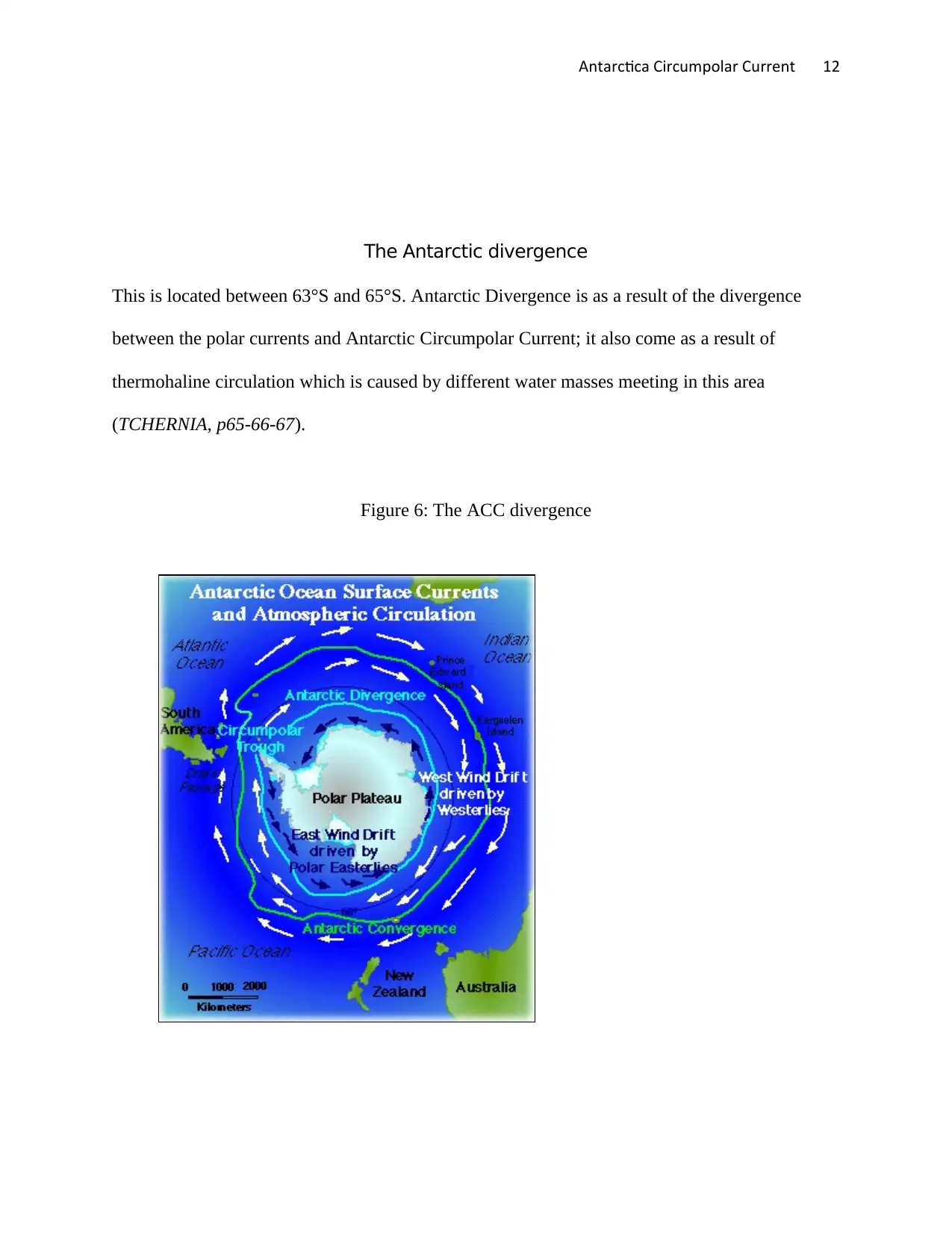
This is located between 63°S and 65°S. Antarctic Divergence is as a result of the divergence
between the polar currents and Antarctic Circumpolar Current; it also come as a result of
thermohaline circulation which is caused by different water masses meeting in this area
(TCHERNIA, p65-66-67).
Figure 6: The ACC divergence
The Antarctic divergence
This is located between 63°S and 65°S. Antarctic Divergence is as a result of the divergence
between the polar currents and Antarctic Circumpolar Current; it also come as a result of
thermohaline circulation which is caused by different water masses meeting in this area
(TCHERNIA, p65-66-67).
Figure 6: The ACC divergence
⊘ This is a preview!⊘
Do you want full access?
Subscribe today to unlock all pages.
Trusted by 1+ million students worldwide

1 out of 26


Related Documents


Your All-in-One AI-Powered Toolkit for Academic Success.
+13062052269
info@desklib.com
Available 24*7 on WhatsApp / Email
![[object Object]](/_next/static/media/star-bottom.7253800d.svg)
Unlock your academic potential
Copyright © 2020–2026 A2Z Services. All Rights Reserved. Developed and managed by ZUCOL.