Antarctica Research Challenges and Discoveries

Verified

Added on  2019/09/13

|3
|422
|406
Homework Assignment
AI Summary
This document presents a solved homework assignment focusing on research in Antarctica. It addresses the challenges faced by researchers due to increasing sea ice, the discovery of gas bubbles in ice by Claude Lorius, the unusual collaboration between French and Soviet glaciologists during the Cold War, and the average temperature difference between glacial and interglacial periods. The assignment also includes references to relevant research articles.
Document Page
Running Head: ARTICLE CRITIQUE WRITING
Article Critique writing
Name
Date
Submitted to
tabler-icon-diamond-filled.svg

Paraphrase This Document

Need a fresh take? Get an instant paraphrase of this document with our AI Paraphraser
Document Page
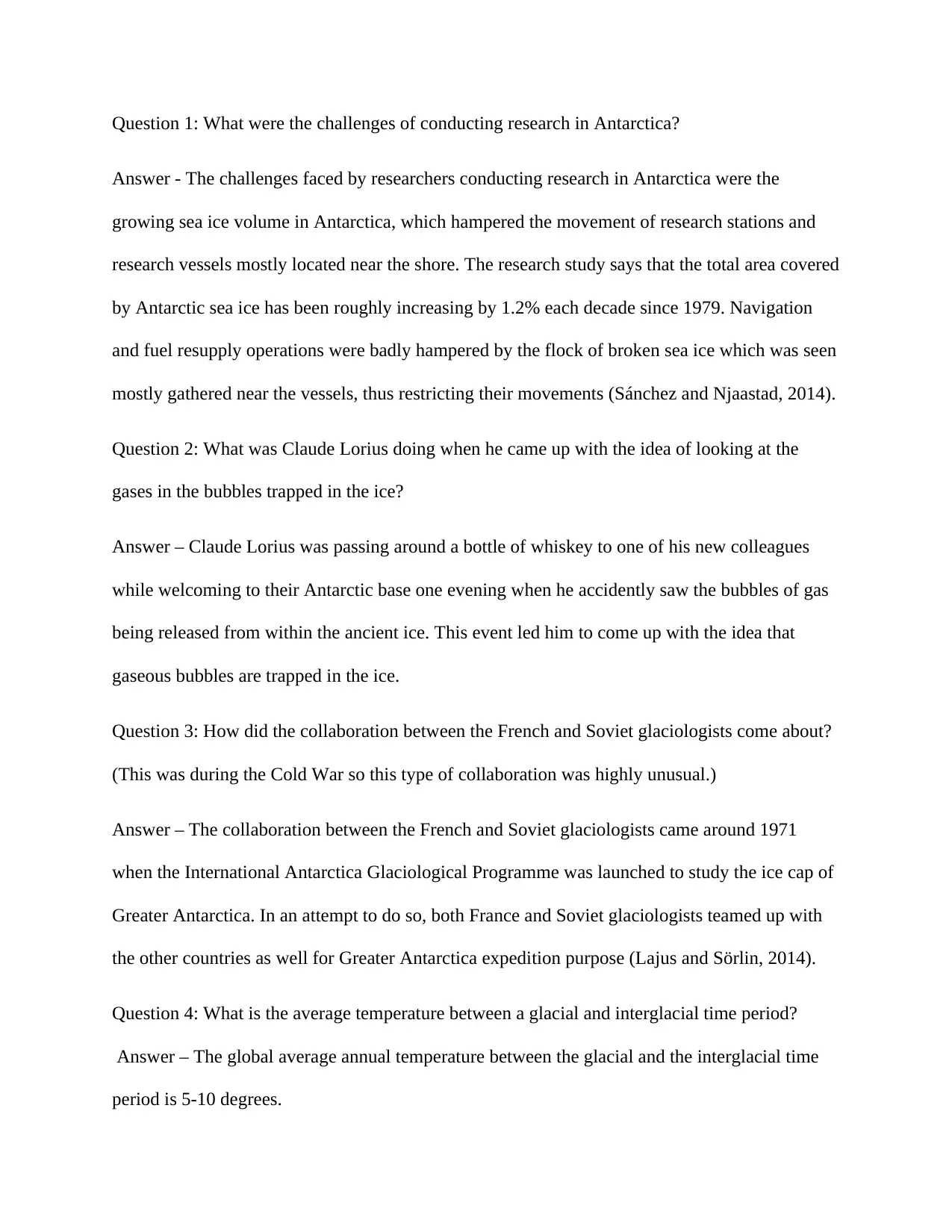
Question 1: What were the challenges of conducting research in Antarctica?
Answer - The challenges faced by researchers conducting research in Antarctica were the
growing sea ice volume in Antarctica, which hampered the movement of research stations and
research vessels mostly located near the shore. The research study says that the total area covered
by Antarctic sea ice has been roughly increasing by 1.2% each decade since 1979. Navigation
and fuel resupply operations were badly hampered by the flock of broken sea ice which was seen
mostly gathered near the vessels, thus restricting their movements (Sánchez and Njaastad, 2014).
Question 2: What was Claude Lorius doing when he came up with the idea of looking at the
gases in the bubbles trapped in the ice?
Answer – Claude Lorius was passing around a bottle of whiskey to one of his new colleagues
while welcoming to their Antarctic base one evening when he accidently saw the bubbles of gas
being released from within the ancient ice. This event led him to come up with the idea that
gaseous bubbles are trapped in the ice.
Question 3: How did the collaboration between the French and Soviet glaciologists come about?
(This was during the Cold War so this type of collaboration was highly unusual.)
Answer – The collaboration between the French and Soviet glaciologists came around 1971
when the International Antarctica Glaciological Programme was launched to study the ice cap of
Greater Antarctica. In an attempt to do so, both France and Soviet glaciologists teamed up with
the other countries as well for Greater Antarctica expedition purpose (Lajus and Sörlin, 2014).
Question 4: What is the average temperature between a glacial and interglacial time period?
Answer – The global average annual temperature between the glacial and the interglacial time
period is 5-10 degrees.
Document Page
References
Sánchez, R. A., & Njaastad, B. (2014). Future challenges in environmental management of
National Antarctic Programs. In Antarctic Futures (pp. 287-306). Springer Netherlands.
Lajus, J., & Sörlin, S. (2014). Melting the glacial curtain: the politics of Scandinavian–Soviet
networks in the geophysical field sciences between two polar years, 1932/33–1957/58. Journal of
Historical Geography, 44, 44-59.
chevron_up_icon
1 out of 3
circle_padding
hide_on_mobile
zoom_out_icon
[object Object]