Cultural Anthropology: Examining Nigerian Culture and Globalization
VerifiedAdded on 2023/06/09
|6
|942
|469
Essay
AI Summary
This essay provides an anthropological exploration of Nigerian culture, examining its infrastructure, social structure, and superstructure. It delves into the historical context of Nigeria, highlighting the diversity of its tribes and the influence of colonialism. The essay discusses the modes of production and subsistence strategies employed by different tribes, as well as the political systems and religious beliefs that have shaped Nigerian society. It also addresses the impact of globalization on Nigerian culture through world systems, transnationalism, and cultural diffusion. The author emphasizes the importance of balancing emic and etic research approaches to gain a comprehensive understanding of the culture.
1
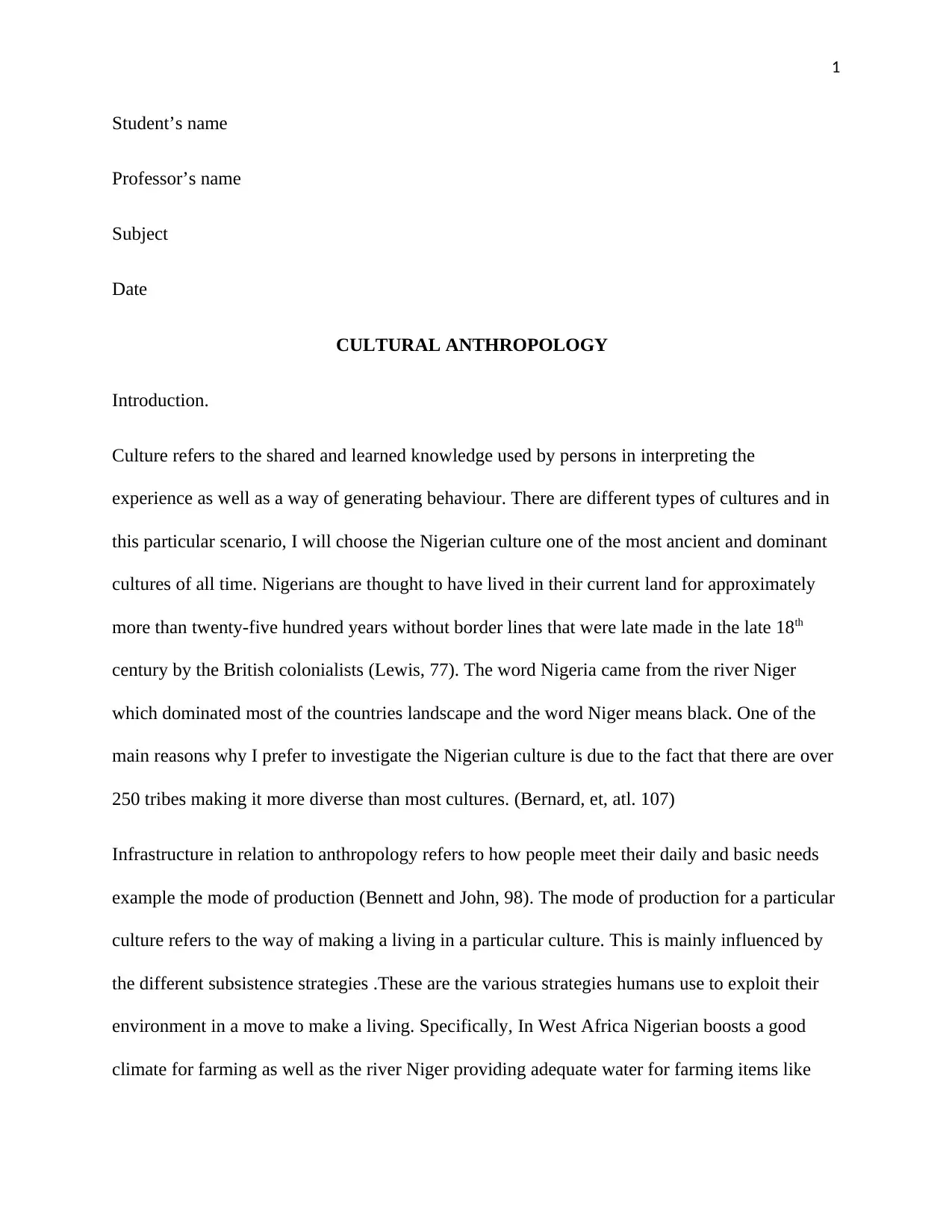
Student’s name
Professor’s name
Subject
Date
CULTURAL ANTHROPOLOGY
Introduction.
Culture refers to the shared and learned knowledge used by persons in interpreting the
experience as well as a way of generating behaviour. There are different types of cultures and in
this particular scenario, I will choose the Nigerian culture one of the most ancient and dominant
cultures of all time. Nigerians are thought to have lived in their current land for approximately
more than twenty-five hundred years without border lines that were late made in the late 18th
century by the British colonialists (Lewis, 77). The word Nigeria came from the river Niger
which dominated most of the countries landscape and the word Niger means black. One of the
main reasons why I prefer to investigate the Nigerian culture is due to the fact that there are over
250 tribes making it more diverse than most cultures. (Bernard, et, atl. 107)
Infrastructure in relation to anthropology refers to how people meet their daily and basic needs
example the mode of production (Bennett and John, 98). The mode of production for a particular
culture refers to the way of making a living in a particular culture. This is mainly influenced by
the different subsistence strategies .These are the various strategies humans use to exploit their
environment in a move to make a living. Specifically, In West Africa Nigerian boosts a good
climate for farming as well as the river Niger providing adequate water for farming items like
Student’s name
Professor’s name
Subject
Date
CULTURAL ANTHROPOLOGY
Introduction.
Culture refers to the shared and learned knowledge used by persons in interpreting the
experience as well as a way of generating behaviour. There are different types of cultures and in
this particular scenario, I will choose the Nigerian culture one of the most ancient and dominant
cultures of all time. Nigerians are thought to have lived in their current land for approximately
more than twenty-five hundred years without border lines that were late made in the late 18th
century by the British colonialists (Lewis, 77). The word Nigeria came from the river Niger
which dominated most of the countries landscape and the word Niger means black. One of the
main reasons why I prefer to investigate the Nigerian culture is due to the fact that there are over
250 tribes making it more diverse than most cultures. (Bernard, et, atl. 107)
Infrastructure in relation to anthropology refers to how people meet their daily and basic needs
example the mode of production (Bennett and John, 98). The mode of production for a particular
culture refers to the way of making a living in a particular culture. This is mainly influenced by
the different subsistence strategies .These are the various strategies humans use to exploit their
environment in a move to make a living. Specifically, In West Africa Nigerian boosts a good
climate for farming as well as the river Niger providing adequate water for farming items like
Paraphrase This Document
Need a fresh take? Get an instant paraphrase of this document with our AI Paraphraser

2
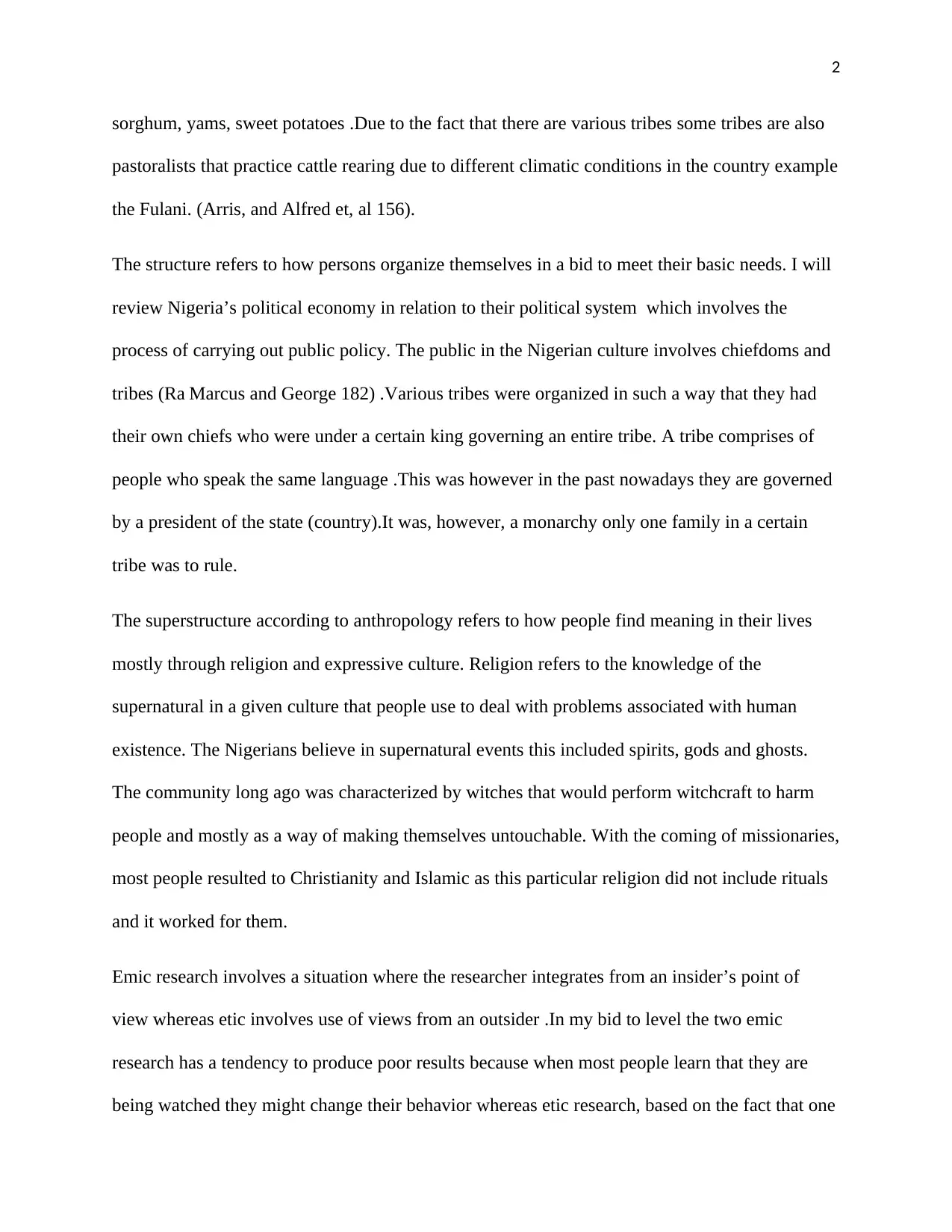
sorghum, yams, sweet potatoes .Due to the fact that there are various tribes some tribes are also
pastoralists that practice cattle rearing due to different climatic conditions in the country example
the Fulani. (Arris, and Alfred et, al 156).
The structure refers to how persons organize themselves in a bid to meet their basic needs. I will
review Nigeria’s political economy in relation to their political system which involves the
process of carrying out public policy. The public in the Nigerian culture involves chiefdoms and
tribes (Ra Marcus and George 182) .Various tribes were organized in such a way that they had
their own chiefs who were under a certain king governing an entire tribe. A tribe comprises of
people who speak the same language .This was however in the past nowadays they are governed
by a president of the state (country).It was, however, a monarchy only one family in a certain
tribe was to rule.
The superstructure according to anthropology refers to how people find meaning in their lives
mostly through religion and expressive culture. Religion refers to the knowledge of the
supernatural in a given culture that people use to deal with problems associated with human
existence. The Nigerians believe in supernatural events this included spirits, gods and ghosts.
The community long ago was characterized by witches that would perform witchcraft to harm
people and mostly as a way of making themselves untouchable. With the coming of missionaries,
most people resulted to Christianity and Islamic as this particular religion did not include rituals
and it worked for them.
Emic research involves a situation where the researcher integrates from an insider’s point of
view whereas etic involves use of views from an outsider .In my bid to level the two emic
research has a tendency to produce poor results because when most people learn that they are
being watched they might change their behavior whereas etic research, based on the fact that one
sorghum, yams, sweet potatoes .Due to the fact that there are various tribes some tribes are also
pastoralists that practice cattle rearing due to different climatic conditions in the country example
the Fulani. (Arris, and Alfred et, al 156).
The structure refers to how persons organize themselves in a bid to meet their basic needs. I will
review Nigeria’s political economy in relation to their political system which involves the
process of carrying out public policy. The public in the Nigerian culture involves chiefdoms and
tribes (Ra Marcus and George 182) .Various tribes were organized in such a way that they had
their own chiefs who were under a certain king governing an entire tribe. A tribe comprises of
people who speak the same language .This was however in the past nowadays they are governed
by a president of the state (country).It was, however, a monarchy only one family in a certain
tribe was to rule.
The superstructure according to anthropology refers to how people find meaning in their lives
mostly through religion and expressive culture. Religion refers to the knowledge of the
supernatural in a given culture that people use to deal with problems associated with human
existence. The Nigerians believe in supernatural events this included spirits, gods and ghosts.
The community long ago was characterized by witches that would perform witchcraft to harm
people and mostly as a way of making themselves untouchable. With the coming of missionaries,
most people resulted to Christianity and Islamic as this particular religion did not include rituals
and it worked for them.
Emic research involves a situation where the researcher integrates from an insider’s point of
view whereas etic involves use of views from an outsider .In my bid to level the two emic
research has a tendency to produce poor results because when most people learn that they are
being watched they might change their behavior whereas etic research, based on the fact that one

3
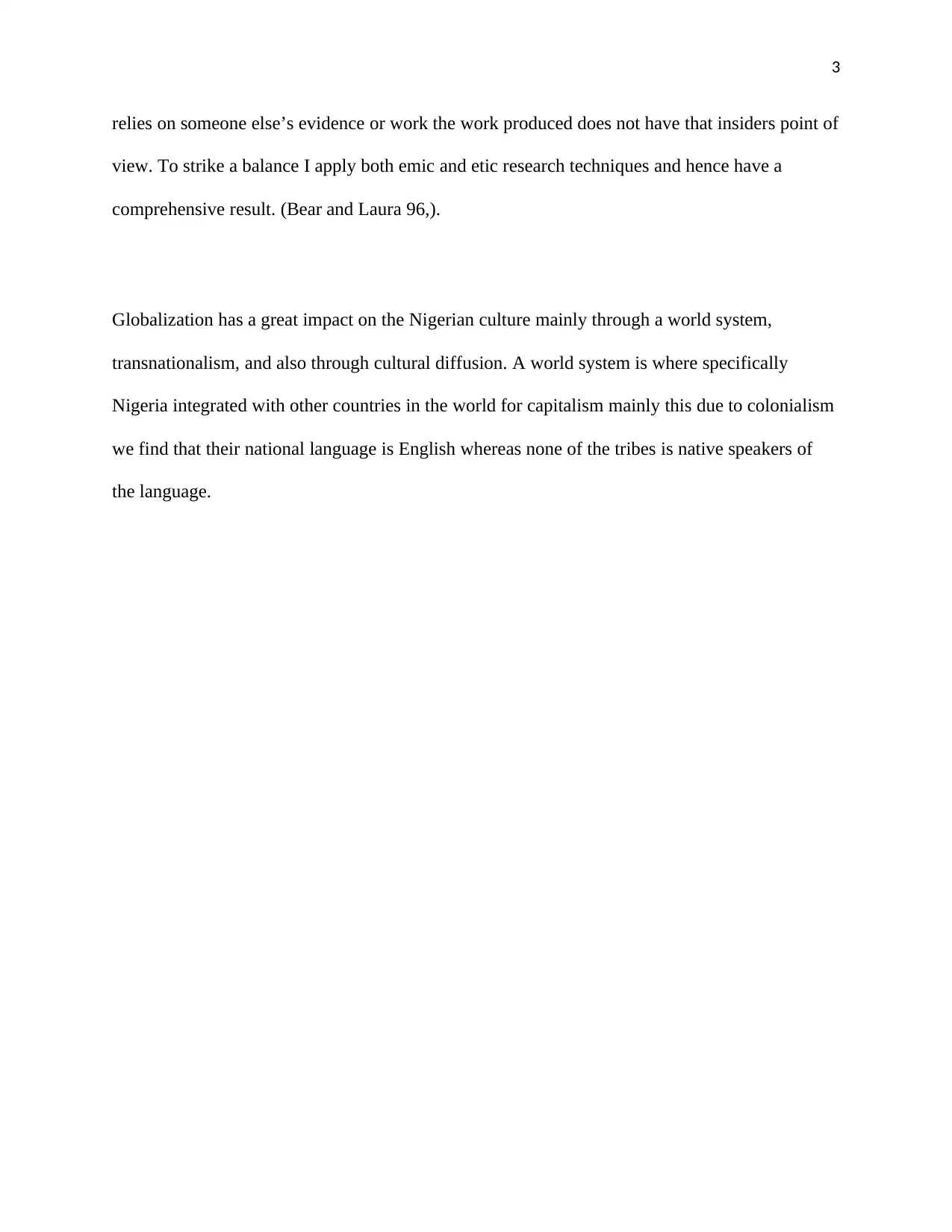
relies on someone else’s evidence or work the work produced does not have that insiders point of
view. To strike a balance I apply both emic and etic research techniques and hence have a
comprehensive result. (Bear and Laura 96,).
Globalization has a great impact on the Nigerian culture mainly through a world system,
transnationalism, and also through cultural diffusion. A world system is where specifically
Nigeria integrated with other countries in the world for capitalism mainly this due to colonialism
we find that their national language is English whereas none of the tribes is native speakers of
the language.
relies on someone else’s evidence or work the work produced does not have that insiders point of
view. To strike a balance I apply both emic and etic research techniques and hence have a
comprehensive result. (Bear and Laura 96,).
Globalization has a great impact on the Nigerian culture mainly through a world system,
transnationalism, and also through cultural diffusion. A world system is where specifically
Nigeria integrated with other countries in the world for capitalism mainly this due to colonialism
we find that their national language is English whereas none of the tribes is native speakers of
the language.
⊘ This is a preview!⊘
Do you want full access?
Subscribe today to unlock all pages.

Trusted by 1+ million students worldwide

4
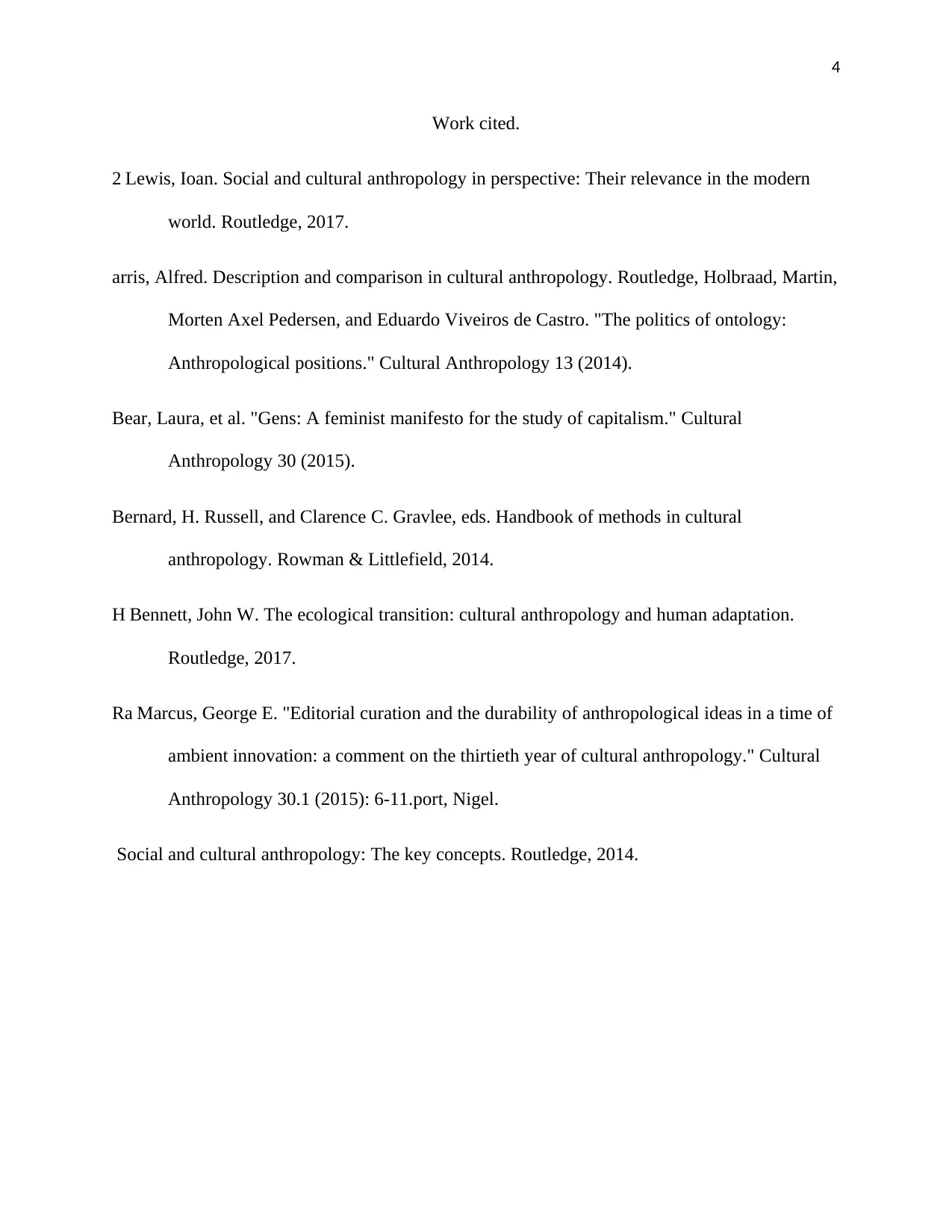
Work cited.
2 Lewis, Ioan. Social and cultural anthropology in perspective: Their relevance in the modern
world. Routledge, 2017.
arris, Alfred. Description and comparison in cultural anthropology. Routledge, Holbraad, Martin,
Morten Axel Pedersen, and Eduardo Viveiros de Castro. "The politics of ontology:
Anthropological positions." Cultural Anthropology 13 (2014).
Bear, Laura, et al. "Gens: A feminist manifesto for the study of capitalism." Cultural
Anthropology 30 (2015).
Bernard, H. Russell, and Clarence C. Gravlee, eds. Handbook of methods in cultural
anthropology. Rowman & Littlefield, 2014.
H Bennett, John W. The ecological transition: cultural anthropology and human adaptation.
Routledge, 2017.
Ra Marcus, George E. "Editorial curation and the durability of anthropological ideas in a time of
ambient innovation: a comment on the thirtieth year of cultural anthropology." Cultural
Anthropology 30.1 (2015): 6-11.port, Nigel.
Social and cultural anthropology: The key concepts. Routledge, 2014.
Work cited.
2 Lewis, Ioan. Social and cultural anthropology in perspective: Their relevance in the modern
world. Routledge, 2017.
arris, Alfred. Description and comparison in cultural anthropology. Routledge, Holbraad, Martin,
Morten Axel Pedersen, and Eduardo Viveiros de Castro. "The politics of ontology:
Anthropological positions." Cultural Anthropology 13 (2014).
Bear, Laura, et al. "Gens: A feminist manifesto for the study of capitalism." Cultural
Anthropology 30 (2015).
Bernard, H. Russell, and Clarence C. Gravlee, eds. Handbook of methods in cultural
anthropology. Rowman & Littlefield, 2014.
H Bennett, John W. The ecological transition: cultural anthropology and human adaptation.
Routledge, 2017.
Ra Marcus, George E. "Editorial curation and the durability of anthropological ideas in a time of
ambient innovation: a comment on the thirtieth year of cultural anthropology." Cultural
Anthropology 30.1 (2015): 6-11.port, Nigel.
Social and cultural anthropology: The key concepts. Routledge, 2014.
Paraphrase This Document
Need a fresh take? Get an instant paraphrase of this document with our AI Paraphraser

5

6
⊘ This is a preview!⊘
Do you want full access?
Subscribe today to unlock all pages.

Trusted by 1+ million students worldwide
1 out of 6
Your All-in-One AI-Powered Toolkit for Academic Success.
+13062052269
info@desklib.com
Available 24*7 on WhatsApp / Email
Unlock your academic potential
Copyright © 2020–2025 A2Z Services. All Rights Reserved. Developed and managed by ZUCOL.