Financial Auditing Report: Incentives and Anti-competitive Behavior
VerifiedAdded on 2021/09/12
|6
|1093
|108
Report
AI Summary
This report analyzes the article "Could perverse incentives encourage financial services compliance and internal audit staff to ignore or engage in illegal behaviour?" by Michael & Williams (2018), which focuses on the Malaysian financial sector. The article investigates why managers, internal auditors, and compliance staff might overlook compliance-related legislation, particularly concerning antitrust laws. The report summarizes the article's key points, including how economic and political incentives can lead to anti-competitive behavior, especially in the Malaysian context, where the lack of resources in the Malaysian Competition Commission and the pursuit of profits can encourage non-compliance. The analysis highlights the article's limitations, such as the absence of regression analysis, and its practical and social implications, including how weakly structured laws can affect auditing and shape society. The conclusion emphasizes that banks in Malaysia have incentives to engage in anti-competitive behavior to cover the costs of compliance programs. The report includes references to related research.

Running head: AUDITING
Auditing
Name of the Student
Name of the University
Author Note
Auditing
Name of the Student
Name of the University
Author Note
Paraphrase This Document
Need a fresh take? Get an instant paraphrase of this document with our AI Paraphraser

Table of Contents
Introduction:...............................................................................................................................3
Article Summary:.......................................................................................................................3
Article Analysis:.........................................................................................................................4
Conclusion..................................................................................................................................5
References:.................................................................................................................................6
Introduction:...............................................................................................................................3
Article Summary:.......................................................................................................................3
Article Analysis:.........................................................................................................................4
Conclusion..................................................................................................................................5
References:.................................................................................................................................6

Introduction:
The chosen article for this report is “Could perverse incentives encourage financial
services compliance and internal audit staff to ignore or engage in illegal behaviour?”
written by Michael & Williams (Michael & Williams, 2018). This report will analyse this
article further after providing an appropriate summary. The chief motive of this chosen article
is to understand that why managers along with internal auditors and compliance staff try to
ignore compliance related legislation. The entire discussion is based on Malaysia.
Article Summary:
The researchers have tried to understand the activity of financial services, compliance
staff as well as internal auditors when political, economic and structural incentives act against
compliance based on antitrust law of the country. In the USA and EU, fixing of inter-bank
rate, blocking of derivatives exchanges coming from the swap business related to credit
default along with other scandals can be considered. In these situations, various scandals have
highlighted that incentives obtaining for engaging with anticompetitive behaviour can
defiantly exist in the sector of financial services (Rodriguez Castro, Ruiz Barbadillo &
Biedma López, 2017). According to theory, lawmakers receive very small amount of
incentives for encouraging this kind of behaviour. Moreover, regulations can implement huge
amount of sanction to discourage equilibrium related to anticompetitive behaviour within
providers of financial services. However, instead of this basic theory, law often provides
incentives to banks for engaging in anticompetitive behaviour. In this context, it needs to
mention that compliance staffs as well as internal auditors encourage this anticompetitive
behaviour. The researchers have observed a theoretical possibility in the context of Malaysia.
In this country, optimal expenses based on antitrust compliance as well as equal equates with
zero. As banks spend money for audit and compliance, they are required to follow illegal
The chosen article for this report is “Could perverse incentives encourage financial
services compliance and internal audit staff to ignore or engage in illegal behaviour?”
written by Michael & Williams (Michael & Williams, 2018). This report will analyse this
article further after providing an appropriate summary. The chief motive of this chosen article
is to understand that why managers along with internal auditors and compliance staff try to
ignore compliance related legislation. The entire discussion is based on Malaysia.
Article Summary:
The researchers have tried to understand the activity of financial services, compliance
staff as well as internal auditors when political, economic and structural incentives act against
compliance based on antitrust law of the country. In the USA and EU, fixing of inter-bank
rate, blocking of derivatives exchanges coming from the swap business related to credit
default along with other scandals can be considered. In these situations, various scandals have
highlighted that incentives obtaining for engaging with anticompetitive behaviour can
defiantly exist in the sector of financial services (Rodriguez Castro, Ruiz Barbadillo &
Biedma López, 2017). According to theory, lawmakers receive very small amount of
incentives for encouraging this kind of behaviour. Moreover, regulations can implement huge
amount of sanction to discourage equilibrium related to anticompetitive behaviour within
providers of financial services. However, instead of this basic theory, law often provides
incentives to banks for engaging in anticompetitive behaviour. In this context, it needs to
mention that compliance staffs as well as internal auditors encourage this anticompetitive
behaviour. The researchers have observed a theoretical possibility in the context of Malaysia.
In this country, optimal expenses based on antitrust compliance as well as equal equates with
zero. As banks spend money for audit and compliance, they are required to follow illegal
⊘ This is a preview!⊘
Do you want full access?
Subscribe today to unlock all pages.

Trusted by 1+ million students worldwide

behaviour for earning the money. They need this money for paying audit activities as well as
compliance themselves. Through analysing data, researchers have found that banks of this
country receive benefits due to anticompetitive behaviour. These banks earn RM 15 billion in
the form of rents even after paying fines and penalties envisioned within the act. The
corporate of Malaysia, especially banking sector facilitates especially anticompetitive
behaviour connected with family and politics. This is because the Malaysian Competition
Commission has lack of resources for investigating and prosecuting this behaviour within the
banking sector of Malaysia. The best act of this bank is to avoid this. Incentives relate to
economic and political aspects encourage engagement of anticompetitive behaviour. This
behaviour has three things related to compliance programmes.
Article Analysis:
The article has considered authors review along with discussion and critique based on
literatures depending on compliance and institutions based on existing data collected from the
financial industry of Malaysia. The actual outcome gives legislative design that can
effectively encourage managers along with their auditors for ignoring the law. This happens
because previous theories cannot explain this concept. However, the entire research work has
experienced some limitations, as the entire process does not consider regression analysis. The
outcomes represent that attempts for explaining phenomenon within the process of audit
management needs to start with laws that govern managerial activities (Wong et al., 2017).
The entire research work has some practical implications. Auditors use this process stated
within the study for assessing the magnitude to which managers of financial services firms
have incentives for complying with laws. The research article has intended to quantify the
extent at which international auditors belong to these firms have incentives for finding
outward conduct (Bronkhorst et al., 2017). The outcome has some social implications as well.
Weakly structured law have affected managerial auditing to derive from previously existing
compliance themselves. Through analysing data, researchers have found that banks of this
country receive benefits due to anticompetitive behaviour. These banks earn RM 15 billion in
the form of rents even after paying fines and penalties envisioned within the act. The
corporate of Malaysia, especially banking sector facilitates especially anticompetitive
behaviour connected with family and politics. This is because the Malaysian Competition
Commission has lack of resources for investigating and prosecuting this behaviour within the
banking sector of Malaysia. The best act of this bank is to avoid this. Incentives relate to
economic and political aspects encourage engagement of anticompetitive behaviour. This
behaviour has three things related to compliance programmes.
Article Analysis:
The article has considered authors review along with discussion and critique based on
literatures depending on compliance and institutions based on existing data collected from the
financial industry of Malaysia. The actual outcome gives legislative design that can
effectively encourage managers along with their auditors for ignoring the law. This happens
because previous theories cannot explain this concept. However, the entire research work has
experienced some limitations, as the entire process does not consider regression analysis. The
outcomes represent that attempts for explaining phenomenon within the process of audit
management needs to start with laws that govern managerial activities (Wong et al., 2017).
The entire research work has some practical implications. Auditors use this process stated
within the study for assessing the magnitude to which managers of financial services firms
have incentives for complying with laws. The research article has intended to quantify the
extent at which international auditors belong to these firms have incentives for finding
outward conduct (Bronkhorst et al., 2017). The outcome has some social implications as well.
Weakly structured law have affected managerial auditing to derive from previously existing
Paraphrase This Document
Need a fresh take? Get an instant paraphrase of this document with our AI Paraphraser

relationships in the context of society. Moreover, this law has helped to shape the society.
Thus, non-compliance areas may focus on deeper problems through which businessmen as
well as lawmakers have constructed and enforced laws. These laws are essential for
compliance and self-assessment.
Conclusion
The entire discussion has analysed antitrust issues within the financial sector. The
researchers have looked at the economic incentives that can lead behaviour of auditors,
especially in the field of anti-trust. The entire article has chiefly focused on the law that can
form management as well as incentives of auditors. This can quantify these incentives and
further can state that how and why previous researchers cannot explain these incentives
successfully. It is observed that banks in Malaysia have the incentives to remain engaged in
anticompetitive behaviour. For covering costs related to these programs, banks need to earn
money.
Thus, non-compliance areas may focus on deeper problems through which businessmen as
well as lawmakers have constructed and enforced laws. These laws are essential for
compliance and self-assessment.
Conclusion
The entire discussion has analysed antitrust issues within the financial sector. The
researchers have looked at the economic incentives that can lead behaviour of auditors,
especially in the field of anti-trust. The entire article has chiefly focused on the law that can
form management as well as incentives of auditors. This can quantify these incentives and
further can state that how and why previous researchers cannot explain these incentives
successfully. It is observed that banks in Malaysia have the incentives to remain engaged in
anticompetitive behaviour. For covering costs related to these programs, banks need to earn
money.

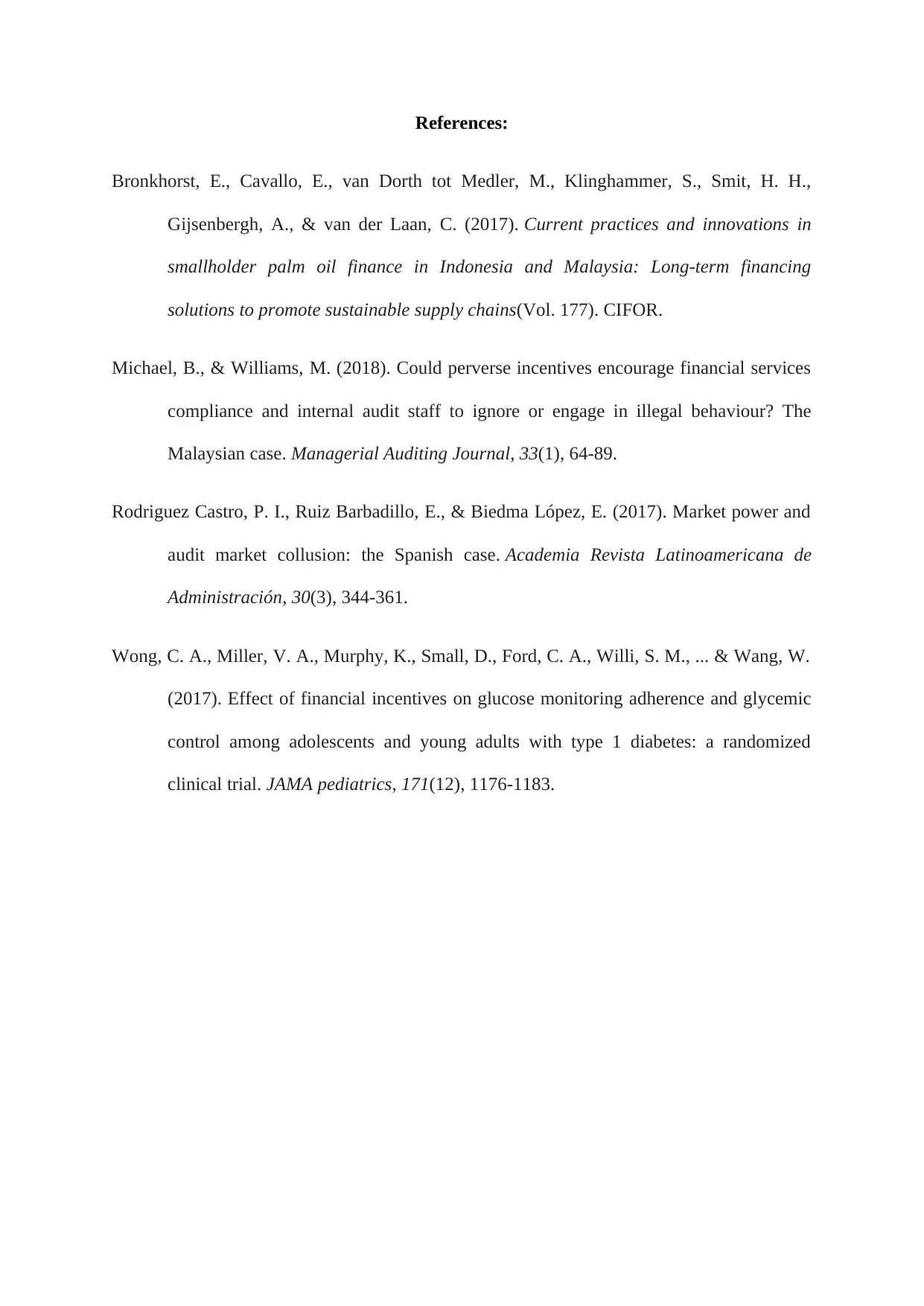
References:
Bronkhorst, E., Cavallo, E., van Dorth tot Medler, M., Klinghammer, S., Smit, H. H.,
Gijsenbergh, A., & van der Laan, C. (2017). Current practices and innovations in
smallholder palm oil finance in Indonesia and Malaysia: Long-term financing
solutions to promote sustainable supply chains(Vol. 177). CIFOR.
Michael, B., & Williams, M. (2018). Could perverse incentives encourage financial services
compliance and internal audit staff to ignore or engage in illegal behaviour? The
Malaysian case. Managerial Auditing Journal, 33(1), 64-89.
Rodriguez Castro, P. I., Ruiz Barbadillo, E., & Biedma López, E. (2017). Market power and
audit market collusion: the Spanish case. Academia Revista Latinoamericana de
Administración, 30(3), 344-361.
Wong, C. A., Miller, V. A., Murphy, K., Small, D., Ford, C. A., Willi, S. M., ... & Wang, W.
(2017). Effect of financial incentives on glucose monitoring adherence and glycemic
control among adolescents and young adults with type 1 diabetes: a randomized
clinical trial. JAMA pediatrics, 171(12), 1176-1183.
Bronkhorst, E., Cavallo, E., van Dorth tot Medler, M., Klinghammer, S., Smit, H. H.,
Gijsenbergh, A., & van der Laan, C. (2017). Current practices and innovations in
smallholder palm oil finance in Indonesia and Malaysia: Long-term financing
solutions to promote sustainable supply chains(Vol. 177). CIFOR.
Michael, B., & Williams, M. (2018). Could perverse incentives encourage financial services
compliance and internal audit staff to ignore or engage in illegal behaviour? The
Malaysian case. Managerial Auditing Journal, 33(1), 64-89.
Rodriguez Castro, P. I., Ruiz Barbadillo, E., & Biedma López, E. (2017). Market power and
audit market collusion: the Spanish case. Academia Revista Latinoamericana de
Administración, 30(3), 344-361.
Wong, C. A., Miller, V. A., Murphy, K., Small, D., Ford, C. A., Willi, S. M., ... & Wang, W.
(2017). Effect of financial incentives on glucose monitoring adherence and glycemic
control among adolescents and young adults with type 1 diabetes: a randomized
clinical trial. JAMA pediatrics, 171(12), 1176-1183.
⊘ This is a preview!⊘
Do you want full access?
Subscribe today to unlock all pages.

Trusted by 1+ million students worldwide
1 out of 6
Your All-in-One AI-Powered Toolkit for Academic Success.
+13062052269
info@desklib.com
Available 24*7 on WhatsApp / Email
Unlock your academic potential
Copyright © 2020–2026 A2Z Services. All Rights Reserved. Developed and managed by ZUCOL.