Anxiety Disorder in UK: A Study of Black Young Adults (18-35)
VerifiedAdded on 2022/06/01
|16
|4031
|39
Report
AI Summary
This report delves into the issue of anxiety disorder among young adults of Black ethnicity in the UK, aged 18-35. It begins with an introduction defining anxiety disorder and highlighting its unique aspects within the Black community. The report then conducts a thorough literature review, analyzing empirical papers and identifying research gaps. Key databases like GHDx, ResearchGate, and Google Scholar were utilized to gather relevant data. The literature review examines studies focusing on the prevalence of mental disorders, discrimination, social capital, and parenting styles. The report also includes a data analysis section, presenting demographic data, causes associated with anxiety disorder, and trend analyses using variables like unemployment and race discrimination. Furthermore, the report analyzes UK policies related to mental health and anxiety disorder, including the Coronavirus Act-2020 and the NHS five-year forward view. Finally, it concludes with a discussion reflecting on the findings and proposes a research proposal based on identified literature gaps. The report covers various aspects of the problem, from the causes of anxiety to the government policies, providing a comprehensive view of the issue.
The course of anxiety disorder among
young adults from black ethnic’s
background in the UK aged between 18-
35
young adults from black ethnic’s
background in the UK aged between 18-
35

Paraphrase This Document
Need a fresh take? Get an instant paraphrase of this document with our AI Paraphraser
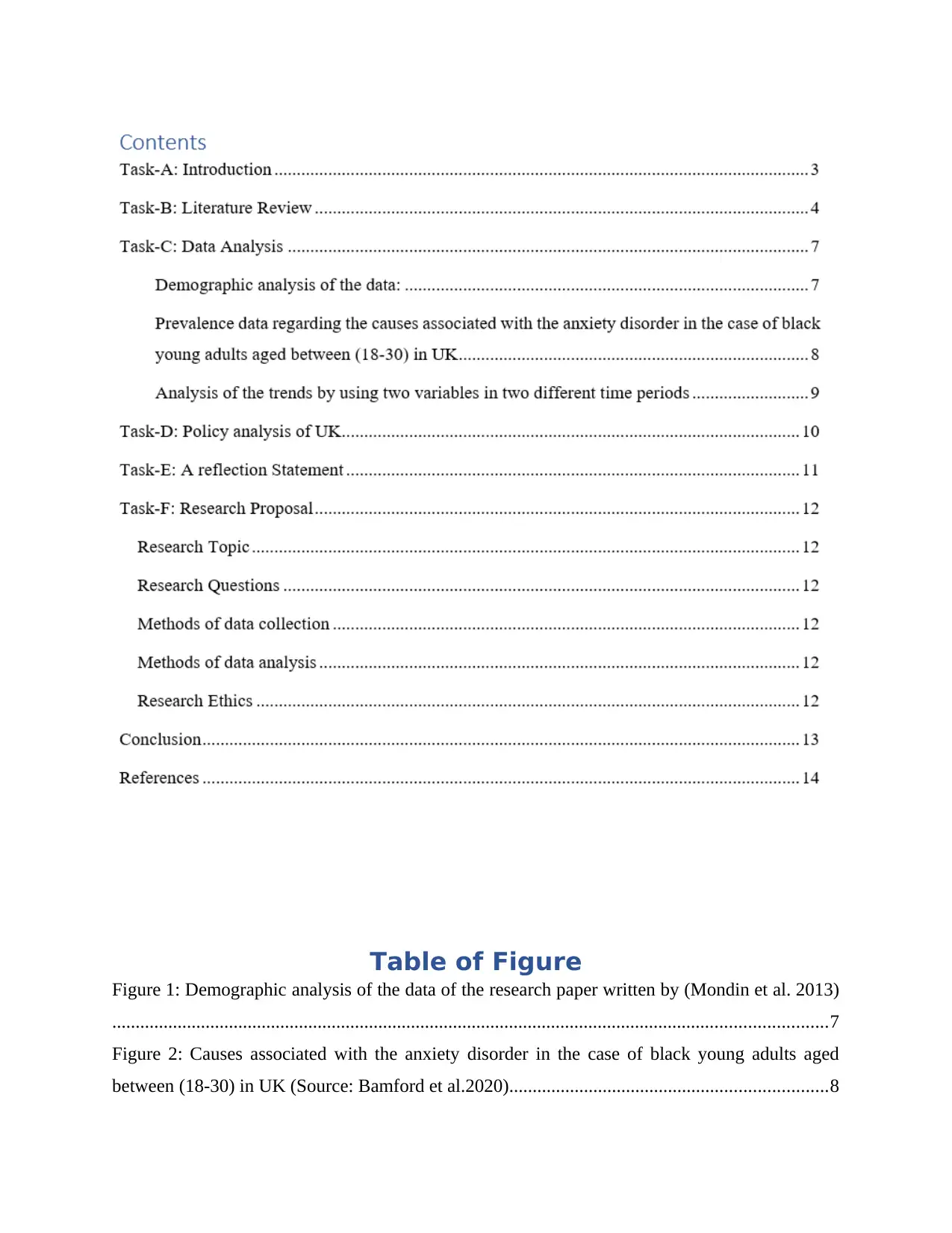
Table of Figure
Figure 1: Demographic analysis of the data of the research paper written by (Mondin et al. 2013)
.........................................................................................................................................................7
Figure 2: Causes associated with the anxiety disorder in the case of black young adults aged
between (18-30) in UK (Source: Bamford et al.2020)....................................................................8
Figure 1: Demographic analysis of the data of the research paper written by (Mondin et al. 2013)
.........................................................................................................................................................7
Figure 2: Causes associated with the anxiety disorder in the case of black young adults aged
between (18-30) in UK (Source: Bamford et al.2020)....................................................................8

Figure 3: Two variables used for analysing trends (Source: Ballenger, 1998 & Stein, 2013)........9
⊘ This is a preview!⊘
Do you want full access?
Subscribe today to unlock all pages.

Trusted by 1+ million students worldwide
Task-A: Introduction
Anxiety disorder refers to a mental state of a person when s/he often becomes anxious about his
or her daily works (Stein et al. 2008). Fehm and Wittchen (2004) said that people with anxiety
disorders feel fear of something that even doesn’t have any existence. Though this mental health
problem occurs to people worldwide, but for black people, the reasons are quite different. This
study deals with the thorough review of the kinds of literature to get relevant data so that
meaningful information can be derived from the analysis of those data. And also, the literature
gap is tried to find out from the selected studies (peer-reviewed Journals). In the task-B of this
study, the literature review is conducted on the empirical papers related to the anxiety disorder
among young adults from black ethnic’s background in the UK aged between 18-35, and in the
task-C, analysis of the statistics found from existing research are tried to be analyzed critically.
In task-D, policy analysis is made on the current policies of the UK regarding the anxiety
disorder or mental health, and task-E shows the discussion regarding the reflection of what I
have learned from this work. Based on the literature gaps found in the literature review section,
some research objectives and questions are prepared and based on these objectives and questions,
a research proposal is created and presented in task-F.
Anxiety disorder refers to a mental state of a person when s/he often becomes anxious about his
or her daily works (Stein et al. 2008). Fehm and Wittchen (2004) said that people with anxiety
disorders feel fear of something that even doesn’t have any existence. Though this mental health
problem occurs to people worldwide, but for black people, the reasons are quite different. This
study deals with the thorough review of the kinds of literature to get relevant data so that
meaningful information can be derived from the analysis of those data. And also, the literature
gap is tried to find out from the selected studies (peer-reviewed Journals). In the task-B of this
study, the literature review is conducted on the empirical papers related to the anxiety disorder
among young adults from black ethnic’s background in the UK aged between 18-35, and in the
task-C, analysis of the statistics found from existing research are tried to be analyzed critically.
In task-D, policy analysis is made on the current policies of the UK regarding the anxiety
disorder or mental health, and task-E shows the discussion regarding the reflection of what I
have learned from this work. Based on the literature gaps found in the literature review section,
some research objectives and questions are prepared and based on these objectives and questions,
a research proposal is created and presented in task-F.
Paraphrase This Document
Need a fresh take? Get an instant paraphrase of this document with our AI Paraphraser
Task-B: Literature Review
The literature search process started with defining the research question- “what is anxiety
disorder among young adults from black ethnic background in the UK aged between 18-35?”.
Then key terms and concepts were selected such as- “anxiety disorder”, “black young adults
aged between 18-35”, “adults with an anxiety disorder from black ethnic background in the UK”
and “Young people with an anxiety disorder in the UK”. To make the key concepts suitable for
searching in search engines, Boolean operators- and, or, not were included between the aforesaid
key terms. To limit or narrow down the search result, some criteria were followed such as-
country of origin was selected as UK, age group was selected as black young adult aged between
18-35, publication type as peer-reviewed journals. Some prominent databases relevant to global
public health such as- GHDx, ResearchGate, Google Scholar, Semantic Scholar, Global health
observatory-WHO, GH Journal search were used for finding out the expected articles pertinent to
the research topic.
The empirical study of WEICH et al. (2004) titled “Common mental disorders and ethnicity in
England: the EMPIRIC Study” focused on revealing the prevalence of Common Mental
Disorders (CMD) among the women of Bangladesh, Pakistan, Indian, Irish, and Black Caribbean
living in England. The study shows that 43% of young Irish women are the subject to CMD and
52% of black women from the ethnic group of the Black Caribbean having mental health
disorder problems. This study also revealed that Bangladeshi black women are having less
common mental disorder problems than that of Bangladeshi white women. However, this study
may show some reasons behind high CMD among women from black ethnic group of people
which is appeared to the literature gap of this study.
One of the recent peer-reviewed Journals titled “Mental disorders among young adults of
immigrant background: a nationwide register study in Norway” written by Ekeberg et al. (2020)
averred that there is a significant difference in getting psychiatric diagnosis of schizophrenia by
immigrants from Pakistan and Iran compared to ethnic Norwegians. This study shows that most
of the Pakistani Immigrants are having low odds of anxiety disorders compared to the Iranian
immigrants regarding anxiety disorders. Ekeberg et al. (2020) found that black Africans are at
risk of schizophrenia and the authors highlighted that extreme discrimination in society causes
The literature search process started with defining the research question- “what is anxiety
disorder among young adults from black ethnic background in the UK aged between 18-35?”.
Then key terms and concepts were selected such as- “anxiety disorder”, “black young adults
aged between 18-35”, “adults with an anxiety disorder from black ethnic background in the UK”
and “Young people with an anxiety disorder in the UK”. To make the key concepts suitable for
searching in search engines, Boolean operators- and, or, not were included between the aforesaid
key terms. To limit or narrow down the search result, some criteria were followed such as-
country of origin was selected as UK, age group was selected as black young adult aged between
18-35, publication type as peer-reviewed journals. Some prominent databases relevant to global
public health such as- GHDx, ResearchGate, Google Scholar, Semantic Scholar, Global health
observatory-WHO, GH Journal search were used for finding out the expected articles pertinent to
the research topic.
The empirical study of WEICH et al. (2004) titled “Common mental disorders and ethnicity in
England: the EMPIRIC Study” focused on revealing the prevalence of Common Mental
Disorders (CMD) among the women of Bangladesh, Pakistan, Indian, Irish, and Black Caribbean
living in England. The study shows that 43% of young Irish women are the subject to CMD and
52% of black women from the ethnic group of the Black Caribbean having mental health
disorder problems. This study also revealed that Bangladeshi black women are having less
common mental disorder problems than that of Bangladeshi white women. However, this study
may show some reasons behind high CMD among women from black ethnic group of people
which is appeared to the literature gap of this study.
One of the recent peer-reviewed Journals titled “Mental disorders among young adults of
immigrant background: a nationwide register study in Norway” written by Ekeberg et al. (2020)
averred that there is a significant difference in getting psychiatric diagnosis of schizophrenia by
immigrants from Pakistan and Iran compared to ethnic Norwegians. This study shows that most
of the Pakistani Immigrants are having low odds of anxiety disorders compared to the Iranian
immigrants regarding anxiety disorders. Ekeberg et al. (2020) found that black Africans are at
risk of schizophrenia and the authors highlighted that extreme discrimination in society causes
this mental disorder and is a reason behind high mental disorder problems among black African
young adults or immigrants living in Norway. This study also signified that a wrong parenting
style can also create distress and mental pressures among black young adults. However, this
study has the lacking of the discussion about the post-migrant factors that causes mental disorder
problem among Black African people.
In their study titled “Social Capital and Mental Health Among Black and Minority Ethnic
Groups in the UK” written by Bamford et al. (2020) highlighted that black young people of
Indian, Bangladesh, Pakistan living in the UK are at extreme risk of psychological distress. The
authors have emphasized that social capital is such a determinant for black young adults (men
and women) which determines the mental health of black in the UK. Bamford et al. (2020) stated
that feelings of insecurity regarding the living costs and future are increasing the mental or
anxiety disorders among young adults in the UK. The authors suggested that investment should
be made for the development of ethnic-centric public health infrastructural development so that
minority people can get proper treatment to solve their anxiety disorder as well as other mental
health problems.
A study titled “Anxiety disorders in African Americans: a case study on the young population
living in the UK” is written by Paradis et al. (1994) focuses on finding out the anxiety disorders
(Panic disorders) in African Americans. This study didn’t find any significant discrepancy in the
symptom profile of African American adults and white adults. This study highlights that black
African Americans (young adults) don’t feel easy to ask for help from mental health experts and
often they are being misguided or misdiagnosed. In this study, it was also found that if the
anxiety disorder or panic disorder can be traced at its early stage, the outcome of the treatment
remains the same irrespective of black or white people. To sum up, of the main findings of this
study, it can be said that still people are being discriminated against in terms of their color or
ethnic group in the medical treatment which is very harmful for human being. However, this
study has a lacking of discussion regarding the proposed treatment strategies for the people of
this ethnic group.
The study titled “An investigation into the effects of anxiety sensitivity in young adults on
childhood depression and anxiety disorder in UK” conducted by Seçer et al. (2019) is made to
find out the relationship among anxiety disorders, anxiety sensitivity, and depressive syndromes
young adults or immigrants living in Norway. This study also signified that a wrong parenting
style can also create distress and mental pressures among black young adults. However, this
study has the lacking of the discussion about the post-migrant factors that causes mental disorder
problem among Black African people.
In their study titled “Social Capital and Mental Health Among Black and Minority Ethnic
Groups in the UK” written by Bamford et al. (2020) highlighted that black young people of
Indian, Bangladesh, Pakistan living in the UK are at extreme risk of psychological distress. The
authors have emphasized that social capital is such a determinant for black young adults (men
and women) which determines the mental health of black in the UK. Bamford et al. (2020) stated
that feelings of insecurity regarding the living costs and future are increasing the mental or
anxiety disorders among young adults in the UK. The authors suggested that investment should
be made for the development of ethnic-centric public health infrastructural development so that
minority people can get proper treatment to solve their anxiety disorder as well as other mental
health problems.
A study titled “Anxiety disorders in African Americans: a case study on the young population
living in the UK” is written by Paradis et al. (1994) focuses on finding out the anxiety disorders
(Panic disorders) in African Americans. This study didn’t find any significant discrepancy in the
symptom profile of African American adults and white adults. This study highlights that black
African Americans (young adults) don’t feel easy to ask for help from mental health experts and
often they are being misguided or misdiagnosed. In this study, it was also found that if the
anxiety disorder or panic disorder can be traced at its early stage, the outcome of the treatment
remains the same irrespective of black or white people. To sum up, of the main findings of this
study, it can be said that still people are being discriminated against in terms of their color or
ethnic group in the medical treatment which is very harmful for human being. However, this
study has a lacking of discussion regarding the proposed treatment strategies for the people of
this ethnic group.
The study titled “An investigation into the effects of anxiety sensitivity in young adults on
childhood depression and anxiety disorder in UK” conducted by Seçer et al. (2019) is made to
find out the relationship among anxiety disorders, anxiety sensitivity, and depressive syndromes
⊘ This is a preview!⊘
Do you want full access?
Subscribe today to unlock all pages.
Trusted by 1+ million students worldwide

from the study made on 670 students in London. In this study, the researchers found that the
young adults or adolescence possessing high anxiety have the five times more chance compared
to normal adult to be the patient of anxiety disorder. And this type of young adults often finds
themselves in a more threatening situation. This study also highlighted that childhood depression
occurs mainly because of social, psychological, and physical factors and the chances of
occurring due to the aforesaid reasons are 67% which is higher. This study has the lacking of
discussion regarding the factors responsible for creating anxiety disorder among young adults.
young adults or adolescence possessing high anxiety have the five times more chance compared
to normal adult to be the patient of anxiety disorder. And this type of young adults often finds
themselves in a more threatening situation. This study also highlighted that childhood depression
occurs mainly because of social, psychological, and physical factors and the chances of
occurring due to the aforesaid reasons are 67% which is higher. This study has the lacking of
discussion regarding the factors responsible for creating anxiety disorder among young adults.
Paraphrase This Document
Need a fresh take? Get an instant paraphrase of this document with our AI Paraphraser
Task-C: Data Analysis
In the part of this empirical work, analysis of the statistics excerpt from various published
literatures relating to the topic of this study.
Demographic analysis of the data:
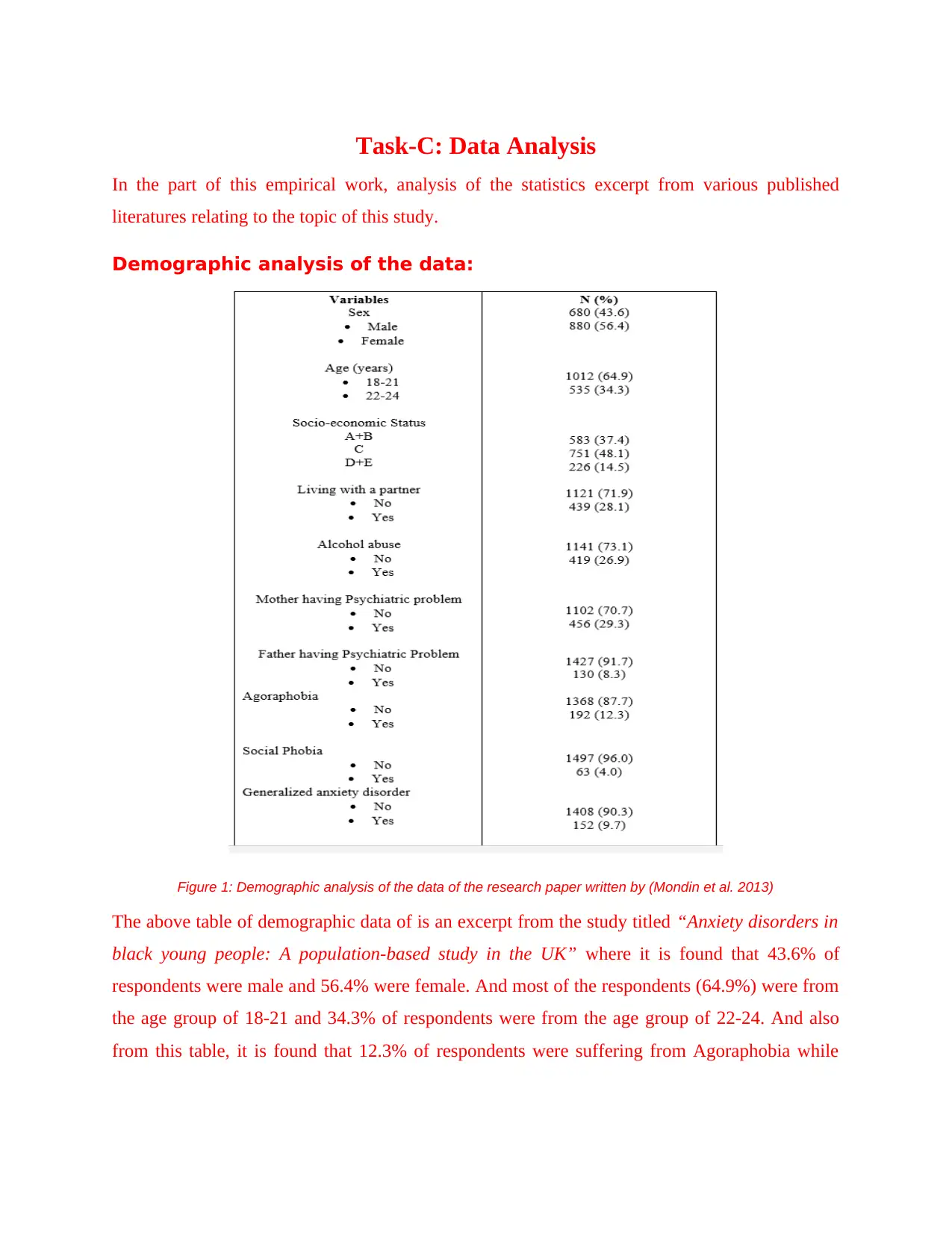
Figure 1: Demographic analysis of the data of the research paper written by (Mondin et al. 2013)
The above table of demographic data of is an excerpt from the study titled “Anxiety disorders in
black young people: A population-based study in the UK” where it is found that 43.6% of
respondents were male and 56.4% were female. And most of the respondents (64.9%) were from
the age group of 18-21 and 34.3% of respondents were from the age group of 22-24. And also
from this table, it is found that 12.3% of respondents were suffering from Agoraphobia while
In the part of this empirical work, analysis of the statistics excerpt from various published
literatures relating to the topic of this study.
Demographic analysis of the data:
Figure 1: Demographic analysis of the data of the research paper written by (Mondin et al. 2013)
The above table of demographic data of is an excerpt from the study titled “Anxiety disorders in
black young people: A population-based study in the UK” where it is found that 43.6% of
respondents were male and 56.4% were female. And most of the respondents (64.9%) were from
the age group of 18-21 and 34.3% of respondents were from the age group of 22-24. And also
from this table, it is found that 12.3% of respondents were suffering from Agoraphobia while
4.0% of respondents were going through social phobia, and also 9.7% respondents were
suffering from Generalized anxiety disorder.
Prevalence data regarding the causes associated with the anxiety
disorder in the case of black young adults aged between (18-30) in
UK
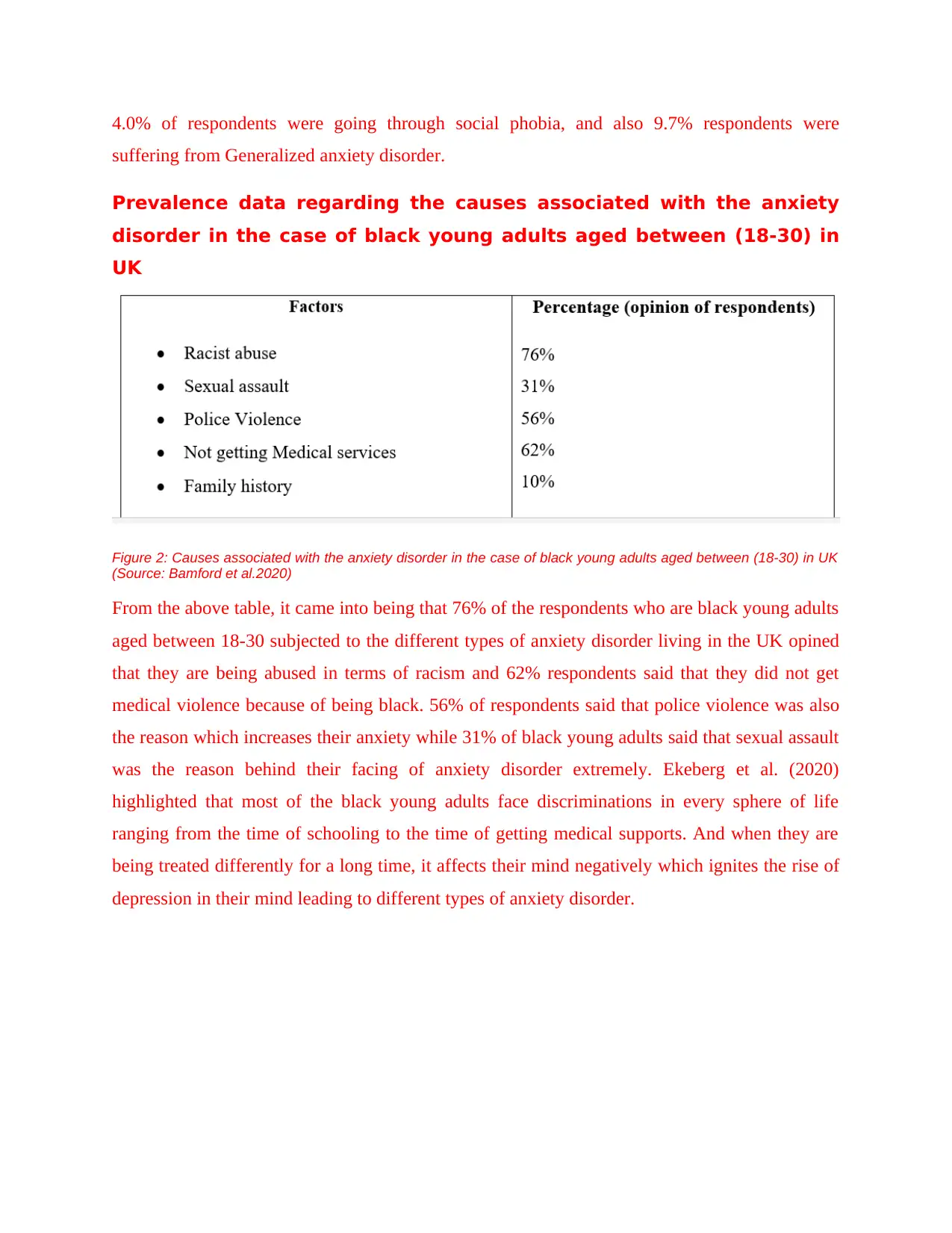
Figure 2: Causes associated with the anxiety disorder in the case of black young adults aged between (18-30) in UK
(Source: Bamford et al.2020)
From the above table, it came into being that 76% of the respondents who are black young adults
aged between 18-30 subjected to the different types of anxiety disorder living in the UK opined
that they are being abused in terms of racism and 62% respondents said that they did not get
medical violence because of being black. 56% of respondents said that police violence was also
the reason which increases their anxiety while 31% of black young adults said that sexual assault
was the reason behind their facing of anxiety disorder extremely. Ekeberg et al. (2020)
highlighted that most of the black young adults face discriminations in every sphere of life
ranging from the time of schooling to the time of getting medical supports. And when they are
being treated differently for a long time, it affects their mind negatively which ignites the rise of
depression in their mind leading to different types of anxiety disorder.
suffering from Generalized anxiety disorder.
Prevalence data regarding the causes associated with the anxiety
disorder in the case of black young adults aged between (18-30) in
UK
Figure 2: Causes associated with the anxiety disorder in the case of black young adults aged between (18-30) in UK
(Source: Bamford et al.2020)
From the above table, it came into being that 76% of the respondents who are black young adults
aged between 18-30 subjected to the different types of anxiety disorder living in the UK opined
that they are being abused in terms of racism and 62% respondents said that they did not get
medical violence because of being black. 56% of respondents said that police violence was also
the reason which increases their anxiety while 31% of black young adults said that sexual assault
was the reason behind their facing of anxiety disorder extremely. Ekeberg et al. (2020)
highlighted that most of the black young adults face discriminations in every sphere of life
ranging from the time of schooling to the time of getting medical supports. And when they are
being treated differently for a long time, it affects their mind negatively which ignites the rise of
depression in their mind leading to different types of anxiety disorder.
⊘ This is a preview!⊘
Do you want full access?
Subscribe today to unlock all pages.
Trusted by 1+ million students worldwide
Analysis of the trends by using two variables in two different
periods
From the review of the papers of (Donaldson et al. 2020; Stein et al. 2001; Secer, 2019), It is
found that low unemployment and race discriminations are the two commonly defined factors
that influence anxiety disorder among the people of black ethnics. And that is why these two
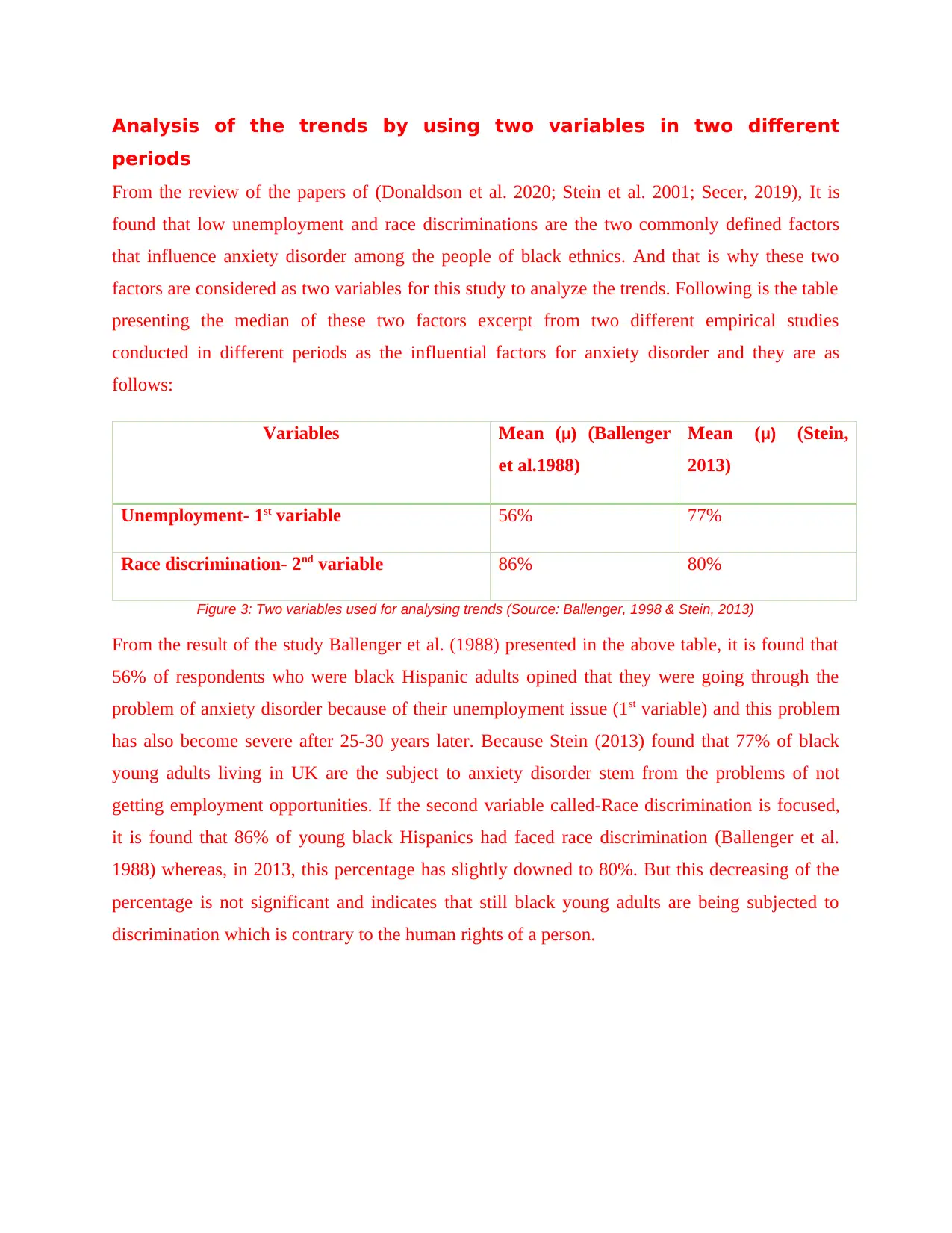
factors are considered as two variables for this study to analyze the trends. Following is the table
presenting the median of these two factors excerpt from two different empirical studies
conducted in different periods as the influential factors for anxiety disorder and they are as
follows:
Variables Mean (μ) (Ballenger
et al.1988)
Mean (μ) (Stein,
2013)
Unemployment- 1st variable 56% 77%
Race discrimination- 2nd variable 86% 80%
Figure 3: Two variables used for analysing trends (Source: Ballenger, 1998 & Stein, 2013)
From the result of the study Ballenger et al. (1988) presented in the above table, it is found that
56% of respondents who were black Hispanic adults opined that they were going through the
problem of anxiety disorder because of their unemployment issue (1st variable) and this problem
has also become severe after 25-30 years later. Because Stein (2013) found that 77% of black
young adults living in UK are the subject to anxiety disorder stem from the problems of not
getting employment opportunities. If the second variable called-Race discrimination is focused,
it is found that 86% of young black Hispanics had faced race discrimination (Ballenger et al.
1988) whereas, in 2013, this percentage has slightly downed to 80%. But this decreasing of the
percentage is not significant and indicates that still black young adults are being subjected to
discrimination which is contrary to the human rights of a person.
periods
From the review of the papers of (Donaldson et al. 2020; Stein et al. 2001; Secer, 2019), It is
found that low unemployment and race discriminations are the two commonly defined factors
that influence anxiety disorder among the people of black ethnics. And that is why these two
factors are considered as two variables for this study to analyze the trends. Following is the table
presenting the median of these two factors excerpt from two different empirical studies
conducted in different periods as the influential factors for anxiety disorder and they are as
follows:
Variables Mean (μ) (Ballenger
et al.1988)
Mean (μ) (Stein,
2013)
Unemployment- 1st variable 56% 77%
Race discrimination- 2nd variable 86% 80%
Figure 3: Two variables used for analysing trends (Source: Ballenger, 1998 & Stein, 2013)
From the result of the study Ballenger et al. (1988) presented in the above table, it is found that
56% of respondents who were black Hispanic adults opined that they were going through the
problem of anxiety disorder because of their unemployment issue (1st variable) and this problem
has also become severe after 25-30 years later. Because Stein (2013) found that 77% of black
young adults living in UK are the subject to anxiety disorder stem from the problems of not
getting employment opportunities. If the second variable called-Race discrimination is focused,
it is found that 86% of young black Hispanics had faced race discrimination (Ballenger et al.
1988) whereas, in 2013, this percentage has slightly downed to 80%. But this decreasing of the
percentage is not significant and indicates that still black young adults are being subjected to
discrimination which is contrary to the human rights of a person.
Paraphrase This Document
Need a fresh take? Get an instant paraphrase of this document with our AI Paraphraser

Task-D: Policy analysis of UK
The government of the UK has been introducing a lot of policies regarding the protection and
betterment of mental health or solving the problem of anxiety disorder of the people of the UK.
In the last year, the UK government prepared the coronavirus act-2020 under which if young
people suffering from Coronavirus faced anxiety disorder problem, they will be specially treated
for their mental health development (Coltart et al. 2020). However, this provision was withdrawn
on 9th December 2020 by gainsaying that the NHS England is enough for caring the coronavirus
patient and patients with anxiety disorder (Grosios et al. 2020). NHS England and its partners
introduced a policy regarding mental health called “NHS five-year forward view” to achieve the
objective of providing equal importance and service to both physical and mental health
(Donaldson et al. 2020). As per the aforesaid policy, NHS increased the access to Psychological
Therapies Programme in the year of 2018 where doubled number of people got psychological
treatments compared to the last 4 years and also a big investment is made to create special young
adult ward to provide the best mental health care services. However, Secer (2019) suggested
including initiatives of the government in the area of employment, housing, and health care
opportunities because those are the reasons behind the depressions and anxiety disorder of young
people. Moreover, to ensure sustainable infrastructure and mental health practice, NHS England
took the initiative to gather a huge amount of local funding, and also this will be led to the
collection of local funds amount of £2.3 billion a year by 2023/24 (Grosios et al. 2014).
In the year of 2017, the UK government provides a report titled “thriving at work” for the
employers to do something to improve the mental health of employees by providing some
suggestions and some of them are as follows (Donaldson et al. 2014):
Preparing a plan that will ensure the monitoring of the mental health of employees and
will enable the employees to communicate with the mental health experts without facing
any kind of hesitation.
Providing the opportunity of having a good work-life balance to the employees.
Ensuring Quality management of employees by HRM.
The Department of Health and Social Care (DHSC) created a cross-governmental action plan to
mitigate the Suicides of people including young adults. In this plan, a national suicide decreasing
The government of the UK has been introducing a lot of policies regarding the protection and
betterment of mental health or solving the problem of anxiety disorder of the people of the UK.
In the last year, the UK government prepared the coronavirus act-2020 under which if young
people suffering from Coronavirus faced anxiety disorder problem, they will be specially treated
for their mental health development (Coltart et al. 2020). However, this provision was withdrawn
on 9th December 2020 by gainsaying that the NHS England is enough for caring the coronavirus
patient and patients with anxiety disorder (Grosios et al. 2020). NHS England and its partners
introduced a policy regarding mental health called “NHS five-year forward view” to achieve the
objective of providing equal importance and service to both physical and mental health
(Donaldson et al. 2020). As per the aforesaid policy, NHS increased the access to Psychological
Therapies Programme in the year of 2018 where doubled number of people got psychological
treatments compared to the last 4 years and also a big investment is made to create special young
adult ward to provide the best mental health care services. However, Secer (2019) suggested
including initiatives of the government in the area of employment, housing, and health care
opportunities because those are the reasons behind the depressions and anxiety disorder of young
people. Moreover, to ensure sustainable infrastructure and mental health practice, NHS England
took the initiative to gather a huge amount of local funding, and also this will be led to the
collection of local funds amount of £2.3 billion a year by 2023/24 (Grosios et al. 2014).
In the year of 2017, the UK government provides a report titled “thriving at work” for the
employers to do something to improve the mental health of employees by providing some
suggestions and some of them are as follows (Donaldson et al. 2014):
Preparing a plan that will ensure the monitoring of the mental health of employees and
will enable the employees to communicate with the mental health experts without facing
any kind of hesitation.
Providing the opportunity of having a good work-life balance to the employees.
Ensuring Quality management of employees by HRM.
The Department of Health and Social Care (DHSC) created a cross-governmental action plan to
mitigate the Suicides of people including young adults. In this plan, a national suicide decreasing
⊘ This is a preview!⊘
Do you want full access?
Subscribe today to unlock all pages.
Trusted by 1+ million students worldwide

1 out of 16


Related Documents


Your All-in-One AI-Powered Toolkit for Academic Success.
+13062052269
info@desklib.com
Available 24*7 on WhatsApp / Email
![[object Object]](/_next/static/media/star-bottom.7253800d.svg)
Unlock your academic potential
Copyright © 2020–2026 A2Z Services. All Rights Reserved. Developed and managed by ZUCOL.