Anxiety Disorder Report: Analysis of Symptoms and Interventions

Verified

Added on  2019/11/25

|4
|580
|263
Report
AI Summary
This report focuses on anxiety disorders, specifically examining social anxiety disorder and generalized anxiety disorder. It delves into the symptoms of these disorders, such as social avoidance, self-consciousness, and physical symptoms, and discusses the challenges in diagnosing these conditions, particularly in older adults. The report highlights the use of the GAD-7 scale for assessment and explores various interventions, including supportive medication and psychotherapy, like problem-solving therapy and cognitive behavioral therapy, to help manage and treat anxiety disorders. The provided references support the discussed information.
Document Page
Running head: ANXIETY BASED DISORDERS AND INTERVENTIONS
ANXIETY BASED DISORDERS AND INTERVENTIONS
Name of the Student
Name of the University
Author note
tabler-icon-diamond-filled.svg

Paraphrase This Document

Need a fresh take? Get an instant paraphrase of this document with our AI Paraphraser
Document Page
1ANXIETY BASED DISORDERS AND INTERVENTIONS
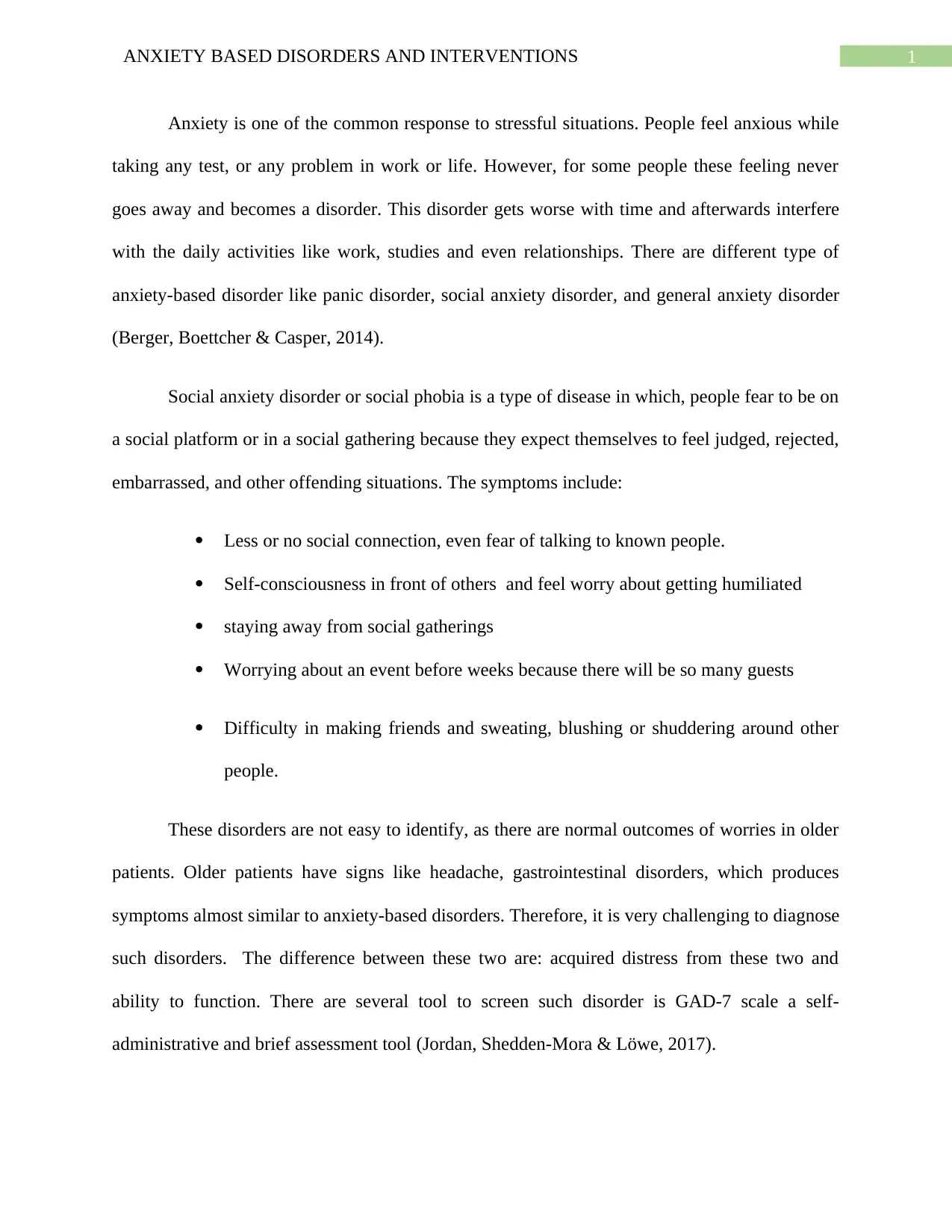
Anxiety is one of the common response to stressful situations. People feel anxious while
taking any test, or any problem in work or life. However, for some people these feeling never
goes away and becomes a disorder. This disorder gets worse with time and afterwards interfere
with the daily activities like work, studies and even relationships. There are different type of
anxiety-based disorder like panic disorder, social anxiety disorder, and general anxiety disorder
(Berger, Boettcher & Casper, 2014).
Social anxiety disorder or social phobia is a type of disease in which, people fear to be on
a social platform or in a social gathering because they expect themselves to feel judged, rejected,
embarrassed, and other offending situations. The symptoms include:
Less or no social connection, even fear of talking to known people.
Self-consciousness in front of others and feel worry about getting humiliated
staying away from social gatherings
Worrying about an event before weeks because there will be so many guests
Difficulty in making friends and sweating, blushing or shuddering around other
people.
These disorders are not easy to identify, as there are normal outcomes of worries in older
patients. Older patients have signs like headache, gastrointestinal disorders, which produces
symptoms almost similar to anxiety-based disorders. Therefore, it is very challenging to diagnose
such disorders. The difference between these two are: acquired distress from these two and
ability to function. There are several tool to screen such disorder is GAD-7 scale a self-
administrative and brief assessment tool (Jordan, Shedden-Mora & Löwe, 2017).
Document Page
2ANXIETY BASED DISORDERS AND INTERVENTIONS
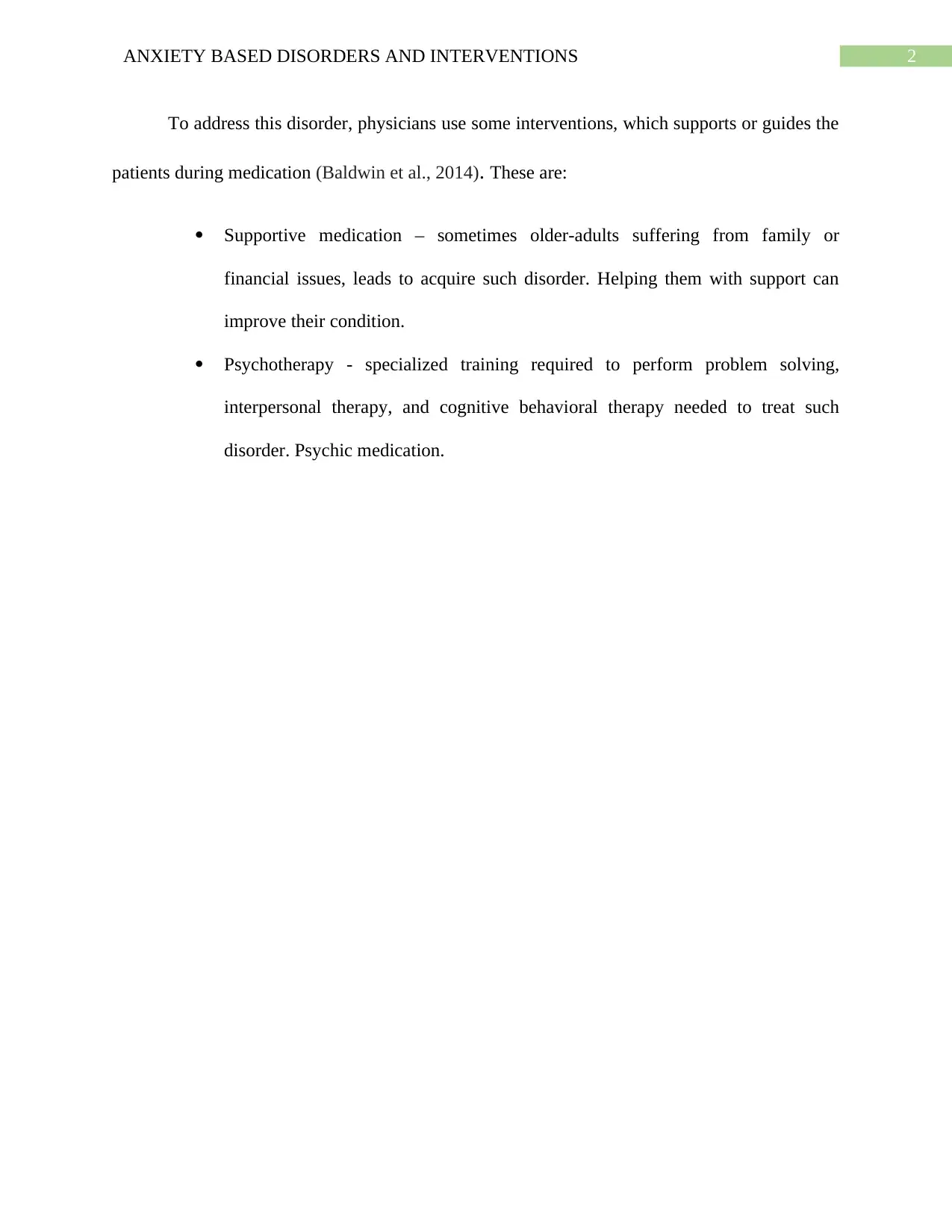
To address this disorder, physicians use some interventions, which supports or guides the
patients during medication (Baldwin et al., 2014). These are:
Supportive medication sometimes older-adults suffering from family or
financial issues, leads to acquire such disorder. Helping them with support can
improve their condition.
Psychotherapy - specialized training required to perform problem solving,
interpersonal therapy, and cognitive behavioral therapy needed to treat such
disorder. Psychic medication.
Document Page
3ANXIETY BASED DISORDERS AND INTERVENTIONS
Reference
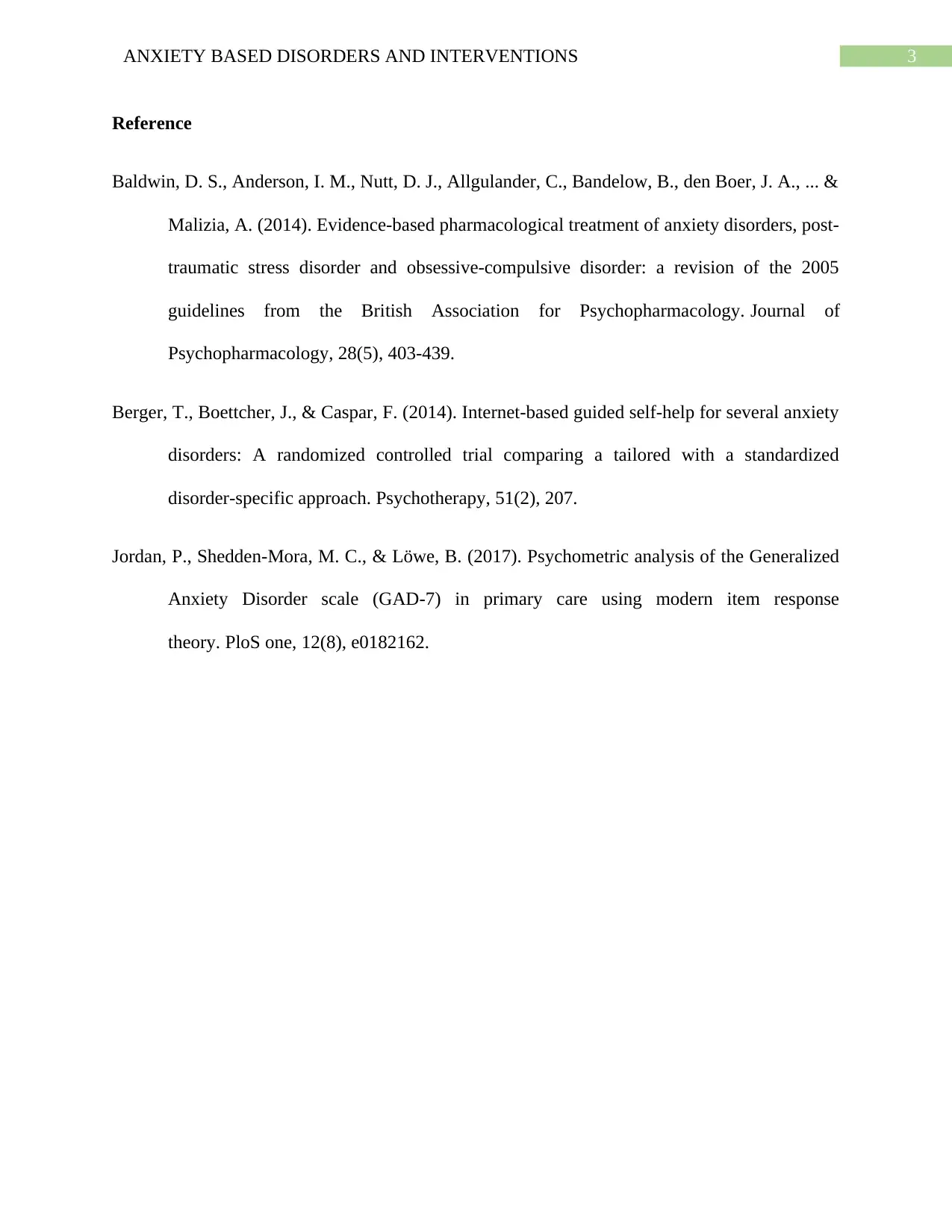
Baldwin, D. S., Anderson, I. M., Nutt, D. J., Allgulander, C., Bandelow, B., den Boer, J. A., ... &
Malizia, A. (2014). Evidence-based pharmacological treatment of anxiety disorders, post-
traumatic stress disorder and obsessive-compulsive disorder: a revision of the 2005
guidelines from the British Association for Psychopharmacology. Journal of
Psychopharmacology, 28(5), 403-439.
Berger, T., Boettcher, J., & Caspar, F. (2014). Internet-based guided self-help for several anxiety
disorders: A randomized controlled trial comparing a tailored with a standardized
disorder-specific approach. Psychotherapy, 51(2), 207.
Jordan, P., Shedden-Mora, M. C., & Löwe, B. (2017). Psychometric analysis of the Generalized
Anxiety Disorder scale (GAD-7) in primary care using modern item response
theory. PloS one, 12(8), e0182162.
chevron_up_icon
1 out of 4
circle_padding
hide_on_mobile
zoom_out_icon
[object Object]