The 1960s: Political, Social, Economic Changes in South Africa

Verified

Added on  2020/02/19

|6
|1568
|34
Essay
AI Summary
This essay delves into the transformative decade of the 1960s in South Africa, focusing on the profound social, political, cultural, and economic shifts that occurred during the implementation of apartheid. It examines the rise of discriminatory racial policies, police brutality, and the suppression of political dissent, including the Sharpeville massacre, which served as a turning point. The paper analyzes the responses of liberation movements like the ANC and PAC, the government's repressive measures, and the resulting economic impacts, including the effects of import substitution and labor discrimination. Furthermore, the essay explores the pervasive social and cultural segregation, the impacts of segregation on planners and planning, and how planners, and planning responded to these changes. The conclusion highlights the adverse consequences of apartheid on various aspects of life and the challenges faced by planners in navigating the political landscape.
Document Page
THE 1960’S CHANGES
1
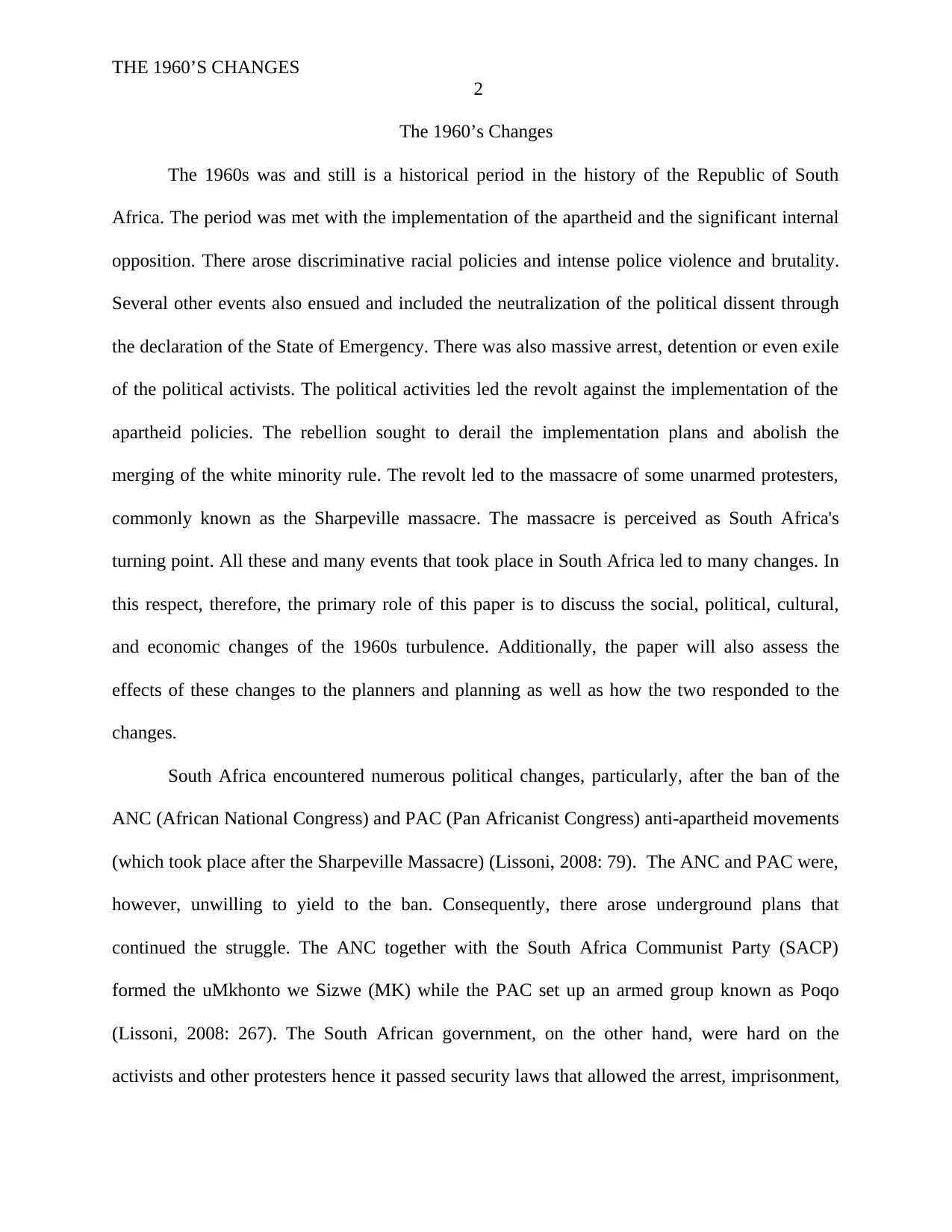
The 1960’s Changes
Student’s Name
Code + Course Name
Professor’s Name
University Name
City, State
Date
tabler-icon-diamond-filled.svg

Paraphrase This Document

Need a fresh take? Get an instant paraphrase of this document with our AI Paraphraser
Document Page
THE 1960’S CHANGES
2
The 1960’s Changes
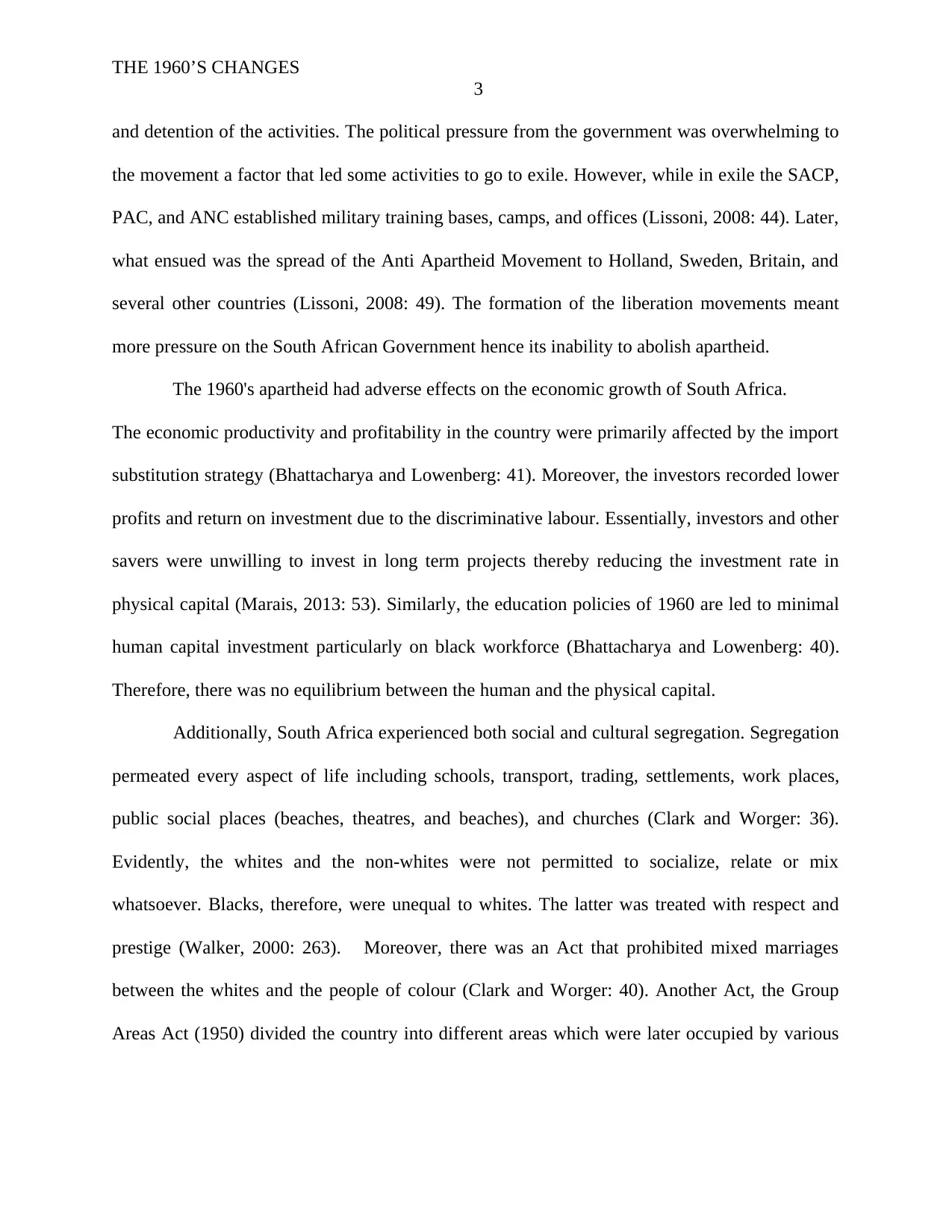
The 1960s was and still is a historical period in the history of the Republic of South
Africa. The period was met with the implementation of the apartheid and the significant internal
opposition. There arose discriminative racial policies and intense police violence and brutality.
Several other events also ensued and included the neutralization of the political dissent through
the declaration of the State of Emergency. There was also massive arrest, detention or even exile
of the political activists. The political activities led the revolt against the implementation of the
apartheid policies. The rebellion sought to derail the implementation plans and abolish the
merging of the white minority rule. The revolt led to the massacre of some unarmed protesters,
commonly known as the Sharpeville massacre. The massacre is perceived as South Africa's
turning point. All these and many events that took place in South Africa led to many changes. In
this respect, therefore, the primary role of this paper is to discuss the social, political, cultural,
and economic changes of the 1960s turbulence. Additionally, the paper will also assess the
effects of these changes to the planners and planning as well as how the two responded to the
changes.
South Africa encountered numerous political changes, particularly, after the ban of the
ANC (African National Congress) and PAC (Pan Africanist Congress) anti-apartheid movements
(which took place after the Sharpeville Massacre) (Lissoni, 2008: 79). The ANC and PAC were,
however, unwilling to yield to the ban. Consequently, there arose underground plans that
continued the struggle. The ANC together with the South Africa Communist Party (SACP)
formed the uMkhonto we Sizwe (MK) while the PAC set up an armed group known as Poqo
(Lissoni, 2008: 267). The South African government, on the other hand, were hard on the
activists and other protesters hence it passed security laws that allowed the arrest, imprisonment,
Document Page
THE 1960’S CHANGES
3
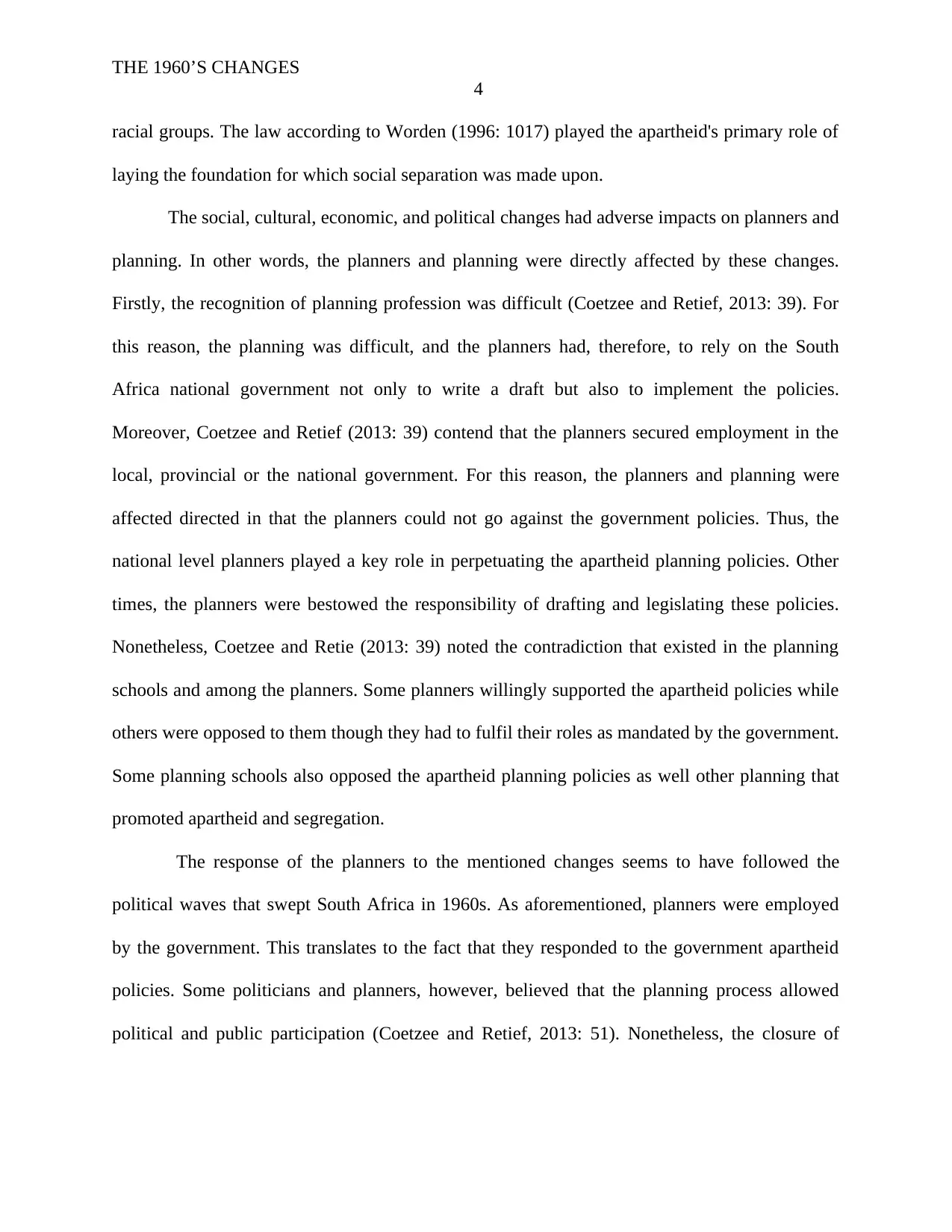
and detention of the activities. The political pressure from the government was overwhelming to
the movement a factor that led some activities to go to exile. However, while in exile the SACP,
PAC, and ANC established military training bases, camps, and offices (Lissoni, 2008: 44). Later,
what ensued was the spread of the Anti Apartheid Movement to Holland, Sweden, Britain, and
several other countries (Lissoni, 2008: 49). The formation of the liberation movements meant
more pressure on the South African Government hence its inability to abolish apartheid.
The 1960's apartheid had adverse effects on the economic growth of South Africa.
The economic productivity and profitability in the country were primarily affected by the import
substitution strategy (Bhattacharya and Lowenberg: 41). Moreover, the investors recorded lower
profits and return on investment due to the discriminative labour. Essentially, investors and other
savers were unwilling to invest in long term projects thereby reducing the investment rate in
physical capital (Marais, 2013: 53). Similarly, the education policies of 1960 are led to minimal
human capital investment particularly on black workforce (Bhattacharya and Lowenberg: 40).
Therefore, there was no equilibrium between the human and the physical capital.
Additionally, South Africa experienced both social and cultural segregation. Segregation
permeated every aspect of life including schools, transport, trading, settlements, work places,
public social places (beaches, theatres, and beaches), and churches (Clark and Worger: 36).
Evidently, the whites and the non-whites were not permitted to socialize, relate or mix
whatsoever. Blacks, therefore, were unequal to whites. The latter was treated with respect and
prestige (Walker, 2000: 263). Moreover, there was an Act that prohibited mixed marriages
between the whites and the people of colour (Clark and Worger: 40). Another Act, the Group
Areas Act (1950) divided the country into different areas which were later occupied by various
Document Page
THE 1960’S CHANGES
4
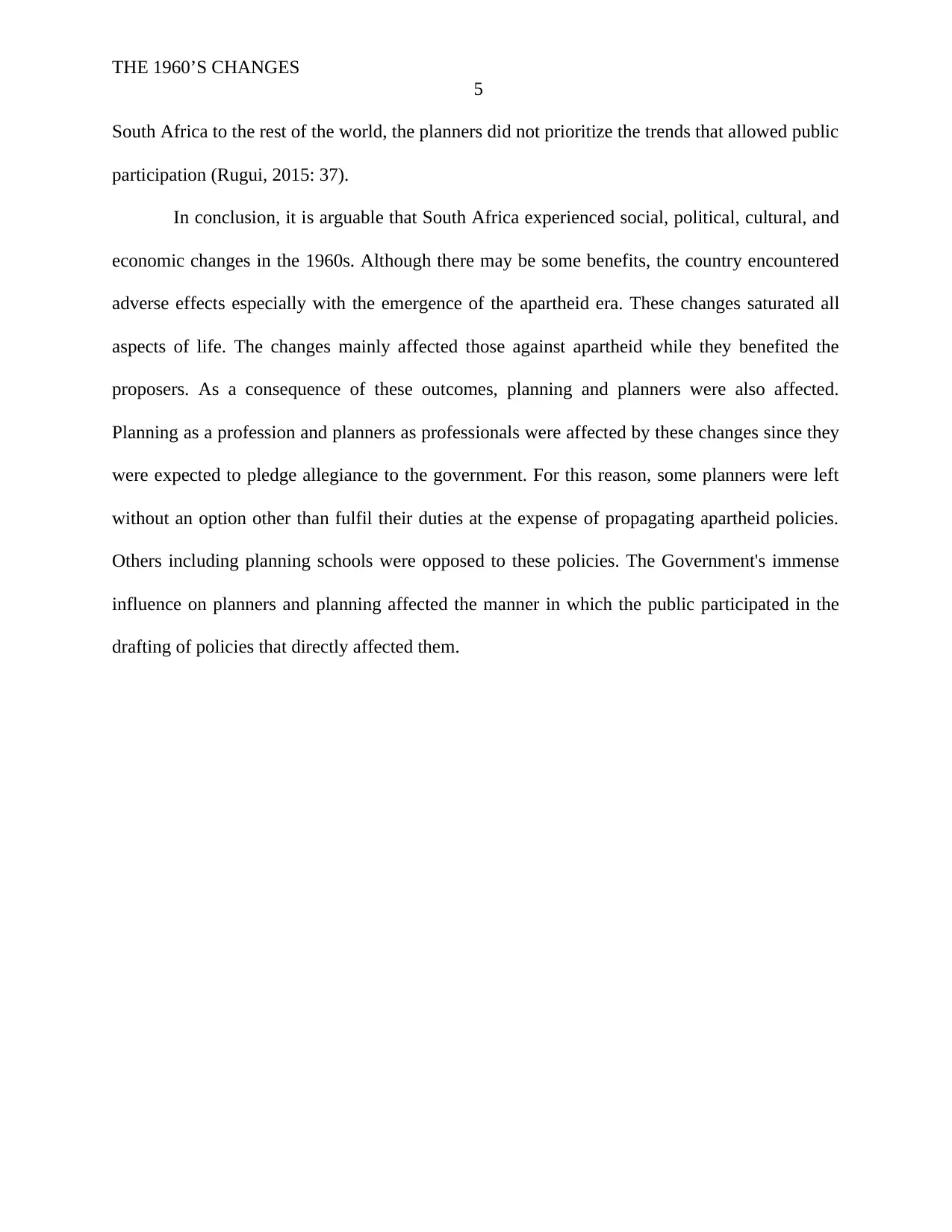
racial groups. The law according to Worden (1996: 1017) played the apartheid's primary role of
laying the foundation for which social separation was made upon.
The social, cultural, economic, and political changes had adverse impacts on planners and
planning. In other words, the planners and planning were directly affected by these changes.
Firstly, the recognition of planning profession was difficult (Coetzee and Retief, 2013: 39). For
this reason, the planning was difficult, and the planners had, therefore, to rely on the South
Africa national government not only to write a draft but also to implement the policies.
Moreover, Coetzee and Retief (2013: 39) contend that the planners secured employment in the
local, provincial or the national government. For this reason, the planners and planning were
affected directed in that the planners could not go against the government policies. Thus, the
national level planners played a key role in perpetuating the apartheid planning policies. Other
times, the planners were bestowed the responsibility of drafting and legislating these policies.
Nonetheless, Coetzee and Retie (2013: 39) noted the contradiction that existed in the planning
schools and among the planners. Some planners willingly supported the apartheid policies while
others were opposed to them though they had to fulfil their roles as mandated by the government.
Some planning schools also opposed the apartheid planning policies as well other planning that
promoted apartheid and segregation.
The response of the planners to the mentioned changes seems to have followed the
political waves that swept South Africa in 1960s. As aforementioned, planners were employed
by the government. This translates to the fact that they responded to the government apartheid
policies. Some politicians and planners, however, believed that the planning process allowed
political and public participation (Coetzee and Retief, 2013: 51). Nonetheless, the closure of
tabler-icon-diamond-filled.svg

Paraphrase This Document

Need a fresh take? Get an instant paraphrase of this document with our AI Paraphraser
Document Page
THE 1960’S CHANGES
5
South Africa to the rest of the world, the planners did not prioritize the trends that allowed public
participation (Rugui, 2015: 37).
In conclusion, it is arguable that South Africa experienced social, political, cultural, and
economic changes in the 1960s. Although there may be some benefits, the country encountered
adverse effects especially with the emergence of the apartheid era. These changes saturated all
aspects of life. The changes mainly affected those against apartheid while they benefited the
proposers. As a consequence of these outcomes, planning and planners were also affected.
Planning as a profession and planners as professionals were affected by these changes since they
were expected to pledge allegiance to the government. For this reason, some planners were left
without an option other than fulfil their duties at the expense of propagating apartheid policies.
Others including planning schools were opposed to these policies. The Government's immense
influence on planners and planning affected the manner in which the public participated in the
drafting of policies that directly affected them.
Document Page
THE 1960’S CHANGES
6
References
Bhattacharya, R. and Lowenberg, A.D., (2010). Impact of apartheid on economic growth:
implications and empirical evidence from South Africa. Comparative Economic Studies, 52(1),
pp.38-61.
Coetzee, J., and Retief, M. (2013).Cities to be Tamed? Standards and Alternative in the
Transformation of Urban South Conference Proceedings. The Journal of Urbanisation, (26)1:
38-54.
Clark, N.L. and Worger, W.H., (2016). South Africa: The rise and fall of apartheid. Routledge.
Lissoni, A., (2008). The South African Liberation Movements in Exile, c. 1945–1970. PhD.,
University of London.
Marais, H., (2013). South Africa pushed to the limit: The political economy of change. Zed
Books Ltd..
Rugui, P., (2015). Review & Amendment of the Planning Profession Act (36 of 2002).
Walker, V.S., (2000). Valued segregated schools for African American children in the South,
1935-1969: A review of common themes and characteristics. Review of Educational Research,
70(3), pp.253-285.
Worden, N., (1996). The making of modern South Africa: Conquest, segregation and apartheid.
The English Historical Review, 111(443), pp.1016-1018.
chevron_up_icon
1 out of 6
circle_padding
hide_on_mobile
zoom_out_icon
[object Object]