An Analysis of Apple's Brand Management: A Comprehensive Report
VerifiedAdded on 2020/11/12
|10
|2814
|467
Report
AI Summary
This report provides an in-depth analysis of Apple Inc.'s brand management strategies. It explores how Apple leverages its brand through collaborations, such as the partnership with Nike, and the use of brand extension techniques. The report delves into the different methods Apple employs to measure brand value, including customer feedback, online traffic, and employee turnover, as well as the application of Keller's Brand Equity Model. It evaluates the advantages and disadvantages of these techniques, offering insights into how Apple maintains and enhances its brand image. The report also examines the impact of brand management on customer satisfaction and the company's overall success. It concludes by summarizing the key findings and emphasizing the importance of brand management in achieving organizational goals.

BRAND MANAGEMENT

Paraphrase This Document
Need a fresh take? Get an instant paraphrase of this document with our AI Paraphraser
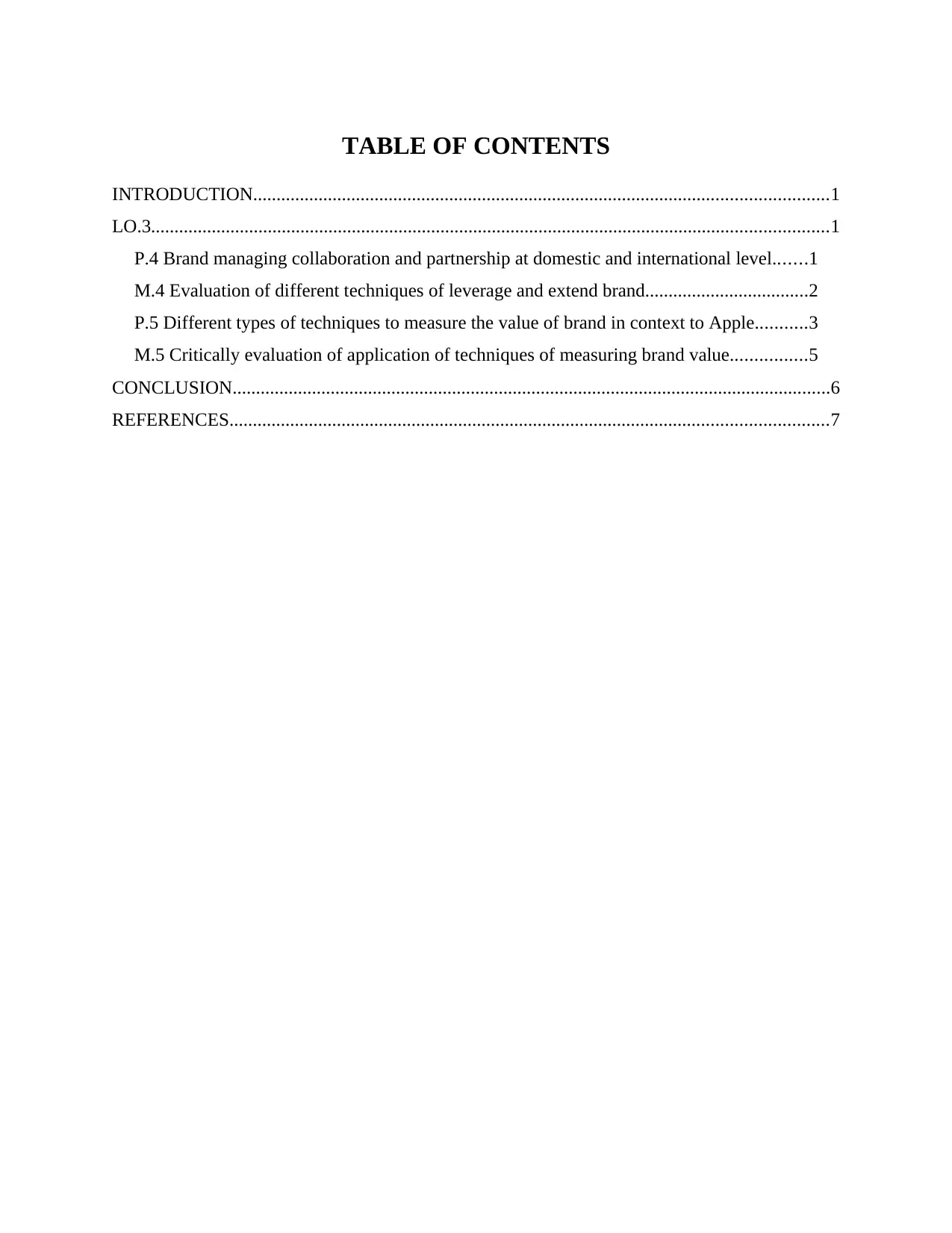
TABLE OF CONTENTS
INTRODUCTION...........................................................................................................................1
LO.3.................................................................................................................................................1
P.4 Brand managing collaboration and partnership at domestic and international level.......1
M.4 Evaluation of different techniques of leverage and extend brand...................................2
P.5 Different types of techniques to measure the value of brand in context to Apple...........3
M.5 Critically evaluation of application of techniques of measuring brand value................5
CONCLUSION................................................................................................................................6
REFERENCES................................................................................................................................7
INTRODUCTION...........................................................................................................................1
LO.3.................................................................................................................................................1
P.4 Brand managing collaboration and partnership at domestic and international level.......1
M.4 Evaluation of different techniques of leverage and extend brand...................................2
P.5 Different types of techniques to measure the value of brand in context to Apple...........3
M.5 Critically evaluation of application of techniques of measuring brand value................5
CONCLUSION................................................................................................................................6
REFERENCES................................................................................................................................7
INTRODUCTION
Brand management is the process of maintaining, improving and upholding a brand so
that the name is associated with the positive results. Brand management includes a number of
essential aspects like customer satisfaction, cost, in-store presentation and competition. It is fact
that the success of the company will not be longer period if management of brand will not be
focused (Rosenbaum-Elliott, Percy and Pervan, 2015). In this present report, Apple Inc. is being
chosen for assessment. It is an American multinational technology company headquartered in
Cupertino, California that design, develop and sell consumer electronic products. This present
report will explain how brand are leveraged overtime domestically and internationally.
Furthermore, report will also evaluate the techniques for measuring value of brand over time.
LO.3
P.4 Brand managing collaboration and partnership at domestic and international level.
There are different brands that collaborate and develop effective partnership at domestic
and international level to achieve the desire goals and objectives of the company. Apple uses to
follow brand leveraging technique (Heding, Knudtzen and Bjerre, 2015). It is the strategy in
which the power of existing brand mane is use in order to support the entry of company into a
new but similar category of product by transmitting valuable information to customers.
Brand Extension vs Line Extension: This is another brand technique that Apple used to
manage the brand as well as keep in touch with the customers. There are two strategies called
line extension and brand extensions. When organisation present extra product in the similar
category of products under the same brand name is called as line extensions. For example, Apple
used to provide head phones, fast chargers, mobile cover with temper glass etc. On the other
hand, brand extension is totally different as when company launch new product that is totally
different from product category.
In order to manage the brand in effective and long lasting way in collaboration and
partnership both in global and domestic level. There is two strongest brand Apple and Nike
which is the example successful and great partnership. These two global brands combine
together with the passion to create a useful as well as great customer product experience with the
aid of design and innovation.
Applications of Nike: There are number of applications of Nike for fitness in the market
for customers, but Nike is recognised brand in sports. Nike is one of the recognised brand and
1
Brand management is the process of maintaining, improving and upholding a brand so
that the name is associated with the positive results. Brand management includes a number of
essential aspects like customer satisfaction, cost, in-store presentation and competition. It is fact
that the success of the company will not be longer period if management of brand will not be
focused (Rosenbaum-Elliott, Percy and Pervan, 2015). In this present report, Apple Inc. is being
chosen for assessment. It is an American multinational technology company headquartered in
Cupertino, California that design, develop and sell consumer electronic products. This present
report will explain how brand are leveraged overtime domestically and internationally.
Furthermore, report will also evaluate the techniques for measuring value of brand over time.
LO.3
P.4 Brand managing collaboration and partnership at domestic and international level.
There are different brands that collaborate and develop effective partnership at domestic
and international level to achieve the desire goals and objectives of the company. Apple uses to
follow brand leveraging technique (Heding, Knudtzen and Bjerre, 2015). It is the strategy in
which the power of existing brand mane is use in order to support the entry of company into a
new but similar category of product by transmitting valuable information to customers.
Brand Extension vs Line Extension: This is another brand technique that Apple used to
manage the brand as well as keep in touch with the customers. There are two strategies called
line extension and brand extensions. When organisation present extra product in the similar
category of products under the same brand name is called as line extensions. For example, Apple
used to provide head phones, fast chargers, mobile cover with temper glass etc. On the other
hand, brand extension is totally different as when company launch new product that is totally
different from product category.
In order to manage the brand in effective and long lasting way in collaboration and
partnership both in global and domestic level. There is two strongest brand Apple and Nike
which is the example successful and great partnership. These two global brands combine
together with the passion to create a useful as well as great customer product experience with the
aid of design and innovation.
Applications of Nike: There are number of applications of Nike for fitness in the market
for customers, but Nike is recognised brand in sports. Nike is one of the recognised brand and
1
⊘ This is a preview!⊘
Do you want full access?
Subscribe today to unlock all pages.

Trusted by 1+ million students worldwide
leading organisation in sports. Thus, On App store, Nike running application and training has
becomes one of the most popular health and fitness application. With the help of running
application, a person can track the number of runs as well as aids to accomplish the goals with
the aspect of making new records and this app has merged as one of the largest running
community as it motivates the person to improve the health and keep the body fit. After some
time, Nike has felt that it is not suitable for all users because every one do not do running. Thus,
to solve this issue, Nike has developed the Training Club especially for women and girls. This
main purpose of this club is to provide fitness to women by rendering more than 100 workouts.
I pod Sport Kit: The position achieved by Nike through this app store is incredible but
after the collaboration with the kin of electronic industry which is Apple Inc. the collaboration
was done in 2016 and after 2016 the success is recorded in the history, Nike is gaining
continuous success. The first project that is launched after the collaboration with Apple is I Pod
sports kit (Atwal and Williams, 2017). The main purpose of designing I Pod is for sports person
for their relaxation like playing songs. The Nike + sensor could be slipped in to any show that
provides feedback in the distance of runner, calories burned and pace instantly through the users
iPod headphones.
The reason backside the success collaboration between Nike with Apple
It is fact that the collaboration of Nike and Apple achieve great heights in the market.
There are many reason's backside the success or achieving great height through collaboration
between two brands are as follows-
The brand image of both the parties are improved with this collaboration and it has raised
the customer awareness.
The market share of the both the brands are increases as the customers of Apple brand
become Nike customers and Nike customers have become Apple customers.
Further, this strategy also help company to explore different market (Çifci and et,al.,
2016).
In addition to this, brand value is increased by a successful collaboration.
M.4 Evaluation of different techniques of leverage and extend brand.
The company apple uses the brand extension in order to manage the brand image. The
brand extension is used to promote the company in many different ways by bringing various
2
becomes one of the most popular health and fitness application. With the help of running
application, a person can track the number of runs as well as aids to accomplish the goals with
the aspect of making new records and this app has merged as one of the largest running
community as it motivates the person to improve the health and keep the body fit. After some
time, Nike has felt that it is not suitable for all users because every one do not do running. Thus,
to solve this issue, Nike has developed the Training Club especially for women and girls. This
main purpose of this club is to provide fitness to women by rendering more than 100 workouts.
I pod Sport Kit: The position achieved by Nike through this app store is incredible but
after the collaboration with the kin of electronic industry which is Apple Inc. the collaboration
was done in 2016 and after 2016 the success is recorded in the history, Nike is gaining
continuous success. The first project that is launched after the collaboration with Apple is I Pod
sports kit (Atwal and Williams, 2017). The main purpose of designing I Pod is for sports person
for their relaxation like playing songs. The Nike + sensor could be slipped in to any show that
provides feedback in the distance of runner, calories burned and pace instantly through the users
iPod headphones.
The reason backside the success collaboration between Nike with Apple
It is fact that the collaboration of Nike and Apple achieve great heights in the market.
There are many reason's backside the success or achieving great height through collaboration
between two brands are as follows-
The brand image of both the parties are improved with this collaboration and it has raised
the customer awareness.
The market share of the both the brands are increases as the customers of Apple brand
become Nike customers and Nike customers have become Apple customers.
Further, this strategy also help company to explore different market (Çifci and et,al.,
2016).
In addition to this, brand value is increased by a successful collaboration.
M.4 Evaluation of different techniques of leverage and extend brand.
The company apple uses the brand extension in order to manage the brand image. The
brand extension is used to promote the company in many different ways by bringing various
2
Paraphrase This Document
Need a fresh take? Get an instant paraphrase of this document with our AI Paraphraser
products in the market. The apple company collaborated with the company Nike to to achieve the
desired success by increasing its brand value.
It is implemented that the collaboration of the companies Nike and apple can have various
benefits and drawbacks which are as follows-
Advantages-
with the collaboration of the companies Nike and Apple there is valuable sharing of the
creative ideas which is beneficial to both the companies (Black and Veloutsou, 2017).
There is better division of the labour of the company Apple and Nike by there
collaboration. The work is divided between the employees of both the companies which
helps the completion of the work on time.
Disadvantages-
Collaboration becomes a disadvantage as there can be difference in the working styles of
the companies. Both the companies Apple and Nike have there own plans and policies of
the organization.
With the collaboration of the companies there is also the collaboration of the employees
and the leaders. There can be too many leaders by combining both the companies and
conflict may arise between them through the varying leadership styles(Javed, Degong,
and Qadeer, 2019).
P.5 Different types of techniques to measure the value of brand in context to Apple.
The most important aspect of organisation success is its value of brand as it is also known
as key to business goals and objectives. It is fact that the product of company is only responsible
for building or maintaining the brand image. Organisations use different strategies and plan to
create a positive brand image in the market (Powell, 2018). All the firms whether small or big
used to satisfy there customers by providing the effective and quality of products. The value of
brand is aids in achieving the higher satisfaction level of customers satisfaction as well as it also
helps in accomplishing the future growth of the company which is very important.
Here are the different types of techniques to measure the value of brand which are as
follows-
Number of Customers: This is the best and most appropriate along with simple way to
measurer the brand value of the organisation. The profit margin and loss of the company is
3
desired success by increasing its brand value.
It is implemented that the collaboration of the companies Nike and apple can have various
benefits and drawbacks which are as follows-
Advantages-
with the collaboration of the companies Nike and Apple there is valuable sharing of the
creative ideas which is beneficial to both the companies (Black and Veloutsou, 2017).
There is better division of the labour of the company Apple and Nike by there
collaboration. The work is divided between the employees of both the companies which
helps the completion of the work on time.
Disadvantages-
Collaboration becomes a disadvantage as there can be difference in the working styles of
the companies. Both the companies Apple and Nike have there own plans and policies of
the organization.
With the collaboration of the companies there is also the collaboration of the employees
and the leaders. There can be too many leaders by combining both the companies and
conflict may arise between them through the varying leadership styles(Javed, Degong,
and Qadeer, 2019).
P.5 Different types of techniques to measure the value of brand in context to Apple.
The most important aspect of organisation success is its value of brand as it is also known
as key to business goals and objectives. It is fact that the product of company is only responsible
for building or maintaining the brand image. Organisations use different strategies and plan to
create a positive brand image in the market (Powell, 2018). All the firms whether small or big
used to satisfy there customers by providing the effective and quality of products. The value of
brand is aids in achieving the higher satisfaction level of customers satisfaction as well as it also
helps in accomplishing the future growth of the company which is very important.
Here are the different types of techniques to measure the value of brand which are as
follows-
Number of Customers: This is the best and most appropriate along with simple way to
measurer the brand value of the organisation. The profit margin and loss of the company is
3
decided is depended on number of customers and customers are ultimately depends on the
quality of products and services offered by company. There are millions of customers of Apple.
Online Traffic: Today, all companies used to maintain there online websites and provide
online delivery of goods and services to customers. In order to measure the value of brand,
organisation could also use to check the online traffic (Cova and Paranque, 2016). Through
online website, company could judge there popularity at both global or domestic level.
Customers Feedback: This is another way of measuring the value of brand is through
taking feedback of customers. The success of the company is depends on the customers because
customers are highly judgemental. For example, the feedback of I phone of Apple is very
impressive as customers are highly satisfied with the products.
Low Employees Turnover: This is another way to measure the value of brand but it is
apart from the product of the company. It is very important that the employees of the company
should be satisfied and happy with the organisation policy and plans because they are the one
who will lead the company towards success (Langner and et.al., 2016). If labour turnover is very
high than it will directly affect the brand image of the company.
In addition to this, there is model which is also used by the organisations to measure the
vale of brand is Keller's Equity Brands Model which are as follows-
1. Identify who are you? (Salience): This is the first step in this model that means to
identify the presence of the company in the market through customer awareness. Apple use
market segmentation in order to identify the brand identity
2. What are you? (Meaning): This is the step is to identify as well as communicate to
customers the meaning of brands like the real information about the products so that customers
could attract (Drewniak and Karaszewski, 2016). The product of the company able to meet the
demand and needs of customers.
3. What do I think? (Response): This steps ensured that what customers feel and judge
about the product of the company. It is true that customers used to judge the products
continuously so company have to maintain the quality and features of product through the life of
products as same before (Keller's Brand Equity Model, 2017).
4. How much connection? (Resonance): This the step that ensure the connection of
customers with the product of the company and this is very important aspect in building the
brand image and measuring value (Balmer and Chen, 2017). This is on top in the Keller brand
4
quality of products and services offered by company. There are millions of customers of Apple.
Online Traffic: Today, all companies used to maintain there online websites and provide
online delivery of goods and services to customers. In order to measure the value of brand,
organisation could also use to check the online traffic (Cova and Paranque, 2016). Through
online website, company could judge there popularity at both global or domestic level.
Customers Feedback: This is another way of measuring the value of brand is through
taking feedback of customers. The success of the company is depends on the customers because
customers are highly judgemental. For example, the feedback of I phone of Apple is very
impressive as customers are highly satisfied with the products.
Low Employees Turnover: This is another way to measure the value of brand but it is
apart from the product of the company. It is very important that the employees of the company
should be satisfied and happy with the organisation policy and plans because they are the one
who will lead the company towards success (Langner and et.al., 2016). If labour turnover is very
high than it will directly affect the brand image of the company.
In addition to this, there is model which is also used by the organisations to measure the
vale of brand is Keller's Equity Brands Model which are as follows-
1. Identify who are you? (Salience): This is the first step in this model that means to
identify the presence of the company in the market through customer awareness. Apple use
market segmentation in order to identify the brand identity
2. What are you? (Meaning): This is the step is to identify as well as communicate to
customers the meaning of brands like the real information about the products so that customers
could attract (Drewniak and Karaszewski, 2016). The product of the company able to meet the
demand and needs of customers.
3. What do I think? (Response): This steps ensured that what customers feel and judge
about the product of the company. It is true that customers used to judge the products
continuously so company have to maintain the quality and features of product through the life of
products as same before (Keller's Brand Equity Model, 2017).
4. How much connection? (Resonance): This the step that ensure the connection of
customers with the product of the company and this is very important aspect in building the
brand image and measuring value (Balmer and Chen, 2017). This is on top in the Keller brand
4
⊘ This is a preview!⊘
Do you want full access?
Subscribe today to unlock all pages.
Trusted by 1+ million students worldwide
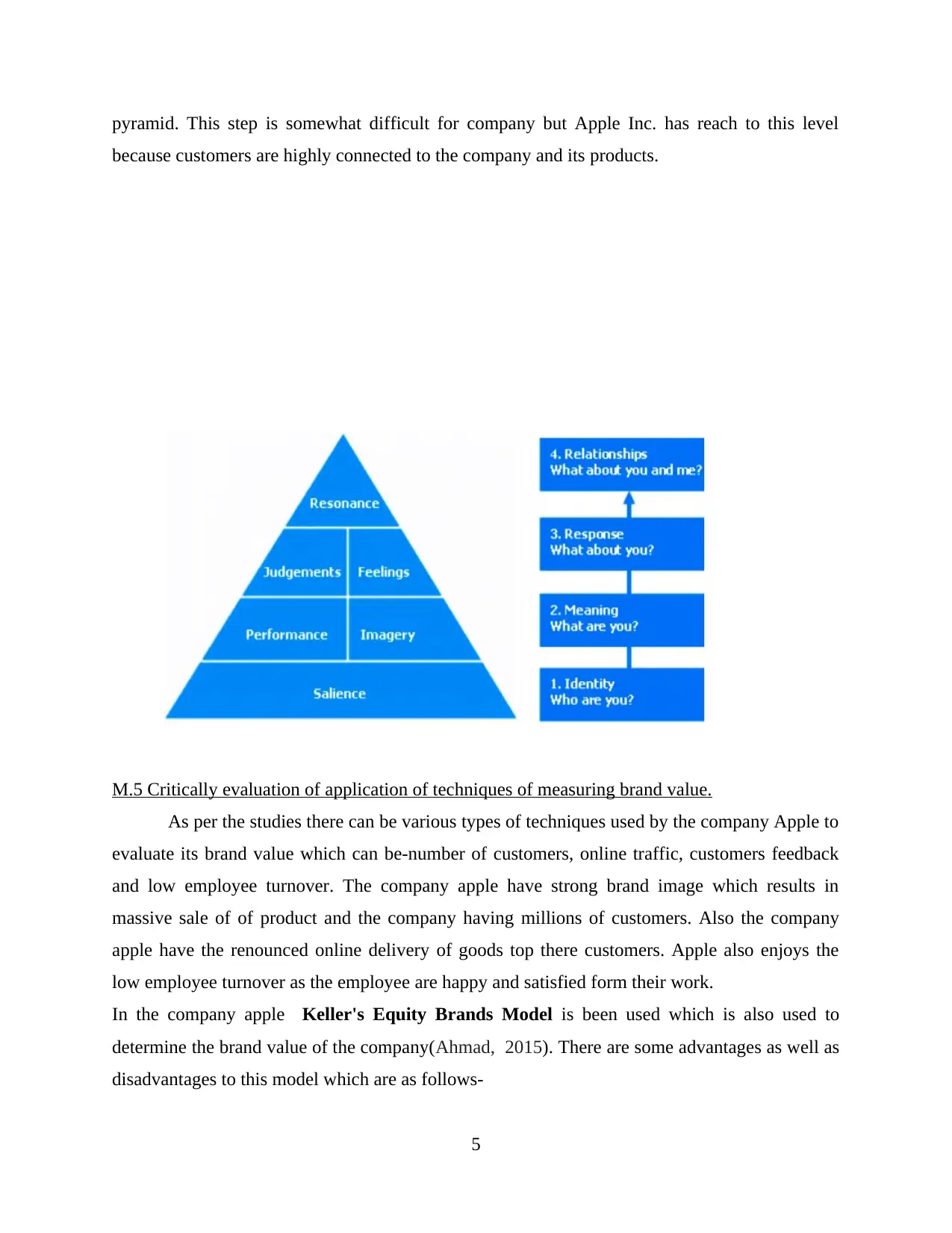
pyramid. This step is somewhat difficult for company but Apple Inc. has reach to this level
because customers are highly connected to the company and its products.
M.5 Critically evaluation of application of techniques of measuring brand value.
As per the studies there can be various types of techniques used by the company Apple to
evaluate its brand value which can be-number of customers, online traffic, customers feedback
and low employee turnover. The company apple have strong brand image which results in
massive sale of of product and the company having millions of customers. Also the company
apple have the renounced online delivery of goods top there customers. Apple also enjoys the
low employee turnover as the employee are happy and satisfied form their work.
In the company apple Keller's Equity Brands Model is been used which is also used to
determine the brand value of the company(Ahmad, 2015). There are some advantages as well as
disadvantages to this model which are as follows-
5
because customers are highly connected to the company and its products.
M.5 Critically evaluation of application of techniques of measuring brand value.
As per the studies there can be various types of techniques used by the company Apple to
evaluate its brand value which can be-number of customers, online traffic, customers feedback
and low employee turnover. The company apple have strong brand image which results in
massive sale of of product and the company having millions of customers. Also the company
apple have the renounced online delivery of goods top there customers. Apple also enjoys the
low employee turnover as the employee are happy and satisfied form their work.
In the company apple Keller's Equity Brands Model is been used which is also used to
determine the brand value of the company(Ahmad, 2015). There are some advantages as well as
disadvantages to this model which are as follows-
5
Paraphrase This Document
Need a fresh take? Get an instant paraphrase of this document with our AI Paraphraser
Advantages-
The keller's brand model is creates the intense and active relationship between the
company Apple and its customers. This is developed by the loyalty of the customers.
By receiving the positive reactions of the customer there is increased brand value of the
company Apple for the future customers.
Disadvantages-
According to the author Kuhn states that there is no role of feelings in the industrial
marketing context and it applies to company Apple also(Hajli and et.al., 2017).
Also suggested that representatives play a role in building brand equity, thus indicating
the need of this model in the company Apple.
CONCLUSION
Brand management is a continues process for improving, maintaining and upholding the
brand with the positive brand results. It also involves the essentials functions of the company for
satisfying the customers. It is fact that he success and growth of the organisation is all depend on
the brand image of the company in the market. This study will conclude collaboration of the
brand managing and also the partnership at domestic and international levels. Furthermore, it
will conclude the major aspects and techniques for value the context of the brand.
6
The keller's brand model is creates the intense and active relationship between the
company Apple and its customers. This is developed by the loyalty of the customers.
By receiving the positive reactions of the customer there is increased brand value of the
company Apple for the future customers.
Disadvantages-
According to the author Kuhn states that there is no role of feelings in the industrial
marketing context and it applies to company Apple also(Hajli and et.al., 2017).
Also suggested that representatives play a role in building brand equity, thus indicating
the need of this model in the company Apple.
CONCLUSION
Brand management is a continues process for improving, maintaining and upholding the
brand with the positive brand results. It also involves the essentials functions of the company for
satisfying the customers. It is fact that he success and growth of the organisation is all depend on
the brand image of the company in the market. This study will conclude collaboration of the
brand managing and also the partnership at domestic and international levels. Furthermore, it
will conclude the major aspects and techniques for value the context of the brand.
6
REFERENCES
Books and Journals:
Ahmad, M.F., 2015. Antecedents of halal brand personality. Journal of Islamic Marketing. 6(2).
pp.209-223.
Atwal, G. and Williams, A., 2017. Luxury brand marketing–the experience is everything!.
In Advances in luxury brand management (pp. 43-57). Palgrave Macmillan, Cham.
Balmer, J.M. and Chen, W., 2017. China’s brands, China’s brand development strategies and
corporate brand communications in China. In Advances in Chinese Brand Management (pp.
19-47). Palgrave Macmillan, London.
Black, I. and Veloutsou, C., 2017. Working consumers: Co-creation of brand identity, consumer
identity and brand community identity. Journal of Business Research.70.pp.416-429.
Çifci, S and et.al., 2016. A cross validation of Consumer-Based Brand Equity models: Driving
customer equity in retail brands. Journal of Business Research. 69(9). pp.3740-3747.
Cova, B. and Paranque, B., 2016. Value slippage in brand transformation: a
conceptualization. Journal of Product & Brand Management.25(1).pp.3-10.
Drewniak, R. and Karaszewski, R., 2016. Brand management in a situation of an economic
crisis: methods of strengthening the brand value in the scope of emerging markets. Asia
Pacific Journal of Marketing and Logistics.28(4).pp.743-758.
Hajli and et.al., 2017. Branding co-creation with members of online brand communities. Journal
of Business Research.70. pp.136-144.
Heding, T., Knudtzen, C.F. and Bjerre, M., 2015. Brand management: Research, theory and
practice. Routledge.
7
Books and Journals:
Ahmad, M.F., 2015. Antecedents of halal brand personality. Journal of Islamic Marketing. 6(2).
pp.209-223.
Atwal, G. and Williams, A., 2017. Luxury brand marketing–the experience is everything!.
In Advances in luxury brand management (pp. 43-57). Palgrave Macmillan, Cham.
Balmer, J.M. and Chen, W., 2017. China’s brands, China’s brand development strategies and
corporate brand communications in China. In Advances in Chinese Brand Management (pp.
19-47). Palgrave Macmillan, London.
Black, I. and Veloutsou, C., 2017. Working consumers: Co-creation of brand identity, consumer
identity and brand community identity. Journal of Business Research.70.pp.416-429.
Çifci, S and et.al., 2016. A cross validation of Consumer-Based Brand Equity models: Driving
customer equity in retail brands. Journal of Business Research. 69(9). pp.3740-3747.
Cova, B. and Paranque, B., 2016. Value slippage in brand transformation: a
conceptualization. Journal of Product & Brand Management.25(1).pp.3-10.
Drewniak, R. and Karaszewski, R., 2016. Brand management in a situation of an economic
crisis: methods of strengthening the brand value in the scope of emerging markets. Asia
Pacific Journal of Marketing and Logistics.28(4).pp.743-758.
Hajli and et.al., 2017. Branding co-creation with members of online brand communities. Journal
of Business Research.70. pp.136-144.
Heding, T., Knudtzen, C.F. and Bjerre, M., 2015. Brand management: Research, theory and
practice. Routledge.
7
⊘ This is a preview!⊘
Do you want full access?
Subscribe today to unlock all pages.
Trusted by 1+ million students worldwide
Hewett, K., Rand, W., Rust, R.T. and Van Heerde, H.J., 2016. Brand buzz in the
echoverse. Journal of Marketing.80(3). pp.1-24.
Javed, M.K., Degong, M. and Qadeer, T., 2019. Relation between Chinese consumers’ ethical
perceptions and purchase intentions: A perspective on ethical company/brand management
strategies. Asia Pacific Journal of Marketing and Logistics.
Langner, S., Schmidt, S., Wiedmann, K.P., Haase, J. and Fritz, S., 2016. Make Brand Love, Not
War: The Power of Combining Explicit and Implicit Brand Attitude Measurement to Detect
Brand Affection. In Let’s Get Engaged! Crossing the Threshold of Marketing’s
Engagement Era (pp. 327-327). Springer, Cham.
Powell, S.M., 2018. Journal of Brand Management: year end review 2018. Journal of Brand
Management. pp.1-6.
Rosenbaum-Elliott, R., Percy, L. and Pervan, S., 2015. Strategic brand management. Oxford
University Press, USA.
Ruane, L. and Wallace, E., 2015. Brand tribalism and self-expressive brands: social influences
and brand outcomes. Journal of Product & Brand Management.24(4).pp.333-348.
Online:
Keller's Brand Equity Model. 2017. [Online]. Accessed through: <http://www.free-
management-ebooks.com/news/kellers-brand-equity-model/>.
8
echoverse. Journal of Marketing.80(3). pp.1-24.
Javed, M.K., Degong, M. and Qadeer, T., 2019. Relation between Chinese consumers’ ethical
perceptions and purchase intentions: A perspective on ethical company/brand management
strategies. Asia Pacific Journal of Marketing and Logistics.
Langner, S., Schmidt, S., Wiedmann, K.P., Haase, J. and Fritz, S., 2016. Make Brand Love, Not
War: The Power of Combining Explicit and Implicit Brand Attitude Measurement to Detect
Brand Affection. In Let’s Get Engaged! Crossing the Threshold of Marketing’s
Engagement Era (pp. 327-327). Springer, Cham.
Powell, S.M., 2018. Journal of Brand Management: year end review 2018. Journal of Brand
Management. pp.1-6.
Rosenbaum-Elliott, R., Percy, L. and Pervan, S., 2015. Strategic brand management. Oxford
University Press, USA.
Ruane, L. and Wallace, E., 2015. Brand tribalism and self-expressive brands: social influences
and brand outcomes. Journal of Product & Brand Management.24(4).pp.333-348.
Online:
Keller's Brand Equity Model. 2017. [Online]. Accessed through: <http://www.free-
management-ebooks.com/news/kellers-brand-equity-model/>.
8

1 out of 10


Related Documents


Your All-in-One AI-Powered Toolkit for Academic Success.
+13062052269
info@desklib.com
Available 24*7 on WhatsApp / Email
![[object Object]](/_next/static/media/star-bottom.7253800d.svg)
Unlock your academic potential
Copyright © 2020–2026 A2Z Services. All Rights Reserved. Developed and managed by ZUCOL.