MGMT1101: Strategic Analysis of Apple Inc. - Management Report
VerifiedAdded on 2023/05/30
|10
|2463
|144
Report
AI Summary
This report builds upon a previous SWOT analysis of Apple Inc. to outline strategies related to its strengths, weaknesses, opportunities, and threats. It examines environmental constraints, including political, economic, social, technological, legal, and environmental factors, and their impact on the company. The report also identifies key stakeholders, such as customers, employees, investors, and suppliers, and discusses Apple's organizational structure, departmentalization, and mechanistic design. Furthermore, it explores employee motivation strategies based on Maslow's hierarchy of needs and provides recommendations for leveraging innovation, consumer feedback, leadership transition, targeting emerging markets, and launching new product lines. The report concludes with control mechanisms, including benchmarking, concurrent, and feedback controls, to monitor progress and ensure goals are met. Desklib provides access to this and other solved assignments to help students with their studies.
Running Head: MANAGEMENT 0
Management
Management

Paraphrase This Document
Need a fresh take? Get an instant paraphrase of this document with our AI Paraphraser
APPLE 1
Table of Contents
Summary....................................................................................................................................2
Strategies in relation with SWOT..............................................................................................2
Environment Constraints............................................................................................................3
Stakeholders...............................................................................................................................5
Organizational Structure and Design.........................................................................................5
Motivating Employees...............................................................................................................7
Recommendations......................................................................................................................7
Controls and Recommendations................................................................................................8
References..................................................................................................................................9
Table of Contents
Summary....................................................................................................................................2
Strategies in relation with SWOT..............................................................................................2
Environment Constraints............................................................................................................3
Stakeholders...............................................................................................................................5
Organizational Structure and Design.........................................................................................5
Motivating Employees...............................................................................................................7
Recommendations......................................................................................................................7
Controls and Recommendations................................................................................................8
References..................................................................................................................................9
APPLE 2
Summary
Apple Inc. is an American multination business firm that manufacturers and design
various consumer electronics and software products. In 1976, this organization was started in
the Garage just to sell handmade computers (Frost & Burnett, 2007). The founder of the
company was Steve Wozniak, Steve Jobs and Ronald Wayne. The reason to be called as a
multination corporation lies in their innovation.
Today, the company is called as the biggest technology hub and continuously
evolving with their innovative products and devices. This report is based on the previous
research (called as PART I) and now it will outline several strategies relating to the SWOT
analysis made in part I. Moreover, various environment constraints are also being discussed
and relation with the respective strategies. This report also outlines various other aspects
connected with the company such as stakeholders, organization design, employee motivation
and recommendations.
Strategies in relation with SWOT
Strengths – Apple strengths lies in their number of patent protection, brand loyalty,
design and innovation. Having many numbers of patents helps the company to be a
first mover in the respective field of technology. This will also bring more profit to
the company, as for using those technologies, other companies need to give them an
amount of price. Moreover, Brand loyalty can also help significantly in the business,
as it will automatically create a promotion in respective with word of mouth publicity.
Innovation is also called as a fuel of competitive advantage (Teece, 2010) and this can
help the company to increase their customer base.
Weakness – Being a giant multinational corporation, the company is also facing some
weakness in the form of proprietary software and high premium prices product.
However, if company formulate plan strategies, they can overcome with these areas of
weakness. For example, the company can use survey tool on the social media sites by
rising questions (Hoffman & Fodor, 2010) like – should their software need to be
open-source like android or they can ask for their suggestions to improve in the
respective field. This will also help them in connecting with the customers and with
Summary
Apple Inc. is an American multination business firm that manufacturers and design
various consumer electronics and software products. In 1976, this organization was started in
the Garage just to sell handmade computers (Frost & Burnett, 2007). The founder of the
company was Steve Wozniak, Steve Jobs and Ronald Wayne. The reason to be called as a
multination corporation lies in their innovation.
Today, the company is called as the biggest technology hub and continuously
evolving with their innovative products and devices. This report is based on the previous
research (called as PART I) and now it will outline several strategies relating to the SWOT
analysis made in part I. Moreover, various environment constraints are also being discussed
and relation with the respective strategies. This report also outlines various other aspects
connected with the company such as stakeholders, organization design, employee motivation
and recommendations.
Strategies in relation with SWOT
Strengths – Apple strengths lies in their number of patent protection, brand loyalty,
design and innovation. Having many numbers of patents helps the company to be a
first mover in the respective field of technology. This will also bring more profit to
the company, as for using those technologies, other companies need to give them an
amount of price. Moreover, Brand loyalty can also help significantly in the business,
as it will automatically create a promotion in respective with word of mouth publicity.
Innovation is also called as a fuel of competitive advantage (Teece, 2010) and this can
help the company to increase their customer base.
Weakness – Being a giant multinational corporation, the company is also facing some
weakness in the form of proprietary software and high premium prices product.
However, if company formulate plan strategies, they can overcome with these areas of
weakness. For example, the company can use survey tool on the social media sites by
rising questions (Hoffman & Fodor, 2010) like – should their software need to be
open-source like android or they can ask for their suggestions to improve in the
respective field. This will also help them in connecting with the customers and with
⊘ This is a preview!⊘
Do you want full access?
Subscribe today to unlock all pages.

Trusted by 1+ million students worldwide
APPLE 3
the help of feedbacks; they can also enhance their designs of the products. High
premium price is a competitive advantage of Apple, which cannot be disturbed but
selling additional and corresponding products with the core products can be fitted
with their planning strategy.
Opportunities – Apple has huge opportunities in the area of distribution network,
strong market presence and differentiation strategy. Apple needs diversity into various
other product lines too with their core products and use the competency of their
already established distribution network. This will help them in saving lot amount of
costs and also attract more number of customers in those new products due to their
strong market presence.
Threats – The company facing several threats in respect with their pricing strategy,
device obsolesce and durability. However, these can be fixed if company make
adequate plans for the same. For example, they can use the brainstorming session
including many skilled managers and researchers to be discussed on pricing strategy.
In respect with device obsolesce, the company need to push regular software updates
as it can enhance the performance of the device.
Environment Constraints
Political Factors – Major sales contribution to Apple company comes from outside
US amounting to more than $113.8 whereas the revenue from the home country is
$68.8 (Clarke & Boersma, 2017). Therefore, many political insurgences in these
nations can have a positive or negative impact on the company.
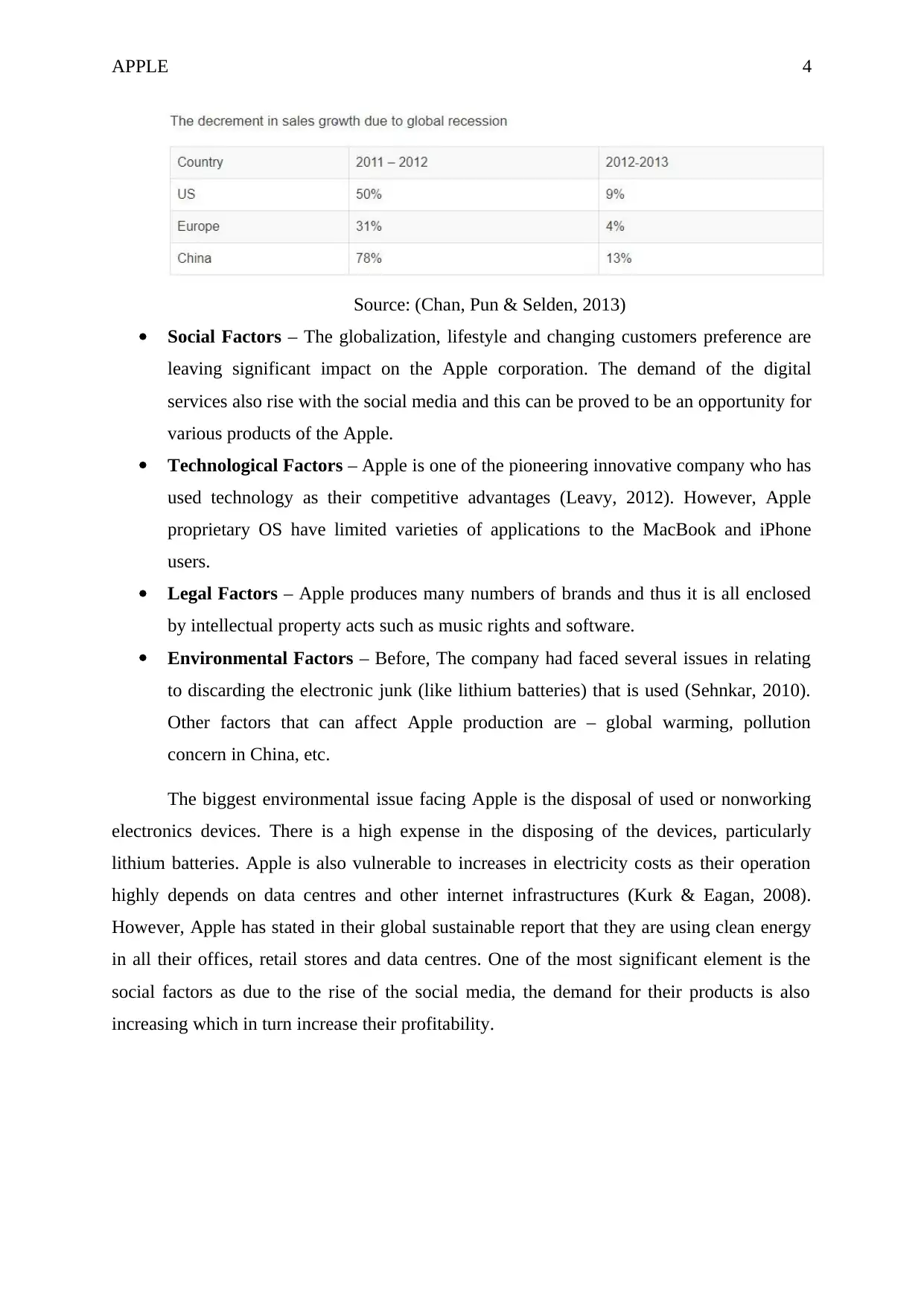
Economic Factors – Recession and economics crises such as increase rate of
inflation can also have a significant impact on Apple. For example, in the global
recession 2013, Apple had observed slow economic growth in 2013 and 2014 (Piketty
& Saez, 2013).
the help of feedbacks; they can also enhance their designs of the products. High
premium price is a competitive advantage of Apple, which cannot be disturbed but
selling additional and corresponding products with the core products can be fitted
with their planning strategy.
Opportunities – Apple has huge opportunities in the area of distribution network,
strong market presence and differentiation strategy. Apple needs diversity into various
other product lines too with their core products and use the competency of their
already established distribution network. This will help them in saving lot amount of
costs and also attract more number of customers in those new products due to their
strong market presence.
Threats – The company facing several threats in respect with their pricing strategy,
device obsolesce and durability. However, these can be fixed if company make
adequate plans for the same. For example, they can use the brainstorming session
including many skilled managers and researchers to be discussed on pricing strategy.
In respect with device obsolesce, the company need to push regular software updates
as it can enhance the performance of the device.
Environment Constraints
Political Factors – Major sales contribution to Apple company comes from outside
US amounting to more than $113.8 whereas the revenue from the home country is
$68.8 (Clarke & Boersma, 2017). Therefore, many political insurgences in these
nations can have a positive or negative impact on the company.
Economic Factors – Recession and economics crises such as increase rate of
inflation can also have a significant impact on Apple. For example, in the global
recession 2013, Apple had observed slow economic growth in 2013 and 2014 (Piketty
& Saez, 2013).
Paraphrase This Document
Need a fresh take? Get an instant paraphrase of this document with our AI Paraphraser
APPLE 4
Source: (Chan, Pun & Selden, 2013)
Social Factors – The globalization, lifestyle and changing customers preference are
leaving significant impact on the Apple corporation. The demand of the digital
services also rise with the social media and this can be proved to be an opportunity for
various products of the Apple.
Technological Factors – Apple is one of the pioneering innovative company who has
used technology as their competitive advantages (Leavy, 2012). However, Apple
proprietary OS have limited varieties of applications to the MacBook and iPhone
users.
Legal Factors – Apple produces many numbers of brands and thus it is all enclosed
by intellectual property acts such as music rights and software.
Environmental Factors – Before, The company had faced several issues in relating
to discarding the electronic junk (like lithium batteries) that is used (Sehnkar, 2010).
Other factors that can affect Apple production are – global warming, pollution
concern in China, etc.
The biggest environmental issue facing Apple is the disposal of used or nonworking
electronics devices. There is a high expense in the disposing of the devices, particularly
lithium batteries. Apple is also vulnerable to increases in electricity costs as their operation
highly depends on data centres and other internet infrastructures (Kurk & Eagan, 2008).
However, Apple has stated in their global sustainable report that they are using clean energy
in all their offices, retail stores and data centres. One of the most significant element is the
social factors as due to the rise of the social media, the demand for their products is also
increasing which in turn increase their profitability.
Source: (Chan, Pun & Selden, 2013)
Social Factors – The globalization, lifestyle and changing customers preference are
leaving significant impact on the Apple corporation. The demand of the digital
services also rise with the social media and this can be proved to be an opportunity for
various products of the Apple.
Technological Factors – Apple is one of the pioneering innovative company who has
used technology as their competitive advantages (Leavy, 2012). However, Apple
proprietary OS have limited varieties of applications to the MacBook and iPhone
users.
Legal Factors – Apple produces many numbers of brands and thus it is all enclosed
by intellectual property acts such as music rights and software.
Environmental Factors – Before, The company had faced several issues in relating
to discarding the electronic junk (like lithium batteries) that is used (Sehnkar, 2010).
Other factors that can affect Apple production are – global warming, pollution
concern in China, etc.
The biggest environmental issue facing Apple is the disposal of used or nonworking
electronics devices. There is a high expense in the disposing of the devices, particularly
lithium batteries. Apple is also vulnerable to increases in electricity costs as their operation
highly depends on data centres and other internet infrastructures (Kurk & Eagan, 2008).
However, Apple has stated in their global sustainable report that they are using clean energy
in all their offices, retail stores and data centres. One of the most significant element is the
social factors as due to the rise of the social media, the demand for their products is also
increasing which in turn increase their profitability.
APPLE 5
Stakeholders
Customers and Consumers – This group includes the original buyer of Apple
products as well as individuals customer. The users accept premium pricing as thehy
are getting high quality and features in these products.
Apple Employees – These stakeholders are composed at Apple Facilities. The main
motives of them are career development and adequate compensation. There are quite
significant as they directly define human resource capabilities in achievement of goals
and earning profit.
Investors – There are interested in getting maximum returns on their investments.
They also make the organization react towards corporate social responsibility.
Employees of Suppliers and Distributors – These are indirect stakeholders in Apple
business and their motive is also proper compensation and job security. Apple has
also maintained suppliers code of conduct.
I feel that Customers/Consumers need to be considered as the top stakeholders of the
company. All the company products and services are directed towards them only. They are
also called to be king pin of an organization.
Organizational Structure and Design
Apple organization structure contributes to effective and rapid innovation, which is an
essential aspect of any organization. It is composed of workforce groups, resources,
departments and interconnection between them (Teece, 2010). Apple has a hierarchical
organization structure but a week functional matrix.
Stakeholders
Customers and Consumers – This group includes the original buyer of Apple
products as well as individuals customer. The users accept premium pricing as thehy
are getting high quality and features in these products.
Apple Employees – These stakeholders are composed at Apple Facilities. The main
motives of them are career development and adequate compensation. There are quite
significant as they directly define human resource capabilities in achievement of goals
and earning profit.
Investors – There are interested in getting maximum returns on their investments.
They also make the organization react towards corporate social responsibility.
Employees of Suppliers and Distributors – These are indirect stakeholders in Apple
business and their motive is also proper compensation and job security. Apple has
also maintained suppliers code of conduct.
I feel that Customers/Consumers need to be considered as the top stakeholders of the
company. All the company products and services are directed towards them only. They are
also called to be king pin of an organization.
Organizational Structure and Design
Apple organization structure contributes to effective and rapid innovation, which is an
essential aspect of any organization. It is composed of workforce groups, resources,
departments and interconnection between them (Teece, 2010). Apple has a hierarchical
organization structure but a week functional matrix.
⊘ This is a preview!⊘
Do you want full access?
Subscribe today to unlock all pages.
Trusted by 1+ million students worldwide
APPLE 6
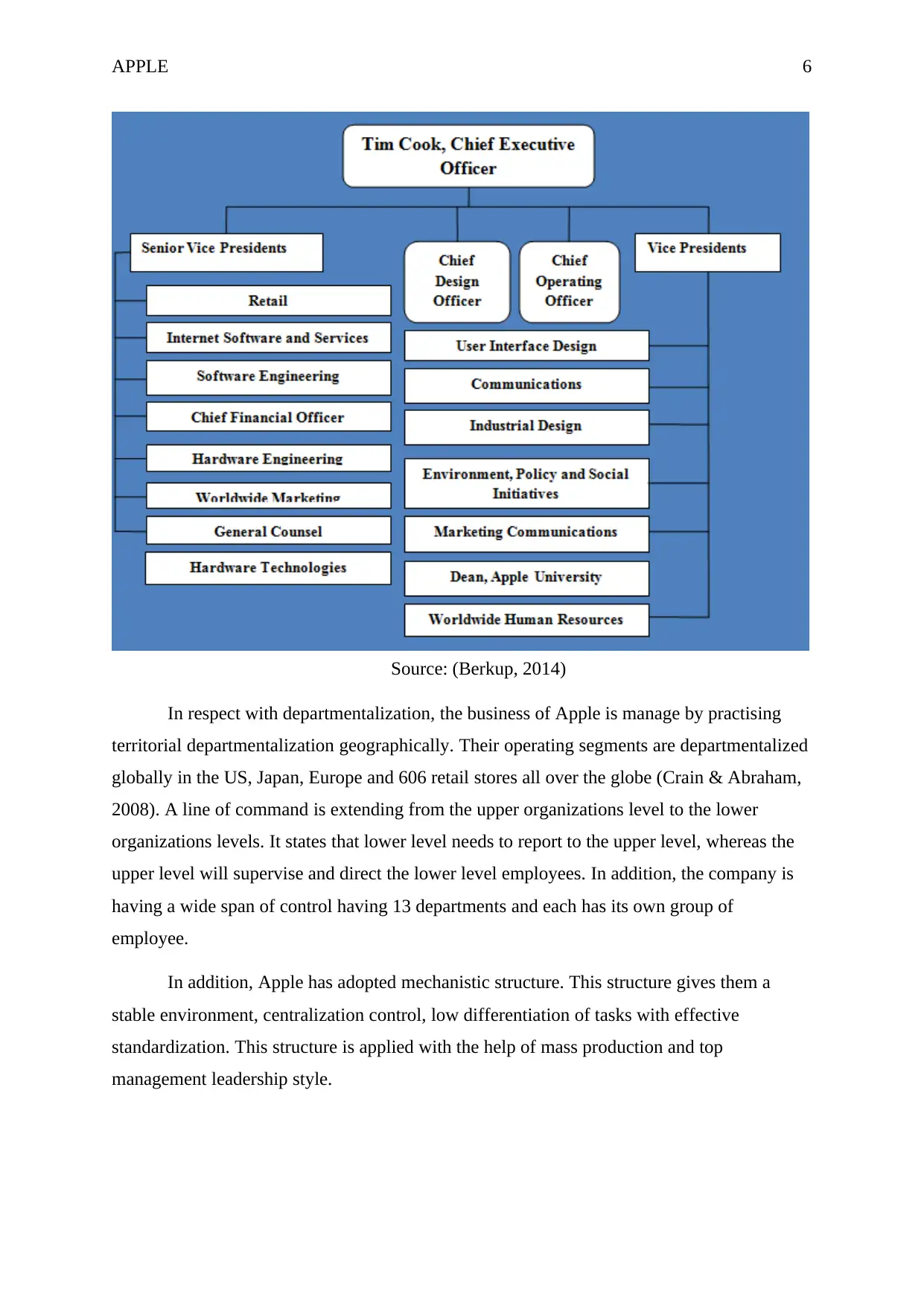
Source: (Berkup, 2014)
In respect with departmentalization, the business of Apple is manage by practising
territorial departmentalization geographically. Their operating segments are departmentalized
globally in the US, Japan, Europe and 606 retail stores all over the globe (Crain & Abraham,
2008). A line of command is extending from the upper organizations level to the lower
organizations levels. It states that lower level needs to report to the upper level, whereas the
upper level will supervise and direct the lower level employees. In addition, the company is
having a wide span of control having 13 departments and each has its own group of
employee.
In addition, Apple has adopted mechanistic structure. This structure gives them a
stable environment, centralization control, low differentiation of tasks with effective
standardization. This structure is applied with the help of mass production and top
management leadership style.
Source: (Berkup, 2014)
In respect with departmentalization, the business of Apple is manage by practising
territorial departmentalization geographically. Their operating segments are departmentalized
globally in the US, Japan, Europe and 606 retail stores all over the globe (Crain & Abraham,
2008). A line of command is extending from the upper organizations level to the lower
organizations levels. It states that lower level needs to report to the upper level, whereas the
upper level will supervise and direct the lower level employees. In addition, the company is
having a wide span of control having 13 departments and each has its own group of
employee.
In addition, Apple has adopted mechanistic structure. This structure gives them a
stable environment, centralization control, low differentiation of tasks with effective
standardization. This structure is applied with the help of mass production and top
management leadership style.
Paraphrase This Document
Need a fresh take? Get an instant paraphrase of this document with our AI Paraphraser
APPLE 7
Motivating Employees
Apple can motivate their employees in various ways. As per the Maslow’s theory, the
needs placed on lower level need to be fulfil on a prior basis. In their company, they fulfil
their employees’ psychological needs by setting up an average salary of $108,483 (Crain &
Abraham, 2008), which basically certify their survival. Safety needs of the employees are
also supported by the company as they have design and develop severals safety standards
including the training of employees for using equipment safely. In addition, As per Apple
2013 annual report, the company is also providing their employees a better workplace by
enhancing worker and supervisor relationships.
Other than basic needs, the company is also focusing on higher order needs. For
example, the employee's esteem needs are fullfiled when company reward their executives by
increment in their bonus salary from 3 to 5 percent. At the top level of Maslow theory, the
company also introducing various education and development programme so that an
employee overall personality can be developed.
Recommendations
With help of both the parts of research, four-pronged approach is being ascertained –
Leverage on Innovation and Consumer Feedback – Due to the rapid advancement
in the technology and with the nature of the industry, it is significant for the
organization to invest in R and D department so that to keep up in the fast-paced
industry. This will lead to innovation and also gives them a competitive advantage.
They also need to improve their products design by taking feedback from the
customers and users
Leadership – The Company need to make transition of leadership. The increased
visibility of its leader will gain more confidence among the shareholders and this will
be best considering their future prospects.
Targeting emerging market – The market potential in the emerging countries is
huge and Apple can tap this easily.
Motivating Employees
Apple can motivate their employees in various ways. As per the Maslow’s theory, the
needs placed on lower level need to be fulfil on a prior basis. In their company, they fulfil
their employees’ psychological needs by setting up an average salary of $108,483 (Crain &
Abraham, 2008), which basically certify their survival. Safety needs of the employees are
also supported by the company as they have design and develop severals safety standards
including the training of employees for using equipment safely. In addition, As per Apple
2013 annual report, the company is also providing their employees a better workplace by
enhancing worker and supervisor relationships.
Other than basic needs, the company is also focusing on higher order needs. For
example, the employee's esteem needs are fullfiled when company reward their executives by
increment in their bonus salary from 3 to 5 percent. At the top level of Maslow theory, the
company also introducing various education and development programme so that an
employee overall personality can be developed.
Recommendations
With help of both the parts of research, four-pronged approach is being ascertained –
Leverage on Innovation and Consumer Feedback – Due to the rapid advancement
in the technology and with the nature of the industry, it is significant for the
organization to invest in R and D department so that to keep up in the fast-paced
industry. This will lead to innovation and also gives them a competitive advantage.
They also need to improve their products design by taking feedback from the
customers and users
Leadership – The Company need to make transition of leadership. The increased
visibility of its leader will gain more confidence among the shareholders and this will
be best considering their future prospects.
Targeting emerging market – The market potential in the emerging countries is
huge and Apple can tap this easily.
APPLE 8
Launching new product line – As the company already have strong presence in the
market and a long and strong distribution system, launching a new product line will
help them a lot.
Controls and Recommendations
Benchmarking will be the process that I will use in monitoring the process, as it will
give me best insights by comparing to the business practices best of industries. Moreover,
Control can focus on events before, during or after a process. To monitor the activities,
concurrent and feedback controls will be the best practices as it will give me the direct
supervision of the activities as well as it can also be ascertained that whether performance
meets established standards or not.
In concurrent control, tracking of employee performance with the help of information
system will also be established so that every employee gets motivated with the
comparison of his or her peer's performance. Moreover, in feedback control, the
performance of the employees can be analysed on a monthly basis by analysing the
difference between output and input.
In addition, to check whether the goal has been accomplished or not, survey can be
raised or polled on the social media sites in relation with the satisfaction or
dissatisfaction. Moreover, it can also be ascertained by analysing region wise growth in
sales and revenue.
Launching new product line – As the company already have strong presence in the
market and a long and strong distribution system, launching a new product line will
help them a lot.
Controls and Recommendations
Benchmarking will be the process that I will use in monitoring the process, as it will
give me best insights by comparing to the business practices best of industries. Moreover,
Control can focus on events before, during or after a process. To monitor the activities,
concurrent and feedback controls will be the best practices as it will give me the direct
supervision of the activities as well as it can also be ascertained that whether performance
meets established standards or not.
In concurrent control, tracking of employee performance with the help of information
system will also be established so that every employee gets motivated with the
comparison of his or her peer's performance. Moreover, in feedback control, the
performance of the employees can be analysed on a monthly basis by analysing the
difference between output and input.
In addition, to check whether the goal has been accomplished or not, survey can be
raised or polled on the social media sites in relation with the satisfaction or
dissatisfaction. Moreover, it can also be ascertained by analysing region wise growth in
sales and revenue.
⊘ This is a preview!⊘
Do you want full access?
Subscribe today to unlock all pages.
Trusted by 1+ million students worldwide
APPLE 9
References
Berkup, S. B. (2014). Working with generations X and Y in generation Z period:
Management of different generations in business life. Mediterranean Journal of
Social Sciences, 5(19), 218.
Chan, J., Pun, N., & Selden, M. (2013). The politics of global production: A pple, F oxconn
and C hina's new working class. New Technology, Work and Employment, 28(2), 100-
115.
Clarke, T., & Boersma, M. (2017). The governance of global value chains: Unresolved
human rights, environmental and ethical dilemmas in the apple supply chain. Journal
of Business Ethics, 143(1), 111-131.
Crain, D. W., & Abraham, S. (2008). Using value-chain analysis to discover customers'
strategic needs. Strategy & Leadership, 36(4), 29-39.
Frost, S., & Burnett, M. (2007). Case study: the Apple iPod in China. Corporate Social
Responsibility and Environmental Management, 14(2), 103-113.
Hoffman, D. L., & Fodor, M. (2010). Can you measure the ROI of your social media
marketing?. MIT Sloan Management Review, 52(1), 41.
Kurk, F., & Eagan, P. (2008). The value of adding design-for-the-environment to pollution
prevention assistance options. Journal of Cleaner Production, 16(6), 722-726.
Leavy, B. (2012). Collaborative innovation as the new imperative–design thinking, value co-
creation and the power of “pull”. Strategy & Leadership, 40(2), 25-34.
Piketty, T., & Saez, E. (2013). Top incomes and the great recession: Recent evolutions and
policy implications. IMF economic review, 61(3), 456-478.
Shenkar, O. (2010). Copycats: How smart companies use imitation to gain a strategic
edge. Strategic Direction, 26(10), 3-5.
Teece, D. J. (2010). Business models, business strategy and innovation. Long range
planning, 43(2-3), 172-194.
References
Berkup, S. B. (2014). Working with generations X and Y in generation Z period:
Management of different generations in business life. Mediterranean Journal of
Social Sciences, 5(19), 218.
Chan, J., Pun, N., & Selden, M. (2013). The politics of global production: A pple, F oxconn
and C hina's new working class. New Technology, Work and Employment, 28(2), 100-
115.
Clarke, T., & Boersma, M. (2017). The governance of global value chains: Unresolved
human rights, environmental and ethical dilemmas in the apple supply chain. Journal
of Business Ethics, 143(1), 111-131.
Crain, D. W., & Abraham, S. (2008). Using value-chain analysis to discover customers'
strategic needs. Strategy & Leadership, 36(4), 29-39.
Frost, S., & Burnett, M. (2007). Case study: the Apple iPod in China. Corporate Social
Responsibility and Environmental Management, 14(2), 103-113.
Hoffman, D. L., & Fodor, M. (2010). Can you measure the ROI of your social media
marketing?. MIT Sloan Management Review, 52(1), 41.
Kurk, F., & Eagan, P. (2008). The value of adding design-for-the-environment to pollution
prevention assistance options. Journal of Cleaner Production, 16(6), 722-726.
Leavy, B. (2012). Collaborative innovation as the new imperative–design thinking, value co-
creation and the power of “pull”. Strategy & Leadership, 40(2), 25-34.
Piketty, T., & Saez, E. (2013). Top incomes and the great recession: Recent evolutions and
policy implications. IMF economic review, 61(3), 456-478.
Shenkar, O. (2010). Copycats: How smart companies use imitation to gain a strategic
edge. Strategic Direction, 26(10), 3-5.
Teece, D. J. (2010). Business models, business strategy and innovation. Long range
planning, 43(2-3), 172-194.

1 out of 10


Related Documents


Your All-in-One AI-Powered Toolkit for Academic Success.
+13062052269
info@desklib.com
Available 24*7 on WhatsApp / Email
![[object Object]](/_next/static/media/star-bottom.7253800d.svg)
Unlock your academic potential
Copyright © 2020–2026 A2Z Services. All Rights Reserved. Developed and managed by ZUCOL.